


















What do you see on a Google results page?
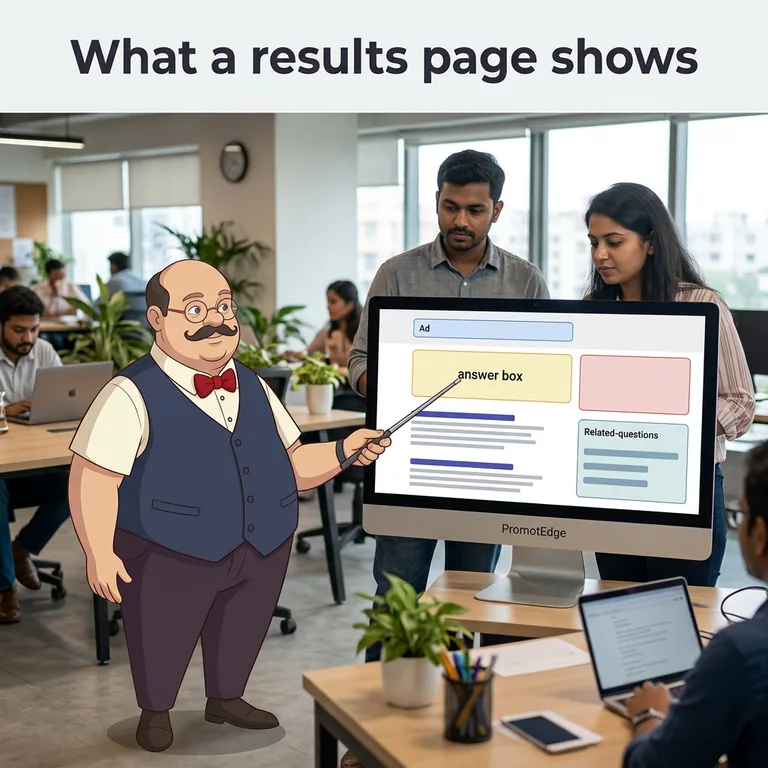
- Ads: marked "Sponsored", usually at the top and bottom. Advertisers pay per click.
- AI Overviews: a short answer written by Google's AI, with links to the pages it used.
- Featured snippet: one page's answer lifted into a box above the normal results.
- People also ask: related questions that open to show short answers.
- Local pack: a map with three nearby businesses, for searches like "printing press near me".
- Organic results: the normal list of pages, which SEO works to improve.
- Images, videos and shopping: shown when Google thinks they suit the search.
Each of these boxes is a SERP feature. Our SERP features page goes through them one by one.
Why the SERP matters more than your ranking
The results page tells you what kind of answer Google thinks the searcher wants. If a search shows a map pack, a well-kept Google Business Profile will do more than a long blog post. If it shows videos, you need a video. If it is all ads and shopping cards, the people searching are ready to buy.
SERP can also stand for the Society for Elimination of Rural Poverty. It is a rural development society that works with poor rural communities in Andhra Pradesh and Telangana. This page is about the search results page.
So before we plan any page, we search the phrase ourselves and study the results page. It takes five minutes and saves months of writing the wrong thing. You can do the same. Then read our plain-English guide to SEO.
Google keeps a gallery that names the common parts of a search page. It lists five kinds: text, rich, image, video and exploration features, such as related searches and related questions. It also says whether you can influence each one from your own website. Our SERP features page goes through the boxes, and our SEO work aims to win them. The basics of SEO are in the glossary.
Why your results look different from your colleague's
Google changes the page for each person. Your city, your device, the language you use and what you searched before can all move results up or down. To see a fairer picture, search in a private window and set the location you care about, or use a rank-tracking tool that checks from a fixed place.
A quick SERP check takes four steps. Open a private window. Set the city you care about. Search the exact words a buyer would type. Then note which boxes appear, such as ads, a map, videos or People also ask, and who holds each one. This is called SERP analysis, and it takes about five minutes. For a full review, see our SEO services.
How to win more space on the SERP
- Answer the main question in the first two lines of your page, so Google can lift it as a snippet.
- Add short question-and-answer sections that match the People also ask box.
- Keep your Google Business Profile complete if you serve a local area.
- Use paid ads for searches where the buyer is ready now and the organic results are crowded.
Not sure where you stand? An SEO audit shows which searches you appear for and which boxes you're missing.
Related terms
- SEO: improving your pages so they show up in the organic results.
- Featured snippet: the answer box at the top of some results pages.
- AEO (answer engine optimisation): shaping pages so search and AI tools quote them as the answer.
- CTR (click-through rate): the share of people who see your result and click it.
Sources
- Google Search Central, February 2026 | https://developers.google.com/search/docs/appearance/visual-elements-gallery Source: Google Search Central, December 2025 | https://developers.google.com/search/docs/fundamentals/how-search-works Source: Society for Elimination of Rural Poverty, Government of Andhra Pradesh, October 2026 | https://www.serp.ap.gov.in/ Source: Society for Elimination of Rural Poverty, Government of Telangana, October 2026: serp.telangana.gov.in