
























The answer that gets me in trouble
As per the LinkedIn version: “SEO is a holistic approach for optimising your digital presence, using keyword research, technical excellence, and strategic content positioning to achieve sustainable organic visibility.”
The real version is simpler. SEO (search engine optimisation) is your website showing up when someone Googles something you sell.
The messy part nobody talks about is everything between those two statements. You need the right keywords (hard to find). Your site needs to load fast and work on mobile (more complex than it sounds). You need other websites linking to you (takes months of relationship-building). And you need patience. A lot of patience.
Six to twelve months for real results. Usually. Sometimes longer.
That version doesn’t sell, but it is the true one.
What SEO actually is (and isn’t)
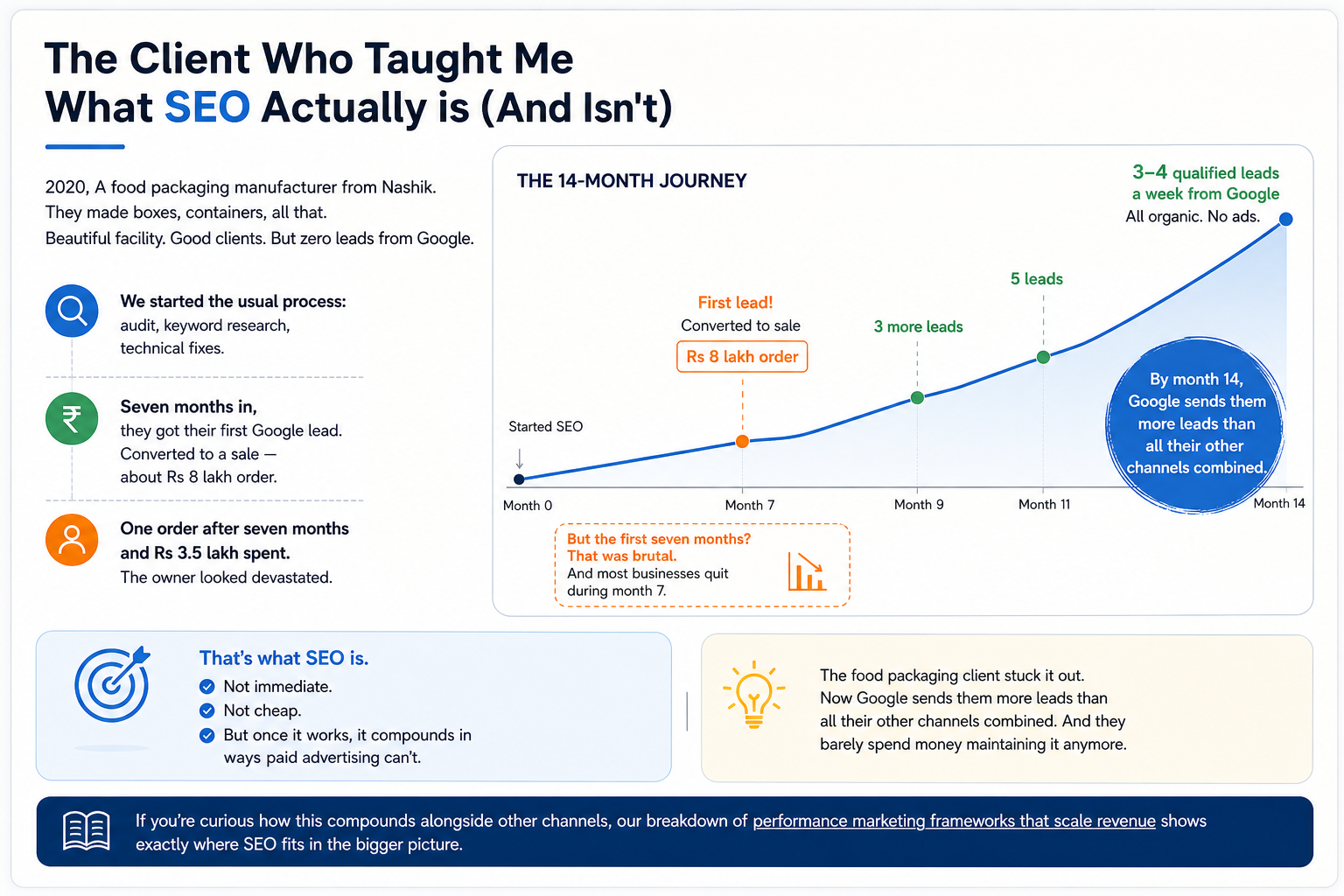
Take a made-up example: a food packaging manufacturer from Nashik. They make boxes and containers. Beautiful facility, good clients, but zero leads from Google.
They start the usual process: audit, keyword research, technical fixes. Seven months in, they get their first Google lead. It converts to a sale, an order of about Rs 8 lakh.
That is one order after seven months and Rs 3.5 lakh spent. The owner looks devastated.
Then month 9 brings three more leads. Month 11, five leads. By month 14, they are getting 3 to 4 qualified leads a week from Google. All organic, no ads. They are just showing up when people search for what they do.
But the first seven months are brutal, and most businesses quit around month 7. They think “this isn’t working”, move their budget to Google Ads, and never see what SEO could have become.
This manufacturer sticks it out. Now Google sends them more leads than all their other channels combined, and they spend very little to maintain it.
That is what SEO is. It is neither immediate nor cheap, but once it works, it compounds in ways paid advertising can’t. If you’re curious how this compounds alongside other channels, our breakdown of performance marketing frameworks that scale revenue shows exactly where SEO fits in the bigger picture.
Why Google puts you on page one
People think Google rankings run on some complicated, secret formula only experts understand. That’s not it. Google is trying to do one thing: show people the most useful answer to what they are searching for.
Every update, ranking factor and guideline comes back to this goal. If your page helps someone solve a problem, understand something better or make a decision, Google has a reason to show it.
If it doesn’t, no amount of tricks will hold your position for long.
Seen this way, your job is to be the most helpful result for a specific search, not to “game” Google.
A “best answer” has three parts:
First, relevance. Does your page answer what they searched for? A page titled “Premium Ceramic Solutions” doesn’t match someone searching “ceramic tiles price.” Change the title to match actual search terms, and it often fixes things.
Second, authority. Is your site trustworthy? Google measures this partly through links, which are other websites voting for you. A link from a major industry publication matters far more than 500 links from random directories. You can’t cheat this one. You have to earn it. We’ve written in depth about backlink building tactics for long-term SEO if you want to understand how this works in practice.
Third, user experience. Does your site work, and is it fast? If your site takes four seconds to load in 2026, you have lost a good portion of your visitors before they see the page. Google takes this seriously and pushes slow sites down in the SERP (search engine results page). Page loading speed has a direct impact on both user experience and rankings, and it’s worth understanding that relationship clearly.
So ranking is not magic. Match what people search for, prove you are trustworthy and make sure your site works properly.
Where most attempts fail
A lot of companies treat SEO as only adding keywords. They focus on that and forget that a real person is reading the page.
That’s when the content starts sounding off. You’ve probably seen lines like this:
“Ceramic tiles ceramic tiles ceramic tiles. We sell ceramic tiles.”
It has the keyword, but it says nothing useful. Google sees it as spam, and it does not help the person reading it either.
Other businesses ignore the basics. Slow website. No proper mobile experience. Broken internal links. You can have the most relevant content out there, but if your site doesn’t function properly, it won’t rank.
The biggest mistake is expecting results instantly.
SEO does not work like that. It builds over time. The first 2 to 3 months usually feel like nothing is happening. Around month 6, you start seeing some movement. By month 12, it begins to make sense. By month 18, if done right, it works like a proper growth channel.
But most businesses don’t wait that long, and that is where they lose the SEO game.
Why the biggest keyword is not always the right one
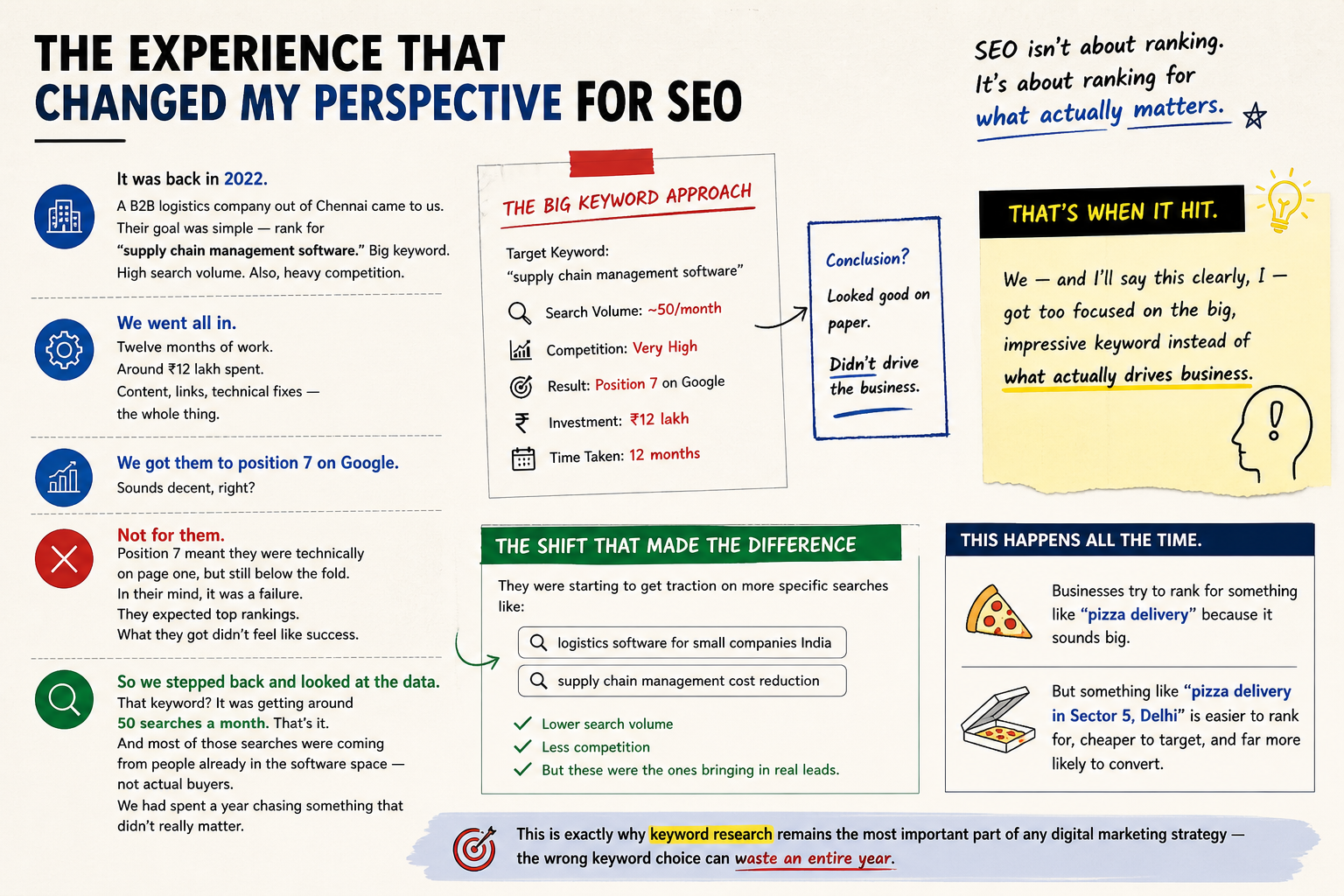
Take another made-up example: a B2B (business-to-business) logistics company out of Chennai. Their goal is simple: rank for “supply chain management software.” It sounds like a big keyword, and it has heavy competition.
They go all in. Twelve months of work, around ₹12 lakh spent, on content, links and technical fixes.
They reach position 7 on Google.
That sounds decent, but not to them. Position 7 means they are technically on page one, but still below the fold. They expected top rankings, so to them it feels like a failure.
So they step back and look at the data.
That keyword gets around 50 searches a month. That’s it. And most of those searches come from people already in the software space, not actual buyers.
Many businesses spend a year chasing something that doesn’t really matter.
At the same time, they start getting traction on more specific searches like “logistics software for small companies India” and “supply chain management cost reduction.” These have lower search volume and less competition, but they bring in the real leads.
The lesson: don’t get so focused on a big, impressive keyword that you forget what actually drives business.
And this happens all the time. Businesses try to rank for something like “pizza delivery” because it sounds big. But something like “pizza delivery in Sector 5, Delhi” is easier to rank for, cheaper to target and far more likely to convert. This is exactly why keyword research remains the most important part of any digital marketing strategy, because the wrong keyword choice can waste an entire year.
What gets you from zero to rank 1
If you are starting SEO from scratch, here is what works, in practical terms and without jargon.
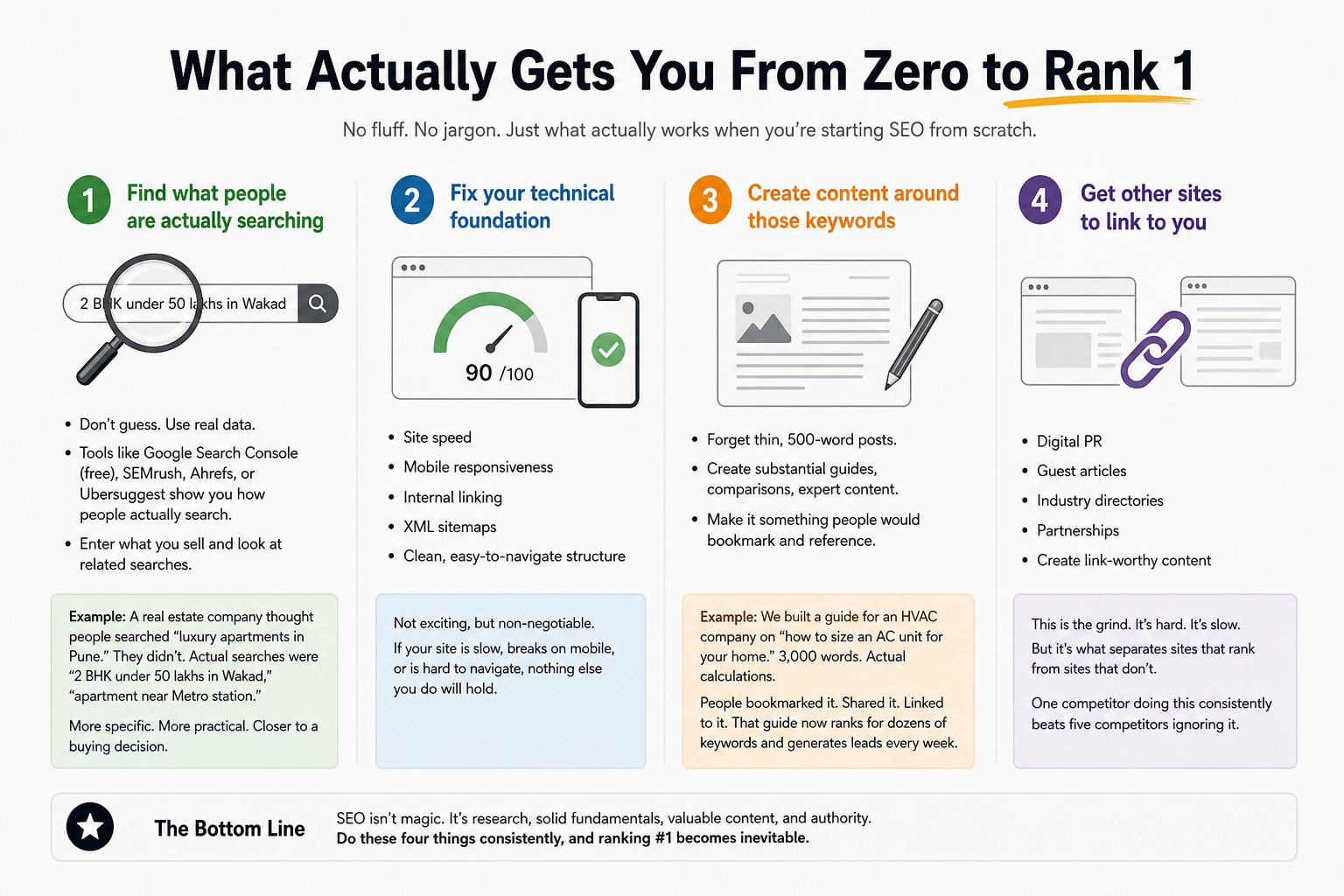
First: find what people are searching for
Don’t guess. Most businesses get this wrong right at the start.
Use real data. Tools like Google Search Console (it’s free), SEMrush, Ahrefs, or Ubersuggest can show you exactly how people are searching. Just enter what you sell and look at the related searches.
You’ll usually be surprised by what you find. What you think people search for and what they actually type into Google are often very different.
Take a made-up example: a real estate company was convinced people searched for “luxury apartments in Pune.” They didn’t. The actual searches looked like this: “2 BHK under 50 lakhs in Wakad,” “apartment near Metro station.” More specific. More practical. And much closer to a buying decision. That’s the difference between traffic and useful traffic, and it’s what separates good real estate digital marketing from wasted budget.
Second: fix your technical foundation
This part is dull, and you can’t skip it.
Site speed. Mobile responsiveness. Internal linking. XML sitemaps.
If your site is slow, breaks on mobile, or is difficult to navigate, nothing else you do will hold. You don’t need advanced SEO at this stage. You need a website that works properly.
Third: create content around those keywords
Skip thin, 500-word blog posts. Write substantial guides, comparisons and expert takes, content that people would bookmark and refer back to.
Take a made-up example: a guide an HVAC company builds on “how to size an AC unit for your home.” It runs to 3,000 words, with actual calculations. People bookmark it, share it and link to it. Over time, a guide like that can rank for dozens of keywords and bring in leads every week.
Fourth: get other sites to link to you
This is the grind: digital PR, guest articles, industry directories, partnerships, and content so useful that people link to it naturally.
It’s hard and slow, but it separates sites that rank from sites that don’t. One competitor doing this consistently beats five competitors ignoring it.
When SEO makes sense and when it doesn’t
SEO works when:
People search for what you sell. If you are a B2B manufacturer of industrial valves, people search “industrial valve suppliers”, so SEO makes sense. If you run a fine dining restaurant, people search “best restaurants near me”, so local SEO makes sense. If your SaaS (software as a service) product solves a specific problem, people search for solutions to that problem, so SEO makes sense.
Your search volume needs to make sense. If only 50 people a month are searching for what you offer, SEO probably isn’t the right play. You’re better off running Google Ads or building direct relationships instead.
And you need to be realistic about time and budget. SEO takes both. At the very least, you’re looking at six months and around ₹50,000 as a starting point. Anything less than that, and you’re judging it before it’s even had time to work.
SEO does not work when:
Nobody searches for what you sell. A very niche B2B service where decision-makers use LinkedIn or WhatsApp, not Google, so traditional SEO won’t help. Network differently.
You’re operating in a market where SEO isn’t the bottleneck. Most people are reaching you through offline channels (referrals, trade shows, direct relationships). Google isn’t where your customers are hunting.
Your market moves too fast. In crypto or emerging tech, today’s keywords are obsolete in six months, and by the time you rank, the market has changed. Ads might be better.
The ROI (return on investment) conversation
An agency promises “300% ROI in 12 months.”
That sounds great until you ask a few questions. What if your industry just doesn’t have that ROI? What if each customer only brings in about ₹15,000 for you? Even after adding 100 customers, you’re still at around ₹15 lakh in total. So where is that 300% coming from? Against a Rs 12 lakh SEO investment, that’s barely break-even.
A better question is how much a customer costs you right now, and how much they are worth. If one customer is worth Rs 2 lakh and Google gives you four customers per month after month 8, SEO is making Rs 8 lakh monthly. That math works.
But you have to know your own numbers first. Most businesses don’t.
Take a made-up example: a luxury real estate developer. One customer is worth Rs 50 lakh in commission. One. If SEO gets them two leads a month, that’s Rs 100 lakh in potential commission monthly. Suddenly Rs 3 lakh monthly SEO investment looks cheap. For a commodity e-commerce store where the margin is Rs 500 per order? The same Rs 3 lakh investment is a bad idea.
There’s no universal answer. It depends on your unit economics (what you earn on each customer or order). Understanding the right digital marketing KPIs and metrics before you begin helps you measure SEO correctly instead of abandoning it too early.
Why I still believe in SEO, even when it’s frustrating
SEO is slow and unpredictable. Sometimes a Google algorithm update wipes out months of work.
But when it works, a business ends up with something that keeps working.
That compounding effect is what makes SEO different from any other channel.
You invest today. Around month 4, it starts. By month 8, you see real results. Then it keeps working, year after year, while everyone else pays for every single click.
SEO takes time. There is no guarantee of when you will see your brand at the top of the SERP, and most people don’t have the patience for it.
The ones who do have the patience win, steadily, for years.
If you’re thinking about SEO for your business, don’t commit based on promises. Commit based on whether your customers actually search for you. If they do, let’s talk about a real SEO strategy. If they don’t, we’ll tell you that too.
Want to know if SEO makes sense for your business?
We’ve been doing this for 11 years. Some conversations turn into projects and some don’t. Either way, you will know whether to invest in SEO or spend your money elsewhere.


