
Most people see a redesign as a visual or ease-of-use upgrade. For SEO, it is one of the riskiest times in a website's life. Many businesses found that years of organic traffic (visitors who come from unpaid search results) disappeared within weeks of a redesign. To redesign a website without losing SEO, see our website redesign with SEO safe-guards.
The design was usually fine. The SEO basics were missing. Most redesign mistakes happen because all the focus goes to visuals and user experience, and none goes to how search engines read and judge a website.
Search engines do not assume a redesigned website is better than the old one. They check again. Every change makes them look at your URLs, content, internal links, crawl paths, page speed and user behaviour signals.
When these change without SEO planning, rankings can drop fast and take months to recover, which is why redesigns that are not led by SEO often bring traffic loss and weaker conversion performance.
In this blog, we cover the common website redesign mistakes from a practical SEO view. You may work with a website design company or with your own UI/UX designer, but either way, this helps you protect your organic visibility and avoid costly fixes after launch.
SEO for website redesign and migration: why most redesigns fail
Redesigns mostly fail because they put looks before strategy. SEO for website redesign and migration means keeping what search engines already know. Before launch, list every old URL and page title, point each old page to its new one with a 301 redirect, keep internal links working and keep the test site out of the index. After launch, watch traffic and enquiries for several weeks. (PromotEdge.) Many businesses treat a redesign as a visual refresh. Looks do matter. 48% of people judge the credibility of a business by its website design. But data-based optimisation matters just as much. Skip it, and planning gets rushed and analytics get ignored. Structural decisions then damage the SEO value a site has built over the years.
Redesign without knowing how your site performs today, and even high-value URLs can get removed. A page may rank well, but if nobody checks its SEO ranking first, it can get rewritten and lose that rank, and the site then looks good but struggles to attract organic traffic or turn visitors into customers.
Planning a redesign? Ask for a free website audit of your current site first, so you know what to keep.
Google's guide to moving a site says to keep the redirects for as long as possible, generally at least one year. It also says that for a small to medium site, most pages can take a few weeks to move (Google Search Central, read 8 November 2026). So watch traffic for weeks after launch, not days, and do not remove the old redirects after a month. The same guide recommends permanent redirects such as 301 and 308, and says they don't cause a loss in PageRank, the link credit a page has earned. It also says a site's visibility in Search may fluctuate for a while during the move, so, in our view, a short dip is expected and is not a sign that the move failed. Moving to a new domain as well? Then submit a Change of Address in Search Console. Google says that tool is needed only for a move from one domain or subdomain to another.
12 website redesign mistakes to watch out for
Most SEO problems in a redesign come from small oversights at the analysis and planning stage. Big technical failures? Rare.
Here are 12 mistakes to keep an eye on.
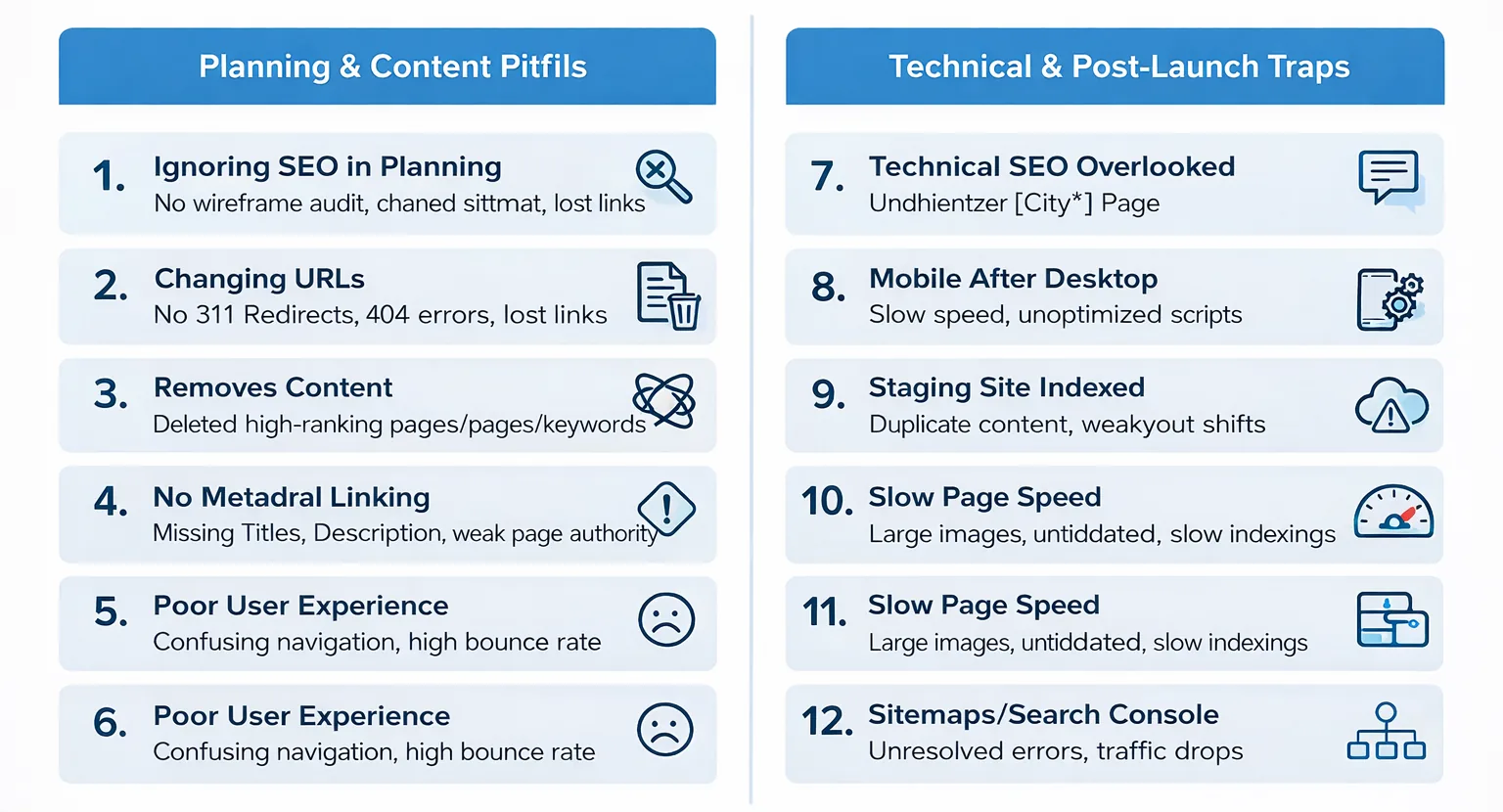
1. Ignoring SEO during redesign planning
One of the earliest and costliest mistakes is treating SEO as a task for after launch. Many projects begin with wireframes and visual themes, and nobody looks at the current organic performance. If SEO is left out of planning, high-value pages and ranking URLs get changed or removed by accident.
SEO should shape the sitemap, the page hierarchy, how deep the navigation goes and which content comes first. Leave it out? The new site may look modern but lose its relevance in search engines.
2. Changing URLs without proper redirects
Changing URLs is common in a redesign. But changing them without proper 301 redirects (a permanent forward from the old address to the new one) is a serious SEO failure. Search engines treat each URL as its own page, so when you remove or alter it, the link between the indexed page and its authority breaks.
If old URLs are not redirected, visitors land on 404 errors and search engines drop pages they had indexed. Rankings fall at once. Crawl budget (the time Google spends on your site) is wasted.
PromotEdge is a web design agency that can redesign your existing website. Every old URL gets mapped to its new version with permanent redirects.
3. Removing or rewriting content that performs well
Content is one of the strongest parts of a site's SEO. In redesigns, many businesses delete or rewrite the content on landing pages or service pages, and sometimes they do it only for design reasons, without a look at search performance. Big mistake. It drops the ranking of keywords that were doing well.
Pages that bring organic traffic, backlinks or featured snippets should be kept, or improved with care, and not replaced again and again. Even small changes to headings, keyword placement or content length can change how a page ranks. Content decisions should follow data. Not looks.
4. Overlooking technical SEO during visual upgrades
Redesigns full of visuals often bring technical problems, such as unoptimised scripts, back-to-back animations and complex frameworks.
They may look good, but they slow down your pages and make crawling less efficient.
Search engines prefer fast and accessible websites. Ignore technical SEO, such as clean HTML, optimised CSS, JavaScript handling and proper rendering, and rankings can fall.
At PromotEdge, our UI/UX designers balance the look of the site with its technical performance, so your SEO does not slip back.
5. Leaving mobile optimisation until after the redesign
Mobile-first indexing means Google mainly looks at the mobile version of a site to rank it. Yet many redesigns start with desktop visuals and adapt them for mobile later, and this often leaves gaps in ease of use, layout shifts and weaker engagement on mobile devices.
We do it the other way round. Before launch, we test your website on different types of devices, so it needs no fixes in the first weeks.
6. Changing the internal linking structure
Internal links spread page authority and guide search engine crawlers. Yet in a redesign, menus, footer links and links inside the text often get simplified without anyone checking their SEO value.
Remove internal links from high-authority pages, and your most important pages can lose rank. A UI/UX design company can help you plan the internal links properly, and so can a digital marketing agency in Kolkata that also has an SEO team.
7. Neglecting metadata and on-page SEO
When a site is moved to a new design, title tags, meta descriptions, header tags and image alt text are often lost or duplicated. Many CMS (content management system) migrations overwrite metadata and leave pages without unique tags. Easy to miss.
This hurts click-through rates and keyword relevance. So whoever does the work, make sure each redesigned page keeps its metadata, or improves it to match what people are searching for.
8. Launching without a proper staging site
Most redesigns use a staging site, a private copy where changes are tested before going live. Problems start when it is not managed well. Say a staging site gets indexed by mistake. Search engines may then crawl an incomplete, duplicate or test version of the website, and they would miss the final one.
That confuses search engines, weakens ranking signals and can cause duplicate content issues. To prevent it, restrict the staging site during development and testing, with no-index tags, password protection and correct robots.txt rules.
At PromotEdge, we run final checks before publishing, so that search engines see only the live version of your website.
9. Not optimising page speed after the redesign
Page speed affects both rankings and user experience. Websites often get slower after a redesign. Why? Large image formats, custom fonts, animations and third-party plugins.
These elements can improve the design, but they add to the loading time if they are not optimised.
From the SEO side, slow pages make crawling less efficient and raise bounce rates (visitors leaving at once), especially on mobile, so a good redesign includes speed work: compressing images, lazy loading, smaller scripts and server-level improvements.
Our UI/UX designers fix these speed problems as part of the redesign, and they test every page during development for loading speed, rendering and SEO readiness.
10. Poor user experience
SEO today goes beyond keywords and backlinks. Search engines also look at how users behave on a website. Think of the time they spend on pages, bounce rates and overall engagement.
If a redesign makes navigation less clear or layouts harder to follow, users leave sooner. That sends a negative signal, and it can affect rankings.
An experienced UI/UX design company ties SEO goals to good UX from the start of the redesign. It reviews navigation and page layouts, so that users can move through the site easily. Engagement stays strong. Search performance stays steady.
11. Not updating XML sitemaps and Search Console
After a redesign, many businesses forget to update and resubmit their XML sitemap (the list of pages you give search engines), so new or changed URLs take longer to be found and indexed, and rankings and traffic recover later.
Search engines use updated sitemaps and Search Console data to see what changed in the redesign. Without them, crawl problems and indexing gaps can stay unnoticed.
In our post-launch SEO process at PromotEdge, we update and submit the XML sitemaps, verify the Search Console properties and watch crawl errors closely. That helps search engines read the redesigned website correctly. Organic performance settles faster.
12. Skipping SEO monitoring and fixes after launch
One of the most common mistakes is to think the work is over once the new site goes live. Ranking swings and crawl errors are normal in this phase, but they still need quick attention, or they cause long-term loss.
For us, post-launch SEO is a part of the redesign itself. We track search performance, check crawl data and run audits, so that problems are found and fixed early, which helps the new website settle quickly and keep improving in visibility and traffic.
Final thoughts
In our experience, a redesign changes more than how a site looks. It changes how search engines crawl, understand and rank the website. See a redesign as a visual upgrade only, and businesses often lose organic visibility that could have been kept.
A good redesign balances design, ease of use and search performance. That takes one team: SEO experts, developers and designers working together. It holds whether the work is done with a website design company, a UI/UX designer or a full-service digital partner.
This is why we start every redesign with SEO. We base choices on data and real user behaviour, so visual changes support long-term performance and do not disrupt it. At PromotEdge, we build websites that can change visually and still stay stable and easy to find in search.
Planning a rebuild? Our website redesign service maps every old page to its new address before anything goes live.
Sources
- Google Search Central, Site move with URL changes, read 8 November 2026: developers.google.com