-
Author: Satesh Shaw
-
Updated Date: Apr-23-2026
-
Views: 2 Min Read
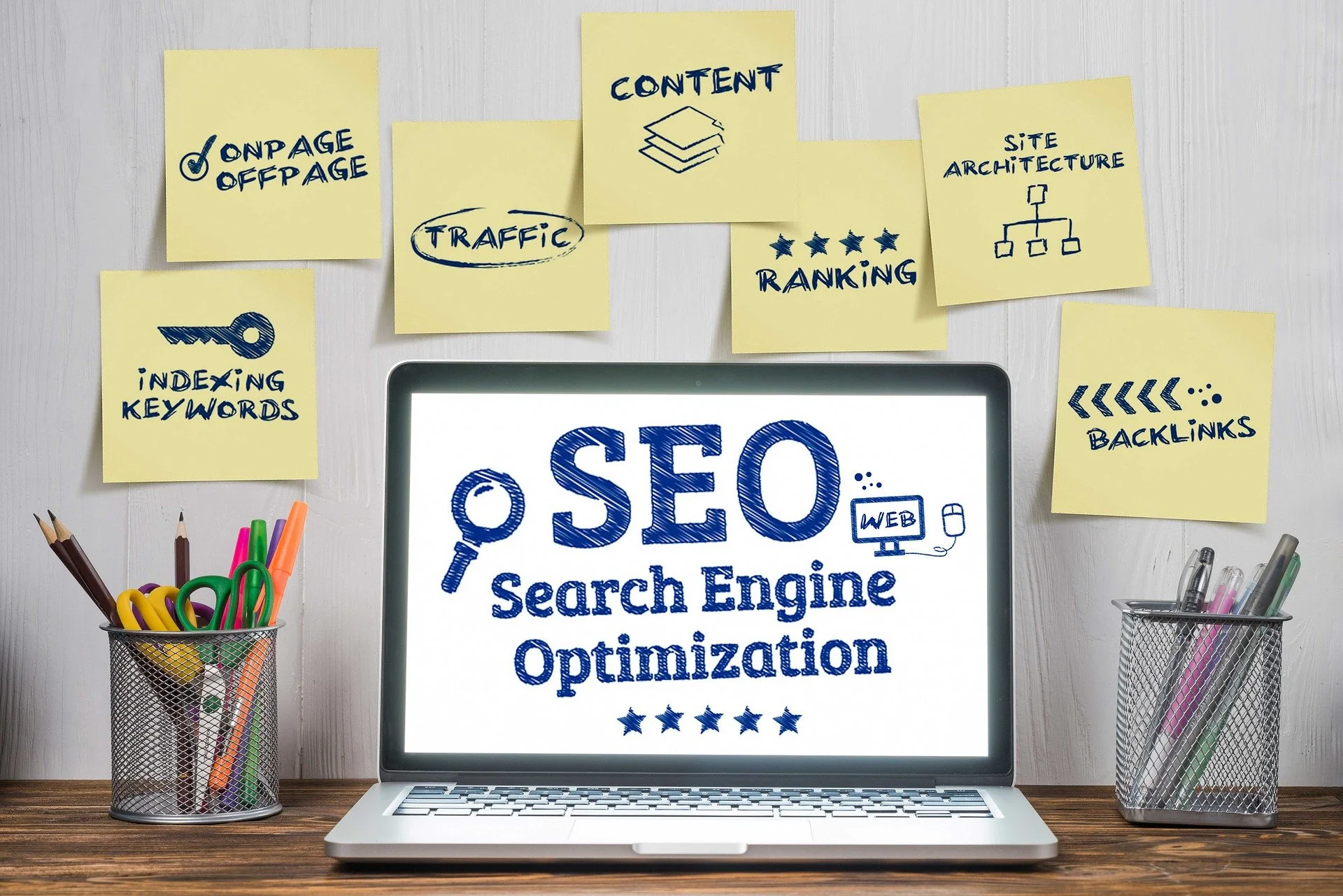
A solid SEO strategy for your business comes down to five things — keyword research, quality content, engaging page titles, optimised URLs, and a smooth user experience. Nail these consistently and your website will rank better, attract the right audience, and generate real leads.
A solid SEO strategy is absolutely pivotal can successfully generate organic traffic to your website and increase brand awareness. It is absolutely true that staying on top of SEO demands a ton of experiments and research. Moreover, Google’s algorithms are constantly tweaking and so it’s very crucial to stay keep your SEO strategy on point every time. If you are in Kolkata, you must get the SEO of your website done by a premier SEO agency in Kolkata, as there is a lot of science to SEO and its algorithms are constantly changing on search engines like Google.
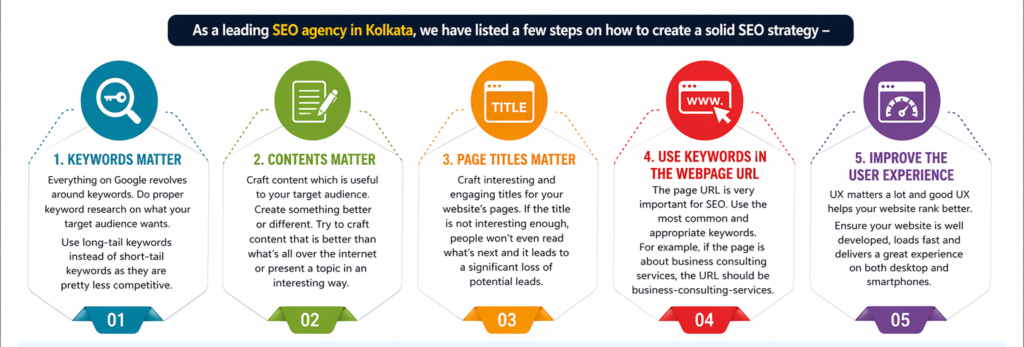
As a leading SEO agency in Kolkata, we have listed a few steps on how to create a solid SEO strategy –
Keywords matter
It is quite known that everything we search on Google revolves around keywords. Keywords research is absolutely crucial and you must do proper keyword research on what your target audience wants and not just on the basis of the content on your website. There are many websites which helps you with keyword research for your target audience. Also remember, you should use long-tail keywords instead of short-tail keywords as they are pretty less competitive.
Contents matter
You must craft a kind of content which is useful to your target audience. The trick is to create something better or different. Try to craft a content which is better than what’s all over the internet or craft something topic in an interesting way.
Page titles matter
Craft interesting and engaging titles for your website’s pages. It is said that if the title is not interesting enough then people won’t even read what’s next and it leads to a significant loss of potential leads. Try your best to make every page title interesting.
Use keywords in the webpage URL
The page URL is also very important for SEO. For example, if a page talks about business consulting services, then the URL for that page should business consulting services. Try targeting the most common and appropriate keywords.
Improve the user experience
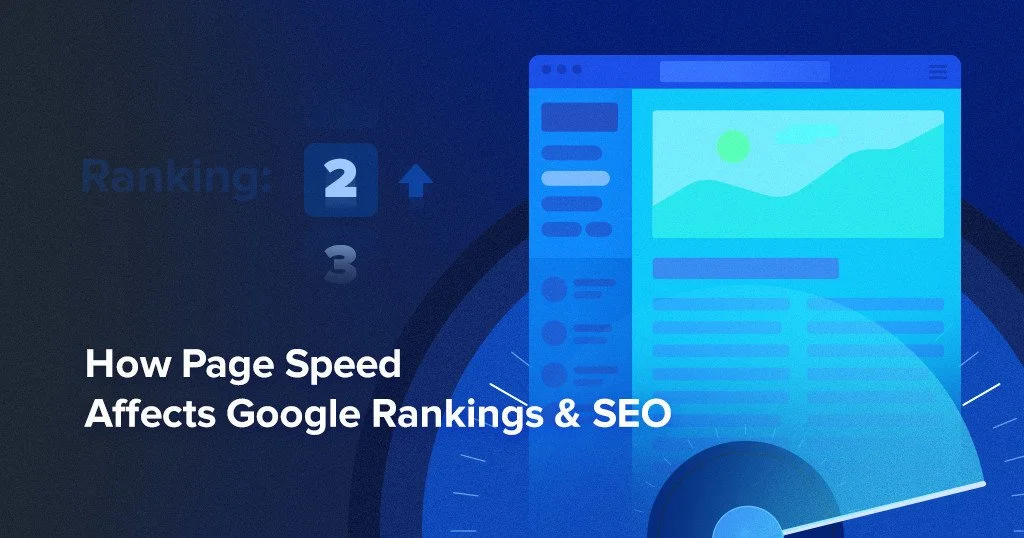
User experience matters a lot and if the UX is good then it will definitely help your website to rank better. The website must be properly developed, the website speed must be impressive. During the last few years, Google has evolved immensely and is now favouring those websites that are able to deliver quality user experience in not only personal computers but also on smartphones.
SEO is definitely no rocket science, but it definitely charges some hard and smart work. If you want your site to be properly optimized for SEO, you must hire an SEO agency. If you are looking out for an SEO agency in Kolkata, our SEO team at PromotEdge would serve you with some fine SEO services which will definitely boost your organic traffic and sales.
Conclusion :
Here’s the thing about SEO — it never really stops. The moment you think you’ve figured it out, Google rolls out a new update. But that’s exactly why having a solid strategy in place matters. Focus on what your audience needs, keep your website in good shape, and the rankings will take care of themselves.
-
What is an SEO strategy and why does it matter for business?
Ans.An SEO strategy is a planned approach to improving your website's visibility on Google. It matters because it drives organic traffic, builds brand awareness, and generates leads — without relying entirely on paid advertising. -
How do keywords help in building an SEO strategy?
Ans.Keywords help you understand exactly what your target audience is searching for. Using the right keywords — especially long-tail ones — makes your content less competitive and more likely to rank higher on Google search results. -
Why are long-tail keywords better than short-tail keywords for SEO?
Ans.Long-tail keywords are more specific and far less competitive than short-tail ones. They attract a more targeted audience who are closer to taking action — making them more valuable for driving quality organic traffic to your website. -
How does user experience affect SEO rankings?
Ans.Google favours websites that deliver a quality user experience — including fast loading speed, mobile-friendliness, and smooth navigation. A well-developed website that works seamlessly on both desktops and smartphones is more likely to rank higher.
Author Details

Latest Posts
-
 18 / Aug
Google Search Console Google Search Console For Social Media: How To Track Instagram, Tiktok, X And Youtube
18 / Aug
Google Search Console Google Search Console For Social Media: How To Track Instagram, Tiktok, X And Youtube -
 05 / Aug
SEO vs GEO vs AEO SEO vs GEO vs AEO: A Simple 2026 Comparison for Businesses
05 / Aug
SEO vs GEO vs AEO SEO vs GEO vs AEO: A Simple 2026 Comparison for Businesses -
 31 / Jul
Uncategorized How to Build a 90-Day Digital Marketing Plan That Works
31 / Jul
Uncategorized How to Build a 90-Day Digital Marketing Plan That Works -
 17 / Jul
Website Redesign 7 Real Signs Your Business Website Needs a Redesign in 2026
17 / Jul
Website Redesign 7 Real Signs Your Business Website Needs a Redesign in 2026 -
 10 / Jul



Blogs
Journey into Ideas Unveiling Tomorrow's Insights Today.






































































































-
What is an SEO strategy and why does it matter for business?
Ans.An SEO strategy is a planned approach to improving your website's visibility on Google. It matters because it drives organic traffic, builds brand awareness, and generates leads — without relying entirely on paid advertising. -
How do keywords help in building an SEO strategy?
Ans.Keywords help you understand exactly what your target audience is searching for. Using the right keywords — especially long-tail ones — makes your content less competitive and more likely to rank higher on Google search results. -
Why are long-tail keywords better than short-tail keywords for SEO?
Ans.Long-tail keywords are more specific and far less competitive than short-tail ones. They attract a more targeted audience who are closer to taking action — making them more valuable for driving quality organic traffic to your website. -
How does user experience affect SEO rankings?
Ans.Google favours websites that deliver a quality user experience — including fast loading speed, mobile-friendliness, and smooth navigation. A well-developed website that works seamlessly on both desktops and smartphones is more likely to rank higher.