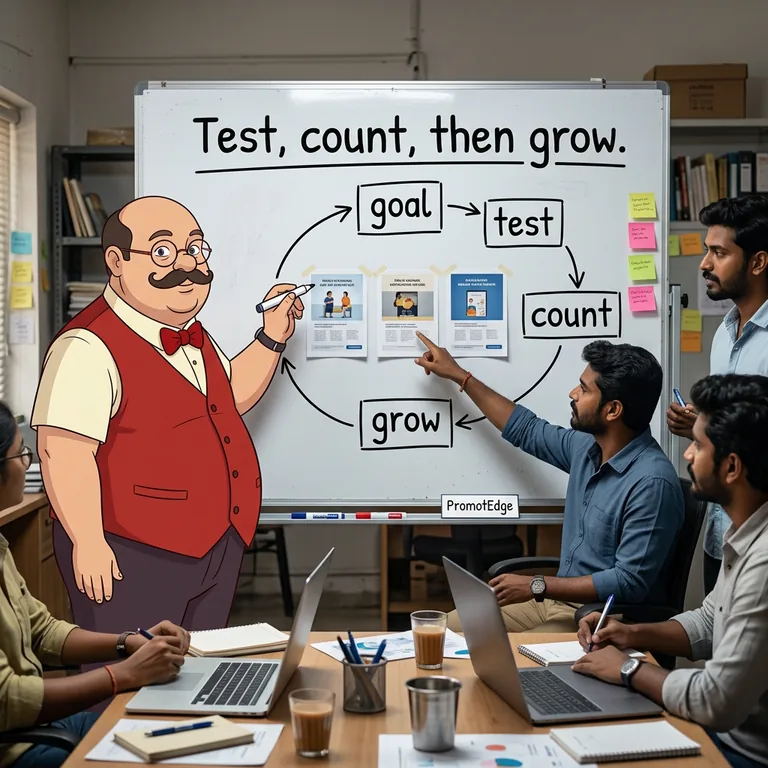
What is performance marketing? The Interactive Advertising Bureau (IAB), an ad industry body, puts the older meaning plainly: the aim was one named action, and the advertiser paid only once that action, for example a sale, had happened. That was the contrast with brand advertising, which was typically paid for by impressions or sponsorship. The same IAB paper adds a caution, though. It says paying on results is one way to pay for performance marketing, and there are others. So we’d call it a data-driven approach first. For a performance marketing plan built around your own action, see our performance marketing services in India.
Performance marketing uses data to build the plan for the next step. Is it risk-free? No. The IAB paper says pay-for-performance can reduce the advertiser’s risk, and the same paper says performance marketing still puts some risk on the advertiser, the publisher and the agency, so we wouldn’t call it safe. The main focus is ROI (return on investment). In practice it means following the market trends, doing A/B testing (showing version A and version B, and counting which does better) and stopping what doesn’t work, and the results can show whether your company should take a high-risk, high-reward chance or not. Next, the benefits.
What Are The Principal Cores Of Performance Marketing?
This post groups performance marketing into 4 core principles. Our view: a performance marketing strategy is built around actions, such as a call or a form fill, and views alone don’t count as a result. Set one clear action, run small tests on the ads and pages, and report on the enquiries and sales they bring. Performance marketing campaigns whose results cannot be counted should be fixed or stopped. (PromotEdge.) These four are our grouping. Use them as a checklist when you talk to an agency, because a principle is useful when you can turn it into a question. Here they are:
First, a focus on results. The plan is built around an action you can count, such as a lead, an app download or a sale. Whether you pay only on that action depends on the buying model.
Then there is measurable performance. Campaigns are watched, checked and tested through their run, because the IAB paper says you must first be able to measure the action before you can call it performance marketing, and that’s what shows what works and what doesn’t.
Third, data-driven optimisation: data guides the changes made to a campaign.
Last, it can be used in a variety of channels. Which ones? It works in many digital channels, and the ones this post covers include PPC ads, social media, email and affiliate marketing, so you can pick the channels where your buyers already are.
Benefits of performance marketing
Start with return. You can get a greater return on investment, or ROI, when spend is judged by actions you can count, because money that brings no enquiry or sale shows up early and can be moved. Do you only pay for results? It depends on the buying model. Google Ads Help says that with cost per click (CPC) bidding you are charged for every click on your ad, and that a Display campaign can be set to charge for conversions instead, if your account is eligible.
Then the audience. Performance marketing lets you aim at a target audience, and an agency puts research into who that is before the money goes out, because an ad shown to the wrong people can’t bring the action you’re counting. Done well, this can help you reach the people you are more likely to convert into sales for your business.
Where is the budget going? An owner should be able to answer that. Performance marketing lets you know how your marketing spend is used and what results it brings, and the IAB paper files this under transparency: results that can be measured and checked.
It also gives you the chance to improve your online marketing as you go. How? The numbers come in while the campaign runs, so you and your agency can look at them, study the trends in the market and decide the next step together. That’s why research skill is what we’d look for in a performance marketing company. And you can scale your campaigns up or down quickly, depending on your budget and goals.
You may also like: Performance marketing vs digital marketing: the difference
What Are The Common Performance Marketing Channels?
This type of marketing runs on data. The job is to examine the data from the campaign and compare it with market trends, and then to act on what the comparison shows, because data that changes no decision is only a report. It reaches its goal through various channels. What are they?
If you want a team to pick and run these channels for you, see our performance marketing services.
Content marketing comes first on our list. An ad needs something to say. An agency can make useful pieces, such as blog articles, infographics or videos, and the aim is to attract and engage your target audience so that some of them convert, though one piece of content can’t promise that by itself.
Social media marketing is used for brand awareness, but there is a lot more to it. It can sell too. Agencies that offer these services create campaigns through ads and other media, with the aim of reaching the target audience and bringing conversions and sales, and in a performance plan those conversions are what gets counted.
Affiliate marketing works on commission. Your brand works with other websites or influencers to market your products or services, and in exchange they get a commission on sales made through their recommendations. Amazon’s Associates programme is one public example: its page says associates share products through customised linking tools and earn from qualifying purchases. Those links are the affiliate links, and they’re where customers can buy. You may have seen a YouTuber or a streamer point viewers to such a link in a sponsored section.
Cost-per-acquisition (CPA) marketing is similar to affiliate marketing. Here you pay for each acquisition, such as a lead or a new customer. A note on the letters. Google Ads Help spells CPA out as cost per action, and it describes Target CPA bidding as automatic bidding, where Google sets the bids.
Email marketing starts with a sign-up. You can even offer free services to potential customers through an ad campaign, and they sign up with their email. Then be patient. Over time you can send customised email campaigns to market your products or services, and because each mail goes to someone who asked for it, it can lift conversions.
Pay-per-click (PPC) advertising is the model this post leans on. In our view, it suits an owner who wants to see what each rupee did. You place ads on search engines (through Google Ads, for example) or on social media platforms (through Meta Ads, for example). How are you charged? Google Ads Help says that with cost per click (CPC) bidding you are charged for every click on your ad. For a social platform, read its own page on how you are charged before you assume it is per click. An agency’s part is to research the market and write the ads.
How to build a performance marketing strategy: how PromotEdge does it
PromotEdge is an integrated marketing agency in India, headquartered in Kolkata, and performance marketing services are part of what we offer. What follows is how we’d plan a campaign, because a method is something you can check before you pay for it.
Our strategy uses the core principles above. Where do we begin? With one action you want from a buyer, and a way to count it. From there we’d guide you on which route is likely to bring the most ROI, and we’d plan ideas that fit market trends, customer behaviour and your brand’s vision and objectives, because an ad that ignores one of those is hard to defend when the numbers come in. We believe in quality above quantity.
Sources
- Interactive Advertising Bureau (IAB), IAB Digital Simplified: Defining Performance Marketing, No date printed in the paper; the PDF file's properties give 18 December 2013. Read 19 November 2026. The IAB is a trade body of media and technology companies. iab.com
- Google Ads Help, Cost per click (CPC): Definition, No date shown on the page. Read 19 November 2026. Google sells the advertising this page describes. support.google.com
- Google Ads Help, Use pay for conversions in Display campaigns, No date shown on the page. Read 19 November 2026. Google sells the advertising this page describes. support.google.com
- Google Ads Help, About Target CPA bidding, No date shown on the page. Read 19 November 2026. Google sells the advertising this page describes. support.google.com
- Amazon, Amazon.in Associates Central (Amazon Associates, Amazon's affiliate marketing program), No date shown on the page. Read 19 November 2026. Amazon runs the affiliate programme this page describes. affiliate-program.amazon.in