
























Technology has progressed rapidly over the years. Even a few years ago, it was so hard to use voice commands for simple research. But with time, it has become part of our daily lives. Google, Alexa, and Siri are ready to answer every question and command. So it’s time for businesses to focus on voice search SEO.
Smart devices are everywhere, and it’s time for businesses to opt for smart strategies. If you want your website to be on top, you can’t just rely on text search. Your content needs to be optimised for how people speak their searches.
Let’s say a user is cooking or washing dishes and suddenly they have a query. It can be anything. For example “How can I keep my paneer softer when cooking” or “What is the name of the song that starts with ‘the music’”. A 2023 survey reported by Statista found that Indian users mostly use voice assistants to play music. Watching online videos comes next. And with time the popularity of voice search has only increased.
People do random voice searches. It is not like when they are typing on their device. Take technical information, like “Which TMT bar do you suggest for building a 2-storey house”. Here too, the questions are longer and more informative.
In this article, we look at voice search optimization and its benefits. We also show how you can build it into your website.
What is Voice Search Optimization (voice search SEO)?
We can categorize voice-enabled commands into two segments: voice search and voice commerce. In the first one, people use voice commands to get information. In the second, they use it to make a purchase.
Regardless, brands need creative SEO techniques and content to appear on top of the search results. Brands also must consider the technical aspect of SEO as well. People use different devices for voice searches. These include smartphones, smart speakers, TVs, and even cars. They use built-in assistants like Siri, Google Assistant, and Bixby.
In the business world, the end game for brands is to grow. To get there, you need to adapt to new technology. Voice search optimisation helps brands:
- Increase brand visibility
- Improve user experience
- Attract more traffic
- Widen content reach
- Build brand trust
So, how does voice search work?
In voice search, the user asks the question out loud, rather than typing it. Smart speakers and other virtual assistants are changing the way we live. Of course, they change the way we search for information online. Just for example, if you ask ‘best SEO agencies in Kolkata’, your voice search-enabled device will show you the results. Many reports have predicted that a large share of searches will be done via voice in the next few years. In 2016, Google CEO Sundar Pichai said that a good share of mobile searches were via voice.
Voice search works well when users are busy and cannot look at their phones. During that time all they have to do is just ask the question loudly to their device.
Browsing has now become more convenient than ever. Voice searches are changing how digital marketers and SEO companies approach SEO in Kolkata and other major cities of India.
Impact on SEO:
Digital marketers will know that Google changes its search algorithm many times in a year. It is quite obvious that these changes affect search results and SEO strategies. Voice search also impacts SEO. Virtual assistants like Alexa and Siri answer your queries with a short sentence, usually from a news source.
Voice searches are made to give the most relevant search results to the users. So, to get a website or information noticed, SEO agencies in Kolkata and other major cities of India have to work more on optimization. They must keep in mind the pattern used by voice search.
Digital marketers have to make sure their content is conversational and easy to understand. It will be helpful because it meets the pattern of voice search. Blogging will always be a big part of making voice search work.
Here is how you can optimize your site or write up for voice search
Interrogative statements
It is essential to make use of interrogative statements. These are the type of short queries that start with what, where, how and why. Users want quick answers. So the query will be in a conversational style.
Devices
As per many reports, most searches come from smartphones/mobile devices, and a good share of those use voice search. Make sure that the website content is optimized for mobile devices.
Local SEO and ‘near me’ strategies
Local SEO and ‘Near me’ strategies work like wonder for voice search since most of the questions asked via voice are short inquiries. For example: ‘Which is the best restaurant near me?’, ‘Gas station near me’, etc.
Is voice search influencing consumer behaviour?
Yes, voice search has left a significant impact on consumer behavior. The days of typing a query and waiting minutes for pages to appear are long gone. Consumers now use technologies like Alexa, Siri, Google Assistant, Cortana, and Amazon Echo every day. They use them for searching and shopping.
Let’s take a look at how voice search is leaving an impression on consumers:
Changing search habits
The worldwide smart speaker industry is expected to grow by $110 billion by 2033. It shows how people are switching to voice search and voice command options. This shift means businesses need to update their SEO strategies.
Making purchase decisions
Voice search has the potential to impact people’s purchase decisions. The technology can help consumers place orders or reorder items with a simple command. This makes it more convenient. Big e-commerce platforms in India like Myntra and Flipkart have added voice search options in many languages. This improves the user experience.
Amazon has also brought voice shopping to Indian homes. Alexa+ in India works in English and Hindi, and Amazon says it understands Hinglish too. Amazon also says Alexa suggests your preferred brand and asks you to confirm before it orders. So shoppers may name a type of product, not a brand. Write product pages in plain words, with clear names and prices.
Higher expectations for faster results
Today’s consumers expect fast, accurate answers in real time. Voice search can meet the expectations, as it is much easier to speak than typing.
How is voice search different from traditional text search?
The way people use search engines has changed after the emergence of voice search. Instead of typing, speaking feels more natural. Hence, the voice search commands are typically longer than text-based search. Here’s an example to clarify:
Text-based search: 2 BHK apartments for rent
Voice Search: Share a list of 2BHK apartments for rent near me
Why voice search SEO matters
The digital world is highly competitive. Every brand is trying to attract their audience’s attention. Brands can’t dare to neglect any new technologies, or they may fall far behind in the competition.
To become visible to people’s queries, pay as much attention to voice search SEO as you do to traditional SEO. Consult with your SEO agency, to create a strategy that can boost your SEO efforts.
Let’s take a look at the importance of voice search SEO for your business:
1. Drives more traffic to your website
It’s not easy to drive traffic to your website. Especially when your competitors are cooking up to beat you. A study shares that for adults in the US, voice assistants are the most popular feature of AI-powered smartphones. And it is not just the US, Indians are also not far behind in this trend.
In fact, according to Google, India is using voice queries nearly two times more than the rest of the world.
2. Improves user experience
Hyper-personalization is the latest marketing in today’s digital world. With many tools, marketers can learn what the audience prefers. They can use demographics, gender, and other factors.
Voice search SEO makes consumer interaction more personalized, convenient, natural, and accessible. Typing a long query can be such a hassle, sometimes. But voice search is much faster and hands-free. By optimizing the website and content, brands can share a clear and concise answer to customer queries, not a vague one.
3. Be a step ahead of your competitors
Understanding the latest trends gives you a competitive edge. The demand for voice search SEO is on an upward trend. So, implementing it into your SEO strategy can help you stay on top of your competitors in SERP.
How to optimize your website for voice search SEO
Voice search asks for a few changes to how you write and set up pages. Google now pays more attention to what a person wants and to natural phrasing. Voice optimisation fits that shift.
Start with a short audit. List the ten pages that bring you the most enquiries. For each page, write down the question a buyer would say out loud, such as which TMT bar suits a 2 storey house. Then check three things. Does the first sentence under a heading answer that question? Does the page load fast on a phone? Are your name, address, hours and phone number the same on the page and on your Google Business Profile? Fix the gaps on these ten pages before you write anything new.
1. Research and target long-tail keywords
In traditional SEO, the search involves keyword-packed phrases like “best laptop 2025 reviews”. While voice searches are generally more-question-based. When using Google, Alexa, Seri people ask the full question for voice search. It is much longer and conversational, for instance, “What’s the best laptop to buy in 2025?”
This difference is what makes voice search more engaging, as it is more human-like communication. So, it sums it up, voice queries are generally:
- Voice searches are longer and more specific. They often go beyond three words, like natural speech.
- People speak to voice assistants as they would to another person. For example, instead of typing “coffee shops near me,” they might say, “Where can I find the nearest coffee shop?”
- Many voice queries start with question words like who, what, where, when, why, or how,. People want quick, direct answers.
That is why Google has introduced AI Overviews and multi-step reasoning models like Gemini. They make typed searches more conversational. Understanding this pattern and acting on it early can make your website more visible to the right audience.
2. Content optimisation
Writing for SEO today means creating content that feels natural and helpful to your readers. To rank well, your content should sound like a real conversation, not like a robot. Use simple language, answer common questions, and focus on what your audience wants to know.
Write in a conversational tone, the way you would explain something to a friend. Here’s how:
- Use personal and relatable pronouns like you, we, us, and they
- Keep the language simple and avoid technical jargon
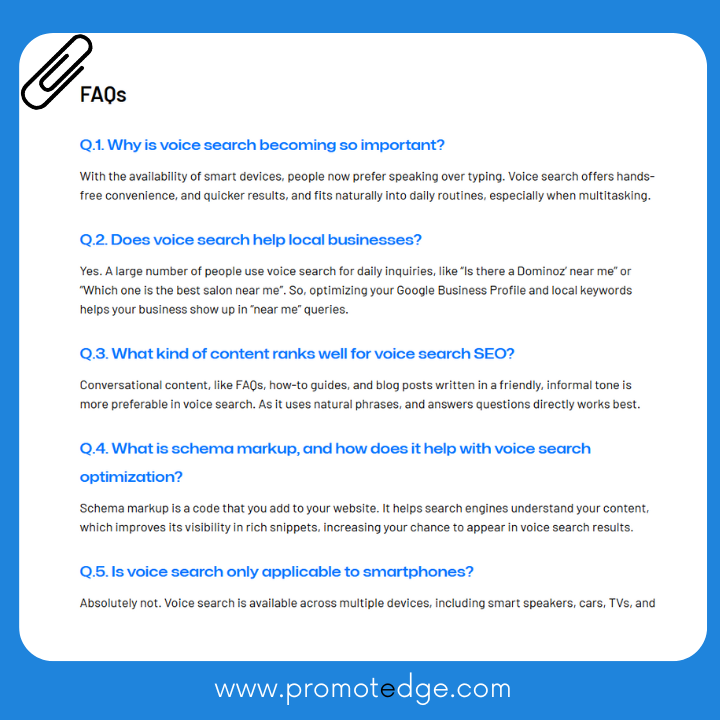
- Include FAQ sections that address common questions your audience might be asking
Make your content easy to understand. But don’t oversimplify it to the point that it loses depth. Aim to strike a balance: informative yet approachable.
Once you’ve set the right tone, you can begin incorporating voice search-friendly keywords. These often come in the form of questions, so it helps to:
- Use question-based headings
- Answer the question directly in the first sentence below the heading
This approach improves your chances of being featured in Google’s snippets and even in AI-generated summaries.
A practical method is to include a dedicated FAQ section at the end of your article. This lets you cover several long-tail and question-based keywords in one go. It can help your visibility in search results.
3. Integrate schema markup
Schema markup is like a blueprint of how you add structured data to your website’s HTML code. It represents how the data is shaped and how it is connected to other models, tables, databases, and devices.
Schema markup is highly influential for both traditional and voice search SEO. It assists Google and other search engines to share detailed information about your brand to the audience.
A word on speakable markup. It marks the parts of a page that suit text to speech. Google lists it as a beta feature, and says it works for users in the U.S. with Google Home devices set to English. Other countries and languages are not supported yet. For an Indian site, clear question headings and short first sentence answers are a better use of time today.
Let’s elaborate on it with an example. Let’s say an organization has integrated an OrganizationSchema. Here’s a demo to help you understand:

And here’s what it can look like in Google when the search engine pulls in FAQs:

4. Focus on local SEO
Smart speakers and integrated voice assistants in our smartphones have made voice search a part of our daily routine. And people do use it to search for what they need in their daily lives.
For brands to increase their visibility locally, they need to improve their local SEO. Start by creating your Google Business Profile. Hiring a local SEO agency can help keep the following details up to date:
- Name
- Opening hours
- Address
- Contact info, etc.
It will improve your visibility in local voice searches.
5. Add voice-friendly content
In voice search SEO, content matters a lot. The quality of your content has a big effect on your ranking in voice search. How you say something counts as much as what you say. Users want content that flows naturally, like how we talk to our friends.
Here are a few tips, we believe can improve your search appearance:
- Write in a conversational tone
- Use short sentences (10 to 12 words)
- Keep paragraphs under 2 sentences
- Include question-based headers
- Create FAQ pages with direct answers
6. Prioritise technical optimisation
In traditional SEO or voice search SEO, your website speed will always be a deciding factor. The audience doesn’t like to wait. And they don’t have reason to. With so many options available, you need to focus on improving your website to attract audience attention.
Tools like Google PageSpeed Insights and GTmetrix help check a website’s performance. They show where you can improve loading speed. Compressing large images, using browser caching and choosing fast and secure hosting can also improve website performance a lot.
After you make changes, check the results in Search Console. In the Performance report, add a Queries filter, choose Custom (regex) and enter question words, for example (who|what|where|when|why|how). Then add a Date filter, choose Compare and set two periods, using weekly granularity for a fair comparison. Look for more question queries and more clicks on the pages you fixed. Typed searches use question words too, so read this as a rough signal and not an exact count of spoken searches.
How does AI impact voice search optimisation?
Artificial intelligence is changing voice search SEO. It uses natural language processing (NLP) to interpret spoken queries more efficiently. In traditional text-based searches users need to mention the exact keywords, to get their desired results. However, AI can analyze the queries by detecting key phrases, sentence structure, and speech patterns. This makes it broader and more user-friendly.
For example, when a user asks, “What’s the best way to reduce stress?”AI can look at the question and also at its context. It can understand tone and past behavior. It uses this to deliver more personalized and relevant results.
For brands to effectively optimize for voice search, a mobile-optimised website is the key. As AI keeps improving, voice search will matter more in digital experiences. So it pays to start early.
Final thoughts
In the early days of SEO, keyword stuffing and simple pages were enough to rank. That time is over. Search engines now reward pages that answer people clearly.
Voice search is growing because it is convenient and makes it easier for users to find information. That makes it a sound strategy to grow your business online.
Though the concept of voice search SEO is relatively new, in the near future, it might change. So, consult with your SEO agency and create a strategy that meets the requirements.
FAQs
Sources
- Google Search Central, September 2026: developers.google.com
- Google Search Console Help, October 2026: support.google.com
- Amazon India, October 2026: aboutamazon.in
- Statista, March 2024: statista.com