-
Author: Anindita Barik
-
Updated Date: Aug-05-2026
-
Views: 2 Min Read
SEO vs GEO vs AEO is not about choosing one strategy over another but understanding how each search system works. This guide explains the differences between SEO, GEO, and AEO, where they overlap, what Google says about AI search optimization, and how businesses should allocate their 2026 marketing budget. Learn which queries trigger AI answers, what can actually be measured, and how to improve visibility across traditional search, AI Overviews, and generative search platforms.
The SEO vs GEO vs AEO debate has produced more acronyms than answers, and most business owners are hearing all three from someone who wants to sell them something.
Before you approve a new line on the budget, it helps to know which of these actually applies to how your customers search.
Two facts are worth having first. Google’s own documentation states there are no additional requirements to appear in AI Overviews or AI Mode, and no special structured data you need to add.
Pew Research Center, analysing 68,879 real Google searches from a panel of 900 US adults, found people clicked a result link on 8% of visits to pages carrying an AI summary, against 15% without one.
So the change in customer behaviour is real, and the required response is far less exotic than the acronyms suggest.
Underneath all three, the machinery is still crawling, indexing and ranking. The older organic versus paid search decision came down to cost per customer, and so does this one.
What SEO, GEO, and AEO Actually Mean
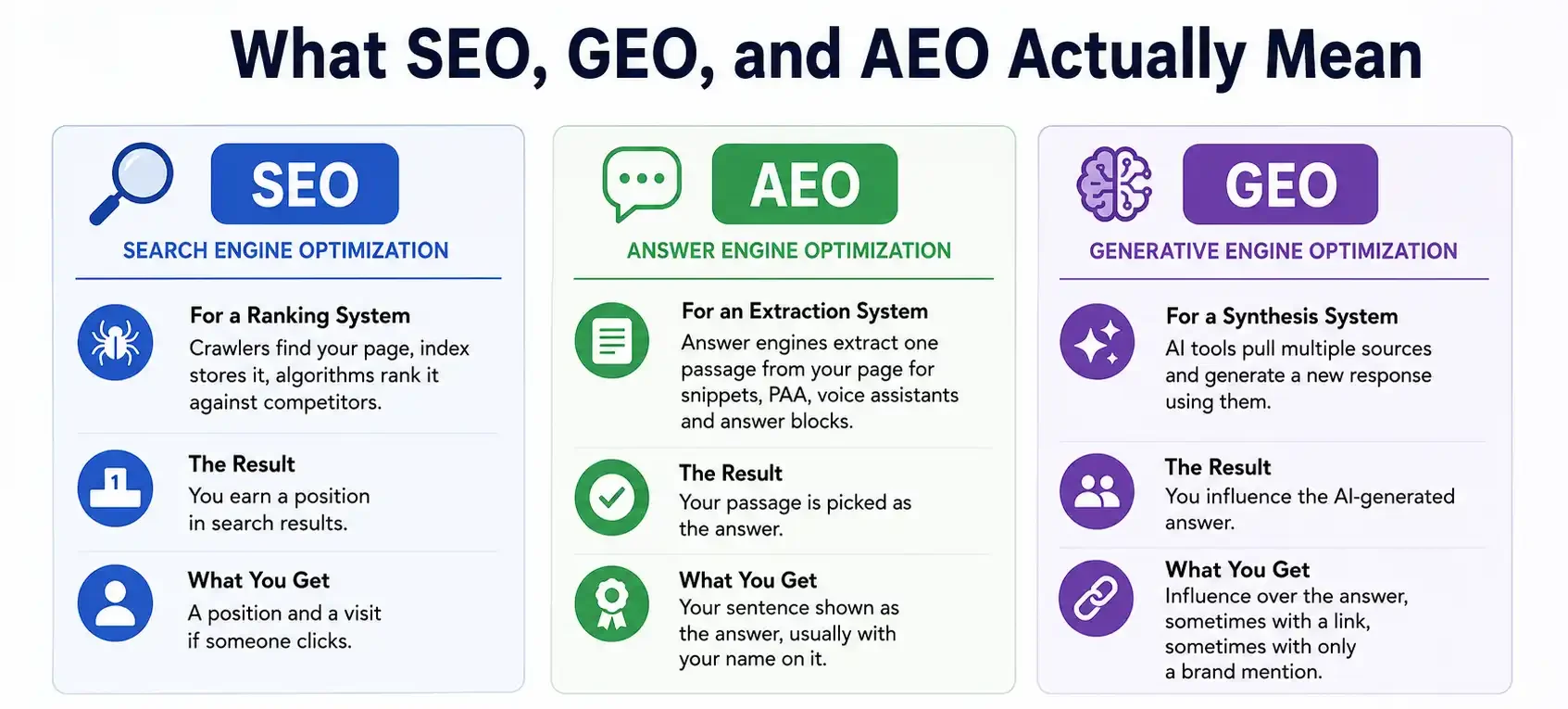
SEO is optimisation for a ranking system. A crawler finds your page, an index stores it, an algorithm orders it against competitors, and a person decides whether to click. What you get is a position and a visit.
AEO or answer engine optimisation, is optimisation for an extraction system. Featured snippets, People Also Ask boxes, voice assistants and answer blocks lift one passage out of a page and display it.
What you get is your sentence shown as the answer, usually with your name on it.
GEO, a.k.a. generative engine optimization is optimizing for a synthesis system. ChatGPT, Perplexity, Gemini and AI Overviews pull several sources and write a fresh response drawing on all of them.
What you get is influence over the answer, sometimes with a link, sometimes with only a brand mention.
GEO is not a marketing invention, which matters if someone tells you it is a fad. The term comes from a paper accepted at KDD 2024, where researchers measured visibility gains of up to 40% in generative engine responses.
AEO has no equivalent origin study. It grew out of the featured snippet era and was renamed once AI answers arrived.
| SEO | AEO | GEO | |
|---|---|---|---|
| System type | Ranking | Extraction | Synthesis |
| What wins | The page | The passage | The claim |
| Where it shows | Blue links, local pack | Snippets, PAA, voice | AI Overviews, chat answers |
| Do you get a link? | Always | Usually | Sometimes |
| What you can report | Clicks, position | Snippet share | Citations, mentions |
| Best for | Buying-stage queries | Common questions | Research-stage queries |
What Google Actually Says About Optimising for AI Answers
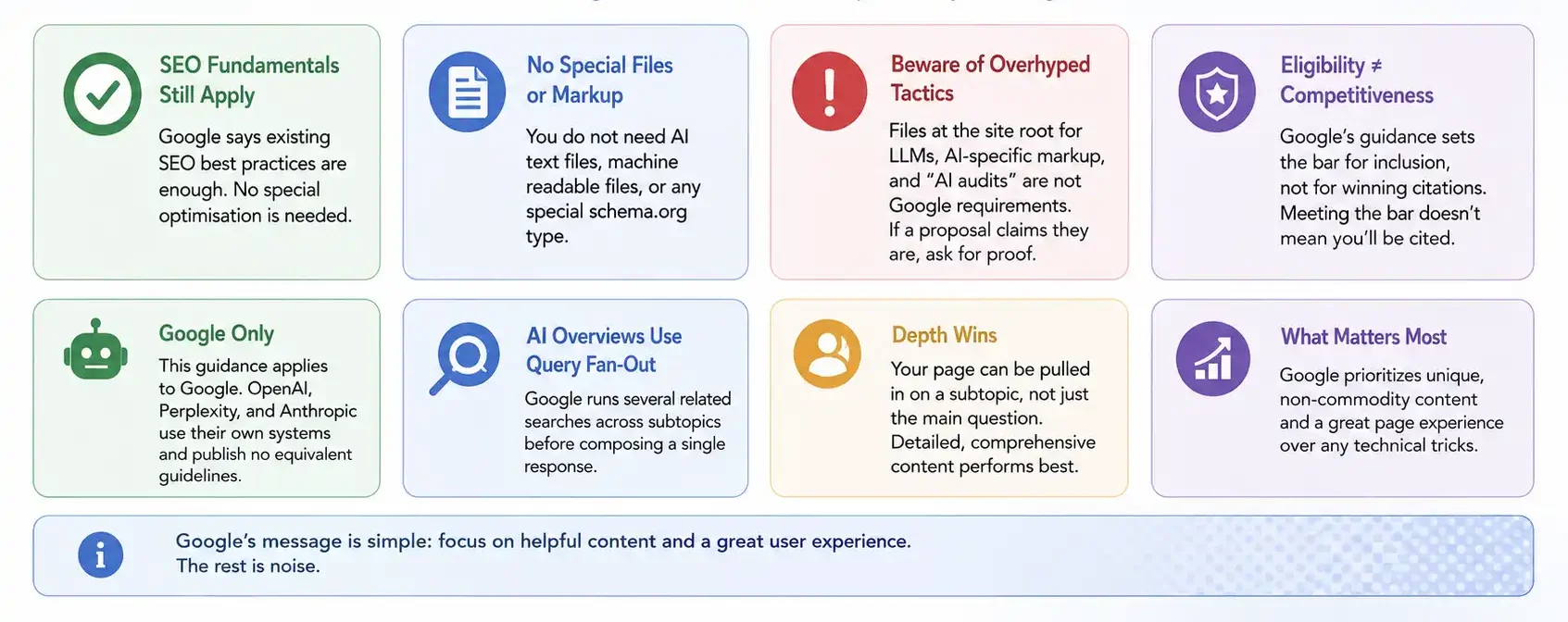
This is the part most comparison articles skip, and it is the part that protects your budget. Google’s documentation is blunt: the existing SEO fundamentals carry over, and no special optimisation is needed.
It goes further and says you do not need to create new machine readable files, AI text files, or markup, and that there is no special schema.org type to add.
That contradicts a good deal of what is being sold in 2026. Files placed at the site root for language models, AI-specific markup, audits that score your site on machine-readable markers.
For Google’s AI surfaces, the documentation says these are not requirements. If a proposal leans on them, ask which of Google’s published pages supports the claim.
Two caveats belong here, because the opposite mistake is also expensive. Google is describing eligibility, not competitiveness, so meeting the bar does not mean winning the citation.
Google’s guidance also governs Google only. OpenAI, Perplexity and Anthropic run their own retrieval and publish nothing equivalent, which is where genuine experimentation still has room.
One information from the same documentation is worth knowing. AI Overviews and AI Mode use a query fan-out technique, running several related searches across subtopics before composing a response.
Your page can therefore be pulled in on a subtopic rather than the headline question, which rewards depth over exact wording.
The same May 2025 guidance from Google Search Relations puts unique, non-commodity content and a good page experience above anything technical.
SEO vs GEO vs AEO: Which Searches Even Produce an AI Answer?
Here is the number that should shape your spending. In the Pew analysis of March 2025 browsing data, 18% of Google searches produced an AI summary. Not most searches. Fewer than one in five.
The split is not random, and it is predictable enough to plan around. Just 8% of one or two word searches produced an AI summary, rising to 53% for searches of ten words or more.
Around 60% of queries starting with who, what, when or why produced one. The typical summary ran 67 words, and 88% cited three or more sources.
For a business, the practical reading is this. Short, branded, transactional and location-led searches mostly still return a familiar page of clickable listings.
Someone typing a service plus a city name wants a supplier, not an explanation, which is why local search visibility has held up better than informational blog traffic.
You can check this yourself in an afternoon, without a tool or a consultant. Take the fifty searches that bring you enquiries, run each one, and record whether an AI answer appears.
That ratio is your GEO and AEO budget. It beats any industry average, because your customers do not search the way the industry average does.
Where the Three Concepts Overlap and Where They Genuinely Diverge
SEO, AEO, and GEO often rely on the same foundational content practices, but each rewards different outcomes. Understanding where they overlap—and where they diverge—helps you create content that performs across both traditional search and AI-powered experiences.
1. Content structure: mostly the same work
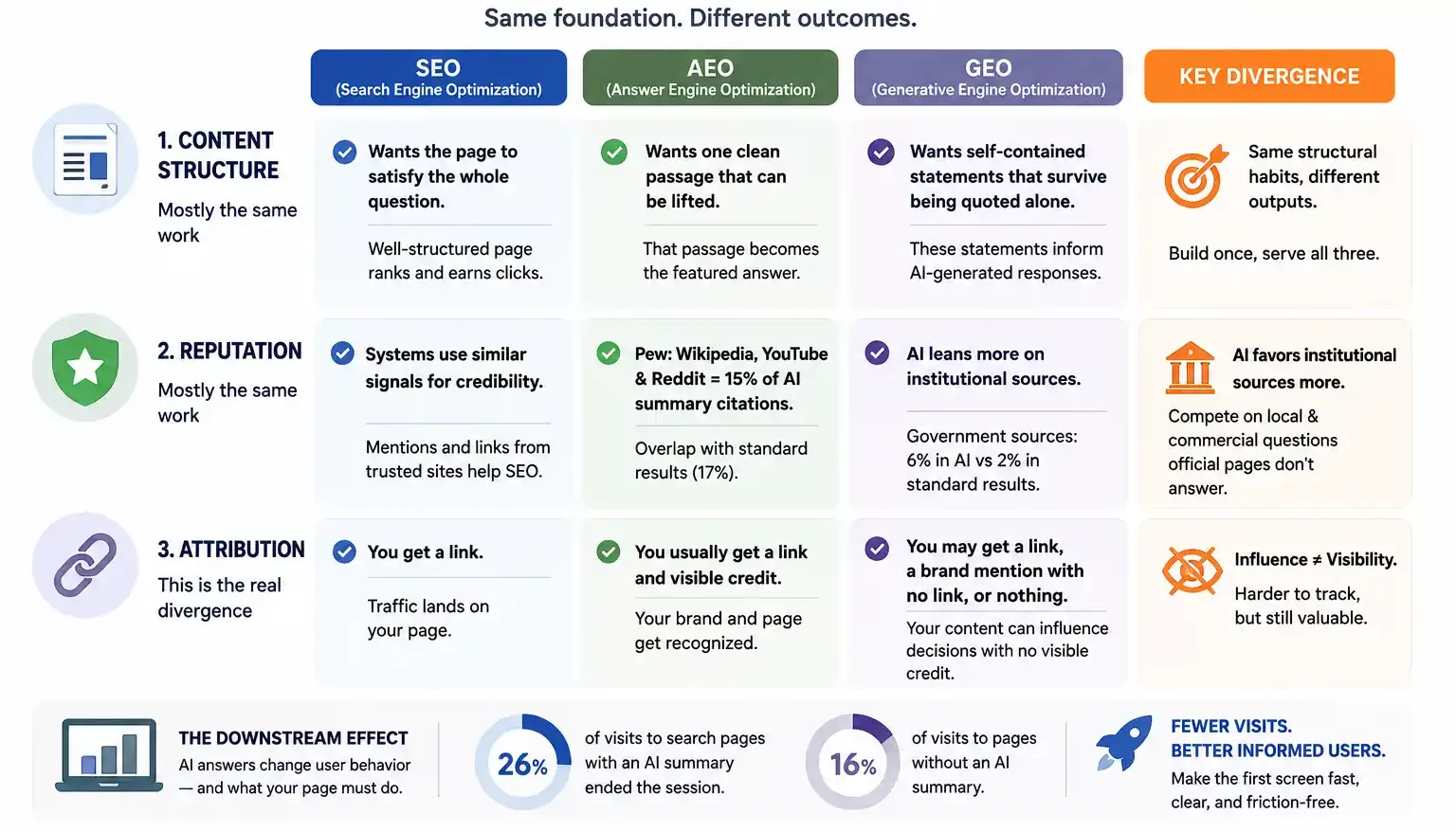
All three reward a direct answer near the top of a section, with the detail underneath. AEO wants one clean passage that can be lifted. GEO wants self-contained statements that survive being quoted alone.
SEO wants the page to satisfy the whole question. These pull in the same direction, so one well-built page can serve all three.
The practical version is unglamorous. Headings phrased the way customers ask, short paragraphs, a plain definition before the explanation, and figures with a source attached.
Most of it already appears in any decent on-page optimization checklist written before AI search existed.
2. Reputation: also mostly the same work
Pew found the three most cited sources in AI summaries were Wikipedia, YouTube and Reddit, together making up 15% of cited sources. Those same three accounted for 17% of sources in standard results.
The overlap is the point. The systems deciding what is credible draw on similar signals, so earning mentions and links from trusted sites pays into every channel at once.
One difference does show up. Government sources appeared in 6% of AI summary citations against 2% of standard results, so AI answers lean harder on institutional sources where they exist.
A clinic, a lender or a law firm should expect to sit behind official pages on general questions, and should compete instead on the local and commercial questions those pages never answer.
3. Attribution: this is the real divergence
With SEO you get a link. With AEO you usually get a link and visible credit. With GEO you may get a link, a brand mention with no link, or nothing you can see at all.
Your content can shape a purchase decision and leave no trace in your analytics, which is uncomfortable but not the same as being ignored.
The downstream effect is measurable. Pew found 26% of visits to search pages with an AI summary ended the browsing session entirely, against 16% for pages without.
Fewer people arrive, and those who do arrive later are better informed. That changes what a page has to do on arrival, usually a faster route to the point on pages built to convert.
Removing friction from the first screen is ordinary interface and experience work, not an AI tactic.
How a Business Should Split Its Budget in 2026
A three-way split is a wrong instinct. These are not three separate budgets competing for the same money. Here is a defensible order of operations.
- Check trigger rates first. Run the searches that bring you enquiries and record which produce AI answers. Everything downstream follows from that ratio, and it costs an afternoon.
- Fix the foundation. Crawlability, indexation, page speed, and structured data that matches what visitors can see. Google’s position is that this covers AI formats too, so it is never wasted money.
- For searches with no AI answer, usually commercial, branded, local and transactional, run classic SEO with the enquiry as the goal. For most businesses this is still where the revenue sits.
- For research-stage questions that do trigger AI answers, restructure toward answer-first passages, add figures a reader can verify, and name the person who wrote it.
- Be present where the systems already look. Community platforms, video and third-party coverage feed both channels, which is one more reason a consistent social presence now has a search payoff.
A blunt position, since hedging, helps nobody. If a site gets under a few thousand organic visits a month, the highest return in 2026 is still ordinary technical and content SEO, not an AI visibility subscription.
Plenty of companies pay monthly to monitor AI citations while the same page title repeats across a hundred pages of their own site. Fix the second thing first.
The exception is any business selling into a research-heavy category, where buyers start by asking a chatbot to shortlist options. Software, professional services, insurance and education sit here.
Being absent from generated answers in those categories is a real cost, and the work should start before the enquiries drop rather than after.
What Businesses Waste The Most Money On
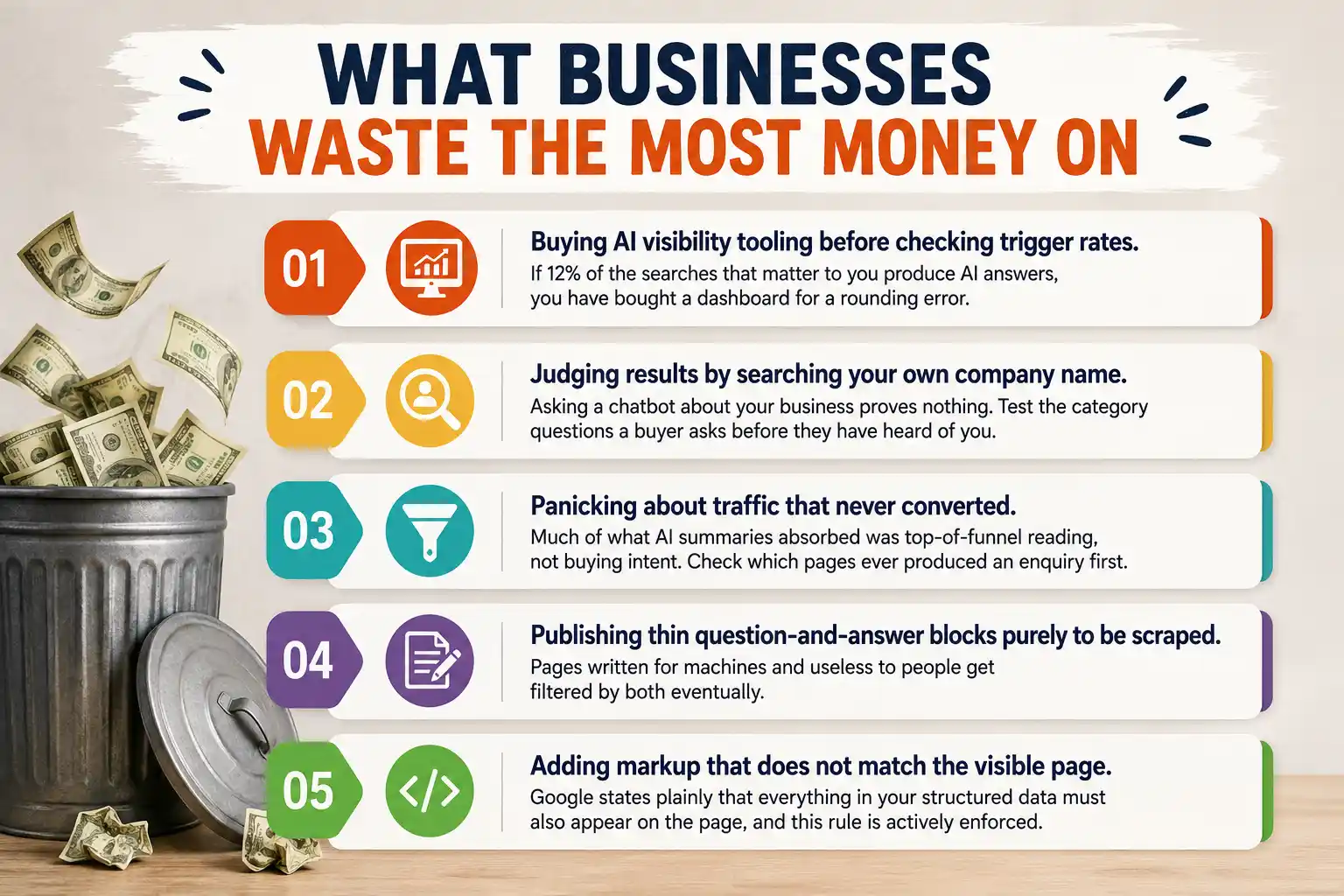
- Buying AI visibility tooling before checking trigger rates. If 12% of the searches that matter to you produce AI answers, you have bought a dashboard for a rounding error.
- Judging results by searching your own company name. Asking a chatbot about your business proves nothing. Test the category questions a buyer asks before they have heard of you.
- Panicking about traffic that never converted. Much of what AI summaries absorbed was top-of-funnel reading, not buying intent. Check which pages ever produced an enquiry first.
- Publishing thin question-and-answer blocks purely to be scraped. Pages written for machines and useless to people get filtered by both eventually.
- Adding markup that does not match the visible page. Google states plainly that everything in your structured data must also appear on the page, and this rule is actively enforced.
What You Can Honestly Measure
Start with what is not possible, so nobody sells it to you. Clicks from AI Overviews and AI Mode are folded into the standard Search Console performance report under the Web search type, with no separate breakout.
Anyone presenting AI Overview rankings pulled from Search Console is inferring, not reporting.
What can genuinely be measured looks like this. Referral visits from chat and answer platforms in your analytics, which are small in volume but tend to convert above average.
A fixed set of category questions run monthly under the same conditions and logged in a spreadsheet, so change is visible without buying anything.
Impression-to-click shifts on informational query groups, which is the earliest signal that AI summaries are absorbing clicks. And assisted conversions, since visitors now arrive later in the buying process.
Two housekeeping points for anyone reviewing a monthly report. Compare like with like, because AI answer coverage varies by country and device.
Ask for branded and non-branded searches to be separated, or a good PR month will be presented as an SEO win. The same applies to reading paid search performance, where blended numbers hide the story.
Wrapping Up
SEO, AEO and GEO are three names for optimising against three different retrieval systems, and most of the underlying work is identical. What changes is which unit gets rewarded: the page, the passage, or the claim.
The sensible route for a business is straightforward. Measure how many of your commercial searches produce AI answers, keep the technical foundation clean, and publish answer-first content backed by figures somebody can verify.
Stop treating an 18% phenomenon as a 100% emergency. That fits inside an existing multi-channel marketing plan rather than replacing it, whichever acronym wins the next naming argument.
Frequently asked questions
-
Is GEO the same as AEO?
Ans.No. AEO optimises for systems that extract one passage and display it directly, such as featured snippets and voice answers. GEO optimises for systems that retrieve several sources and generate a new response. -
Is AEO better than SEO for a business?
Ans.Neither is better, because they answer different questions. AEO wins visibility without a guaranteed click, while SEO wins the click and the enquiry. For commercial and local searches, which rarely trigger AI answers, SEO still produces most of the revenue. -
Is AI SEO the same as AEO?
Ans.The terms are used interchangeably by many practitioners, along with AIO and LLMO. Wikipedia's entry lists them as related names for the same practice. Google itself uses none of these labels and refers simply to AI features in Search. -
What are the main types of SEO?
Ans.The standard split is on-page, off-page and technical, with local SEO treated separately because it depends on business listings and proximity rather than page content. AEO and GEO sit on top of these rather than replacing them. -
Does my business need an llms.txt file?
Ans.Not for Google. The documentation states you do not need to create new machine readable files or AI text files to appear in AI features. Support among other AI systems is inconsistent, so treat it as a cheap experiment rather than a requirement. -
How long does GEO take to show results?
Ans.Citation changes can appear within weeks, because generated answers refresh faster than rankings, but they are also less stable. Expect visible movement in one to three months, and expect it to fluctuate between checks.
Author Details

Latest Posts
-
 18 / Aug
Google Search Console Google Search Console For Social Media: How To Track Instagram, Tiktok, X And Youtube
18 / Aug
Google Search Console Google Search Console For Social Media: How To Track Instagram, Tiktok, X And Youtube -
05 / Aug
SEO vs GEO vs AEO SEO vs GEO vs AEO: A Simple 2026 Comparison for Businesses
-
 31 / Jul
Uncategorized How to Build a 90-Day Digital Marketing Plan That Works
31 / Jul
Uncategorized How to Build a 90-Day Digital Marketing Plan That Works -
 17 / Jul
Website Redesign 7 Real Signs Your Business Website Needs a Redesign in 2026
17 / Jul
Website Redesign 7 Real Signs Your Business Website Needs a Redesign in 2026 -
 10 / Jul



Blogs
Journey into Ideas Unveiling Tomorrow's Insights Today.

-
Is GEO the same as AEO?
Ans.No. AEO optimises for systems that extract one passage and display it directly, such as featured snippets and voice answers. GEO optimises for systems that retrieve several sources and generate a new response. -
Is AEO better than SEO for a business?
Ans.Neither is better, because they answer different questions. AEO wins visibility without a guaranteed click, while SEO wins the click and the enquiry. For commercial and local searches, which rarely trigger AI answers, SEO still produces most of the revenue. -
Is AI SEO the same as AEO?
Ans.The terms are used interchangeably by many practitioners, along with AIO and LLMO. Wikipedia's entry lists them as related names for the same practice. Google itself uses none of these labels and refers simply to AI features in Search. -
What are the main types of SEO?
Ans.The standard split is on-page, off-page and technical, with local SEO treated separately because it depends on business listings and proximity rather than page content. AEO and GEO sit on top of these rather than replacing them. -
Does my business need an llms.txt file?
Ans.Not for Google. The documentation states you do not need to create new machine readable files or AI text files to appear in AI features. Support among other AI systems is inconsistent, so treat it as a cheap experiment rather than a requirement. -
How long does GEO take to show results?
Ans.Citation changes can appear within weeks, because generated answers refresh faster than rankings, but they are also less stable. Expect visible movement in one to three months, and expect it to fluctuate between checks.