-
Author: Anindita Barik
-
Updated Date: Oct-13-2026
-
Views: 2 Min Read
Digital marketing for home service businesses helps plumbers, HVAC technicians, electricians, and roofers attract local customers and convert enquiries into booked jobs. The strategy combines local SEO, Google Business Profile optimization, Google Maps, Search Ads, Local Services Ads, customer reviews, and service-specific landing pages. Businesses should match marketing channels to customer intent, build trust with accurate information, and track qualified leads, booking rates, cost per booked job, and revenue. A structured 90-day plan helps improve visibility, lead quality, and marketing performance in 2026.
A homeowner with a burst pipe does not spend hours comparing plumbers. They search for help, check a few local results, read reviews, and call the company they trust. A broken AC can follow a similar path, while a panel upgrade or roof replacement gives homeowners more time to research, compare contractors, and understand costs.
This difference shapes digital marketing for home service businesses. Not every customer reaches a business with the same level of urgency or intent. Emergency searches need quick visibility, while planned services need useful information that helps customers make a decision.
A strong strategy follows this journey: Demand → Visibility → Trust → Lead → Booked Job → Revenue.
Local SEO and Google Maps help businesses get found locally. Search Ads and Local Services Ads capture ready-to-book demand. SEO content, reviews, project photos, and clear service information help turn that visibility into trust and enquiries. The goal is simple: reach customers when they need the service and make the next step easy.
Match the Marketing Channel to the Customer’s Intent
A home service marketing strategy should start with the customer, not the platform.
Before deciding how much to spend on SEO, PPC or Local Services Ads, look at what people actually search for. Local keyword research shows which phrases people in your service area use, and this search phrase also tells you how close that person is to hiring.
| Customer need | Example search | Priority channel |
|---|---|---|
| Emergency | “emergency plumber near me” | Local Services Ads (LSA) + Maps + Search Ads |
| Immediate repair | “AC repair near me” | Maps + LSA + PPC + SEO |
| Planned service | “electrician for panel upgrade” | SEO + PPC |
| High-ticket replacement | “roof replacement cost” | SEO + PPC + remarketing |
| Research | “how long does an HVAC system last” | Content SEO → service page |
The closer someone is to making a booking, the more important demand-capture channels become. Google Maps, Local Services Ads and Search Ads can put a business in front of people who already know what service they need.
SEO and content have a different job. They help customers who are still comparing options, understanding a problem or researching a larger purchase.
This is why the same marketing mix does not work equally well for every home service company. An emergency plumbing call and a roof replacement may end with the same outcome, but the customer takes a very different route to get there.
Build Your Home Services Marketing Stack in This Order
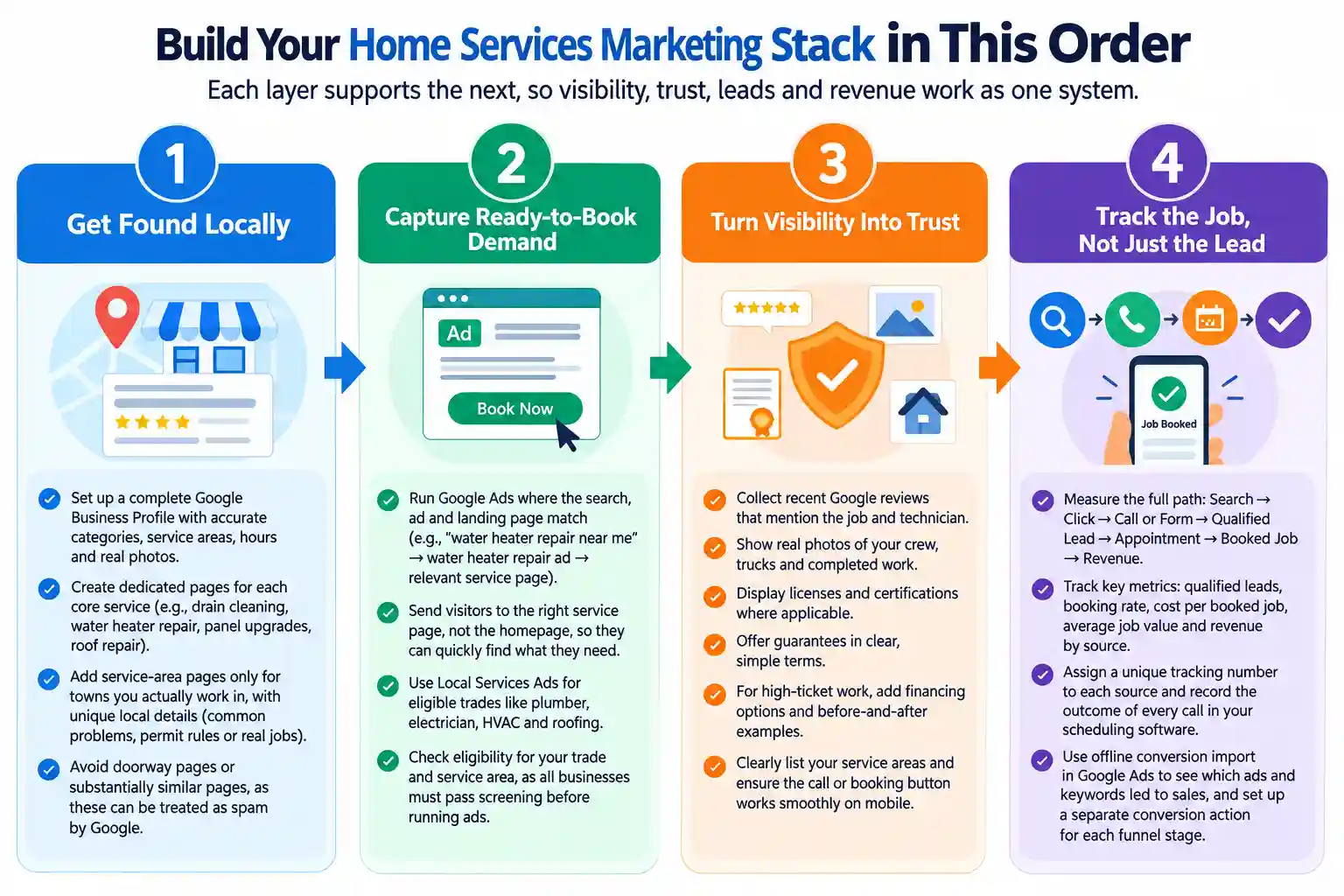
Create four layers in sequence. Each layer supports the next, so visibility, trust, leads and revenue work as one system.
Layer 1: Get Found Locally
Local SEO for home services begins with a complete Google Business Profile. Google ranks local results based on relevance, distance and prominence, and its help page says more reviews and positive ratings can help local ranking.
Fill in accurate categories, service areas, hours and real photos. Then build one page for each core service, such as drain cleaning, water heater repair, panel upgrades or roof repair.
Add service-area pages only for towns you actually work in, and give each one something specific: common local problems, permit rules or real jobs. Do not publish ten city pages with only the city name changed.
Google’s spam policies treat pages created for specific cities that all push visitors to one page, as well as substantially similar pages, as doorway abuse. The local SEO checklist covers the profile and citation setup in the right order.
Layer 2: Capture Ready-to-Book Demand
Google Ads for home services works when the search, the ad and the page match. A search for “water heater repair near me” should trigger a water heater repair ad, land on a water heater repair page, and end at a call button or booking form.
Sending that click to the homepage makes the searcher hunt for a service they already named.
Google describes Local Services Ads as pay-per-lead listings for verified providers. Its eligible home services list includes plumber, electrician, HVAC and roofing, and every business must pass screening first, so check eligibility for your trade and service area before budgeting.
Layer 3: Turn Visibility Into Trust
Ranking gets a home service company considered. Trust gets it called. A homeowner about to let a stranger into the house checks the business before dialing.
What answers that check: recent Google reviews that mention the job and technician, real photos of your crew, trucks and finished work, licenses and certifications where they apply, and guarantees explained in plain words.
For high-ticket work, add financing terms and before-and-after examples. Name your service areas clearly, and make sure the call or booking button works properly on a phone.
Layer 4: Track the Job, Not Just the Lead
The full path is Search → Click → Call or Form → Qualified Lead → Appointment → Booked Job → Revenue. Traffic, calls and form fills show what happens at the start, but they do not show which leads become actual jobs.
Home service lead generation should be measured by qualified leads, booking rate, cost per booked job, average job value and revenue by source. These metrics show whether the leads coming through each channel turn into valuable work.
Give each source its own tracking number and record the outcome of every call in your scheduling software. Google Ads can import offline conversions, which shows which ads and keywords led to sales, and Google recommends a separate conversion action for each funnel stage.
Plumbing vs. HVAC vs. Electrical vs. Roofing: What Changes?
| Business | Demand pattern | Marketing priority |
|---|---|---|
| Plumbing | Emergency + repair | LSA + Maps + Search Ads |
| HVAC | Emergency + seasonal + replacement | LSA + PPC + Local SEO |
| Electrical | Repair + planned projects | Local SEO + PPC + Maps |
| Roofing | High-ticket + longer consideration | SEO + PPC + reviews + remarketing |
Plumbing demand is mostly emergency and repair, so answer speed and Maps visibility decide who gets the call. The guide to digital marketing for plumbing companies goes deeper.
HVAC adds heat waves, cold snaps and expensive replacements, so it needs paid capture in season and research content for replacement quotes. The full plan is in the HVAC digital marketing strategy guide.
Electrical work splits between urgent repairs and planned jobs like panel upgrades, and local SEO carries the planned side. There is more in the guide to marketing strategies for electricians.
Roofing is a high-ticket purchase with a long comparison phase. Reviews, project photos and remarketing carry more weight than call speed. A separate guide covers roofing digital marketing.
Measure Home Services Marketing by Booked Jobs
Take an illustrative funnel. Out of 100 leads, 70 qualify, 50 become appointments and 35 turn into booked jobs. At an $800 average job value, that is $28,000 in revenue.
With $7,000 in marketing spend, cost per lead looks like $70, but cost per booked job is $200. Revenue is 4× spend.
Traffic, impressions, rankings, cost per click and click-through rate help diagnose a campaign. Qualified leads, booked jobs, cost per booked job, average job value and revenue tell the owner whether marketing works commercially. For the wider method, see how to measure digital marketing ROI.
What’s Different About Home Services Marketing in 2026?
Customers now find home service companies through Google organic results, Google Maps, AI-generated answers, review platforms, directories and other recommendation surfaces. Any of them can shape who gets called.
The practical response is consistent, verifiable information everywhere: services, locations served, qualifications, process, pricing factors, FAQs and real project experience. Conflicting details between your site, Business Profile and directories make it harder for people to trust what they see.
Google’s documentation says AI Overviews and AI Mode have no additional requirements or special schema markup, and that standard SEO fundamentals still apply. So schema is not a shortcut. Clear pages and accurate business information still do the work.
A 90-Day Digital Marketing Plan for Home Service Businesses
Days 1 to 30: Fix the Foundation
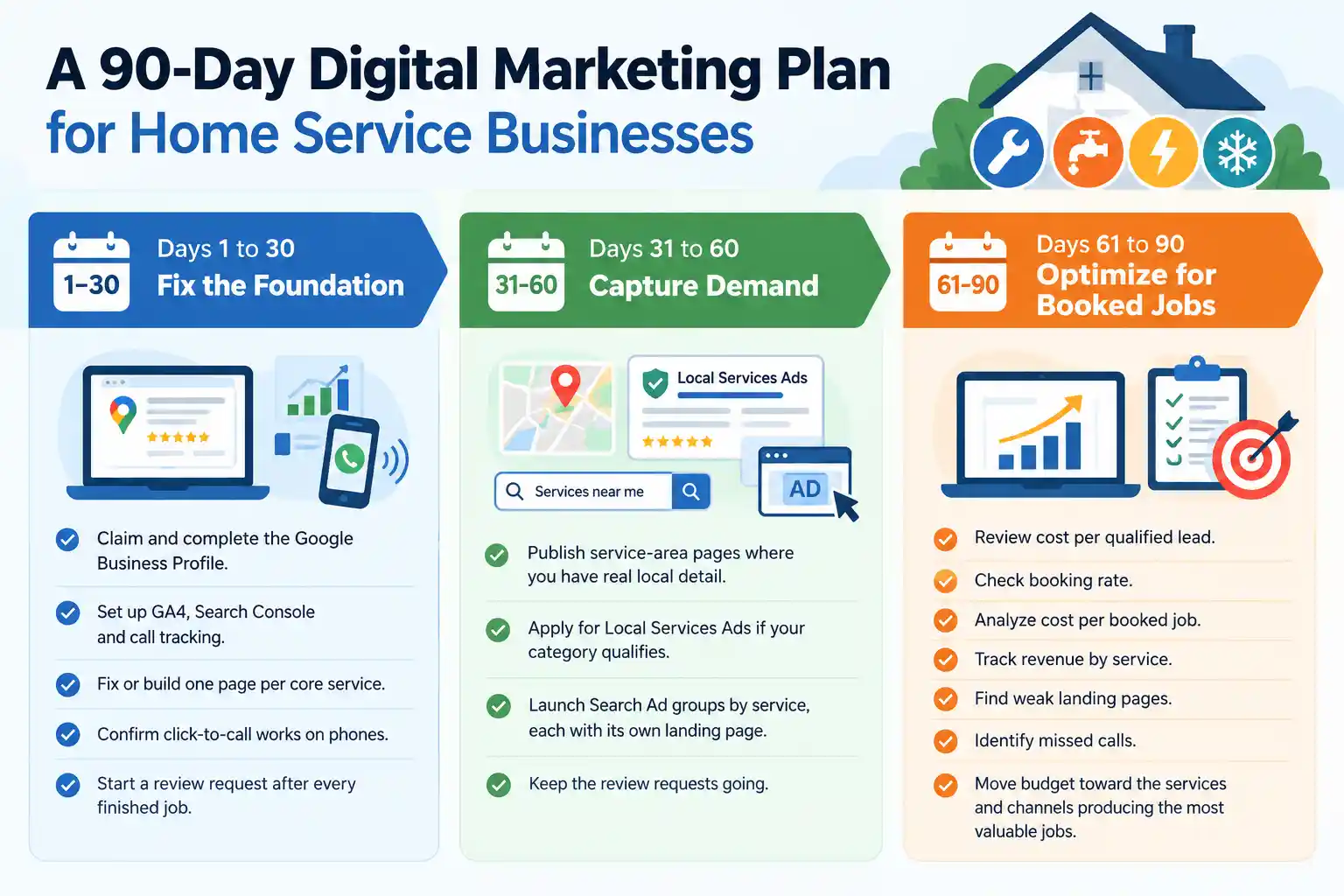
Claim and complete the Google Business Profile. Set up GA4, Search Console and call tracking. Fix or build one page per core service, confirm click-to-call works on phones, and start a review request after every finished job.
Days 31 to 60: Capture Demand
Publish service-area pages where you have real local detail. Apply for Local Services Ads if your category qualifies. Launch Search Ad groups by service, each with its own landing page, and keep the review requests going.
Days 61 to 90: Optimize for Booked Jobs
Review cost per qualified lead, booking rate, cost per booked job, revenue by service, weak landing pages and missed calls. Move budget toward the services and channels producing the most valuable jobs.
Home Services Digital Marketing Checklist
☐ Google Business Profile optimized
☐ Core service pages created
☐ Useful service-area and location pages
☐ Review acquisition process
☐ Local Services Ads where eligible
☐ Service-specific Search campaigns
☐ Relevant landing pages
☐ Mobile click-to-call
☐ Call and form tracking
☐ Qualified-lead tracking
☐ Booked-job tracking
☐ Revenue attribution
☐ Problem-solving home service SEO content
☐ Consistent business information across major platforms
Conclusion
Digital marketing for home service businesses does not have to cover every channel. It has to match each channel to customer intent and follow every lead to a booked job. Start with the Business Profile and call tracking, then add paid capture where the numbers support it.
PromotEdge Digital’s local SEO services can audit your profile, service pages and tracking to show which searches turn into jobs.
FAQs
Author Details

Latest Posts
-
13 / Oct
Digital Marketing Digital Marketing for Home Service Businesses: The 2026 Playbook
-
 18 / Sep
Search Engine Optimization AI Is Changing Seo: You Still Rank, But Clicks Are Falling
18 / Sep
Search Engine Optimization AI Is Changing Seo: You Still Rank, But Clicks Are Falling -
 11 / Sep
-
 18 / Aug
Google Search Console Google Search Console For Social Media: How To Track Instagram, Tiktok, X And Youtube
18 / Aug
Google Search Console Google Search Console For Social Media: How To Track Instagram, Tiktok, X And Youtube -
 05 / Aug
SEO vs GEO vs AEO SEO vs GEO vs AEO: A Simple 2026 Comparison for Businesses
05 / Aug
SEO vs GEO vs AEO SEO vs GEO vs AEO: A Simple 2026 Comparison for Businesses

Blogs