-
Author: Milan Shyamal
-
Updated Date: Oct-01-2026
-
Views: 2 Min Read
GEO for B2B starts from one change in how engineers and procurement teams research. Instead of opening ten supplier websites, they can ask an AI system a question like this:
“Which type of industrial pump is suitable for corrosive chemicals, and what specifications should I evaluate before choosing a manufacturer?”
The system can draw on several sources and produce one answer before the buyer contacts any supplier. In Forrester’s Buyers’ Journey Survey, 2025, 94% of business buyers reported using AI in their buying process.
So the work is making your products, capabilities, technical knowledge and supporting evidence understandable and retrievable during that research. If you need the definition first, start with the basics of Generative Engine Optimisation.
Why GEO for B2B Is an Information Problem First
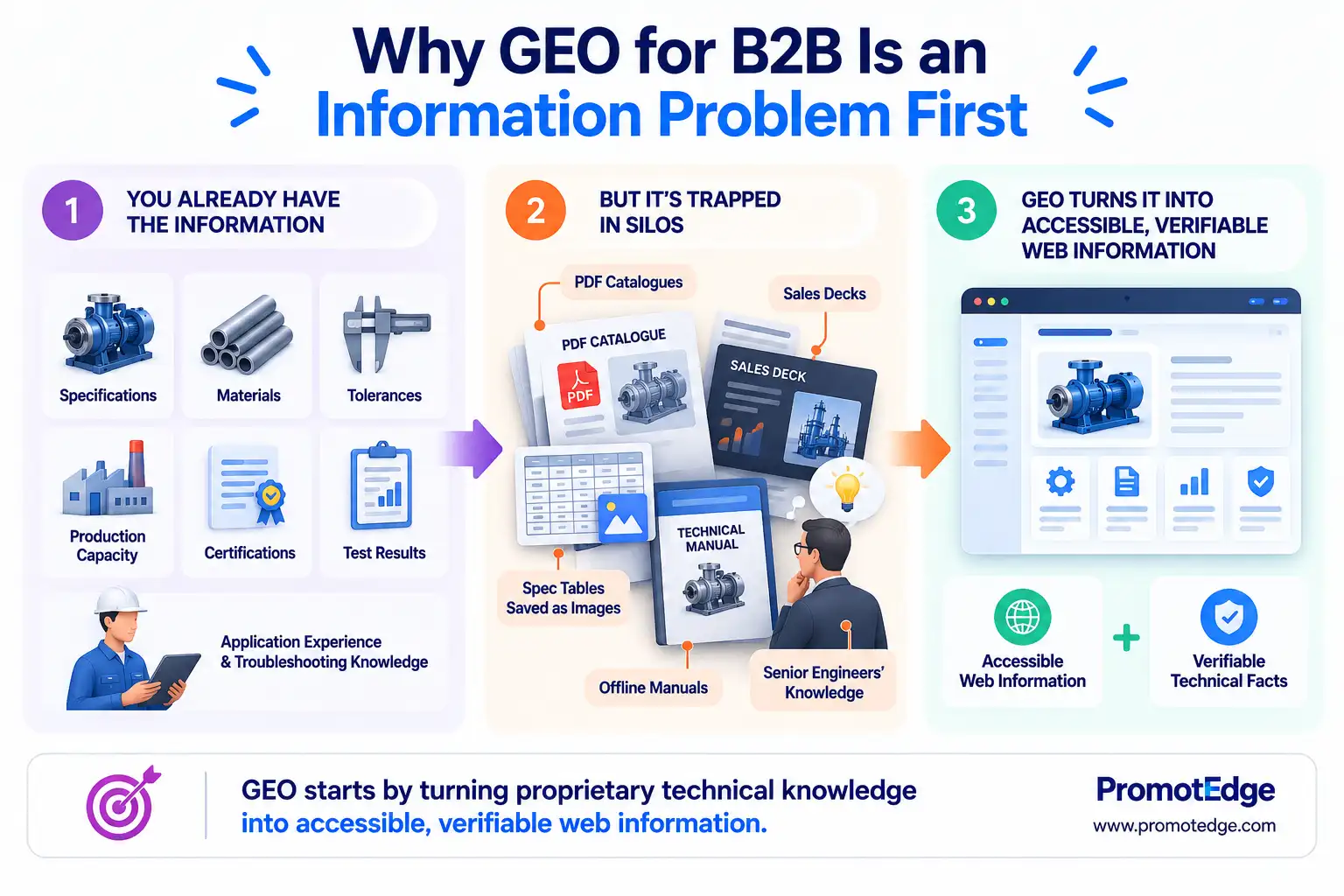
Most industrial companies already hold the information buyers are asking AI systems about. Specifications, materials, tolerances, production capacity, certifications, test results, application experience and troubleshooting knowledge usually exist somewhere in the business.
The trouble is from where that information originates: PDF catalogues, sales decks, spec tables saved as images, offline manuals and the memory of senior engineers. Google’s guidance on its AI features tells site owners to make sure important content is available in textual form.
That is why another generic 1,500-word article on “What is a gear pump?” adds little. What the web lacks is your pressure ratings, your wetted materials and your installation record.
For industrial brands, GEO begins with converting proprietary technical knowledge into accessible and verifiable web information.
What Does AI Need to Understand About an Industrial Brand?
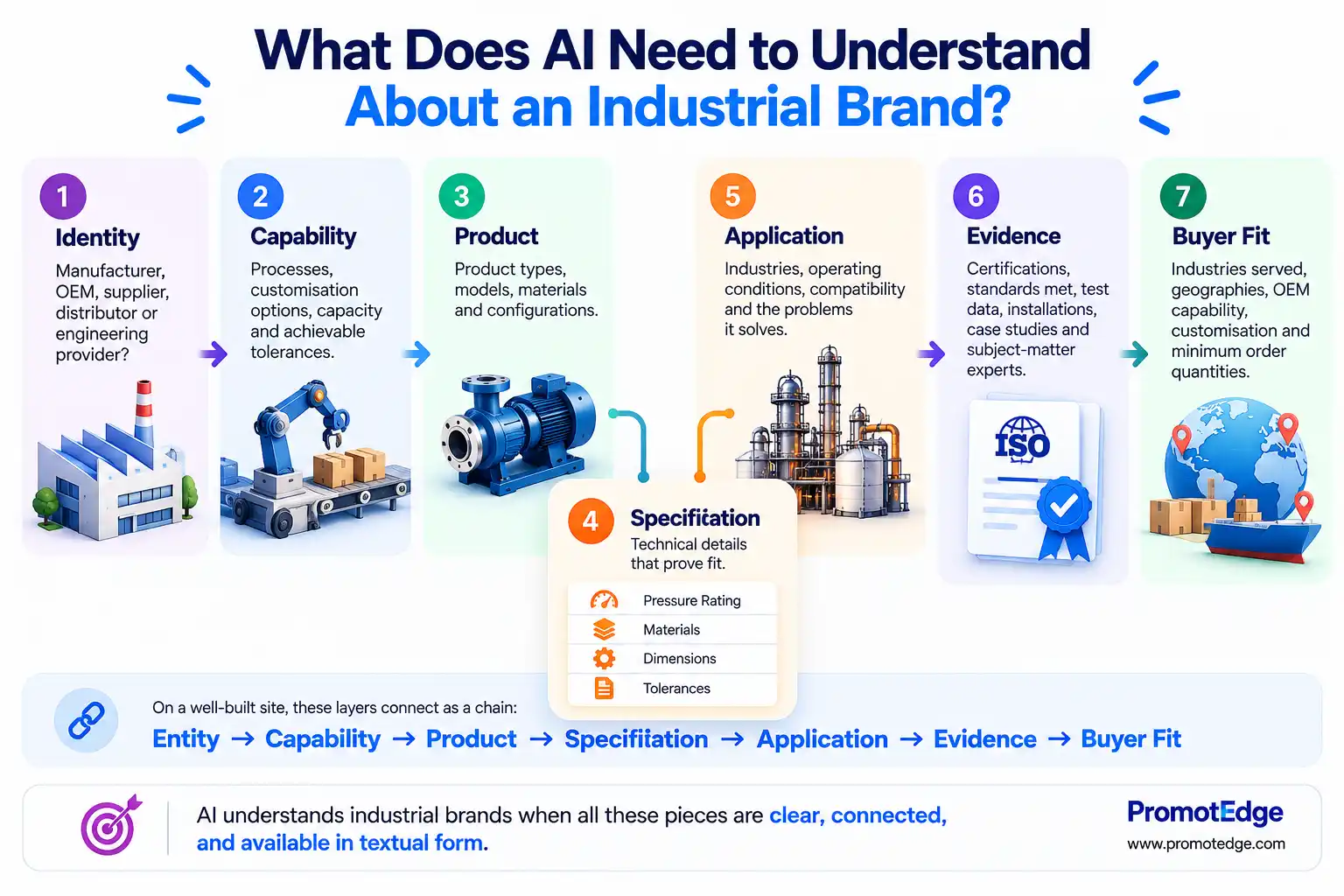
Answering a sourcing question well means piecing together several facts about your company. PromotEdge’s B2B AI Information Model groups those facts into six layers.
Identity
Manufacturer, OEM, supplier, distributor, exporter or engineering provider? A distributor and a manufacturer answer different buyer questions.
Capability
What can you actually make or deliver? Processes, customisation options, capacity and achievable tolerances.
Product
What exactly do you sell? Product types, models, materials, configurations and specifications.
Application
Where should the product be used? Industries, operating conditions, compatibility and the problems it solves.
Evidence
What supports your claims? Certifications, standards met, test data, installations, case studies and named subject-matter experts.
Buyer Fit
Who are you the right supplier for? Industries served, geographies, OEM capability, customisation and minimum order quantities where relevant.
On a well-built site, these layers connect as a chain:
Entity → Capability → Product → Specification → Application → Evidence → Buyer Fit
Specification sits between product and application because it proves a product fits a use. If a human visitor cannot trace that chain on your site, expecting an AI system to reconstruct it reliably is unrealistic.
Match Your Website to the Questions B2B Buyers Ask AI
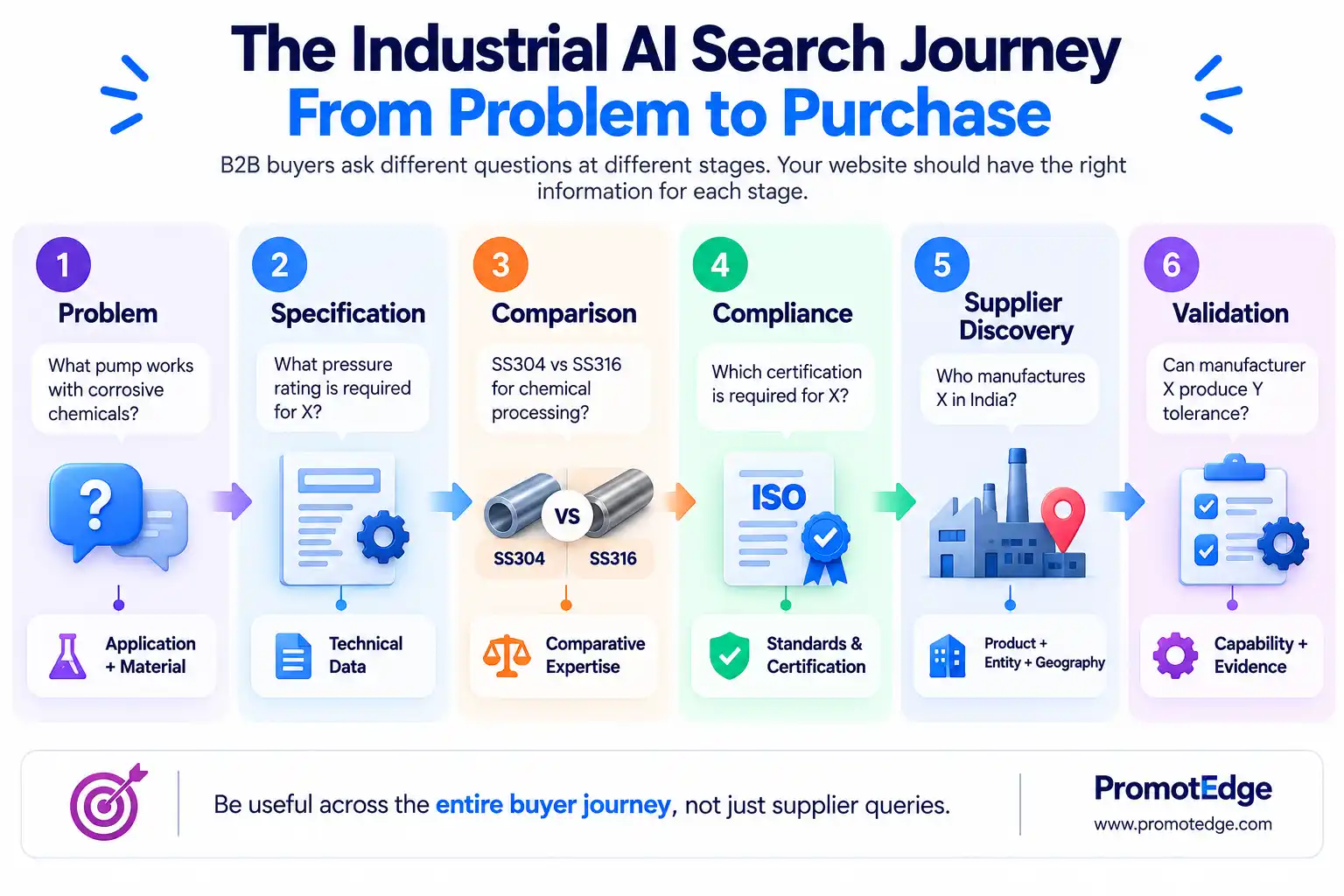
Industrial AI discovery goes well beyond “best manufacturer of X” prompts, and each buying stage needs different information from your site.
| Buyer Stage | Example Question | Information Required |
|---|---|---|
| Problem | What pump works with corrosive chemicals? | Application + material |
| Specification | What pressure rating is required for X? | Technical data |
| Comparison | SS304 vs SS316 for chemical processing? | Comparative expertise |
| Compliance | Which certification is required for X? | Standards and certification |
| Supplier discovery | Who manufactures X in India? | Product + entity + geography |
| Validation | Can manufacturer X produce Y tolerance? | Capability + evidence |
Read down the first column and you have the Industrial AI Search Journey:
Problem → Specification → Comparison → Compliance → Supplier → Validation.
Only one of those six stages asks for a supplier by name. A company that publishes only supplier-style pages has little to offer in the first four stages, where the buyer’s requirements get written. Aim to be useful across the whole sequence.
Build Source Pages, Not “GEO Content”
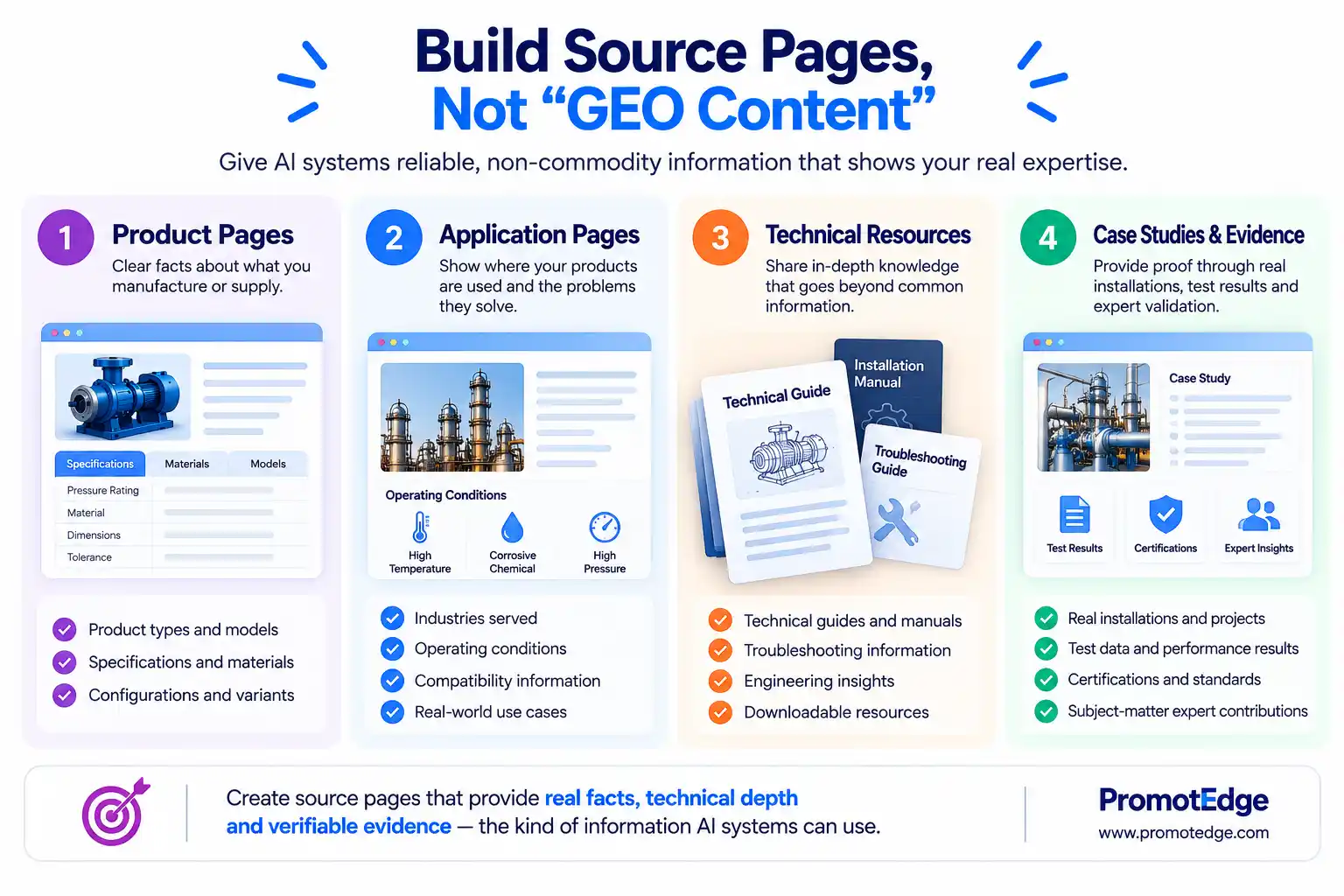
“Writing for AI” is the wrong target. Google’s guide to generative AI search asks for reliable, non-commodity content with expert insight beyond common knowledge.
The 2024 KDD paper that introduced GEO tested content modifications across a benchmark of 10,000 queries.
The researchers reported that methods including citations, quotations and statistics could improve source visibility, with their top-performing methods producing roughly 30–40% relative gains on the study’s Position-Adjusted Word Count metric. Results varied by query and domain.
Product Pages Establish Facts
A strong product page runs in a predictable order: definition, specifications, materials, operating limits, applications, compatibility, standards and downloadable documentation.
Compare two lines:
Weak: “Our innovative solutions deliver unmatched performance.”
Useful: “The pump uses SS316 wetted components and is designed for corrosive chemical-processing duty.”
The second provides specific product information that can support an answer; the first is largely an unverified marketing claim.
Application Pages Establish Suitability
Structure these around the buyer’s situation: the problem, operating conditions, recommended solution, why it fits, its limitations and the relevant product. Stating limitations is what separates an engineering page from a brochure.
Technical Resources Establish Expertise
Answer the questions engineers actually send your sales team. Why does a mechanical seal fail early? SS304 or SS316 for dilute sulphuric acid? Your sales engineers’ inbox is the best keyword research you have.
Case Studies Establish Evidence
Instead of making unsupported claims such as “Helped a leading manufacturer improve efficiency,” present the case study through a clear sequence: describe the situation, define the operating requirement, explain the solution, outline how it was implemented, and conclude with measurable results supported by numbers approved by the client for publication.
Specific, retrievable information is what makes a page useful as a source, and the same pages carry the commercial weight in digital marketing for industrial machinery companies.
First-Party Facts Need Third-Party Corroboration
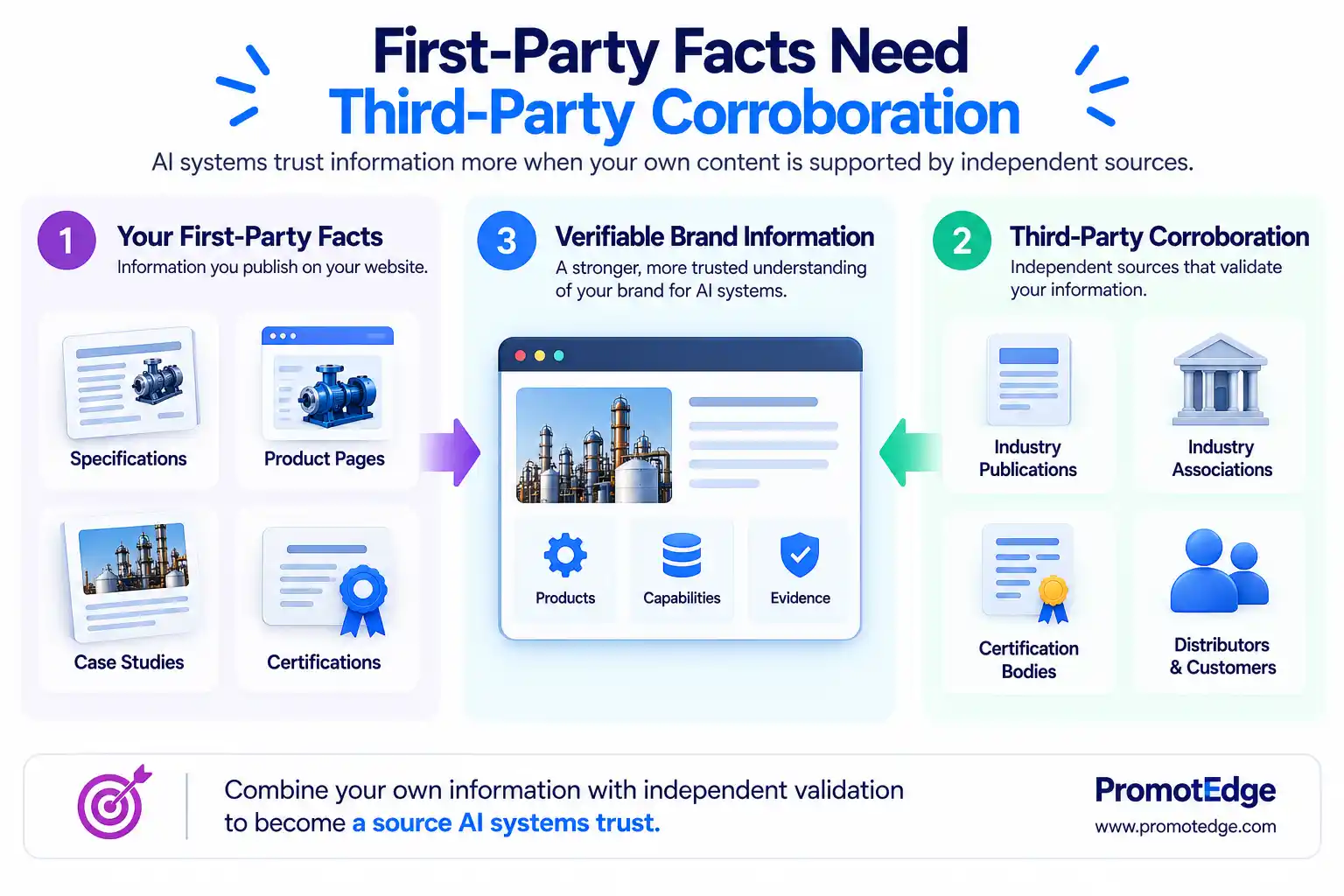
First-party evidence is what you control: product pages, specifications, case studies, technical documentation, certifications and expert articles.
Third-party corroboration is what others publish: industry publications, professional associations, certification bodies, distributors, customers, trade events and reputable directories.
The Source Principle means using first-party facts supported by credible third-party sources.
Buyers already work this way. Forrester’s announcement of The State Of Business Buying, 2026 says answer engines often deliver incomplete or unreliable information, and buyers compensate by seeking validation from trusted sources.
The aim is consistency. When your certification, capacity and product names match across your site, distributor listings and the certifier’s register, the facts are easier to confirm. Google notes that seeking inauthentic mentions isn’t as helpful as it might seem.
Technical GEO: Keep It Boring
Google states there are no additional technical requirements for AI Overviews or AI Mode beyond being indexed and eligible for a snippet.
GEO doesn’t replace B2B SEO. The product, application and technical pages that make a manufacturer useful to AI search also serve conventional organic searches, which is why SEO, AEO and GEO overlap heavily.
The difference is architecture: it must support not only a keyword but the facts and relationships needed to answer a buyer’s question.
- Put specifications in crawlable HTML text, not only in images or PDFs.
- Keep key pages indexable and linked from related pages.
- Use descriptive titles and headings, and identical company and product names everywhere.
- Make structured data match the visible page, as Google’s documentation advises.
- Keep up normal technical SEO hygiene, including how Googlebot crawls and renders your pages.
Google says Search ignores llms.txt and needs no special schema for Google AI Overviews. Other AI platforms document less, so claims about how they weigh schema or llms.txt are industry hypotheses.
Measure Whether You’re Becoming a Source
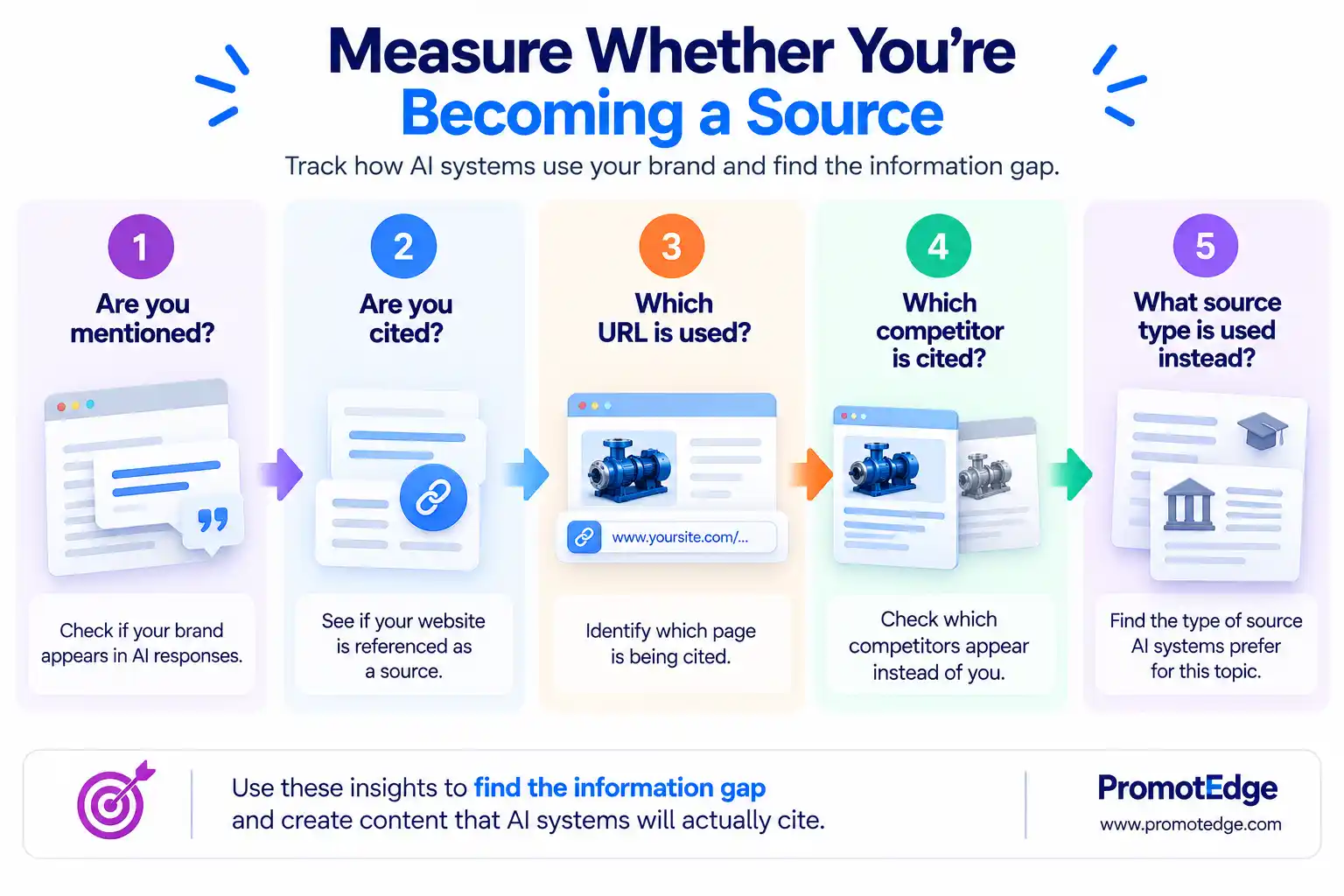
Build a fixed set of 20–40 prompts across problems, technical, comparison, supplier and brand questions. Re-run it monthly and record:
Mentioned? → Cited? → Which URL? → Which competitor? → Which source was used instead?
The last question does the diagnostic work: it points to a possible information gap, not a proven cause. If the AI system doesn’t use your information, what source does it use instead?
A competitor’s product page being cited is a reason to compare the completeness and structure of your own. If an industry publication is cited, examine what independent evidence or technical depth it provides.
If a distributor appears instead of the manufacturer, compare how accessible, detailed and specific each product page is.
Alongside prompts, track AI referrals, Search Console’s Generative AI performance report where available, organic performance, qualified enquiries and RFQs.
Become a Source Worth Using
The goal of GEO for B2B isn’t to write for AI. It’s to become a source worth using.
For a manufacturer, that means making capabilities, specifications, applications, expertise and evidence accessible, understandable and verifiable.
Start with the product line generating the most RFQs. Move its critical catalogue information into crawlable HTML, connect it to relevant applications and technical resources, and add evidence that substantiates the product claims.
-
What is GEO for B2B, and how does it differ from SEO?
Ans.GEO for B2B means making a company’s capabilities, products and expertise easier for AI search systems to find, understand and reference. It builds on SEO by considering whether your information can support a buyer’s answer, alongside whether your pages appear in conventional search results. -
Which pages should a manufacturer optimise first for AI search?
Ans.Start with the product line generating the most qualified enquiries or RFQs. Improve its product pages, then connect them to application guidance, technical resources and supporting case studies. Prioritise missing specifications and evidence over publishing more general blog posts. -
Are PDF catalogues enough for industrial AI search visibility?
Ans.PDFs can provide useful documentation, but important product facts should also appear in crawlable HTML. Publish specifications, materials, operating limits and applications on relevant web pages, and retain downloadable catalogues for buyers who need detailed documents. Google recommends making important information available in textual form. -
Do manufacturers need special schema or llms.txt for Google AI search?
Ans.No. Google says AI Overviews and AI Mode require no special schema or additional AI text files. Pages must be indexed and eligible to appear with a snippet. Any structured data you use should accurately reflect the visible content; meeting these conditions does not guarantee inclusion. -
How can B2B companies measure whether GEO is working?
Ans.Track a consistent set of buyer questions and record brand mentions, citations and the URLs used as sources. Combine those observations with identifiable AI referral traffic, qualified enquiries and RFQs. Treat prompt checks as a sample of visibility, since answers can vary between runs. -
What technical information can manufacturers publish without exposing confidential data?
Ans.Publish approved specifications, application guidance, certifications and case-study results that buyers need to evaluate suitability. Keep proprietary processes, confidential customer details and commercially sensitive information private. Use engineering and client approval where necessary before publishing evidence.
Author Details

Latest Posts
-
 11 / Sep
-
 18 / Aug
Google Search Console Google Search Console For Social Media: How To Track Instagram, Tiktok, X And Youtube
18 / Aug
Google Search Console Google Search Console For Social Media: How To Track Instagram, Tiktok, X And Youtube -
 05 / Aug
SEO vs GEO vs AEO SEO vs GEO vs AEO: A Simple 2026 Comparison for Businesses
05 / Aug
SEO vs GEO vs AEO SEO vs GEO vs AEO: A Simple 2026 Comparison for Businesses -
 31 / Jul
Uncategorized How to Build a 90-Day Digital Marketing Plan That Works
31 / Jul
Uncategorized How to Build a 90-Day Digital Marketing Plan That Works -
 17 / Jul
Website Redesign 7 Real Signs Your Business Website Needs a Redesign in 2026
17 / Jul
Website Redesign 7 Real Signs Your Business Website Needs a Redesign in 2026


Blogs
Journey into Ideas Unveiling Tomorrow's Insights Today.

-
What is GEO for B2B, and how does it differ from SEO?
Ans.GEO for B2B means making a company’s capabilities, products and expertise easier for AI search systems to find, understand and reference. It builds on SEO by considering whether your information can support a buyer’s answer, alongside whether your pages appear in conventional search results. -
Which pages should a manufacturer optimise first for AI search?
Ans.Start with the product line generating the most qualified enquiries or RFQs. Improve its product pages, then connect them to application guidance, technical resources and supporting case studies. Prioritise missing specifications and evidence over publishing more general blog posts. -
Are PDF catalogues enough for industrial AI search visibility?
Ans.PDFs can provide useful documentation, but important product facts should also appear in crawlable HTML. Publish specifications, materials, operating limits and applications on relevant web pages, and retain downloadable catalogues for buyers who need detailed documents. Google recommends making important information available in textual form. -
Do manufacturers need special schema or llms.txt for Google AI search?
Ans.No. Google says AI Overviews and AI Mode require no special schema or additional AI text files. Pages must be indexed and eligible to appear with a snippet. Any structured data you use should accurately reflect the visible content; meeting these conditions does not guarantee inclusion. -
How can B2B companies measure whether GEO is working?
Ans.Track a consistent set of buyer questions and record brand mentions, citations and the URLs used as sources. Combine those observations with identifiable AI referral traffic, qualified enquiries and RFQs. Treat prompt checks as a sample of visibility, since answers can vary between runs. -
What technical information can manufacturers publish without exposing confidential data?
Ans.Publish approved specifications, application guidance, certifications and case-study results that buyers need to evaluate suitability. Keep proprietary processes, confidential customer details and commercially sensitive information private. Use engineering and client approval where necessary before publishing evidence.