-
Author: PromotEdge
-
Updated Date: Jan-22-2026
-
Views: 2 Min Read
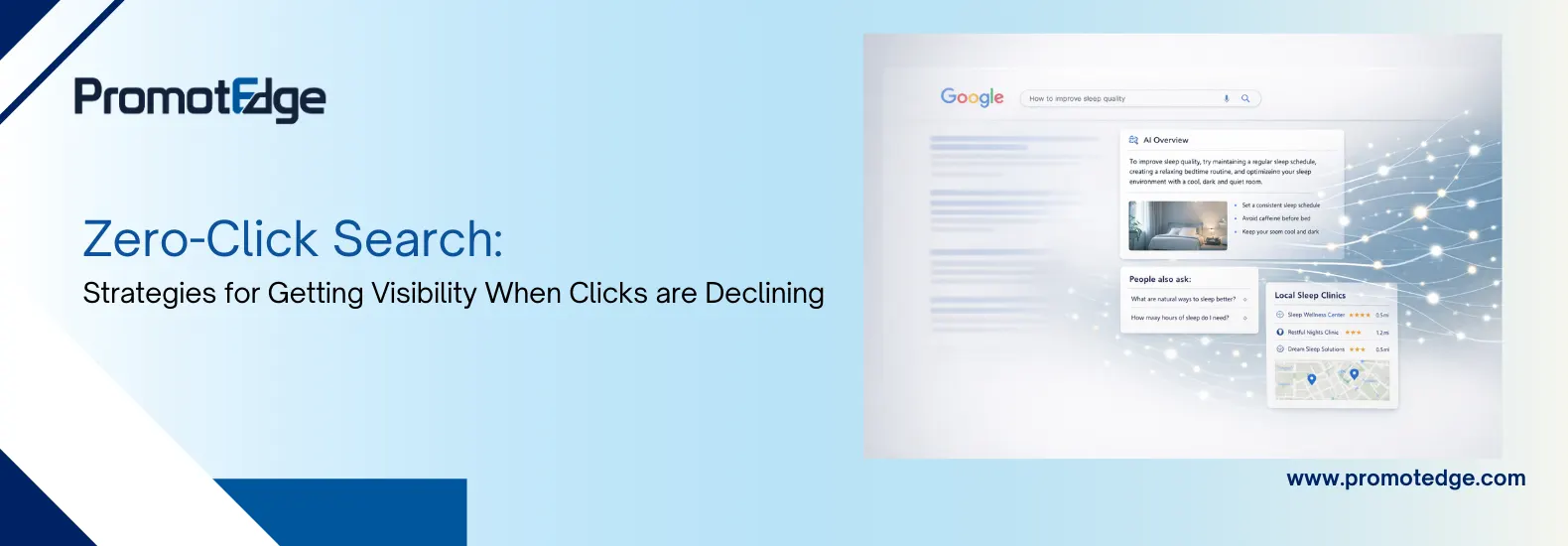
Zero-click search happens when users get answers directly on the search results page—through AI Overviews, featured snippets, People Also Ask boxes, or local packs—without clicking on a website.
Search performance used to be measured by clicks and impressions even a year ago. Reporting frameworks in SEO prioritized keyword positions, click-throughs, and traffic volumes. Brands also rely on these metrics to judge campaign performance. But this has changed in the last few months.
On July 8, 2025, Google announced the rollout of AI Mode for all users in India, making it easier than ever to ask Google anything you’re curious about, get a helpful AI-powered response, and explore topics more deeply on the web.”
And with this, how SEO was measured changed fundamentally. At present, users find most of their answers to queries directly on the results page. This means they get the information they want without the need to click on the site. And whether we want to accept it or not, Zero-click searches are definitely not a passing phase. For businesses, this is a clear indication that visibility now matters more than visits.
Whether you are a B2B brand or own a local business, following the same-old strategies and performance metrics won’t get you anywhere. You need a marketing agency that has understood the changes and adapted to them.
For the last few months, PromotEdge has also been going through the same. We have done research on the root causes and also come up with strategies on how we can cope. Let’s take a look:
Why Clicks Are Declining, Even When Rankings Hold
This is something brands often get confused about. “My ranking is still the same, but why aren’t people clicking to my site?”
Search engines are designed to reduce friction and help users find information as fast as possible. That’s why there are so many options, including:
- Featured snippets,
- AI summaries,
- People Also Ask boxes.
If you look a bit closely, you will see that now there are “read more” options on some meta descriptions, while others don’t have them.
A page may still rank well and yet see fewer visits. That does not signal failure. It signals that the search engine is using your content to satisfy intent directly. The value has shifted from traffic volume to presence at the point of decision.
Not just that, we’ve also seen cases where Google doesn’t display the written meta title or description. Instead, it selects content from the page that better matches the user’s query. When a page ranks for multiple searches, Google often rewrites snippets to suit each query.
This means it’s time for marketers and brands to modify their seo goals and strategies:
Rethinking SEO Goals and Strategy in a Zero-Click Environment
SEMrush has shared that about 60% of searches now yield no clicks. This turns up to be a nightmare for marketers. But then the data also suggests that almost 70% of businesses report higher return on investment (ROI) from using AI in SEO.
The question is no longer “How do we get the click?” It is “How do we get seen, remembered, and trusted?”
Rankings still matter. But they are no longer the ultimate way of measuring success. Brands need to monitor impression visibility and assisted action. Being cited by the SERP is often as powerful as being visited.
Here are a few strategies we have been trying and testing over the 3-4 months that have shown promising outcomes:
Strategy 1: Optimise for SERP, Not Just Positions
In the past, SEO teams measured success largely by how high a page ranked. The goal was simple. Move from page two to page one, then push closer to the top. Visibility was treated as a by-product of ranking. Optimisation efforts revolved around titles, links, and keywords that helped climb the ladder. That approach worked when search results were mostly a list of blue links.
But at present, the result pages look very different. With featured snippets, People Also Ask boxes, local packs, and now AI-generated overviews, ranking alone no longer guarantees visibility. A page can rank well and still be overlooked if it doesn’t appear in these expanded result features. This is where the focus has shifted.
Instead of optimising only for position, SEO now aims to secure more surface area on the search results page. That means creating content that can be reused, summarised, or referenced directly by Google’s systems.
- Featured snippets show concise answers.
- People Also Ask boxes extend reach into related questions.
- AI-generated summaries quote or paraphrase content that is clearly written and well-structured.
- Local packs surface business details without requiring a site visit.
Rather than resisting these features, modern SEO works with them. Content is now structured with clarity in mind. Answers appear early on the page. Sections are clearly defined. Headings explain intent rather than tease it. This makes it easier for search engines to understand the content and select the most relevant parts for different query types.
AI overviews have accelerated this shift. These summaries aim to deliver quick, reliable explanations. So, they favour content that is direct, organised, and contextually complete. Pages that explain a topic cleanly without padding or ambiguity are more likely to be referenced, even when users don’t click through.
Strategy 2: Write Answer-First Content That Builds Trust
In the past, direct answers were neglected. There was a lingering fear that if users find what they need on the results page, they won’t visit the website at all. While that concern is understandable, it no longer reflects how search behaviour actually works.
Clarity doesn’t dilute value. It filters intent. When brands deliver answer-first content, they become more visible. It’s because it aligns with how people search today. Users don’t want to waste their time on reading unnecessary contexts. They want direct answers that don’t force them to dig further. When brands focus on this aspect, it builds confidence in the source. That confidence matters more than the click itself.
Content written with an answer-first approach is now doing well, because:
- Users are more satisfied and less frustrated when searching.
- Brands look more reliable and transparent, rather than promotional.
- Brands connect with users who are genuinely interested, not just casually browsing.
Marketers shouldn’t withhold information to protect traffic. They need to demonstrate competence upfront. Because if a user does decide to click later, they want to know more in detail. Even if those visits may be fewer, they are often more meaningful.
Strategy 3: Strengthen Entity and Brand Signals
In a zero-click environment, visibility depends heavily on how well search engines understand who is behind the content. This is where entity-based optimisation becomes critical.
Search engines are no longer just ranking pages. They are mapping relationships between brands, topics, locations, and services. Consistent brand naming, accurate business details, structured data, and a clear topical focus all help search engines recognise and categorise your brand as a defined entity rather than a collection of disconnected pages.
When these signals are strong, your content is more likely to be referenced across snippets, panels, and AI-generated summaries. As users see your brand repeatedly, it builds familiarity and trust, even without clicks. They begin to recognise the brand name and associate it with a particular topic or solution.
That recognition often shows up later as branded searches. At that stage, users aren’t comparing options casually, they’re looking for you specifically. In this way, zero-click visibility doesn’t eliminate traffic; it reshapes when and why it arrives.
Strategy 4: Treat Local and SERP Actions as Conversions
One of the biggest blind spots in traditional SEO reporting is the assumption that conversions only happen on a website. In a zero-click world, that assumption no longer holds.
Many user actions now occur directly on the search results page. Someone may call a business from a
- Local listing,
- Request directions,
- After reading reviews, or
- Save a location for later.
It doesn’t necessarily have to be because they visited the site. These actions are not passive. They are intentional. So, only focusing on sessions and pageviews in SEO reporting might miss these signals. And this can also make it seem like the performance has become weaker.
But in reality, search behaviour has shifted. In fact, Google’s core update (December 2025) clearly suggests that newer AI-driven results will pull from sources like Google Business Profiles, especially for local searches. This means businesses with well-maintained, up-to-date profiles often gain more visibility and engagement directly on the search results page. Local brands that keep their profiles organised tend to show up more clearly than those that don’t, even when no website visit happens.
Strategy 5: Measure Signals, not Sessions
Traffic still has value, but it no longer tells the full story of search performance. In a zero-click environment, success is better measured through a broader set of signals.
Search impressions over time show whether visibility is going upward or downward. Share of voice across SERP features tells us how often your brand appears on the search results page compared to competitors. This includes featured snippets, People Also Ask sections, AI-generated summaries, and local listings. Even if users don’t click, seeing your brand repeatedly builds familiarity and trust.
Growth in branded searches shows that people are starting to remember you. When users search for your brand name directly, it usually means they’ve encountered your business before through search results, summaries, reviews, or recommendations and are now coming back with intent.
Local actions and assisted conversions capture the behaviour that traditional analytics miss. Calls from Google listings, direction requests, review checks, or saves all indicate interest and decision-making, even though they don’t count as website sessions.
When you look at these signals together, you get a more realistic view of how SEO is performing. Visibility is leading to awareness, and awareness is turning into demand, just not always through an immediate website visit.
Strategy 6: Align Content with High-Intent Moments
Not all zero-click impressions carry the same weight. Some searches are purely informational and momentary. They satisfy curiosity and disappear just as quickly.
Others sit much closer to decision-making.
These include searches where users are comparing options, evaluating providers, or trying to understand which solution fits their situation. In these moments, even a single exposure can influence perception.
When your content appears clearly and confidently at this stage, even without a click, it can reinforce credibility at exactly the right time. The user may not act immediately, but the brand stays top of mind. When they’re ready to decide, that familiarity often guides the final choice.
The key is not to chase every query equally, but to focus effort where visibility can meaningfully shape outcomes.
Final Thoughts
It’s true that clicks are declining. Traffic is thinning. But that doesn’t necessarily make it a bad thing. It is because visibility is expanding. As a matter of fact, brands can now gain more attention from users as long as they provide immediate answers to what their audience wants. Brands need to work with a team marketer who crafts custom search strategies that will help them gain relevance. Because the purpose of the zero-click search is to filter content that offers clarity, consistency, and credibility. Those who show up helpfully, even without expecting the click, are the ones users remember when it finally counts.
FAQs
1. What is zero-click search in AI Overview?
Zero-click search in AI Overviews happens when Google answers a query directly using AI summaries, so users get information on the results page without clicking through to a website.
2. How does AI Overview affect SEO?
AI Overviews reduce reliance on clicks by surfacing summaries, snippets, and local data. SEO now focuses more on visibility, credibility, and being referenced rather than only driving traffic.
3. What is a zero-click content example?
A zero-click content example is a featured snippet, People Also Ask answer, or AI summary that pulls information from a page and displays it directly on Google.
4. Are AI Overviews always accurate?
No. AI Overviews aim to be helpful but can sometimes oversimplify, miss context, or combine sources incorrectly, which is why authoritative, well-structured content still matters.
5. Is zero-click search and AI Overview bad?
Not necessarily. While clicks may drop, visibility, brand recall, and assisted actions often increase. For many businesses, influence shifts earlier in the decision-making process.
Latest Posts
-
22 / Jan
-
 22 / Dec
Digital Marketing Google December 2025 Core Update
22 / Dec
Digital Marketing Google December 2025 Core Update -
17 / Dec
-
11 / Dec
Digital Marketing AI in PPC: How AI Is Changing Paid Advertising
-
29 / Nov

Blogs