


-
Author: PromotEdge
-
Updated Date: Feb-11-2026
-
Views: 2 Min Read
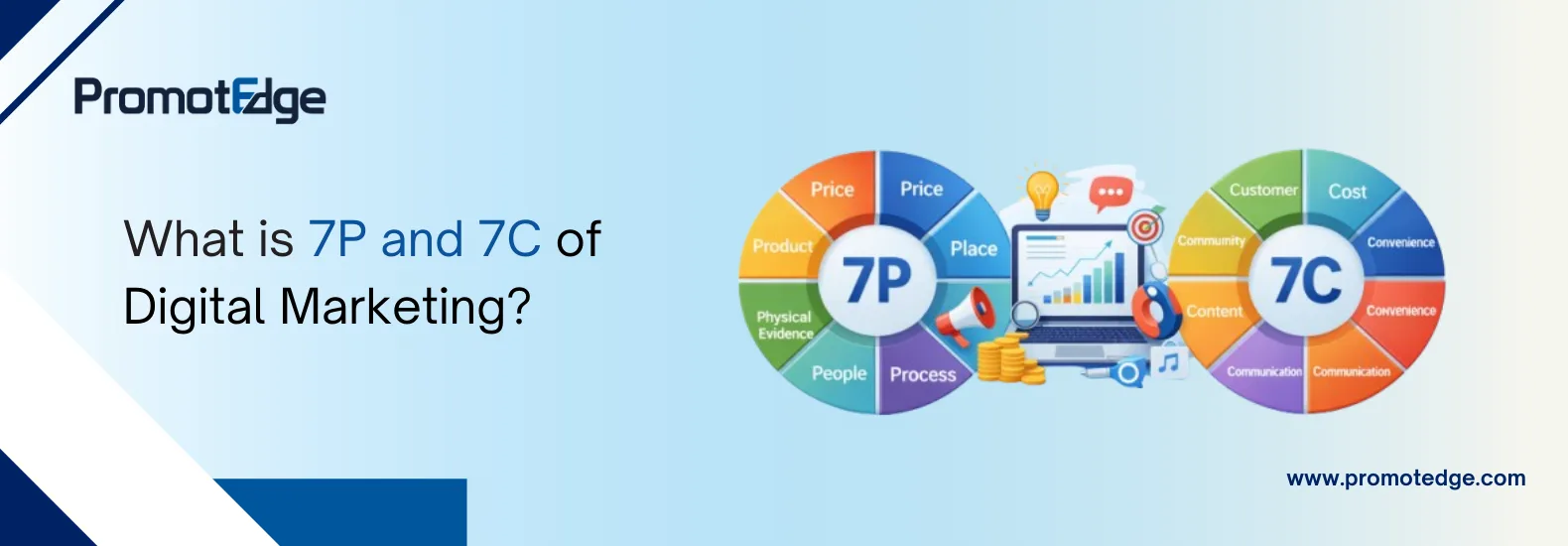
The 7Ps and 7Cs of digital marketing are two strategic frameworks. The 7Ps focus on business elements—Product, Price, Place, Promotion, People, Process, and Physical Evidence—while the 7Cs focus on customer experience—Customer, Cost, Convenience, Communication, Community, Consistency, and Conversion.
The 7Cs and 7Ps of digital marketing are two frameworks for planning and executing successful online strategies.
When it comes to 7Ps, they are an evolution of the traditional marketing mix into a digital marketing environment. The 7Cs are more about providing an experience to the customer when they’re online.
By integrating both frameworks into your digital strategies, you’ll ensure that internal processes align with what the customer requires. It will help grow conversions in competitive markets.
So, marketers applying the 7Ps of marketing can be seen in many examples. This includes paying for targeted advertising and creating fast checkout processes. Understanding the differences between the 7Ps and the 7Cs will allow you to create campaigns that are smarter.
What Does 7Cs of Digital Marketing Mean?
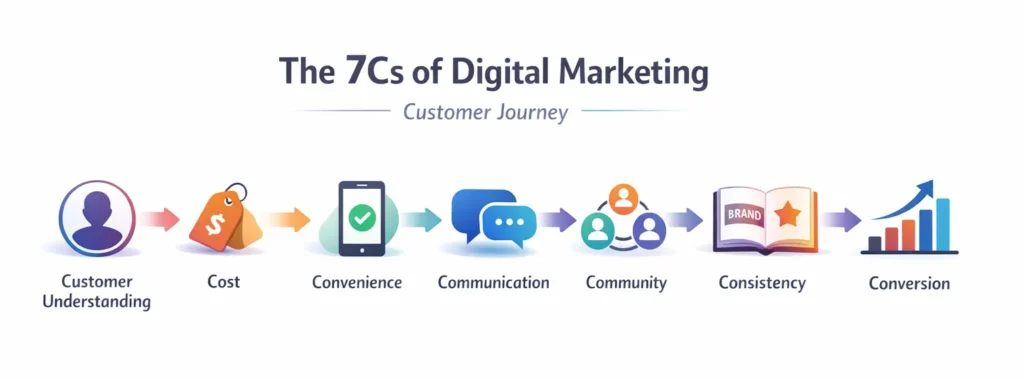
In the 7Cs of digital marketing, each customer interaction is predicated on their point-of-view. This is done to build loyalty on the web through a frictionless experience from beginning to end. It allows brands to convert browsers into paying customers.
Each “C” builds off of the previous, thus allowing customers to follow from discovering to repeat purchases. The 7Cs are particularly effective in the eCommerce or services industries, where building trust generates sales.
Customer Understanding
The first aspect is understanding your customer. It provides insight into what they like, what they dislike, and what is holding them back. By understanding your customers, you can customize your digital presence (websites, email campaigns) to resonate deeply with them. It will help you offer products and services that address their real-life challenges. Using this knowledge effectively can significantly increase conversion rates of your marketing efforts.
Cost
Cost refers to not only the price of your product and service but also the cost of time, effort, and the emotional barriers. These aspects may prevent consumers from purchasing (e.g., a lack of confidence at checkout). Businesses utilizing the cost dimension of the 7Cs provide multiple pricing models, free trial options, and one-click purchasing options. This makes it easy for consumers to try their products and services without taking on any risk or effort. It ultimately leads to greater sales from customers, particularly those shopping online late.
Convenience
All of this means that customers can easily complete their purchase on any digital device without seeing a delay in loading time between pages or forms, while using Mobile-friendly technology to optimally fit their devices; offering immediate service via chat, providing the option to complete their purchase over WhatsApp, and instant user support.
Communication
Two-way engagement between customers and businesses fosters long-term trust between the two by providing customers with value-added communications in addition to their initial question or reason for contacting the business. Through two-way interaction with your customer base, you will create lasting relationships that generate future referral sales
Community
By fostering a sense of community around your product or service, you are able to convert a one-time buyer into a loyal brand ambassador. Creating an all-in-one community hub will allow your customers to connect, network, and achieve great things together as a community. Utilizing word-of-mouth promotion is one of the least expensive ways to build customer loyalty over a long period of time.
Consistency
This standard operating procedure (SOP) provides direction for creating a style guide that guarantees consistency of your company’s brand voice and visual elements. When created as described in this SOP, all of the brand’s communications (website, social media presence, advertising, and email marketing) will have the same “look and feel” thus making it easy for customers to remember, trust, and identify with your company, regardless of which platform they are using.
Conversion
It is about tracking measurable metrics (clicks, signups, and purchases) to determine how well each aspect of the marketing campaign is working. For example, a business can use Google Analytics and also test different headlines, buttons, and offers via A/B tests to see which combinations generate the largest percentage of visitors resulting in purchases.
What Does 7P Mean for Digital Marketing?
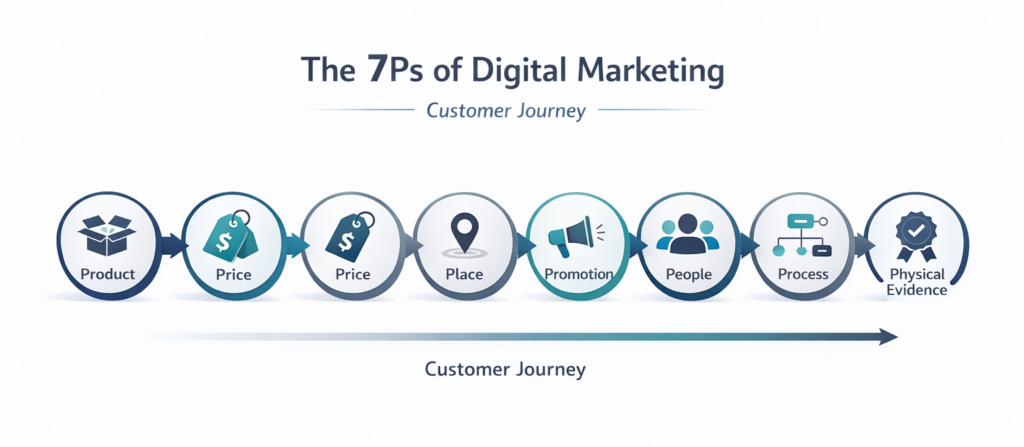
The purpose of the 7Ps is focusing on your internal work, your Offer, Delivery, and Promotion. These three elements determine what makes your product appealing to consumers, as well as the ways in which your products will become available to them through digital channels.
Product
Your product defines its core value, including the features of that product (Content, User Experience) and ways in which it can be consumed digitally. For example, if your product were an online course, the product would include video Lessons, downloadable templates, interactive quizzes and lifetime access to help solve the skill gap for busy professionals seeking career advancement.
Price
The price defines the different ways in which consumers can pay for a product, including
- List prices,
- Discounted prices,
- Bundled Prices,
- Subscription Prices,
- Or EMI Payments through digital wallets or Impulse Purchases.
The best way to maximize the accessibility of premium features for consumers is to offer early bird discounts or tiered plans, allowing you to increase revenue from various buyer segments while not alienating price-conscious consumers.
Place
The Place defines where consumers can find your offering and purchase Your Offering. The place also includes optimizing the format in which users can find your offering and easily purchase it, including
- Web Base E-Commerce Websites,
- Mobile Applications,
- E-Commerce Listings on Amazon or eBay,
- Social Commerce Shops,
- Or Catalogs onWhatsApp,
While also optimizing the load times and navigation experience to accommodate the shopping habits of consumers on mobile devices while on their commute or taking a break at work.
Promotion
This approach is all about awareness generation and demand with SEO strategy and tactics, advertising on paid platforms, influencer marketing, emails directed at prospects, and creating and posting videos on YouTube and Instagram reels. All this to show how real people used your digital product at just the right moment for people searching for it with the intent of purchasing it, and re-engaging those people with warm leads until they convert into purchasers.
People
The role of people is to provide an exceptional customer experience. The people include customer support agents who answer incoming chats, video creators providing video content, and social media influencers promoting the product. Each person has undergone training to provide friendly and knowledgeable customer interactions that create lasting relationships with customers and lead to positive online reviews.
Process
The process streamlines the customer journey from inquiry to delivery by implementing automated emails for onboarding, self-serve dashboard access, quick response time to support requests, and progress tracking throughout the entire process, helping to increase the perceived ease and dependability of the experience for customers and decreasing customer abandonment at critical points, such as paying or setting up.
Physical Evidence
The physical evidence provides evidence that your digital product is of high quality through customer testimonials, customer case studies, certifications, demo videos, trust badges on the checkout page, etc. to reassure visitors to your website that your digital product works how it is marketed and dispel the doubt of visitors with regards to online fraud and empty promises.
Difference between 7P and 7C of Marketing
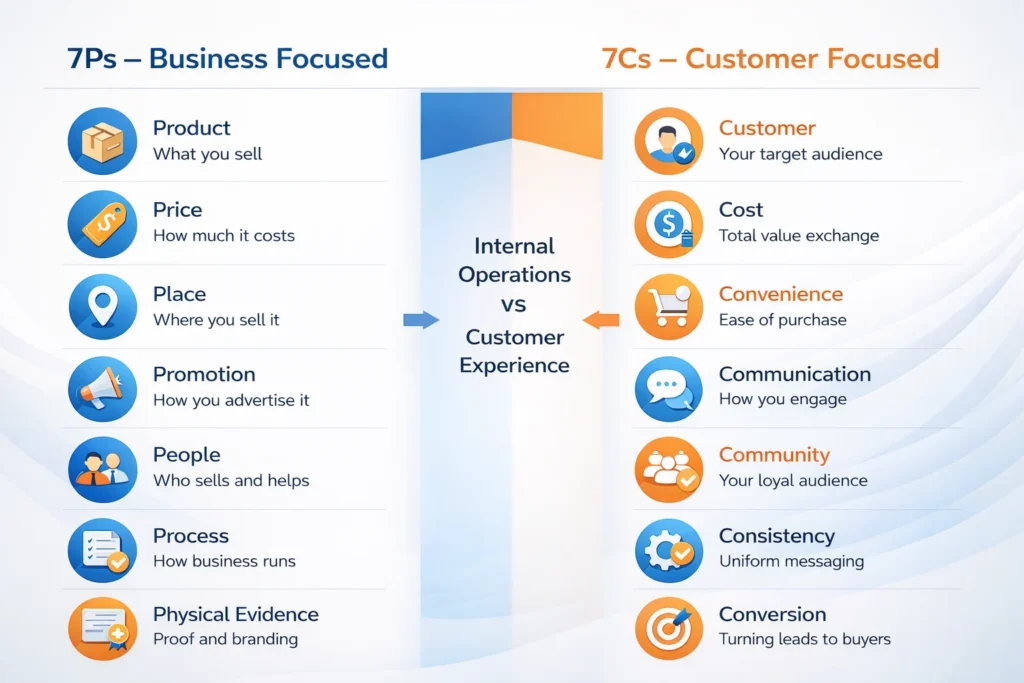
Below table can help you get complete understanding of the difference between 7P and 7C of marketing:
Aspect |
7P (Business-Focused) |
7C (Customer-Focused) |
| Core View | Internal operations | User experience |
| Key Strength | Offer creation | Friction removal |
| Best For | Product launches | Online conversions |
Final Words
To be successful online you should learn, understand, and master both the 7Ps and 7Cs of digital marketing. You must implement these principles together when building and managing your digital marketing campaigns for optimal conversion rates.
The 7Ps of digital marketing focus on what you are providing to your consumers, while the 7Cs of digital marketing focus on what your consumers want to receive from you. Therefore, if you want to balance both the 7Ps and 7Cs of digital marketing effectively, it is important that you first understand how they relate to each other.
This is where PromotEdge can prove to be a handful. All our digital marketing strategies follow the respective principles and ensure businesses get all the required benefits.
FAQs
-
What does 7P mean in Digital Marketing?
Ans.7P stands for Product, Price, Place, Promotion, People, Process and Physical Evidence - this refers to the toolkits that marketers will use when creating and selling digital products successfully. -
How are the 7C's different from a traditional Marketing Mix?
Ans.7C's of Digital Marketing focus on customer-focussed aspects, notably Convenience, in this "Online Journey" of potential sales. Thus, allowing the customer to have more influence over the success of your digital product sales than the traditional marketing mix. -
Does a small business need to have access to the 7P and 7C frameworks to create a marketing strategy?
Ans.Yes, both frameworks allow small businesses to simplify their planning; use 7Ps to create your digital creative products (e.g. Product Pages), and use 7Cs as the design to optimize for ease of Navigation During Checkout. -
What are real examples of the 7Ps of Digital Marketing?
Ans.Examples of 7Ps of digital marketing are price through - EMI - Easy Monthly Payments, Place through WhatsApp shops, Promotion through Search Engine Optimisation and Ads targeting college course seekers. -
Why is it important for you to understand the differences between 7P's and 7C's?
Ans.By knowing the difference between 7P's and 7C's, your business can produce/market a valid and strong offer (7P's) and create an offer that consumers adopt with ease (7C's). This results in a doubling of your digital success.
Latest Posts
-
 19 / Mar
-
18 / Feb
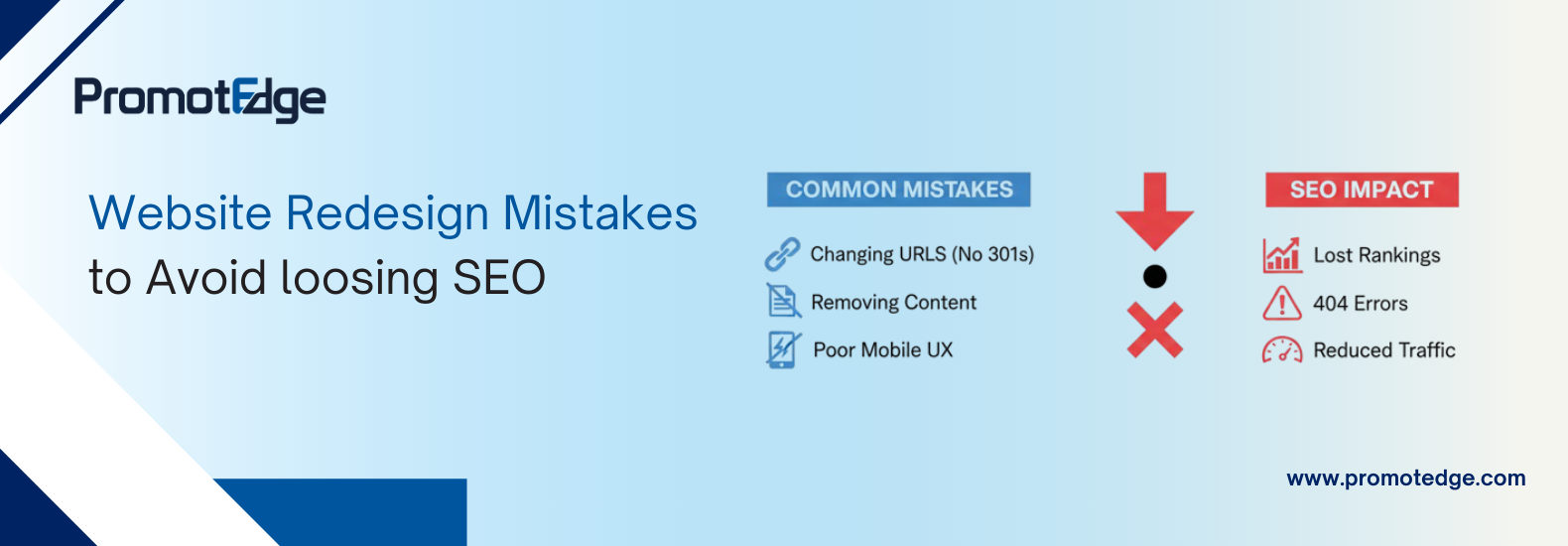
Web Solution 12 Website Redesign Mistakes to Avoid Losing SEO
-
11 / Feb
Digital Marketing What is 7P and 7C of Digital Marketing?
-
22 / Jan
-
22 / Dec
Digital Marketing Google December 2025 Core Update
Blogs
Journey into Ideas Unveiling Tomorrow's Insights Today.































































-
What does 7P mean in Digital Marketing?
Ans.7P stands for Product, Price, Place, Promotion, People, Process and Physical Evidence - this refers to the toolkits that marketers will use when creating and selling digital products successfully. -
How are the 7C's different from a traditional Marketing Mix?
Ans.7C's of Digital Marketing focus on customer-focussed aspects, notably Convenience, in this "Online Journey" of potential sales. Thus, allowing the customer to have more influence over the success of your digital product sales than the traditional marketing mix. -
Does a small business need to have access to the 7P and 7C frameworks to create a marketing strategy?
Ans.Yes, both frameworks allow small businesses to simplify their planning; use 7Ps to create your digital creative products (e.g. Product Pages), and use 7Cs as the design to optimize for ease of Navigation During Checkout. -
What are real examples of the 7Ps of Digital Marketing?
Ans.Examples of 7Ps of digital marketing are price through - EMI - Easy Monthly Payments, Place through WhatsApp shops, Promotion through Search Engine Optimisation and Ads targeting college course seekers. -
Why is it important for you to understand the differences between 7P's and 7C's?
Ans.By knowing the difference between 7P's and 7C's, your business can produce/market a valid and strong offer (7P's) and create an offer that consumers adopt with ease (7C's). This results in a doubling of your digital success.


