
























In 2026, these frameworks help firms track results more exactly and use budgets better. AI automation is on the rise. Data privacy rules are getting stricter. So firms now build tidy systems that grow campaigns more efficiently.
Many firms prefer this way of working. Every campaign can be tracked from click to final purchase. This article explains the targeting strategies that help firms grow over the long term.
Core elements of performance marketing frameworks
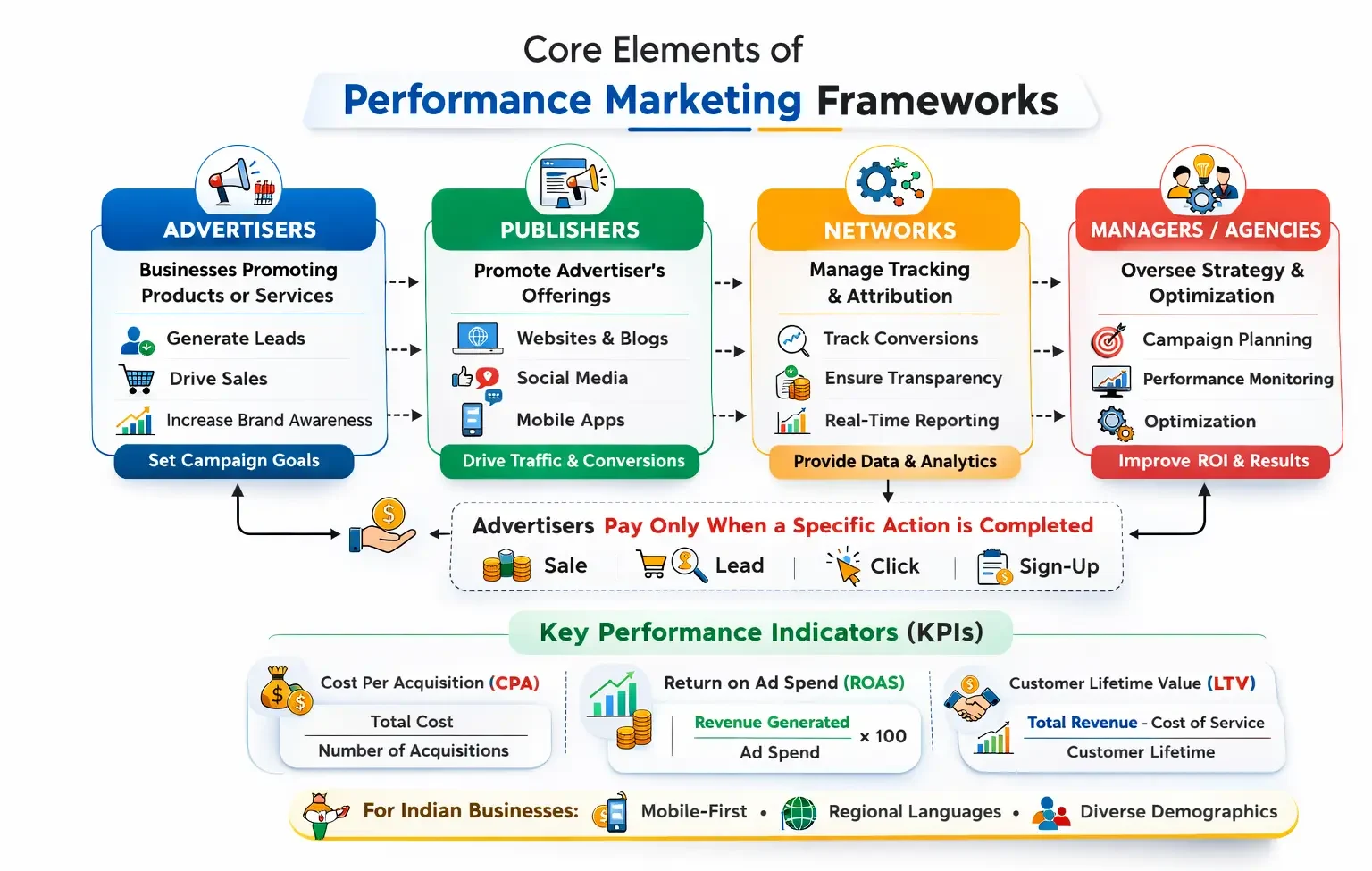
A performance marketing framework has four players. They work together to get results you can measure.
1. Advertisers
These are the firms that want to promote their products or services. They want results such as leads or purchases.
2. Publishers
Publishers promote the advertiser’s offers. They use blogs, websites, social media channels and mobile apps.
3. Networks
Networks such as Impact or CJ run the tracking systems. These record each conversion. They also show clear attribution across channels.
4. Managers or Agencies
Marketing teams or agencies manage the campaign plan, track results and tune the campaign.
In this system, advertisers pay only when a set action is done. That could be a sale, a lead or a click, depending on the campaign model.
A strong performance marketing strategy also depends on clearly defined Key Performance Indicators (KPIs) such as:
- Cost Per Acquisition (CPA)
- Return on Ad Spend (ROAS)
- Customer Lifetime Value (LTV)
These metrics show the real revenue impact of marketing. Clicks or impressions alone do not. Indian firms also need to think about local languages, mobile-first habits and different kinds of customers.
Building a strong performance marketing strategy
Know your target audience before you build a strategy.
1. The first step is audience segmentation. Use first-party data from websites, mobile apps and customer databases. AI-powered tools study this data. They find users who are ready to buy. They also predict what those users will do next.
2. Next, marketers check how campaigns do using platforms such as Google Analytics 4 and Meta Business Suite. Metrics like click-through rate (CTR) and cost per click (CPC) show whether ads are reaching the right audience.
For example, many e-commerce brands now use automated bidding on Google Ads. They add retargeting on Meta to win back abandoned carts.
These insights help marketers refine bidding and improve ad creatives. Campaigns then run more efficiently. As a result, firms can cut Customer Acquisition Cost (CAC) and raise their conversion rate.
A strong strategy also uses cross-channel marketing. Paid search, social media ads and display campaigns work together. They keep your brand visible across many platforms.
Retargeting is another key part. Some users visit a website but leave without buying. You can reach them again with personalized ads or email reminders. This helps win back abandoned carts and raise conversion rates.
Firms must also follow privacy rules such as GDPR and India’s Digital Personal Data Protection (DPDP) Act. Ethical data habits and consent-based tracking let firms grow campaigns and stay compliant.
Key performance marketing models for 2026
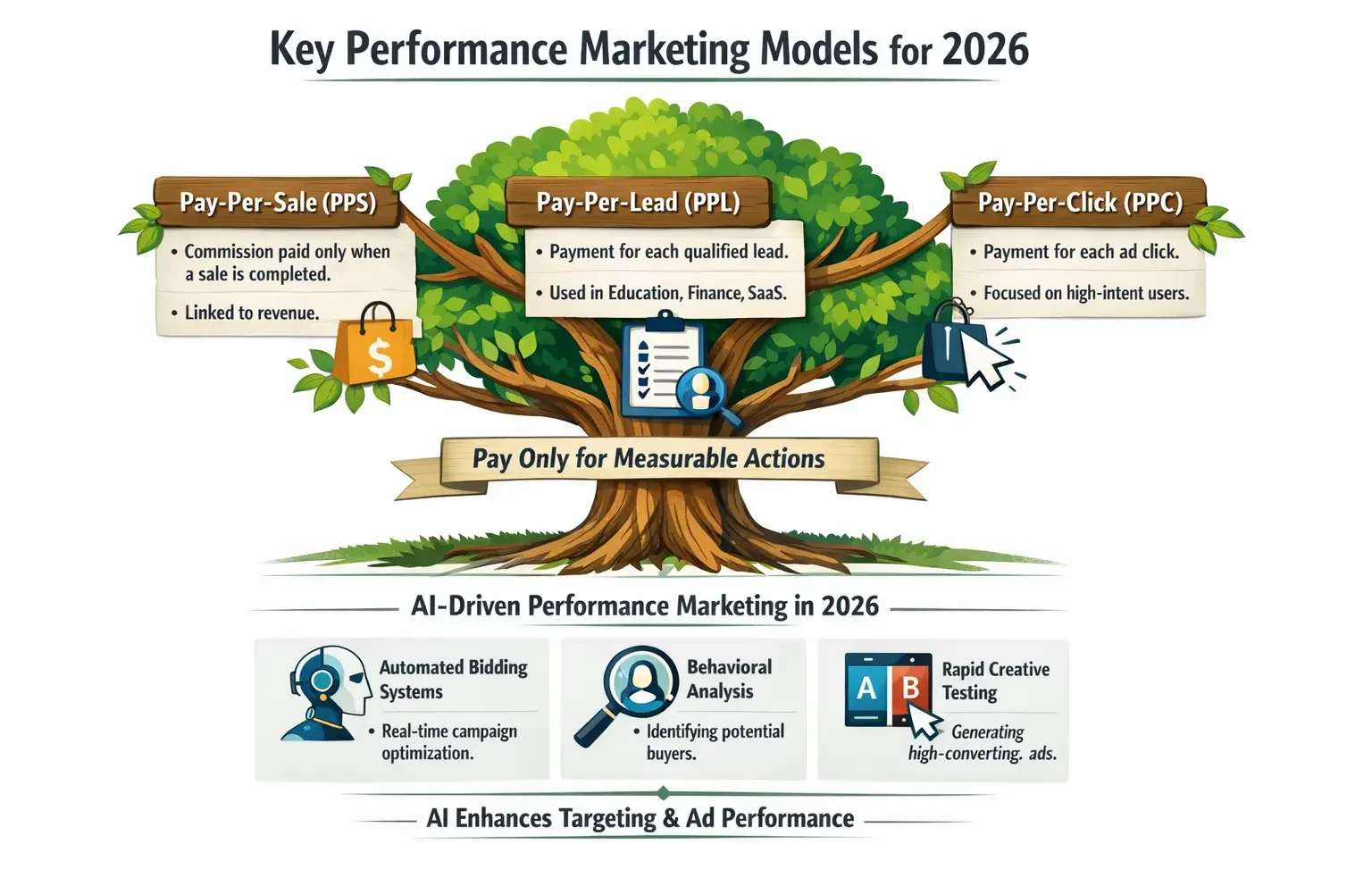
Campaigns generally run on three main payment models.
1. Pay-Per-Sale (PPS)
Advertisers pay a commission only when a sale is done. This is common in e-commerce. Marketing costs are directly linked to revenue.
2. Pay-Per-Lead (PPL)
Firms pay when a qualified lead is generated. This model is widely used in education, finance and SaaS. In these fields, leads need follow-up before they convert.
3. Pay-Per-Click (PPC)
Advertisers pay each time a user clicks on their ad. Campaigns are tuned so that clicks come from high-intent users. These users are more likely to convert.
These models cut financial risk. Firms pay only for actions they can measure.
In 2026, AI-driven models matter more and more. Platforms like Google and Meta now use automated bidding systems. These tune campaigns in real time to get the most return on ad spend.
AI systems study user signals. These include browsing patterns, past purchases and engagement history. They use them to find likely buyers. This lets marketers focus ad budgets on the audiences most likely to convert.
AI also makes creative testing fast. Tools can generate and test many ad variations to find which messages and visuals convert best.
Optimising the performance marketing funnel
The funnel covers the whole customer path. It runs from awareness to repeat purchases.
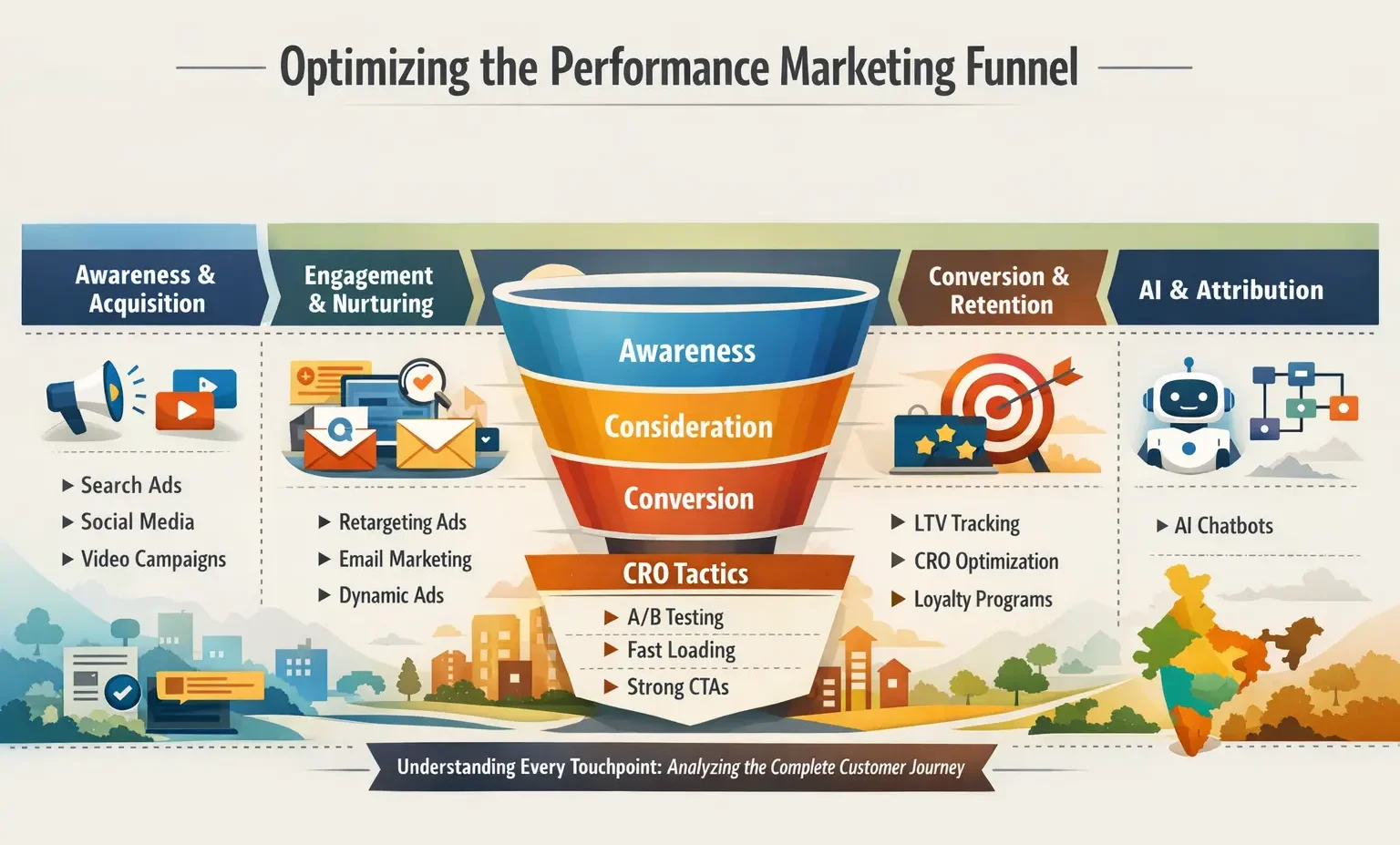
- At the top of the funnel, firms focus on visibility and new users. Search ads, social media ads and video campaigns introduce the brand to more people.
- The middle of the funnel is about engagement. Here you nurture potential customers. Retargeting, personalized emails and product ads remind users of items they viewed.
- The bottom of the funnel turns interested users into paying customers.
This is where Conversion Rate Optimization (CRO) becomes important. Some techniques can raise conversion rates. They include A/B testing landing pages, faster website loading and clear calls-to-action.
Tracking Customer Lifetime Value (LTV) also shows the long-term value of each customer. Some firms focus on keeping customers, not only getting new ones. For them, overall marketing efficiency improves.
For firms in India, local communication can further improve results. Local languages help engagement in diverse markets. So do culturally relevant messages.
Many brands are also adding AI chatbots to their marketing funnels. These tools give instant replies to user questions. They guide potential customers through the buying process.
Another key development is multi-touch attribution modeling. It does not give credit only to the final interaction. This model looks at every touchpoint that leads to a conversion. This helps marketers see which channels sway buying decisions.
Role of AI and automation in performance marketing strategies in 2026
Artificial Intelligence plays a major role in performance marketing strategies in 2026. Automation tools now handle bidding, campaign tuning and ad placement. Little manual effort is needed.
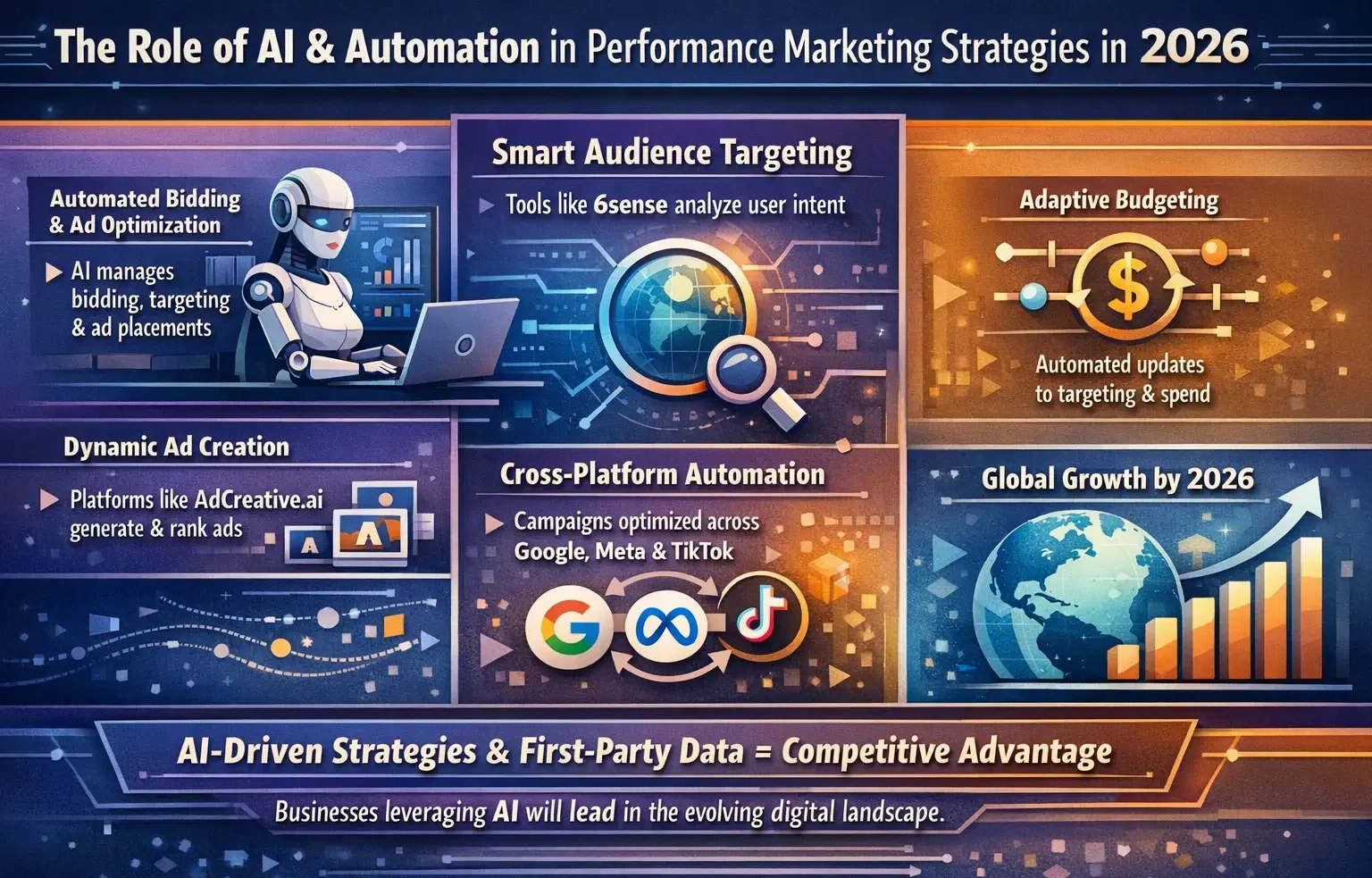
Platforms such as AdCreative.ai generate many versions of ads. They rank them by their predicted conversion results. Tools like 6sense study user intent. They help decide where and when ads should be shown.
Automation systems keep adjusting campaigns. They work across Google, Meta and TikTok. Ad algorithms change. These systems then update targeting and budget on their own.
This level of automation lets firms scale campaigns with little extra manual effort.
Firms that adopt AI-driven strategies will compete better. So will firms that build strong first-party data.
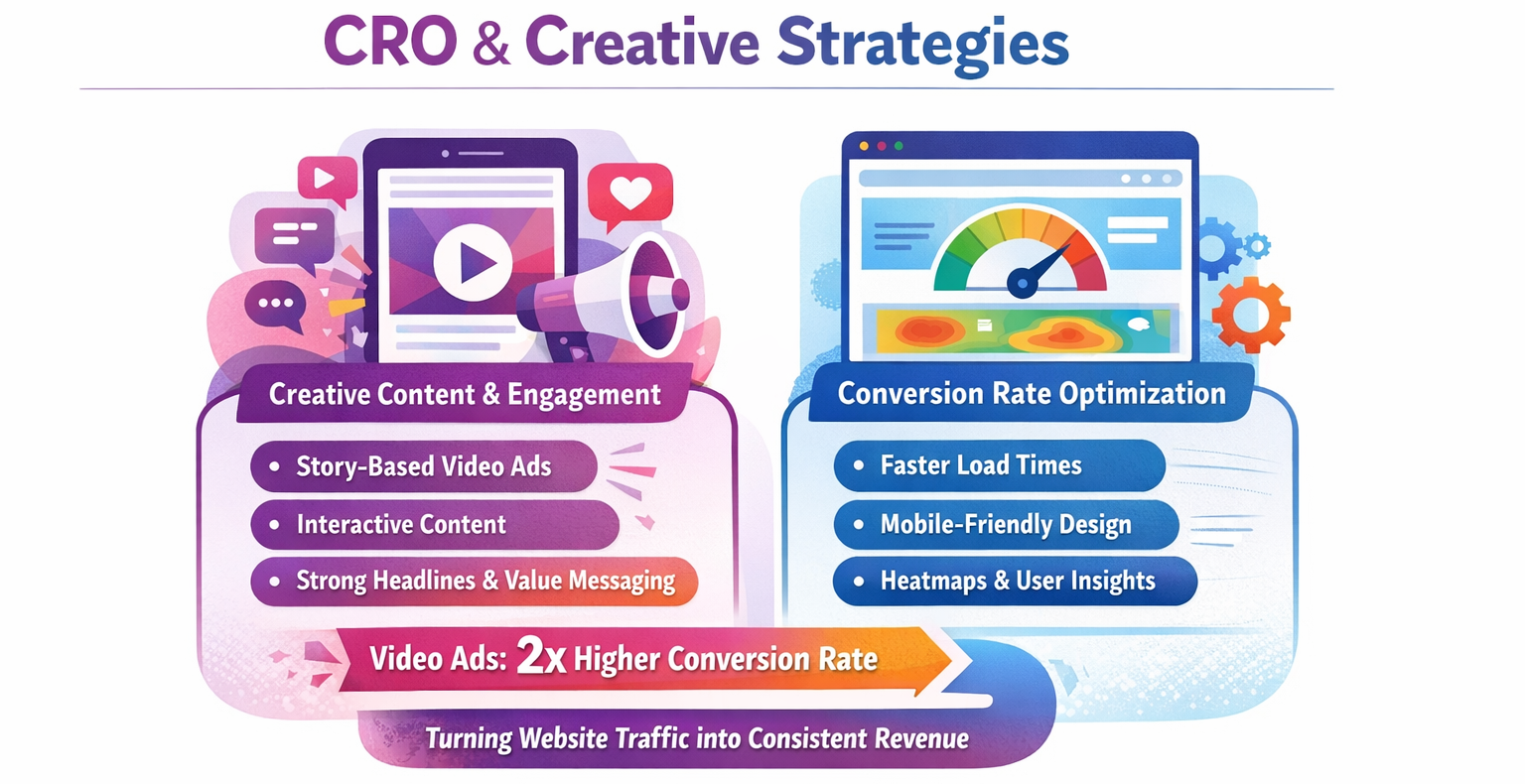
CRO and creative strategies
Creative content matters a lot in performance marketing.
Story-based video ads catch attention in crowded digital spaces. So does interactive content. Strong headlines that clearly show value make users click and explore further.
Video ads often get more engagement than static display ads. This is true especially on social media.
Conversion Rate Optimization is about the user experience. It starts after visitors reach the website. Faster pages, mobile-friendly design and simple navigation make it easier to buy.
Marketing teams also use tools such as heat maps to see where users drop off during the buying process. These insights help improve website design and remove friction from the buying path.
Combine strong creative content with CRO techniques. Then website traffic can turn into steady revenue.
From audience segmentation to conversion optimization, each stage of the funnel adds to long-term growth. Firms that focus on key metrics such as ROAS, CPA and customer lifetime value can keep refining their plans. Returns improve.
PromotEdge builds performance marketing strategies like these for brands. Our goal is to help brands turn marketing spend into steady, measurable revenue.


