
























The good news is, you don’t need to be a marketing expert to find profitable keywords. You just need to know where to look and what to look for. The sweet spot is always a keyword that enough people are searching for, but not so many businesses are competing over. Nail that balance, and you get the right traffic from people who are already halfway ready to buy.
The keyword that changed everything
Three years ago, a textile manufacturer from Surat came to us. They sold industrial cotton fabrics. Been in business for eighteen years. Decent company, solid products, no online business whatsoever.
Their first question? “Which keywords should we target?”
We asked: “How many people a month are searching for ‘industrial cotton fabrics India’?”
Their answer: “Dunno. Sounds like a good keyword though, doesn’t it?”
It didn’t. Turns out maybe 200 people a month were searching that term across all of India. We spent time digging. Turns out textile mills in Surat were actually searching things like “ghat-pattern cotton wholesale” and “saree fabric bulk supplier Gujarat.” Specific. Local. Fewer searches, but way more relevant.
We built their strategy around those, aiming for qualified people who were searching for the exact thing the company sold.
That’s keyword research: finding, not guessing.

What is keyword research?
Keyword research is finding what people are typing into search engines when they want what you sell. That’s genuinely the entire definition. Everything else is just… process.
Most businesses skip this. They build websites around what sounds good. “Premium digital solutions.” “Innovative fintech platform.” Words their CEO approves. Words nobody’s actually searching for.
Keyword research flips that. You find the actual language your customers use, then build your content around that. Sounds backwards? It is. But it’s also why some websites get organic traffic and others get… nothing.
The process matters because there are thousands of keywords you could target. Your budget is finite. Your team’s time is finite. You have to pick the right ones. That’s the whole point of research: being intentional instead of throwing darts.
Why keyword research matters, even when it doesn’t feel like it
Most agencies talk about keyword research like it’s a checkbox. “We did keyword research, found 50 keywords, let’s build content.”
That’s backwards. Keyword research determines everything.
Bad keyword research = you’ll rank for the wrong words. Spend six months improving rankings for keywords nobody searches. Wonder why traffic doesn’t move. Then blame Google for being “rigged.”
Good keyword research = you pick words that have search volume, lower competition, and actual business value. Those eight keywords turn into traffic. Traffic turns into leads. Leads turn into revenue.
Direction matters more than effort. Better keywords can change results even with the same budget and the same timeline.
India is a competitive environment. Everything from e-commerce to education is fighting for attention. Being ROI-first means starting with keyword research. That’s the PromotEdge approach: ROI first, always. If you want to understand why keyword research is the most important part of digital marketing, the logic is simple. Wrong direction means wasted effort, no matter how hard you work.
Types of keywords and why they matter
Not all keywords are equal. Some are easy. Some are impossible. Some convert like crazy. Some are just noise.
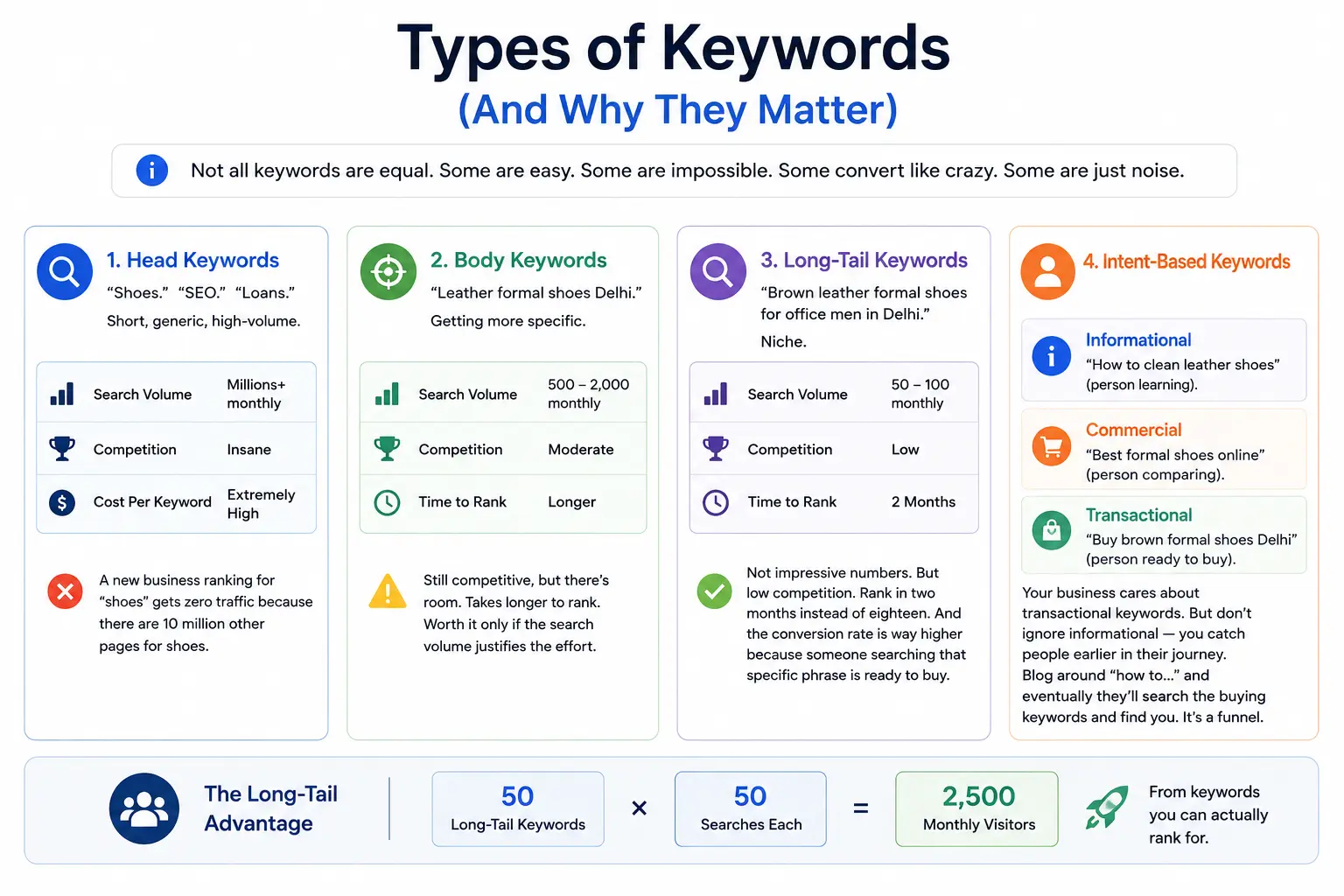
- Head Keywords Short, generic, high-volume. “Shoes.” “SEO.” “Loans.” Sounds good. Actually terrible for most businesses. Search volume is huge (millions monthly). Competition is insane. Cost per keyword is extremely high. A new business ranking for “shoes” gets zero traffic because there are 10 million other pages for shoes.
- Body Keywords “Leather formal shoes Delhi.” Getting more specific. 500-2000 monthly searches. Still competitive, but there’s room. Takes longer to rank. Worth it only if the search volume justifies the effort.
- Long-Tail Keywords “Brown leather formal shoes for office men in Delhi.” Niche. Maybe 50-100 searches monthly. Not impressive numbers. But low competition. Rank in two months instead of eighteen. And the conversion rate is way higher because someone searching that specific phrase is ready to buy. Most businesses ignore long-tail keywords. Biggest mistake. Fifty long-tail keywords with 50 searches each = 2,500 monthly visitors from keywords you can actually rank for. This is also where understanding how LSI keywords affect SEO becomes a real advantage. Related terms reinforce your relevance without cannibalising your primary targets.
- Intent-Based Keywords Informational: “How to clean leather shoes” (person learning).
Commercial: “Best formal shoes online” (person comparing).
Transactional: “Buy brown formal shoes Delhi” (person ready to buy). Your business cares about transactional keywords. But don’t ignore informational keywords, because you catch people earlier. Blog around “how to…” and eventually they’ll search the buying keywords and find you. It’s a funnel.
How to Do Keyword Research Step by Step
The steps are mentioned below.
Step 1: List everything you do
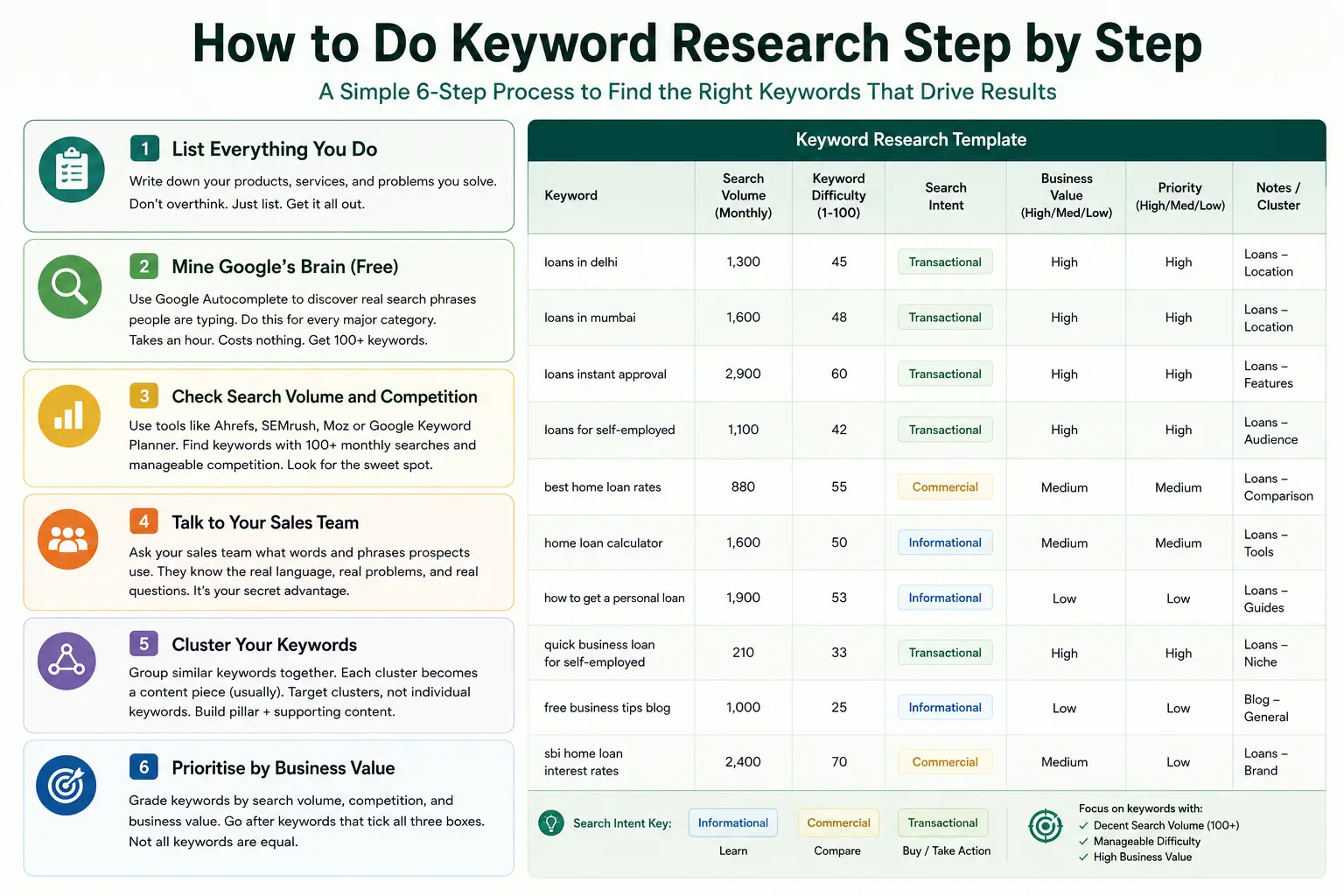
Write down your products, services and the problems you solve. Don’t overthink. Just list. A real estate agent might list: properties, home loans, investment advice, area guides. A pharma company: pain relief, diabetes, arthritis, respiratory. Get it all out.
Step 2: Use Google’s autocomplete (free)
Go to Google. Type “loans in” and watch the autocomplete. “Loans in Delhi,” “Loans in Mumbai,” “Loans instant approval,” “Loans for self-employed.” That autocomplete? That’s real search volume. Those are real phrases people are typing. Write them down.
Do this for every major product/service category you have. Takes an hour. Costs nothing. Gives you 100+ keywords instantly.
Step 3: Check search volume and competition
Now you need a tool. Ahrefs, SEMrush, Moz, even Google Keyword Planner (free, basic data). Put your list in. See which ones have 200+ monthly searches. Which ones have lower competition. Focus there.
You’re looking for the sweet spot: decent search volume (100+), manageable competition. A keyword with 500 searches and moderate competition beats one with 50,000 searches and insane competition.
Step 4: Talk to your sales team
This is the step most agencies skip. Sit down with sales. Ask: “What words do prospects use when they call? What phrases come up repeatedly in conversations?”
Your sales team is a goldmine. They hear the language customers actually use. This is real language, not marketing speak. That’s your advantage.
For a B2B SaaS company, the sales team might say: “Clients always ask about implementation timelines and API integrations.” Now you’re targeting “quick SaaS implementation,” “simple API setup,” etc. Keywords the Internet doesn’t already have 500 blogs about.
Step 5: Cluster your keywords
Group similar keywords together. “Best shoes,” “shoe comparisons,” “shoes vs sneakers” go together. “Buy shoes online,” “order shoes Delhi,” “shoe delivery” go together. Each cluster becomes a content piece (usually).
This is where strategy comes in. You’re not targeting 200 individual keywords. You’re targeting 15-20 keyword clusters. Each cluster has a pillar piece (main post) and supporting content. That structure is what content strategy actually looks like.
Step 6: Prioritise by business value
Not all keywords are equal. A “quick business loan for self-employed” keyword might have 200 monthly searches. But if your average loan size is Rs 2 lakhs, one customer from that keyword is worth Rs 10,000+ in revenue.
A “free business tips blog” keyword might have 1,000 searches. Zero commercial value. Don’t prioritise equally.
Grade keywords by search volume, competition and business value. Go after keywords that tick all three boxes.
Keyword research tools
You’ll need two tools: one for data, one for tracking.
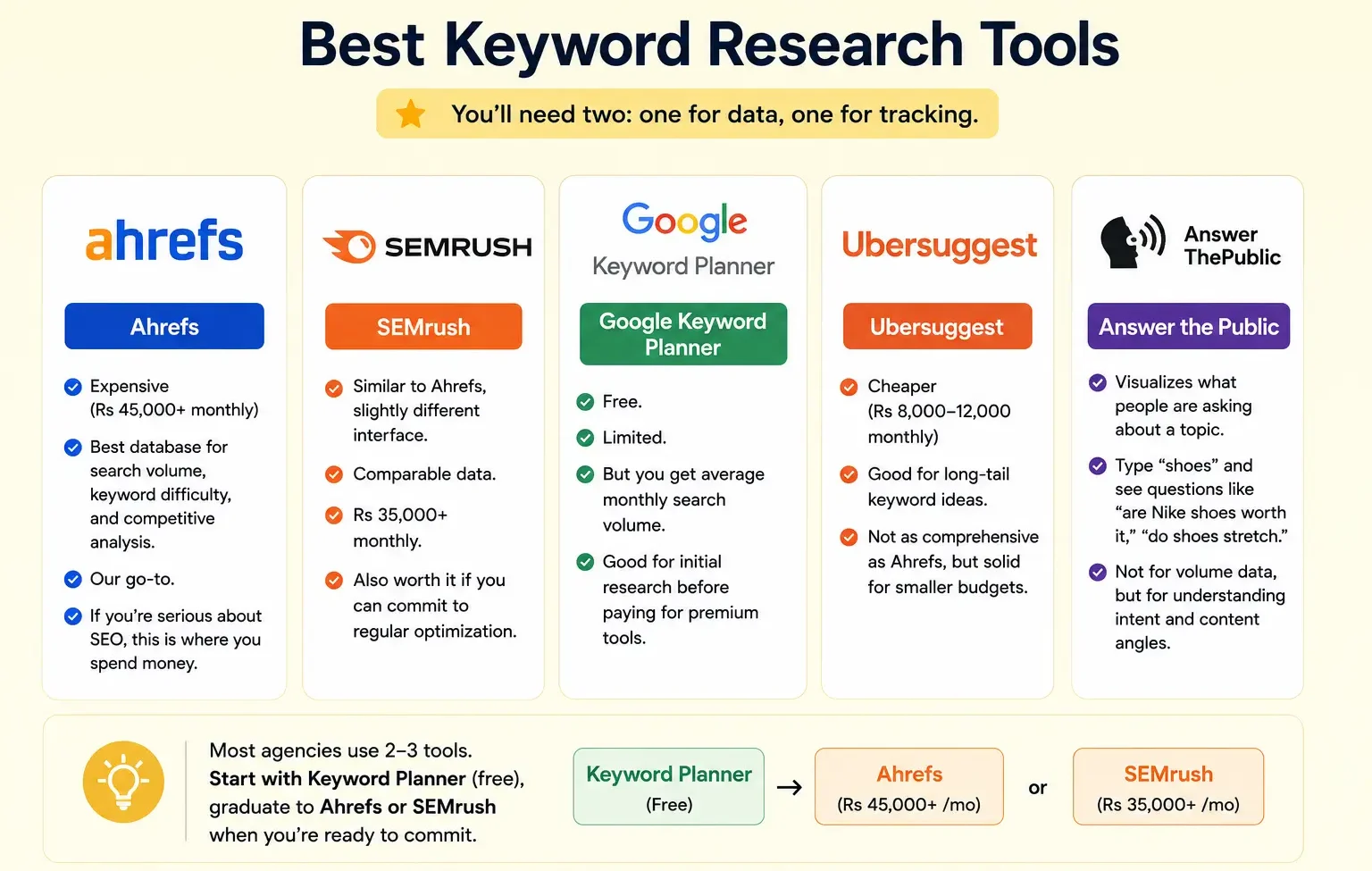
- Ahrefs Expensive (Rs 45,000+ monthly). A strong database for search volume, keyword difficulty, and competitive analysis. Our go-to. If you’re serious about SEO, this is where you spend money.
- SEMrush Similar to Ahrefs, slightly different interface. Comparable data. Rs 35,000+ monthly. Also worth it if you can commit to regular optimization.
- Google Keyword Planner Free. Limited. But you get average monthly search volume. Good for initial research before paying for premium tools.
- UberSuggest Cheaper (Rs 8,000-12,000 monthly). Good for long-tail keyword ideas. Not as detailed as Ahrefs, but solid for smaller budgets.
- Answer the Public Visualizes what people are asking about a topic. Type “shoes” and see questions like “are Nike shoes worth it,” “do shoes stretch.” Not for volume data, but for understanding intent and content angles. Most agencies use 2-3 tools. Start with Keyword Planner (free), graduate to Ahrefs or SEMrush when you’re ready to commit.
Common keyword research mistakes that hurt your strategy
Mistake 1: Targeting too broad
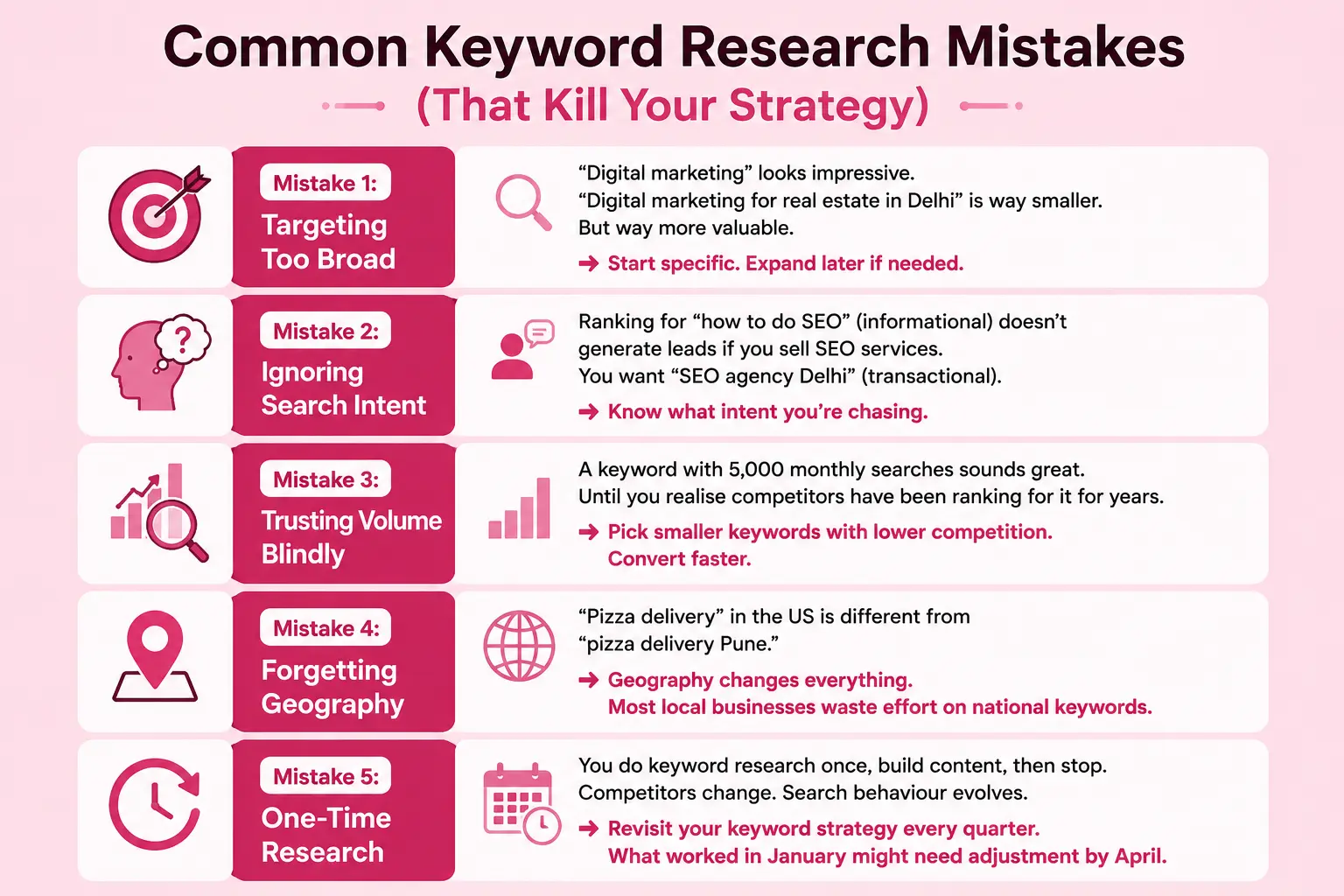
“Digital marketing” looks impressive. “Digital marketing for real estate in Delhi” is way smaller. But way more useful. Start specific. Expand later if needed.
Mistake 2: Ignoring search intent
Ranking for “how to do SEO” (informational) doesn’t generate leads if you sell SEO services. You want “SEO agency Delhi” (transactional). Know what intent you’re chasing. This is one of the most costly SEO content writing mistakes businesses make: creating content without aligning it to the right intent.
Mistake 3: Trusting volume blindly
A keyword with 5,000 monthly searches sounds great. Until you realise competitors have been ranking for it for years. Pick smaller keywords with lower competition. Convert faster.
Mistake 4: Forgetting geography
“Pizza delivery” in the US is different from “pizza delivery Pune.” Geography changes everything. Most local businesses waste effort on national keywords.
Mistake 5: One-time research
You do keyword research once, build content, then stop. Competitors change. Search behaviour evolves. Revisit your keyword strategy every quarter. What worked in January might need adjustment by April.
How keywords connect to on-page SEO and content strategy
Keyword research doesn’t exist in isolation. It feeds directly into everything else.
Pick the right keywords, write content around them, optimise pages (on-page SEO), rank and get traffic. Each step depends on the one before. Bad keywords break the whole chain.
That’s why we treat keyword research as the foundation. Build wrong here, everything else crumbles.
Measuring keyword success
You pick keywords. You rank for them. Now what? Measure this:
Traffic: Did the keyword actually bring visitors?
Conversions: Did those visitors do anything (call, email, form)?
Revenue: If you track it, did that keyword convert to revenue?
Too many businesses measure only rankings. “We rank position 3 for keyword X.” Okay. But did anyone click? Did anyone buy? No? Then the ranking doesn’t matter.
Track back from revenue. Which keywords brought paying customers? Do more of that. Which keywords brought tons of traffic but zero conversions? Either improve the page or deprioritize it.
Singular or plural: do you need both?
Google treats the singular and plural forms of a keyword as related, but the results can differ. In 2016, Google's John Mueller explained that the two are seen as different searches, so the order of results can change, as reported by Search Engine Journal. Plural forms are often used when people compare options or look for a category.
The more specific the search, the more alike the results tend to be. A search for "cars in Los Angeles" and one for "car in Los Angeles" gave different results in the example we looked at. Adding a brand name made them similar.
What to do: check the live results for both forms before you pick your main keyword. Choose the form that matches your page, a plural for a category or comparison page and a singular for one product or service. Then use the other form naturally in your text. Do not stuff both in.
Ready to find keywords that convert?
We help brands across India build their keyword strategies. Some conversations turn into projects. Some don’t. Either way, you’ll know whether your current keywords are the problem.


