
























Good results come from the basics done well. These are the right audience, a clear offer and ads that say something specific. They also include regular A/B testing (running two versions to see which wins) and steady tuning of the campaign. This guide covers what works, the mistakes to avoid and how to get a better ROI (return on investment) from LinkedIn Ads. LinkedIn sits next to Google Search as one of the few places where performance marketing can reach people based on professional intent. Other platforms mostly go by behaviour signals. That is why the higher cost often makes sense for B2B companies with big deal values.
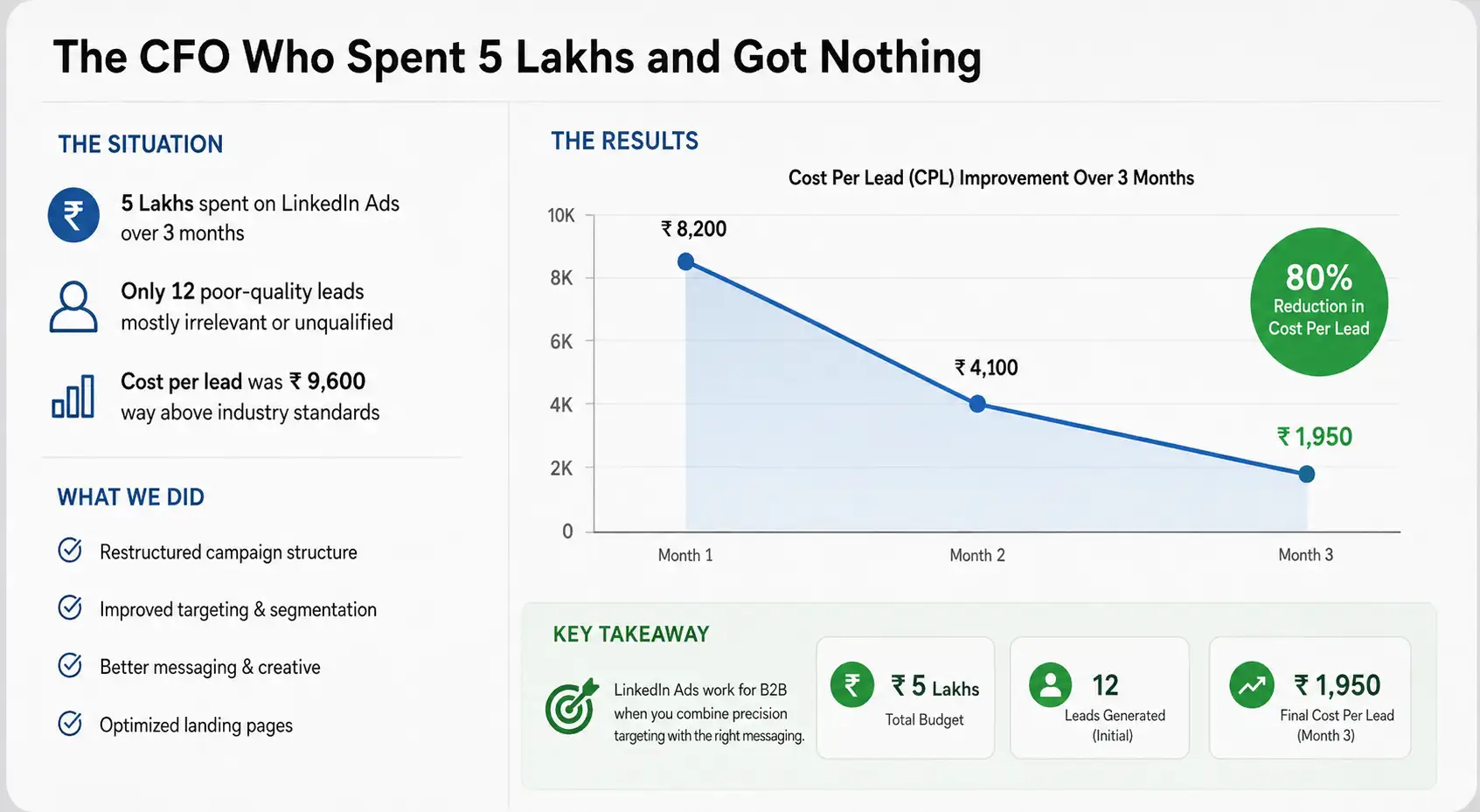
A company that spent 5 lakhs and got almost nothing
Take a software company in Bangalore. This is an illustrative example, not a named client. The founders set aside 5 lakhs for LinkedIn ads over three months and hoped for 40 to 50 decent leads. They got 12. Most were not useful. One was a student in their early twenties. One was a business development executive with no power to buy. One person asked if the founder wanted to "explore partnership opportunities". That usually means "I want to sell you something".
The first thing to check is the ad account. The campaign structure was messy. It targeted software architects across India in every industry. It mixed product campaigns with thought-leadership content. It sent people to landing pages that looked like they were made in 2012.
Cost per lead was Rs 9,600, and that is not a typo.
A healthy B2B account on LinkedIn pays far less per lead, though the figure depends on the industry. This account was burning money and nobody could say why.
The fix was to restructure everything: new targeting, separate campaigns by job level, and better messaging. Better messaging is a different thing from better design. The cost per lead then moved like this.
In month one it was Rs 8,200 per lead. Still bad.
In month two it came down to Rs 4,100. Getting there.
By month three it was Rs 1,950.
So yes, LinkedIn works for B2B, but it rewards precision, and most companies spend as if they were firing buckshot instead of aiming. The same pattern shows up on every paid channel. As we explain in what agencies hide about performance marketing, the problem is almost never the platform. It is the targeting, the structure and the messaging.
Why LinkedIn costs so much
LinkedIn's CPM (cost per thousand impressions) is much higher than Facebook's, and its CPC (cost per click) is much higher than Google Search's. You will pay more for fewer clicks and impressions.
Many people decide it is not worth it on that number alone. They are comparing the wrong metrics.
LinkedIn is expensive because the people on it have decision-making power, so their attention is worth more. A CFO earning Rs 2 crore a year, or an engineering director at a 500-person tech company, is a valuable impression. To reach people like that, LinkedIn is often cheaper than the alternatives. The sales director at a mid-sized manufacturing firm will not respond to Facebook ads, but may respond to a LinkedIn message. That is the premium you are paying.
I tell clients that LinkedIn is expensive if you target everyone and good value if you target exactly the right person.
Here is an illustrative example. An industrial equipment manufacturer in Jamshedpur wants to reach procurement heads at steel plants: a specific title, a specific industry, a specific region. A campaign aimed at about 5,000 people across India could bring cost per lead down to around Rs 1,600. If their average deal is 25 lakhs, Rs 1,600 per lead looks like a bargain.
Now suppose the same company targets "anyone in manufacturing". The ads reach plant workers, HR assistants and people with no purchasing power, and cost per lead jumps to Rs 7,000-8,000. Same channel, very different result. Targeting made the difference, not LinkedIn.
Campaign structure that works
This is where most people go wrong.
They create one campaign with one ad. It is aimed at everyone remotely connected to their industry. The budget is Rs 50,000 a month. Then they wonder why the results are poor.
B2B on LinkedIn does not work like Facebook ads for FMCG (fast-moving consumer goods). Facebook is a volume game: put enough impressions in front of enough people and some will convert. LinkedIn is a precision game. You need fewer, tighter audiences and a more specific message for each one.
We create separate campaigns for separate audience segments. "Decision makers" is too broad a segment. Campaigns work better when they are split into groups like these.
- IT Directors at companies with 500+ employees in financial services
- Plant Managers at manufacturing facilities in tier-2 cities with 200-1000 employees
- CFOs at listed companies looking for cost management solutions
Each segment gets ad copy written for its own pain point. CFOs respond to ROI language, plant managers to operational efficiency, and IT directors worry about security and scalability. Same product, different message. This audience-first approach is the same discipline behind how to build a marketing funnel that converts. People at different stages need different messages, and one-size-fits-all messaging leaks leads at every stage.
Also run separate campaigns by seniority. C-suite, VPs and managers each get their own creative. You speak to a CEO differently ("Reduce operational costs by 18% in Q3") than to a manager ("Simplify your team's reporting process").
What the campaign structure looks like
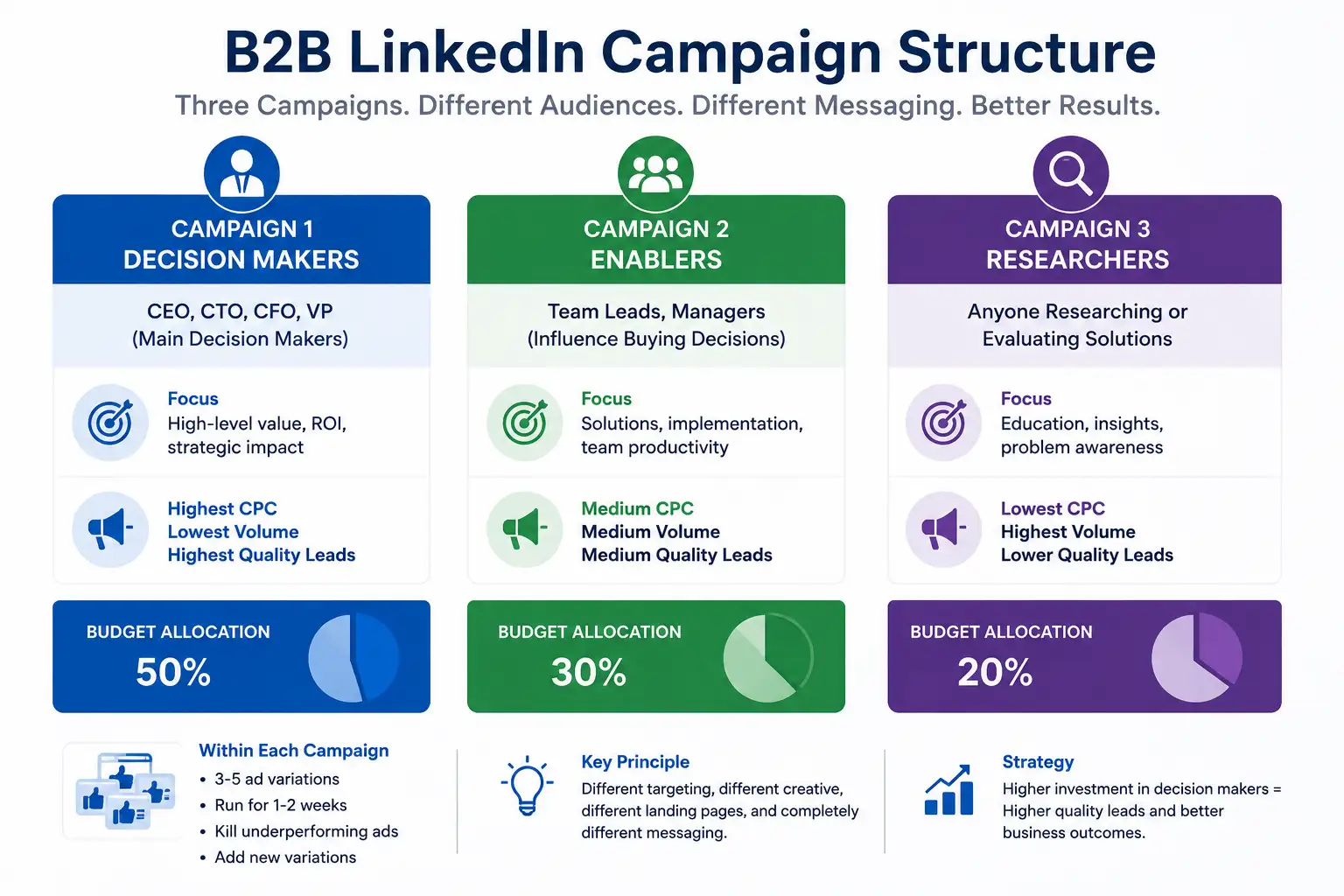
Campaign 1 is for decision makers: CEO, CTO, CFO and VP, the main decision makers.
Campaign 2 is for enablers: team leads and managers who influence buying decisions but do not have the final sign-off.
Campaign 3 is for researchers: anyone in the account who might be researching or evaluating solutions.
That is all. Three campaigns, each with its own targeting, creative and landing page. The difference is in the messaging, not in the logo or colour scheme.
Inside each campaign, run 3-5 ad variations. LinkedIn rotates creatives poorly compared to Facebook, so the algorithm needs more variations to find what works. Run them for 1-2 weeks, drop what underperforms and add new ones.
Budget split: 50% to the decision maker campaign, 30% to enablers and 20% to researchers. The decision maker campaign will have the highest CPC and the lowest volume, but the best leads. That is intentional.
The targeting trap
LinkedIn's targeting options are extensive, maybe too extensive. It is like walking into a store with a million products and no shopping list. You want to pick everything and end up with nothing useful.
Most people start by choosing:
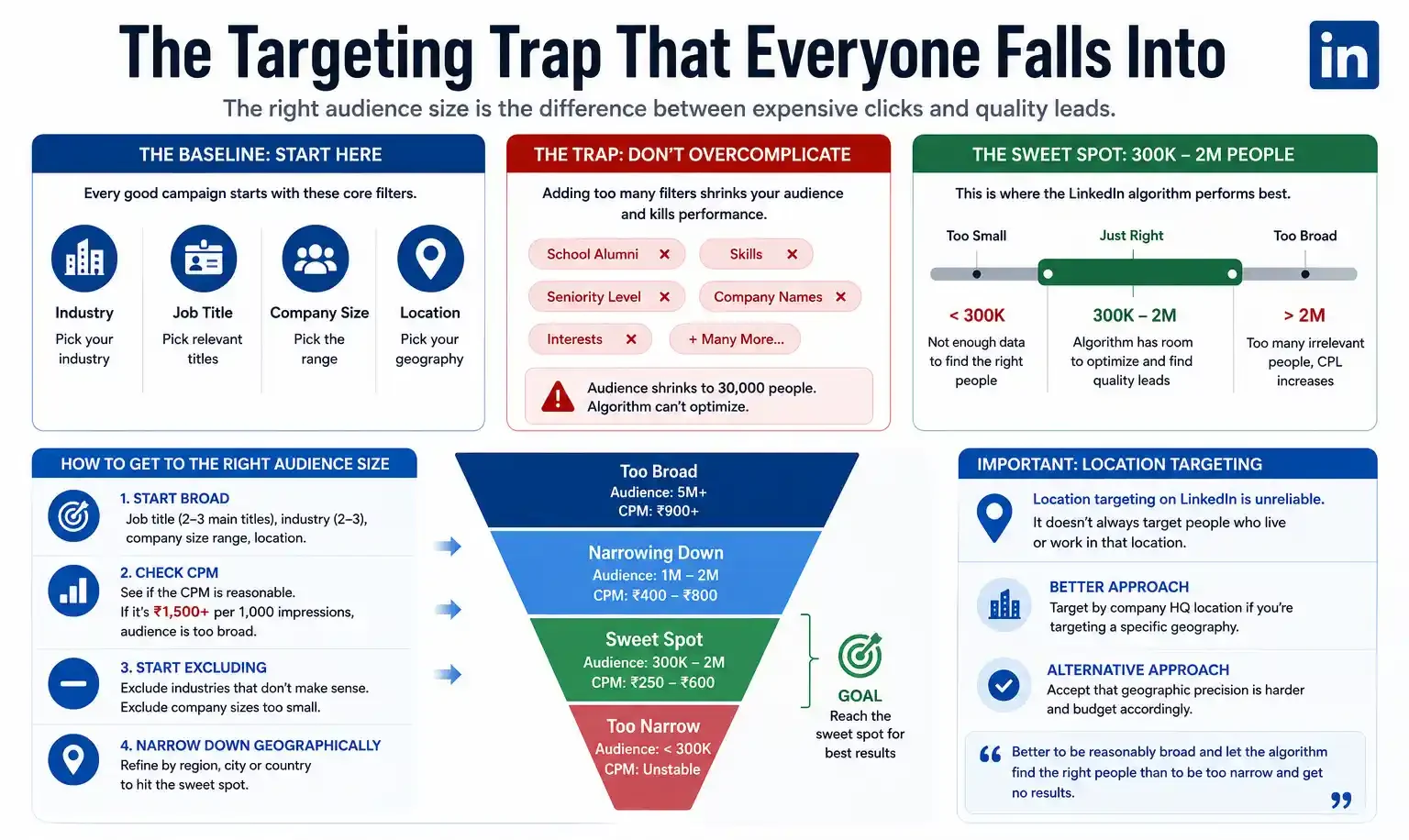
- Industry (pick your industry)
- Job title (pick relevant titles)
- Company size (pick the range)
- Location (pick the geography)
That is a fine baseline. Then they get fancy and add school alumni filters, skills, seniority level, company names and interests. The audience shrinks to 30,000 people. LinkedIn's algorithm now has so few people to show ads to that it cannot optimise well.
The sweet spot is an audience between 300,000 and 2 million people. Below 300,000 the algorithm has no room to find the right people. Above 2 million you are too broad, and cost per lead climbs because you reach too many irrelevant people.
How do you get to the right size? Start broad: 2-3 main job titles, 2-3 industries and a company size range. Check whether the CPM is reasonable. If it is Rs 1,500+ per thousand impressions, the audience is too broad, so start excluding. Drop industries that do not make sense, leave out company sizes that are too small, and narrow down the geography.
One lesson from painful trial and error: location targeting on LinkedIn is unreliable. If you pick Bangalore, Hyderabad and Pune, you would expect people who live or work there. But it does not always work that way. If you need a specific geography, target by company HQ location. Or accept that geographic precision is harder, and budget for it.
The ad creative problem
People assume the issue with LinkedIn ads is creative: "Our ad isn't catchy enough." "We need better design." "The copy isn't compelling."
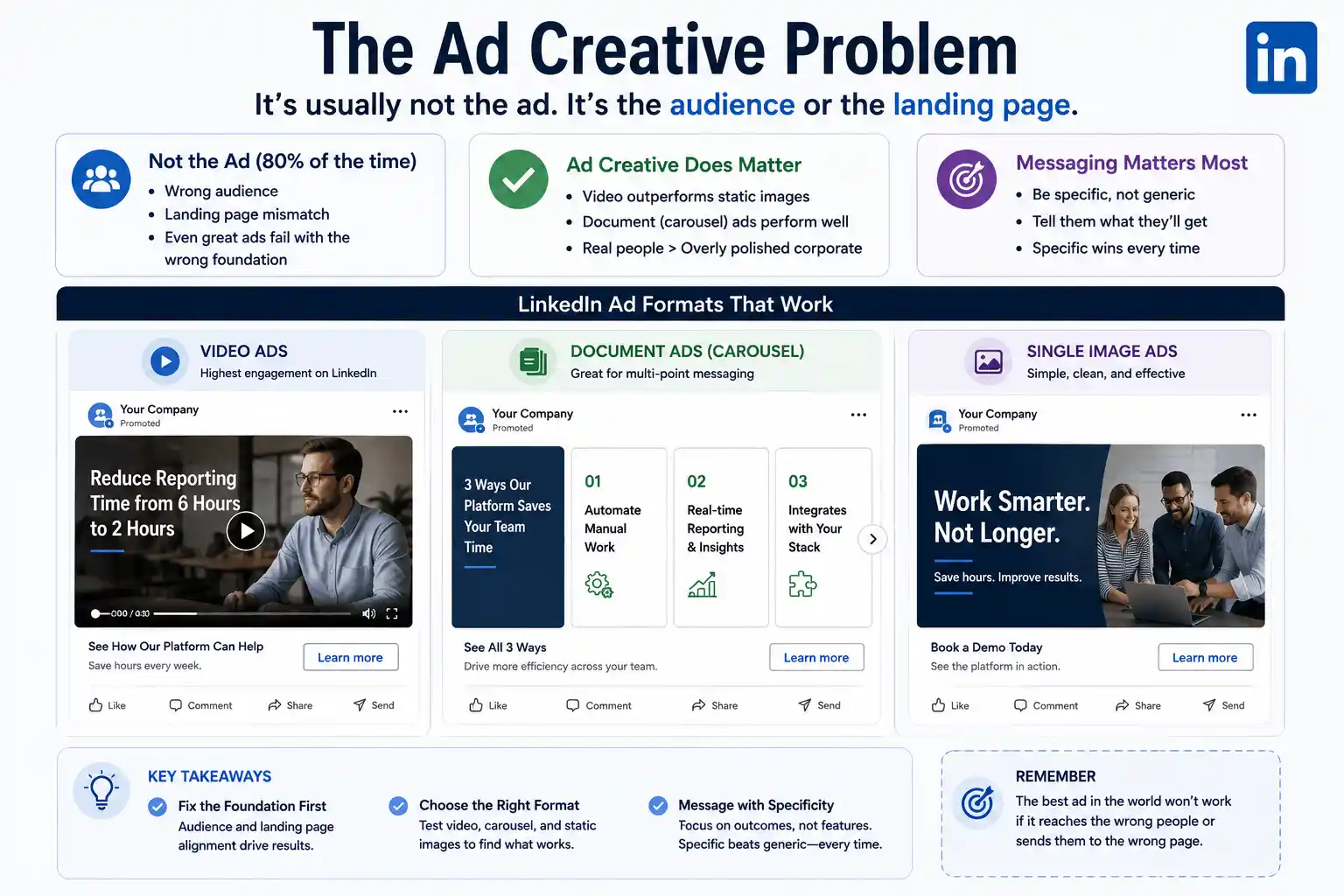
Sometimes that is true. But most of the time the problem is the audience or the landing page, not the ad. I have run ugly ads on LinkedIn that performed well because the audience was right. I have also run beautiful ads with poor results. We were targeting the wrong people or sending them to a landing page that did not match.
Creative still matters. On LinkedIn, video tends to beat static images, and document ads (LinkedIn's carousel-style ads) tend to do well. Ads with real people also tend to beat overly polished corporate ones. A real photo of your team and an honest headline work better than a stock photo of a person in a suit shaking hands.
The message matters most. "Increase your team's productivity" is generic. "Reduce reporting time from 6 hours to 2 hours using our platform" is specific. Specific wins. Tell people what they will get from you.
Budget: what works in India
Here are budget levels to plan around.
Minimum viable budget: Rs 40,000 a month. Below that, don't bother, because LinkedIn cannot optimise with such small daily spend. Your cost per lead will be much higher than it should be because the algorithm is guessing.
Entry-level serious budget: Rs 80,000-1,20,000 a month. This is enough for 2-3 campaigns with a decent daily budget ($15-20 a day per campaign). You will have meaningful data in 4 weeks.
Working budget for most B2B companies: Rs 1,50,000-3,00,000 a month. This suits companies doing 5-15 lakhs of revenue a month who can invest in lead generation. Run 3-4 campaigns. Expect 40-100 leads a month depending on industry. Convert some share of them to deals.
Aggressive growth budget: Rs 4,00,000+ a month. This is for companies with product-market fit that want to scale, or for enterprise deals where a single customer is worth crores.
Now for allocation. In the first month, split 60% to new customer acquisition and 40% to remarketing (showing ads again to people who already engaged with you).
In months 2-3, go 50-50 if you have an email list and earlier engagement. Otherwise stay at 60-40.
From month 4, put 40% on new people and 60% on warm audiences. By now people have visited your site, downloaded your content and engaged with your ads, and they are much cheaper to convert.
A campaign that almost worked, and why it didn't
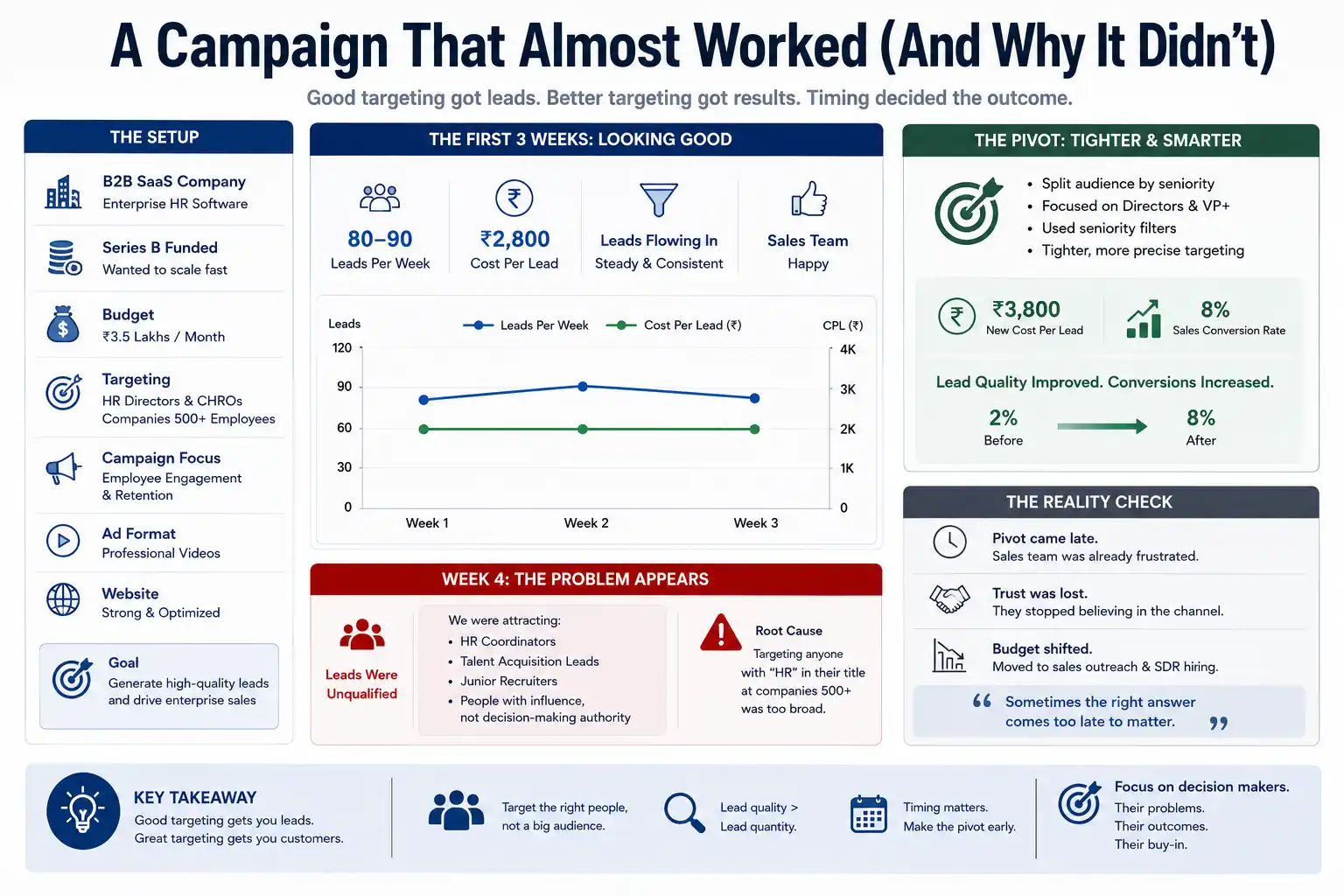
Here is an illustrative example, not a named client. A B2B SaaS company selling enterprise HR software, series B funded, wants to grow customer acquisition fast. The budget is Rs 3.5 lakhs a month, which is aggressive but doable.
The campaigns target HR directors and CHROs at companies with 500+ employees. The targeting looks good, the messaging is about employee engagement and retention, the videos are professional and the website is solid.
For the first three weeks, leads come in at 80-90 a week, at Rs 2,800 per lead. That is not bad for enterprise software, and the sales team is happy.
In week four the sales team reports that the leads are unqualified. People are interested, but they are not decision makers. They are HR coordinators and talent acquisition leads, people who can influence a purchase but have no authority to buy.
The problem is in the targeting. It captures anyone with "HR" in their title at companies with 500+ employees, from the CHRO down to junior recruiters.
So the audience is split: one campaign for VP+ level and another for directors, with tighter seniority filters. CPL (cost per lead) rises to Rs 3,800. But lead quality improves a lot, and the sales conversion rate goes from about 2% to 8%.
Here is the part that does not fit a neat story. By the time the change is made, the sales team is already frustrated and no longer trusts the channel. Even though the Q2 numbers show real improvement, they have mentally moved on. The company shifts its budget to sales outreach and SDR (sales development representative) hiring. Sometimes the right answer comes too late to matter.
Why we keep coming back to this channel
Despite the budget worries, the algorithm frustrations and the targeting complexity, we still use LinkedIn for B2B clients.
It works, though not for every company or every industry. For the right company, at the right point in its growth, with the right audience and proper execution, it is different. No other channel gives you access to decision makers the way LinkedIn does.
Facebook gets you quantity, Google gets you intent, and LinkedIn gets you people with authority and budget. That is worth the premium. ROI comes first, whichever channel you use.
Want to explore this for your B2B business? Talk to our performance marketing team. We will look at your industry, deal size, sales cycle and audience. We will tell you straight whether LinkedIn makes sense or whether Google Ads, email or something else would serve you better.
Start small and stay consistent
LinkedIn Ads reward patience and specificity more than volume or clever tricks. Brands that do this well in India tend to be the most consistent ones.
Talk to us about LinkedIn ads
Tell us about your business. We will give you an honest view of what is likely to work and what will waste money.


