
























Meanwhile, ads underperform, leads ghost you, and “almost customers” vanish forever.
The funnel is not a slide. It is a leaky pipe that you keep patching while spending real money.
The day I realised most marketing was just theatre
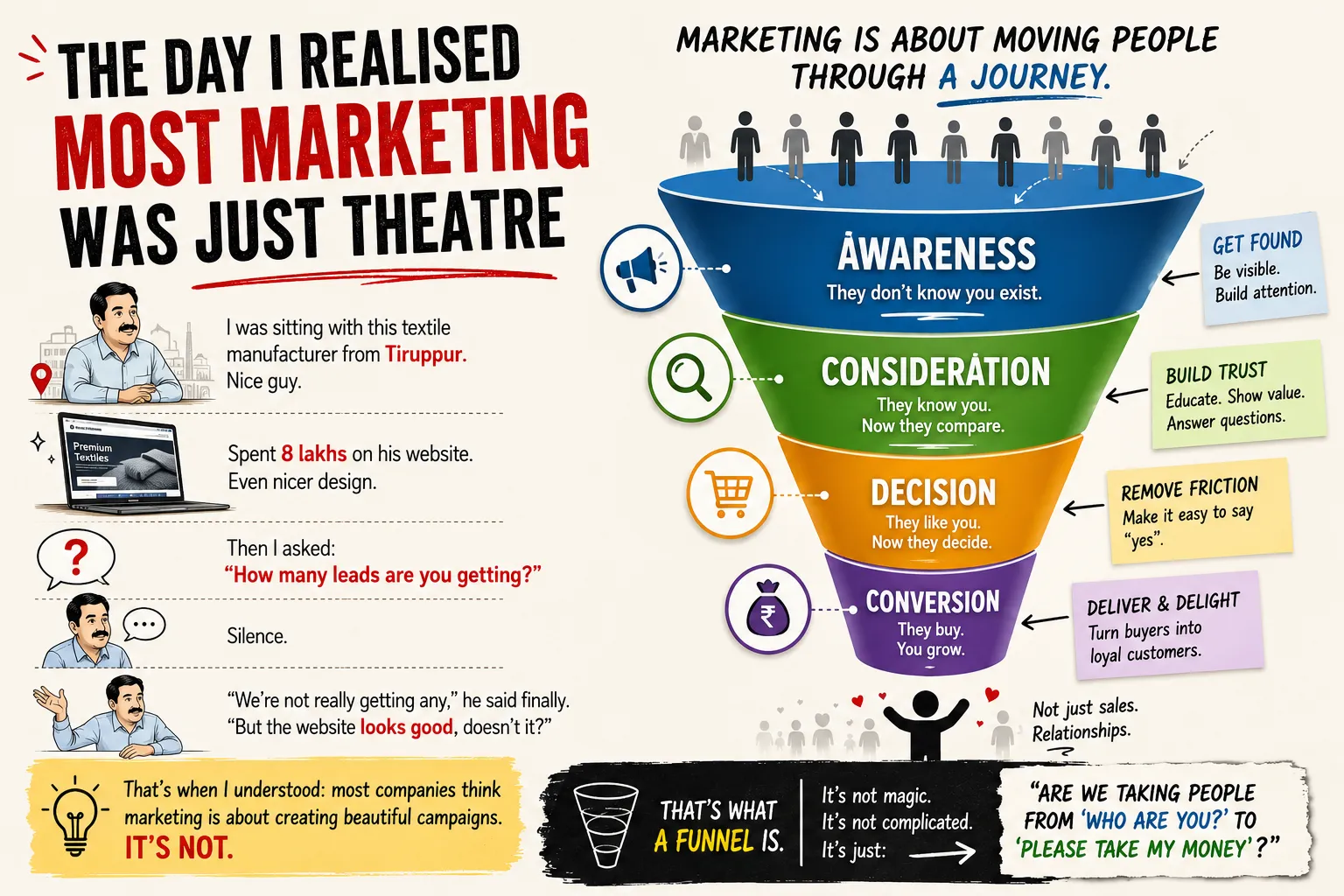
I was sitting with this textile manufacturer from Tiruppur. Nice guy. Spent a big sum on his website. Even nicer design. Then I asked: “How many leads are you getting?”
Silence.
“We’re not really getting any,” he said finally. “But the website looks good, doesn’t it?”
That’s when I understood: most companies think marketing is about creating beautiful campaigns. It’s not. Marketing is about moving people from stage to stage. Awareness to consideration to decision. And most of us are terrible at it.
That’s what a funnel is. It’s not magic. It’s not complicated. It’s just: “Are we taking people from ‘who are you?’ to ‘please take my money’?”
What a marketing funnel actually is
Think of people moving down through stages.
Your potential customers start at the top (many). They move through stages. Some drop off. Some move forward. The ones who reach the bottom become paying customers (fewer of them). That’s it. That’s the funnel.
The funnel is leaky. Most companies are bleeding prospects at every stage and not even realising it.
ROI (return on investment) comes first, so you need to know where people are getting stuck. Are they aware you exist? Do they know you after clicking your ad? Are they comparing you with three other options and picking someone else? The answers live in your data.
TOFU, MOFU, BOFU: what these mean
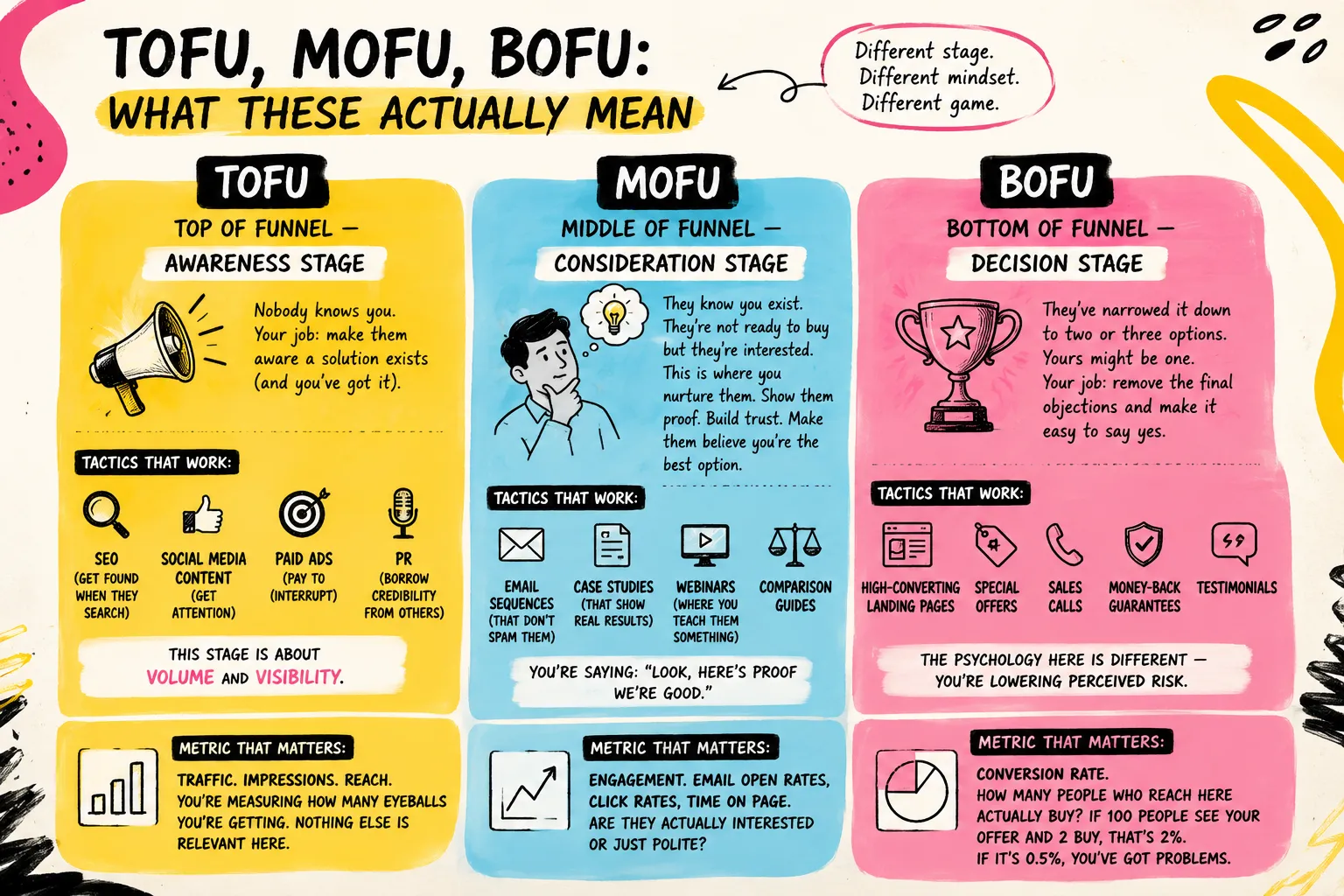
TOFU (top of funnel): awareness stage
Nobody knows you. Your job: make them aware a solution exists (and you’ve got it).
Tactics that work: SEO (get found when they search), social media content (get attention), paid ads (pay to interrupt), PR (borrow credibility from others). This stage is about volume and visibility.
Metric that matters: Traffic. Impressions. Reach. You’re measuring how many eyeballs you’re getting. Nothing else is relevant here.
MOFU (middle of funnel): consideration stage
They know you exist. They’re not ready to buy but they’re interested. This is where you nurture them. Show them proof. Build trust. Make them believe you are the right option.
Tactics: Email sequences that don’t spam them, case studies that show real results, webinars where you teach them something, comparison guides. You’re saying: “Look, here’s proof we’re good.”
Metric that matters: Engagement. Email open rates, click rates, time on page. Are they actually interested or just polite?
BOFU (bottom of funnel): decision stage
They’ve narrowed it down to two or three options. Yours might be one. Your job: remove the final objections and make it easy to say yes.
Tactics: High-converting landing pages, special offers, sales calls, money-back guarantees, testimonials. The psychology here is different: you are lowering perceived risk.
Metric that matters: Conversion rate. How many people who reach here actually buy? If 100 people see your offer and 2 buy, that’s 2%. If it’s 0.5%, you’ve got problems.
The funnel leaks nobody talks about
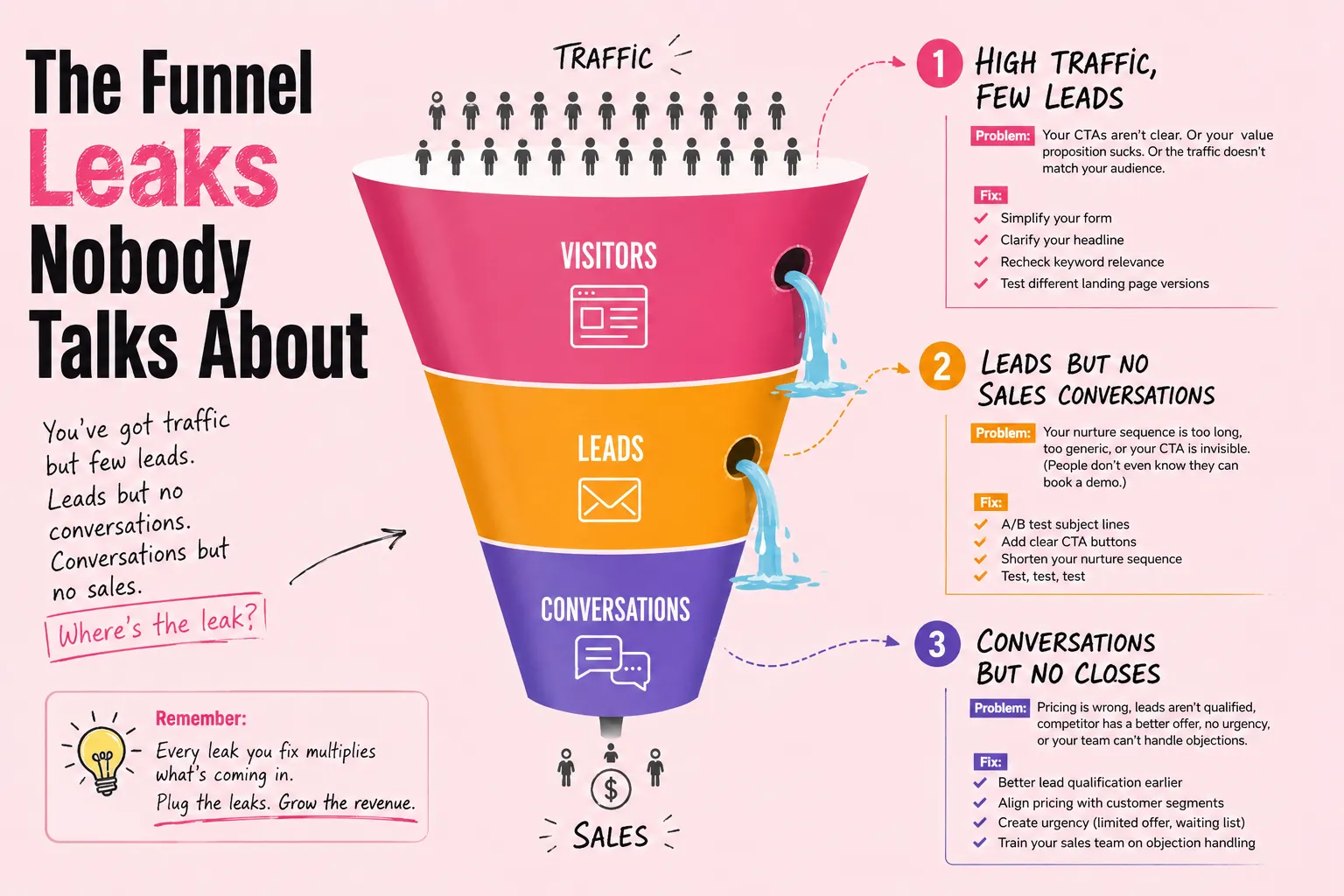
You’ve got traffic but few leads. Leads but no conversations. Conversations but no sales. Where’s the leak?
Leak 1: High Traffic, Few Leads
Thousands visit, few signup. Problem? Your CTAs aren’t clear. Or your value proposition is weak. Or the traffic doesn’t match your audience. For example, a B2B software company may bid on keywords that bring website visitors but not actual prospects. Lots of noise, little signal.
Fix: Simplify your form. Clarify your headline. Recheck keyword relevance. Test different landing page versions for higher conversions.
Leak 2: Leads but no sales conversations
You’ve got email subscribers but they’re not showing up for demos. Problem? Your nurture sequence is either too long or too generic. Or your subject lines are weak. Or people do not even know they can book a demo, because your CTA is not visible. This is common.
Say the “Book a Call” button sits below the fold in your email. People do not scroll, so they never see it. Move it up and more people can book.
Fix: A/B test subject lines. Add clear CTA buttons. Shorten your nurture sequence. Test, test, test.
Leak 3: Conversations but no closes
Your sales team is talking to people. Nobody’s buying. Problem could be: pricing is wrong, you’re not qualifying leads properly, your competitor has a better offer, there’s no urgency to decide now, or your sales team doesn’t know how to handle objections.
Fix: Better lead qualification earlier. Align pricing with different customer segments. Create urgency (limited offer, waiting list). Train your sales team on objection handling.
Metrics that matter
Most agencies report: “Domain authority went up by 5 points. We built 200 backlinks. Your rankings improved for 47 keywords.” These numbers feel impressive and mean absolutely nothing.
Here’s what matters:
- Conversion rates by stage: TOFU-to-MOFU, MOFU-to-BOFU and BOFU-to-close. Track these.
- Cost per acquisition: how much are you spending to get one paying customer? Compare month-to-month. It should be trending down.
- Customer lifetime value: how much will a customer spend with you over the long term? Are your funnel optimizations bringing high-value or low-value customers?
- Funnel velocity: how long does it take from first touch to closed deal? Faster can mean better (less sales overhead) but slower doesn’t always mean worse (some complex sales take time).
The only metric that actually matters at the end of the day? Revenue. Did your marketing investments result in more money in the bank?
B2B funnels vs. B2C funnels
B2B: long, complex, many decision-makers
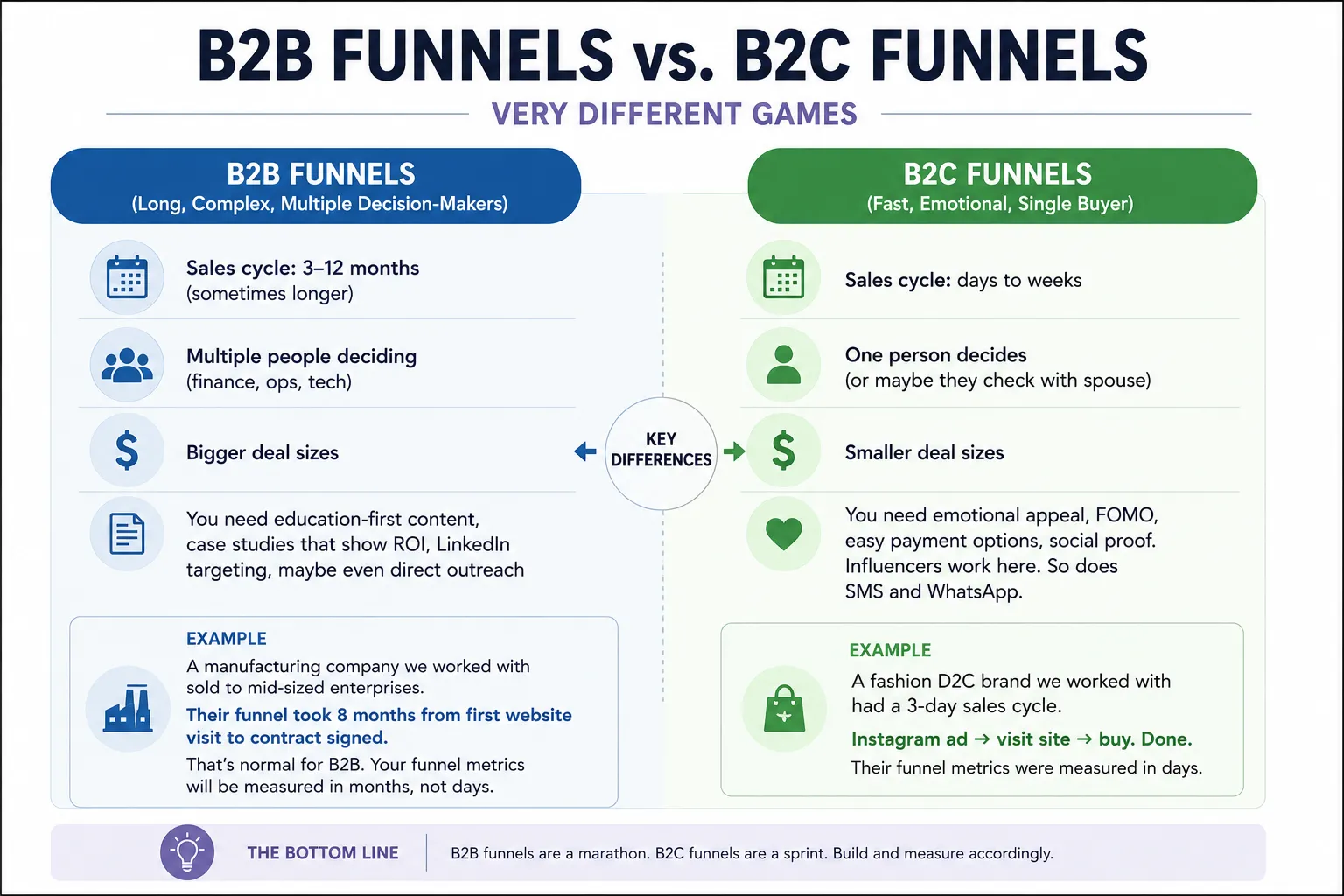
Sales cycle: 3-12 months (sometimes longer). Multiple people deciding (finance, ops, tech). Bigger deal sizes. You need education-first content, case studies that show ROI, LinkedIn targeting, maybe even direct outreach.
Example: Take a manufacturer that sells to mid-sized enterprises. Its funnel can take many months from first website visit to signed contract. That is normal for B2B. Your funnel metrics will be measured in months, not days.
B2C: fast, emotional, single buyer
Sales cycle: days to weeks. One person decides (or maybe they check with spouse). Smaller deal sizes. You need emotional appeal, FOMO, easy payment options, social proof. Influencers work here to amplify your brand reach. So does SMS and WhatsApp.
Example: A fashion D2C (direct-to-consumer) brand can have a sales cycle of just days: Instagram ad, visit the site, buy. Its funnel metrics are measured in days.
Post-purchase: the part nobody gets right
Most people miss this: the sale is not the end. After the purchase, the real work starts.
You’ve got a new customer. Now they might:
- Have a bad onboarding experience and refund
- Love it and buy more (upsell opportunity)
- Recommend you to friends (referral opportunity)
- Churn after two months because you didn’t keep them engaged
Most companies ignore this. They obsess over the initial sale and then wonder why repeat purchases are low. Build a retention funnel alongside your acquisition funnel. Keep customers happy. That’s where the real money is.
One client story
Here is a made-up example. A chemical manufacturer from Gujarat wants to rank for “B2B chemical suppliers India”. It is a big keyword and looks impressive.
Say they build a whole funnel around it, with content, backlinks and paid ads. After a long time they sit at position 5 on Google and never make page 1.
The catch is that the big keyword does not help them. Their real customers are not searching “B2B chemical suppliers.” They are searching “epoxy resin suppliers Gujarat” and “industrial adhesives Surat”. These are specific, long-tail searches.
So they rebuild the funnel around those keywords, with different content and different messaging. This brings far more qualified leads than the big keyword ever would.
The lesson: keyword research determines everything. Get it wrong and your whole funnel is built on sand.
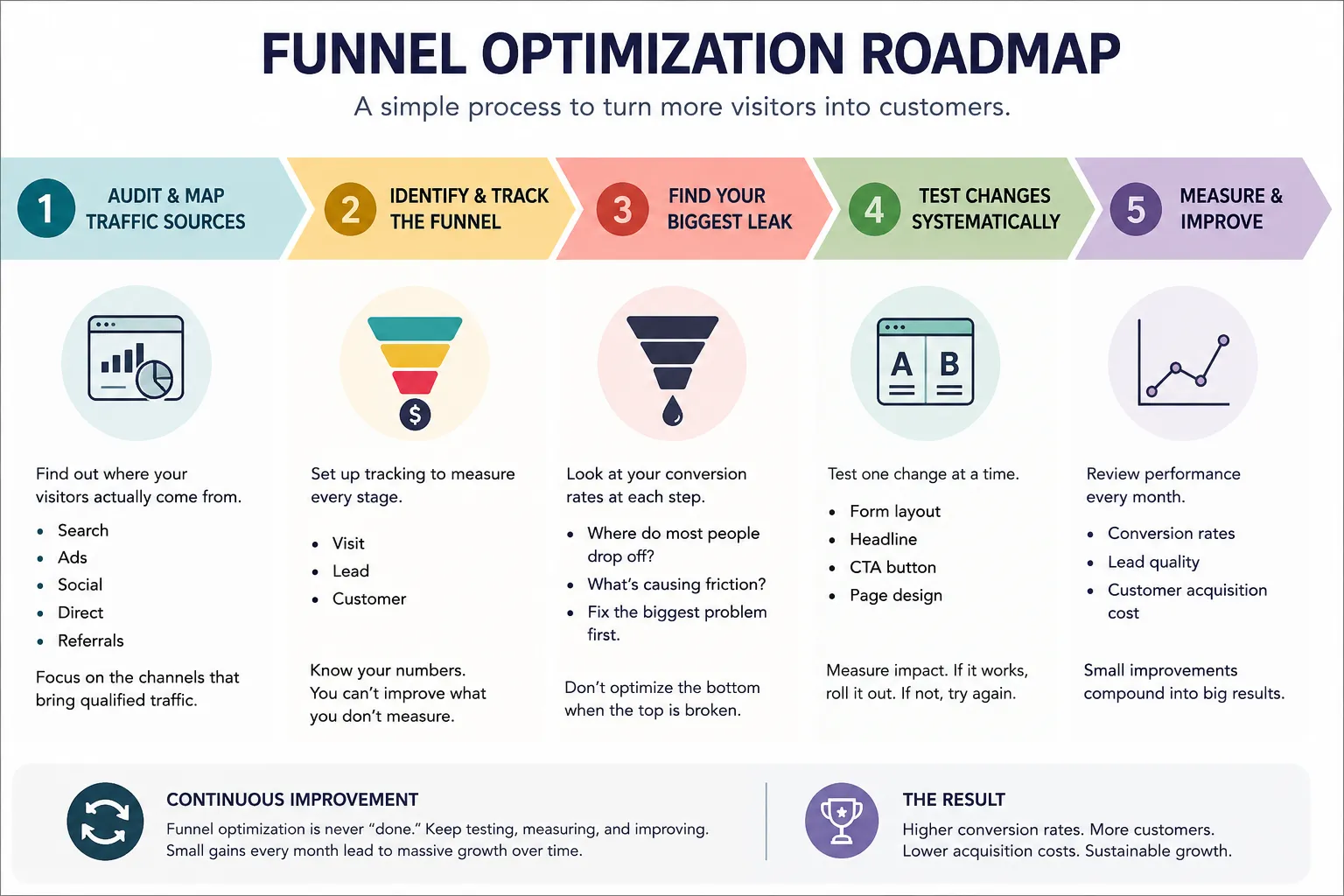
Building your funnel, step by step
Step 1: Map Where People Actually Come From
Don’t assume. Google Analytics will tell you: Search? Ads? Social? Direct? Referrals? Focus on the channels that bring qualified traffic (people who could actually buy from you).
Step 2: Set Up Funnel Tracking
You need to know: How many people visit → How many become leads → How many become customers. Without this tracking, you’re flying blind.
Step 3: Find Your Biggest Leak
Where are you losing the most people? If 1000 visit but only 10 signup, fix the signup problem first. Don’t optimise the bottom when the top is broken.
Step 4: Test Changes Systematically
Change one thing. Measure impact. Roll it out if it works. Rinse and repeat. Too many companies change five things at once, see results go up, and have no idea which change helped.
Step 5: Measure. Always Measure.
Every month, look at your conversion rates. Are they improving? Stalling? Getting worse? You need this data to make decisions.
Why this matters
A good funnel is the difference between a business that scales and one that plateaus. Between ROI-positive marketing and ROI-negative marketing. Between “we have a marketing problem” and “we have a process problem.”
Most Indian SMEs haven’t built their funnel intentionally. They’re doing digital marketing but not strategically. Which is why they throw money at ads and wonder where it went.
Build a funnel. Optimise it. Watch revenue grow with the right digital marketing agency partner.
Is your funnel working?
Let’s audit your funnel and find the leaks.


