
























Building a real affiliate marketing business takes more than adding links to content. You need to build an audience and earn credibility. You need to measure conversions. And you need to improve your best-performing offers over time. Are you a content creator, a SaaS (software-as-a-service) company or a brand? Either way, affiliate marketing works best as part of a broader digital marketing strategy. It supports steady growth. It does not rely on short-term earnings.
A made-up example: the creator who earned from affiliate links by accident
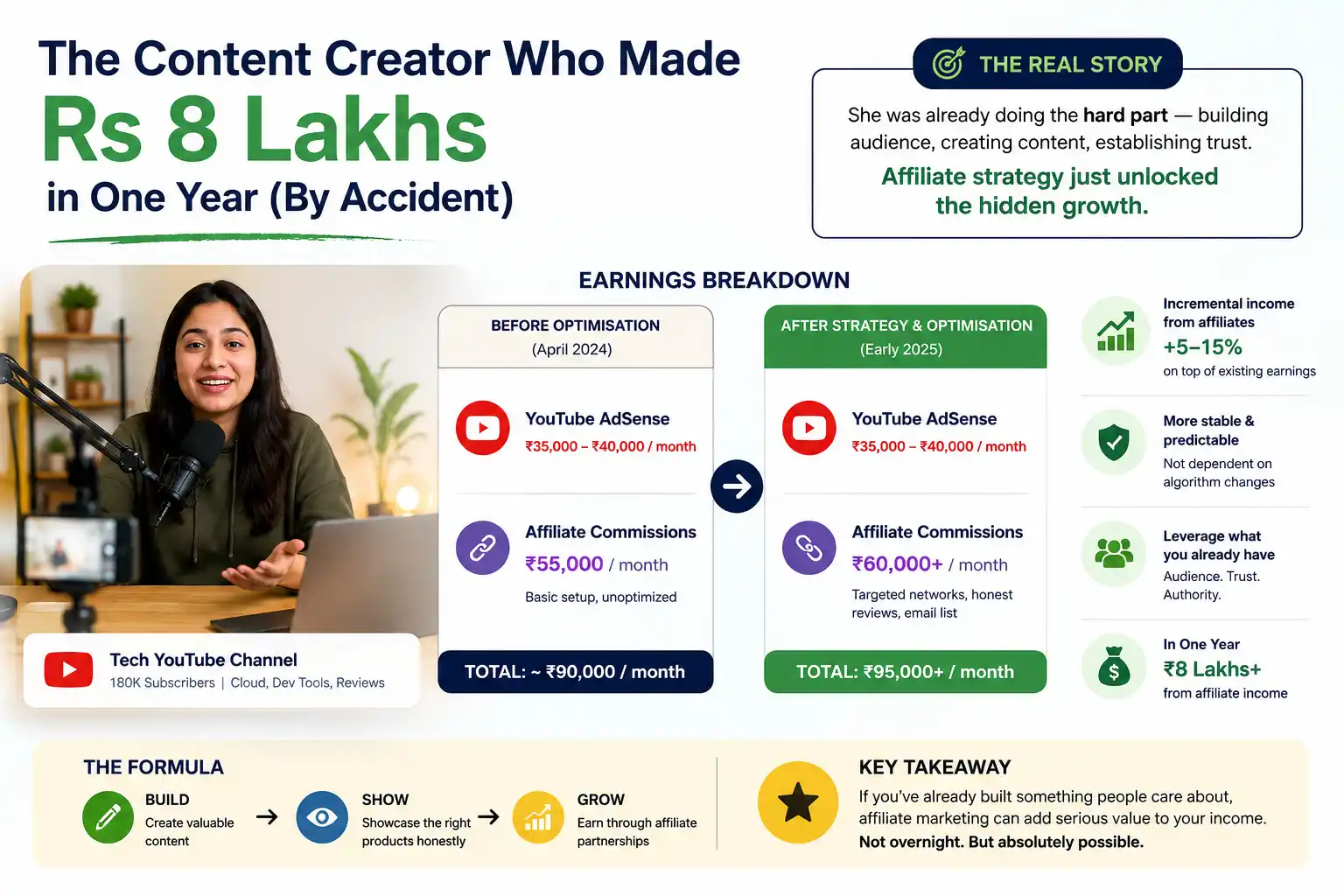
Picture a tech YouTube channel with 180k subscribers. (This example is made up to show the idea.) It reviews cloud hosting platforms, dev tools and similar products. Nice niche, decent production quality, engaged audience.
Suppose you ask how much she makes from YouTube ads.
“Maybe Rs 35,000 to 40,000 a month,” she says. “Not great for the effort. Considering switching to just doing sponsored content for vendors.”
Then you ask about affiliate links in the video descriptions.
Turns out she makes Rs 55,000 a month from affiliate commissions. That is almost as much as the YouTube ads, and she isn’t even optimising for it. She isn’t tracking which platforms generate most revenue or testing different commission rates. She just adds hosting company affiliate links, tool referral links, and whatever else she mentions in videos. Basic and unoptimised.
She builds a proper strategy. She uses different affiliate networks for different categories. She writes honest comparisons that earn higher commissions. She builds an email list where she can promote products more actively. Say it takes about six months and affiliate income reaches Rs 60,000+ a month. It is stable and predictable, and no algorithm change can kill it (unlike YouTube ad revenue).
She was already doing the hard part: building an audience, creating content and earning trust. The affiliate income just uses what was already there. Build, show your work, grow. Affiliate revenue is the growth part.
Nobody makes lakhs overnight with affiliate marketing. What you can do is add to your income if you have already built something that people care about: audience, authority and trust.
Why affiliate marketing in India is different
International affiliate programmes are easy to join. There are tons of networks, such as Amazon Associates, CJ Affiliate and ShareASale. You apply, get approved in days, and start promoting.
India is more complicated.
Most international networks take several weeks to approve Indian affiliates. Some don’t approve India at all. Payment is usually via Wise or international bank transfer. This needs a bank account that accepts USD transfers (not all Indian banks do). Commissions are also lower than what international creators get. Nobody is explicit about the reason. But market size and perceived lower conversion rates from Indian customers play a part.
Indian affiliate networks are limited. ShareASale India has decent coverage. Flipkart Affiliate works for e-commerce. But you’re nowhere near the breadth you’d have in other countries. Approval can be slower because companies are more conservative.
Indians are also skeptical of affiliate promotions. We all know someone who promotes sketchy courses or health supplements for commission. So trust is harder to build. You need to be explicit about affiliate relationships. Google and FTC basically require this anyway. But Indians especially expect full transparency. This trust-first principle is the same one that makes influencer marketing work in India. Audiences can quickly tell when a recommendation is genuine and when it is purely transactional. That difference affects conversion rate.
Direct relationships usually work better. Find companies you actually use. Email their marketing team and ask if they have an affiliate programme. Many will, especially if you have an audience. They’ll often negotiate better commissions because you’re dealing with a human, not an automated system.
The only viable path
Most “affiliate marketing gurus” on the internet will tell you to start with zero audience. Build a site, get traffic, monetise. It can work. But in India it is brutally hard. Established players compete hard. Building site traffic is slow and expensive.
The viable path: start with existing audience or authority.
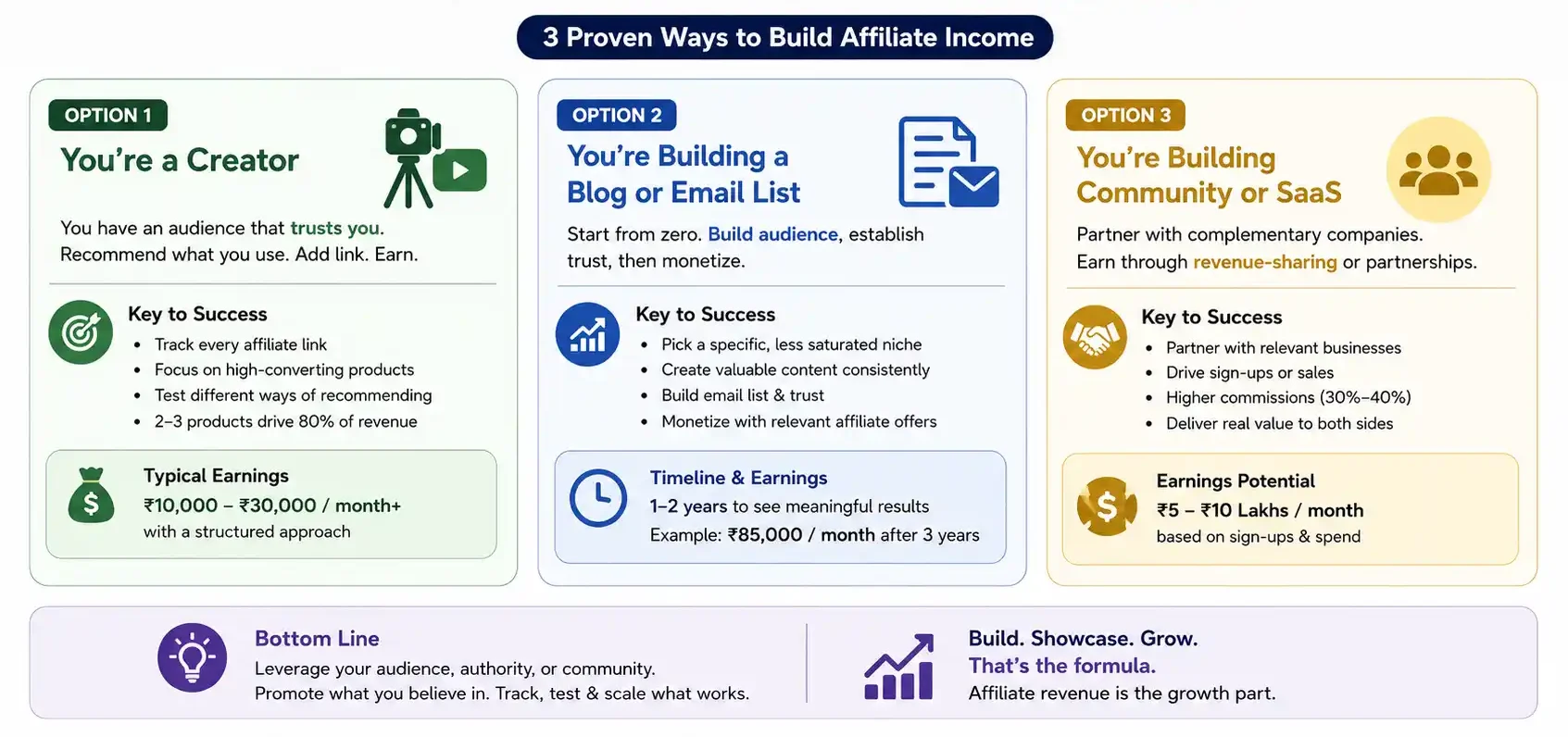
Three options:
Option 1: You’re a creator
You’ve got an audience. They trust you and already listen to what you say. This is the easiest path to affiliate revenue. You mention a product you actually use. You add an affiliate link in the description or comments. Some percentage of people buy. That is your commission.
The problem is that most creators don’t structure this properly. They add affiliate links haphazardly. They don’t track which products convert. They don’t test different ways of recommending things. They make a little each month and think that is the ceiling.
A structured approach: create a spreadsheet and track every affiliate relationship. Watch which ones convert, and promote the high-converting ones more actively. Test different ways of presenting them: in descriptions, in video, in pinned comments and in email lists. Most creators find that a few products generate most of the revenue. Focus on those and create dedicated content around them.
Option 2: You’re building a blog or email list
This is a harder path. You’re starting from zero and nobody knows you. So you need to pick a niche. Build an audience through content (blog posts, YouTube, TikTok, whatever). Establish trust. Then monetise with affiliate links.
Expect it to take a year or two before affiliate revenue becomes meaningful. Be strategic about your niche. “Personal finance in India” is saturated with people who have been building for years. “Indian expats building passive income abroad” is less saturated. Pick the specificity that lets you win.
We know someone (a client, Honest AI) who started a finance education blog focused on millennial investors. They built the email list slowly and promoted robo-advisors, tax software and investment courses. Not life-changing, but real money from something that started as a side project.
Option 3: You’re building a community or SaaS
Do you run a community (Slack group, Discord, Telegram, Facebook group) or a SaaS product? Then you can partner with complementary companies. This usually doesn’t involve affiliate links. It involves revenue-sharing or partnership arrangements. You get paid for customers you send who sign up. Commissions can be higher because the company is getting real value.
Here is a made-up example. A Slack community for indie hackers in India sends 200-300 sign-ups a year to certain dev tools. One tool pays them 40% commission on whatever those customers spend in year one. That could be 5-10 lakhs a month, depending on how many sign up and how much they spend.
Commission structures
Most people think affiliate marketing is about commission percentage. It is 10% vs 15% vs 30%. It sounds obvious that a higher percentage is better.
It is more complicated than that.
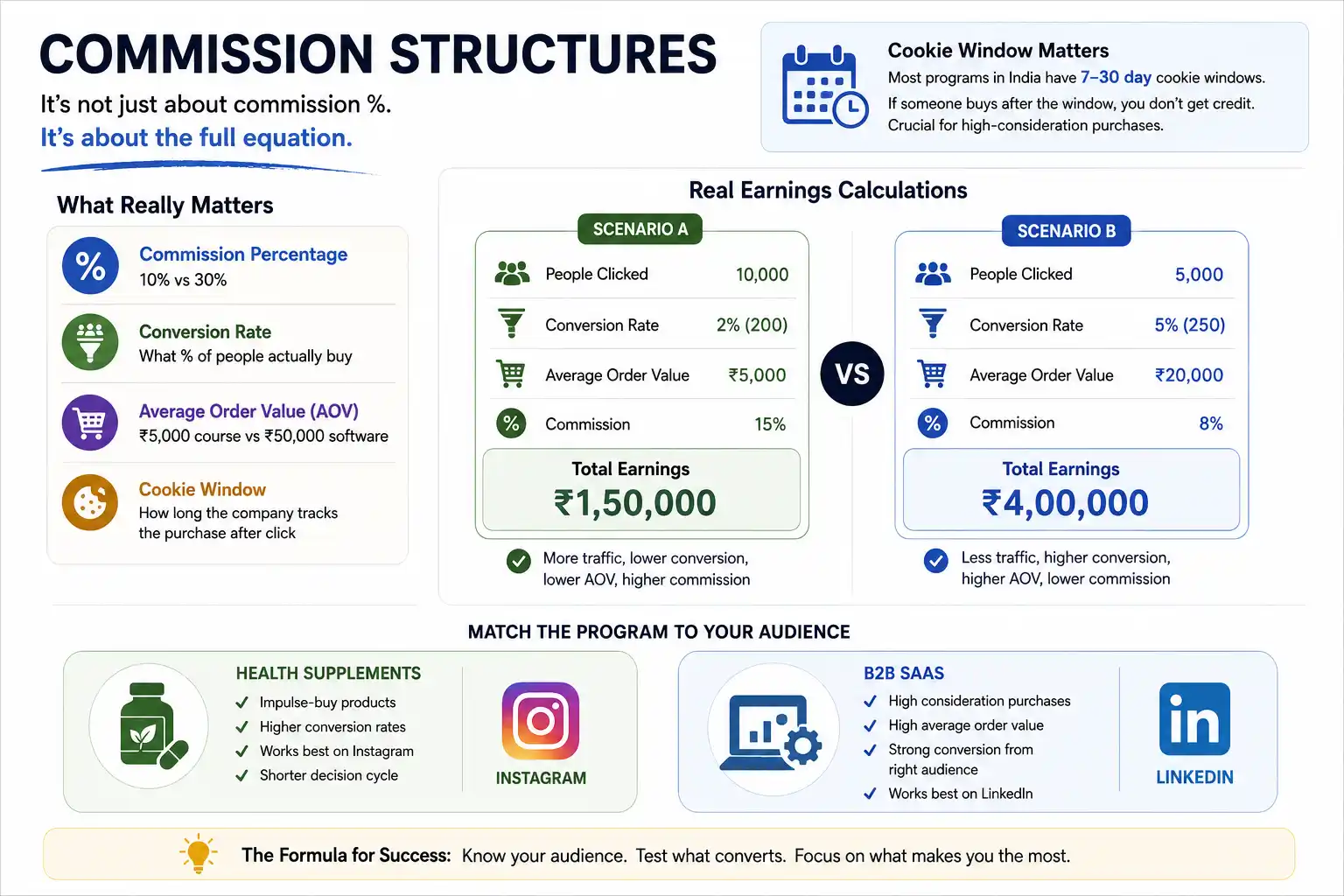
A 5% commission on something that converts at 10% is far better than a 30% commission on something that converts at 0.5%. So you need to think about:
- Commission percentage (10% vs 30%)
- Conversion rate (what % of people you send actually buy)
- Average order value (Rs 5,000 course vs Rs 50,000 software)
- Cookie window (how long after clicking your link does the company still credit you if they buy?)
Most affiliate programmes in India have short cookie windows. If someone clicks your link and buys 45 days later, you may not get credit. This matters a lot for high-consideration purchases like software or real estate.
So a real calculation looks like:
10,000 people click your affiliate link. 2% (200) actually buy. Average order value Rs 5,000. Commission 15%. Total: 200 × 5,000 × 15% = Rs 1,50,000.
Versus:
5,000 people click your affiliate link. 5% (250) actually buy. Average order value Rs 20,000. Commission 8%. Total: 250 × 20,000 × 8% = Rs 4,00,000.
Less traffic and a lower commission, but higher conversion and higher order value mean far more money.
This is why knowing your audience matters. Health supplement affiliate programmes love Instagram. It has high conversion on impulse products. B2B SaaS affiliate programmes prefer LinkedIn. It has high average order value and strong conversion from the right audience. You’ve got to match the programme to the audience that will actually convert.
The problem with promoting everything
Say you join 15 affiliate programmes and promote 15 different products. You get a small commission from each. No single product grows. Revenue stays between Rs 5,000-15,000 monthly and never scales.
This is where many affiliate marketers in India plateau and give up.
The better path is focus. Pick 3-5 products you actually believe in. Build real, honest relationships with your audience around those products. Go deeper with fewer products instead of broader with more.
Here is a made-up example of a health and wellness creator. She has maybe 4,000 monthly visitors to her site. She promotes 12 different supplement and fitness products. She makes about Rs 8,000 a month. Revenue is flat because no single promotion has any weight.
Suppose she focuses. She picks the three health supplements she genuinely uses and loves. She writes detailed reviews and compares them fairly against alternatives. She builds an email sequence around each. She stops promoting the other nine.
It takes two months for revenue to settle as the new content rolls out. By month four, she makes Rs 22,000 monthly from those three products alone. Her perceived authority is higher. Customers trust the recommendations more because there aren’t so many. Conversion goes up, and so does average order value (AOV).
Then she adds product number four (a fitness app she actually uses) and revenue jumps to Rs 31,000. Still only four products. The lesson is depth over breadth.
A campaign that looked good but wasn’t
Now a second made-up example. A creator has 250k YouTube followers on a finance channel. She has built an email list of 45,000 people. She wants to build affiliate revenue. She has good instincts.
She joined five financial SaaS affiliate programmes (investment apps, portfolio tracking tools, tax software). Commission rates were high (15-20%) and so was AOV (Rs 10,000-50,000 per signup or transaction). It seemed perfect.
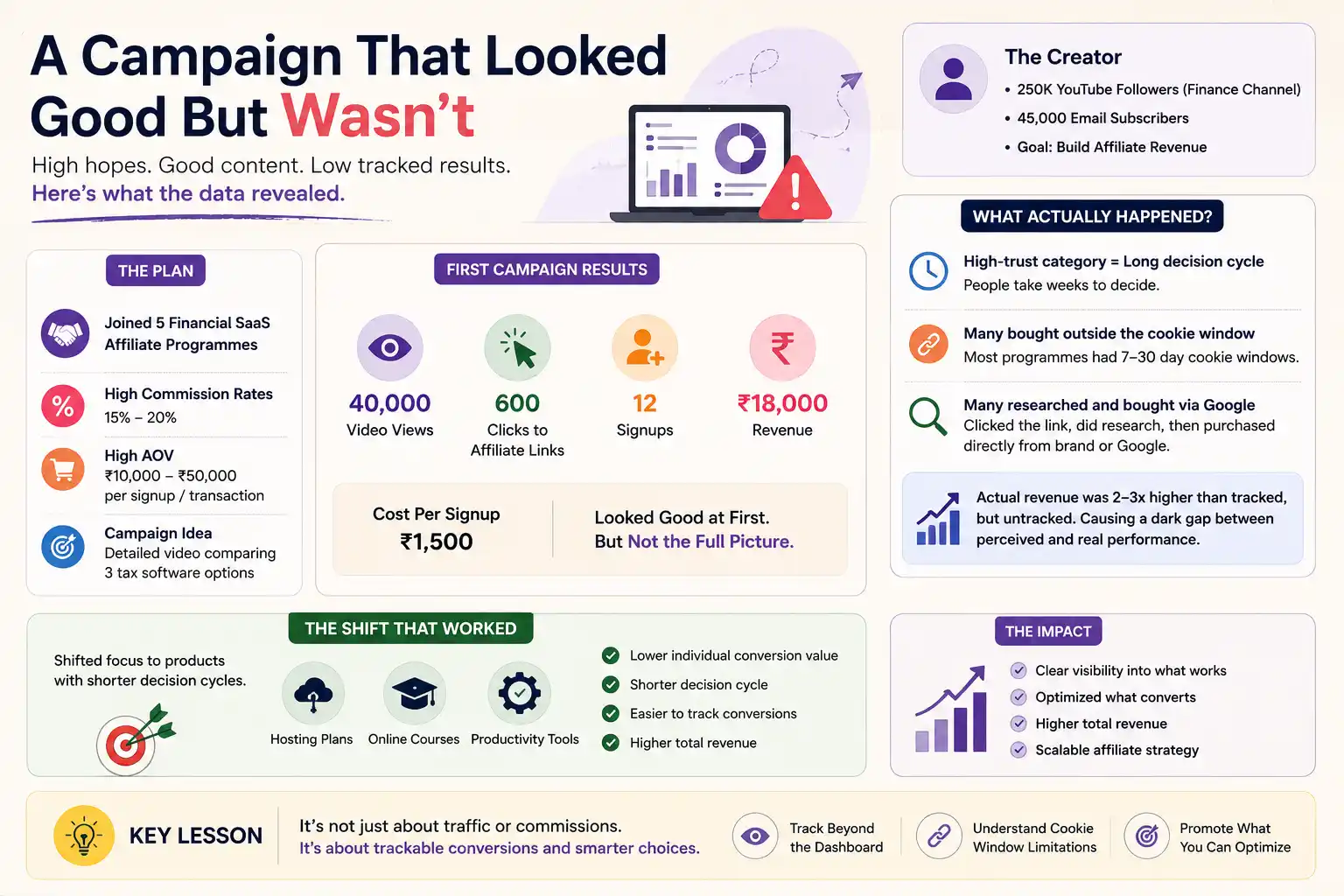
Her first campaign was a detailed video comparing three tax software options. It was genuine and honest about pros and cons, with affiliate links in the description. She expected high conversion given how specific and honest the video was.
The result: 40,000 video views, 600 clicks to affiliate links, and 12 people actually signed up. Revenue was Rs 18,000, about Rs 1,500 per signup.
It looked good at first. But then the creator checked the conversion data more carefully. Financial SaaS is usually a high-trust purchase. People click your link, then take weeks to decide. Many bought outside the cookie window. Others clicked, did their own research, then bought from a Google search instead of going back through the affiliate link.
Actual revenue was probably higher than what showed in the affiliate dashboard, but it was untracked. That created a gap between what she thought was happening and what was actually happening.
She moved to promoting products with shorter decision cycles. These were hosting plans, online courses and productivity tools. Conversion rates were lower individually, but at least they were trackable. Total revenue was higher because she could see what worked and do more of it.
Building your own affiliate network
This is a high-impact option that many people don’t think about.
If you’re a SaaS company, an online course or a physical product brand, you can build your own affiliate network. Get other creators and influencers to promote your product for commission.
It costs you a platform (Tapfiliate, impact.com, or even just a spreadsheet). It also costs some admin time and a commission on each sale.
The benefit is customer acquisition that can be far cheaper than ads. You only pay commission on sales, not on clicks, and you get access to the affiliates’ audiences directly.
Here is a made-up example. A D2C (direct-to-consumer) personal care brand starts an affiliate programme. It recruits 20 micro-influencers (10k-50k followers), three YouTube creators and five bloggers. The commission is 20% on sales. In the first month it makes Rs 80,000 in sales (Rs 16,000 of that goes out as commission). By month three it makes Rs 4,20,000 in sales (Rs 84,000 goes out as commission, which leaves Rs 3,36,000). It grows because the brand is deliberate about recruiting the right affiliates. These are people whose audiences match the brand.
Don’t open it to just anyone. Recruit affiliates who have your target audience, pay them fairly, and support them with content. Get them to actually promote, rather than just putting your link on their site and leaving it.
Tracking and analytics
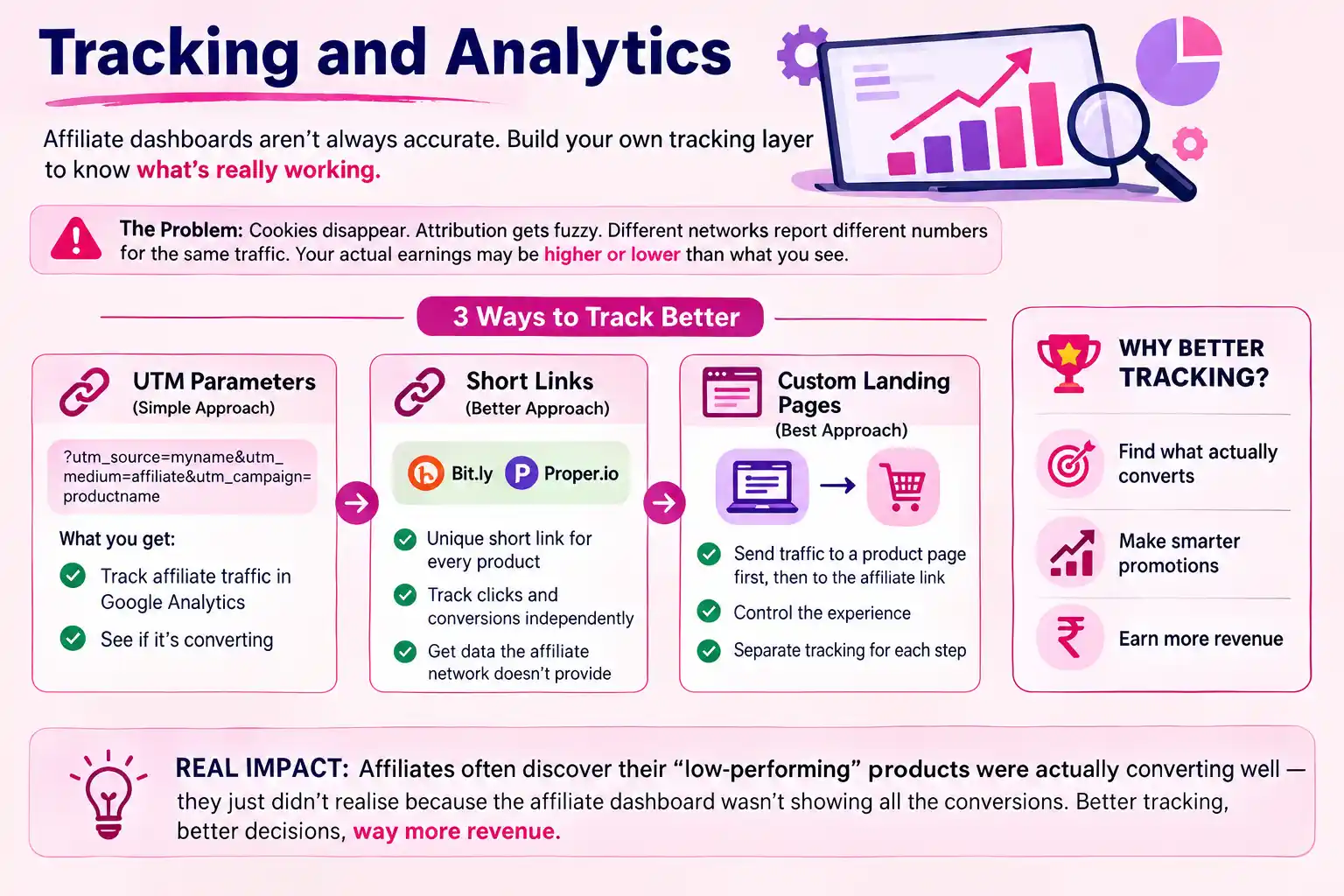
Affiliate network tracking isn’t perfect, which is frustrating. Cookies disappear. Attribution gets fuzzy. Different networks report different numbers for the same traffic.
This means your actual earnings are probably higher or lower than what you see in the dashboard. You need to build your own tracking layer.
A simple approach is UTM parameters. Add ?utm_source=myname&utm_medium=affiliate&utm_campaign=productname to every affiliate link. Then track in Google Analytics where your affiliate traffic is coming from and if it’s converting.
A better approach is short links (Bit.ly, proper.io) with your own tracking. Every product gets a unique short link. You track clicks and conversions independently. This gives you data the affiliate network doesn’t provide.
The best approach, if you’re running enough volume, is custom landing pages. Send traffic to a page about the product, and then to the affiliate link. This gives you control over the experience and separate tracking for each step.
Affiliates often find that their “low-performing” products were converting well. They just didn’t realise, because the affiliate dashboard wasn’t showing all the conversions. Better tracking leads to better decisions. This is why how to measure digital marketing ROI is essential reading for anyone running affiliate campaigns. Affiliate dashboards are a starting point, not a source of truth.
The reality check: when not to do affiliate marketing
Affiliate marketing in India makes sense if:
- You already have audience or authority (not starting from zero)
- Your audience trusts you and cares about recommendations
- You can recommend products authentically (not just for the commission)
- Your goal is to add to your existing income, not replace your day job
Affiliate marketing doesn’t make sense if:
- You’re starting from zero audience and expect to make money immediately
- You’re willing to be dishonest about products to earn commissions (your audience will notice and trust will drop)
- You think affiliate marketing alone can be your full-time income (it can, but it is rare and takes years)
- You’re in a niche with no affiliate programmes or low conversion potential
The people who make serious money from affiliate marketing in India have usually spent years building something else first. It may be a YouTube channel, blog, email list or community. Affiliate money is the cherry on top. If you don’t have the cake yet, focus on building that.
Integrating affiliate revenue into your broader strategy
This is where it gets practical. Affiliate marketing works best when it’s part of a bigger system.
Say you run a SaaS company and you want to build affiliate revenue alongside your direct sales. Or you’re a creator and you want to monetise beyond ads. Or you’re building a digital marketing presence and want multiple revenue streams.
The structure looks like:
Start with content (blog, YouTube, podcast, email). Then build an audience (email list, social followers). Then make direct sales or offers (your own product or service). Then add affiliate recommendations (complementary products to serve your audience better).
Most people reverse this. They start with affiliate links and wonder why nobody buys. Build the audience and trust first. Monetise second. This applies across content marketing, email marketing and the rest of digital marketing.
Want to explore affiliate strategy for your brand or audience? Maybe you’re a creator, a SaaS company or a brand thinking about this. Talk to our performance marketing team. We’ll help you work out whether affiliate revenue makes sense for your situation and how to structure it.
Where to start
Affiliate marketing in India works best as a real business, not a hunt for quick rewards. Success comes from patience, consistency and specificity, not volume or clever shortcuts. The brands succeeding with affiliate marketing in India are the consistent ones. If you’re looking to build an affiliate marketing strategy that drives steady growth for your business, talk to us.
Want to build affiliate revenue that actually grows?
PromotEdge helps creators and brands set up affiliate programmes that last. Whether you’re building an audience or running an established platform, we can help you earn from it.


