
























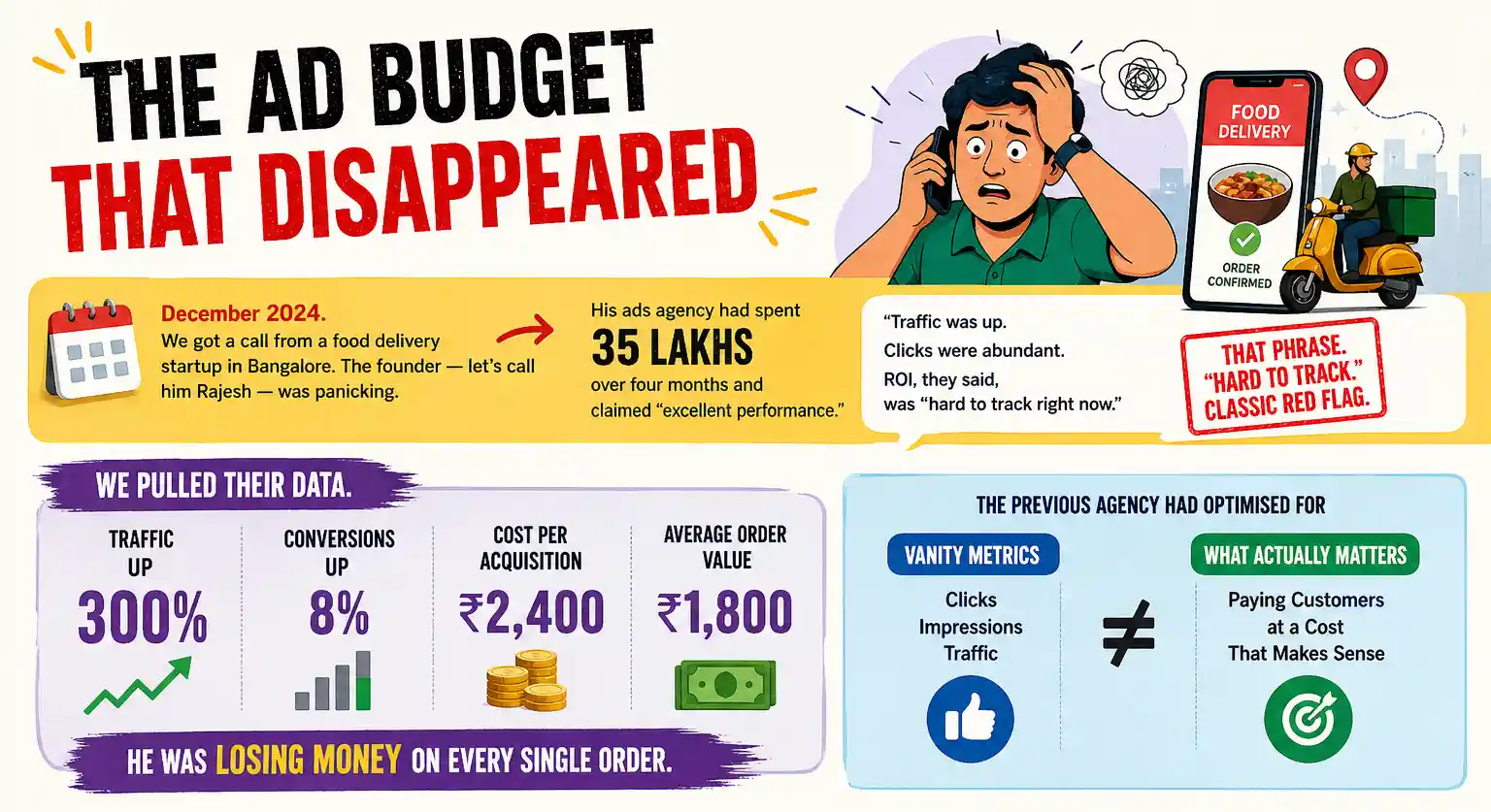
“Hard to track” is a classic red flag.
A data check showed the problem. Traffic was up a lot, but conversions barely moved. The cost per acquisition (what it costs to win one customer) was higher than the value of an average food order.
He was losing money on every order.
The previous agency had optimised for vanity metrics such as clicks, impressions and traffic, when what mattered was paying customers at a cost that made sense. That’s the difference between marketing and performance marketing. And most Indian businesses still don’t know the difference.
What performance marketing means (it’s smaller than you think)
“Performance marketing” gets thrown around so often that it now means almost nothing.
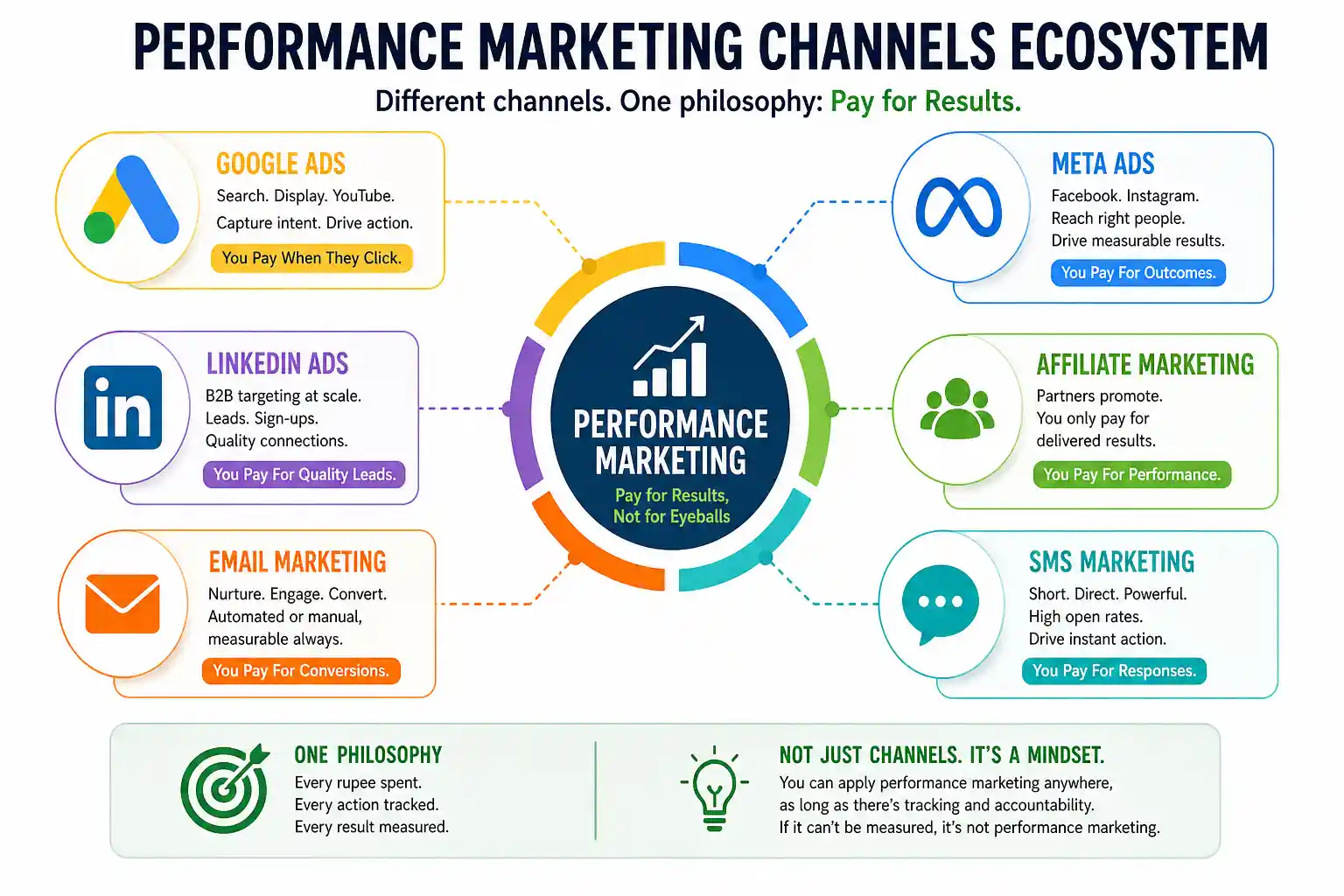
The tight definition is this: you set a specific action, such as a click, a form fill or a purchase, and you pay only when that action happens. You pay for results.
Brand marketing is different. You pay for awareness and “brand building”: you run a campaign, reach people and assume some of them will eventually buy.
Performance marketing leaves no room for assumptions. Every rupee has to tie to something measurable. We call this ROI first, always. At PromotEdge, every decision goes through that lens.
Most people think performance marketing is just Google Ads and Facebook Ads. Those are channels. Performance marketing is an approach, and you can apply it to email, affiliate networks, SMS and even old-school direct mail if you’re tracking responses.
These channels are where most businesses start because they offer real-time tracking and very precise targeting.
Google Ads vs. Meta Ads, and why the argument is pointless
Every new client asks: “Should we do Google or Facebook?”
Wrong question.
With Google Ads, someone is actively searching. They type “buy running shoes Bangalore” and your ad appears. Intent is high, because they are ready to buy. Conversion rates are usually higher, and cost per action tends to be lower because you’re not fighting for attention. But search volume has a ceiling. If only 2,000 people a month search for what you sell, that’s your limit.
With Meta Ads, someone is scrolling Instagram, minding their own business, and you interrupt them with a good image of your running shoes. Intent is lower and conversion rates are usually lower too. But you can reach millions of people. Cost per action might be higher, but volume makes up for it.
The answer to “which one” is both.
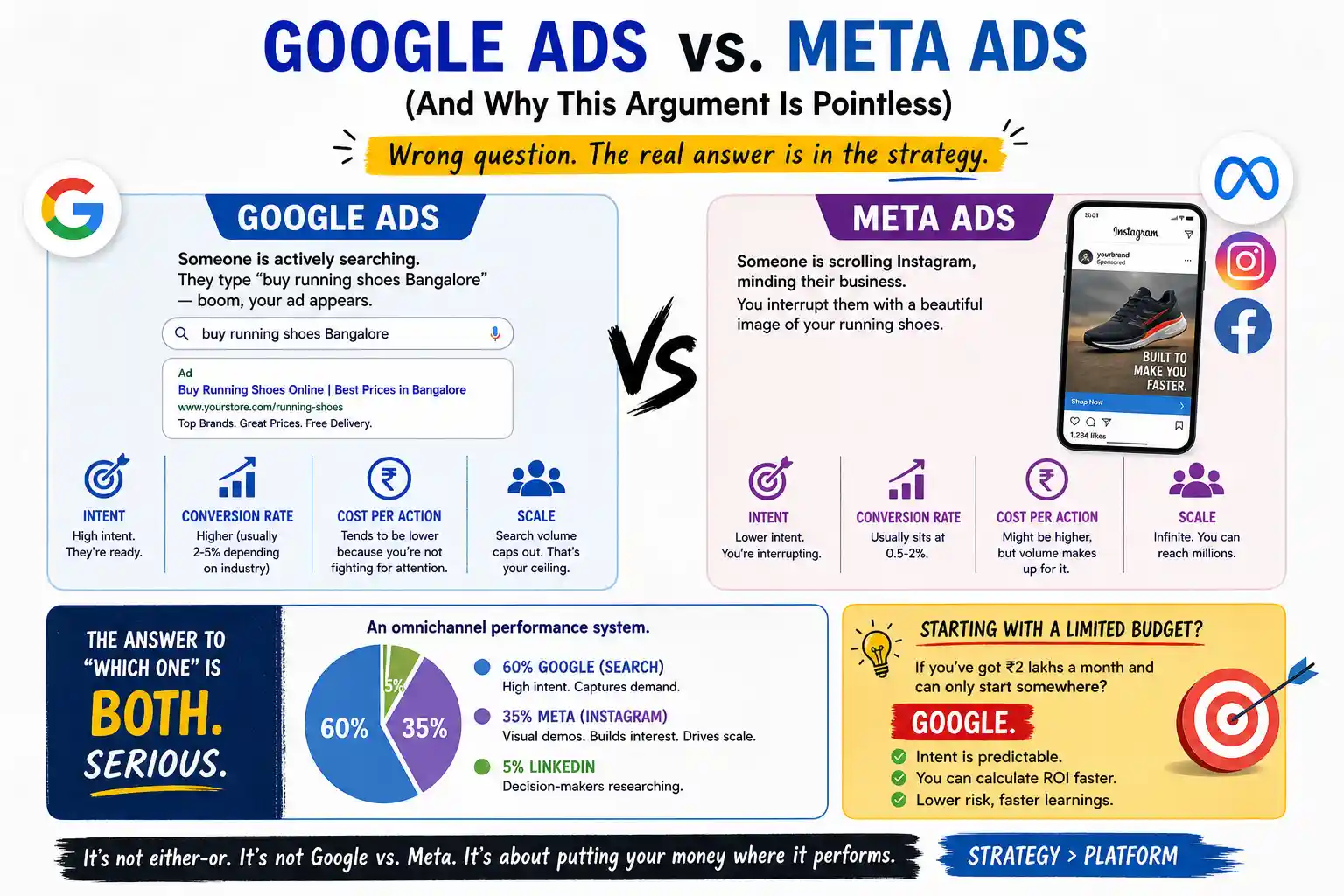
A SaaS (software as a service) client we work with gets most of its conversions from Google (search), a good share from Meta (Instagram for visual product demos) and a small share from LinkedIn (decision-makers researching). Together they work as one performance system.
If you have Rs 2 lakhs a month and can only start somewhere, start with Google. Intent is predictable, and you can calculate ROI faster.
Pricing models, and why your agency may have chosen wrong
CPC, CPM, CPA, CPL, ROAS, ROAC: the acronyms can become a way to hide weak results.
Here is what the main ones mean:
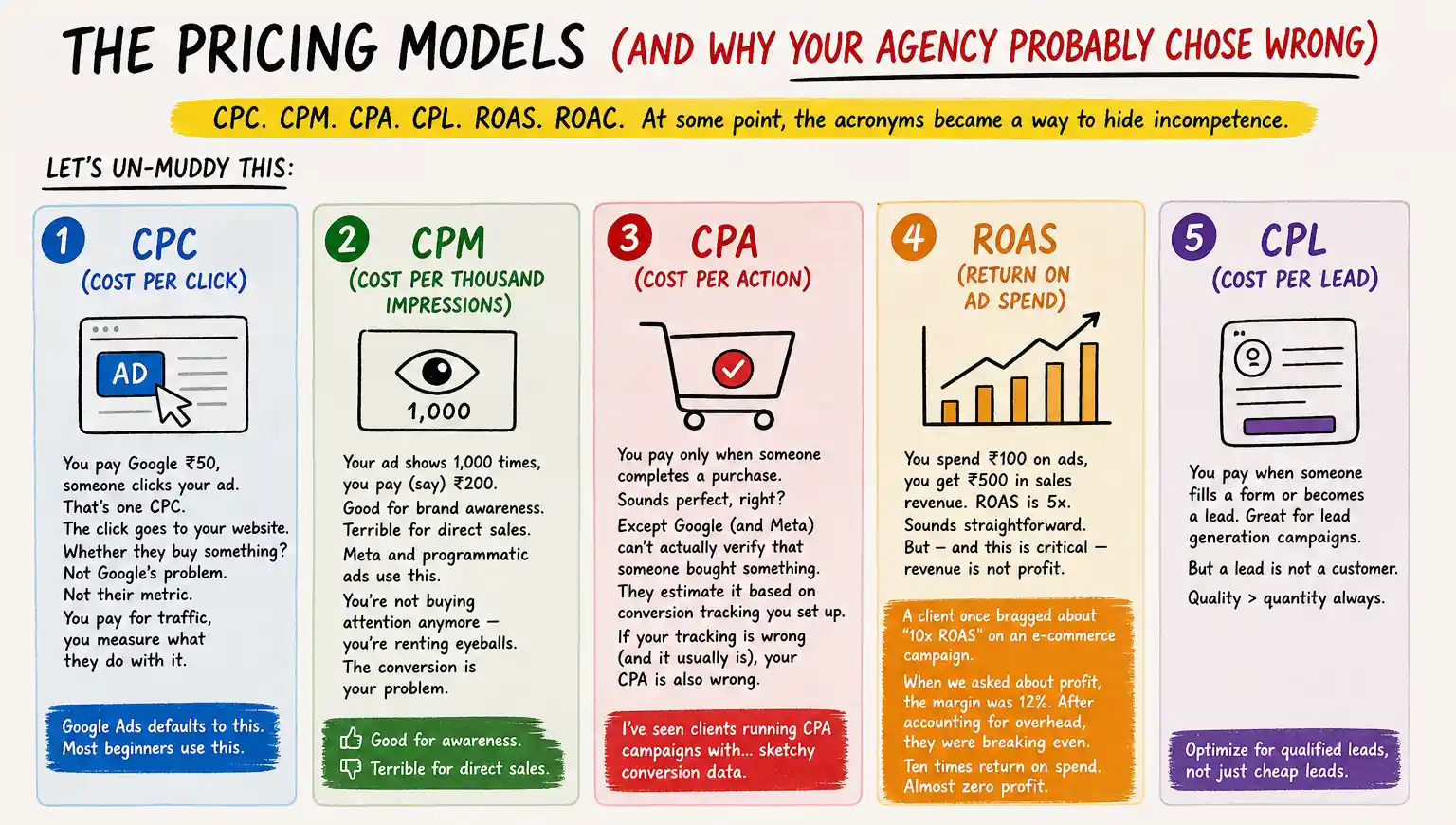
- CPC (cost per click)
You pay Google Rs 50 and someone clicks your ad. The click goes to your website. Whether they buy anything is not Google’s concern. You pay for traffic and you measure what visitors do with it. Google Ads defaults to this, and most beginners use it.
- CPM (cost per thousand impressions)
Your ad shows 1,000 times and you pay, say, Rs 200. This is good for brand awareness and weak for direct sales. Meta and programmatic ads use it. You are renting eyeballs, and the conversion is your problem.
- CPA (cost per action)
You pay only when someone completes a purchase. That sounds perfect, but Google and Meta can’t verify that someone bought something. They estimate it from the conversion tracking you set up. If your tracking is wrong, your CPA is wrong too, and tracking is often wrong. I’ve seen clients run CPA campaigns on unreliable conversion data.
- ROAS (return on ad spend)
You spend Rs 100 on ads and get Rs 500 in sales revenue, so ROAS is 5x. That sounds straightforward, but revenue is not profit. A client once bragged about a high ROAS on an e-commerce campaign. When we asked about profit, the margin was thin, and after overheads they were barely breaking even.
What should you use? CPA if you can track it accurately. ROAS if you’re smart about distinguishing revenue from profit. CPC if you want simplicity.
Budget: how much, and why most people get it wrong
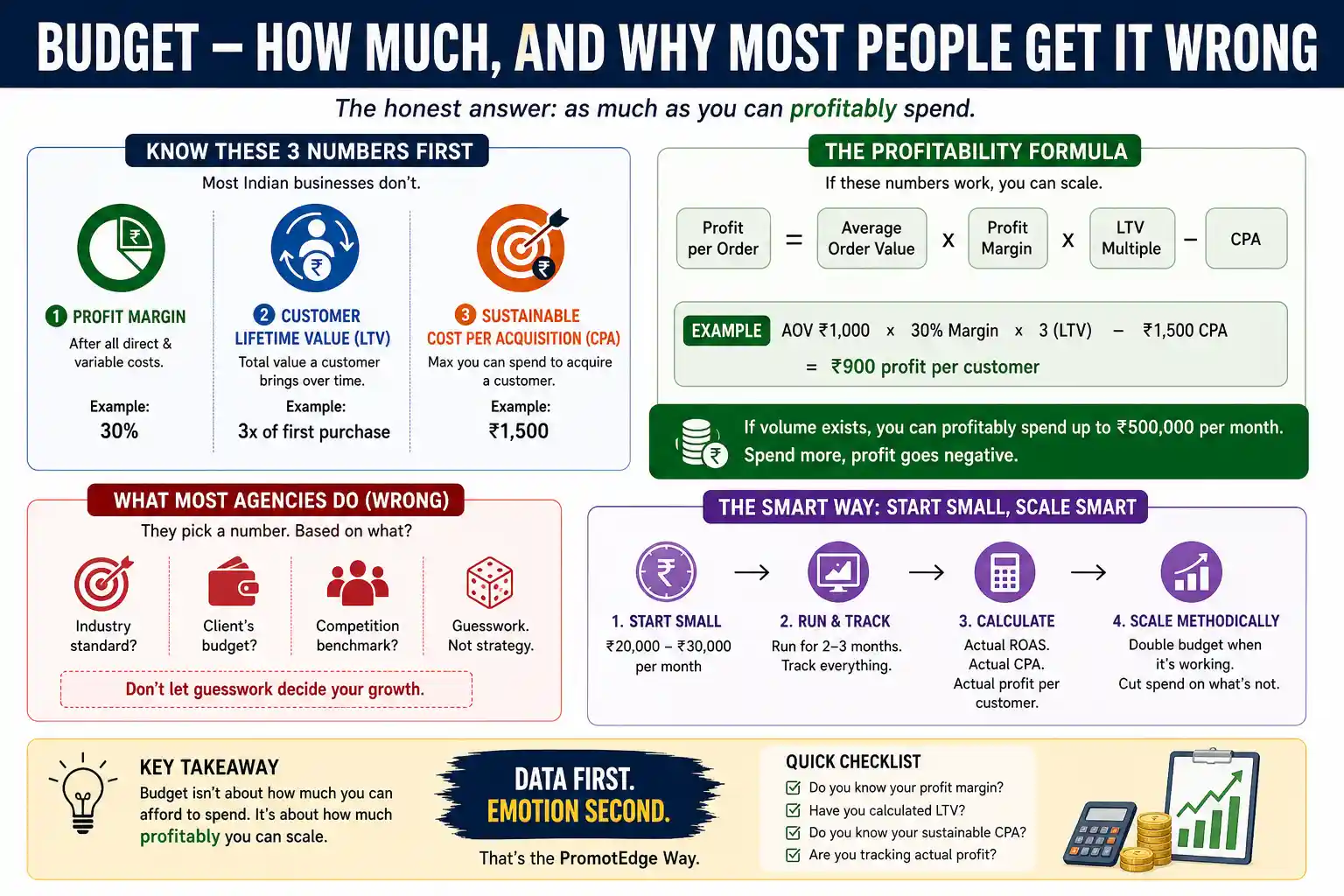
We get asked this constantly: “How much should I spend on ads?”
The honest answer: as much as you can profitably spend.
But that requires knowing three numbers: your actual profit margin, your average customer lifetime value (LTV) and your sustainable cost per acquisition. Many Indian businesses don’t know them.
If you’re selling items at 30% margin on an average order of Rs 5,000, your profit per order is Rs 1,500. With an LTV of 3x the first purchase, your lifetime profit per customer is Rs 4,500. That means your CPA can go up to Rs 1,500 and you still break even on the first order, with two more profitable orders to follow. If you’re acquiring 300 customers a month at that CPA, you can profitably spend up to Rs 4,50,000 a month. Scale the customer volume, scale the budget.
Many agencies don’t calculate this. They quote a number, like “Rs 1 lakh a month” or “Rs 5 lakhs a month”, based on an industry standard or the client’s budget. That is guesswork.
We recommend starting small, at Rs 20,000-30,000 a month, for 2-3 months. Track everything and calculate your actual ROAS, CPA and profit per customer. Then scale step by step: double the budget where it’s working and cut spend where it’s not.
That’s the PromotEdge way. As a performance marketing agency, we put data first and emotion second.
Attribution, or why you don’t know what is working
Someone sees your ad on Instagram. Doesn’t click. Next day, they Google your product name and click the Google Ad. They visit your website. That night they visit again directly from their bookmarks. Next day they buy.
Which channel deserves credit?
Google will say it was their search ad (last-click). Instagram will say it was them (first-touch). In reality all three helped, but platforms don’t think that way.
This is why attribution is so unreliable. Every platform claims credit for your conversions, and if your CRM (customer records system) isn’t connected correctly to your ad accounts, you’re flying blind.
We put UTM parameters (tags that show where a click came from) on every link and use Google Analytics 4 for basic tracking. The UTM-tagged links go into the CRM so we can see the full path. When a deal closes, we trace it back to the first, last and middle ad touches. It is imperfect and still more accurate than platform-reported metrics.
Some agencies just trust Google’s dashboard and celebrate rising “conversions” that are miscounted.
The work no one wants to do
Most performance marketing campaigns underperform because of the unglamorous stuff that nobody wants to spend time on.
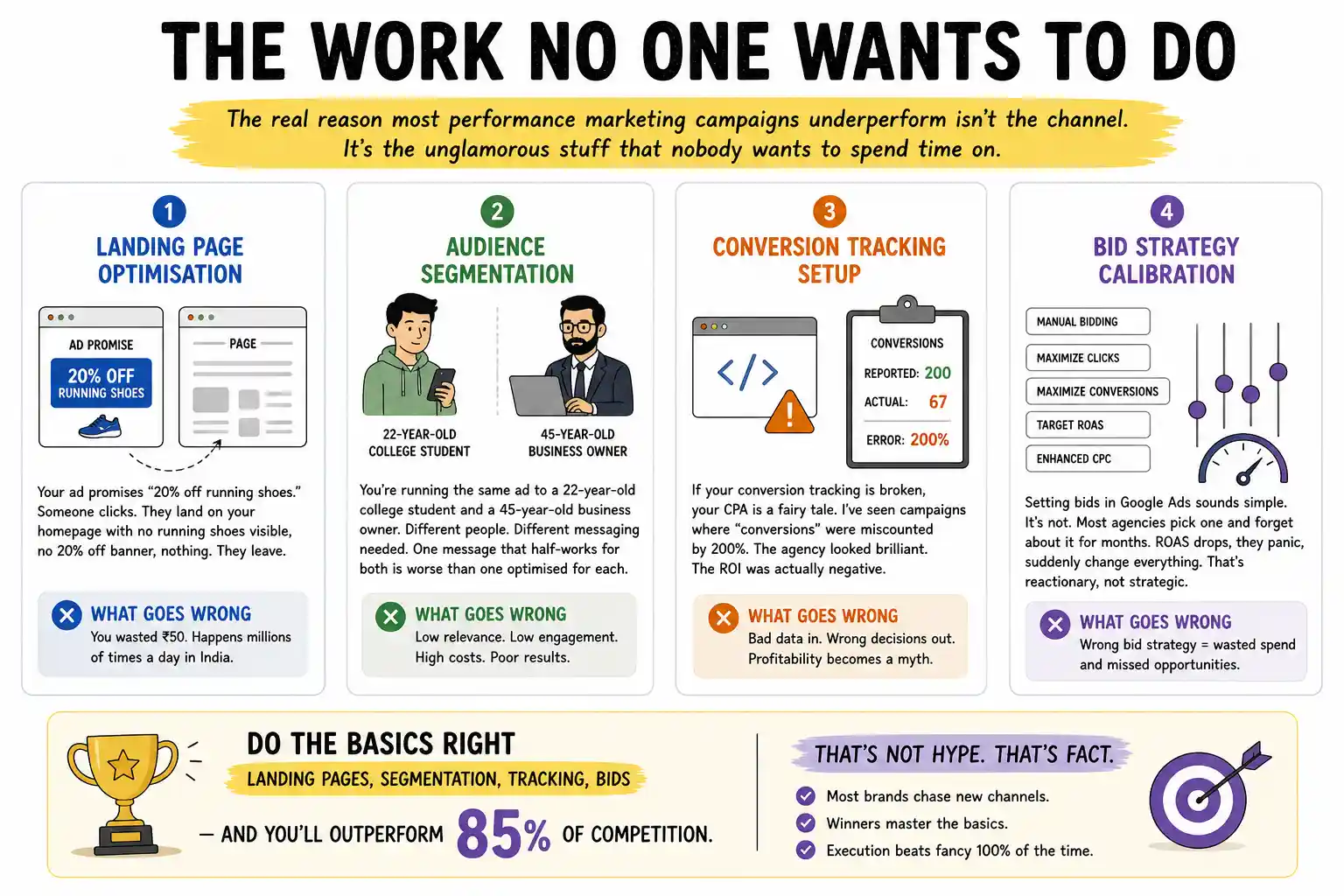
- Start with the landing page. Your ad promises “20% off running shoes.” Someone clicks and lands on your homepage with no running shoes and no 20% off banner. They leave, and you have wasted Rs 50. This happens all the time in India.
- Segment your audience. If you run the same ad to a 22-year-old college student and a 45-year-old business owner, you need different messages for different people. One message that half-works for both is worse than one optimised for each.
- Set up conversion tracking properly. If it is broken, your CPA is a fairy tale. I’ve seen campaigns where “conversions” were badly miscounted. The agency looked brilliant, while the ROI was actually negative.
- Get your bid strategy right. Setting bids in Google Ads sounds simple, but manual bidding, automated bidding, target ROAS and maximise conversions each have trade-offs. Some agencies pick one and forget about it for months. ROAS drops, they panic and change everything at once. That is reacting, not planning.
Do the basics right (landing pages, segmentation, tracking and bids) and you will outperform most of your competition.
When performance marketing makes sense (it’s not always)
This is the part some agencies don’t say.
Performance marketing doesn’t work for everything.
If your product has a 12-month sales cycle, and the average deal is Rs 50 lakhs, then a Google Ad that costs Rs 100 per click can be fine. A 0.2% conversion rate can still be profitable. But the feedback loop is slow, and you won’t know if your strategy works for eight months.
If your product is brand-new and people don’t know it exists, blasting them with ads might be premature. You might need brand awareness first, through traditional marketing, content and word-of-mouth.
If your market is tiny (say, industrial equipment for a specific niche), there might not be enough search volume to make Google Ads work.
In all these cases, performance marketing is a poor fit. We’ve turned down projects, even though it costs us revenue, because setting a client up for failure isn’t good for anyone.
Performance marketing works well when demand exists (people are searching), you have a clear conversion action (buy, sign up, submit a form) and profit margins allow for the CPA. Examples are e-commerce, SaaS with monthly fees and lead generation for high-ticket services.
The problems we’re still solving, because platforms aren’t
View-through conversions are no longer reliable.
Cross-device tracking is broken.
iOS attribution got much harder after Apple’s privacy changes. As a result, you can’t properly track conversions coming from iPhones.
Privacy regulations such as GDPR and India’s data rules make tracking harder every year. Third-party cookies are going away. Platforms are moving to first-party data and machine learning models that are unpredictable.
This is why the biggest shift right now is towards conversion-focused landing page design and pixel accuracy, which means making sure every conversion is tracked correctly. If you can’t trust the data, you can’t trust the ROI.
We build systems with specific web implementations to track conversion events more accurately than platform defaults. It takes work and the work is dull, yet it is what separates good campaigns from campaigns that only look good.
What gets measured gets done
It is a simple observation.
Performance marketing forces you to measure and question, so you know whether something worked or wasted money. That discipline is the whole value.
Some teams hate it. They say, “Everything needs a number? That kills creativity.” But creativity that doesn’t convert is art, and you don’t need an expensive ad campaign for art.
The clients who win at performance marketing embrace this mindset. They are building a system, not hunting for one killer campaign: test, measure, scale what works and stop what doesn’t, month after month.
It is dull work and a dependable path to steady growth.
Got a campaign that needs real ROI?
We’ve spent years untangling performance marketing myths for Indian brands. Many campaigns underperform because of three fixable things: tracking, landing pages and bid strategy. We help fix exactly those.


