
























Once content is flowing, focus on what drives discovery. That means thumbnails, keyword-rich titles and calls to action. They turn viewers into subscribers and subscribers into customers. Reply to comments and collaborate with creators in your space. Use YouTube’s own tools like Shorts, playlists and end screens to keep people watching longer. Brands that win on YouTube build trust over time. They show up, stay real and give value before they ask for anything.
A video with many views can still bring no business
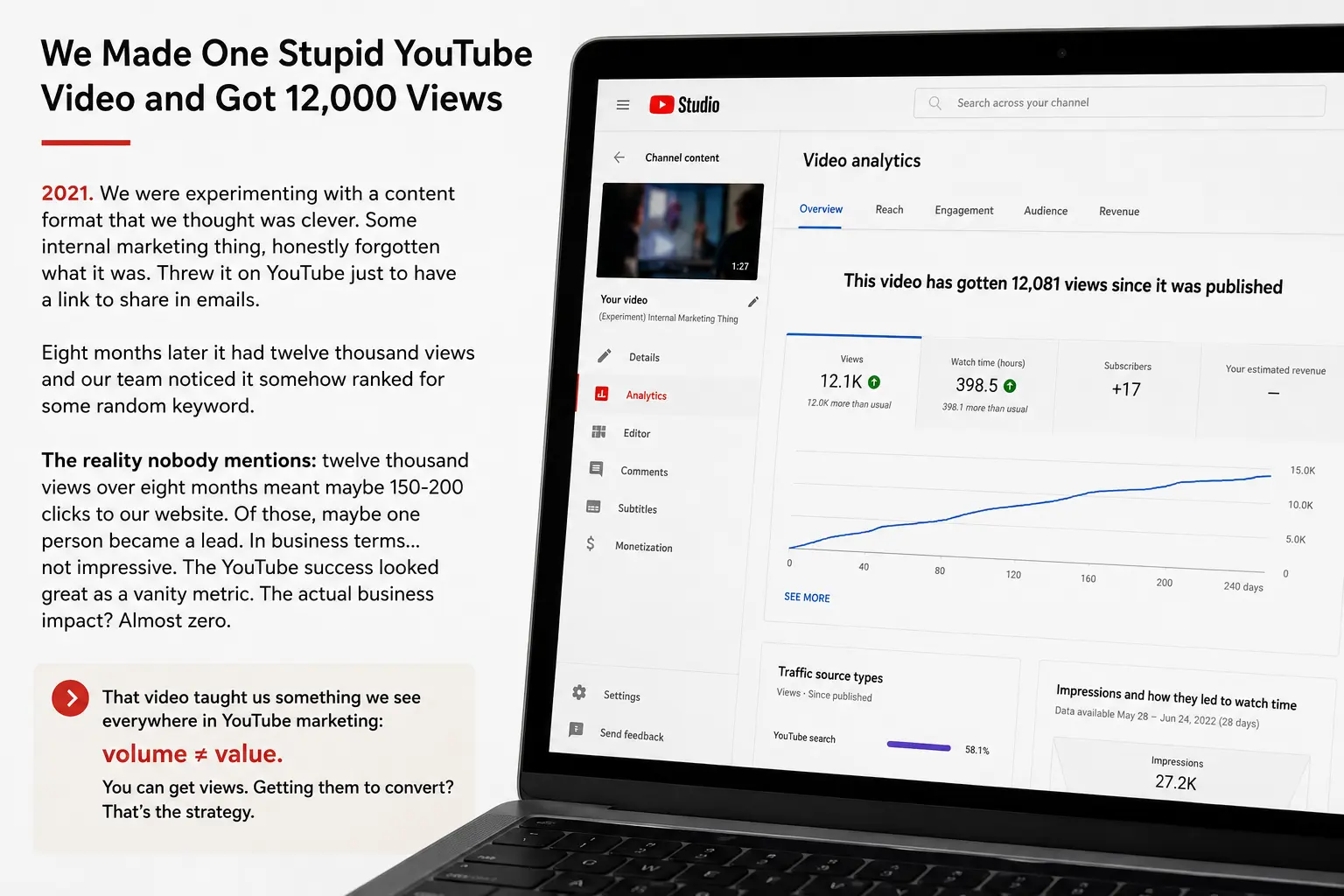
Here is a pattern we see often. A team makes a video just to have a link to share in emails, puts it on YouTube and forgets about it.
Months later the video has thousands of views, because it somehow ranked for some random keyword.
Look at the business side, though. Those views may send only a small number of clicks to the website, and hardly anyone becomes a lead. The video looks great as a vanity metric, but the real business impact is almost zero.
This is common in YouTube marketing: more views do not mean more value. You can get views. Getting them to convert? That’s the strategy.
Why YouTube matters right now (even though most businesses waste it)
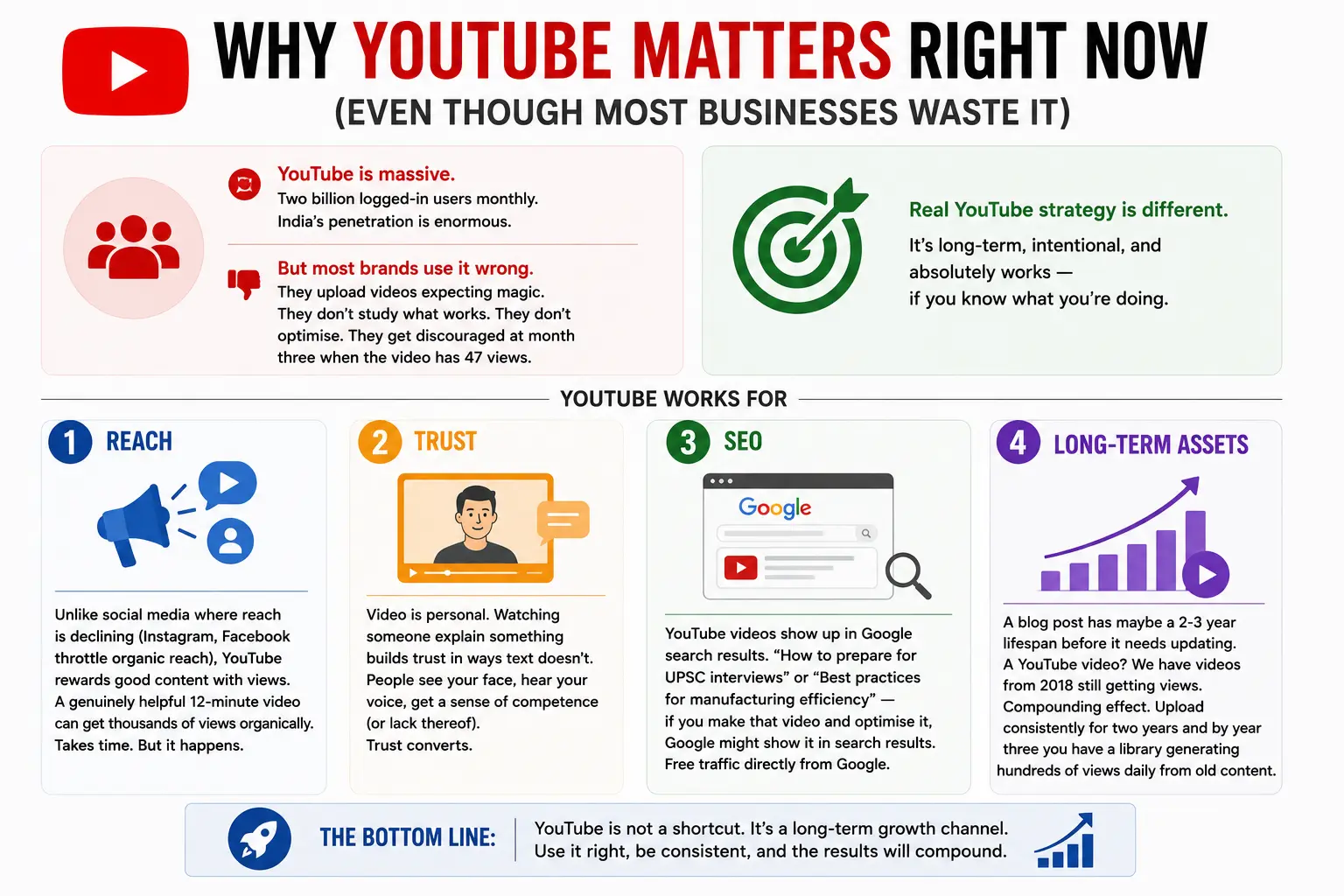
YouTube is massive, and India is one of its biggest markets. But most brands use it wrong.
They upload videos expecting magic. They don’t study what works. They don’t optimise. They get discouraged at month three when the video has 47 views.
Real YouTube strategy is different. It’s long-term, intentional, and it works if you know what you’re doing.
- YouTube works for reach
Social media reach is declining (Instagram, Facebook throttle organic reach). YouTube is different. It rewards good content with views. A genuinely helpful 12-minute video can get thousands of views organically. Takes time. But it happens.
- YouTube works for trust
Video is personal. Watching someone explain something builds trust in ways text doesn’t. People see your face, hear your voice, get a sense of competence (or lack thereof). Trust converts.
- YouTube works for SEO
YouTube videos show up in Google search results. Take “How to prepare for UPSC interviews” or “Best practices for manufacturing efficiency”. Make that video and optimise it. Google might show it in search results. Free traffic directly from Google. If you want to understand how search visibility works more broadly, our blog on whether SEO is still relevant in 2026 is a good read.
- YouTube works for long-term assets
A blog post has maybe a 2-3 year lifespan before it needs updating. A YouTube video? We have videos from 2018 still getting views. Compounding effect. Upload consistently for two years. By year three you have a library generating hundreds of views daily from old content.
How to create a YouTube strategy
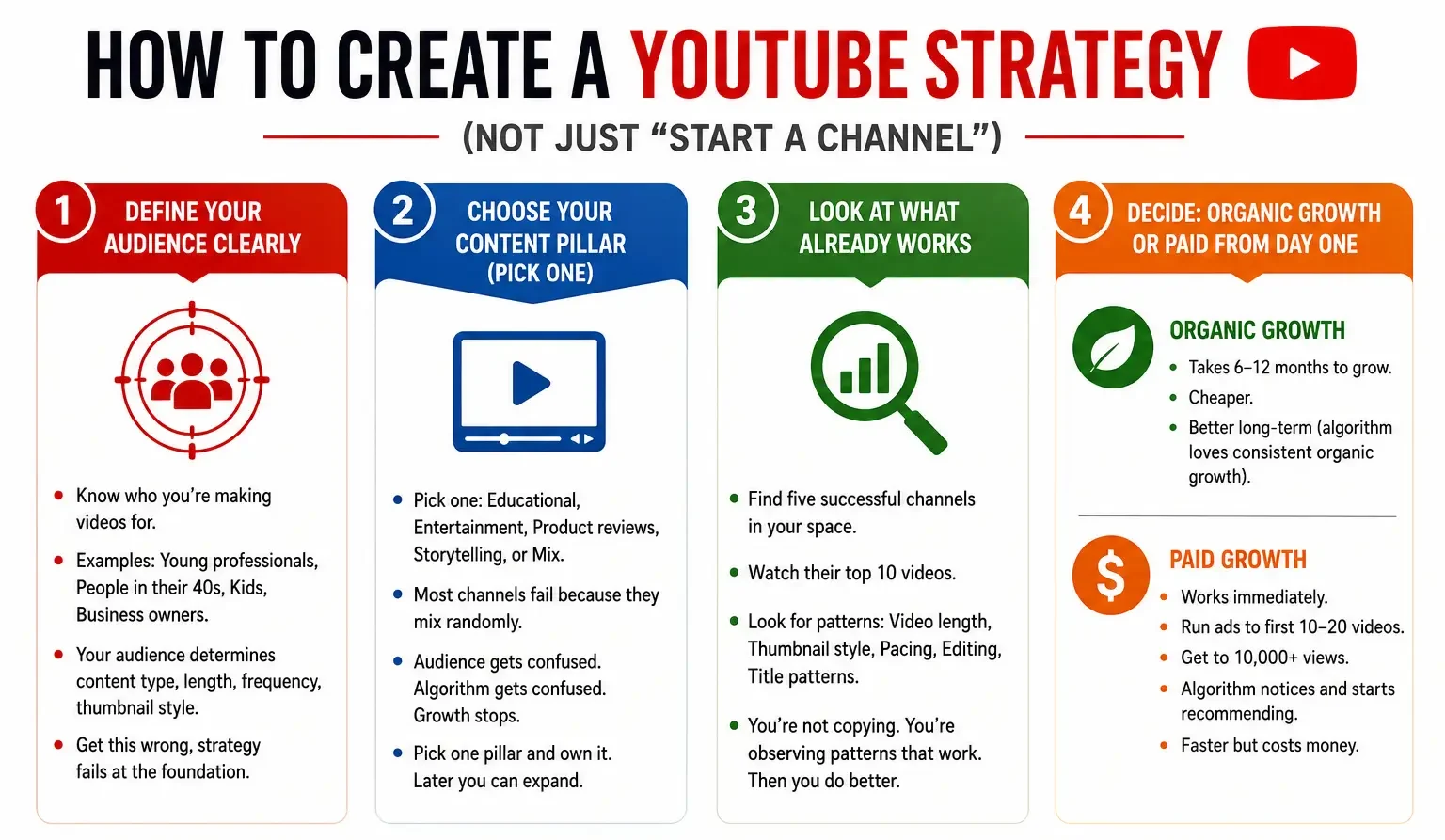
Most people skip straight to filming, but without a strategy, you’re just creating content and hoping for the best.
Step 1: Define your audience clearly
Who are you making videos for? Not “everyone.” That’s how you fail. Are you targeting:
- Young professionals in tier-1 cities learning new skills?
- People in their 40s researching products?
- Kids? (Different platform, different rules.)
- Business owners looking for B2B solutions?
Your audience determines everything. That includes content type, video length, upload frequency and thumbnail style. Get this wrong and your strategy fails at the foundation.
Step 2: Choose your content pillar (pick one)
Educational? Entertainment? Product reviews? Storytelling? Mix? Most channels fail because they mix randomly. Educational channel one week, entertainment the next. Audience gets confused. Algorithm gets confused. Growth stops.
Pick one pillar and own it. Later you can expand. Not now. This focus mirrors what we discuss in our guide on best digital marketing strategies: focus beats spreading yourself thin.
Step 3: Look at what already works
Find five successful channels in your space. They need not be competitors. They can be channels solving similar problems. Watch their top 10 videos. What’s common? Video length? Thumbnail style? Pacing? Editing? Title patterns?
You’re not copying. You’re observing patterns that work. Then you do better.
Step 4: Decide between organic growth and paid from day one
Organic takes 6-12 months to meaningfully grow. If you can wait, do organic. Cheaper. Better long-term (algorithm loves consistent organic growth).
Paid works immediately. Run ads to your first 10-20 videos. Get them to 10,000+ views. YouTube’s algorithm notices and starts recommending them organically. Faster but costs money.
Most successful channels do both: small ad spend on good videos + consistent organic uploads.
Content types that work on YouTube
These are the formats that tend to drive views, trust and leads.
- Educational content
“How to…” videos rank forever. “How to start a manufacturing business,” “How to optimise warehouse operations,” “How to train a sales team.” Educational content gets views years later.
- Case studies and transformations
These are story-driven. Show the before, the struggle, the solution and the after. People watch these, engage with them and share them. A student’s exam preparation story for an education brand is a good example. It is a slow burn, but the views are consistent.
- Expert commentary
React to industry news. Share opinions. This works for B2B more than B2C. A manufacturing expert may comment on industrial trends. That gets engagement from industry people. Narrow reach. High value audience.
- Product demos and unboxings
Show your actual product, how it works, its limitations, its benefits. Keep it real, not polished corporate speak. Just honest, creative presentation of facts.
- Behind-the-scenes
People are curious. Show how you work. Your office, your team, your process. Doesn’t need to be fancy. Just authentic. Builds connection.
YouTube content production that doesn’t kill your budget
You don’t need a production team. Seriously.
What you need: a camera (your phone works). You need decent lighting (window light or a cheap LED panel, Rs 2,000). You need a microphone (Rs 1,500 USB mic is fine). And you need editing software (DaVinci Resolve is free and professional).
Start there. Once you hit 50,000 subscribers and views are consistent, invest in better gear. Not before.
For production, these formats have worked for us:
- Talking head format (you, speaking to camera): cheapest and most authentic.
- Screen recording + voice-over (for tutorials): Effective for educational content.
- Slides + voice-over: Less engaging but still works if content is strong.
- Hybrid (some talking head, some B-roll): More engaging than pure talking head. Takes more time to film and edit.
Start with talking head. It’s fast. It’s authentic. It works.
YouTube SEO basics (making videos findable)
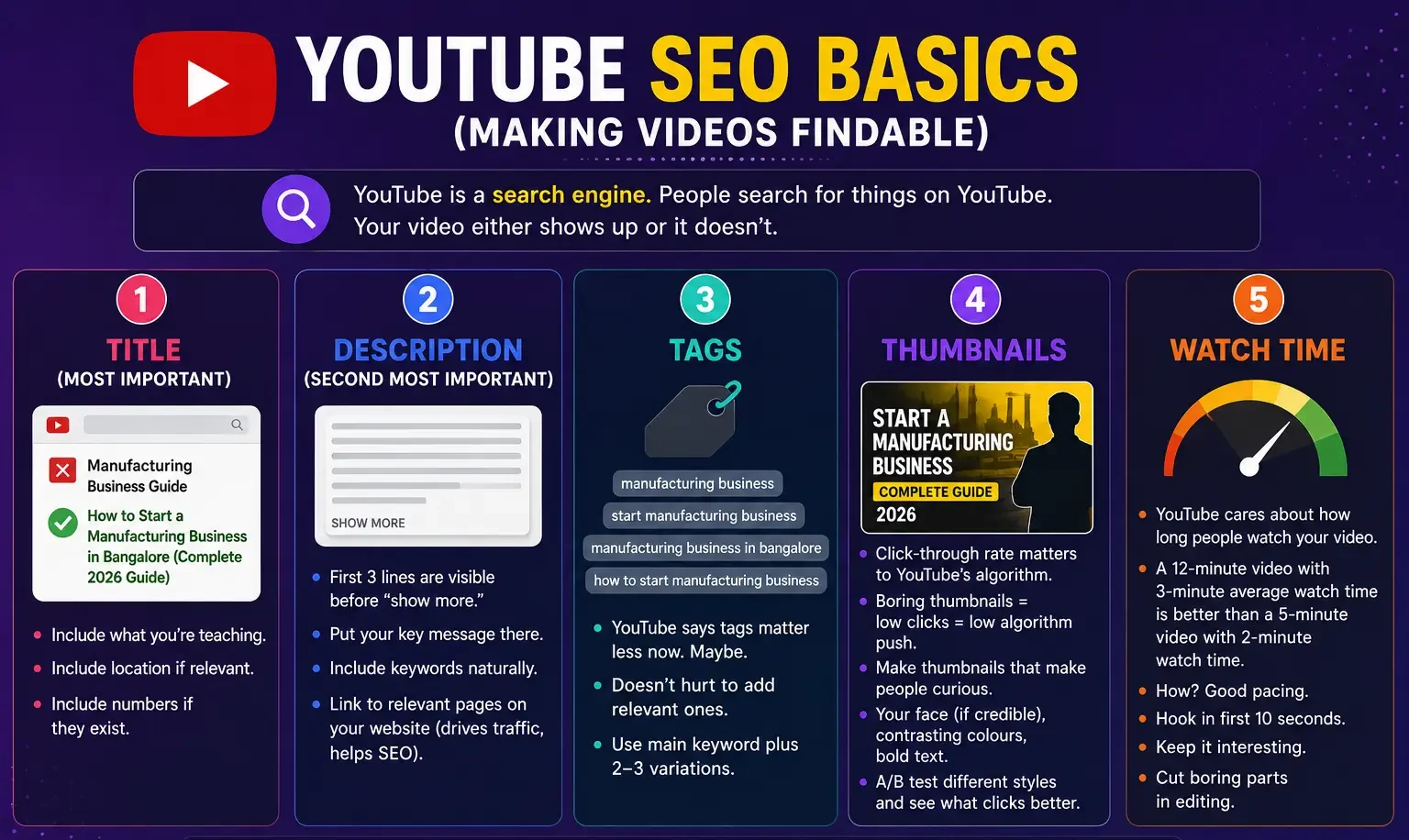
YouTube is a search engine. People search for things on YouTube. Your video either shows up or it doesn’t. Understanding YouTube SEO in depth will give you a serious edge here.
1. Title (most important)
“Manufacturing Business Guide” gets buried. “How to Start a Manufacturing Business in Bangalore (Complete 2026 Guide)” gets found. Include what you’re teaching. Include location if relevant. Include numbers if they exist.
2. Description (second most important)
First 3 lines are visible before “show more.” Put your key message there. Include keywords naturally. Link to relevant pages on your website (drives traffic, helps SEO).
3. Tags
YouTube says tags matter less now. Maybe. Doesn’t hurt to add relevant ones. Use main keyword plus 2-3 variations.
4. Thumbnails
Click-through rate matters to YouTube’s algorithm. Boring thumbnails = low clicks = low algorithm push. Make thumbnails that make people curious. Your face (if credible), contrasting colours, bold text. A/B test different styles and see what clicks better.
5. Watch time
YouTube cares about how long people watch your video. A 12-minute video with 3-minute average watch time is better than a 5-minute video with 2-minute watch time. How? Good pacing. Hook in first 10 seconds. Keep it interesting. Cut boring parts in editing.
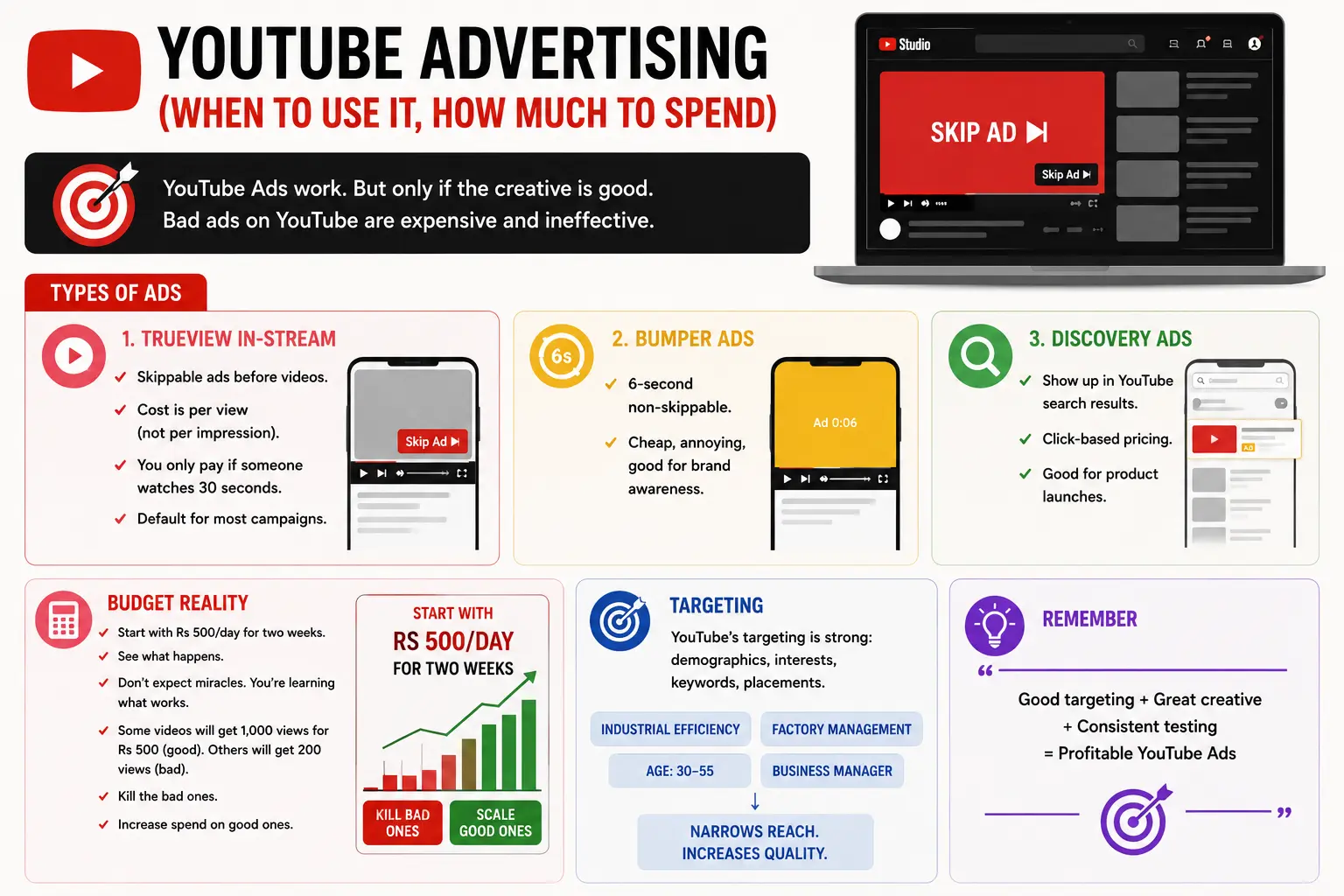
YouTube advertising (when to use it, how much to spend)
YouTube Ads work. But only if the creative is good. Bad ads on YouTube are expensive and ineffective.
Types of ads
TrueView in-stream ads are skippable ads before videos. Cost is per view (not per impression). You only pay if someone watches 30 seconds. Default for most campaigns.
Bumper ads are 6-second, non-skippable ads. Cheap, annoying, good for brand awareness.
Discovery ads show up in YouTube search results. Click-based pricing. Good for product launches.
Understanding how search advertising vs display advertising works will help you pick the right ad format for your goal.
Budget reality
Start with Rs 500/day for two weeks. See what happens. Don’t expect miracles. You’re learning what works. Some videos will get 1,000 views for Rs 500 (good). Others will get 200 views (bad). Kill the bad ones. Increase spend on good ones.
Targeting
YouTube’s targeting is strong. You can use demographics, interests, keywords and placements. A manufacturing company targets “industrial efficiency” and “factory management”. The age is 30-55. The title is business manager. That narrows reach. Increases quality.
How to measure YouTube success
Views are vanity. Traffic is real. Conversions are meaningful.
Track these numbers:
- Views: an okay metric, and a better one once you cross 5,000.
- Watch time: do people watch 50% of your video on average, or 10%? That matters.
- Click-through rate: what percentage of viewers click your website link in description?
- Website traffic from YouTube: use UTM parameters (?utm_source=youtube). They track how many website visitors came from YouTube.
- Conversions from YouTube traffic: of the YouTube visitors, how many converted (lead, purchase, contact)?
A video with 1,000 views and 10 website clicks is better than one with 10,000 views and 20 clicks. Because clicks lead to business. Views are just numbers.
One more reality check
YouTube marketing is not quick. A realistic timeline: in months 1-3 you’re learning and getting minimal traction. Months 4-6 you’re finding what works. Months 7-12 you’re seeing compounding growth. By year two you have something.
But here’s the trade-off. That channel keeps generating leads in year three and beyond without additional effort (just maintenance). Compare that to Google Ads which stop the moment you stop paying.
This is the long-term thinking that builds brands. Not sexy, but it works. Build your YouTube presence, show your expertise and let it grow over time.
Summary
Want a YouTube strategy that works?
PromotEdge works with education brands, manufacturing companies and service providers. We help them with their YouTube channels.


