
























The Question I Get Wrong Almost Every Time
And I usually say something clean. Marketing on Google. Social media ads. Email newsletters. All the tactics bundled together.
For an hour I’ve outlined why this definition lacks depth. Digital marketing is more than a collection of media to reach consumers. It works very differently from older ways of reaching customers. You identify consumers based on what they are searching for on search engines, websites and social media. You can even use a purchase made one month ago. You do not broadcast your message to everyone in the hope that one person listens. You reach people who have already shown interest in buying what you sell.
In contrast, traditional media such as print, TV & billboards advertise a company’s products to general consumers. Digital marketing lets you show ads to consumers in a specific city, based on their current location. For example, if you have been searching for ceramic tiles, you see third-party sites offering that product at the time requested.
Thus, the difference between the two mediums is greater than the medium itself.
Why we started PromotEdge in 2015
I’m 20-something, fresh out of college. My uncle ran a small electronics business. Good margins, but barely any customers came through the website he had built.
So I thought: let me run Google ads. A small spend brought a few enquiries, and some turned into orders. The sale paid back the ad spend many times over.
I showed my uncle the analytics: where the traffic came from, which keywords triggered the ads, how many people visited the product page. He said something I’ve never forgotten: “This is like magic. You know exactly where the customer came from.”
And that’s when I realized most Indian business owners had no idea this was possible. They were still spending money on Yellow Pages ads and billboards because that’s what they’d always done. Not because it worked.
The shift from “I hope people see this” to “I know exactly who’s seeing this and what they’re doing” is the entire revolution of digital marketing. Everything else is just tactics on top of that foundation.
The channels, without the boring textbook version
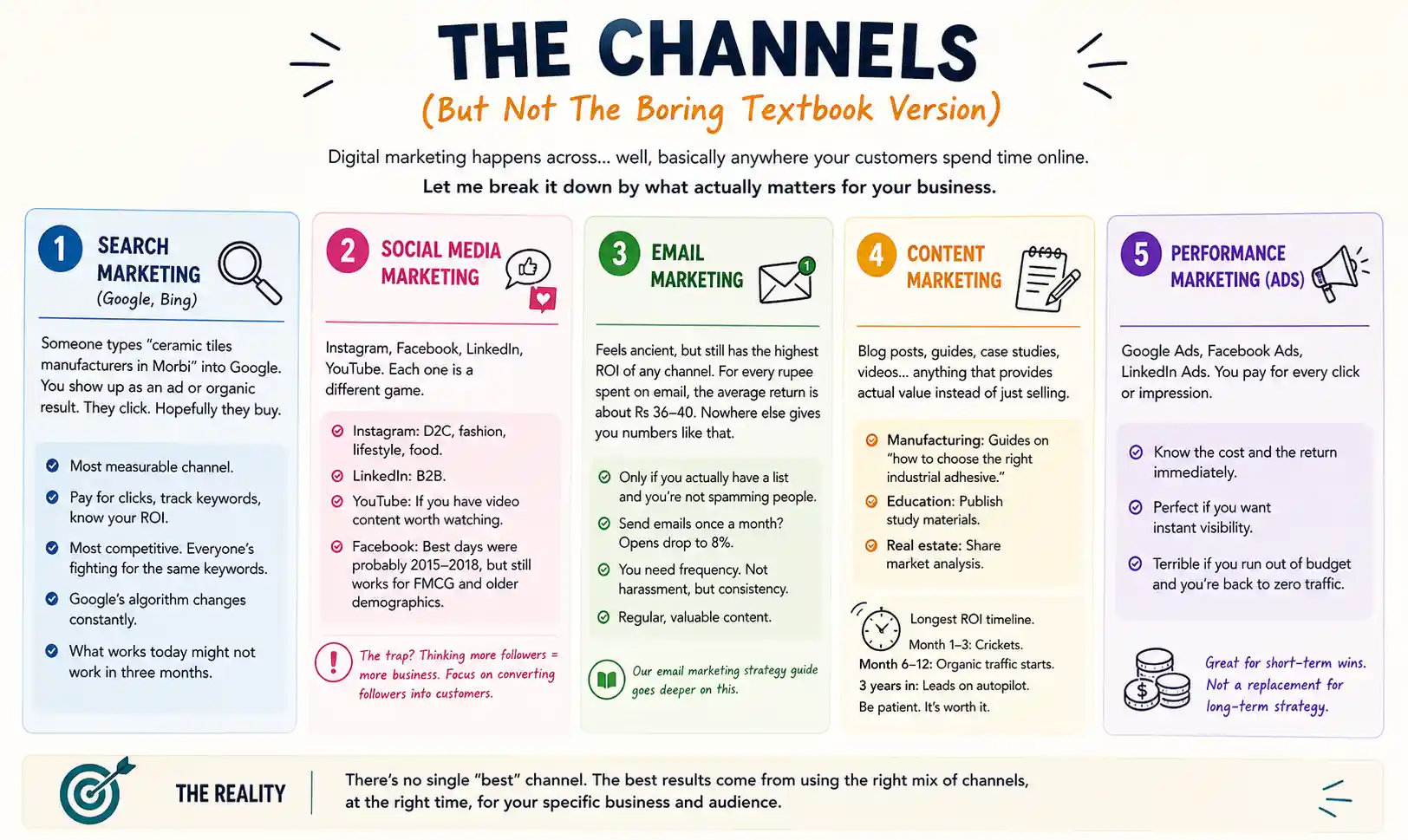
Digital marketing happens wherever your customers spend time online. Here are the channels that matter for your business.
1. Search marketing (Google, Bing)
Someone types “ceramic tiles manufacturers in Morbi” into Google. You show up as an ad or organic result. They click. Hopefully they buy.
This is the most measurable channel. You pay for clicks, track which keywords convert, and immediately know your ROI (return on investment). It is also the most competitive channel, because everyone is fighting for the same keywords. And Google’s algorithm changes constantly, so what works today might not work in three months.
2. Social media marketing
Instagram, Facebook, LinkedIn, YouTube. Each one is a different game.
Instagram works for D2C brands, fashion, lifestyle, food. LinkedIn for B2B. YouTube if you have video content that people actually want to watch. Facebook’s peak days were probably 2015 to 2018, but it still works for FMCG and older demographics.
The trap is thinking more followers means more business. A clothing brand can have 200k Instagram followers and still make minimal revenue. This happens if it focuses on engagement and pretty photos, not on turning followers into customers. Wrong game.
3. Email marketing
This feels ancient until you realise it still gives some of the highest returns of any channel.
But only if you actually have a list and you’re not spamming people. Some companies email their subscribers once a month and then wonder why opens drop. You need frequency. That means consistency and regular, valuable content, and no harassment.
Our email marketing strategy guide goes deeper on this if you want the tactical breakdown.
4. Content marketing
Writing blog posts, guides, case studies, videos… anything that provides actual value instead of just selling. A manufacturer could write guides on “How to choose the right industrial adhesive.” An education startup could publish study materials. A real estate developer could share market analysis.
This one has the longest ROI timeline. Month 1-3? Crickets. Month 6-12? You start getting organic traffic that doesn’t cost anything. Three years in? Your content is generating leads on autopilot. But you have to be patient enough to actually get there.
5. Performance marketing (ads)
Google Ads, Facebook Ads, LinkedIn Ads. You pay for every click or impression. You know the cost and the return immediately. Perfect if you want instant visibility. Terrible if you run out of budget and you’re back to zero traffic.
Why most businesses get this wrong (and how not to be that company)
Take a real estate builder of luxury homes in Bangalore. Say they have run Facebook ads for two years and spent lakhs of rupees. And they got only a handful of inquiries.
Why? They showed beautiful project photos to everyone in India. This included cities like New Delhi, Mumbai and Kolkata where they had no projects. They spent on engagement metrics (likes and comments) instead of getting leads. And they had no way of measuring whether people who clicked on their ads became leads.
Digital marketing is not “using digital channels and hoping”. It is a practical approach. Understand who you want to reach online. Measure what success looks like. Drop the tactics that do not work.
The fix is simple. Target only Bangalore and nearby cities. Focus on form submissions, not likes. Use performance marketing properly. Pay for the action you actually want, not just attention.
The strategy part: tactics without strategy are an expensive failure
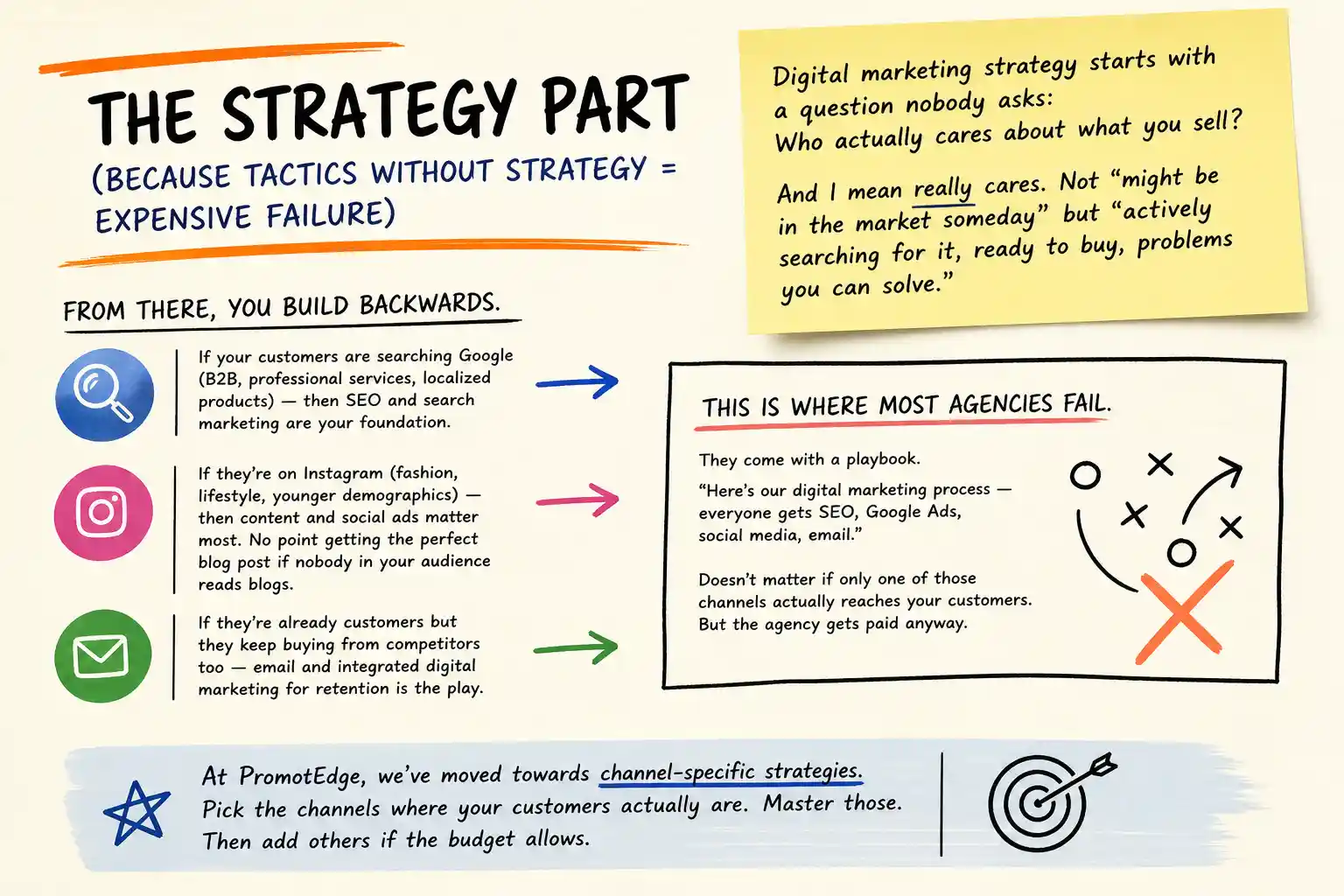
Digital marketing strategy starts with a question nobody asks. Who actually cares about what you sell?
And I mean really cares. Not “might be in the market someday” but “actively searching for it, ready to buy, problems you can solve.”
From there, you build backwards.
If your customers are searching Google (B2B, professional services, localized products), then SEO services and search marketing are your foundation.
If they’re on Instagram (fashion, lifestyle, younger people), then content and social ads matter most. No point getting the perfect blog post if nobody in your audience reads blogs.
If they’re already customers but they keep buying from competitors too, then email and integrated digital marketing for retention is the play.
This is where most agencies fail. They come with a playbook: “Here’s our digital marketing process. Everyone gets SEO, Google Ads, social media, email.” It doesn’t matter if only one of those channels actually reaches your customers. But the agency gets paid anyway.
At PromotEdge, we’ve moved towards channel-specific strategies. Pick the channels where your customers actually are. Master those. Then add others if the budget allows.
What happens when you do this right
Take a textile maker in Tirupur that makes fabrics for apparel brands. Usually nobody searches Google for them specifically. Their customers already know the major manufacturers.
But there is something to find. Young entrepreneurs starting fashion brands were searching “fabric suppliers bulk orders” and “how to find textile manufacturers.” There was search intent. There was demand. It was just hidden.
Build a content strategy around that. Guides for new apparel entrepreneurs. How to evaluate fabric quality. Bulk order processes. Landing pages optimised for conversion. Targeted ads for people searching those terms.
The first three months are slow: some marketing spend and almost no enquiries. Many businesses quit here.
Months 4 to 6 bring the first new clients.
By month 10, enquiries can come in without paid ads, and the ad budget can come down.
None of this is about being clever. It is about finding where actual demand exists, showing up there consistently, measuring what works, and having the patience to let it compound. Most businesses don’t have that patience. They want results in month 1. Digital marketing doesn’t work that way, except for paid ads, and those are expensive.
The metrics that matter
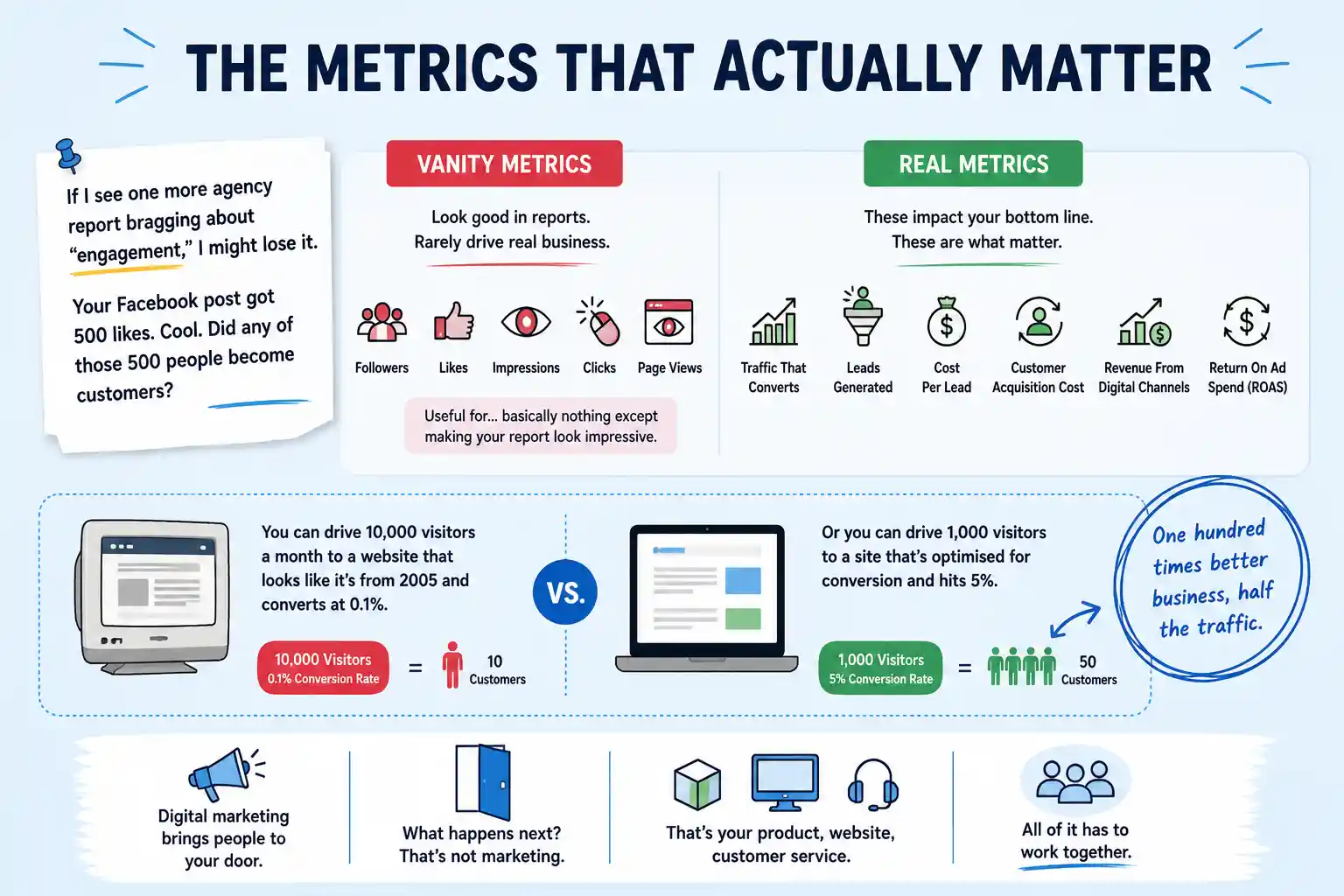
If I see one more agency report bragging about “engagement,” I might lose it.
Your Facebook post got 500 likes. Cool. Did any of those 500 people become customers?
Vanity metrics are: followers, likes, impressions, clicks, page views. Useful for… basically nothing except making your report look impressive.
Real metrics are: traffic that converts, leads generated, cost per lead, customer acquisition cost, revenue from digital channels, return on ad spend (ROAS).
This is where your website design and overall brand strategy matter. You can drive 10,000 visitors a month to a website that looks like it’s from 2005 and converts at 0.1%. Or you can drive 1,000 visitors to a site that’s optimised for conversion and hits 5%. Five times the customers from a tenth of the traffic.
Digital marketing brings people to your door. What happens next? That’s not marketing. That’s your product, website, customer service. All of it has to work together.
So, what is digital marketing?
It involves reaching someone who needs your product or service at the right moment with a specific message.
You can measure everything you do, from who clicked the ad to where they clicked it and what they bought. For every rupee you spend, there is an actual number attached to it (a return).
You can be flexible. You can start slow, test, learn quickly, and scale up when you find something that works. You can kill what doesn’t work.
It’s not magic; however, it is much better than running an ad in a newspaper and praying someone reads it.
Good digital marketing does not depend on the latest shiny tool or platform. They understand their customers and know where they spend time online. They deliver (continuously) what they want.
Once you have achieved this, measure, learn, and do more of what works.
The main thing we care about is ROI, and we remind ourselves of this in every strategy meeting. Everything else is background noise.
If you’re unsure whether digital marketing is a good fit for your business, call us and we’ll tell you honestly whether it is. Either way, contact us for your next step.
Ready to build a digital marketing strategy?
We work with brands across India. We’ll tell you honestly whether digital marketing fits your business. We’ll also tell you what channels matter most for your customers.


