
























Indians also check email heavily on mobile and during commute hours. If your email isn’t mobile-first, with a clean layout and fast-loading images, it gets deleted before it is read.
Indian customers buy trust along with the product. They want to know there’s a real person on the other side who will pick up if something goes wrong. So show them reviews from people who look and sound like them.
Mention COD (cash on delivery) if you offer it. It still matters a lot. Tell them your WhatsApp support number. Make them feel like they’re getting a deal their neighbor doesn’t know about yet. Segment your list, speak to people in their context, and stop treating your entire customer base as one giant blob. Do that, and your emails will get opened and make you money.
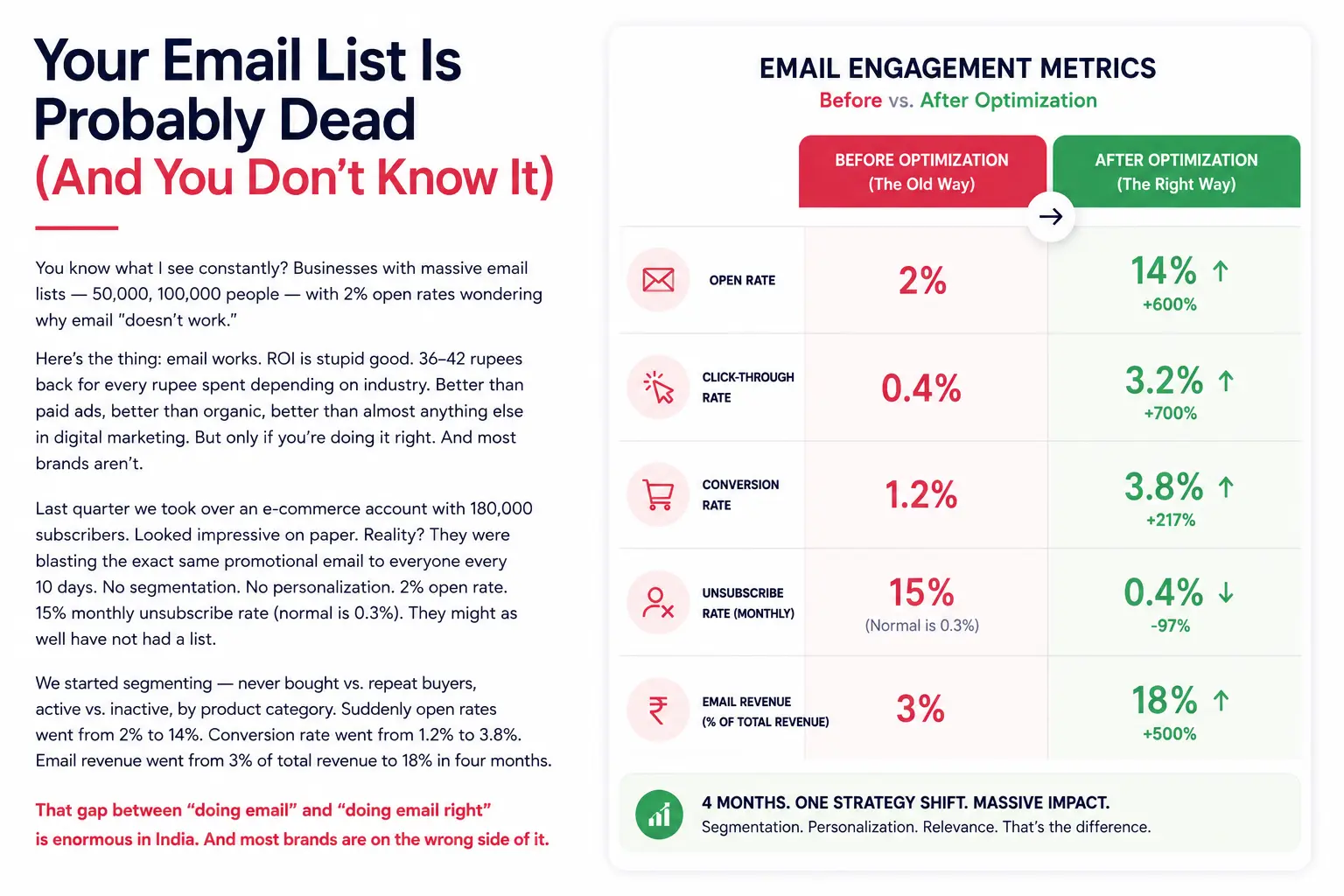
Your email list is probably dead (and you don’t know it)
We often see businesses with massive email lists, 50,000 or 100,000 people, and 2% open rates, wondering why email “doesn’t work.”
Email works. Its ROI (return on investment) is very strong, and often better than paid ads or organic reach. That’s why many businesses include it as a core part of their digital marketing services. But only if you’re doing it right. And most brands aren’t.
Picture an e-commerce brand with 180,000 subscribers (a made-up example). It looks impressive on paper. In reality, it sends the exact same promotional email to everyone every 10 days. No segmentation. No personalization. A 2% open rate and a very high unsubscribe rate. It might as well have no list.
Now start segmenting: never bought vs. repeat buyers, active vs. inactive, and by product category. Open rates, conversions and email revenue all improve, because each person gets something relevant.
That gap between “doing email” and “doing email right” is enormous in India. And most brands are on the wrong side of it.
First, do you actually have a real list?
This matters way more than the number.
50,000 emails with 2% open rate is worse than 500 emails with 45% open rate. I’d take the small engaged list every time. Actually converting 225 people is better than technically reaching 50,000 who don’t care.
Audit your list right now:
How many bounces? More than 5% is a problem. Dead emails, spam traps, fake addresses in there.
What’s unsubscribe rate? 0.5% is fine. 1% is concerning. 2%+ means something’s wrong: frequency, content, or you’re sending to people who never opted in.
Who actually opens? If it’s below 8%, your list is cold or your subject lines are terrible. Probably both.
In India especially, people have options. WhatsApp, SMS and notifications mean email isn’t the only channel. But if someone opened your last three emails, they’re interested. If someone hasn’t opened in six months? They’re gone and taking up space.
A small engaged list beats a large cold list every single time. ROI, unsubscribe rates and sender reputation are all better with quality.
Building a list that works
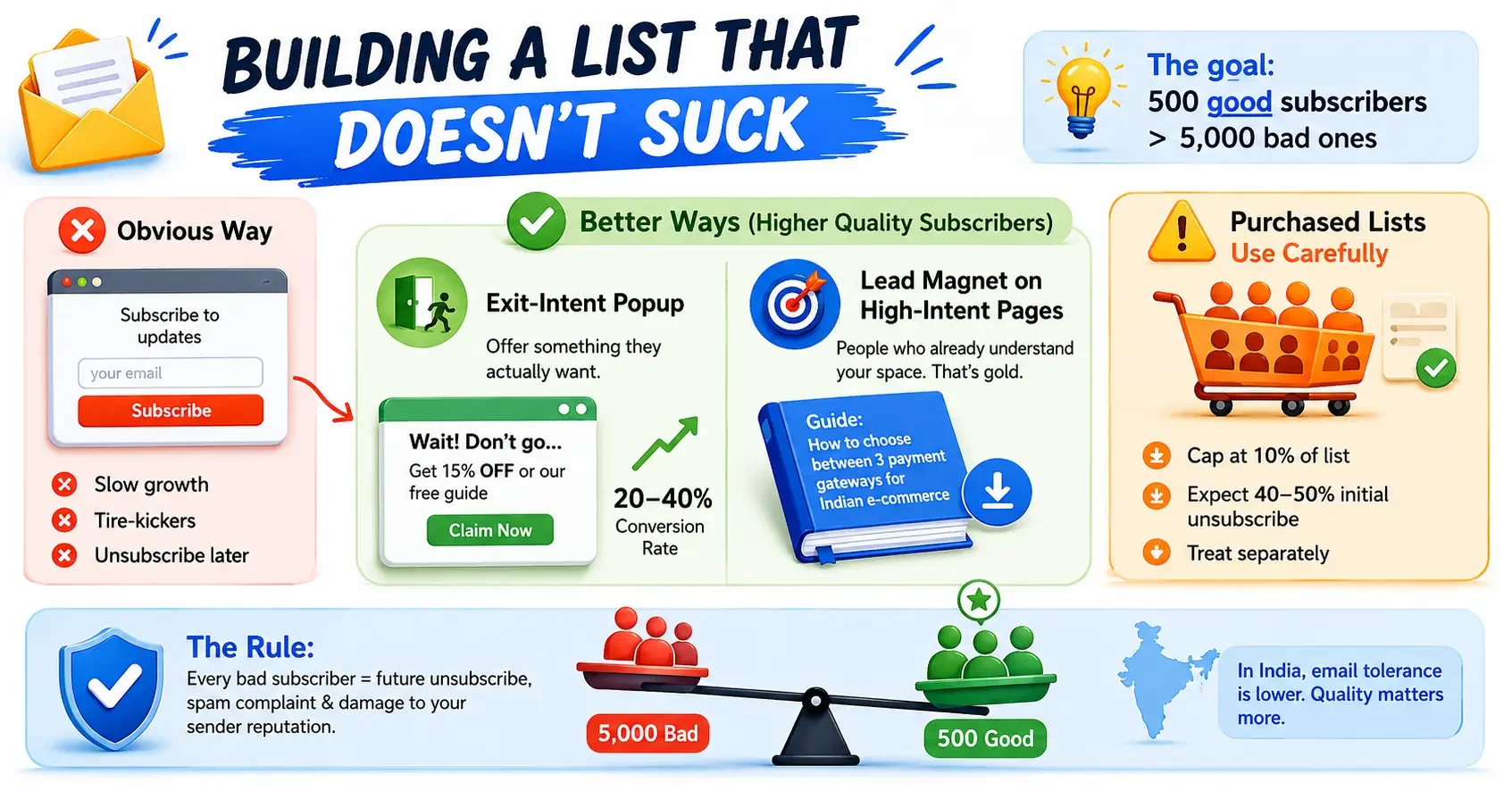
Obvious way: form on your website. “Subscribe to updates” or “Get 10% off” or something. Slow. You get tire-kickers who just want the discount then unsubscribe.
Better ways:
Exit-intent popup. Someone’s leaving your site. Offer them something they actually want: a guide, 15% off, access to a webinar. Subscribers are better quality because they went out of their way.
Lead magnet on high-intent pages. Product page, pricing, comparison guide. “Download our guide: How to choose between these three payment gateways for Indian e-commerce.” You get people who already understand your space. That is very useful.
Take a SaaS company (a made-up example) with a generic “subscribe” button. Build a specific lead magnet instead: “Comparison: Our tool vs Competitor A vs Competitor B.” The people who download it already understand the problem, so they respond far better when the nurture sequence goes out.
Purchased lists. These are controversial and risky if you’re not careful: spam complaints and low engagement are common. If you’re smart about it (verified Indian audience, recent data), it can work. Cap purchased growth at a small share of your list and treat it separately. Expect many unsubscribes at first, then it settles.
The rule: grow by 500 good subscribers instead of 5,000 bad ones. Every bad subscriber is a future unsubscribe, a spam complaint, damage to your sender reputation. In India where tolerance for email is lower, this is extra true.
Segmentation is where the real money is
You have a real list. Now what?
If you email everyone the same thing, you’ve already lost.
Someone who’s never bought shouldn’t get the same email as someone who’s bought five times. Someone in Delhi shouldn’t get “free shipping in Maharashtra” emails. Someone who opened your last three emails shouldn’t get the same message as someone who hasn’t opened in six months.
Divide your list. Send what they actually want.
By purchase status: never bought. One-time buyer. Repeat buyer. VIP (highest spender). Repeat buyers get exclusive early access to new products. One-time buyers get “come back” email with discount. Never-buyers get educational content about why people use you. Each gets different messaging.
By recency: active (opened in last 30 days). Inactive (opened 30-90 days ago). Cold (90+ days). Cold list gets win-back campaign: “We miss you. 20% off.” Inactive gets “What’s new.” Active gets regular content.
By geography: India is massive. Mumbai user ≠ Chennai user ≠ Jaipur user. Different payment methods, different product availability, different seasonality. Segment and customise. “Free shipping in Punjab” doesn’t apply to Delhi person, but it’ll convert someone in Punjab.
By engagement: high-engagement people love your emails. Email them twice a week. Medium-engagement? Once a week. Low-engagement? Monthly. People who never open? Put them in quarterly list or give them final exit email.
Advanced segmentation happens on behaviour: clicked this email, bought this product, viewed this page. That requires tracking. It’s worth it. Behaviour-based segmentation usually lifts ROI.
Vinnay’s actual strategy: start with three segments (never bought, repeat, inactive). Run two months. Add geography. Add engagement. One thing at a time. Don’t explode into 47 variables immediately or you’ll go insane.
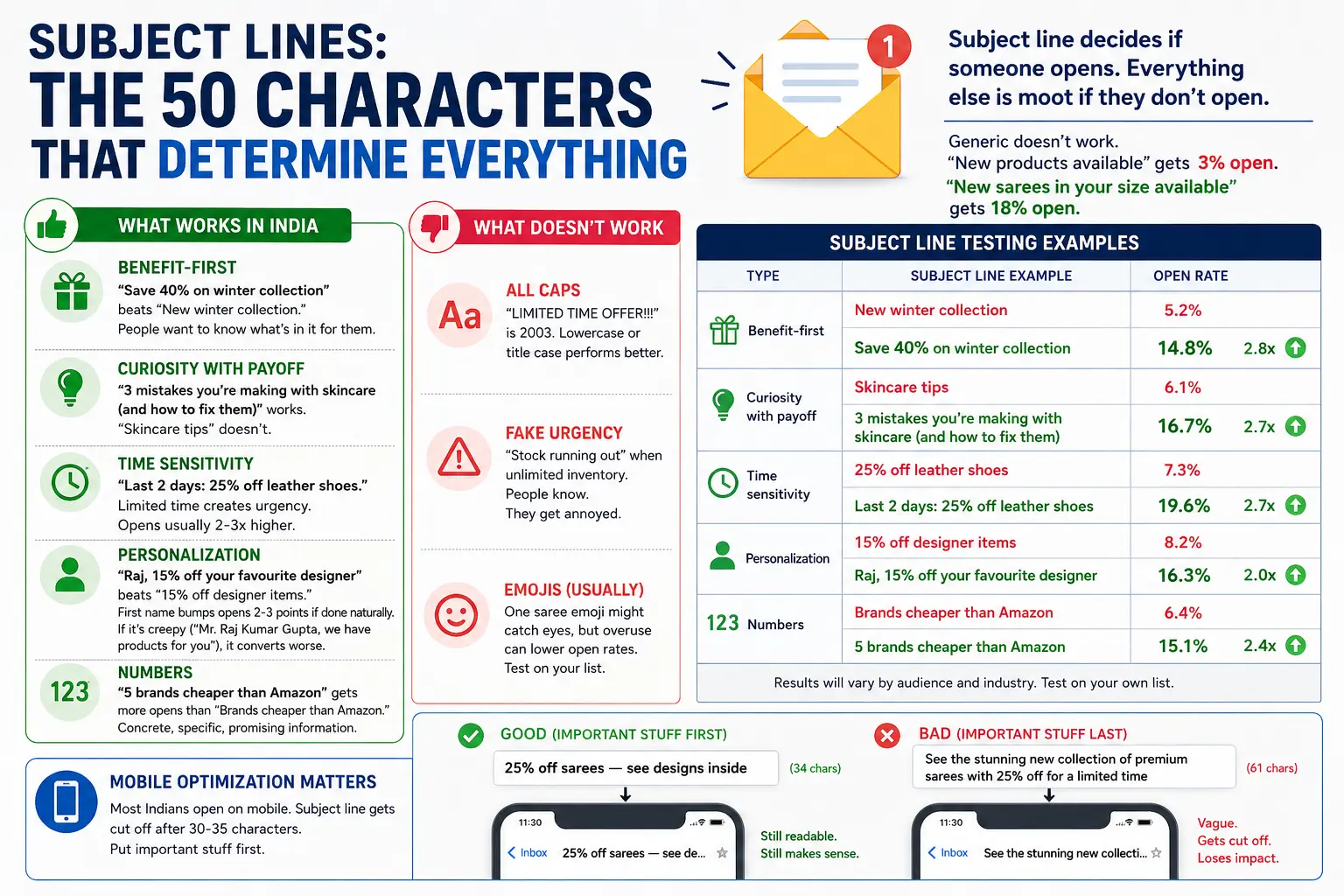
Subject lines: the 50 characters that decide everything
Subject line decides if someone opens. Everything else is moot if they don’t open.
Generic doesn’t work. “New products available” is vague. “New sarees in your size available” is specific, and specific subject lines get opened more. Specificity and personalization matter a lot.
What works in India:
- Benefit-first: “Save 40% on winter collection” beats “New winter collection.” People want to know what’s in it for them.
- Curiosity with payoff: “3 mistakes you’re making with skincare (and how to fix them)” works. “Skincare tips” doesn’t.
- Time sensitivity: “Last 2 days: 25% off leather shoes.” Limited time creates urgency and lifts opens.
- Personalization: “Raj, 15% off your favourite designer” beats “15% off designer items.” A first name can lift opens if done naturally. If it’s creepy (“Mr. Raj Kumar Gupta, we have products for you”), it converts worse.
- Numbers: “5 brands cheaper than Amazon” tends to get more opens than “Brands cheaper than Amazon.” It is concrete and specific.
What doesn’t work:
- All caps: “LIMITED TIME OFFER” feels like 2003. Normal sentence case performs better.
- Fake urgency: “Stock running out” when unlimited inventory. People know. They get annoyed.
- Emojis (usually): one saree emoji might catch eyes, but overuse can lower open rates. Test on your list.
- One more: mobile optimization. Most Indians open on mobile. Subject line gets cut off after 30-35 characters. Put important stuff first. “25% off sarees: see designs inside” gets cut to “25% off sarees: see de…” Still readable. If you lead with “See the stunning new collection of premium sarees with 25% off…” mobile users see “See the stunning new collection…” which is vague.
How often to email
How often should you email?
Enough to be top-of-mind, not so much that they hate you.
E-commerce? Once a week solid. Twice a week if you have a sale. Daily is excessive unless you’re Myntra or Flipkart with literally new stock every day.
SaaS? Weekly or bi-weekly. Sharing tips, feature updates, case studies. Too frequent and people ignore. Too infrequent and they forget you exist.
News? Daily is fine.
B2B? Monthly newsletter plus monthly promotion. That’s usually sweet spot.
One odd thing about India: unsubscribe rates can go down when you email more often, up to a point. Brands think “daily emails will kill the list” and decrease frequency. Engagement crashes. Increase frequency back to every other day, engagement goes up.
The reason: Indian lists are biased toward deal-hunters. They want frequent emails about offers. Email too infrequently, they forget and unsubscribe out of boredom. Email regularly with good offers, they stay engaged.
That said, segment frequency. Inactive people? Once a month. Repeat buyers? Twice a week. Use automation to manage this.
Automation: set it up once and let it work
Manual campaigns are fine. But automation is where email becomes a real revenue machine.
Welcome series: someone subscribes. Automatically get 3-5 emails over 2 weeks. First: thanks and discount code. Second: what we do. Third: social proof. Fourth-Fifth: closer look at product/benefits.
Abandoned cart: email 1 (30 mins): “You left something.” Email 2 (next day): “What you almost bought. 10 left in stock.” Email 3 (two days): “15% off just for you.”
Some abandoned carts turn into sales. Easy money.
Inactive reactivation: haven’t opened in 90 days. One final email: “We miss you. 20% off, come back.” If they don’t open that, move to quarterly list or remove.
Post-purchase: someone buys. “Your order shipped.” “Here’s how to use it.” “Customers also bought…” “Review your purchase.” “Related products.”
This is where margins grow. A post-purchase sequence can get a buyer to add accessories over the next 90 days. It compounds.
Set these up once. They run forever. You only change when performance tanks.
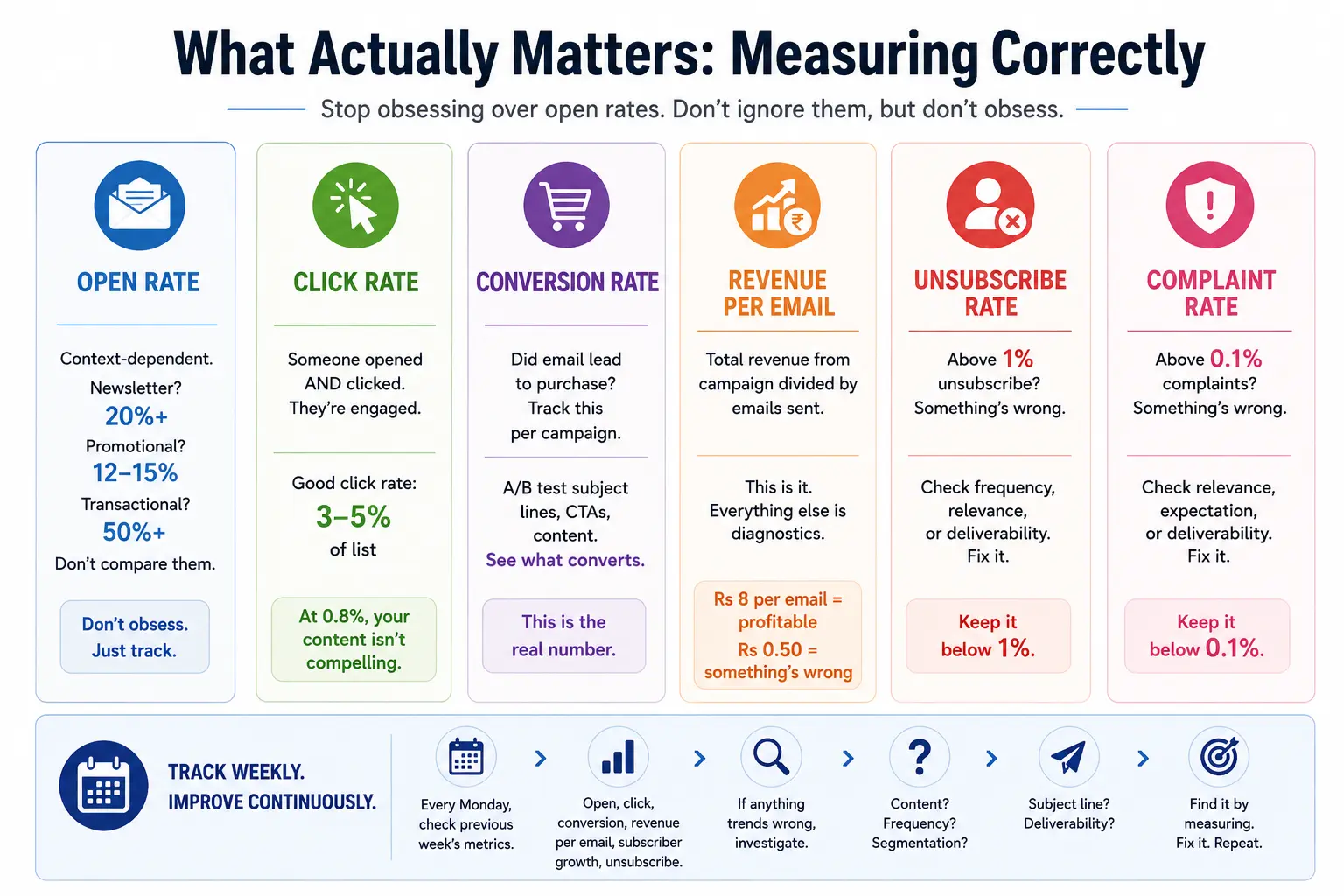
What matters: measuring correctly
Stop obsessing over open rates. Well, don’t ignore them, but don’t obsess.
- Open rates are context-dependent. Newsletter? 20%+ expected. Promotional? 12-15%. Transactional? 50%+. Don’t compare them.
- Click rate is better. Someone opened AND clicked. They’re engaged. Good click rate: 3-5% of list. At 0.8%, your content isn’t compelling.
- Conversion rate. Did email lead to purchase? Track this per campaign. A/B test subject lines, CTAs, content. See what converts. This is the real number.
- Revenue per email. Total revenue from campaign divided by emails sent. This is it. Everything else is diagnostics. If you’re at Rs 8 per email, that’s profitable. At Rs 0.50, something’s wrong.
- Unsubscribe and complaint rate. Above 1% unsubscribe or 0.1% complaints? Something’s wrong. Frequency, relevance, or deliverability issue. Fix it.
We track all weekly. Every Monday, check previous week’s metrics. Open, click, conversion, revenue per email, subscriber growth, unsubscribe. If anything trends wrong, investigate. Content? Frequency? Segmentation? Subject line? Deliverability? Find it by measuring.
The platform question: what do you actually need?
Platforms range free to expensive.
- Free: Mailchimp. For small lists it is free and works. Not fancy, but reliable.
- Small business (500-5,000): Mailchimp paid, Brevo (formerly Sendinblue), HubSpot free. All work. Brevo is popular in India, good for SMS+email combo.
- Growing (5,000-50,000): Klaviyo (if e-commerce, especially Shopify), Brevo paid, Drip. Have automation, segmentation, integrations.
- Enterprise: Marketo, HubSpot, ActiveCampaign. Expensive but strong.
Don’t overthink it. Start with what your audience uses or what integrates with your store. Email is email. A Rs 50/month platform with smart strategy beats Rs 50,000/month platform with no strategy.
Focus on list quality, segmentation, automation. Tool is secondary.
Three things to start with this week
- Audit your list metrics. Open rate, click rate, unsubscribe rate. You can’t improve what you don’t measure.
- Create one automated email sequence. Welcome series if you’re starting fresh, abandoned cart if you have e-commerce, win-back if you’re dormant. Just one. Get that working.
- Segment your list into at least three groups: never bought, repeat buyer, inactive. Send different email to each. That one change will improve every metric.
Do this for two months. Track metrics. If working, add more automation. Build, measure, grow. That’s it.
The bottom line
If you take one thing from this, take this: email marketing that works in India comes from patience and specific details, not volume or clever tricks.
Fix your email list
We build email strategies for Indian brands, and many start with a dead list. Let’s audit yours.


