
























The call that changed how we run influencer campaigns
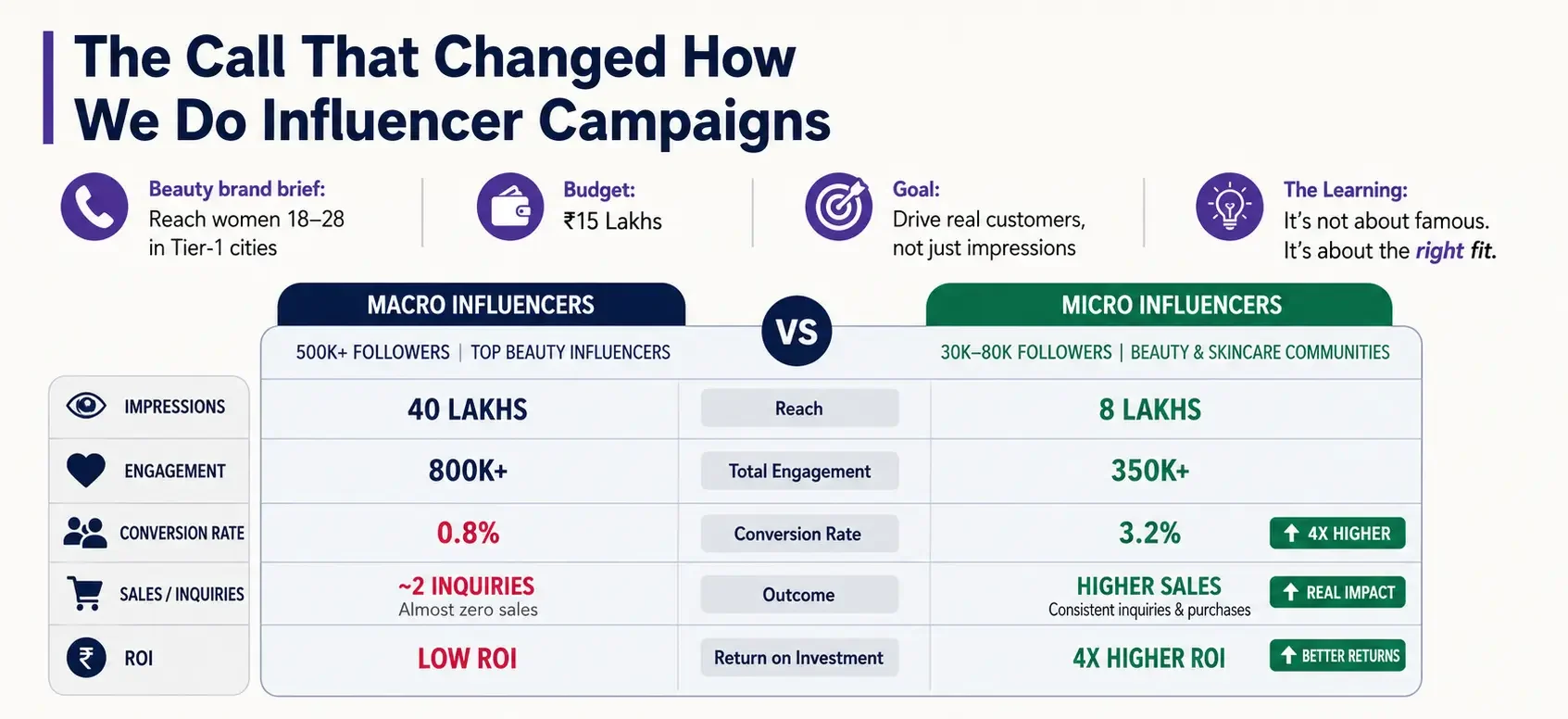
They had a budget of Rs 15 lakhs. They wanted to reach young women, age 18-28, in Tier-1 cities. The brief was clear and the job seemed straightforward.
So we did what most agencies do. We pulled a list of “top beauty influencers”, the names everyone knows, each with 500K+ followers. We negotiated rates, sent them the product and briefed them on brand messaging.
On paper, the campaign looked great. Impressions and engagement were big. The analytics looked spectacular.
But sales were almost zero. Only two customers got in touch. There was also one support complaint. It was about an influencer allegedly endorsing a competitor product while the campaign was live.
The founder was frustrated. “You got me famous. You didn’t get me customers.”
So our team sat down and looked at the actual audience data. The followers of the “big-name” influencers skewed 26+ and mostly lived in the metros. They got attention, but not from our target audience. Meanwhile, four micro-influencers we had added almost casually drove the actual sales. They had 30K-80K followers in beauty and skincare communities. Their conversion rate was clearly higher than that of the big names.
That taught us what many agencies never work out. Influencer marketing is about finding the right people talking to the right audience. Fame has little to do with it. Size does not matter. The right fit does.
What influencer marketing actually is
Influencer marketing is when someone with an audience talks about your product or service to that audience. In exchange, you pay them, give them free product, or offer commission on sales. That is the skeleton. The meat is in the questions behind it. Do their followers trust them? Are those followers the people you want to reach? Will they actually buy what you sell?
It is different from celebrity endorsement. There, a famous actor shows up in your ad and most of their audience does not care, because they are not fans of your category. An influencer has followers who chose to follow them for content in your category. A makeup influencer’s followers want makeup tips. A fitness influencer’s audience wants workout advice.
That voluntary relationship with the audience makes the difference. Trust matters more than visibility. See how our influencer marketing service is structured, or reach out directly to talk strategy.
Why is influencer marketing growing so fast in India? A few reasons matter.
First, Instagram and YouTube now reach hundreds of millions of people in India, and the numbers keep growing. Second, YouTube Shorts and Instagram Reels turned regular people into creators. You no longer need Hollywood production value. A girl filming skincare routines on her phone in Bangalore can have 200K engaged followers. Third, Indian influencers cost less than Western ones, so your budget stretches further. Fourth, Indian creators understand local markets, local languages and local behaviour. A brand selling in Punjab does not need a Delhi influencer repeating national messaging. It needs someone who gets Punjabi culture, humour and buying patterns. This is the same audience-first thinking that should drive your social media optimisation strategy. Channel selection and creator selection both start with knowing exactly who you are talking to.
The types of influencers (and which ones actually work)
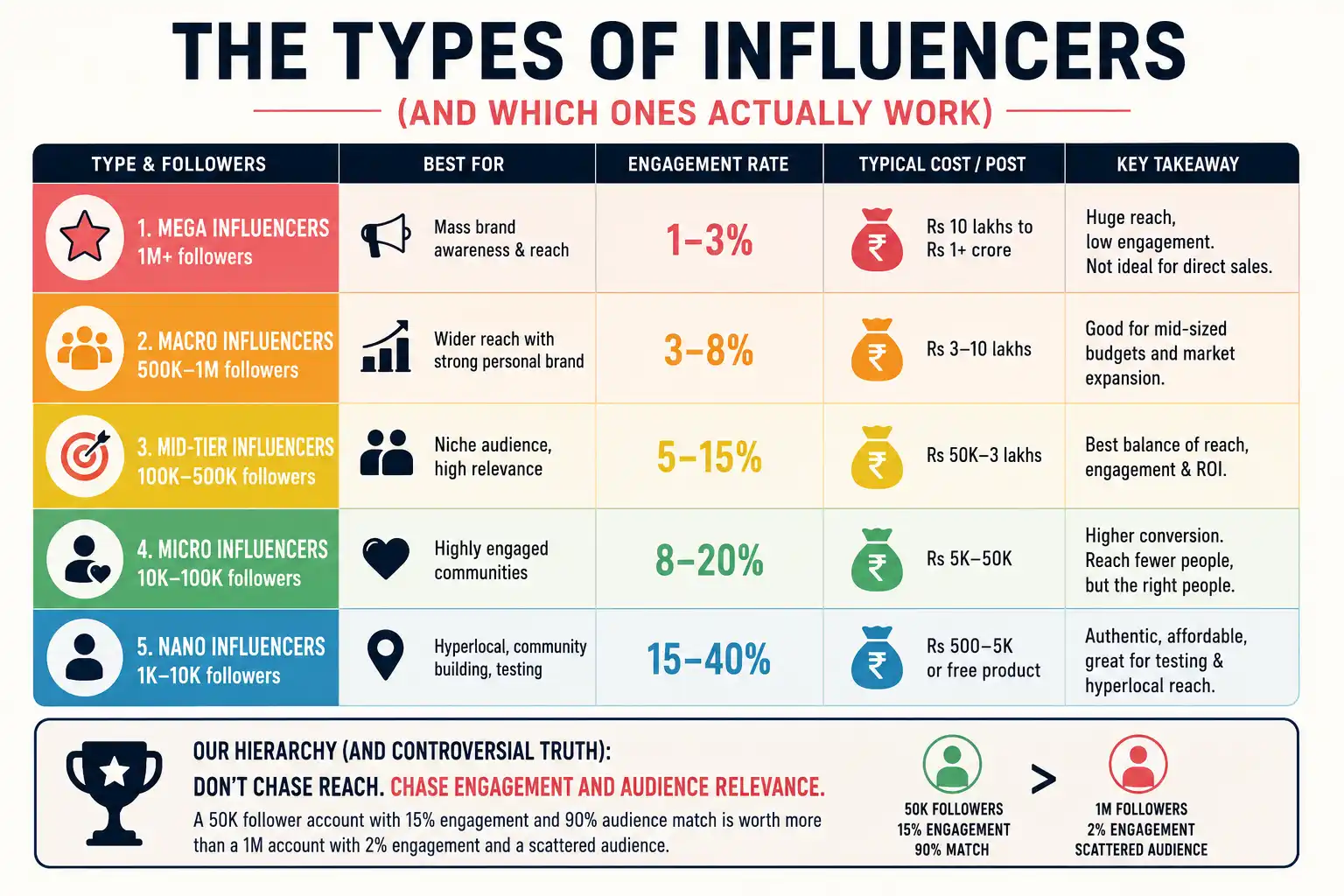
Not all influencers are the same. The size of their following decides what you can realistically expect.
1. Mega influencers (1M+ followers)
Think actors, cricketers and big YouTubers. You hire them for brand awareness and reach. A single post can get 50M+ impressions. That sounds amazing until you look at engagement. It is often 1-3% because the audience is huge but scattered. They cost Rs 10 lakhs to Rs 1+ crore per post. Use them for a new product launch, when everyone in the country needs to know at once. They are not ideal for driving direct sales or building community.
2. Macro influencers (500K-1M followers)
These are established creators with strong personal brands, high production value and steady engagement (3-8%). They cost Rs 3-10 lakhs per post. They suit mid-sized budgets and give wider reach than micro-influencers. They still have some community feel. We use them for brands entering new markets or wanting to make a product category look credible. The engagement is real. But engagement is not conversion, a lesson we learnt the hard way.
3. Mid-tier influencers (100K-500K followers)
This is where strategy lives. They charge Rs 50K-3 lakhs per post, and engagement runs 5-15%. These creators stick to their niche: a fitness coach with 300K followers all interested in gym routines, or a parenting blogger with 250K followers who are all parents. Their audience is tight, qualified and listens. In our experience, mid-tier influencers often give better ROI (return on investment) than other categories. The audience and the product usually match.
4. Micro influencers (10K-100K followers)
These are the unsung heroes. They charge Rs 5K-50K per post, and engagement is 8-20% because the people who follow them really care. Think of a dermatologist with 45K followers all interested in skincare, or a sustainable fashion creator with 60K followers who want eco-friendly clothes. Micro-influencers convert better because their followers are their community. You spend less and reach fewer people, but they are the right people. A smaller spend can bring bigger returns.
5. Nano influencers (1K-10K followers)
Sometimes called “regular people”. This could be a local boutique owner with 8K followers or a college student running a meme account with 5K. Engagement can be 15-40%. They cost Rs 500-5K, or just free product. We use nano influencers for hyperlocal campaigns and community building. We also use them to test messages before spending on bigger creators. They are unpolished but authentic.
Our rule, and it is a bit controversial in the industry: don’t chase reach. Chase engagement and audience relevance. A 50K follower account with 15% engagement and a 90% match to your target is worth more than a 1M account with 2% engagement and a scattered audience.
Finding the right influencer: the framework that works
Say you know what you are looking for: a mid-tier fitness influencer in Delhi for a protein powder brand. How do you find them?
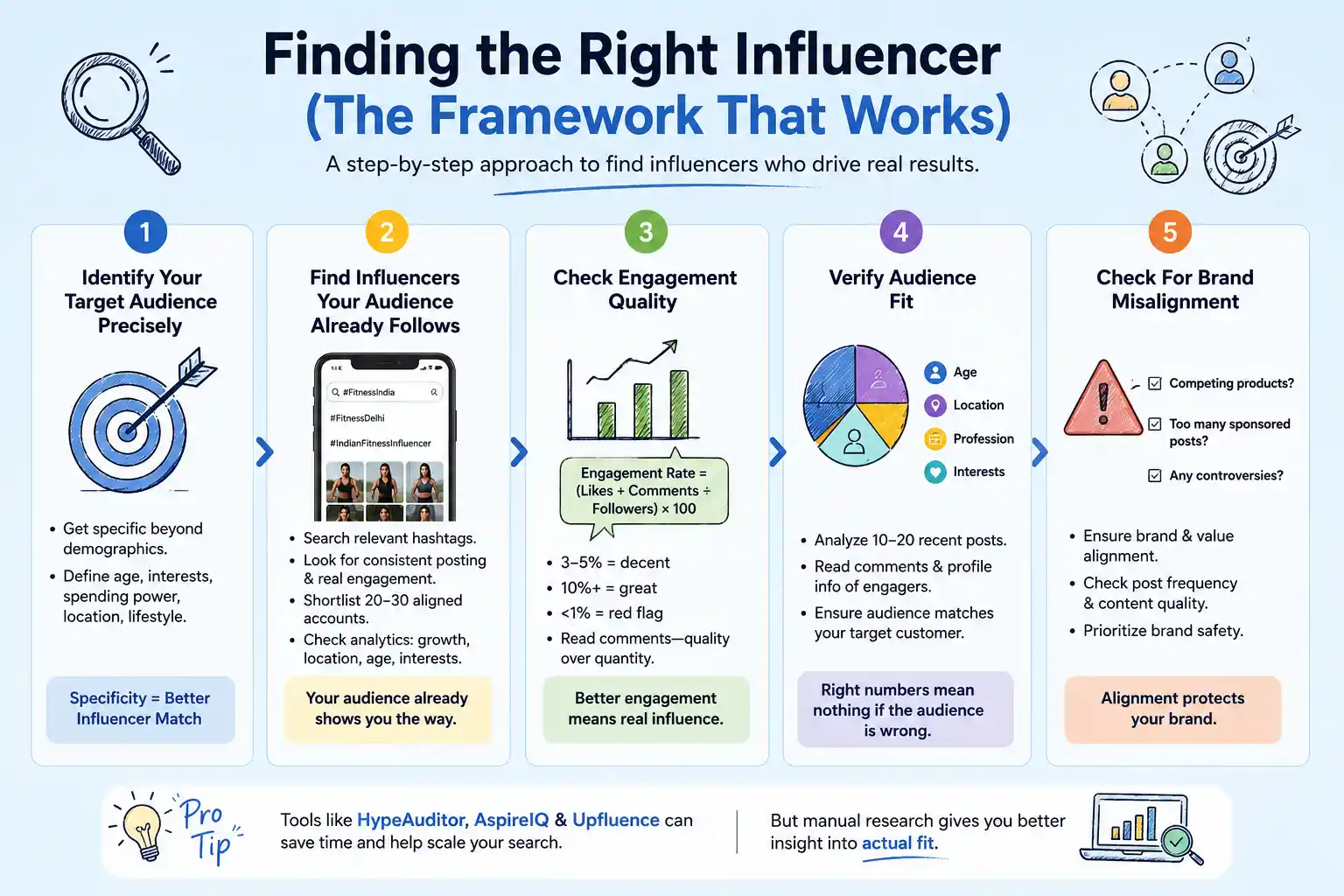
Step one: identify your target audience precisely
Do not stop at “women 18-35”. Write “women 22-28, fitness-interested, spending Rs 3K+ a month on wellness, living in metro cities”. This detail matters. An influencer who suits Rs 5K/kg whey protein is not the same as one for Rs 15K/month fitness coaching.
Step two: find influencers your audience already follows
Go on Instagram or YouTube and search hashtags relevant to your product, such as #FitnessIndia, #FitnessDelhi and #IndianFitnessInfluencer. Look at who posts consistently and who gets real engagement (likes and comments, not bot followers). Follow 20-30 accounts that seem to fit. Check their analytics for follower growth, audience location, age range and interests.
Step three: check engagement quality
Calculate the engagement rate: (total likes + comments / follower count) x 100. Above 3-5% is decent and above 10% is great. Below 1% probably means bought followers. Check comment quality too. Are people leaving thoughtful comments, or generic “nice pic” spam? A really engaged audience has real conversations.
Step four: verify audience fit
Look at their 10-20 most recent posts and read the comments. Who is engaging? From their profiles, what are their age range, location and profession? Does this match your target customer? Sometimes an influencer has great numbers but the wrong audience.
Step five: check for brand misalignment
Is the influencer promoting competing products? How often do they post sponsored content? If it is every other post, they are a content agency, not a creator. It shows in engagement. Have there been controversies? We are not trying to judge anyone, but brand safety matters.
Tools like HypeAuditor, AspireIQ and Upfluence automate some of this. They are worth the money if you run several campaigns. Still, manual research gives better insight into actual fit than any tool.
Campaign planning that separates good results from disasters
You have found your influencers. Now what? This is where most brands go wrong.
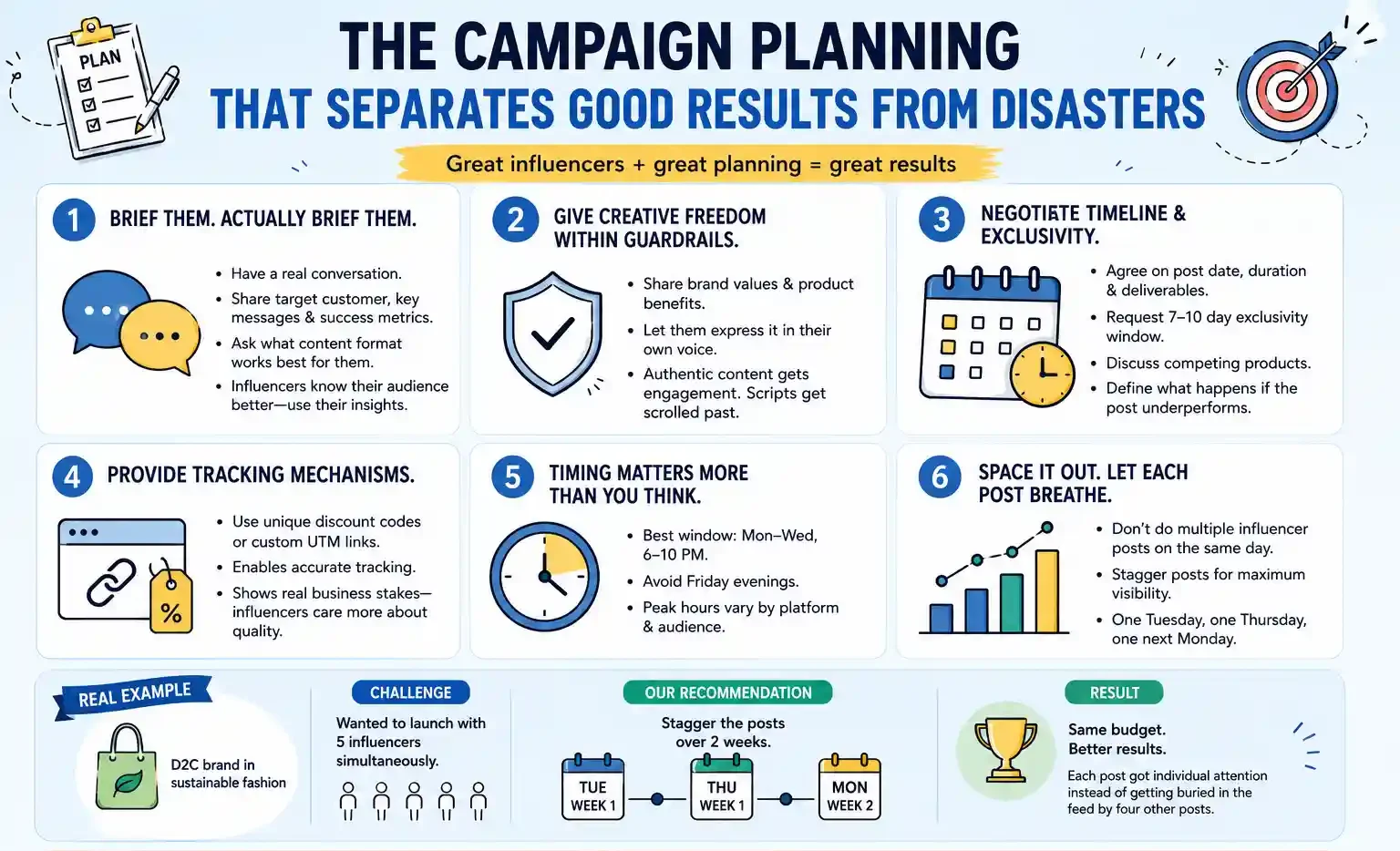
- Brief them properly. Do not just email a product and hope. Have a conversation. Tell them your target customer, what you want them to communicate and what success looks like. Ask which content format works best for them, because an influencer knows their audience better than you do. A photographer might prefer carousel posts. A YouTuber might want a 5-minute unboxing. Let them bring ideas.
- Give creative freedom within guardrails. Tell them the brand values and the product benefits, but let them say it in their own voice. A fitness influencer saying “I genuinely love this whey” feels different from a scripted ad saying “scientifically formulated protein isolate”. One gets engagement. The other gets scrolled past.
- Agree on timeline and exclusivity. When should the post go live? How long should it stay up? Can they promote competing products during the campaign? (A tip: ask for a 7-10 day exclusivity window either side of the post.) What happens if the post underperforms: do they redo it or move on? Settle this upfront.
- Provide tracking. Give the influencer a unique discount code or a custom UTM link (a tag added to a link so you can see where the visits came from). It helps you measure. It also shows the influencer there are real business stakes, so they care more about quality.
- Timing matters more than you think. Post on Monday to Wednesday, 6-10 PM. Peak hours change by platform and audience, but this window generally works. Do not launch a campaign on a Friday evening. Do not run several influencer posts on the same day. Space them out. For example, one on Tuesday, one on Thursday and one next Monday. Then each post can breathe.
- We worked with a D2C (direct-to-consumer) brand selling sustainable fashion. They wanted to launch with five influencers at once. We recommended staggering the posts over two weeks instead. The budget stayed the same. But each post got individual attention instead of being buried in the feed by four other posts that week.
Measuring results: the part everyone gets wrong
Most brands measure vanity metrics. “We got 50K likes.” Great. Did you sell anything?
Real measurement has layers.
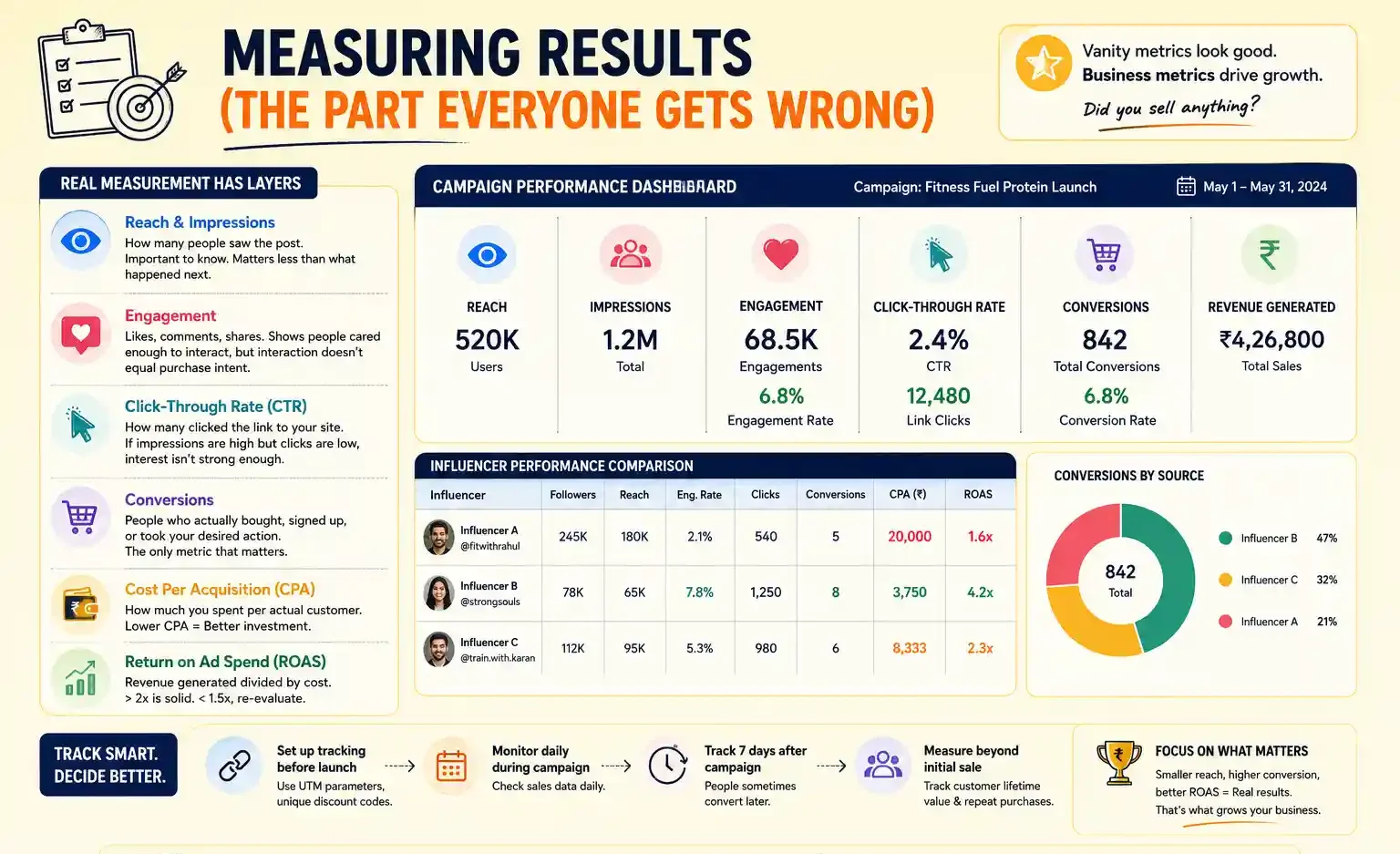
Reach and impressions tell you how many people saw the post. That is worth knowing, but it matters less than what happened next.
Engagement means likes, comments and shares. It shows people cared enough to interact, but interaction does not mean purchase intent.
Click-through rate (CTR) is how many people clicked the link to your site. This matters. If an influencer gets 50K impressions but only 300 clicks, the audience is not interested enough to look further.
Conversions are people who actually bought, signed up or took the action you wanted. This is the only metric that matters to your business. A post with modest engagement can still convert well if the audience is qualified. Our guide on how to build a marketing funnel that converts shows how this fits into the broader picture. Influencer content sits at the top. The funnel below it has to be built to catch and convert that traffic.
Cost per acquisition (CPA) is how much you spent per actual customer. Influencer A costs Rs 1 lakh and brings 5 customers, so the CPA is Rs 20K. Influencer B costs Rs 30K and brings 8 customers, so the CPA is Rs 3,750. Influencer B is the better investment, even though they are smaller.
Return on ad spend (ROAS) is revenue divided by cost. If you spent Rs 1 lakh on influencers and got Rs 4 lakhs in sales, your ROAS is 4x. Above 2x is solid. Below 1.5x, re-think your strategy.
Set up tracking before the campaign launches. Use UTM parameters in links and give influencers unique discount codes. Check sales data daily during the campaign and for 7 days after, because people sometimes click later. Look beyond immediate sales to customer lifetime value: do these customers buy once, or come back?
Legal and compliance: the stuff nobody talks about
Every brand and influencer should know this, but most ignore it.
- Disclose sponsored posts. Influencers need to add #ad, #sponsored or #partner, clearly and not in tiny text at the bottom. FTC guidelines in the US and ASA guidelines in India both require this. Most influencers know. Some don’t. Make it part of your brief: “Please add #ad to the caption.”
- Income tax matters. Influencers earn income from brand collaborations and should declare it. That is between them and the income tax department, but many do not. If you pay an influencer more than Rs 20K (or whatever the current threshold is), they should give you an invoice. They should also give a GST number if registered.
- Product claims need proof. If an influencer says your product “cures acne”, you need clinical studies to back it up. The Advertising Standards Council takes this seriously. Campaigns can get paused when an influencer makes an unsubstantiated health claim.
- Contracts matter, even for Rs 5K collaborations. What happens if the influencer deletes the post? What if they promote a competitor next week? What if the post gets negative comments? Have a basic contract that covers deliverables, timeline, payment terms, exclusivity and content ownership.
- Content for kids is regulated. If you promote anything to kids, understand COPPA (if you target US audiences) and the equivalent Indian guidelines. Influencers cannot collect data from minors without parental consent.
Most legal problems come from a lack of clarity upfront, not from big disputes. A written brief prevents many misunderstandings.
The campaign that taught us the most
A regional cosmetics brand in Maharashtra wanted national presence. They had never done influencer marketing. Their instinct was to hire big names. They had a list of accounts with 50K+ followers.
We suggested a different approach: test first. We identified 15 mid-tier and micro-influencers in beauty, skincare and makeup communities across India. We did not focus on follower count. We focused on audience match. Did their audience actually buy cosmetics? Were they interested in regional and local beauty brands? Could they represent the product authentically?
We ran a pilot campaign across all 15 influencers. We negotiated rates because it was a test, sent them the product and let them create freely.
The results were messy. Some influencers drove solid sales. Some drove nothing. Two posts got negative comments (people said the influencer was “selling out”). But the pilot showed the approach worked.
So we scaled. We put the remaining budget behind the top-performing influencers. We added a few new ones in the same vein and ran a 60-day extended campaign.
It took testing, willingness to get some things wrong, and willingness to optimise based on data. If we had stuck with the original “hire big names” plan, we would probably have seen decent revenue and thought it was great. We would have missed the actual opportunity. This test-and-scale discipline is the same logic behind fix your backwards digital marketing strategy. Most brands invest before they validate. Then they wonder why results do not compound.
The future of influencer marketing in India
Trends shift. TikTok got banned. YouTube Shorts and Instagram Reels took off. Affiliate marketing became bigger than sponsored posts in some categories. Authenticity became non-negotiable as audiences got savvier.
One thing will not change: people buy from people they trust. Influencers are trusted voices in their communities, and that relationship can be worth more than an ad.
Where is this going? Micro and nano influencers will keep growing. Brands will move from “hire one celebrity” to “partner with 10 micro-influencers for different audience segments”. Affiliate models, where the influencer gets paid only if they drive sales, will become more common. Audiences can smell a fake collaboration from miles away, so authenticity will matter even more. This fits a wider shift in content. As we explain in why video marketing is the ultimate tool for promoting businesses, raw, real, creator-driven content often outperforms polished brand-produced video at building trust.
For brands, the takeaway is simple. Don’t chase followers. Chase fit. Test before scaling. Measure what matters (revenue, not vanity metrics). Build relationships with creators, not just one-off campaigns. Big or small, the influencer matters less than having the right audience.
Ready to launch your influencer marketing campaign?
We run influencer campaigns across India. Some we have scaled after a test. Some taught us what does not work. Either way, we know how to match brands with creators and make the math work.


