
























Reels also help with engagement and trust. Quick tutorials, behind-the-scenes clips, trending audio and relatable humour let a brand show its personality in a way long videos cannot, so it feels more approachable. Brands that post Reels regularly can see more followers and engagement, and sometimes more sales. Short video is now a core part of Instagram marketing. We cover the bigger shift in why video marketing is the ultimate tool for promoting businesses: short, authentic, platform-native video is where attention is, and brands that skip it hand their audience to competitors.
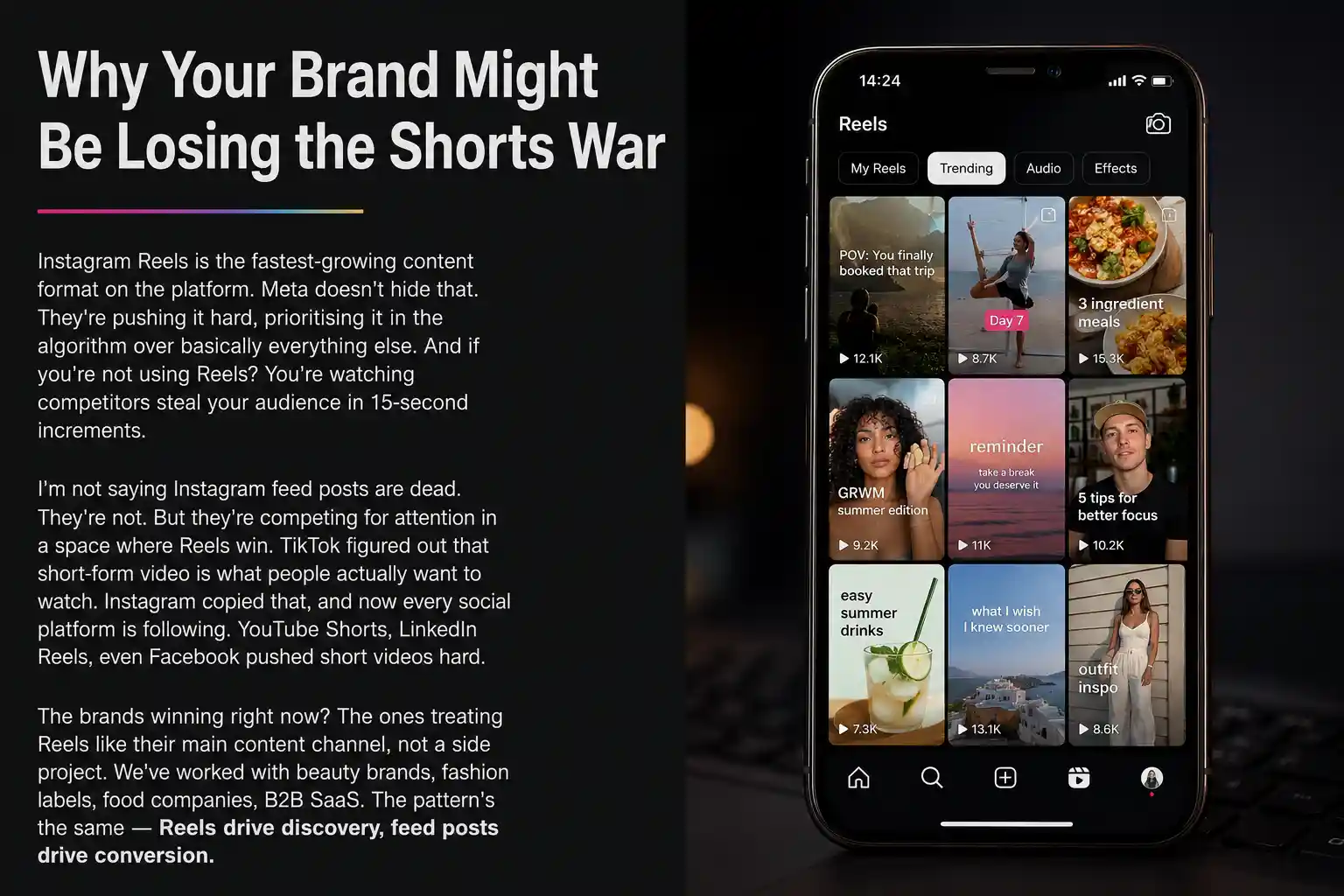
Why your brand might be losing the shorts war
Meta is pushing Reels hard and gives them priority in the algorithm over almost everything else. If you are not using Reels, your competitors are taking your audience 15 seconds at a time.
Feed posts are not dead. But they now compete for attention in a space where Reels win. TikTok showed that people want to watch short videos. Instagram copied the format, and other platforms followed, such as YouTube Shorts and Facebook.
The brands winning right now treat Reels as their main content channel, not a side project. The pattern is usually the same: Reels bring discovery, and feed posts bring conversion (people actually buying or enquiring).
How the Instagram algorithm treats Reels
Everyone says "the algorithm favours Reels". That is true, but what does it mean in practice?
Instagram's algorithm is not one thing. It is dozens of signals competing. For Reels, it looks at completion rate (did people watch the whole thing), shares, comments, saves, and how quickly people reacted after the Reel appeared.
It also looks at your account's history. If you have never posted Reels, your first one will not get the same reach as an account with a regular Reels habit. That is not a punishment. Recommender systems test a post on a small group first, and if it does well, they show it to more people.
The watch time game
Completion rate matters most. If someone scrolls past your Reel and it auto-plays for one second, that counts as a view, but it is a poor signal. If someone watches 90% of your 30-second Reel, that is a strong one.
Take a D2C (direct-to-consumer) fashion brand that posts beautiful Reels with good editing but gets low completion rates. People click away in the first 3 seconds, because those seconds are all slow, moody establishing shots. There is no reason to keep watching.
The fix is a hook in the first second: show something that makes the viewer think, "okay, I need to see where this goes". Completion rates improve once the opening earns the next few seconds.
Shares and saves are your secret signal
Instagram counts comments and likes, but shares and saves carry more weight. When someone saves your Reel, they are saying, "I want to come back to this." When they share it, they are saying, "This matters enough to send to someone else." Both are strong signals.
Most brands chase likes, which is the wrong metric. Aim for shares and saves instead. Make something useful, surprising or entertaining enough that people want to keep it.
Content ideas that convert
Plenty of Reels go viral and bring no customers. That is not a win. Focus on content that builds an audience and also drives something you can measure.
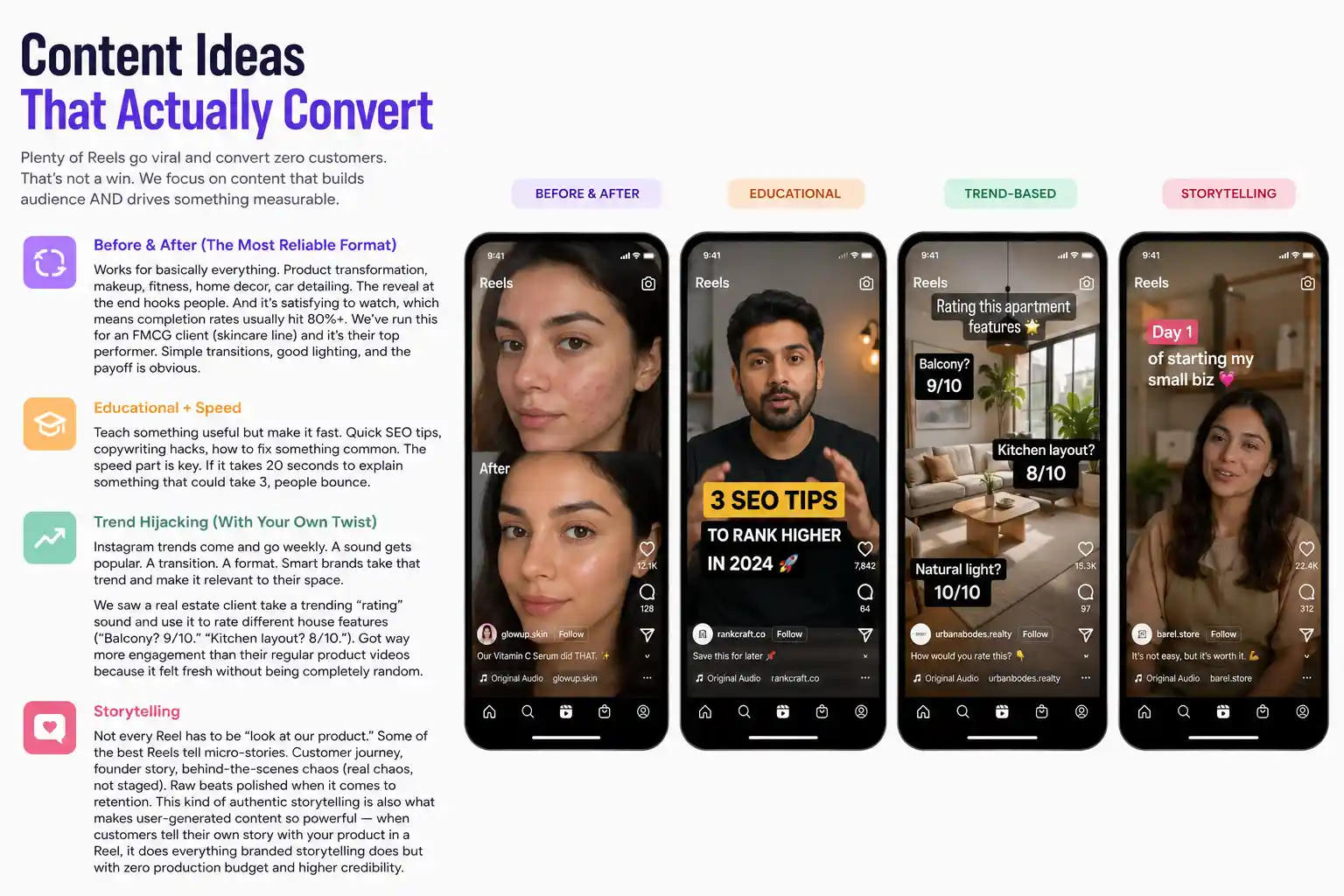
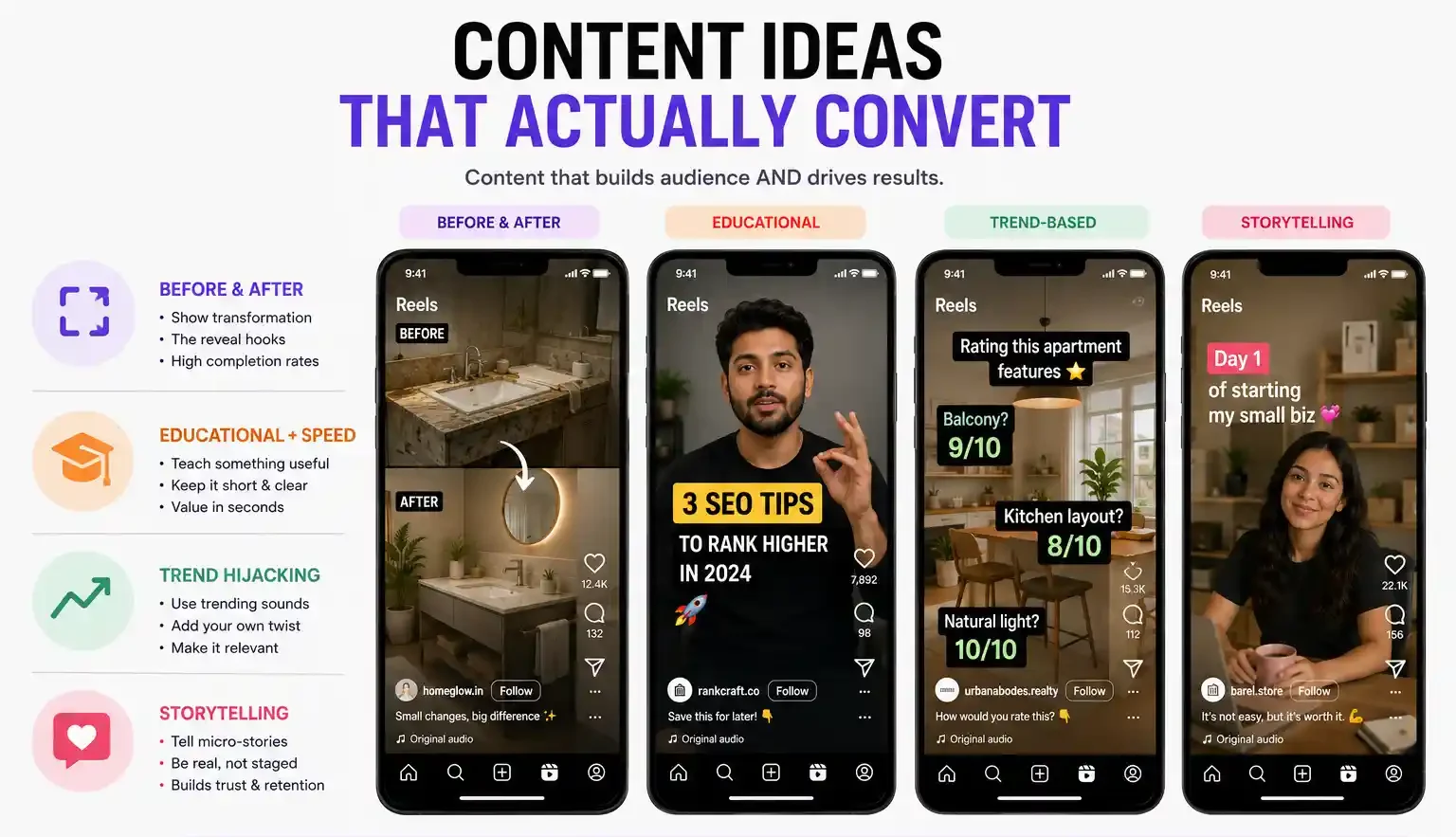
- Before & after (the most reliable format)
This works for almost everything: product transformation, makeup, fitness, home decor, car detailing. The reveal at the end hooks people, and it is satisfying to watch, so completion rates are usually high. Use simple transitions and good lighting, and make the payoff obvious.
- Educational + speed
Teach something useful, and make it fast: quick SEO (search engine optimisation) tips, copywriting hacks, how to fix a common problem. Speed is the key. If it takes 20 seconds to explain something that needs 3, people leave.
- Trend hijacking (with your own twist)
Instagram trends change every week. A sound gets popular, or a transition, or a format. Smart brands take the trend and make it fit their own space.
For example, a real estate brand could take a trending "rating" sound and use it to rate house features ("Balcony? 9/10." "Kitchen layout? 8/10."). That feels fresh without being random, so it can get more engagement than regular product videos.
- Storytelling
Not every Reel has to say "look at our product". Some of the best tell small stories: a customer's experience, the founder's story, behind-the-scenes chaos (real, not staged). Raw content usually holds attention better than polished content. Authentic storytelling is also what makes user-generated content so powerful. When customers tell their own story with your product in a Reel, you get the effect of branded storytelling with no production budget and more credibility.
Editing that makes people stop scrolling
You do not need professional editing software to make good Reels. You do need to know what works.
The first half second is everything. Add text or a quick cut, something that makes people pause before they skip. This is the hardest part.
Transitions should not be show-offs. Use smooth cuts, quick fades and matching movements across clips. Instagram's built-in editor has become good, so you do not need CapCut, though it is a solid tool.
Use text overlays, but not on every frame. Text tells people what to watch for and helps them follow the video. Captions also let people watch without sound, which matters because most people scroll on mute.
Trending audio helps with algorithm reach. Original audio that fits your brand builds recognition. Some brands have a sound signature: people hear it and know it is them.
Keep the pacing tight. Fast cuts work better than long, lingering shots, especially in the first 10 seconds.
An example from a food brand
Take a food brand testing two versions of a Reel. The first is polished and high production: a 30-second video of the product. It gets decent views and okay engagement.
The second is shot on a phone. The creator makes a mistake, cuts to the finished product and keeps the laugh in. It gets more completion and more engagement. The reason is not that it is "more authentic", a word that has been used too much. It is less polished in a way that feels real.
If the brand then goes back to a very polished version, engagement drops, so it settles somewhere in between. That is the grind of it.
Hashtag strategy for Reels
Hashtag research matters a lot for feed posts. For Reels it is different.
Instagram does not push Reels to hashtag pages the way it does feed posts. It ranks Reels on engagement patterns, not hashtags. So hashtags work as a safety net more than a growth lever.
Still, use them. Mix high-volume hashtags related to your niche with lower-volume ones specific to your content. Five to ten is enough, not 30. Instagram is also getting stricter about hashtag spam.
Hashtags do help in one way. If someone uses your hashtag, your Reel might show up on that hashtag page. Some people follow hashtags, and they might discover you there. But this is a secondary source of traffic.
The real growth comes from watch time, shares, saves and comments. Hashtags are nice to have. Do not obsess over them.
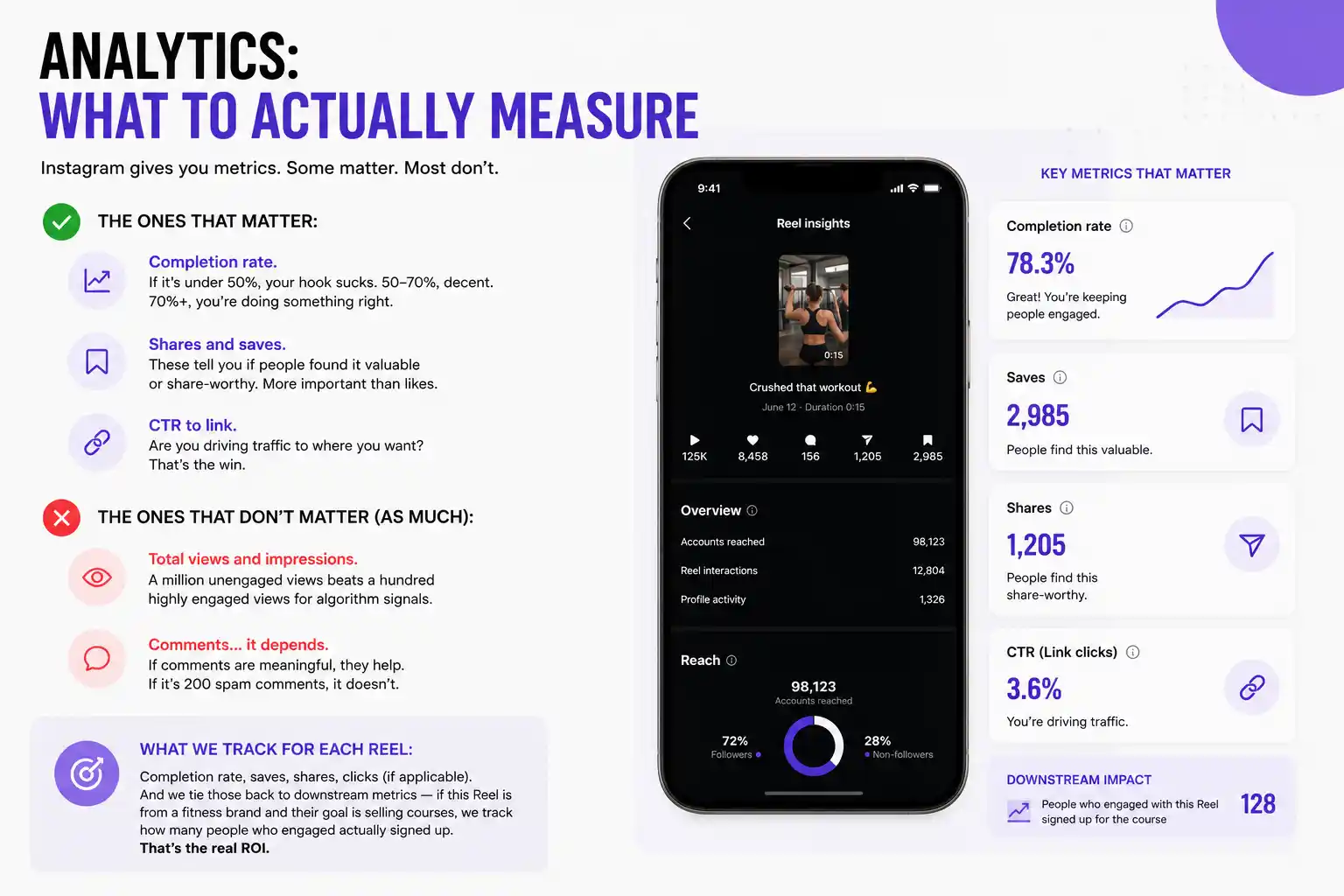
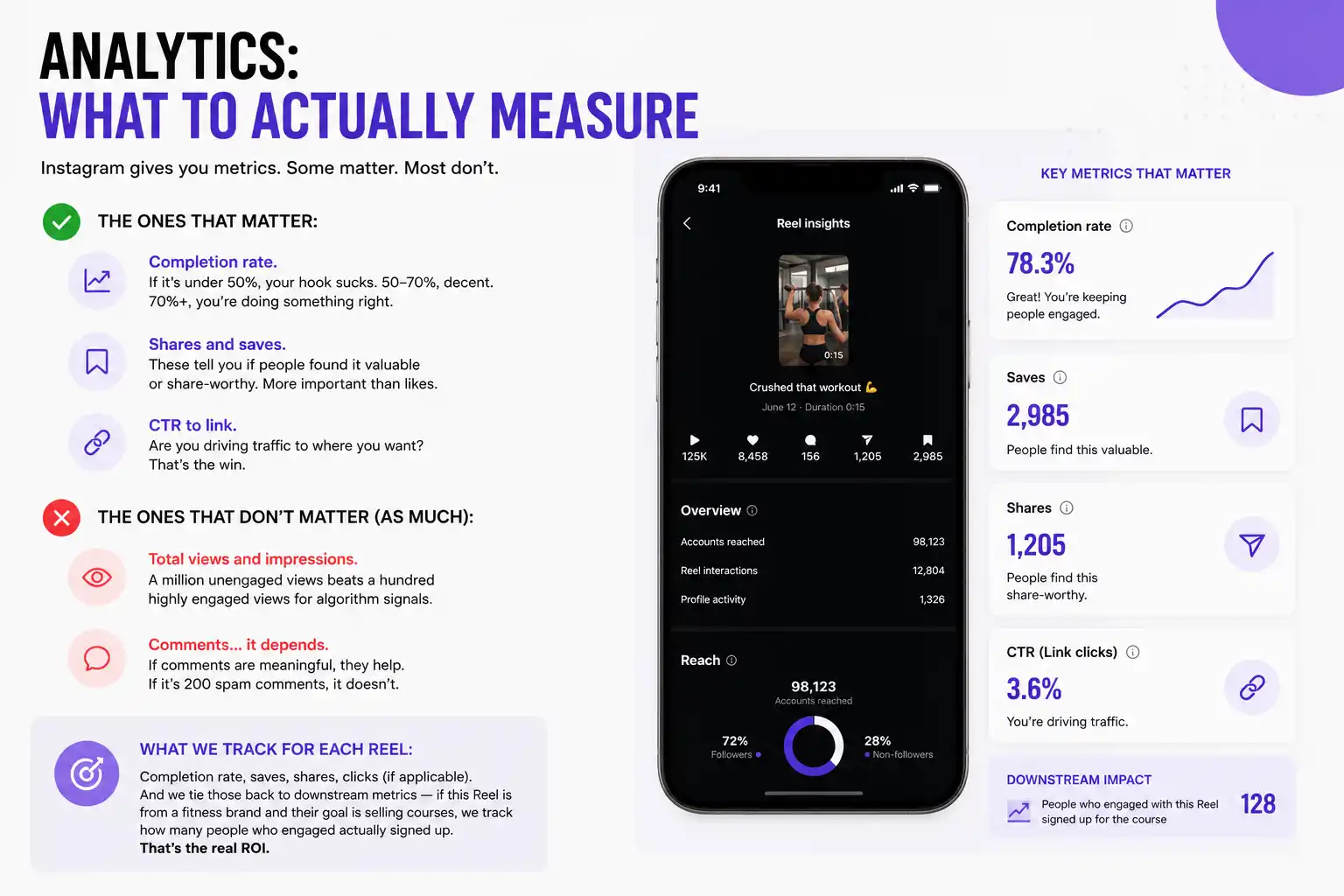
Analytics: what to measure
Instagram gives you many metrics. Some matter and most do not.
These metrics matter most:
Completion rate. If most viewers leave before the end, your hook is weak. If most stay, you are doing something right.
Shares and saves. They tell you whether people found the Reel useful or worth sharing. They matter more than likes.
Click-through rate (CTR) to your link, if you have a link in your bio or on the Reel. The question is whether you are driving traffic to where you want it.
These matter less: total views and impressions. It sounds odd, but a million unengaged views are worth less than a hundred highly engaged ones as algorithm signals. Engagement is the currency.
Comments depend. Meaningful comments help. Two hundred spam comments do not.
For each Reel we track completion rate, saves, shares and clicks (where they apply). We then tie those back to later results. If the Reel is for a fitness brand that sells courses, we track how many people who engaged with the Reel signed up. That is the real ROI (return on investment).
Brands that do well with Reels
Here are three patterns that work, described in general terms without naming any client.
Take a cosmetics brand that posts a Reel every day. Each one is educational or follows a trend, and it does not hard-sell. It teaches makeup techniques or reacts to trending sounds with product demos. A brand like this can grow most of its following through Reels discovery.
A home decor D2C brand does before-and-afters, and that is its whole strategy: one room transformation a week. A small share of Reel viewers become customers, and across many views that adds up to a lot of sales.
An e-learning platform shares quick tips and micro-lessons of 10 to 15 seconds each. They may not go viral, but they build authority in a niche and convert. Reach is smaller, but the engagement is of much higher quality.
The pattern: they picked one type of content, got good at it and stayed consistent, instead of switching formats every week.
Why most brands get this wrong
Many treat Reels as a checkbox: "post a Reel once a week" because the strategy says so, with no thought for the hook, the editing, or whether it matters to the business.
Some go viral once and chase that format forever. Viral does not mean relevant to your goals.
Others post random content with no link to the rest of their strategy, like a B2B (business-to-business) manufacturing company posting dance trends. Does it build authority? Does it drive anything? This is what we mean by fixing a backwards digital marketing strategy: tactics without strategy produce activity without results, and Reels are no exception.
Many also give up too early. "We posted three Reels and saw no results." Three is not a sample size. You need at least 10 to 15 to see what works.
How to start
You have read this far, so it is time to start. Here is the order.
First, pick a format that makes sense for your business. Do not pick what is trendy. Pick what you can repeat and what ties to your goals: educational, storytelling or before-and-after. Choose one and master it.
Second, if you have already posted content, audit your analytics. What performs now is your clue for direction.
Third, shoot 5 to 10 Reels in one session. Batch creating is faster and more consistent than making one whenever you find time.
Fourth, post on a schedule. Consistency sends a signal to the algorithm. The same day and time each week is ideal.
Fifth, measure. Watch completion rate, and look at shares and saves. After 10 Reels you will see patterns. Do more of what works.
Sixth, iterate. Tweak based on data: a slightly different hook, different pacing, a different format. Test it.
Do not overthink it. A phone camera and natural light beat a perfect studio setup that never ships.
Your competitive advantage with Reels
Reels are still young as a major platform feature, and the algorithms are still settling. In a year or two, most brands will be good at this. Right now, brands that take Reels seriously are ahead because most do not.
The advantage comes from consistency and from knowing your audience. Make content that interests them, not everyone, and do not stop.
If you want a full social media strategy that includes Reels, or a focused social media campaign, we do that kind of work, from Reels performance and follower growth to the content calendar. Our full social media optimisation service covers Reels strategy, content calendar and analytics, so your short-form video connects to business results as well as views.
What to take away
Reels reward patience and specificity more than volume or clever tricks. The brands that do this well in India are not smarter, only more consistent.


