
























For Indian websites specifically, a technical SEO audit means fixing issues like crawl errors, slow load times on 4G networks, broken redirect chains and missing structured data. Do this before you invest more in content or backlinks. Technical problems cap how well even good content can rank.
The website that looked perfect but ranked nowhere
Three months ago, we got a call from a manufacturing export company. Beautiful website. Real web development firm built it. Responsive design, clean code, the works.
They were getting maybe 40 organic visits a month. For a B2B company with actual search demand in their vertical, that’s… rough.
We ran a technical audit. We found 47 crawl errors, uncompressed images that took forever to load, no schema markup and redirect chains. Broken internal links were scattered across 3,000+ pages.
Their web team had optimised everything for looks and user experience. Nobody had optimised it for Google.
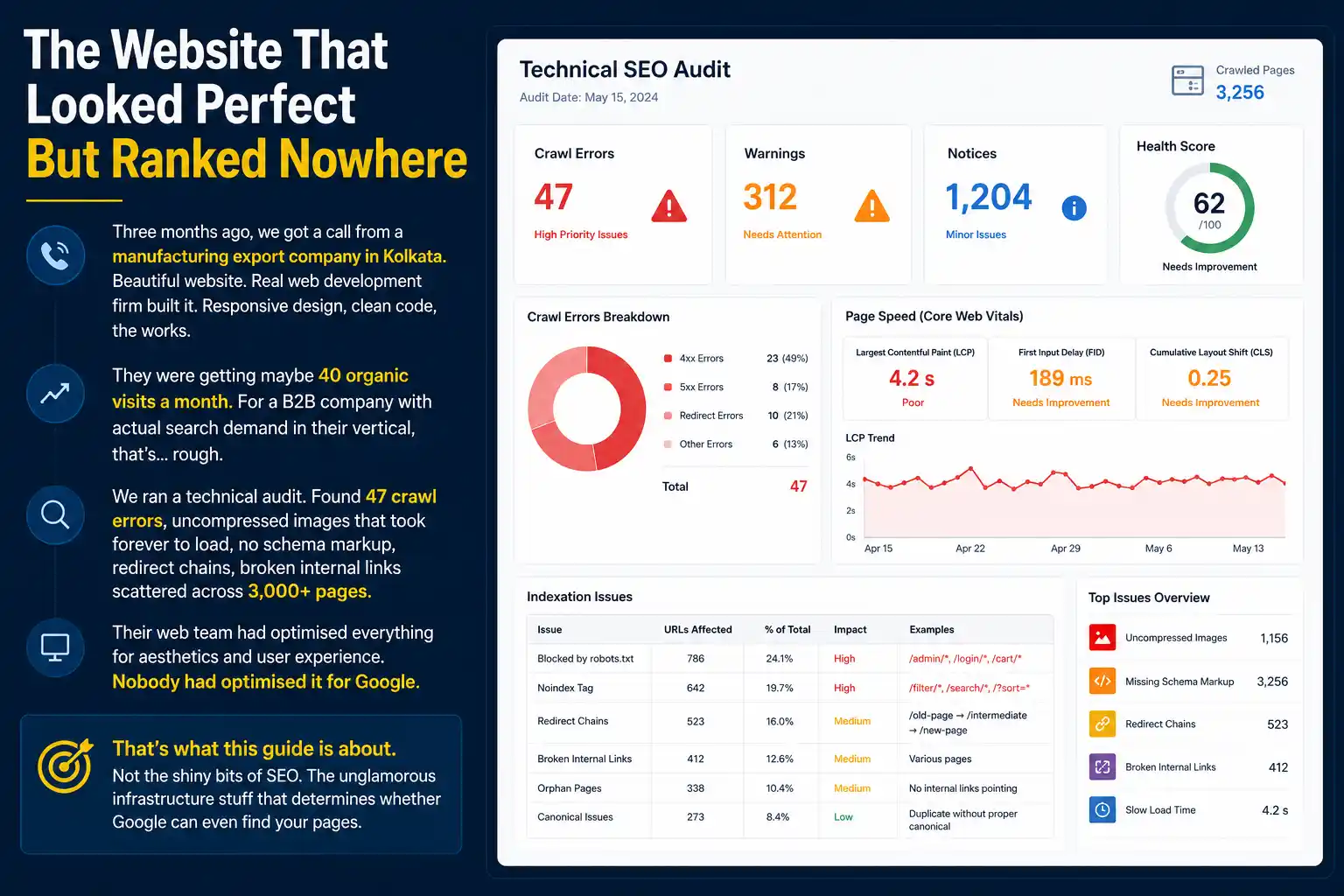
That’s what this guide is about. Not the shiny bits of SEO. The unglamorous infrastructure that decides whether Google can even find your pages.
What is a technical SEO audit
A technical audit checks whether your website’s infrastructure is set up properly for search engines. Speed. Mobile compatibility. Crawlability. Indexation. HTTPS security. Redirects. Sitemaps. Schema markup. It is all the plumbing that most people ignore until something breaks.
Here’s the bit that frustrates me: brands invest heavily in content and backlinks, then ignore the foundation. It’s like building a house with an excellent interior design but the roof leaks.
Google’s algorithm can’t rank a page it can’t find. It can’t rank fast content if the page loads in 8 seconds. It can’t understand what your page is about without proper schema. Technical SEO is the prerequisite for everything else working. It works alongside on-page SEO and off-page SEO. All three have to work together before rankings move.
The core audit checklist
I’ll break down what we actually test when we audit a site. These are the categories that directly affect rankings and crawl efficiency.
1. Crawlability and Indexation
Can Google actually find all your important pages? Start by checking Google Search Console’s Coverage report. You’ll see how many pages Google has found. More importantly, you’ll see which ones it can’t.
Common issues are robots.txt blocking entire sections, noindex tags on pages you want to rank and redirect chains. Another is soft 404s (pages that look like they exist but send weird error codes).
One client in the textile industry had their entire product catalogue set to noindex. Someone added it when the site launched as a test environment. It was never removed, so the pages stayed hidden from Google.
2. Page Speed and Core Web Vitals
Google’s ranking algorithm penalises slow pages. Not heavily, because other factors matter more. But enough that a slow site will lose to a faster competitor with similar content.
The three metrics are Largest Contentful Paint (how fast the main content loads), First Input Delay (how snappy the page feels) and Cumulative Layout Shift (does the layout jiggle around while loading). Test these in Google PageSpeed Insights or Search Console’s Core Web Vitals report.
For Indian businesses, many of your users are on 4G, not 5G. A 5MB image load time barely matters to a Delhi office worker on fibre. It matters a lot to a customer on Airtel 4G in tier-2 cities.
Optimise accordingly. Compress images. Defer non-critical JavaScript. Use a CDN if possible.
3. Mobile Responsiveness
Google indexes the mobile version of your site first now. If your mobile version is broken or slow, your entire site’s ranking potential is compromised.
Check the Mobile-Friendly Test in Search Console. Look for rendering issues, text too small to read, buttons too close together. Test on actual phones if possible, not just Chrome’s device emulation.
4. HTTPS and Security
Google prefers secure sites. It is not a massive ranking boost, but it’s one of hundreds of factors. More importantly, unsecured sites look sketchy to users. Fix it if you haven’t already.
Visitors who see the “Not Secure” warning often leave without filling in your form. HTTPS removes that warning.
5. XML Sitemap and Robots.txt
Your XML sitemap tells Google “here are all my important pages.” It doesn’t guarantee ranking, but it helps Google discover pages that might not be linked from elsewhere.
Check that your sitemap exists (usually at yoursite.com/sitemap.xml). Check that it’s valid and that it includes your important pages. Robots.txt tells Google what it can and can’t crawl.
Common mistake: robots.txt is configured too restrictively. We’ve seen sites with images, stylesheets and JavaScript files blocked by robots.txt. Google can’t render the page properly if it can’t load those resources.
6. Redirects and Canonicals
Redirect chains (page A redirects to B redirects to C) slow down crawling and waste your crawl budget. Keep redirects to one hop. Remove old redirects after 6 months.
Canonical tags tell Google “if there are multiple versions of this page, this is the main one.” Helps prevent duplicate content issues. Use them if you have session parameters, tracking codes, or multiple versions of the same page.
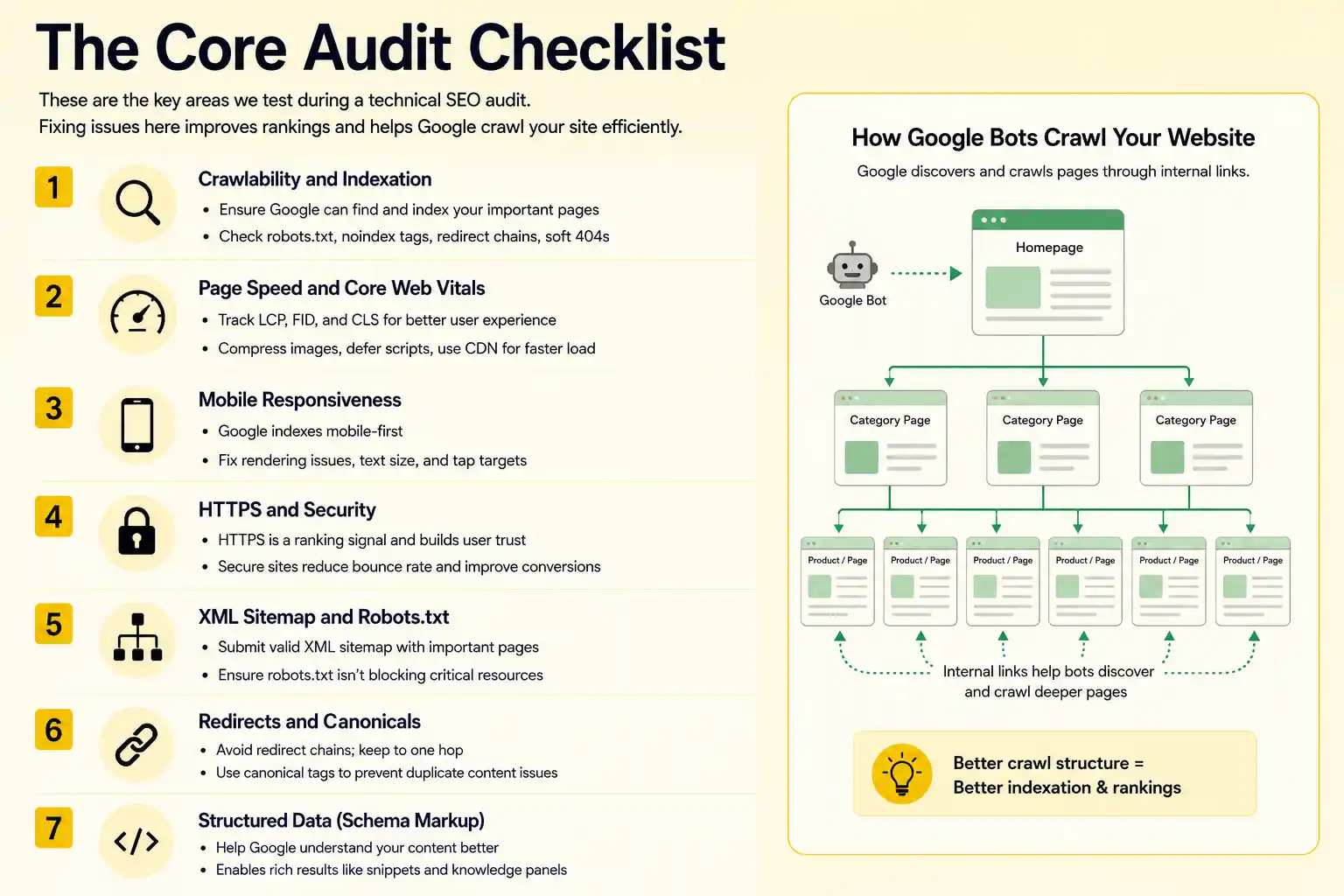
7. Structured Data (Schema Markup)
Schema tells Google what your content is actually about. Product pages, articles, reviews, FAQs, events. Proper schema can help you earn featured snippets, rich snippets and knowledge panels.
Most Indian websites skip this entirely. Or implement it incorrectly. We’ve seen sites with product schema that claims a product is simultaneously priced at Rs 500 and Rs 5000.
It’s worth doing right. Not optional anymore.
Common technical issues
Let me walk through problems we find regularly, and what solving them looks like.
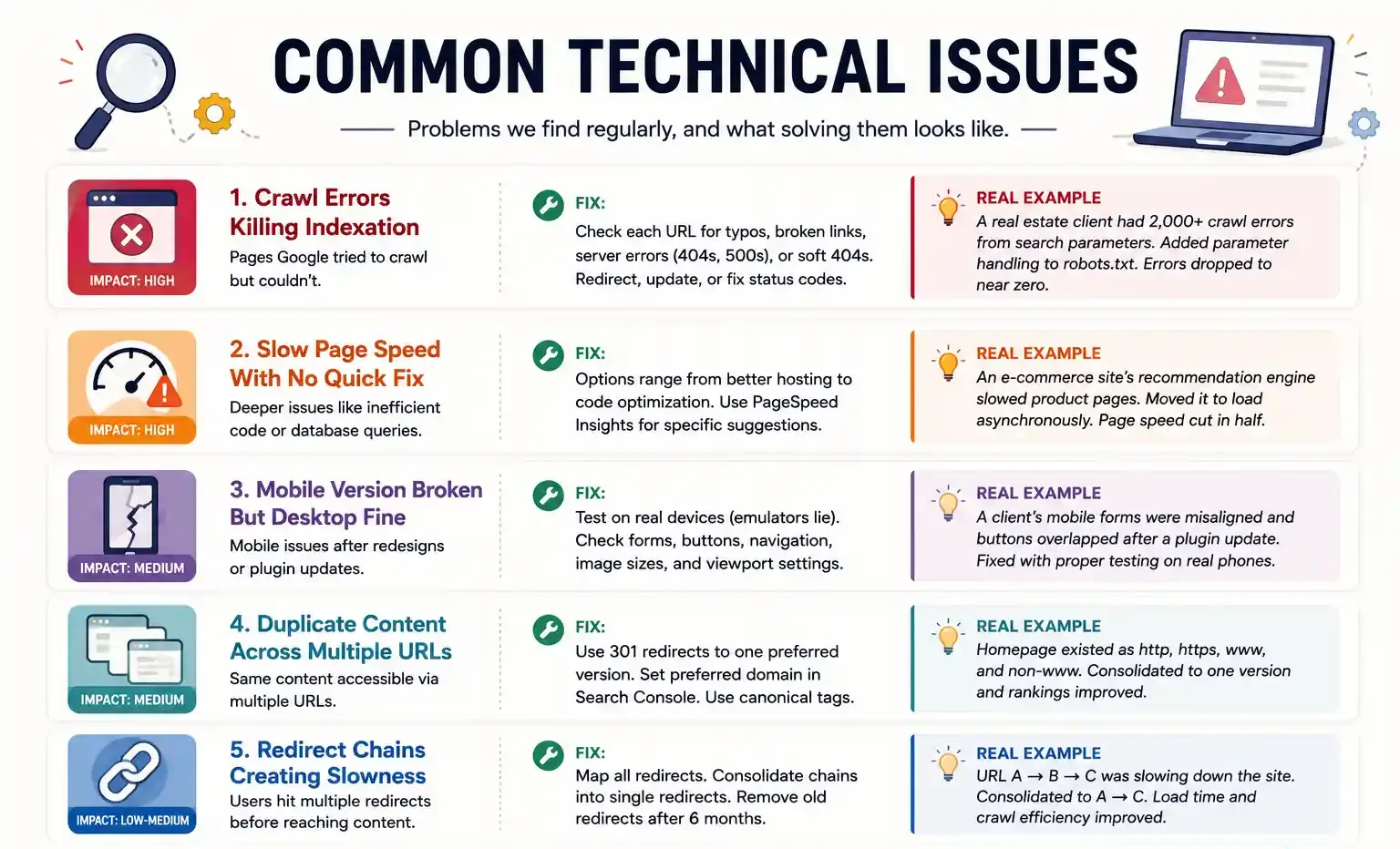
- Crawl errors that block indexation
You’ll see these in Google Search Console under Coverage. Pages Google tried to crawl but couldn’t.
Fix: Check each URL. Look for typos, broken links, server errors (404s, 500s). For 404s, redirect them to a relevant page or delete the sitemap entry. For 500 errors, investigate your server logs. For soft 404s (page looks like it works but returns a weird status code), fix the status code.
One real estate client had 2,000+ crawl errors from search parameters. Google was trying to crawl things like “property?filter_1=&filter_2=&filter_3=” infinitely. We added parameter handling to robots.txt to stop that.
- Slow page speed with no quick fix
Sometimes the issue is deeper than image compression. We’ve seen sites with slow database queries that make every page load take 6 seconds.
Fix options range from “swap web hosts” (nuclear) to “defer JavaScript loading” (surgical). Work with your web team on this. If you don’t have one, tools like Google PageSpeed Insights give specific suggestions.
One e-commerce site in Bangalore found that their recommendation engine was slowing down product pages. They moved it to load asynchronously. It no longer blocked the main page load.
- Mobile version broken but desktop fine
It usually happens after a redesign where mobile wasn’t tested. Or a plugin update broke something on mobile only.
Fix: Test everything on actual mobile phones. Emulators lie sometimes. Check forms, buttons, navigation, image sizes. Fix viewport settings if text is too small.
- Duplicate content across multiple URLs
Your homepage appears as yoursite.com and www.yoursite.com. Or http and https versions both exist. Google sees these as different pages and dilutes your ranking authority.
Fix: Use 301 redirects to consolidate to one version. Also set your preferred domain in Search Console settings. Use canonical tags as backup.
- Redirect chains that slow things down
URL A redirects to B, B redirects to C. Every visitor hits three servers before reaching content.
Fix: Map all your redirects. Consolidate chains into single redirects. Remove redirects older than 6 months (users bookmarks are expired anyway).
Tools we use, and which ones are worth the cost
You don’t need all of them. Start with the free ones. Add paid tools only if you hit limitations.
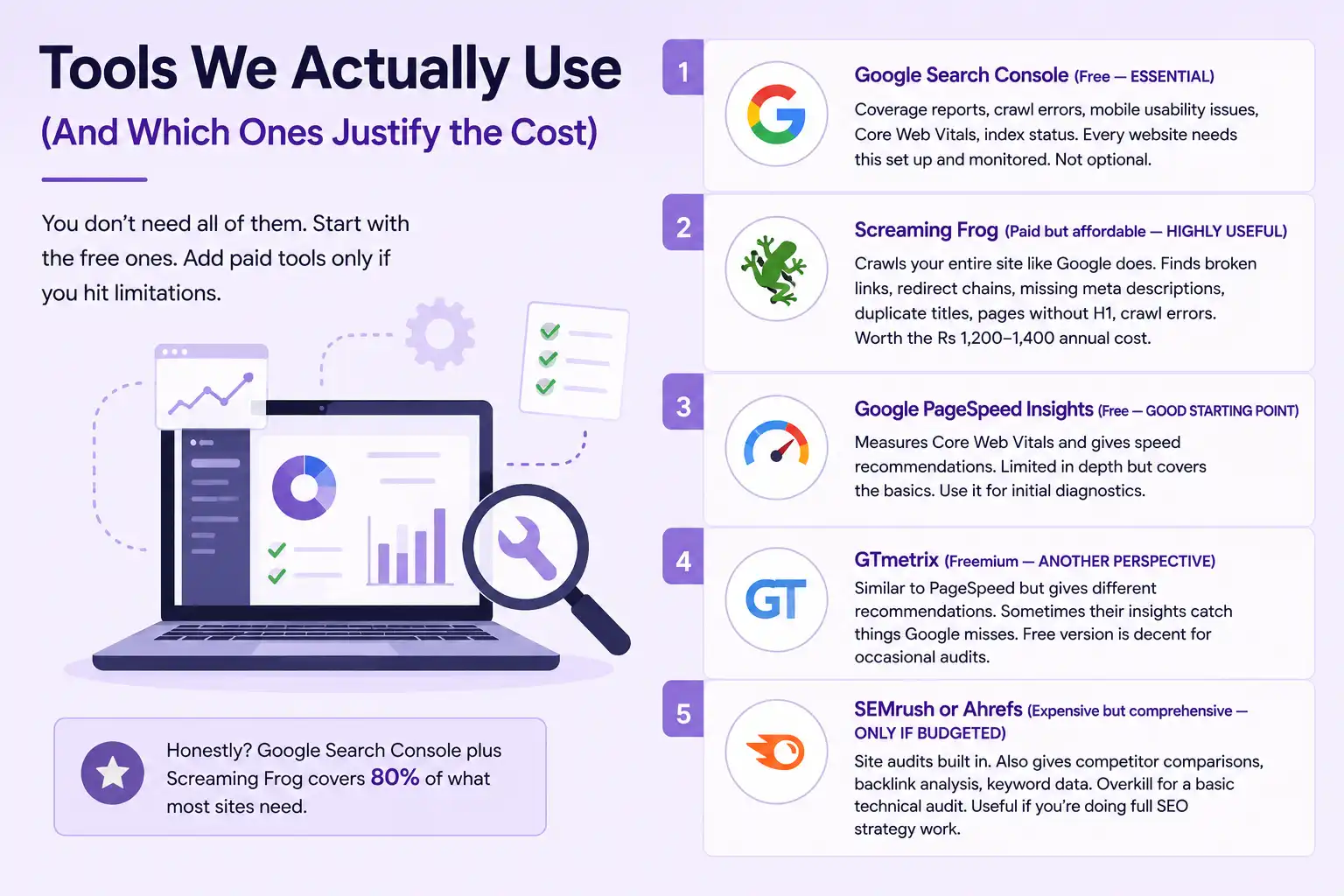
1. Google Search Console (free, essential)
This is your baseline. Coverage reports, crawl errors, mobile usability issues, Core Web Vitals, index status. Every website needs this set up and monitored. Not optional.
2. Screaming Frog (paid but affordable)
Crawls your entire site like Google does. Finds broken links, redirect chains, missing meta descriptions, duplicate titles, pages without H1 and crawl errors. Worth the Rs 1,200-1,400 annual cost if you audit sites regularly.
3. Google PageSpeed Insights (free, a good starting point)
Measures Core Web Vitals and gives speed recommendations. Limited in depth but covers the basics. Use it for initial diagnostics.
4. GTmetrix (free and paid versions)
Similar to PageSpeed but gives different recommendations. Sometimes their insights catch things Google misses. Free version is decent for occasional audits.
5. SEMrush or Ahrefs (expensive, only if budgeted)
Site audits built in. It also gives competitor comparisons, backlink analysis and keyword data. Overkill for a basic technical audit. Useful if you’re doing full SEO strategy work.
Google Search Console plus Screaming Frog covers most of what most sites need.
How often should you audit
Depends on your site size, traffic, and change frequency.
Small sites (under 500 pages, light traffic): annual audit is fine. Quarterly monitor of Search Console.
Medium sites (500-5,000 pages, solid traffic): semi-annual audits. Monthly Search Console checks. Immediate investigation if traffic drops.
Large sites (5,000+ pages, significant traffic): quarterly audits. Weekly monitoring of your main metrics. Dedicated person watching for issues.
After any major change (redesign, migration, server switch, CMS update), audit within two weeks.
We had a client migrate from Shopify to Magento. They didn’t audit for three months. By then, many of their product pages had broken redirects, and recovery cost them traffic.
The technical audit workflow
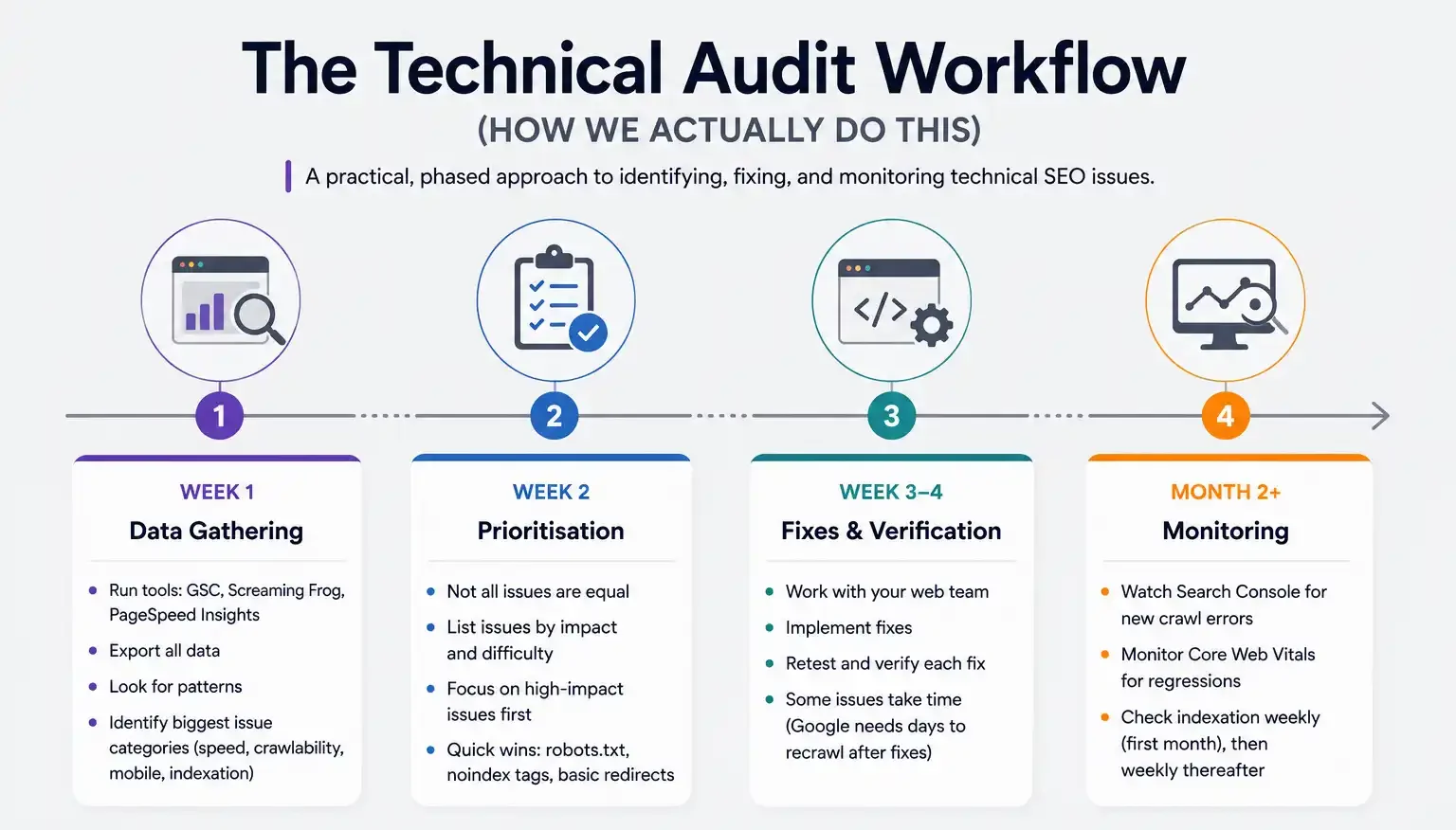
If you want to audit your own site, here’s roughly the process:
Week 1: data gathering. Run your site through Google Search Console, Screaming Frog and PageSpeed Insights. Export all the data. Look for patterns. What’s the biggest issue category: speed, crawlability, mobile or indexation?
Week 2: prioritise. Not all issues are equal. A crawl error affecting 3,000 pages matters more than a missing alt text on one image. List issues by impact and difficulty. Quick wins first, usually robots.txt issues, noindex tags, basic redirects.
Weeks 3 and 4: fixes and verification. Work with your web team. Implement fixes. Retest each one. Some issues take time, because Google needs days to recrawl after you fix redirects.
Month 2 onwards: monitoring. Watch Search Console for new crawl errors. Monitor Core Web Vitals for regressions. Check indexation weekly.
Why most agencies skip technical SEO
A lot of digital marketing agencies in India don’t properly understand technical SEO. They focus on keywords, content, and backlinks. That’s easier to explain to clients and easier to show results for.
Technical work is harder to show off. You can’t say “we reduced crawl errors by 47%” the same way you say “we ranked you for 12 new keywords.” So agencies often brush over it or outsource it to some random freelancer.
But technical issues are the foundation. Bad technical health will tank even great content. We’ve seen it repeatedly.
At PromotEdge, we treat technical SEO as non-negotiable. Benjamin and his team dig into this stuff. We’ve learned the hard way that skipping it costs clients months of lost traffic recovery later.
When to call in help and when to do it yourself
Be honest with yourself about your technical skills.
You can probably handle: setting up Search Console, running free audit tools, reading reports, spotting obvious issues like missing mobile responsiveness.
You probably shouldn’t attempt: modifying robots.txt on a live site without a backup, implementing schema markup incorrectly, changing redirect structures without proper mapping, migrating servers.
If you’re not 100% confident, get help. A bad technical fix can break your site faster than you’d think. A freelancer can accidentally block the entire site from Google.
Worth the investment to get it right the first time. Whether that’s hiring an agency like us, finding a good freelancer, or skilling up your in-house team.
Need help with your technical audit?
Our web team at PromotEdge can check your technical foundations. We’ll identify what’s broken and prioritise fixes by impact. We’ll make sure your site’s infrastructure is ready for the SEO work that comes after.


