
























Brand visibility is about being seen and remembered. Brand meaning is about what people associate with your business when they see it. A strong brand strategy connects both. Visibility attracts attention. But clear meaning builds trust, preference, and lasting customer relationships.
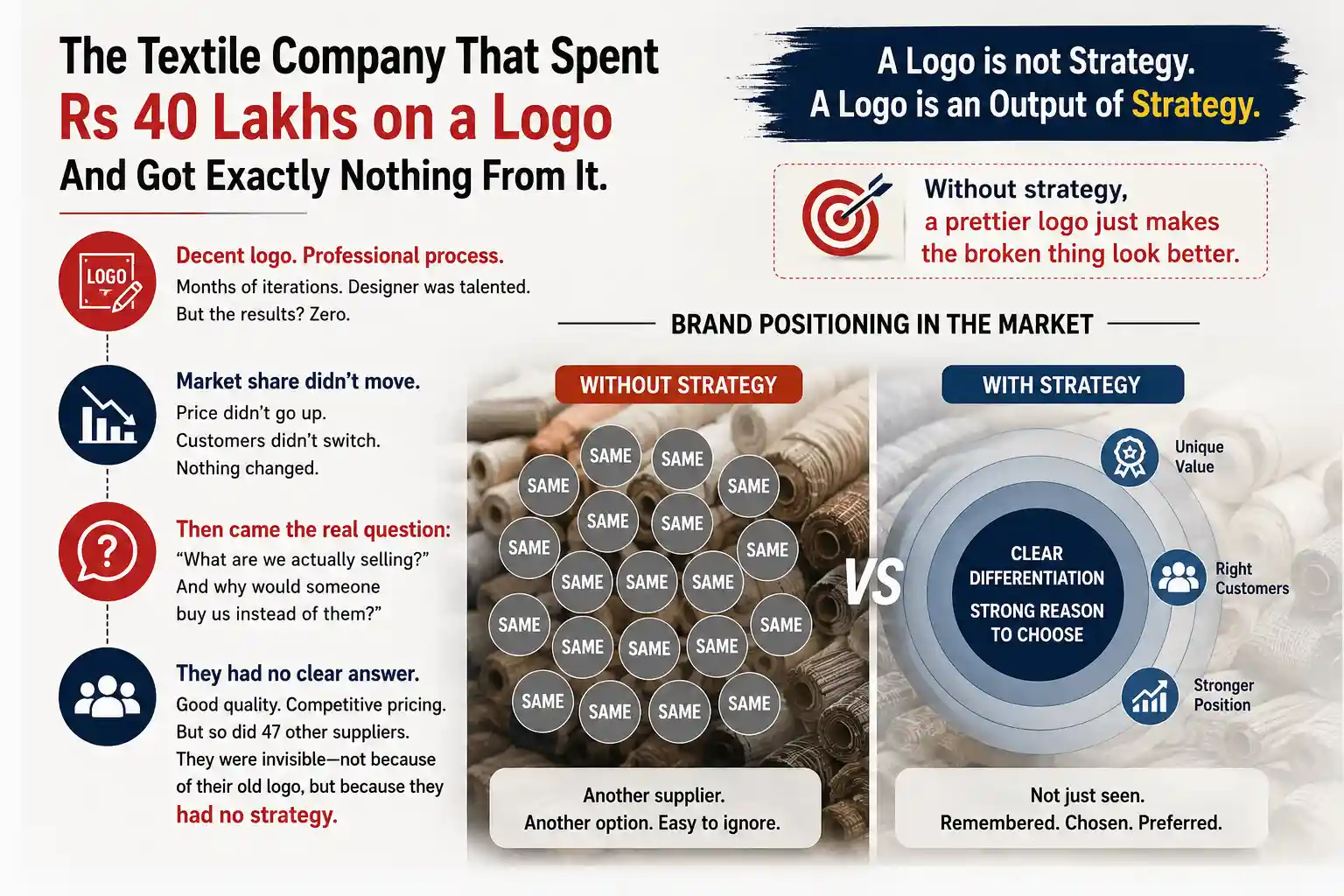
The textile company that spent lakhs on a logo
And got nothing from it. (This is a made-up example.)
Decent logo, too. Modern, clean, more abstract than their old one. The designer was talented. The process was professional. Months of iterations.
But their market share didn’t move. Their price didn’t go up. Customers didn’t suddenly choose them over competitors. Nothing changed except their website looked fresher.
Why? Because a logo is not strategy. A logo is an output of strategy. And if the strategy is broken, a prettier logo just makes the broken thing look better.
That’s when someone finally asked: “Wait, what are we actually selling? And why would someone buy us instead of them?”
They couldn’t answer. Not clearly. The company made fabric for industrial textiles. Good quality. Competitive pricing. But so did 47 other suppliers. They were invisible to customers not because of their old logo. They were invisible because they had no strategy. This is a common gap in brand identity design projects. The visuals are beautiful, but they fall flat. The strategy was never laid before the designer opened Illustrator.
What brand strategy actually is
Most people think it’s:
- A logo and colour palette
- A tagline
- Your brand voice and tone
- Your visual identity
Those are brand assets. They come after strategy.
Brand strategy is the answer to three questions:
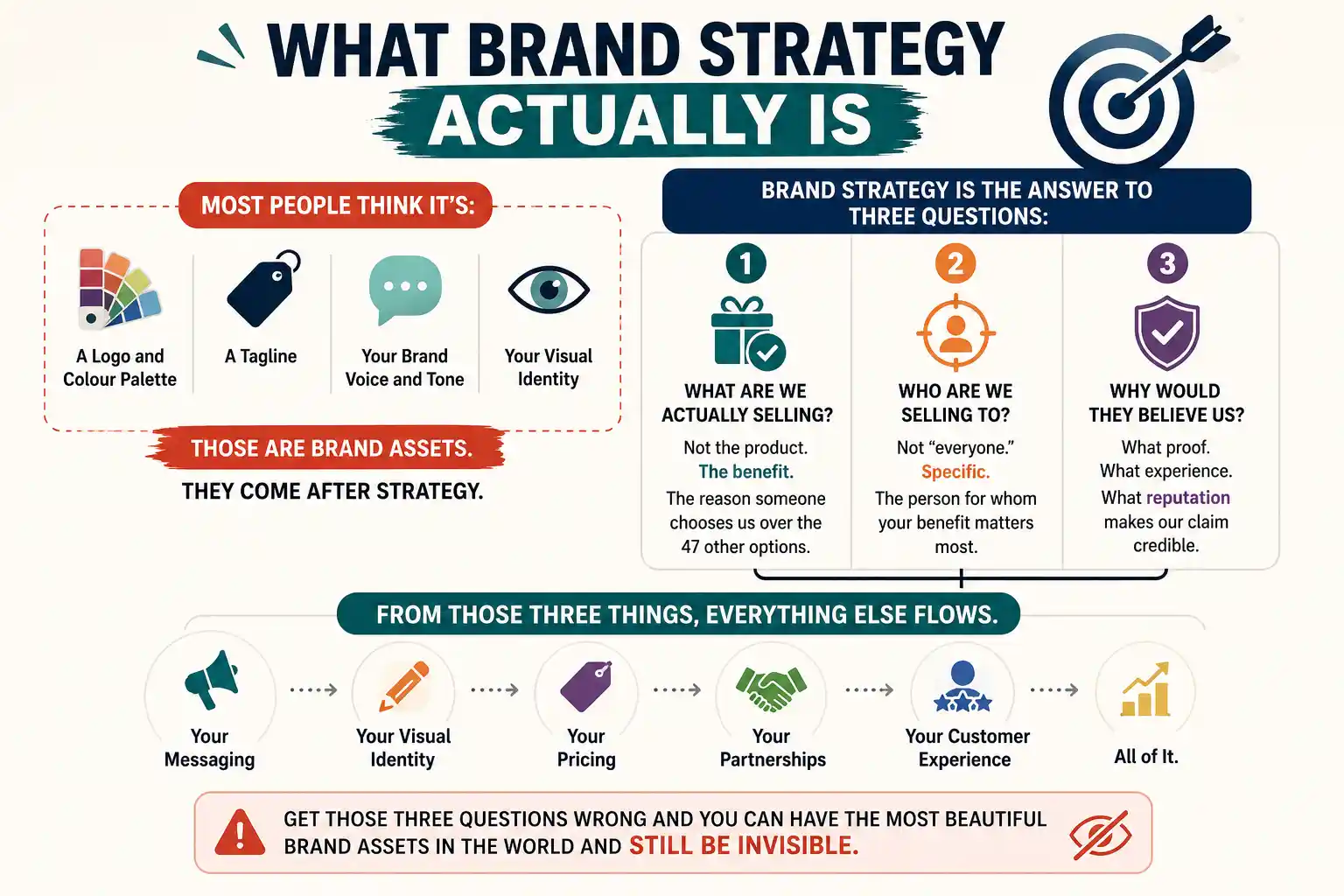
1. What are we actually selling? Not the product. The benefit. The reason someone chooses us over the 47 other options.
2. Who are we selling to? Not “everyone.” Specific. The person for whom your benefit matters most.
3. Why would they believe us? What proof. What experience. What reputation makes our claim credible.
From those three things, everything else flows. Your messaging. Your visual identity. Your pricing. Your partnerships. Your customer experience. All of it.
Get those three questions wrong and you can have the most beautiful brand assets in the world and still be invisible. Our guide on brand vs branding vs brand identity explains this. Many businesses mix up the three, invest in the wrong layer first and wonder why nothing changes.
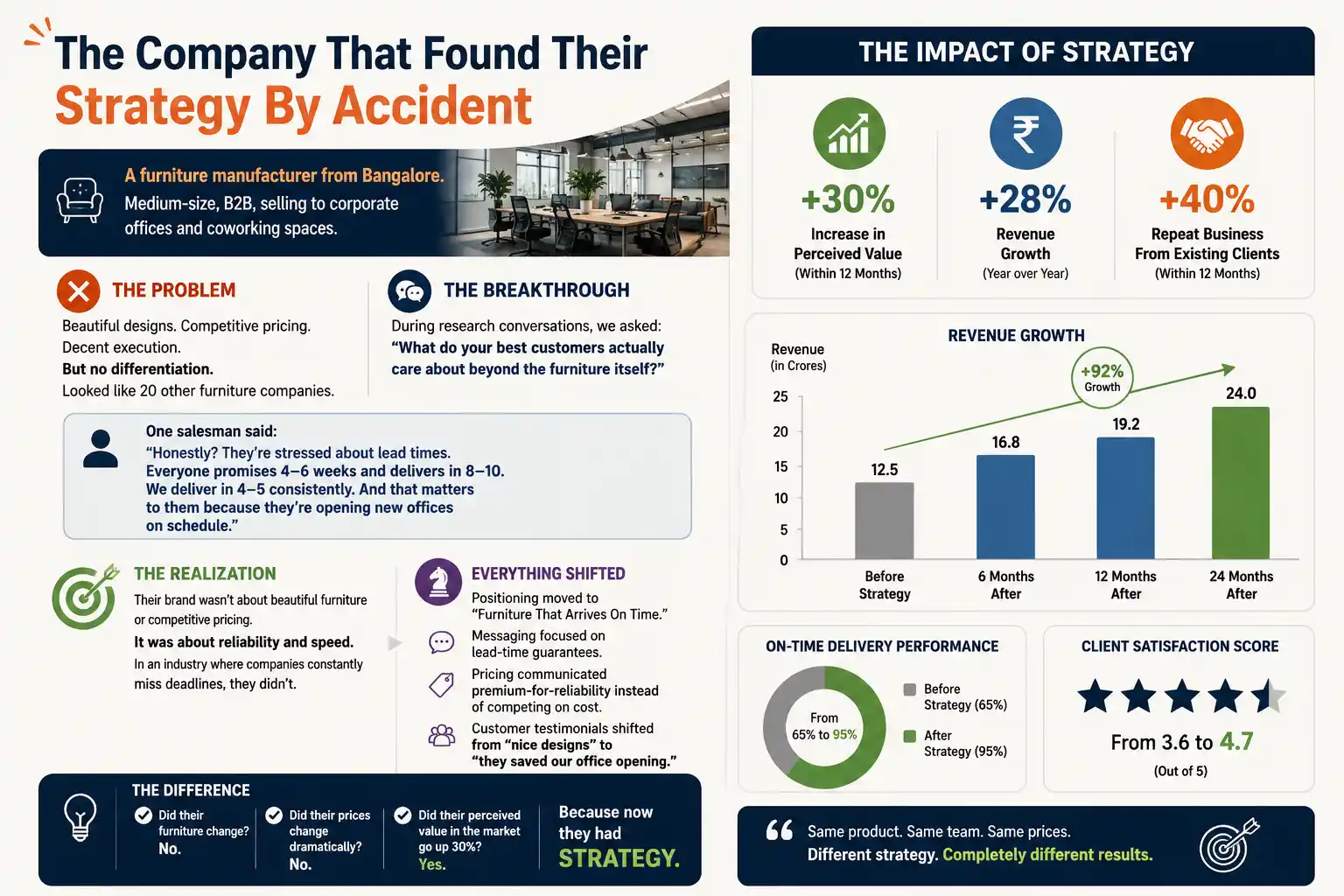
The company that found its strategy by accident
Take a furniture manufacturer (a made-up example). It is medium-sized and sells B2B (business to business). It supplies corporate offices and coworking spaces.
They had beautiful designs. Competitive pricing. Decent execution. But no differentiation. Looked like 20 other furniture companies.
Suppose we ask the sales team: “What do your best customers actually care about beyond the furniture itself?”
One salesman might answer: “Honestly? They’re stressed about lead times. Everyone promises 4-6 weeks and delivers in 8-10. We deliver in 4-5 consistently. And that matters to them because they’re opening new offices on schedule.”
That one comment changed everything. Their brand wasn’t about beautiful furniture or competitive pricing. It was about reliability and speed. In an industry where companies constantly miss deadlines, they didn’t.
Everything shifted. Positioning moved to “Furniture That Arrives On Time.” Messaging focused on lead-time guarantees. Pricing showed a premium for reliability. It did not compete on cost. Customer testimonials shifted from “nice designs” to “they saved our office opening.”
Did their furniture change? No. Did their prices change dramatically? No. Did their perceived value in the market go up? Yes, because now they had strategy.
That is the difference strategy makes.
The four components
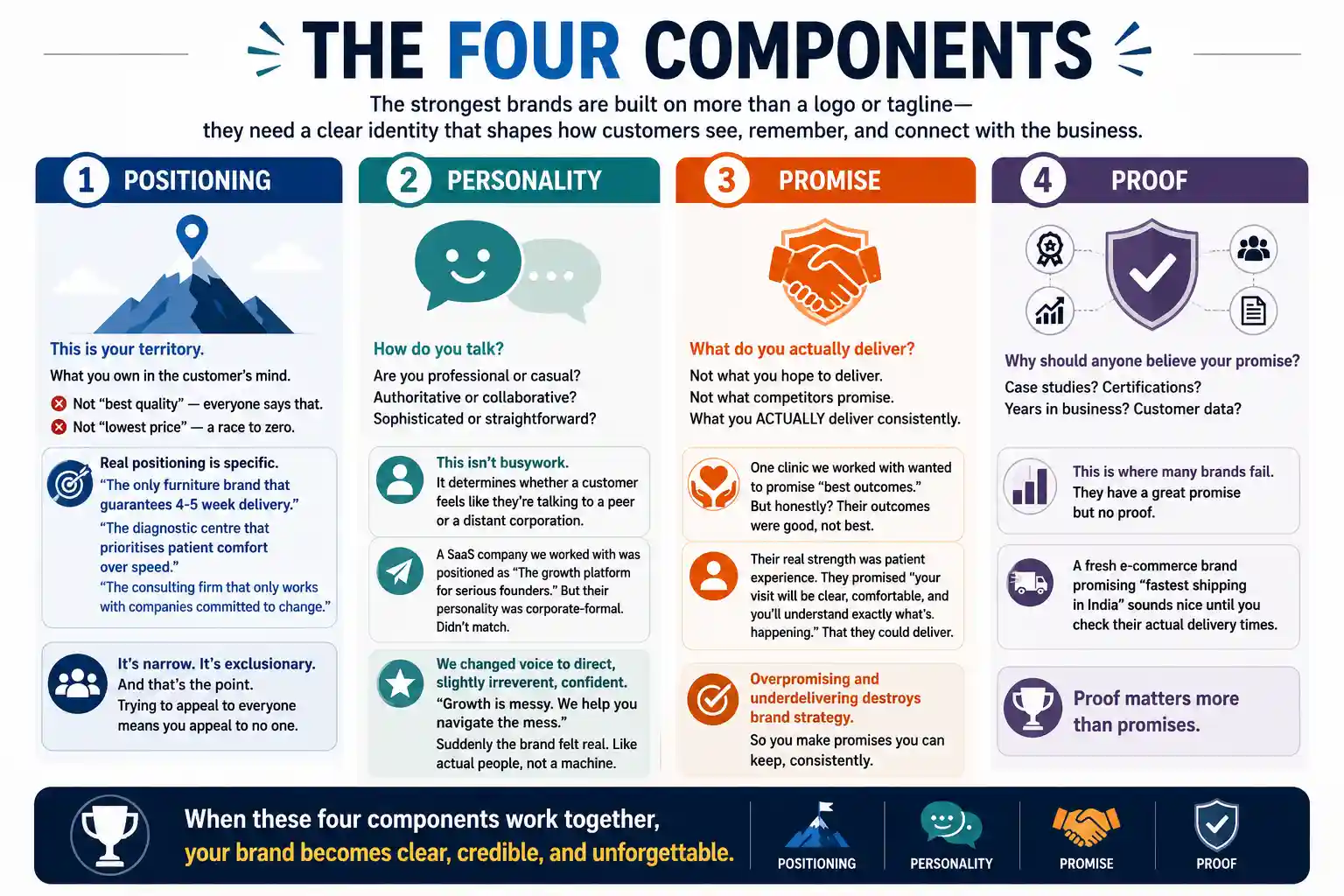
Strong brands need more than a logo or tagline. They need a clear identity that shapes how customers see and remember the business.
1. Positioning
This is your territory. What you own in the customer’s mind. Not “best quality”, because everyone says that. Not “lowest price”, because that is a race to zero.
Real positioning is specific. “The only furniture brand that guarantees 4-5 week delivery.” “The diagnostic centre that prioritises patient comfort over speed.” “The consulting firm that only works with companies committed to change.”
It’s narrow. It’s exclusionary. And that’s the point. Trying to appeal to everyone means you appeal to no one.
Positioning is also the foundation of brand strategy and positioning work. Without a clear, specific position in the market, every marketing choice becomes guesswork.
2. Personality
How do you talk? Are you professional or casual? Authoritative or collaborative? Sophisticated or straightforward?
This isn’t busywork. It determines whether a customer feels like they’re talking to a peer or a distant corporation. Take a SaaS company (another made-up example) positioned as “The growth platform for serious founders.” But their personality was corporate-formal. Didn’t match.
Change the voice to direct, slightly irreverent and confident. “Growth is messy. We help you work through the mess.” Suddenly the brand feels real, like actual people and not a machine.
3. Promise
What do you actually deliver? Not what you hope to deliver. Not what competitors promise. What you ACTUALLY deliver consistently.
Take a clinic that wants to promise “best outcomes.” But honestly? Their outcomes were good, not best. Their real strength was patient experience. They promised “your visit will be clear, comfortable, and you’ll understand exactly what’s happening.” That they could deliver.
Overpromising and underdelivering destroys brand strategy. So you make promises you can keep, consistently.
4. Proof
Why should anyone believe your promise? Case studies? Certifications? Years in business? Customer data?
This is where many brands fail. They have a great promise but no proof. A fresh e-commerce brand may promise “fastest shipping in India”. It sounds nice until you check their actual delivery times. Proof matters more than promises.
Brand strategy vs marketing
Marketing is reach. “How do we get our message in front of more people?”
Brand strategy is meaning. “What do we actually mean to people?”
You can have great marketing and weak brand strategy. Lots of visibility, no loyalty. Companies spend crores on ads. Everyone knows them. Nobody buys from them twice.
You can have weak marketing and strong brand strategy. Low visibility, fierce loyalty. Customers who know you will defend you. Will refer you. Will pay a premium.
Best situation? Strong strategy with good marketing. Limited audience, but they’re the RIGHT audience. And they’re loyal.
Worst situation? Weak strategy with big marketing budget. Lots of people see you. Nobody cares.
The Indian context
In India, most businesses compete on price. Manufacturing costs less here, so everyone assumes that’s the main selling point.
But price is not a strategy. Price is the last resort of a brand with no strategy.
Take a packaging company that calls itself “the cheapest in the market” (a made-up example). That’s not positioning. That’s a race to zero. And eventually, someone cheaper enters the market and you’re done.
Reposition it as “customisation without the wait.” They could do small runs and quick turnarounds. That mattered to small businesses. Suddenly they weren’t competing on price. They were competing on service. And they could charge accordingly.
That is brand strategy in India. Find something you can deliver that your competitors either can’t or won’t.
How to build brand strategy
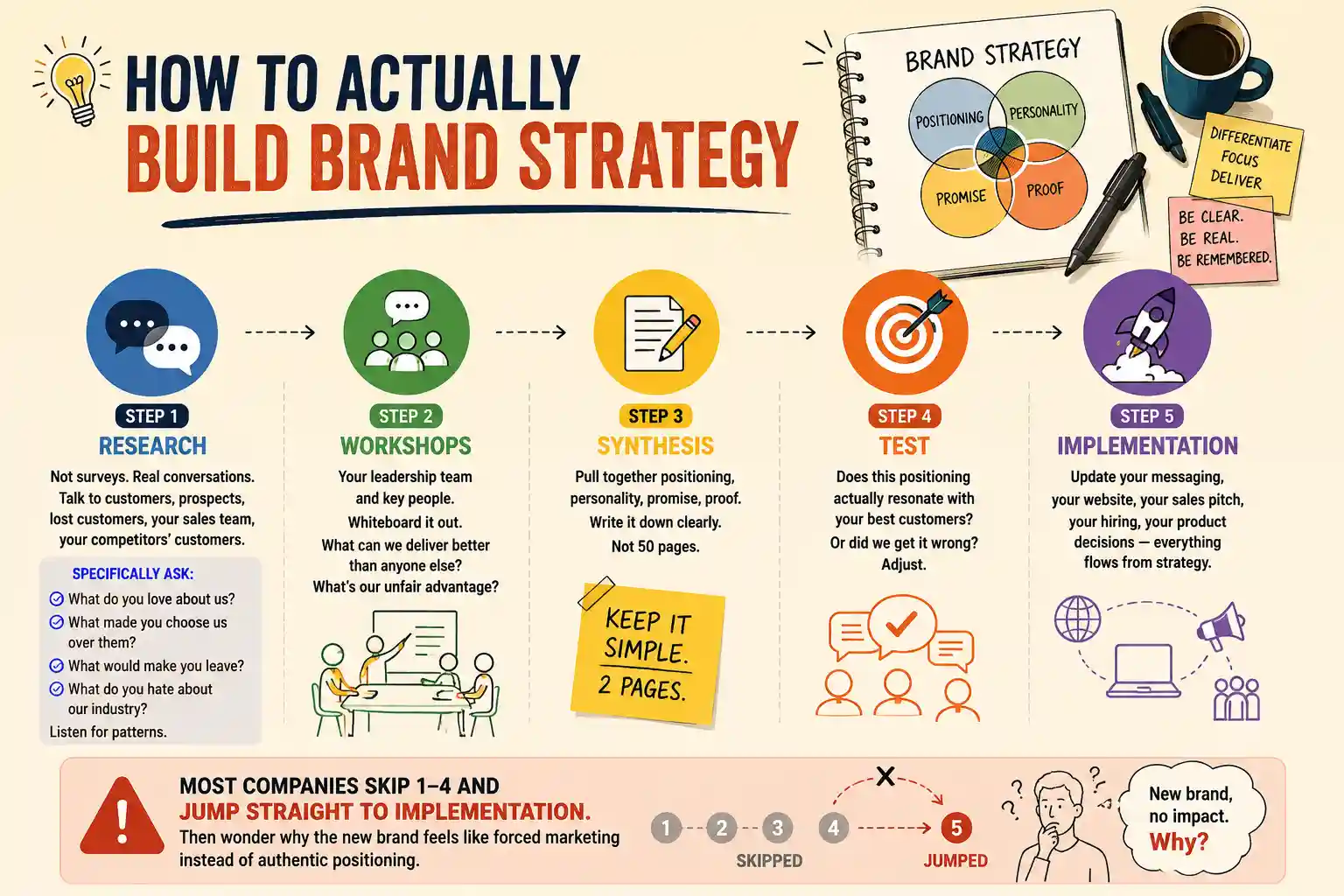
Step 1, research: not surveys. Real conversations. Talk to customers, prospects, lost customers, your sales team, your competitors’ customers.
Specifically: “What do you love about us?” “What made you choose us over them?” “What would make you leave?” “What do you hate about our industry?” Listen for patterns.
Step 2, workshops: your leadership team and key people. Whiteboard it out. What can we deliver better than anyone else? What’s our unfair advantage?
Step 3, synthesis: pull together positioning, personality, promise and proof. Write it down clearly. Not 50 pages. 2 pages.
Step 4, test: does this positioning actually resonate with your best customers? Or did we get it wrong? Adjust.
Step 5, implementation: update your messaging and website. Update your sales pitch, hiring and product decisions. Everything flows from strategy.
Most companies skip 1-4 and jump straight to implementation. Then wonder why the new brand feels like forced marketing instead of authentic positioning.
What happens when you get strategy right
Pricing power goes up. Because you’re not competing on price anymore. You’re competing on what you uniquely deliver.
Customer acquisition costs go down. Because your message resonates with the RIGHT people and they’re easier to convert.
Retention improves. Because customers chose you for a specific reason. You consistently deliver on that.
Employee recruitment improves. People want to work for a company with a clear purpose. Not “make money”, which is assumed. But “we deliver X to people who care about Y.” That attracts the right team.
Decision-making gets easier. Should you enter this new market? Does it fit your positioning? No? You say no. You’re not tempted by every revenue opportunity because you know who you are.
A founder might put it this way: “Before strategy, I’d chase any opportunity. Now I know exactly who we serve and what we deliver. Business got easier because I was doing less, but smarter.”
The uncomfortable truth
Brand strategy forces you to say no to things.
No to customers who don’t fit your positioning. No to revenue opportunities that don’t fit your promise. No to markets where you can’t deliver on your positioning.
That’s hard for founders who’ve been taking whatever business comes their way. But the companies that grow well are not the ones doing everything. They are the ones doing one thing very well.
If you build your brand strategy and you’re uncomfortable with the implications, that’s a sign you’re doing it right. A good strategy should make some people uncomfortable. It’s exclusive by design.
We work with brands across India on positioning, identity and strategy. Some are startups figuring it out for the first time. Some are established companies. They realise their strategy has drifted or become irrelevant. Both situations need the same thing: clear thinking about who you are and what you deliver. If that’s where you are, let’s talk about your positioning.
The bottom line
If you take one thing from this, take this. Good brand strategy comes from patience and specific details, not volume or clever tricks.
Ready to build your brand strategy?
PromotEdge works with brands across India. We help them define positioning, personality, and promise. Whether you’re starting fresh or repositioning, let’s clarify who you are and what you deliver.


