
























You then need a consistent experience across your website, packaging, social media and customer service. Content and marketing follow. Stay consistent, measure what works and give the brand time to build trust. This is what a complete brand strategy looks like in practice. It is a step-by-step process that makes people choose you even when they have other options.
A founder with a product and nothing else
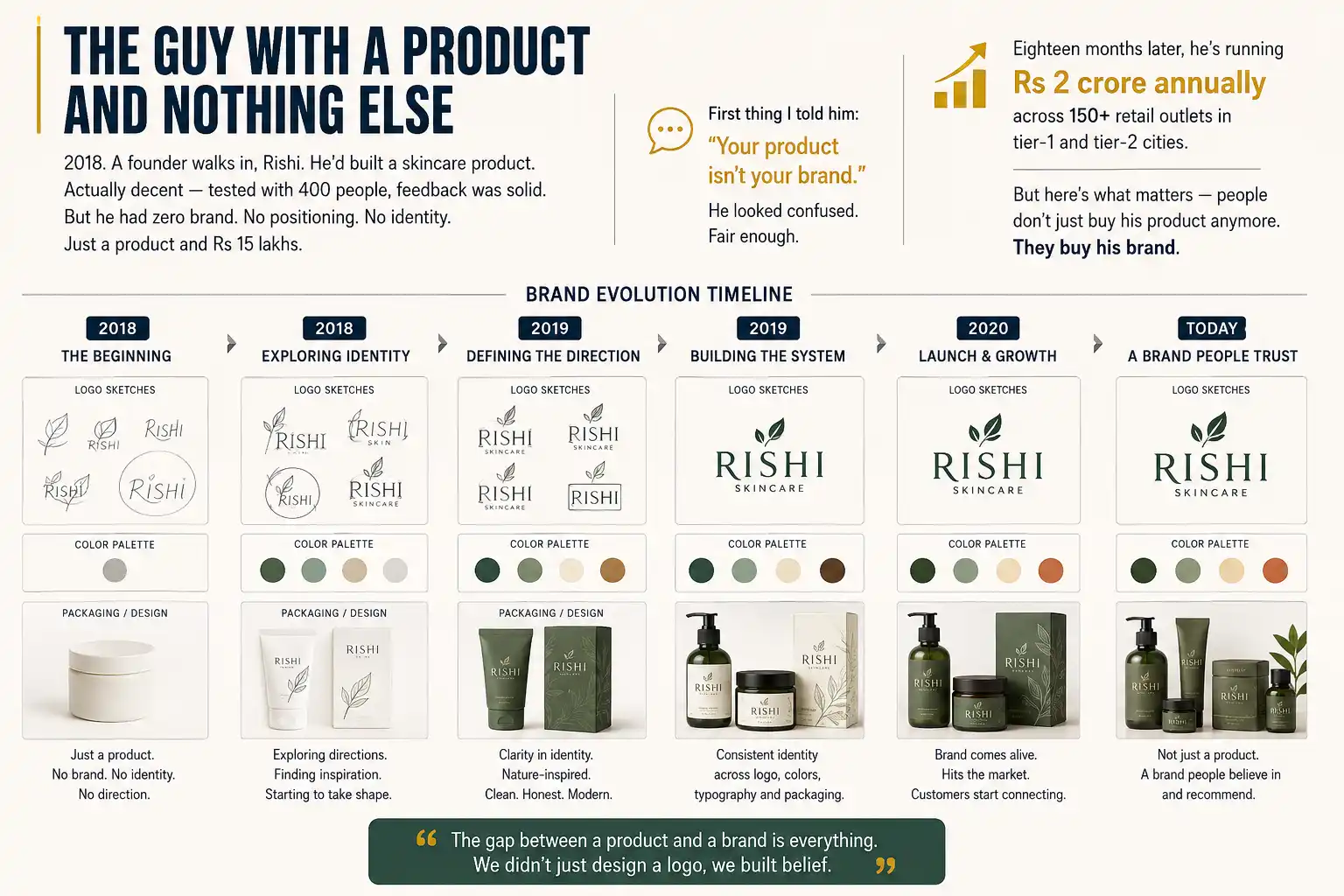
Take an example (a made-up one, to explain the idea). A founder, Rishi, walks in. He has built a skincare product. It is decent and early testers liked it. But he has no brand: no positioning, no identity. He has a product and a budget.
The first thing we tell him: “Your product is not your brand.”
He looks confused. That is fair.
Now picture him a year or two later. People no longer buy only his product. They buy his brand. That gap is what this article is about.
Four layers of a brand (most brands do only one)
Brand-building has four layers. Most founders think it is only the first.
Layer 1 is identity: logo, colours, fonts and visual style. This is what everyone sees, but it is a small part of the work. Many people think this is all of branding.
Layer 2 is positioning: who you are, what problem you solve and why you are different. Many brands skip this or get it wrong. Then their marketing does not stick because the core idea is vague.
Layer 3 is experience: your website, packaging, social media tone and customer service. Consistency here builds trust. It is harder than it sounds.
Layer 4 is amplification: how people find you, through content, ads, PR (public relations) and partnerships. You can have a beautiful brand. But if nobody sees it, it earns nothing.
Successful brands do all four. The order can vary: some build identity first, some positioning. But all four have to happen, and skipping any layer costs you. Our guide on brand vs branding vs brand identity explains how the layers connect. Many founders mix them up, so they spend on the wrong layer at the wrong time.
Understand your customer
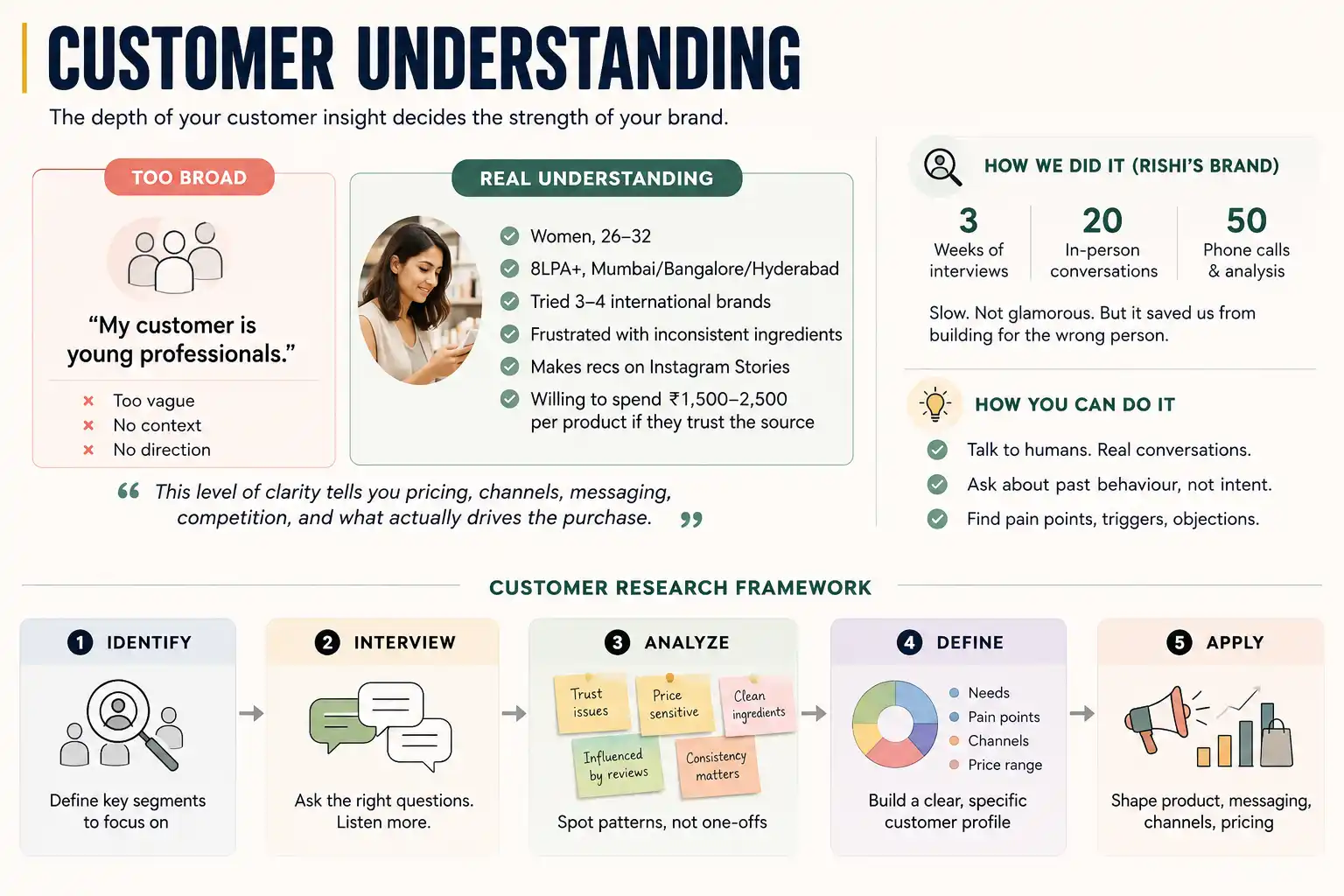
Most founders say: “My customer is young professionals.”
That is too broad to be useful.
Real customer understanding sounds like this: “Women aged 26-32, earning 8 LPA or more, based in Mumbai, Bangalore or Hyderabad. They have tried 3-4 international skincare brands, are frustrated with inconsistent ingredients, share product recommendations on Instagram Stories, and will spend Rs 1,500-2,500 per product if they trust the source.”
See the difference? The second tells you the pricing, the channels, the messages that will work and who your real competition is.
For a brand like Rishi’s, you would spend a few weeks interviewing people, some in person and some on calls. You would also study how buyers of similar products behave on Instagram. It is slow and not glamorous. But it stops you building a brand for the wrong person.
You can do this without a big research budget. Talk to real people. Do not ask “would you buy this?”, because the answer tells you little. Ask these instead. When did you last buy in this category? What did you buy, and why? What annoyed you? What would make you switch?
Positioning: hard to get right the first time
Positioning is not your tagline, your elevator pitch or your value proposition.
Positioning answers one question: in your customer’s mind, what do you own, and why?
BMW has long used “the ultimate driving machine”. A good position stays in people’s minds.
For Rishi, the first draft is: “Premium Indian skincare for the modern woman.” It is generic, and many other brands say the same thing.
Second draft: “Skincare built for Indian skin, transparent about ingredients, dermatologist-backed.” Better, but it still does not own anything specific.
Final version, after interviews, competitor study and a few wrong attempts: “The skincare brand where you know exactly what goes into your skin, because we explain why we chose each ingredient.”
That one line shapes everything else. It shapes ingredient stories in marketing and educational website content. It shapes packaging that shows the ingredients. It shapes customer service that can explain the product science.
Many brands skip this and go straight to ads. The ads do not land because the positioning is vague or missing. This is where an agency can help, because it is the part founders struggle with most.
Identity design: making the brand look right
Once positioning is fixed, identity gets easier, though not easy.
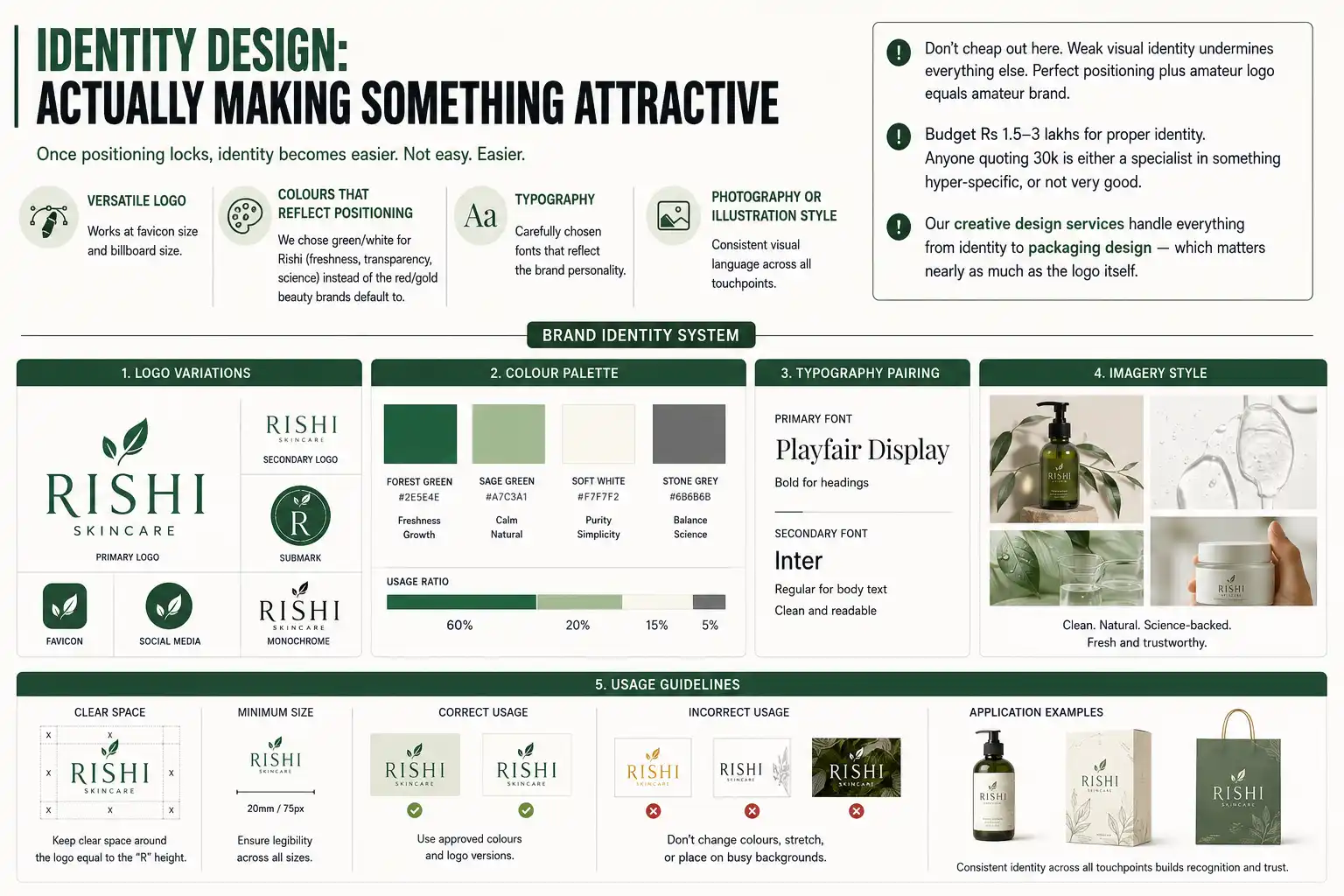
You need a logo that works at favicon size (the tiny icon in a browser tab) and billboard size. You need colours that reflect your positioning. For Rishi, that is green and white (freshness, transparency, science) instead of the red and gold many beauty brands use. You also need typography, a photography or illustration style and a proper brand guidelines document.
Do not cut corners here. A brand built on a Canva template looks weak next to a properly designed one. It shows at once. A weak visual identity undermines everything else. Perfect positioning with an amateur logo still looks like an amateur brand.
As a rough guide, budget Rs 1.5-3 lakhs for a proper identity. A very low quote, such as Rs 30,000, usually means limited work.
Our creative design services cover everything from identity to packaging design, which matters almost as much as the logo.
Brand experience: consistency matters more than perfection
A beautiful logo can still get no traction when the brand is inconsistent across touchpoints.
Brand experience includes your website (often the most important asset, since many buying decisions happen there). It includes your packaging (the first impression). It includes your social media tone (keep one voice, not just pretty posts). It also includes your customer service response time.
A slow website loses trust. So do Instagram captions that change personality every week, and a support team that ignores messages. Each touchpoint either supports your brand or contradicts it.
Say Rishi’s brand has one voice on Instagram: helpful, slightly sarcastic, educational. Every post supports it. Many brands sound as if a different person wrote each post. That is confusion, not a brand.
We build websites that match the brand and are easy to use, so more visitors become customers. E-commerce sites need this most, because one weak touchpoint lowers the value of the whole brand.
Consistency beats perfection. Posting once a week in the same tone and quality is better than posting daily with no pattern.
What it costs
These are rough planning figures for a mid-market D2C (direct-to-consumer) brand targeting 10-50 lakh potential customers:
- Brand strategy and positioning: Rs 1-2 lakhs with an agency, nothing if you do it yourself
- Visual identity: Rs 1.5-3 lakhs
- Website: Rs 2-5 lakhs (custom), Rs 50-75k (template)
- Packaging design: Rs 2-4 lakhs
- Initial content (photography, copy, social assets): Rs 1-2 lakhs
- Marketing for the first 3 months: Rs 3-8 lakhs, depending on channels
- Total: Rs 10-25 lakhs for a solid launch.
That only covers launch. After that, you need about Rs 3-5 lakhs a month for 12 months to build the brand. Many brands fail because founders treat launch as the end. Launch is when the real work starts.
Timeline
Months 1-2: customer research, competitor study and a positioning workshop. The output is one clear positioning statement.
Months 2-3: identity design (logo, colours, fonts, guidelines). Take feedback from a small group only. Feedback from fifty people gives you a messy compromise.
Months 3-4: website, initial content, photography and copy for key pages.
Months 4-5: payment gateways, email systems and a social content calendar for 2-3 months.
Months 5-6: soft launch to early adopters only. Get feedback and adjust.
Month 6 onwards: scale up with ads, content, partnerships and PR.
This timeline assumes you work on it full time. If you work part time, expect it to take two to three times as long.
Common mistakes
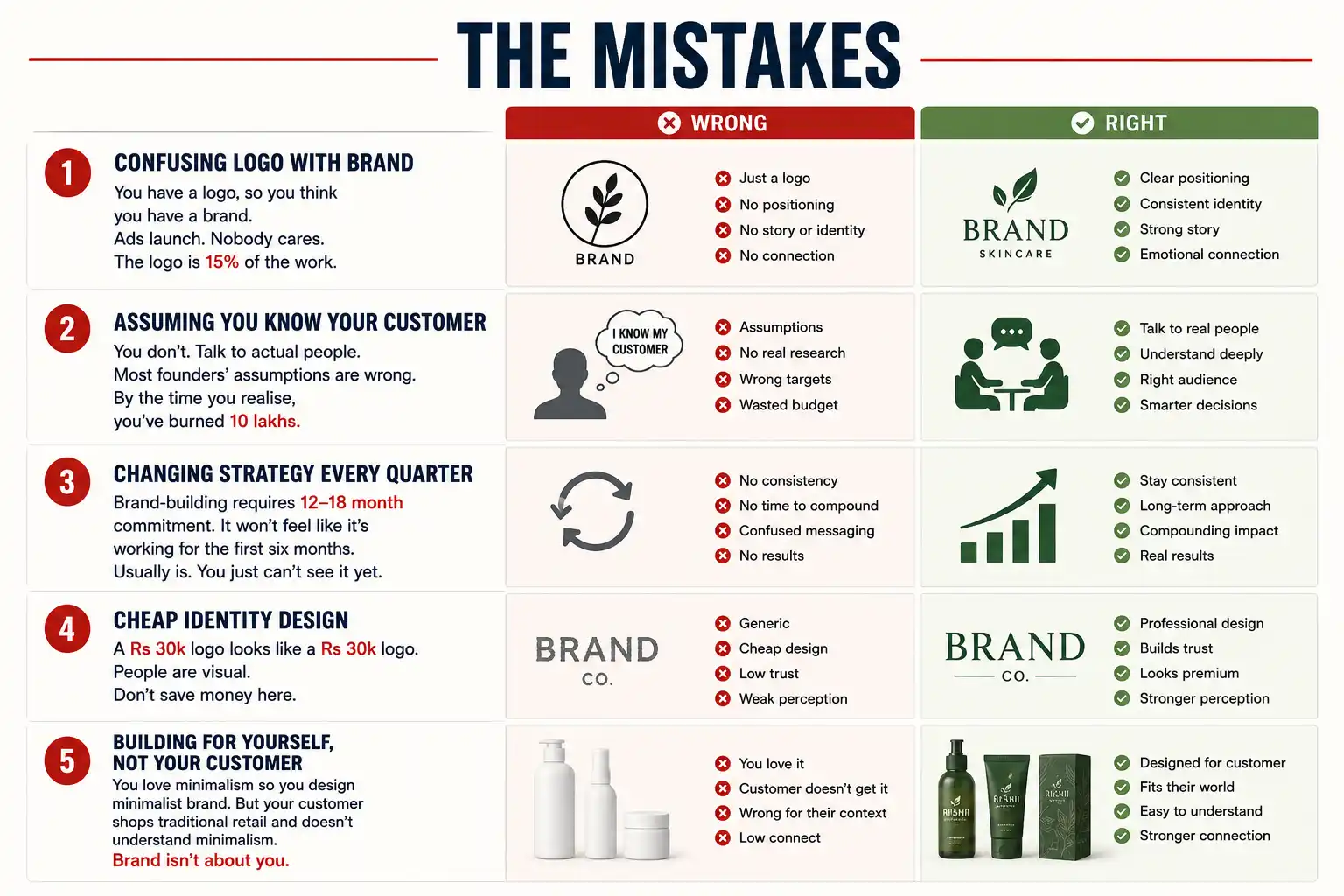
Mistake 1: confusing the logo with the brand. You have a logo, so you think you have a brand. The ads launch and nobody cares. The logo is a small part of the work.
Mistake 2: assuming you know your customer. Talk to actual people. Founders’ assumptions are often wrong, and by the time you realise, you may have spent lakhs.
Mistake 3: changing strategy every quarter. Brand-building needs a commitment of 12-18 months. It may not feel like it is working for the first six months, but it usually is. You just cannot see it yet.
Mistake 4: cheap identity design. People judge by what they see, so do not save money here.
Mistake 5: building for yourself and not your customer. You love minimalism, so you design a minimalist brand. But your customer shops in traditional retail and may not connect with minimalism. The brand is not about you.
Why brand-building is worth the wait
Brand-building is the slowest marketing channel. Ads work in weeks, while branding takes years.
The other side is that after a few years, a real brand becomes a strong asset. Your most loyal customers come from liking the brand, not from ads. You can charge premium prices and your margins improve. Competition matters less because you own something in the customer’s mind that is hard to copy.
Stop paying for ads and they disappear the same day. Stop spending on your brand and it still sticks, though not forever.
A product alone does not grow like this. A brand, like Rishi’s in our example, can add new products and new categories because people already trust it.
We work with brands at every stage, from positioning workshops for early founders to integrated marketing strategy for growing companies. Whether you need design, web development or brand films, the foundation is the same. It is clear positioning, a consistent experience and real customer understanding. We can't do magic alone.
Talk to us about your brand
PromotEdge works with brands from early positioning to scaling.


