
























When the six fit together, people recognise the brand wherever they meet it. The framework also helps you see how you want customers to view the brand, and how customers see themselves when they use it.
The brand you think you are vs. the brand you actually are
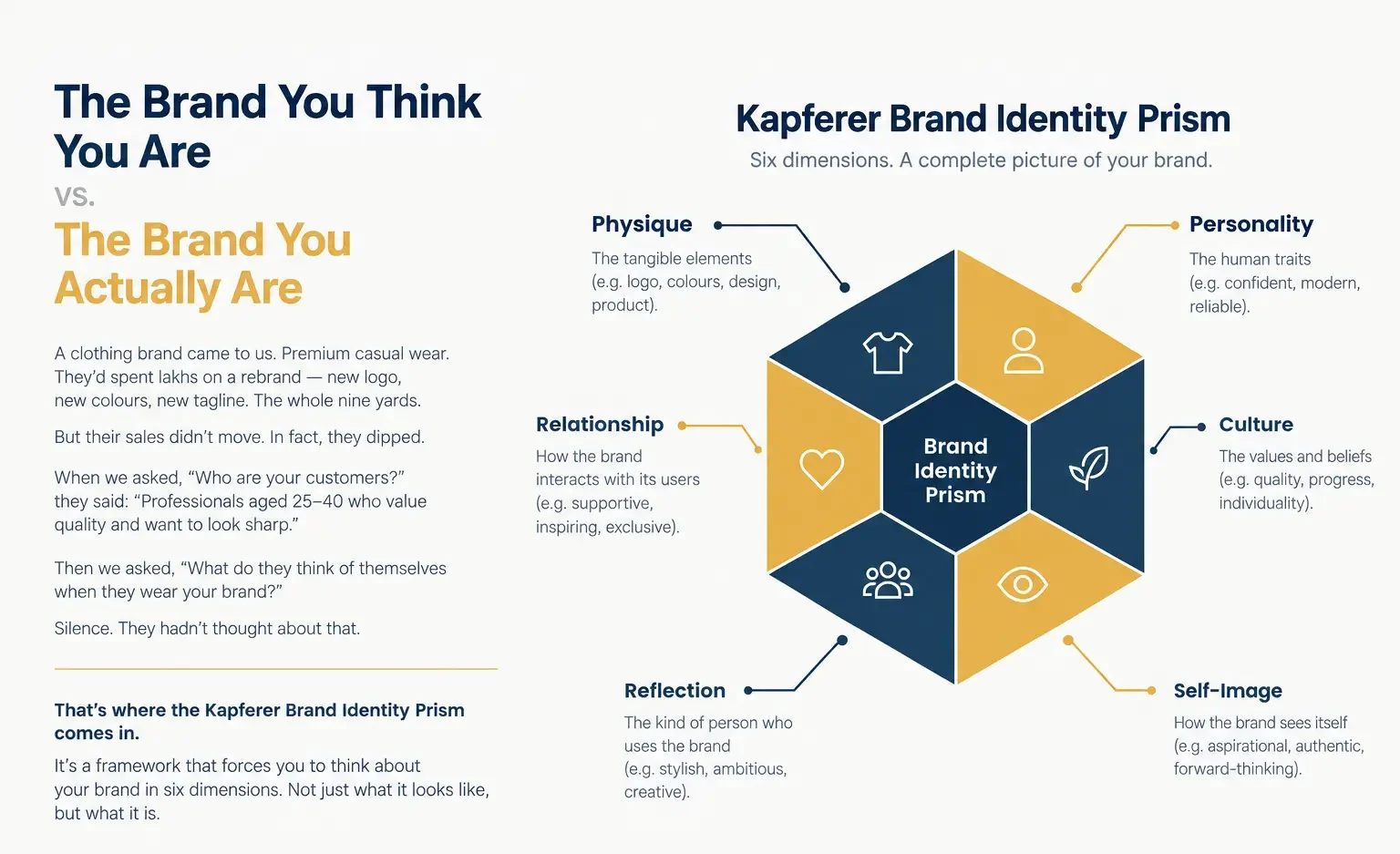
Picture a clothing brand selling premium casual wear: jeans, shirts, jackets. It spends lakhs on a rebrand, with a new logo, new colours (navy and gold) and a new tagline.
Sales do not move. They may even dip.
So you ask a simple question: “Who are your customers?”
The owner says: “Professionals aged 25-40 who value quality and want to look sharp.”
Then you ask: “What do they think of themselves when they wear your brand?”
The owner has not thought about that. The brand identity is all physical: the logo, the colours, the fit. Nobody has defined who the brand is or what values it stands for. Nobody has defined what kind of person wears its jeans, or what those jeans mean to that person.
This is where the Kapferer Brand Identity Prism helps. It makes you think about your brand in six dimensions, so you see what it is beyond how it looks.
The six dimensions explained
The Prism has six sides. Think of it as looking at your brand from six angles. If you ignore even one, the picture is incomplete.
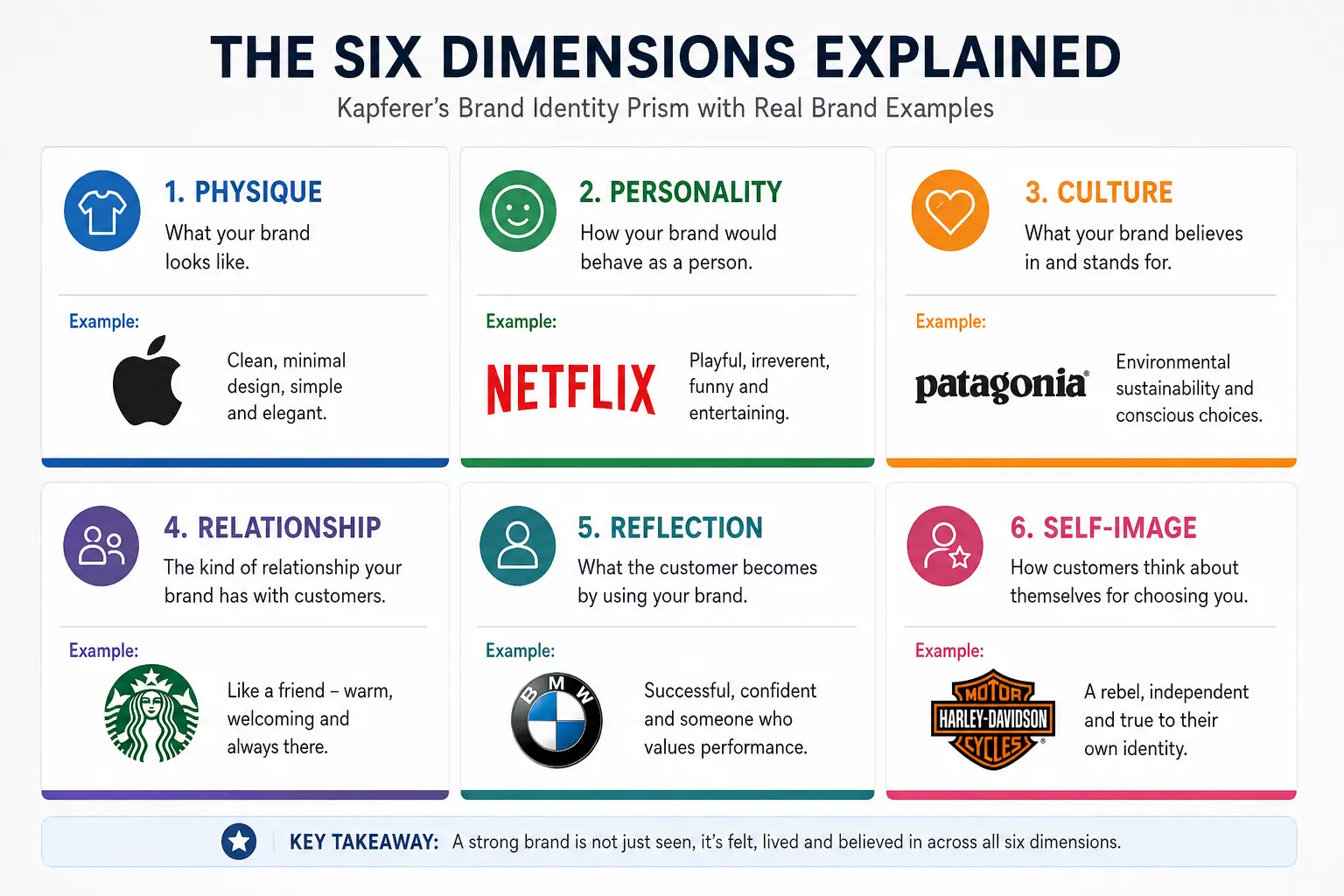
Dimension 1: Physique
This is what your brand looks like: the logo, the colours, the packaging, the store design, the website and the product itself.
It is the most obvious dimension and also the most overrated. Most brands obsess over it. They spend months getting the shade of blue right, and meanwhile they have not decided what the brand stands for.
Physique is necessary but not enough. Apple’s physique is minimalism, clean lines and white backgrounds. It works because Apple’s personality backs it up: innovative, uncompromising about user experience, rebellious against the status quo. Without that personality, it would be pretty packaging.
Dimension 2: Personality
This is how your brand would behave if it were a person. Is it funny or serious? Formal or casual? Bold or cautious? Rebellious or conventional?
Netflix sounds playful and irreverent in its marketing. Red Bull is extreme and daring. ICICI Bank is professional and solutions-focused.
Your personality should show up everywhere: your tone of voice, your customer service, your marketing copy and your product decisions.
Say a fintech startup writes copy like a government bank: very formal, very stiff. “We provide secure financial services.” Nobody cares. Shift the personality to “the money app that actually gets it”: still professional, but friendly and a little cheeky. That matches what young Indians want from a fintech brand.
Dimension 3: Culture
This is what your brand believes in: its values, and the bigger cause it stands for beyond making money.
Patagonia’s culture is environmental sustainability, and it will turn down profitable deals that break its values. Tesla’s culture is speeding up the move to sustainable energy. Nike’s culture is, increasingly, diversity and inclusion.
Culture sounds lofty, but it is practical. It tells your employees how to behave and tells customers whether to trust you. It guides every decision on product, hiring, marketing and partnerships.
Say a manufacturing company says its culture is “quality without compromise.” Sounds good. Then ask: “If a customer wants a large order at 20% lower price, do you compromise?” If they have not thought it through, the answer exposes the gap. Once they do think it through, the product roadmap may change. They may find they are willing to compromise when revenue is at stake.
That is the value of naming your culture: it exposes contradictions.
Dimension 4: Relationship
This is how your brand connects with customers. What kind of relationship does it have with them?
Some brands are like friends (Coca-Cola, Starbucks). Some are like mentors (MasterClass). Some are like doctors (healthcare brands) and some like coaches (fitness brands).
This matters because it sets what customers expect from you. A friend brand needs to be casual, available and fun. A mentor brand needs to be trustworthy, knowledgeable and patient.
Say an ed-tech brand positions itself as a friend, but takes 24 hours to reply. Friends reply immediately, so the signal is mixed. Reposition it as a “knowledgeable guide” and a 24-hour reply feels normal. The relationship now matches the experience.
Dimension 5: Reflection
This is what the customer becomes by using your brand. Or at least, what they think they become.
A BMW buyer buys the image of themselves as successful. A Greenply plywood buyer buys the image of someone who cares about quality and durability.
This is why luxury brands work. They sell reflection as much as product, and it is usually a brand campaign that carries that aspirational message to the audience.
Take a clothing brand with affordable fashion and sustainable materials. It does not sell “sustainable clothes”. It sells “I’m someone who cares about the planet and looks good doing it.” That is reflection. Once the brand understands that, its marketing can move from educational messaging about materials to aspirational messaging about being part of something bigger.
Dimension 6: Self-Image
This is how customers think about themselves in relation to your brand. It’s the internal identity they adopt when they use or support you.
It’s different from Reflection. Reflection is “what I become.” Self-Image is “who I am as a person for choosing this.”
Someone who uses a Harley-Davidson thinks of themselves as a rebel. Someone who uses organic skincare thinks of themselves as conscious. Someone who reads Penguin Classics thinks of themselves as intellectual.
Self-image drives loyalty. People stay loyal to protect an identity they have adopted.
Why most brands fail at this
Most brands get one or two dimensions right. Then they wonder why the brand does not stick.
Take a luxury handmade jewellery brand. Its physique is beautiful, with exquisite designs and premium packaging. Its culture is clear: ethical sourcing and fair trade. But its personality is inconsistent. Sometimes it sounds luxurious and premium. Sometimes it sounds casual and friendly.
Customers do not know what to expect. Is the brand for formal occasions or everyday wear? Is it aspirational or approachable? The mixed signals weaken its identity.
Another example: a tech startup with a rebellious personality that positions against big tech. But it has a corporate physique, with a standard UI, boring colours and a corporate website. The personality says “we’re disruptors”. The physique says “we’re another corporate tool”. Customers get confused.
Consistency across all six dimensions is what makes a brand strong. When customers see your logo (physique), they should think of your personality. When they meet your culture (how you treat people), it should reinforce everything else.
How to use the Prism for your brand
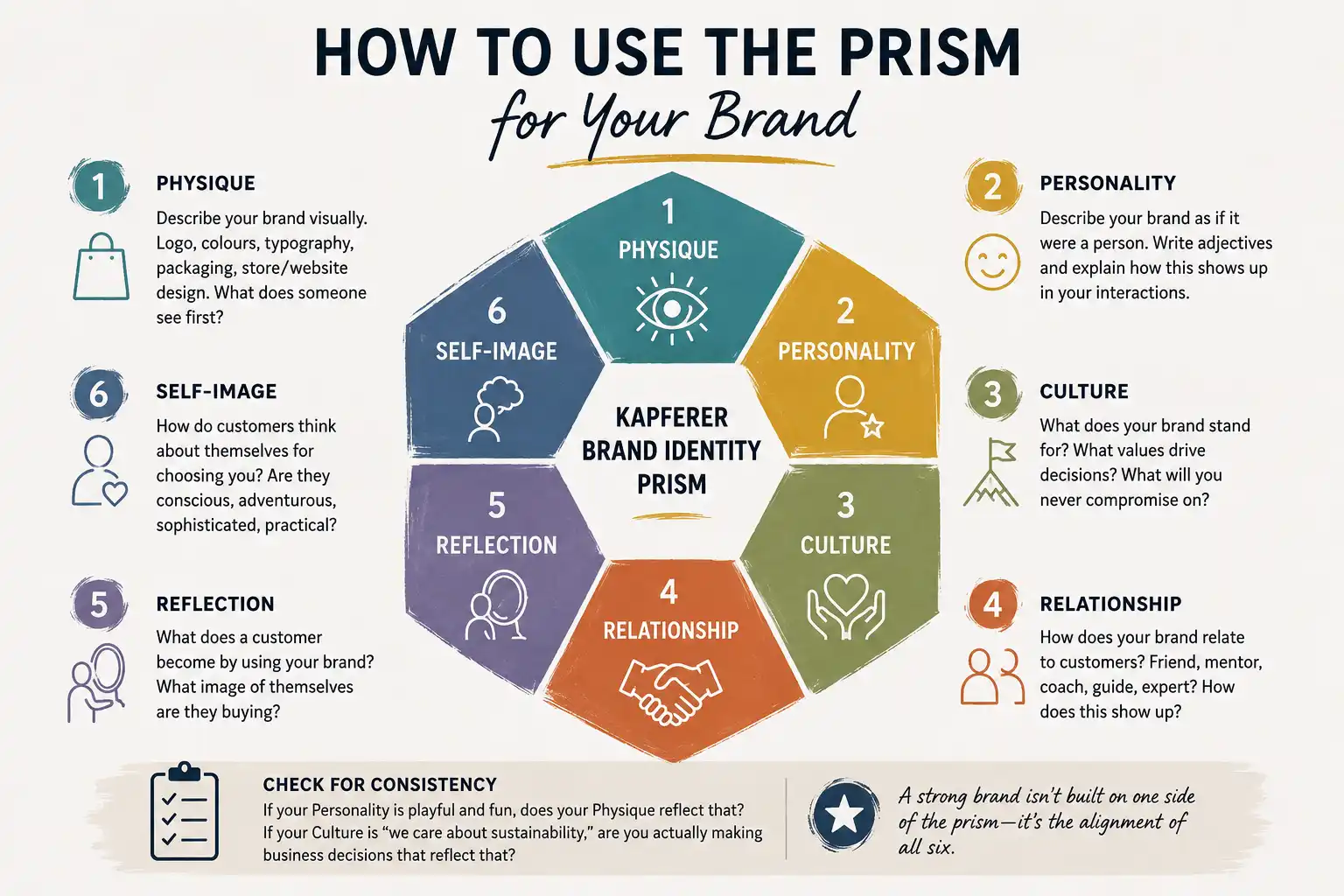
Start by mapping each dimension, and be honest. Write what you are right now, not what you want to be.
Dimension 1: Physique
Describe your brand visually. Logo, colours, typography, packaging, store/website design. Write it down in detail. What does someone see when they encounter your brand first?
Dimension 2: Personality
Describe your brand as if it were a person. Funny or serious? Formal or casual? Confident or humble? Write adjectives. Then write a paragraph about how this personality shows up in your interactions with customers.
Dimension 3: Culture
What does your brand stand for? What values drive decisions? Do not just write “quality”, because everyone claims quality. Be specific. What are you willing to sacrifice for? What won’t you compromise on? Answer honestly.
Dimension 4: Relationship
How does your brand relate to customers? Friend, mentor, coach, guide, expert? Be specific. Write how this relationship shows up when you talk to customers and when you support them.
Dimension 5: Reflection
What does a customer become by using your brand? Think of identity, not function. If someone uses your product, what image of themselves are they buying?
Dimension 6: Self-Image
How do customers think about themselves for choosing you? Are they conscious? Adventurous? Sophisticated? Practical? Write it down.
Then check for consistency. This step matters most. If your personality is playful and fun, does your physique reflect that? If your culture is “we care about sustainability”, do your business decisions reflect that?
An example: the muesli brand that got it right
Here is a made-up example. A muesli brand in Mumbai is trying to break into a market dominated by big FMCG (fast-moving consumer goods) players. It has a good product: quality oats, no added sugar, actually tasty.
But it has no brand identity. It tries to be everything: healthy, tasty, affordable, premium, convenient, traditional.
Mapping the Prism gives this:
- Its physique is minimalist: neutral colours, simple packaging, nothing flashy.
- Its personality is sensible and straightforward, like a friend who gives honest advice.
- Its culture is trust and transparency. It lists ingredients and sourcing, and hides nothing.
- Its relationship with customers is that of a trusted advisor who looks out for your health.
- For reflection, the customer thinks: “I’m smart about what I eat. I don’t fall for marketing gimmicks.”
- For self-image, the customer thinks: “I’m health-conscious but not obsessive. I care about what goes in my body.”
Once this is clear, everything follows. Marketing moves from “superfood” language to “no nonsense”. The website becomes cleaner and easier to read. Customer service becomes more direct and honest.
This will not drive explosive growth. It builds steady growth and brings in the right customers. They value honesty over marketing. They stay around, and they recommend the brand to others because it matches their identity.
Common mistakes when using the Prism
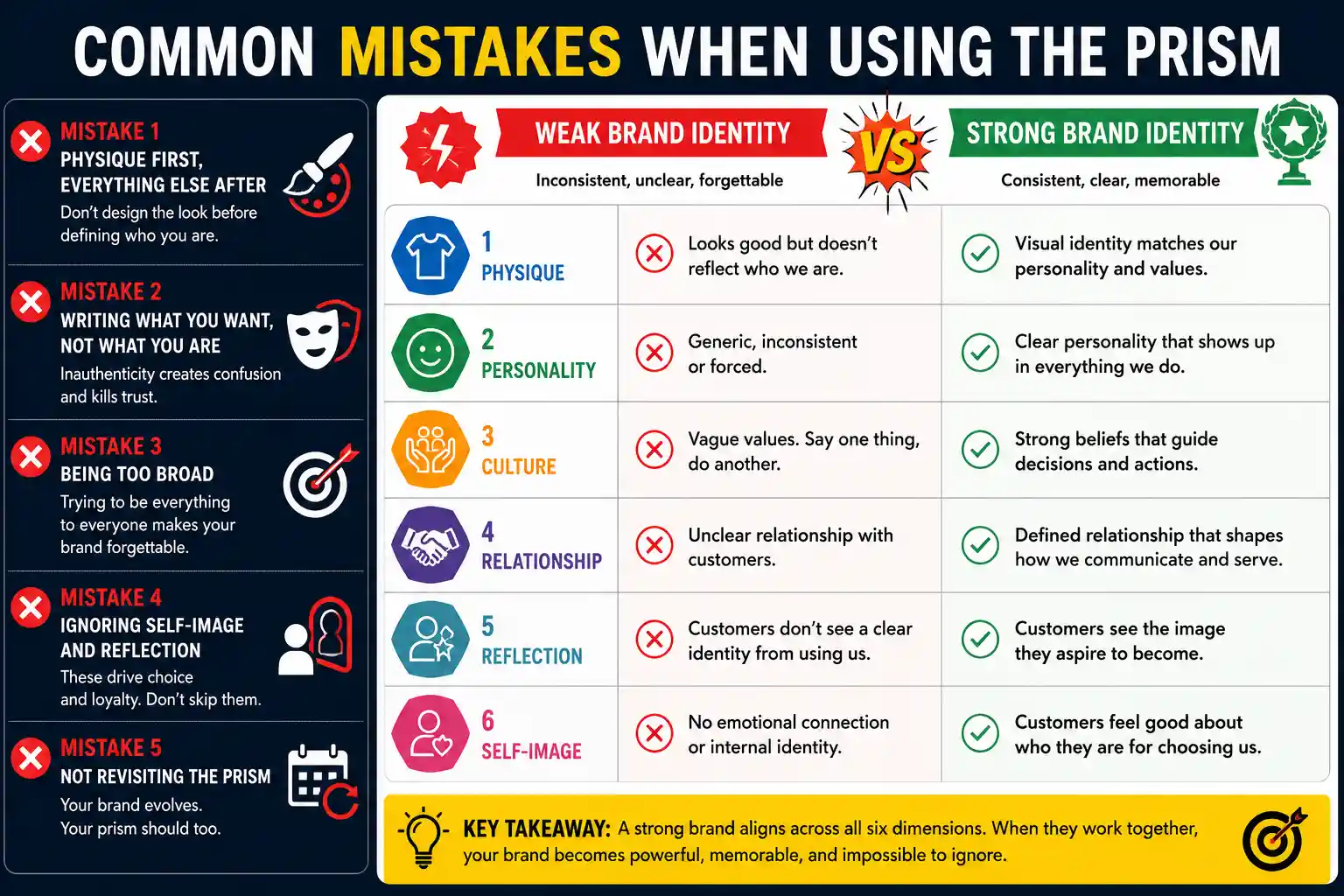
Most brands get this wrong in predictable ways.
Mistake 1: Physique first, everything else after
Brands obsess over logo redesigns before they have clarified their personality or culture. That is the wrong order. Define your dimensions first, then design the physique.
Mistake 2: Writing what you want, not what you are
Brands describe their personality as “playful and innovative” when they are actually formal and cautious. That contradiction undoes everything. Write what you actually are, then decide if you want to change.
Mistake 3: Being too broad
“We’re all things to all people.” That does not work. A strong brand is specific. You may appeal to several audiences, but your dimensions should be tight and clear. Vague dimensions confuse everyone.
Mistake 4: Ignoring self-image and reflection
Brands skip these because they seem philosophical. But they are your most powerful dimensions, because they are why customers choose you. Do not skip them.
Mistake 5: Not revisiting the Prism
Some brands create the Prism once and never look at it again. That is a mistake. As your business grows, markets change and customers evolve, your Prism may need adjusting. Revisit it every 2-3 years.
Building your brand identity with the Prism
The Kapferer Prism is a clarity tool more than a marketing tool. It forces you to answer hard questions about who you are as a brand. Once you have that clarity, design, messaging, customer experience, hiring and partnerships follow more easily.
Most brands are confused. They say they are premium but price like budget. They claim to be customer-focused but reply to emails after three days. They want to be innovative but hire only experienced people. These contradictions leak out.
The Prism helps you catch contradictions before they damage your brand. Get clarity first, then execution. Without clarity, even perfect execution will not save you.
So start mapping, and be honest about where you are. If there are gaps between who you want to be and who you are, decide whether to change the reality or change the ambition. Do not pretend the gaps do not exist.
Brand identity comes from a clear understanding of who you are, aligned across all six dimensions. A rebrand or a new logo cannot replace that.
Want help clarifying your brand identity?
We can help you map your brand dimensions using frameworks like the Kapferer Prism, and find the gaps holding you back.


