
























A conversation that comes up often
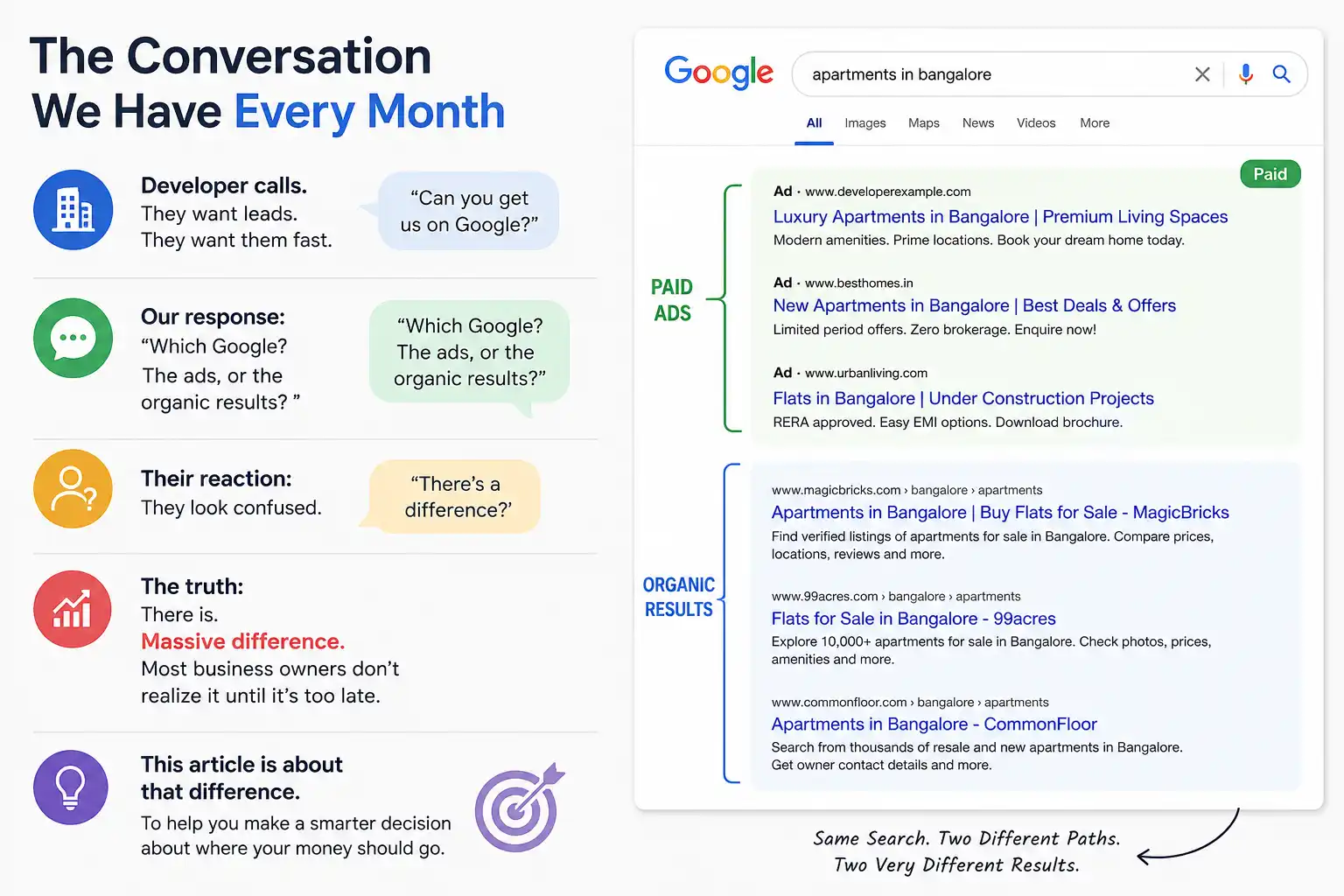
The first question to ask is: “Which Google? The ads, or the organic results?”
They look confused: “There’s a difference?”
There is, and it is a big one. Most business owners don’t understand it until they have spent money one way or the other and wish they had chosen differently.
This article explains that difference so you can make a smarter decision about where your money should go. We are not pushing you towards either channel.
The basic difference
PPC = Pay Per Click. You bid on a keyword. When someone searches it, your ad might show. They click. You pay Google. That money stops the moment you stop paying.
SEO = Search Engine Optimisation. You optimise your website, write good content and earn backlinks. Over time, Google ranks you higher for relevant searches and you get traffic, with no direct payment per click.
PPC is renting traffic. SEO is building traffic.
Think of it this way. PPC is like paying rent for a storefront. Great location, foot traffic guaranteed. But every month, you pay. If you stop paying, foot traffic stops. SEO is like owning the storefront. Takes longer to get established, requires ongoing maintenance, but once it’s yours, the foot traffic keeps coming.
Both have their place. But understanding the mechanics first clarifies which makes sense for your situation.
How SEO Works
You don’t get a choice about whether Google shows your site. Google’s algorithm crawls your pages, understands what they’re about, and decides whether they’re relevant for search queries.
If your content matches what people are searching for, if your website is technically sound, if other reputable sites link to you, and if people actually engage with your pages, Google ranks you higher. No payment required.
But getting to that point takes work.
Take a made-up example: a manufacturing company wants to rank for “industrial ball valves suppliers Ahmedabad.” It is a good keyword with real demand. But their website has no proper content, zero backlinks, and Google Search Console shows 80% crawl errors.
They spend three months on technical fixes and two months on content strategy. Then they publish eight detailed guides targeting the keyword and related variations, and do backlink outreach to industry publications and trade directories.
By month nine, they rank on the first page. By month twelve, they are at position three. By month eighteen, they see 40-50 qualified leads a month from organic search.
They spend steadily on fixes, content and links over those 18 months. But then, and this is the key part, those leads keep coming. In year two, they don’t need to increase spend much because the compounding effect has taken over.
How PPC works
You create an ad. You bid on a keyword. Your ad shows when someone searches. They click. You’re charged.
It is simple and immediate. You control the budget and the messaging, and you see results in days, not months.
The same manufacturer could have started PPC immediately. Set up a Google Ads campaign, bid on “industrial ball valves Ahmedabad,” and been generating leads by week one.
But the cost? Every click is paid for, and in a competitive B2B space clicks can be expensive. Work it out with your own numbers: cost per lead = cost per click ÷ the share of visitors who enquire. With a made-up ₹100 click and 1 in 10 visitors enquiring, each lead costs ₹1,000.
PPC scales. More budget = more clicks = more leads. But it never compounds the way SEO does. Spend a lot on PPC in year one and you get leads in proportion to that spend. Spend nothing in year two and you get zero leads.
That is the main trade-off. For a closer look at how to run PPC profitably, our guide on how to run profitable Google Ads campaigns is worth reading before you set a single budget.
The cost comparison, done properly
Costs depend on your market and goals, so we do not quote ranges here. Compare the shape of the spending instead.
SEO for a B2B service business (12-month project):
- Initial audit and strategy (one-time)
- Content creation (blog posts, guides), mostly in the first six months
- Ongoing management and optimisation
- Backlink building, mostly in the first six months
- Year one is the heaviest spend
- Year two onwards: much less intensive than year one
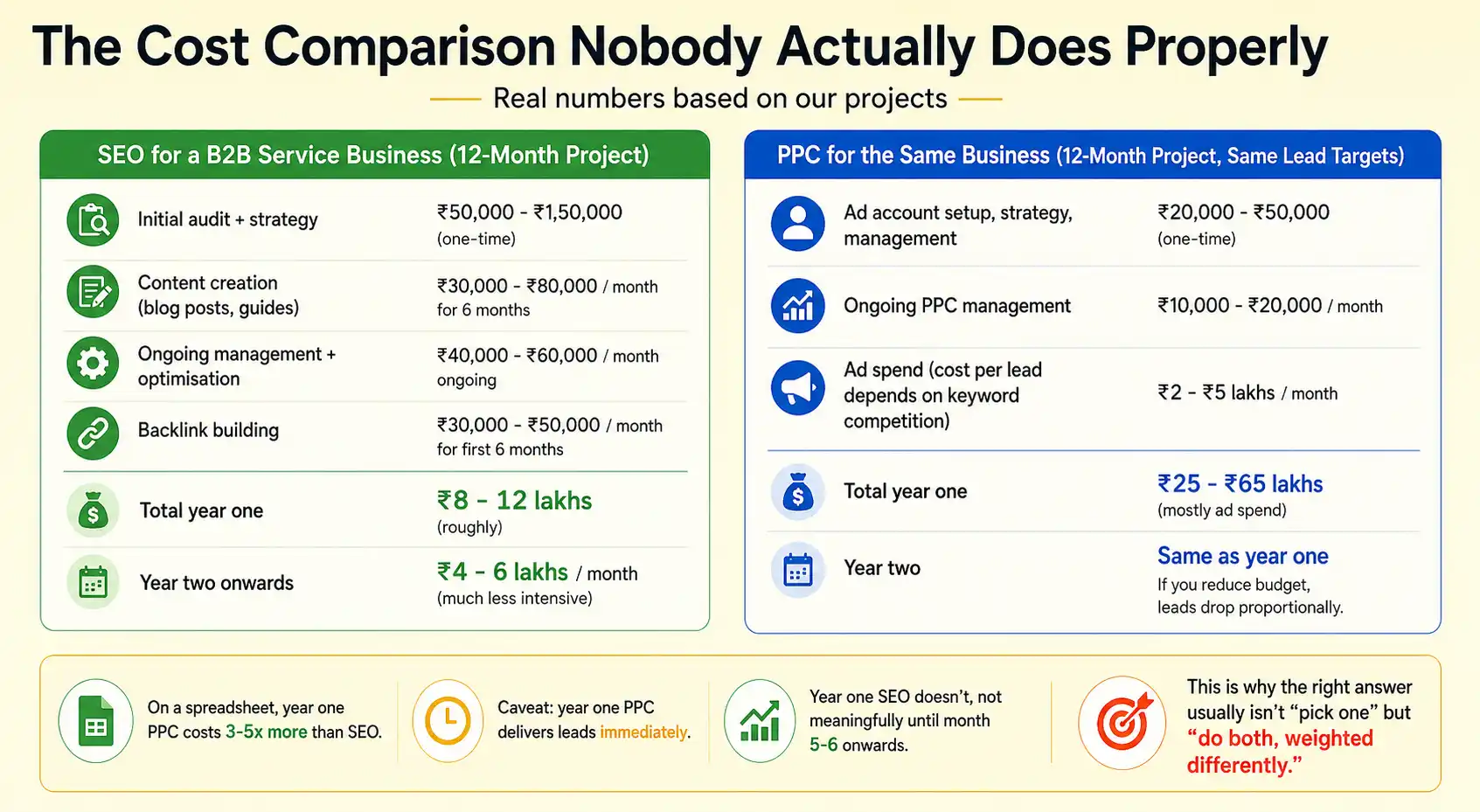
PPC for the same business (12-month project, same lead targets):
- Ad account setup, strategy and management (one-time)
- Ongoing PPC management
- Ad spend, the biggest cost (cost per lead depends on keyword competition)
- Year one: mostly ad spend
- Year two: same as year one. If you reduce budget, leads drop proportionally.
On a spreadsheet, year one PPC often costs more than SEO, mostly because of ad spend. But year one PPC delivers leads immediately, while year one SEO doesn’t, not meaningfully until month 5-6 onwards.
This is why the right answer is usually to do both, weighted differently.
Timeline: when do you get results?
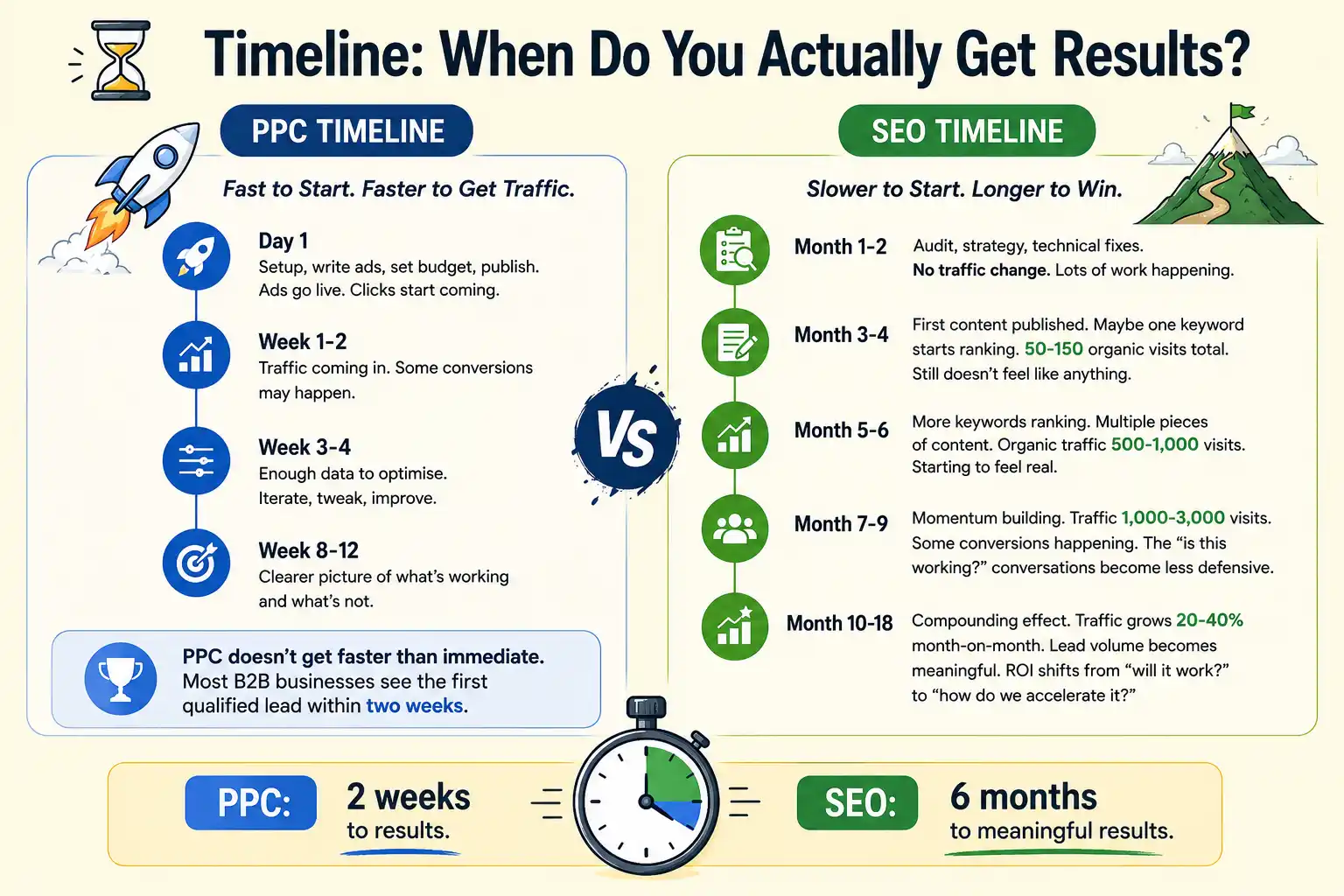
PPC timelines:
Set up your account, write ads, set a budget and publish. By the next day, your ads are live and clicks are coming. Some might convert immediately, but most won’t. Still, you are getting traffic.
You will iterate: change ad copy, adjust bids, refine targeting. By week three or four, you should have enough data to optimise. By week 8-12, you will have a sense of whether this is working.
PPC is fast, but it does not give instant conversions. A B2B business can expect its first qualified lead within the first few weeks.
SEO timelines:
- Month 1-2: audit, strategy and technical fixes. There is no change in traffic. A lot of work is happening, but nothing is visible to the client.
- Month 3-4: first content is published and maybe one keyword starts ranking. Organic visits are still very few, and it doesn’t feel like anything yet.
- Month 5-6: more keywords rank and there are multiple pieces of content. Organic traffic grows, and it starts to feel real.
- Month 7-9: momentum builds and some conversions happen. The “is this working?” conversations become less defensive.
- Month 10-18: the compounding effect shows. Traffic keeps growing month on month and lead volume becomes meaningful. ROI (return on investment) discussions shift from “will it work?” to “how do we accelerate it?”
- PPC: weeks to results. SEO: around 6 months to meaningful results.
Conversion quality: not all leads are equal
Someone clicking a PPC ad is often at a different stage of their decision journey than someone who found your site organically and read your detailed guide.
A PPC clicker might still be doing early research (“What are my options?”). An organic searcher who read your 3,000-word guide on “how to choose industrial ball valves” is much further along, so they are more qualified and more likely to convert.
In general, PPC brings higher volume but lower conversion rates, and SEO brings lower volume but higher conversion quality.
Take a made-up example: a SaaS company. Their PPC ads get 400 clicks a month at a 5% conversion rate, which is 20 leads. The average deal value is Rs 5 lakhs, and 10% of leads convert to a sale. That is roughly 2 customers per month from PPC, at a much higher cost per customer, because every click is paid for.
Their SEO brings 150 organic visits per month at an 18% conversion rate, because these are warm, educated visitors. That is 27 leads, and with the same 10% sales conversion, roughly 2.7 customers per month. The cost per customer is lower because the SEO work is spread over many months.
The economics are very different by month 12, once SEO kicks in.
A brand that did PPC for 6 months, then moved towards SEO
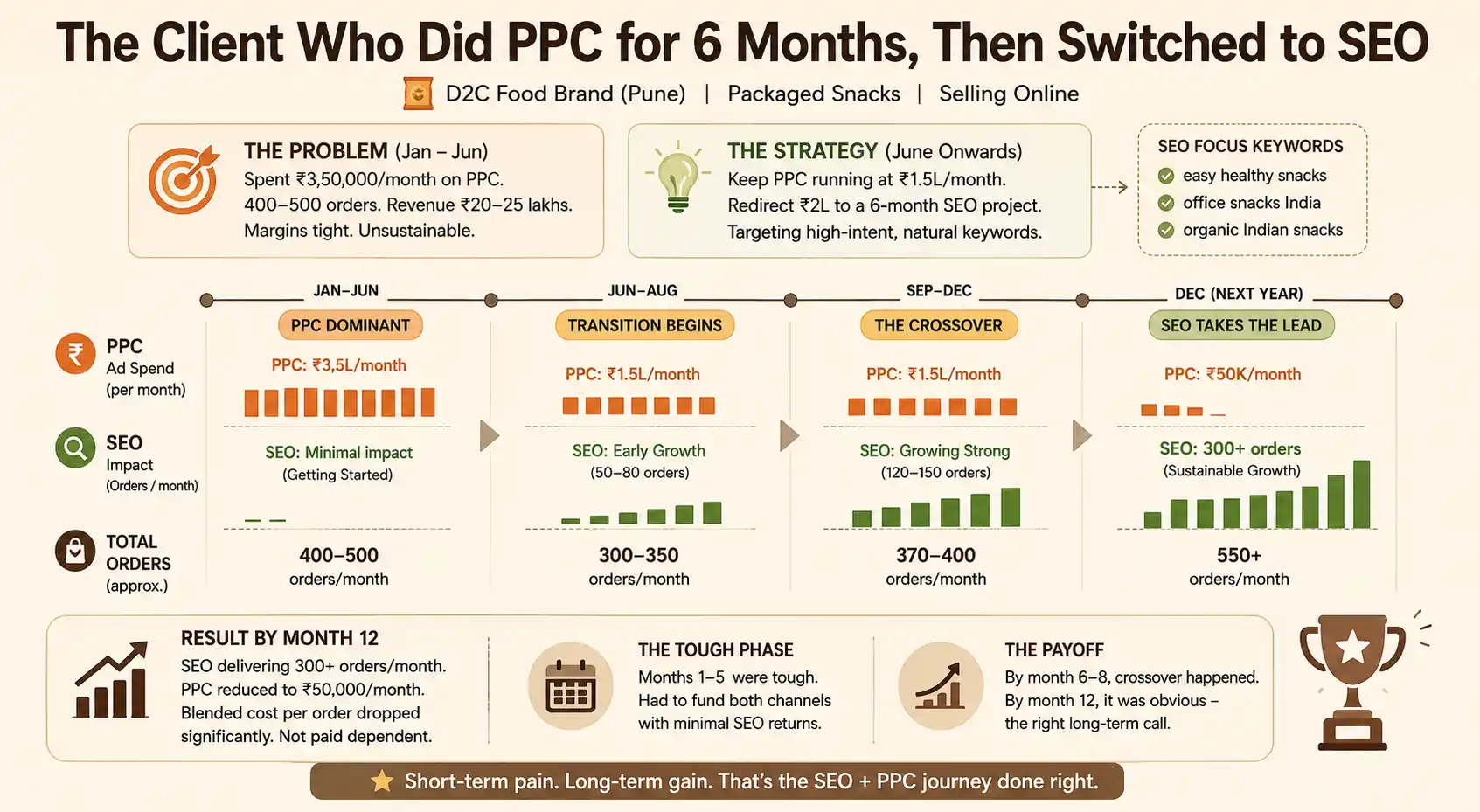
Take another made-up example: a D2C (direct-to-consumer) food brand based in Pune, selling packaged snacks online.
They start with PPC in January because they need sales fast. They spend Rs 3,50,000/month on ads and get decent traction: 400-500 orders a month and revenue of around Rs 20-25 lakhs (after margins and operational costs, actual profit is lower).
By June, they are frustrated. “We’re spending 3.5 lakhs and making 20 lakhs in revenue, but margins are tight and it feels unsustainable.” They ask for help to reduce ad spend.
The shift: maintain PPC at Rs 1.5 lakhs/month (keep the lights on) and redirect the rest to a six-month SEO project. The content strategy is built around “easy healthy snacks,” “office snacks India” and “organic Indian snacks”, their natural keywords with decent search volume. This is exactly why keyword research is important: it separates campaigns that compound from those that flatline.
By December, PPC is still at Rs 1.5 lakhs/month and delivering 250 orders, and SEO brings 120-150 orders a month (growing). Total orders are 370-400, with much better economics because SEO needs less reinvestment.
By month 12 (December of next year), SEO delivers 300+ orders monthly, and PPC has dropped to Rs 50,000/month (just maintaining). Their blended cost per order drops significantly, and they no longer depend on paid spend.
The transition period, months 1-5, is hard. They have to fund both channels while getting minimal SEO benefit. But by month 6-8, the crossover happens, and by month 12 it is obvious this was the right call.
When SEO is the right choice
You have budget but not urgency. You can wait 6 months. You’re not about to run out of cash.
Your industry has stable, predictable search demand. People search for your stuff consistently, year-round. (Contrast with seasonal businesses where PPC might be smarter for specific months.)
Keyword competition is moderate, not extreme. “Yoga classes Delhi” you’ll never own organically. “Yoga classes in Sector 42 Gurgaon” you could rank for in 6-8 months.
Your business model works with organic leads. Some businesses (like high-ticket B2B) need fewer but higher-quality leads, and SEO is a good fit. Volume-dependent models might need PPC’s scale.
You can commit to consistency. SEO needs ongoing investment. If you’re the type of company that jumps channels every 2 months, don’t start SEO. You’ll waste the first 4 months building foundation, then quit before anything happens. Our search engine optimisation service is built precisely for businesses ready to make that commitment.
When PPC is the right choice
You need leads now, this week, not in six months.
You have seasonal demand. Ice cream sales spike in summer. Tourist hotels in peak season. PPC suits this well. You turn it on high during peak months, dial it down otherwise. SEO doesn’t work on/off like that.
Keyword competition is extreme. You’re in a space where every competitor is fighting for the same terms. Organic growth would take 18+ months. PPC lets you compete immediately.
You have a new product launch. You need buzz fast. PPC can create velocity while you build the SEO foundation in parallel.
Your CAC (customer acquisition cost) tolerance is high. Luxury goods, high-ticket services and enterprise software are examples. If margins support expensive customer acquisition, PPC works.
The reality: you should probably do both
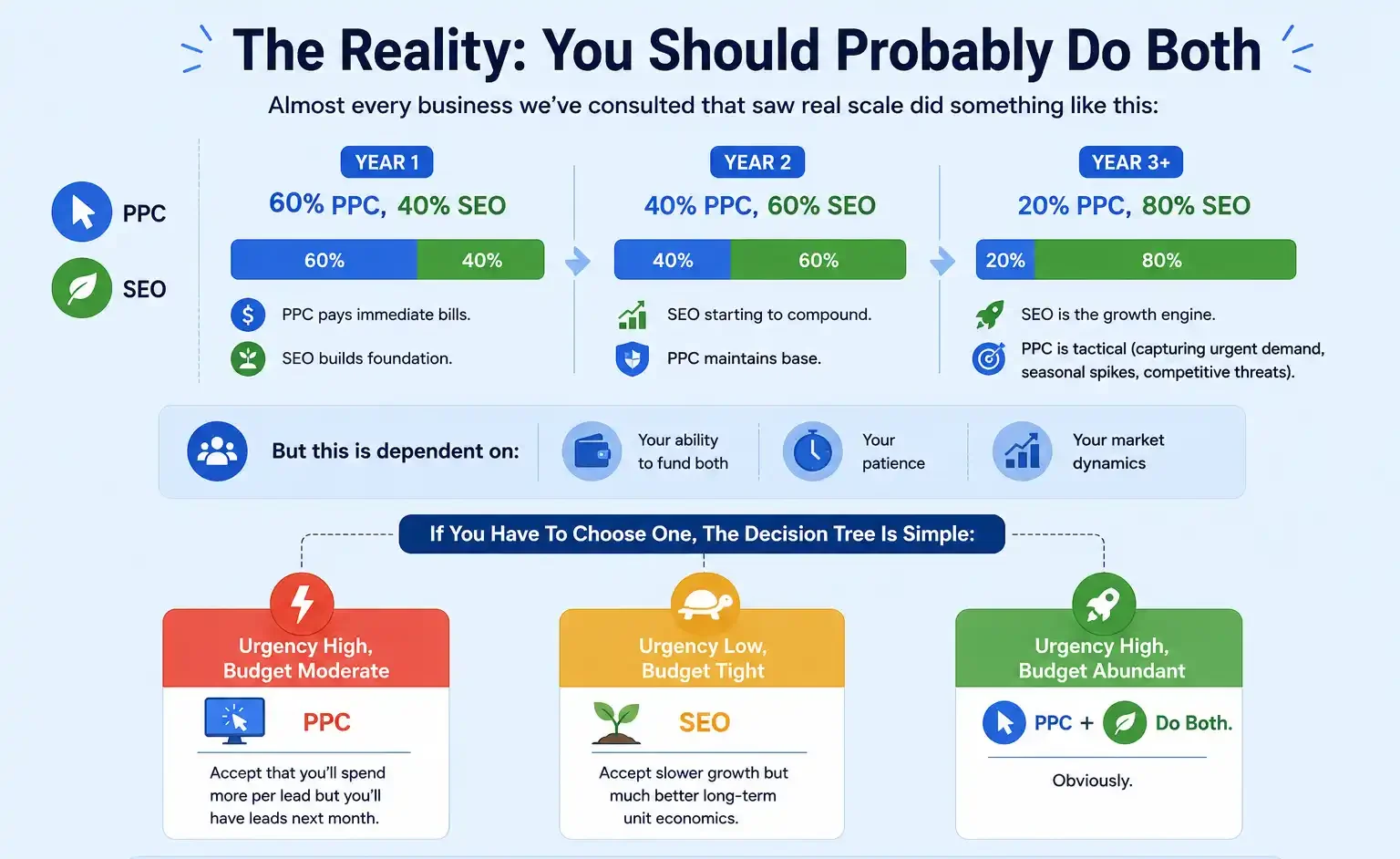
A split like this is one way to do both:
Year 1: 60% PPC, 40% SEO. PPC pays immediate bills. SEO builds the foundation.
Year 2: 40% PPC, 60% SEO. SEO starts to compound. PPC maintains the base.
Year 3+: 20% PPC, 80% SEO. SEO is the growth engine. PPC is tactical, used to capture urgent demand, seasonal spikes and competitive threats.
But this depends on your ability to fund both, your patience and your market.
If you have to choose one, the decision tree is simple:
Urgency high, budget moderate = PPC. Accept that you’ll spend more per lead but you’ll have leads next month.
Urgency low, budget tight = SEO. Accept slower growth but much better long-term unit economics.
Urgency high, budget abundant = do both.
Common mistakes
- Starting SEO but expecting PPC results is one mistake. You do SEO, month four comes around, traffic is 200 visitors, and the founder says “this isn’t working” and kills the project. Six months later it probably would have worked. Timing matters.
- Cutting PPC too early to fund SEO is the opposite problem. You kill PPC when SEO hasn’t ramped up yet, and now you have no leads for three months. You should have overlapped them more.
- Assuming PPC is easy because it’s immediate is another. People spend huge amounts because “Google will manage the bid.” It won’t. PPC needs constant optimisation, testing and refinement, and badly run PPC bleeds money.
- Thinking SEO is cheaper because you’re not paying per click is a mistake too. You’re paying in time and coordination. Poorly executed SEO with wrong keywords and no strategy wastes that investment. “Cheap” doesn’t mean it works.
- Not tracking attribution properly means you run both channels and don’t know which one actually closes deals (attribution is knowing which channel gets the credit for a sale). You can’t optimise what you don’t measure, so set up tracking before you start either channel.
How to decide
Ask yourself these questions, honestly:
- How desperate are we for revenue? If the answer is “very, we need leads immediately,” start with PPC. If “we can plan,” start with SEO.
- Can we actually commit to six months of SEO work? This is the biggest killer. Most companies can’t. They want fast results and consistency isn’t their strength. PPC suits them better.
- What’s our blended unit economics look like? If your margins are thin and CAC can’t be high, SEO is the only play. If margins support expensive acquisition, you have options.
- How technical is our team? PPC can be run by smart generalists. SEO requires deeper technical/content specialisation. If you don’t have that in-house, you need an agency either way.
- What does our customer research say? Are they Googling for answers or just scrolling? Are they early-stage research or late-stage decision? This determines search behaviour.
Answer those and you will have your answer. Or talk to us if you want a second opinion.
Not sure which channel fits your business?
We build both SEO and PPC strategies. Some businesses need PPC immediately, some do better with SEO first, and most need both, weighted differently. Let’s figure out which is right for you.


