
























In short: choose WordPress for versatility and content marketing. Choose Shopify for a simple online store. Choose a custom CMS when you need complete control and tailor-made features, or have outgrown ready-made platforms.
A platform choice that looked right and went wrong
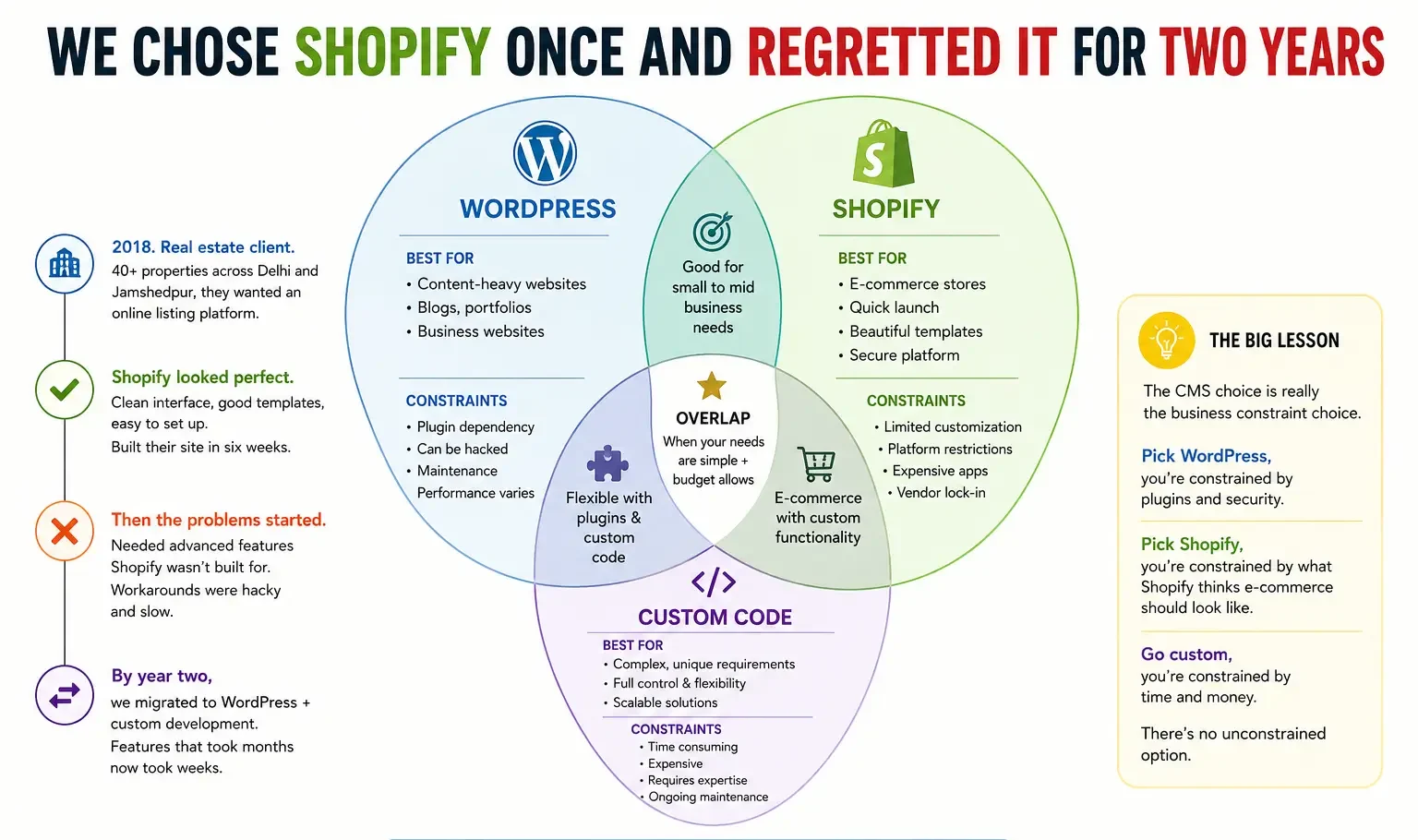
Here is an illustrative example, not a named client. A real estate business with 40+ properties across Delhi and Jamshedpur wants an online listing platform.
Shopify looks perfect: a clean interface, good templates, easy setup. The site is built in six weeks and the client is happy, at first.
Then the client wants agents to upload properties directly. Shopify does not really do that without custom code. Then they want a mortgage calculator embedded. Then lead routing based on geography. Feature by feature, Shopify becomes the wrong tool.
By year two the team is fighting the platform constantly and building workarounds that are hacky and slow. Finally the site moves to WordPress with custom development, and the same features take weeks instead of months.
The lesson is obvious in hindsight: the CMS choice is really a choice of business constraints. WordPress limits you through plugins and security risks. Shopify limits you to what Shopify thinks e-commerce should look like. Custom limits you by time and money. No option is free of constraints.
So ask "which constraints can I live with?" before you ask which platform is best.
WordPress: the kitchen sink that works
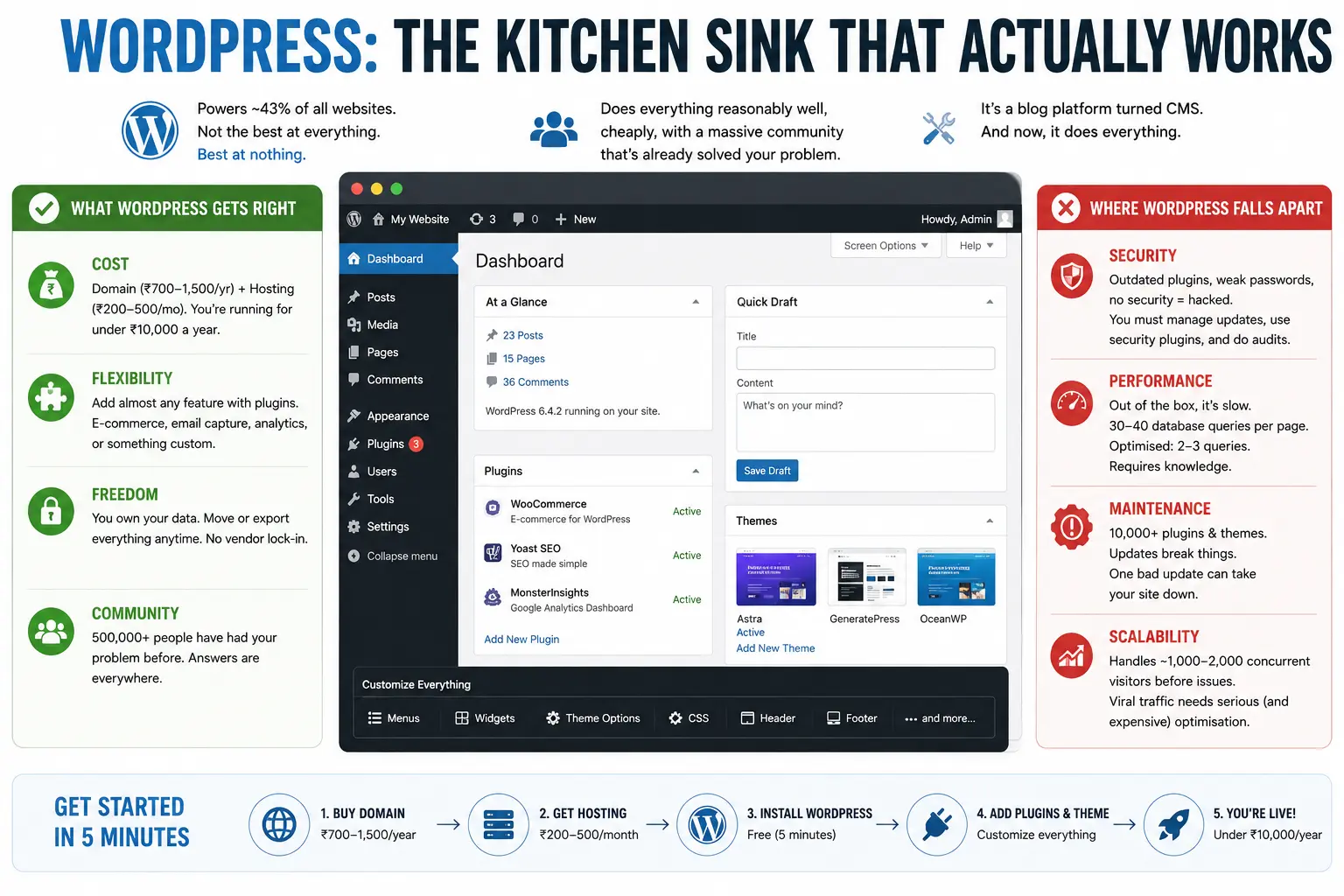
WordPress powers a large share of all websites on the internet. That is not because it is the best at everything. It is not the best at any one thing. It started as a blog platform that someone turned into a CMS, and now it does everything.
It does everything reasonably well and cheaply, and it has a huge community of people who have already solved your problem.
What WordPress gets right
It is cheap to start. Buy a domain (Rs 700-1500 a year), get hosting (Rs 200-500 a month for small sites) and install WordPress (free, and a 5-minute job). You are running for under Rs 10,000 a year.
It is flexible. With plugins you can add almost any feature. Examples are WooCommerce for e-commerce, OptinMonster for email capture and MonsterInsights to bring Google Analytics right in. If there is no plugin for what you want, you can hire a developer to write one.
You own your data. Your database lives on your hosting, not on some company's servers. If you want to export everything and move to another platform, you can. Try doing that with Shopify.
The community is huge. If you get stuck, many people have had your problem before, and the answers are on StackOverflow, the WordPress forums and Reddit.
Where WordPress falls apart
Security is the first problem. Out of the box, WordPress is about as safe as leaving your car running with the keys in it. Outdated plugins are vulnerable, and weak passwords get hacked. We have cleaned up hacked WordPress sites, and it is not fun. You need to manage updates, use security plugins and run regular audits. It is an ongoing burden.
Performance is the second. WordPress out of the box is slow. A standard page makes many database queries to load. Caching plugins and optimisation cut that down a lot, but you need the know-how. Many WordPress sites are slow.
Maintenance is the third. Because there are so many plugins and themes, updates arrive constantly. One bad plugin update can break your site, and then you scramble to find which one. Sites go down at 2am because of a plugin incompatibility nobody anticipated. WordPress itself rarely breaks. Your plugins do.
Scalability has limits too. Once traffic gets heavy, WordPress struggles unless you run serious infrastructure. If your site goes viral, it will not keep up without expensive optimisation.
Shopify: the opinionated e-commerce machine
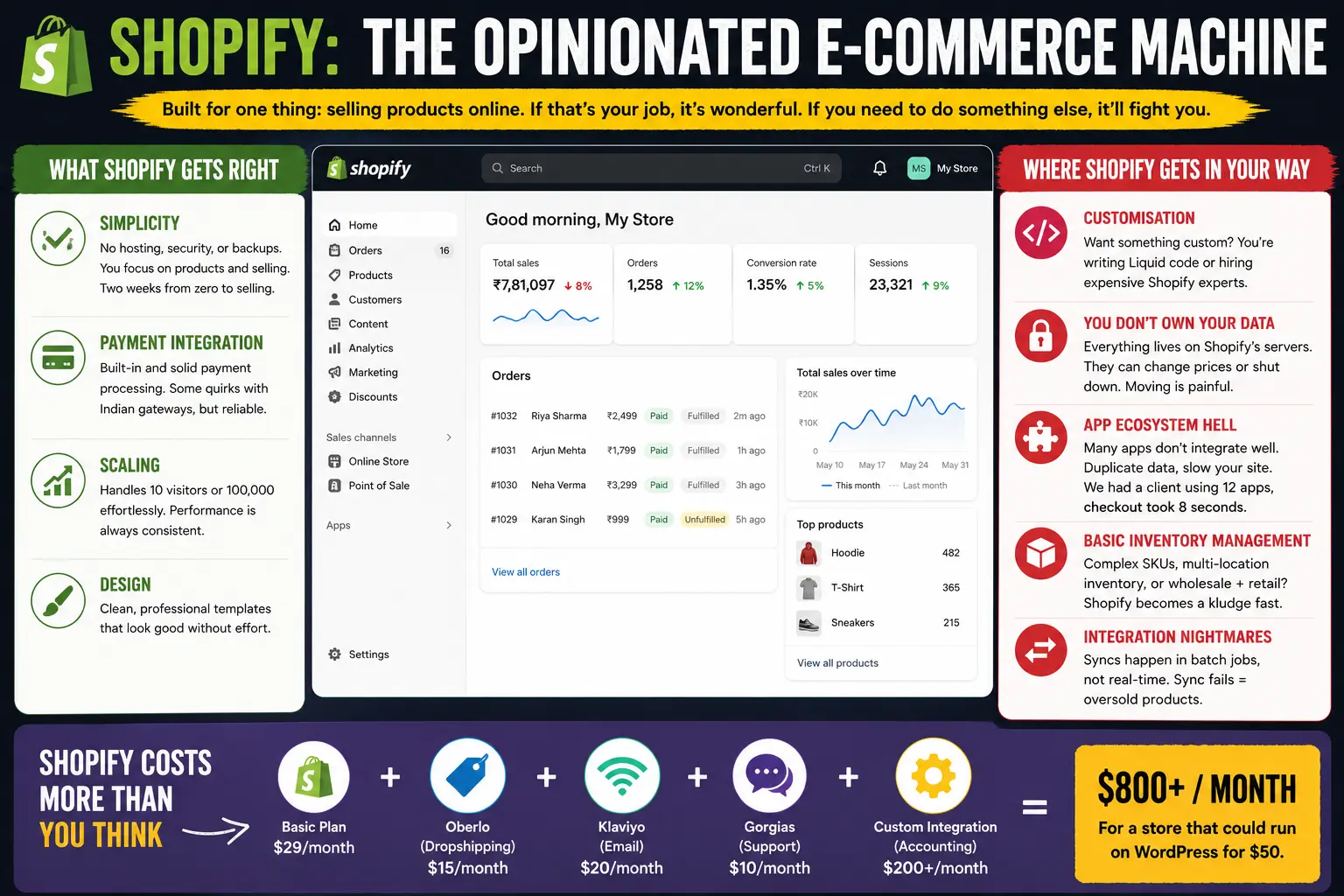
Shopify is built for one thing: selling products online. If that is your job, it works very well. If you need it to do something else, it will fight you.
What Shopify gets right
It is simple. You do not need to think about hosting, security or backups, because Shopify handles them. You focus on products and selling. Two weeks from zero to selling is reasonable.
Payments are built in and solid. They are not perfect, and there are still some quirks with Indian payment gateways, but they are mostly reliable.
It scales easily. Whether you get 10 visitors a month or 100,000, performance stays consistent.
The default templates are clean. They are not custom and not beautiful, but they look professional without effort.
Where Shopify gets in your way
Customisation is limited. If you want to change something Shopify does not allow, you write Liquid code (Shopify's templating language). Or you hire a Shopify specialist, who are expensive. A simple feature request can become a multi-week project because Shopify's constraints are so rigid.
You do not own your data. Your customer list and sales history live on Shopify's servers. They can change their pricing at any time, or shut down, and you cannot switch platforms without serious pain.
The app ecosystem can hurt. Shopify's app store looks great until you use it. Many apps do not integrate cleanly, duplicate data and slow your site. A store with many apps can end up with a slow checkout, because each app adds overhead.
Inventory management is basic. Some cases are hard for it. These include complex SKUs (stock keeping units, the codes for each product variant), stock spread across locations, or wholesale alongside retail. There, Shopify quickly turns into a kludge (a bad makeshift solution).
Integrations are fragile. You can sync inventory with your wholesale channel or pull customer data into your CRM. But the syncs often run as midnight batch jobs, not in real time. A sync that fails silently can lead to overselling.
Shopify costs more than you think
The basic plan looks cheap. Then you add apps for dropshipping, email and customer service, plus a custom integration with your accounting software. The monthly bill climbs well past the plan price, for a store that could run on WordPress for far less.
Custom development: when you need something they don't have
Sometimes WordPress and Shopify just do not fit. You may have an unusual business model, an unusual technical requirement or an industry constraint that no platform anticipated.
That’s when you build custom.
The real cost of custom
It costs a lot. A custom web application starts at Rs 5-10 lakhs at the very least, and more realistically Rs 15-30 lakhs. It takes 4-9 months. If you need complex features and integrations, add another 6 months and another 20 lakhs.
It carries risk. You are not using a proven platform, you are building something unique. What if the requirements were miscalculated? What if the architecture does not scale? These are real possibilities.
You carry the maintenance. Unlike WordPress or Shopify, a custom platform is your responsibility. You need a developer on retainer for support, feature updates and security patches. A WordPress plugin may break now and then. A custom platform can break if you sneeze at it wrong.
Knowledge leaves with people. If your developer leaves, their knowledge leaves too. Custom code is hard to document, and the next person has to reverse-engineer how things work. We have inherited custom platforms where nobody understood why a particular function worked the way it did, but removing it would break everything.
When custom makes sense
Custom makes sense when you have a specific business model that neither WordPress nor Shopify supports. Also, the development cost pays for itself in 18-24 months through operational efficiency or revenue.
One example is a textile trading company in Tiruppur (the fabric town). It needs real-time price updates based on commodity markets. It also needs inventory allocation across hundreds of distributors and margin calculations that change with the market. That is not WordPress or Shopify territory. Custom makes sense.
Another is a food delivery aggregator. It needs matching algorithms, real-time order status and payment splits across restaurants and drivers. Neither platform can do that. You need custom.
More often, I see a business that could run fine on WordPress decide to build custom because it sounds impressive. A luxury furniture store on a custom platform is a poor decision. Shopify would have been the right choice and saved Rs 20 lakhs.
How we choose: a simple decision list
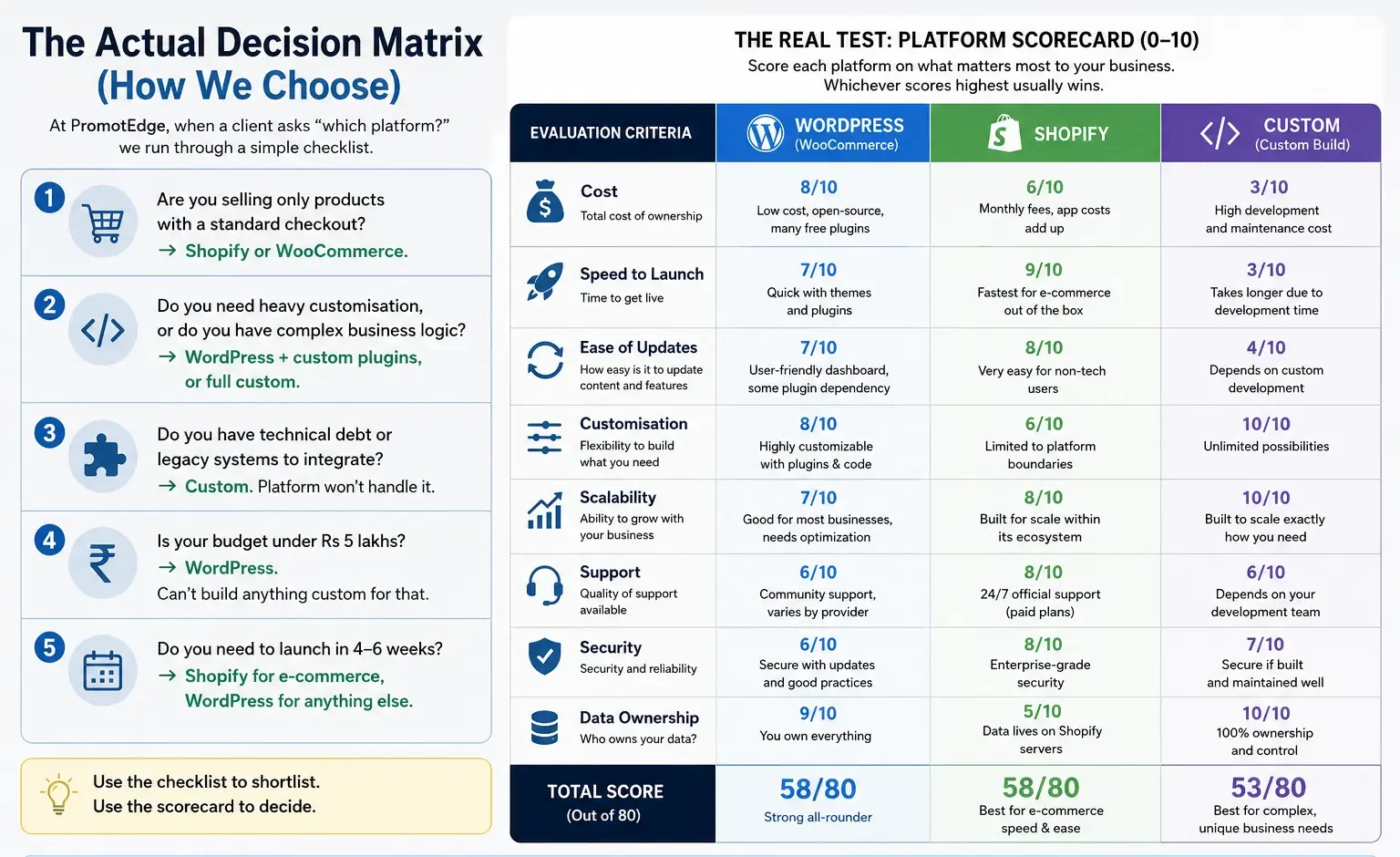
At PromotEdge, when a client asks "which platform?", we run through a simple checklist.
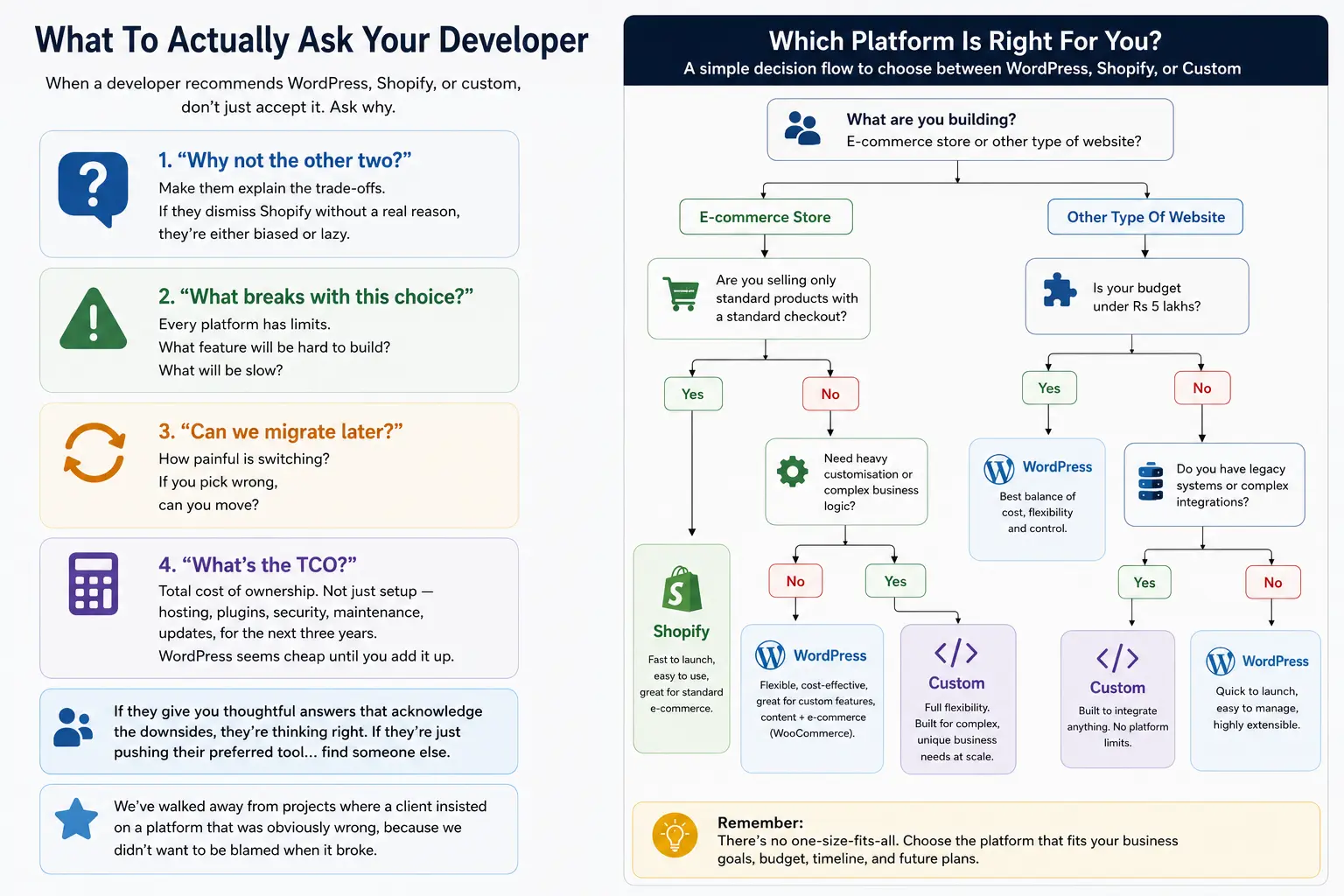
If you sell only products with a standard checkout, go for Shopify or WooCommerce.
If you need heavy customisation or have complex business logic, go for WordPress with custom plugins, or full custom.
If you have technical debt or legacy systems to integrate, go custom. A platform will not handle it.
If your budget is under Rs 5 lakhs, go for WordPress. You cannot build anything custom for that.
If you need to launch in 4-6 weeks, use Shopify for e-commerce and WordPress for anything else.
The real test is what breaks your business if it is missing. Build a quick scorecard. Score each platform from 0 to 10 on cost, speed to launch, ease of updates, customisation, scalability, support, security and data ownership.
Whichever scores highest usually wins.
Three examples of platform choices for Indian businesses
Here are three illustrative examples, not named clients, to show how this works in practice.
A Jamshedpur steel distributor
The business sells sheet metal, tubes, angles and other building materials. Inventory is massive. 15 regional sales reps take orders offline. But the business wants an online catalogue and order process.
Could they use Shopify? Technically yes. But they need pricing that changes with order volume (bulk discounts) and integration with their ERP (enterprise resource planning) system for real-time inventory. Shopify would need custom apps and integrations. These are expensive and fragile.
The answer is WordPress with WooCommerce and custom development. The custom part is inventory sync with the ERP, in real time, and pricing that changes by order. That might cost around Rs 8 lakhs and take 3 months, after which orders flow in without manual entry. Getting the digital marketing strategy right alongside the platform choice helps the whole thing work end to end.
A Pune fashion brand (D2C, direct to consumer)
The brand sells clothing online directly to consumers. It has a standard product catalogue, payment processing and customer email campaigns.
Shopify is the obvious choice. The brand can launch in about 8 weeks, connect Instapage for ads and use Klaviyo for email automation. The initial setup, including paid traffic, might cost around Rs 2 lakhs.
Would WordPress be better? Maybe for cost, since Shopify apps add up. But the brand would lose about 6 months of time to market and need a developer for ongoing support. For them, Shopify's premium is worth it.
A Bangalore SaaS company
The company is building a project management tool, its core product. It needs a website, a blog, a knowledge base and an authentication system that ties into the app. (SaaS means software as a service, software that customers pay to use online.)
WordPress will not work. They need custom authentication, API integrations and features WordPress does not support. Shopify is irrelevant. The answer is full custom, with a React frontend and a Node backend: around Rs 25 lakhs, 6 months, plus ongoing support.
Is it worth it? Yes. Their product needs professional tech infrastructure anyway, and a WordPress site would look cheap and fragmented next to it. Pairing this with strong performance marketing services then helps them acquire users faster once the platform is live.
WordPress or Shopify: which version?
A tactical note: WordPress.com vs WordPress.org, and Shopify Plus vs regular Shopify, change the maths.
WordPress.com (the hosted version) is safer and more managed, but less flexible and more expensive. You cannot install custom plugins or themes. It is good for blogs and small businesses. WordPress.org (self-hosted) gives you full control but needs technical know-how or a developer.
Shopify Plus is for high-volume businesses. It can be configured heavily, but it costs lakhs of rupees a month. For most Indian businesses, regular Shopify is fine.
The truth about platform migrations
You pick the wrong platform and realise it in year two. Now what?
Migrating from Shopify to WordPress is messy. You can export products, but product descriptions, images and variants lose formatting. Customisation you paid for does not move, so you essentially rebuild. We have done this before. Budget Rs 3-5 lakhs and 2-3 months, and expect some data loss that you will need to fix by hand.
Migrating from WordPress to Shopify is cleaner but still painful. Your custom plugins do not exist on Shopify, so features you built have to be rebuilt as Shopify apps or workarounds. Moving platforms can mean paying for the same feature twice.
Moving from custom to anything else is basically a rebuild. You start over, which is why the first choice matters so much.
What to ask your developer
- When a developer recommends WordPress, Shopify or custom, do not just accept it. Ask why.
- "Why not the other two?" Make them explain the trade-offs. If they dismiss Shopify without a real reason, they are either biased or lazy.
- "What breaks with this choice?" Every platform has limits. Which feature will be hard to build? What will be slow?
- "Can we migrate later?" How painful is switching? If you pick wrong, can you move?
- "What is the TCO?" That means total cost of ownership. Count more than setup: hosting, plugins, security, maintenance and updates for the next three years. WordPress seems cheap until you add it up.
If they give you thoughtful answers that admit the downsides, they are thinking right. If they just push their preferred tool, find someone else. We have walked away from projects where a client insisted on a platform that was clearly wrong. We did not want to be blamed when it broke.
Why this matters for business
Platform choice is a business decision. It affects your costs, your speed to market, your ability to scale and even your team's sanity.
Pick WordPress when you need flexibility and are comfortable managing tech. Pick Shopify when you are purely selling products and want something that handles operations for you. Go custom only when the maths clearly favours it.
We have shipped sites on all three. A wrong choice cascades into budget overruns, missed launch dates and teams fighting the platform instead of serving customers. The right platform is the one whose constraints fit your reality.
If you are standing at this decision point with a specific business problem, we work through this regularly as part of Web Solutions. We will work out what actually solves your problem, then build it right.
Where to go from here
Whichever platform you pick, start small, measure honestly, fix what breaks and build on what works.
Not sure which path your business should take?
We help Indian businesses make this exact decision. We do not push any particular platform. We give you an honest assessment of what makes sense for your situation.


