
























Strong brand equity builds customer loyalty, supports premium pricing and improves credibility. A good reputation also makes customers more likely to choose you and recommend you. This is the long-term payoff of a well-executed brand strategy. It sets you apart today, and it keeps adding to your price premium and customer loyalty for years.
The asset that is not on your balance sheet
Here is an example. It is made up, but the pattern is very common.
Take a steel fabrication business that supplies larger manufacturers. It prices very low because it believes it must compete on cost. A competitor with the same product quality and a similar size charges more and still sells more.
Why do buyers not complain about the higher price?
The competitor's salesperson might put it like this: "People know we have been around for twenty years. They trust us. They will wait for our delivery instead of buying cheap."
That is brand equity.
The first business has the same product, the same quality and the same delivery time. But it has no brand equity, so it is a commodity (a product buyers compare only on price). It competes on price and barely survives on its margins.
The competitor has built something invisible, and it shows up every year as a price premium.
What brand equity is
Many people think a brand is a logo. The logo matters, but brand equity is something bigger.
Brand equity is the extra value your brand adds to your product. It is why people pay more for a Bata shoe than for an identical shoe from an unknown brand. It is why ITC's Aashirvaad flour sells even though it costs a little more. It is why Maruti sells well even against cars with more features.
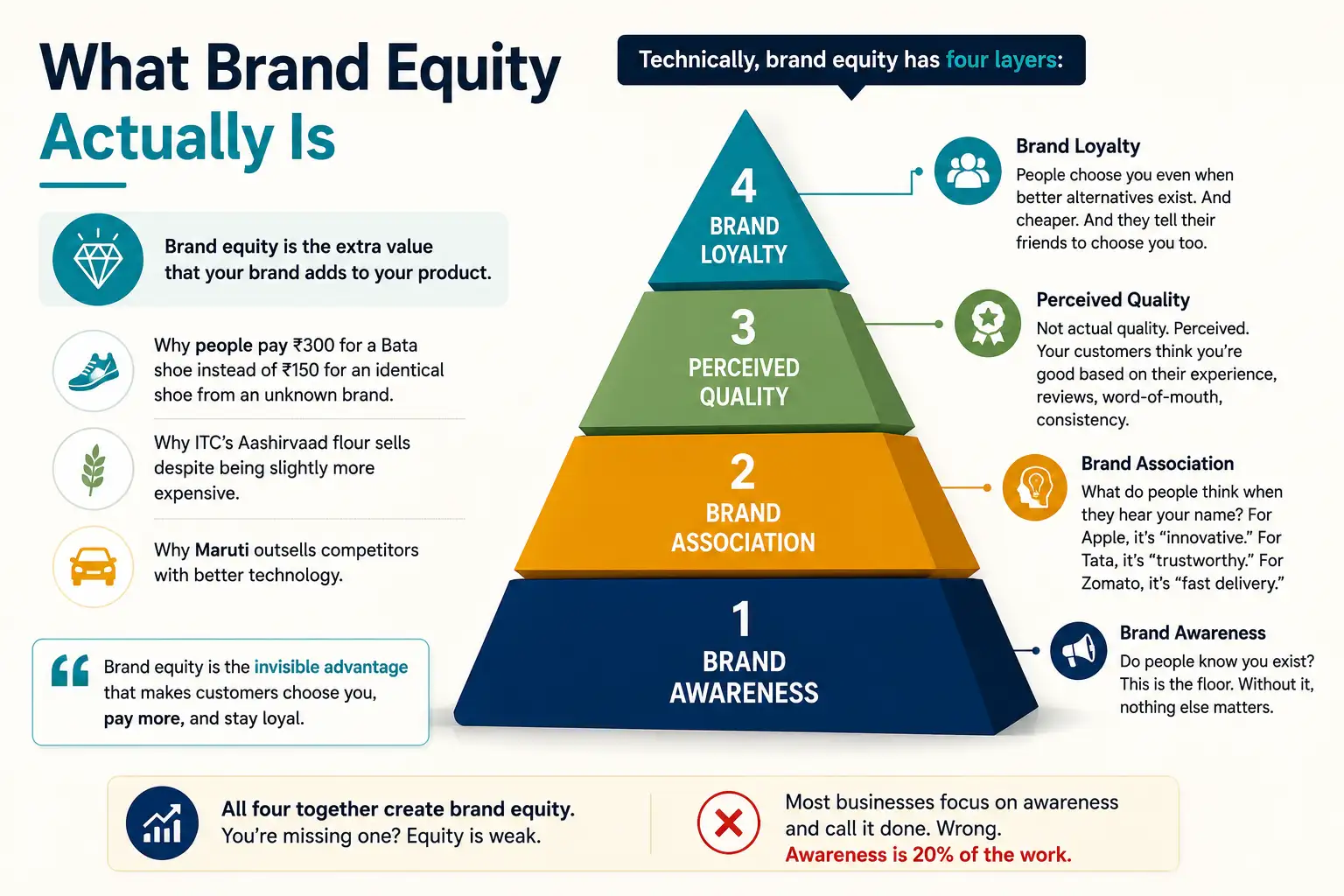
Brand equity has four layers.
The first is brand awareness. Do people know you exist? This is the floor. Without it, nothing else matters.
The second is brand association. What do people think when they hear your name? For Apple it is "innovative", for Tata it is "trustworthy" and for Zomato it is "fast delivery".
The third is perceived quality. This is what customers believe, not the real quality. They think you are good because of their own experience, reviews, word of mouth and how consistent you are.
The fourth is brand loyalty. People choose you even when better or cheaper options exist, and they tell their friends to choose you too.
All four together create brand equity. If one is missing, the equity is weak.
Most businesses focus on awareness and stop there. They run ads, people see them, and they think they have built a brand. They have not. Awareness is only a small part of the work. We explain the same difference in brand vs branding vs brand identity. Confusing awareness with equity is a common and costly mistake in brand-building.
How much is brand equity worth?
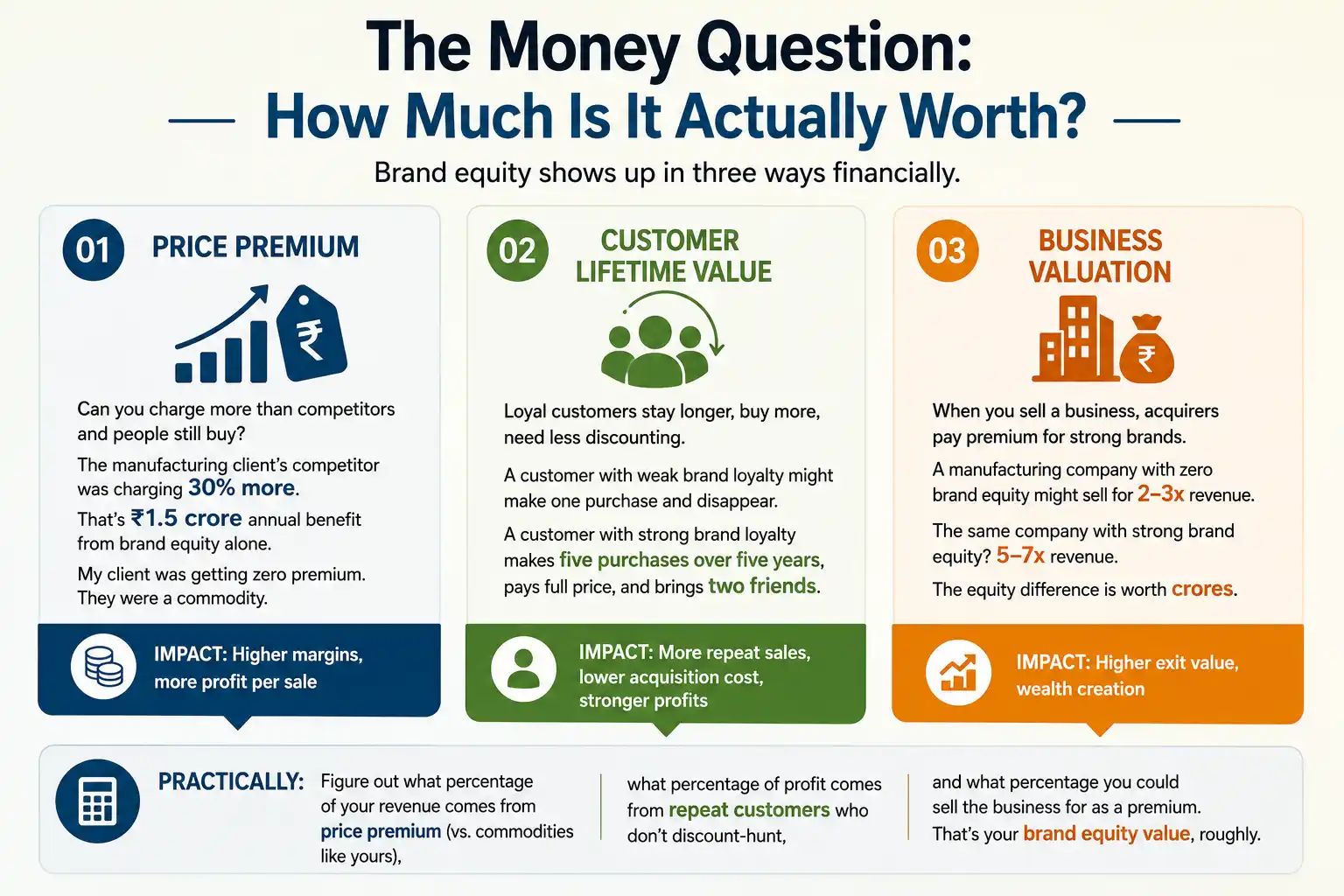
Brand equity shows up in money in three ways.
The first is price premium. Can you charge more than competitors and still sell? In our example, the competitor charges more and still sells more. That extra money every year comes from brand equity alone. The first business gets no premium at all. It is a commodity.
The second is customer lifetime value. Loyal customers stay longer, buy more and need fewer discounts. A customer with weak loyalty might buy once and disappear. A customer with strong loyalty buys again and again over the years, pays full price and brings friends.
The third is business valuation. When you sell a business, buyers pay a premium for a strong brand. Two companies with the same revenue can sell for very different prices, and the one with strong brand equity gets more.
To get a rough value in practice, work out three things. How much of your revenue comes from price premium compared with plain commodities like yours? How much of your profit comes from repeat customers who do not hunt for discounts? And how much extra a buyer would pay for your brand? Together these give you a rough value of your brand equity.
How strong brand equity gets built
There is no shortcut. It is built in steps.
You start with a consistent experience. Every customer touchpoint should deliver what you promise: website, product and support, all working together. Most brands fail here because something is always out of line. The website says "premium quality" but customer service ignores complaints. Marketing says "fast delivery" but delivery is often slow. Inconsistency destroys equity faster than anything else.
Then you build recognition, so that people see you in many places. This need not be ads. It can be word of mouth, social media, mentions in articles or partnerships. In our example, the competitor is known because industry publications and B2B (business-to-business) directories mention it, and referrals keep coming. Ads are not the reason.
Then you show evidence: reviews, case studies, long customer relationships, employee testimonials and published work. Anything that proves you deliver will do. Brand equity grows when a third party vouches for you. This is why user-generated content is one of the strongest ways to build equity. A real customer's endorsement carries more credibility than anything the brand can say about itself.
Then you stay consistent over time, which is the hard part. In year 2, year 5 and year 10, the promise and the delivery must stay the same. Companies that keep rebranding, change their positioning or chase trends destroy equity. Companies that stay consistent for years build real equity.
Last, and this is where most brands fail, you put the equity to use. Once you have it, you can charge premium prices, expand into related categories, raise prices over time and stop discounting. Many brands build equity and never earn from it.
Real-world examples
Rupa is a hosiery brand that has been around since 1972. Its equity is trust. Parents buy Rupa for their kids because they know the brand. It charges a premium over unbranded products, and it has used that equity to expand into more categories.
Maruti entered the market when Ambassador dominated. It built its equity around reliability, resale value and its service network. That took time, but once it was built, rivals copied it and offered cheaper cars, and Maruti still sold more. The reason was equity.
Chipotle in the US (yes, an international example) owns the idea of customisable, fast, responsible food. That positioning created strong equity, and it lets Chipotle charge more than similar competitors and still have queues of customers.
In India, look at any business that has done well for ten years or more, and you will find it built equity. This holds for FMCG (fast-moving consumer goods) brands, financial services brands and the e-commerce platforms that survived. They invested in consistency and brand-building even when cheaper options existed.
How to measure brand equity
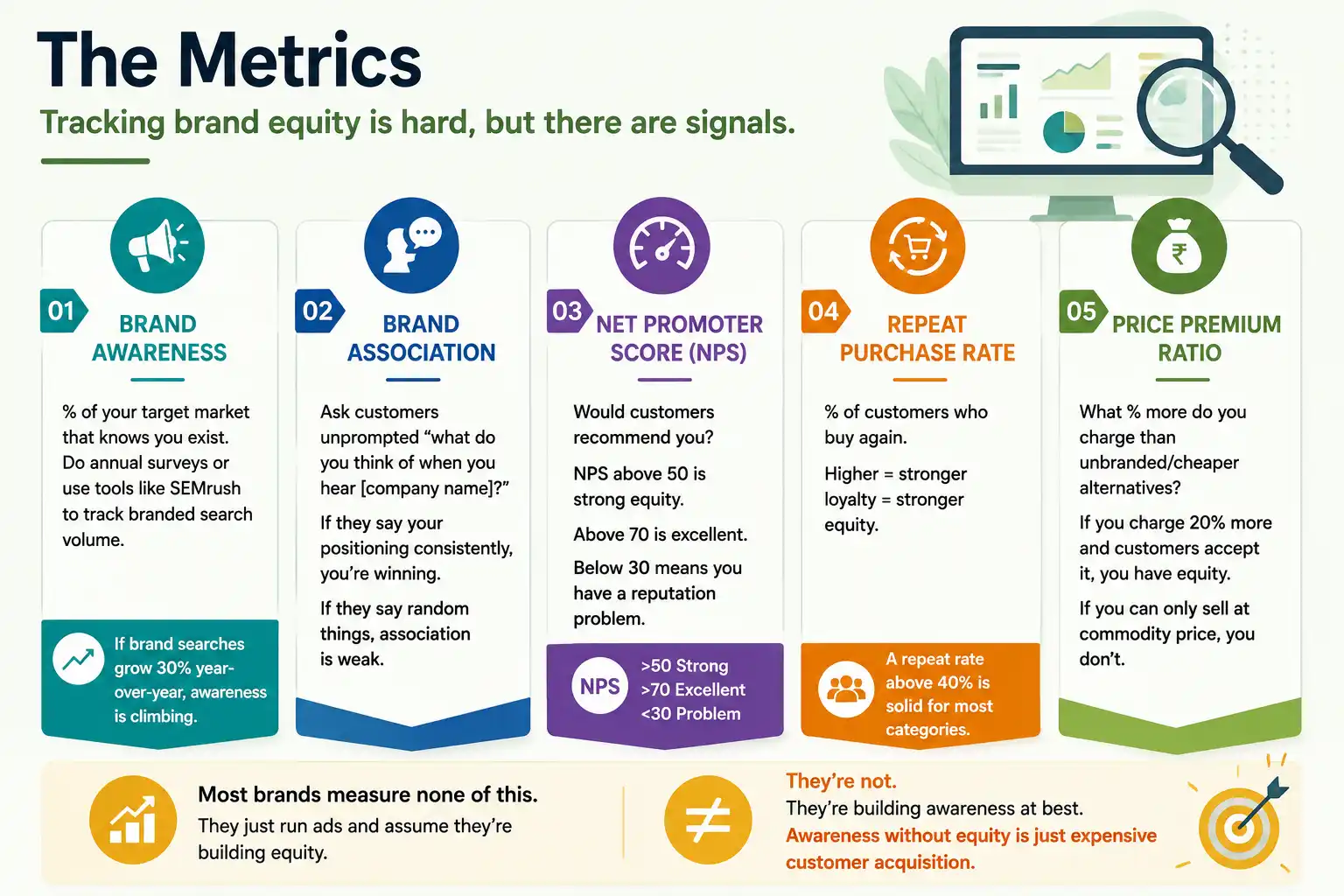
Brand equity is hard to track, but there are signals.
For brand awareness, find out what share of your target market knows you exist. Run a survey each year, or use tools like SEMrush to track branded search volume. If searches for your brand name keep growing year after year, awareness is climbing.
For brand association, ask customers without any hints: "What do you think of when you hear [company name]?" If they repeat your positioning, it is working. If they say random things, the association is weak.
Net Promoter Score (NPS) tells you whether customers would recommend you. A high score points to strong equity. A low score means you have a reputation problem.
The repeat purchase rate is the share of customers who buy again. The higher it is, the stronger the loyalty and the equity.
The price premium ratio is how much more you charge than unbranded or cheaper alternatives. If you charge more and customers accept it, you have equity. If you can only sell at the commodity price, you do not.
Most brands measure none of this. They run ads and assume they are building equity, but at best they are building awareness. Awareness without equity is just expensive customer acquisition.
Where brands go wrong
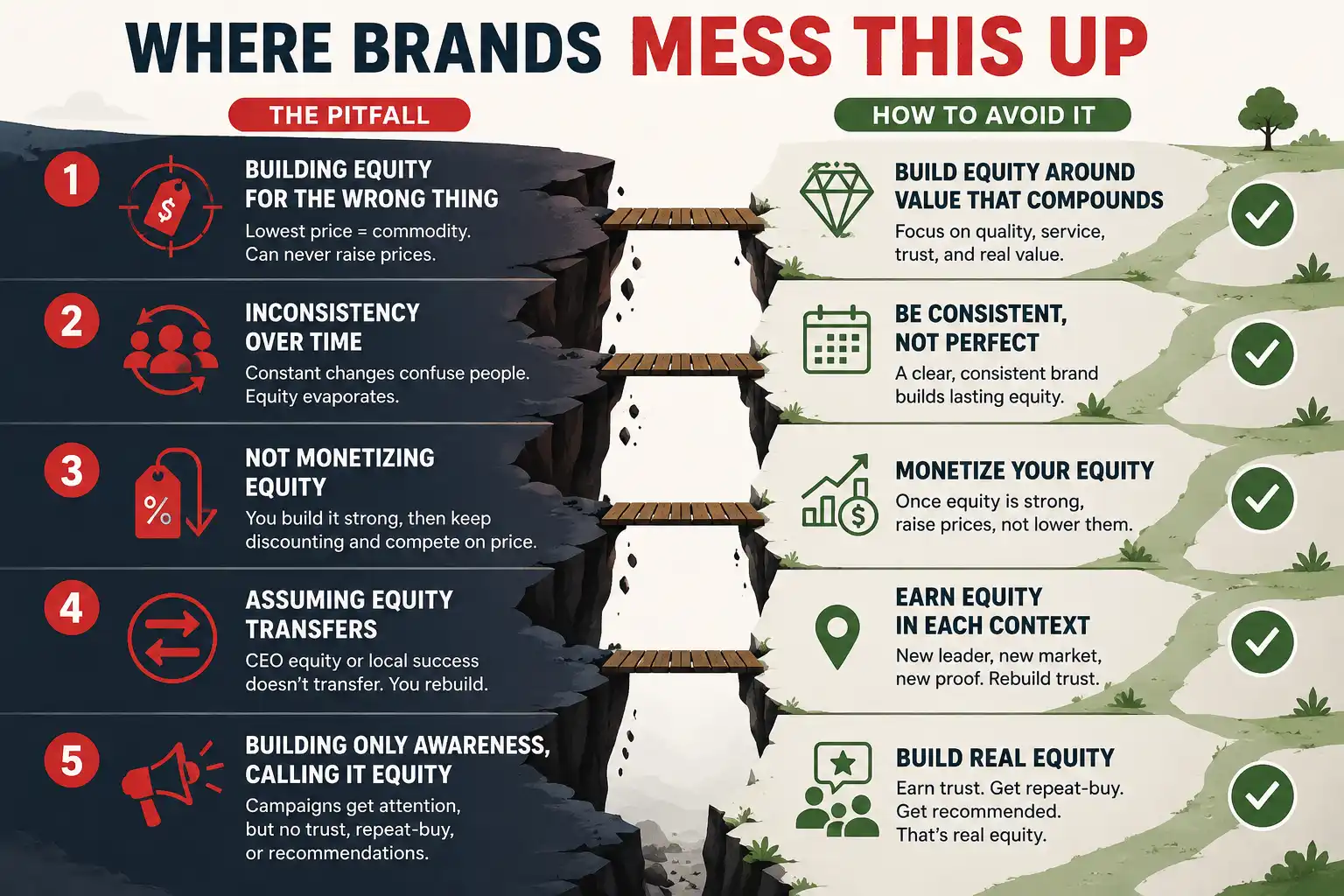
The first mistake is building equity around the wrong thing. If your brand stands for "lowest price", you are a commodity that can never raise prices. Build equity around value, quality, service and trust, which keep adding up over time.
The second is inconsistency over time. Say you have five marketing managers in ten years, each with a different vision, and the brand keeps getting rebranded. Equity fades because people do not know what to expect. Consistency matters more than perfection.
The third is not earning from the equity. Everyone loves your brand, but you keep discounting and competing on price. You have built an asset and then thrown away its value. Once equity is strong, raise prices instead of lowering them.
The fourth is assuming equity transfers. The CEO's personal reputation does not pass on to the brand. Equity that is strong in one city does not carry over to the whole country. In a new market, you rebuild from the start.
The fifth is building only awareness and calling it brand equity. You run campaigns, get followers and win awards for ads, but people still do not trust you, buy again or recommend you. That is noise, not equity.
How long it takes
Brand equity takes time, and nobody should promise otherwise. These are rough timelines.
In 18 to 24 months you can build basic awareness and first associations, if you do everything right and have the budget. That is not equity yet.
At about three years, with consistent work, you start to see a real price premium, repeat customers and word of mouth. Margins improve. This is equity starting to form.
After five years or more you have real equity. You can charge a premium, expand into new categories and hold your ground against competitors. Customers choose you over cheaper options.
After ten years or more it becomes generational equity. Your brand is simply the good option, and competitors have to do far better to take your share. Coca-Cola, Tata and ITC are examples.
Many brands give up in year 2 or get distracted in year 3. The ones that stick it out to year 5 are the ones that do well in their categories. It takes artistry plus strategy.
Why we still believe in this
Because it works. Go back to our steel fabrication example. If that business rebuilds its positioning around being trusted for precision, it can slowly win back a price premium. Its margins improve and it stops competing on cost.
Its competitor does not need to spend extra on marketing in that time, because it already has twenty years of equity. This is the big advantage of a strong brand. Once built, it gives returns for decades.
Customer acquisition costs keep rising, ad CPMs (the price of showing an ad to a thousand people) keep climbing and discounting is becoming the default. In this situation, brand equity gives you a lasting edge over competitors.
We work with brands at every level, from positioning and strategy to identity design, website experience, brand films and integrated marketing. The base is always the same: consistency, clear positioning and enough patience to let it add up.
Let's build brand equity for your business
PromotEdge helps brands build lasting equity, from strategy to execution across all channels.


