-
Author: Anindita Barik
-
Updated Date: Sep-17-2026
-
Views: 2 Min Read
Understanding how to create viral reels in India involves more than following every Instagram trend. Successful Reels often combine a strong opening, relevant trending audio, relatable ideas, concise storytelling, and content designed around audience behaviour. This guide explores practical ways to identify emerging trends, choose suitable formats, improve watch time, and create culturally relevant content for Indian audiences. It also highlights the difference between viral reach and business success, showing how consistent posting, audience building, performance tracking, and original creative angles can turn short-term attention into long-term value.
Creating viral Reels in India requires a strong hook, relevant trends, engaging storytelling, and content tailored to the target audience. Using popular formats, regional language or cultural references, trending audio, concise messaging, and consistent posting can increase reach and engagement. This is the short-form video layer of a complete social media optimisation — Reels drive discovery and reach, while the rest of your social presence converts that attention into followers and eventually customers.
Three Million Views and Zero Rupees Spent
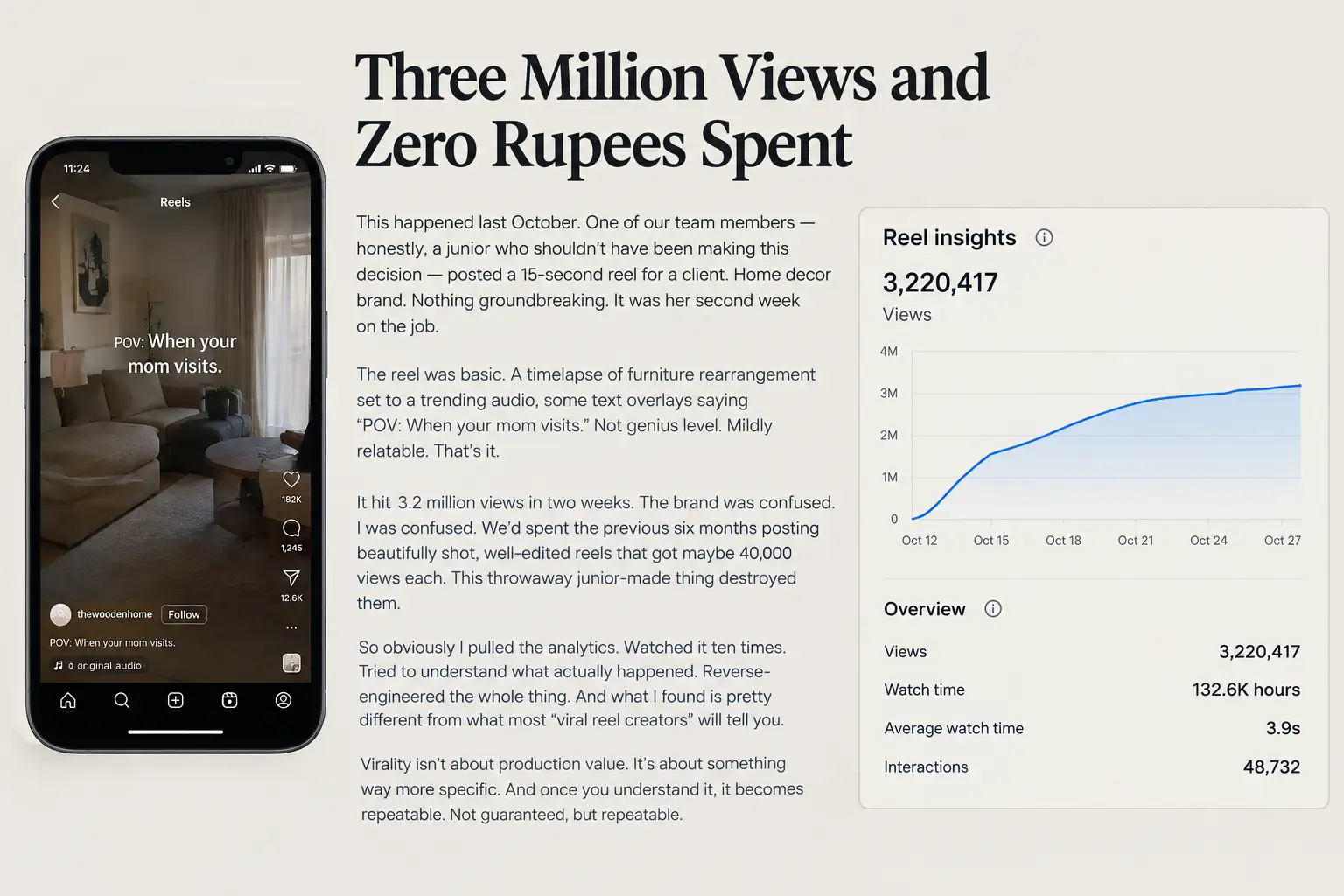
This happened last October. One of our team members — honestly, a junior who shouldn’t have been making this decision — posted a 15-second reel for a client. Home decor brand. Nothing groundbreaking. It was her second week on the job.
The reel was basic. A timelapse of furniture rearrangement set to a trending audio, some text overlays saying “POV: When your mom visits.” Not genius level. Mildly relatable. That’s it.
It hit 3.2 million views in two weeks. The brand was confused. I was confused. We’d spent the previous six months posting beautifully shot, well-edited reels that got maybe 40,000 views each. This throwaway junior-made thing destroyed them.
So obviously I pulled the analytics. Watched it ten times. Tried to understand what actually happened. Reverse-engineered the whole thing. And what I found is pretty different from what most “viral reel creators” will tell you.
Virality isn’t about production value. It’s about something way more specific. And once you understand it, it becomes repeatable. Not guaranteed, but repeatable. This principle is the same one we break down in our guide on Instagram Reels marketing — the brands consistently hitting high view counts are applying systems, not luck.
Why Your 4K Produced Reel Died at 3,000 Views
Instagram’s algorithm — I mean Meta’s algorithm, because it’s all one system now — doesn’t care about production quality. At all. I’ve seen reels shot on a phone’s front camera with bad lighting outperform videos shot in actual studios.
What the algorithm DOES care about is this: does someone stop scrolling and watch? Did they watch the whole thing? Did they engage after?
That’s it. Everything else is secondary.
Your beautifully shot reel about a product launch? Probably has terrible “stop scrolling” power. People see it, it looks nice, they keep scrolling. Doesn’t matter how much you spent on production.
The junior’s reel about furniture rearrangement? Stopped people immediately. Made them go “oh, that’s MY problem” and they watched. Full watch rate was probably 70%+. Algorithm said “okay, this is engaging to actual humans, show it to more humans.”
This is why reels that feel raw and authentic perform better than polished ones. Because authentic feels more real, more relatable, more like something a friend would show you instead of something a brand is trying to sell you.
The Hook Is Everything
The first second determines everything.
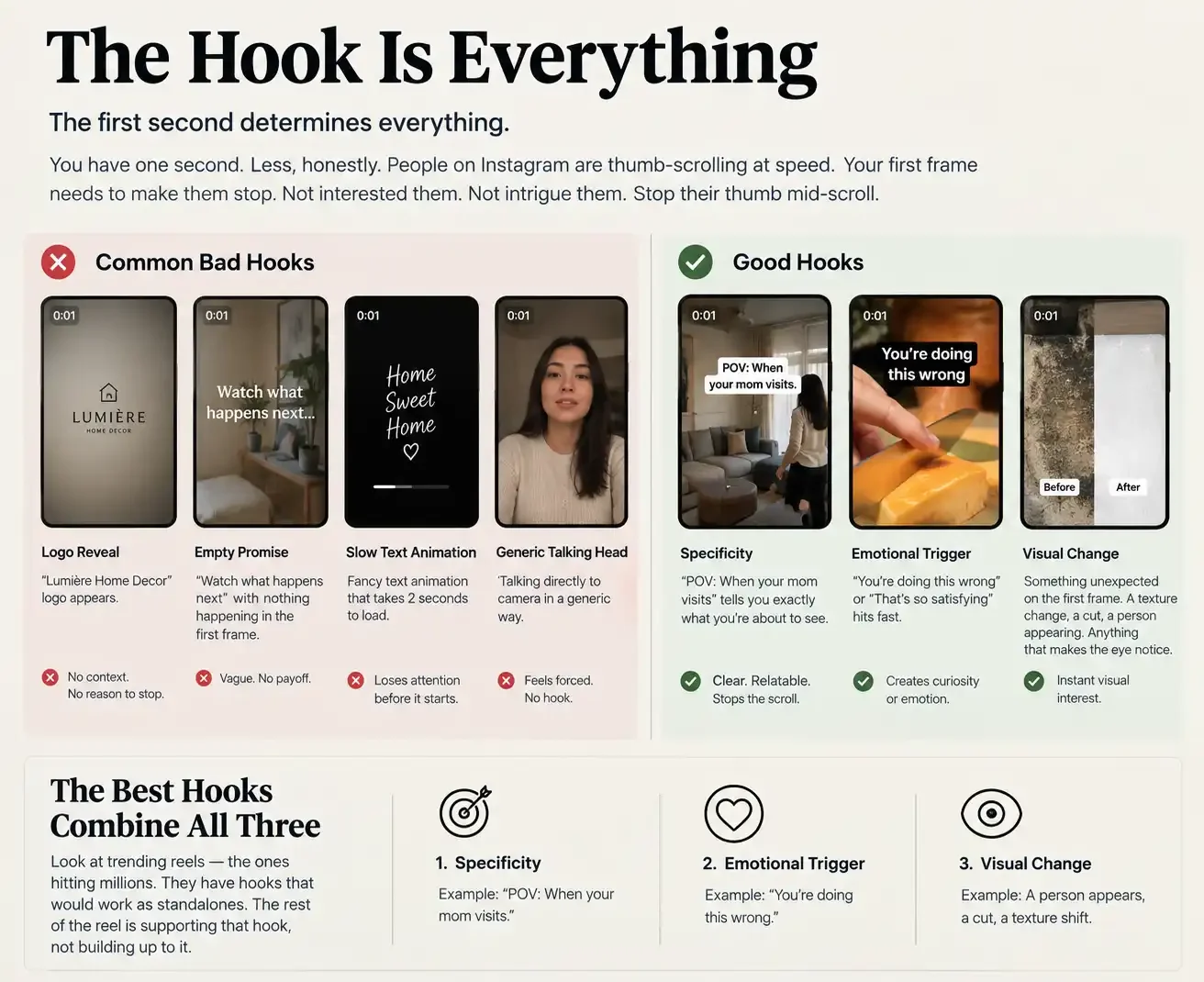
You have one second. Less, honestly. People on Instagram are thumb-scrolling at speed. Your first frame needs to make them stop. Not interested them. Not intrigue them. Stop their thumb mid-scroll.
Common bad hooks:
Logo reveal. “Watch what happens next” with nothing happening in the first frame. Fancy text animation that takes 2 seconds to load. Talking directly to camera in a generic way. “Here’s something you need to see…”
Why? Because they’re weak. They don’t promise anything specific. They ask the viewer to invest time based on nothing.
Good hooks:
Specificity. “POV: When your mom visits” tells you exactly what you’re about to see. You either relate or you don’t. No ambiguity. Emotional trigger. “You’re doing this wrong” or “That’s so satisfying” hits fast. Visual change. Something unexpected on the first frame. A texture change, a cut, a person appearing. Anything that makes the eye notice.
The best hooks combine all three. Look at trending reels — the ones hitting millions. They have hooks that would work as standalones. The rest of the reel is supporting that hook, not building up to it.
I’ve been preaching this to our team for three years. Haimanti, who runs our social account, finally started applying this six months back and suddenly our own content started performing better. Turns out it’s not a home decor thing. It’s a human psychology thing.
Trends Die Faster Than People Think
There’s a window. A specific window. For most trends in India, it’s about 5-7 days.
Day 1-2: Early adopters jumping on it. Low views but high engagement rate because it’s novel.
Day 3-5: Peak virality window. Algorithm is pushing it hard because early signals are positive.
Day 6-7: Still viable but declining. The algorithm is getting bored.
Day 8+: Dead. Unless you’re a massive brand with existing reach, trend-jacking this late won’t work.
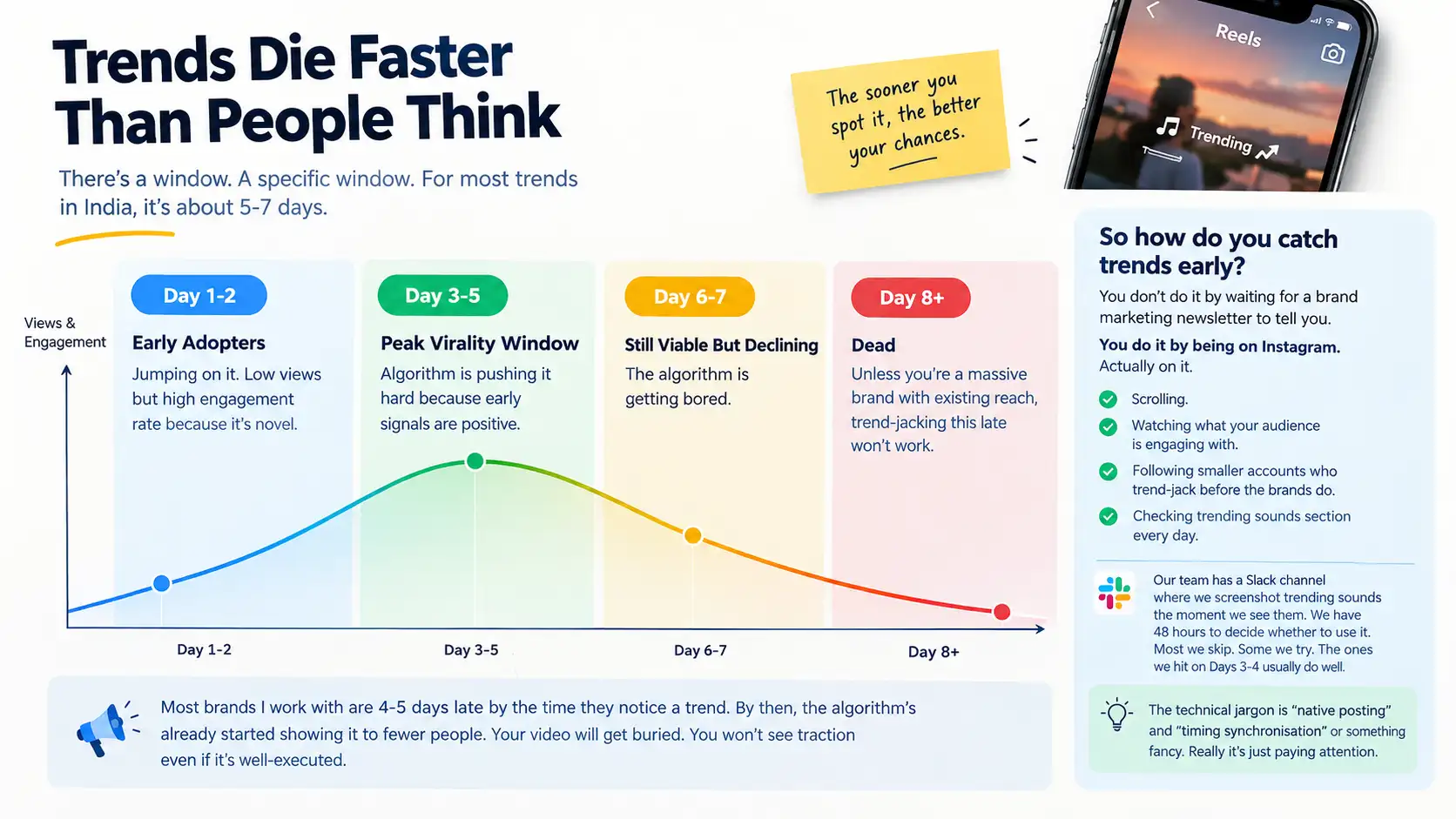
Most brands I work with are 4-5 days late by the time they notice a trend. By then, the algorithm’s already started showing it to fewer people. Your video will get buried. You won’t see traction even if it’s well-executed.
So how do you catch trends early? You don’t do it by waiting for a brand marketing newsletter to tell you. You do it by being on Instagram. Actually on it. Scrolling. Watching what your audience is engaging with. Following smaller accounts who trend-jack before the brands do. Checking trending sounds section every day.
Our team has a Slack channel where we screenshot trending sounds the moment we see them. We have 48 hours to decide whether to use it. Most we skip. Some we try. The ones we hit on Days 3-4 usually do well. This real-time awareness of what’s working is the same skill that makes social media content creation strategy effective — the calendar matters, but the ability to pivot quickly toward what’s gaining traction in the moment is what separates brands that consistently hit high numbers from those that post consistently but never break out.
The technical jargon is “native posting” and “timing synchronisation” or something fancy. Really it’s just paying attention.
The Furniture Brand That Went From Zero to Noticed
After the viral reel, we had to think: was it luck or was there something we could repeat?
So we did an post-mortem. We analysed similar brands doing well. We looked at what themes performed. We mapped out a strategy.
Turns out the “POV” format was hot at that time for home content. It’s a specific format that viewers of home content were engaging with heavily. The trending audio was a recently viral sound (in the day 3-4 window when we posted). The MOV (mom visiting) angle was relatable to Indian audiences specifically — desi humour that doesn’t translate globally.
We intentionally replicated this formula.
Step 1: Picked a trending sound that was gaining traction (checked at 3pm on a Tuesday, middle of the early-adopter window).
Step 2: Decided on a desi cultural moment (Diwali prep time, that specific window where people are cleaning and rearranging).
Step 3: Used a format we knew was performing (POV + text overlay).
Step 4: Edited in-house, no fancy effects, under 30 seconds, shot on a phone.
Step 5: Posted at 7:30 PM on a Wednesday (peak scroll time for that audience).
That reel got 2.8 million views. Close to the first one, not exact, but in the same range.
Third time, it got 1.2 million. Still massive, but declining. The hook wasn’t as strong. We tried to repeat it too soon after the algorithm had already shown it everywhere.
Point is: virality has variables. You can’t guarantee it, but you can increase odds dramatically if you understand what those variables are.
Audio Is Not Your Music, It’s The Algorithm’s Music
This is something most brands miss completely.
You’re thinking: “Let’s use a royalty-free track that fits our brand.” Stop.
What matters is: is this audio ALREADY viral? Is the algorithm recognising it? Are other people using it in ways that are performing?
Original audio is almost never viral on the first use by a brand. It might be on the 100th use by micro-creators who’ve already made it famous.
So you’re not choosing audio based on quality or fit. You’re choosing audio based on current virality momentum. Use the sound that’s already trending. Thousands of people are hearing it repeatedly. The algorithm is familiar with it. Viewers are primed for it.
Yes, sometimes a brand can create the audio trend. But that requires either massive reach already or a creator who goes viral first and then the audio becomes famous second.
For 99% of brands: use trending audio. Not original. Not “on-brand.” Trending. The ones that are already hot. Then apply your creative angle to it.
I had to explain this to a jewelry brand last month. They wanted to use classical Indian music because it “matched their brand.” I said no. We used a Hinglish trending audio instead. That reel outperformed their previous month’s entire content library. This is similar to the argument in why video marketing is the ultimate tool for promoting businesses — the medium and format that your audience is already consuming determines your starting point, and trying to create a new format from scratch when proven ones exist is just making the algorithm’s job harder.
When Virality Actually Becomes Business Value
Here’s the part nobody talks about. The 3 million view reel? Generated zero direct sales.
Zero.
We were expecting a surge in website traffic, online orders, something. Nope. The reel went viral, followers came in, engagement looked amazing, and then… nothing.
Why? Because virality from a reel is usually from people outside your target audience. A random person scrolling, doesn’t follow the brand, doesn’t need furniture right now, just found it entertaining and watched it. They left a like and moved on.
Viral views and business results are different things.
What actually works:
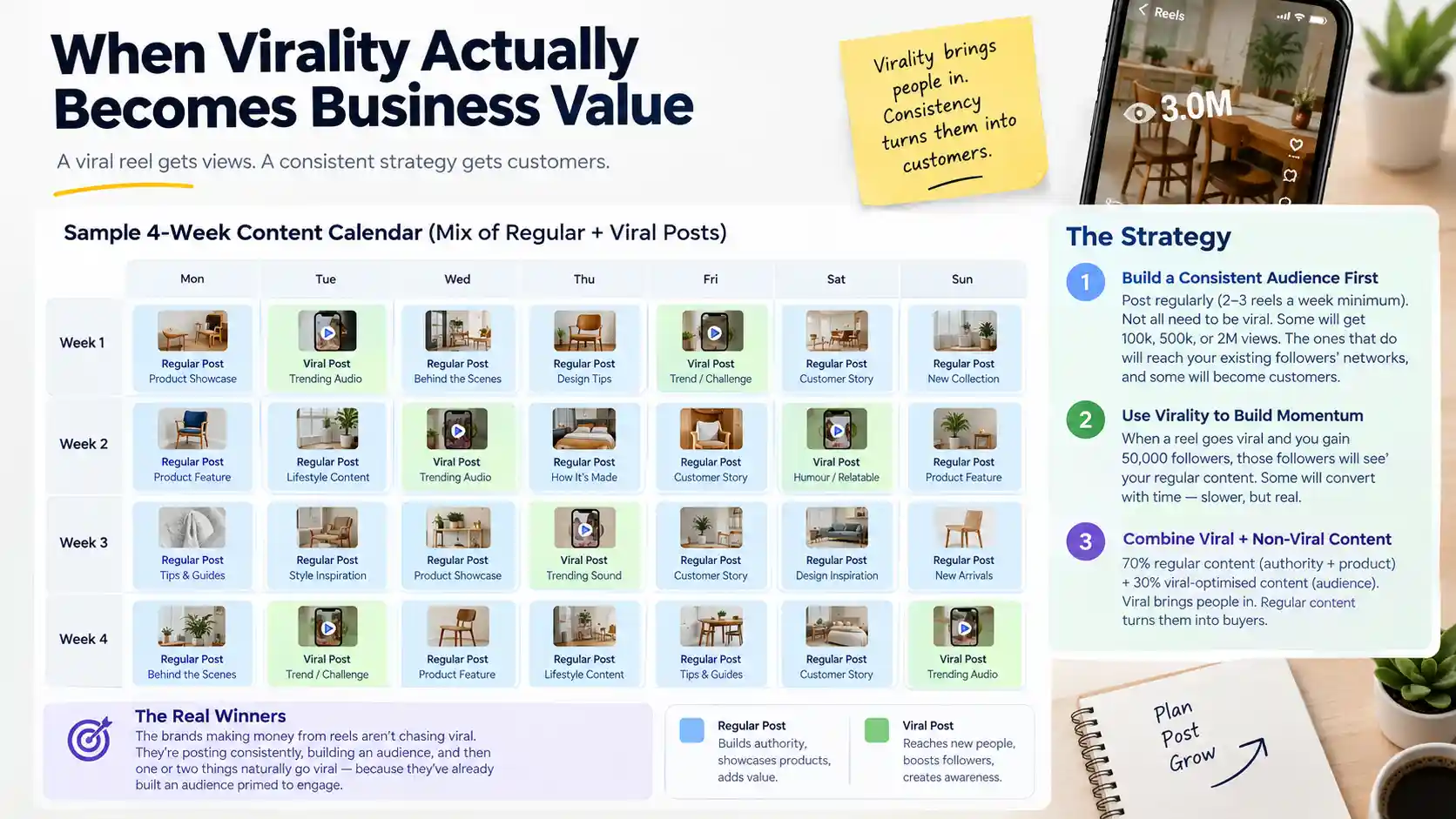
- Building a consistent audience first: Post regularly (2-3 reels a week minimum). Not all of them need to be viral. But some will get 100k views, some 500k, some 2M. The ones who do will be shown to your existing followers’ networks, and some of those followers will become customers.
- Using virality to build follower momentum : When a reel goes viral and you gain 50,000 followers, those followers are now seeing your regular content. Some of that regular content might have a soft CTA or showcase products. Slower conversion but real.
- Combining viral with non-viral content : 70% regular content that builds authority and showcases your product. 30% viral-optimised content that builds audience. The viral stuff brings people in. The regular stuff converts them.
The brands I see actually making money from reels aren’t the ones chasing viral. They’re the ones posting consistently, building audience, and then one or two things naturally go viral because they’ve built an audience primed to engage.
What You Should Actually Be Doing
Right, practical stuff. If you want to hit viral or at least do better than you’re doing now:
Post frequency: minimum 2-3 reels a week, ideally more if you can. This isn’t negotiable. The more shots you take, the better odds one lands.
Hook game: spend 50% of your effort on the first 3 frames. That determines whether anything else matters.
Audio strategy: check trending sounds every morning. Pick one that feels relevant. Post within 3-5 days of it entering the trend window. Not sooner (too early, algorithm hasn’t favoured it yet), not later (momentum is dying).
Timing: post between 6-9 PM for most Indian audiences. Peak scroll time. Thursday-Saturday usually outperforms Monday-Wednesday. (Weekends = more free time = more scrolling.)
Format: keep it short. 15-30 seconds. Anything longer and people bail. Anything shorter and you don’t have time to land the message.
Caption: no call-to-action on viral reels. No “tap bio” or “link in bio.” It looks desperate and kills algorithm performance. Engagement feels less organic.
Metrics focus: care about watch time and completion rate first, likes second, shares third. Comments are good but less important than watch completion. Algorithm prioritises watch time because that’s what it uses to determine engagement.
Track patterns: which hooks, audios, times, formats are converting for YOUR audience? Not for Instagram’s algorithm generally. Your specific audience might respond differently.
The brands doing this consistently — posting regularly, optimising for their audience, timing well, jumping on trends early — are the ones hitting multiple 500k+ view reels per month. Not always viral, but consistently high-performing.
Viral Is Not The Same As Successful
I want to end with this because I think it matters more than the technical stuff.
You don’t need your reel to go viral to build a successful Instagram presence. You need consistency, you need relevance, you need to understand your audience.
Some of the brands making actual money from Instagram aren’t the ones with the viral moments. They’re the ones who’ve built an engaged community of 50,000-200,000 followers who actually care about the product. Those followers might not be exciting for a viral headline. But they convert.
So chase viral if you want to. It’s fun. It validates something about your content. But know that virality and business success are correlated, not causative. You can go viral and gain no customers. Or post consistently to a niche audience and build a real business.
The smartest approach combines both. Build a consistent presence first (boring, not viral, but foundational). Then optimise for virality as you scale. Then when something does go viral, you have an audience already primed to care and engage.
One more thing: originality matters more than most people think. I know I just spent a lot of words saying use trending audio and don’t be original. What I mean is: use trending formats and audio as your foundation. Then add an original angle. The “POV: When your mom visits” was original. The trend-jacking was the audio and format. The originality was the specific cultural angle.
That’s the sweet spot. Trend-jack the form, own the content through authenticity.
| Approach | Best for | Watch out for |
|---|---|---|
| DIY | Small teams, tight budgets | Slow ramp-up, trial-and-error |
| Freelancer | Specific project bursts | Inconsistency, limited ownership |
| Agency | Ongoing work, senior input | Higher retainer, less control |
Quick checklist before you start:
- Define the one thing you want: leads, sales, awareness — pick one.
- Baseline your numbers: write down where you are today.
- Pick a 90-day window: nothing moves in 2 weeks.
- Agree on success metrics: with whoever is paying the bill.
- Set up proper tracking: GA4, UTMs, call tracking.
- Review monthly: kill what doesn’t work, double down on what does.
The Bottom Line
If you take one thing from this: how to create viral reels in india strategy behind trending rewards patience and specificity, not volume or clever tricks. Start small, measure honestly, fix what breaks, and compound what works. The brands doing this well in India aren’t smarter — they’re just consistent. Need a hand with this for your business? Talk to us.
Ready to Build Your Reel Strategy?
PromotEdge has helped 250+ Indian brands across FMCG, fashion, home, and e-commerce build presence through social video. Let’s talk about your reels strategy and get you posting with a plan, not just hoping something sticks.
FAQs
-
Do I need fancy equipment to make viral reels?
Ans.No. Phone camera is enough. Honestly, professional equipment sometimes hurts because it makes content feel less authentic. More casual, rawer-looking reels often perform better. The only equipment that truly matters is something to stabilise your phone (even a tripod works) and good lighting if you're shooting indoors. Everything else is secondary to content quality and hook strength. -
How do I find trending sounds early enough to matter?
Ans.Instagram's sounds section, scroll to "trending." Check every morning. Follow smaller creators in your niche — they trend-jack faster than brands. Join creator communities or Slack groups where people share emerging sounds. Some tools track this, but honestly, just spending 15 minutes daily on Instagram watching what creators are using gives you enough edge. You don't need fancy tools. You just need attention. -
If one reel goes viral, will my next reel automatically perform well too?
Ans.Nope. Each reel is judged independently by the algorithm. A viral reel will bring you followers, and yes, your next few reels will have a slight advantage because you have more followers for the algorithm to show it to. But a mediocre reel will still bomb, even after a viral hit. You have to maintain quality and strategy with every single post. One viral moment isn't permission to get lazy.
Author Details

Latest Posts
-
 21 / Sep
Whatsapp Marketing WhatsApp Marketing for Indian SMBs
21 / Sep
Whatsapp Marketing WhatsApp Marketing for Indian SMBs -
 19 / Sep
-
 18 / Sep
Google Ads Google Ads Quality Score: Full Breakdown
18 / Sep
Google Ads Google Ads Quality Score: Full Breakdown -
17 / Sep
-
 07 / Sep
Content Writing Copywriting vs Content Writing: Which One Actually Wins
07 / Sep
Content Writing Copywriting vs Content Writing: Which One Actually Wins
Related Knowledge