-
Author: Anindita Barik
-
Updated Date: Sep-21-2026
-
Views: 2 Min Read
WhatsApp Marketing in India helps businesses meet customers where conversations are already happening. A small business can use WhatsApp to answer enquiries, share new products, follow up with leads, announce offers, and build customer relationships. The WhatsApp Business App is suitable for basic communication, while the Business API supports automation, integrations, and campaigns at scale. Before starting, businesses should collect clear opt-ins and create a simple response plan. Relevant content, sensible messaging frequency, and regular performance tracking can make WhatsApp a valuable marketing channel.
Your customers are already on WhatsApp. They’re checking it first thing in the morning, replying to messages during lunch breaks, sending voice notes at weird hours. Your Kolkata-based D2C brand, or that Bangalore fashion shop, or the Delhi consultancy — they’re all missing half their audience if they’re not there.
WhatsApp isn’t just a chat app anymore. It’s becoming the default communication channel for Indian businesses, especially SMBs. And it’s not about spammy broadcast messages or aggressive sales pitches. The real opportunity is connecting with people where they’re actually paying attention. A proper WhatsApp marketing guide can help businesses understand the key strategies, tools, and best practices before getting started.
Here’s the thing though: most small businesses are doing it wrong. They’re treating WhatsApp like email, or worse, like SMS. They haven’t figured out the difference between WhatsApp Business App and WhatsApp Business API. They don’t know about broadcast lists, click-to-WhatsApp ads, or opt-in compliance. No wonder their open rates are mediocre and their reputation is tanking.
WhatsApp Business App vs. Business API — Know the Difference
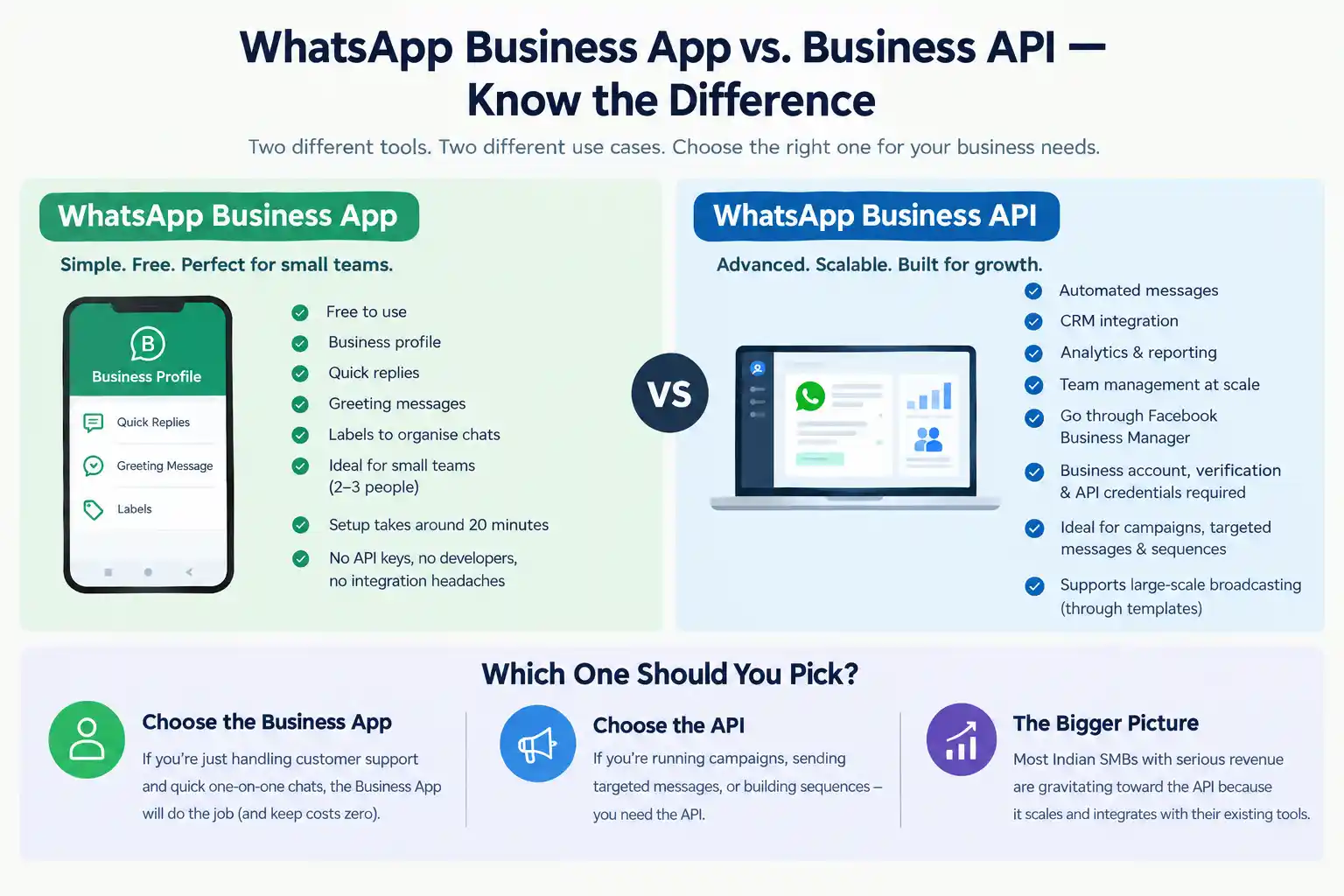
Let’s start with the basics, because getting this wrong will mess up your whole strategy. Two different tools. Two completely different use cases.
The WhatsApp Business App is free. It’s basically WhatsApp for desktop with business features bolted on. You get a business profile, quick replies, greeting messages, labels to organise chats. If you have a small team — say, two or three people handling customer queries — this is sufficient. It’s like using bahut simple tools. Setup takes 20 minutes. No API keys, no developers, no integration headaches.
The WhatsApp Business API is the enterprise version. This is where you send automated messages, integration with CRM systems, analytics, team management at scale. You need to go through Facebook Business Manager (Meta owns WhatsApp now, remember?). You’ll need a business account, verification, and API credentials.
For broadcasting — sending the same message to hundreds or thousands of people — you absolutely need the API or at least templates. Broadcast lists in the Business App are capped at manual sending to maybe a few hundred contacts. Not scalable. Not reliable.
Which one should you pick? If you’re just handling customer support and quick one-on-one chats, the Business App will do the job (and keep costs zero). If you’re running campaigns, sending targeted messages, or building sequences — you need the API. Most Indian SMBs with serious revenue are gravitating toward the API because it scales and integrates with their existing tools.
Broadcast Lists: The Workhorse of SMB Campaigns
This is where most of the action happens for small businesses. Broadcast lists let you send a single message to multiple people at once, and each person receives it as an individual message (not a group chat). They don’t see the other recipients. It feels personal.
With the Business App, you can create a broadcast list and add up to 256 contacts. Click send once. Message goes out to all of them. It’s simple, but limited. If you have 5,000 customers, you’re going to be creating dozens of lists or doing this manually.
With the API, broadcast lists are theoretically unlimited (Meta’s infrastructure handles scale). You can segment by purchase history, location, engagement level. You can track delivery and read status. You can see who replied.
Here’s the real power: people actually check WhatsApp messages. Open rates run 50-90% depending on your list quality. Compare that to email, which hovers around 20-30% for SMBs. That’s not a small difference. That’s the whole difference between a marketing channel that works and one that doesn’t. This open rate advantage is why WhatsApp broadcast campaigns consistently outperform other owned channels when measured properly — which is exactly the kind of channel-by-channel analysis our guide on digital marketing KPI metrics helps you set up from day one.
Click-to-WhatsApp Ads: Pulling People into Your Funnel
You know how Facebook and Instagram ads work. You run an ad, someone clicks it, they land on your website or a form. Click-to-WhatsApp ads flip that. Someone clicks your ad, they open WhatsApp directly and can message you immediately.
Why is this useful? Because you’re meeting people where they already are. No landing page friction. No form to fill. Just a direct conversation. For Bangalore SaaS products or Delhi e-commerce stores, this converts really well for lead gen, support, and product inquiries.
You set these up in Meta Ads Manager. Choose your audience, set a message that pops up when they click, and they’re routed to a WhatsApp conversation with your business account. From there, it’s automation: a greeting, a quick link, or a human team member taking over depending on your setup.
The tricky part: managing the inbound volume. Click-to-WhatsApp ads can flood your WhatsApp inbox if you’re not prepared. You need a team ready to respond, or smart automation. Slow response kills the vibe and wastes the ad spend.
The Opt-in Trap (And Why Ignoring It Costs You Everything)
This is non-negotiable, but I see small business owners completely botching this. WhatsApp compliance rules — especially in India — are strict.
You cannot send marketing messages to someone unless they’ve explicitly opted in. Not implied. Not pre-checked boxes. Explicit. They said “yes, send me updates from your store.”
How do you get opt-in? A few ways:
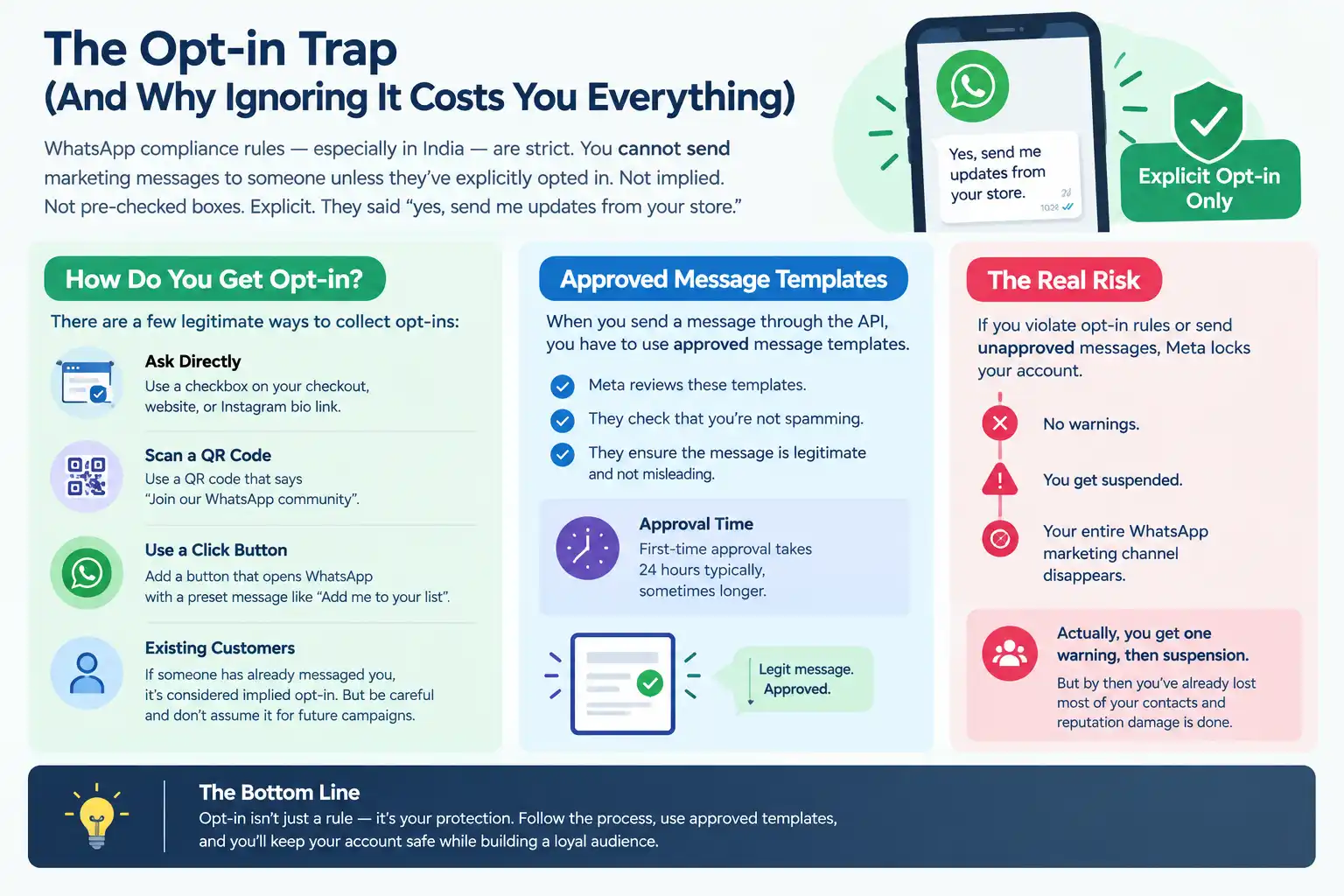
- Ask directly: “Sign up for WhatsApp offers” checkbox on your checkout, your website, your Instagram bio link
- Scan a QR code that says “Join our WhatsApp community”
- Click a button that opens WhatsApp with a preset message like “Add me to your list”
- Existing customers who already messaged you = implied opt-in, but be careful here
When you send a message through the API, you have to use approved message templates. Meta reviews these. They check that you’re not spamming, that the message is legitimate, that it’s not misleading. First-time approval takes 24 hours typically, sometimes longer.
If you violate opt-in rules or send unapproved messages, Meta locks your account. You don’t get warnings. You get suspended. Your entire WhatsApp marketing channel disappears.
Actually, scratch that — you get one warning, then suspension. But by then you’ve already lost most of your contacts and reputation damage is done.
Segmentation and Personalization (Without Sounding Like a Robot)
This is where WhatsApp beats email hands down. It feels like a conversation, not a broadcast. If you can segment your audience and send relevant messages, engagement goes through the roof.
Let’s say you’re a Kolkata fashion retailer. You could segment by product category: send denim collection updates only to people who bought denim last season. Or by purchase value: VIP customers get early access, casual buyers get standard launch announcements. Or by engagement: loyal customers get special offers, inactive ones get re-engagement campaigns.
With the API, you can automate all of this. But the moment you add personalization, keep it authentic. “Hi Priya, we think you’ll love the new summer collection based on your last purchase” hits different than “Hi [first_name], check out these products [product_names].” One feels like a friend. One feels like spam from 2008.
Building Community and Loyalty Beyond Transactions
The real magic of WhatsApp for SMBs isn’t always about the immediate sale. It’s about maintaining a community. People expect direct access. They want to ask questions, get updates, feel special.
A lot of successful SMBs are using WhatsApp groups (not broadcast lists, actual groups) for exclusive communities. VIP customers in one group get insider access to new products. Another group for feedback and beta testing. Another for customer stories and community vibes. Matlab, you’re building something that feels like membership, not marketing.
The downside: WhatsApp groups need moderation. You’re managing conversations, not just pushing messages. It requires time and attention. But the loyalty you build is real. People in these groups become your advocates. They tell their friends. They stick around even if your price goes up slightly.
Analytics and Measuring What Actually Matters
Here’s something I notice: SMBs obsess over email metrics (open rate, click rate, unsubscribe rate) but don’t think about WhatsApp analytics the same way. They should.
With the Business API, you get delivery status (sent, delivered, read), response rates, conversation duration. You can see which message templates perform best. Which segments reply most. Which broadcasts get forwarded (huge indicator of good content).
But honestly? The best metric for WhatsApp is simple: are people replying? Are they asking questions? Are they making purchases after receiving a message? WhatsApp is so direct that traditional marketing metrics feel less important. If 50 people message you back asking about a product, that’s not a “conversion rate” — that’s a conversation. That’s sales waiting to happen.
Common Pitfalls and How to Avoid Them
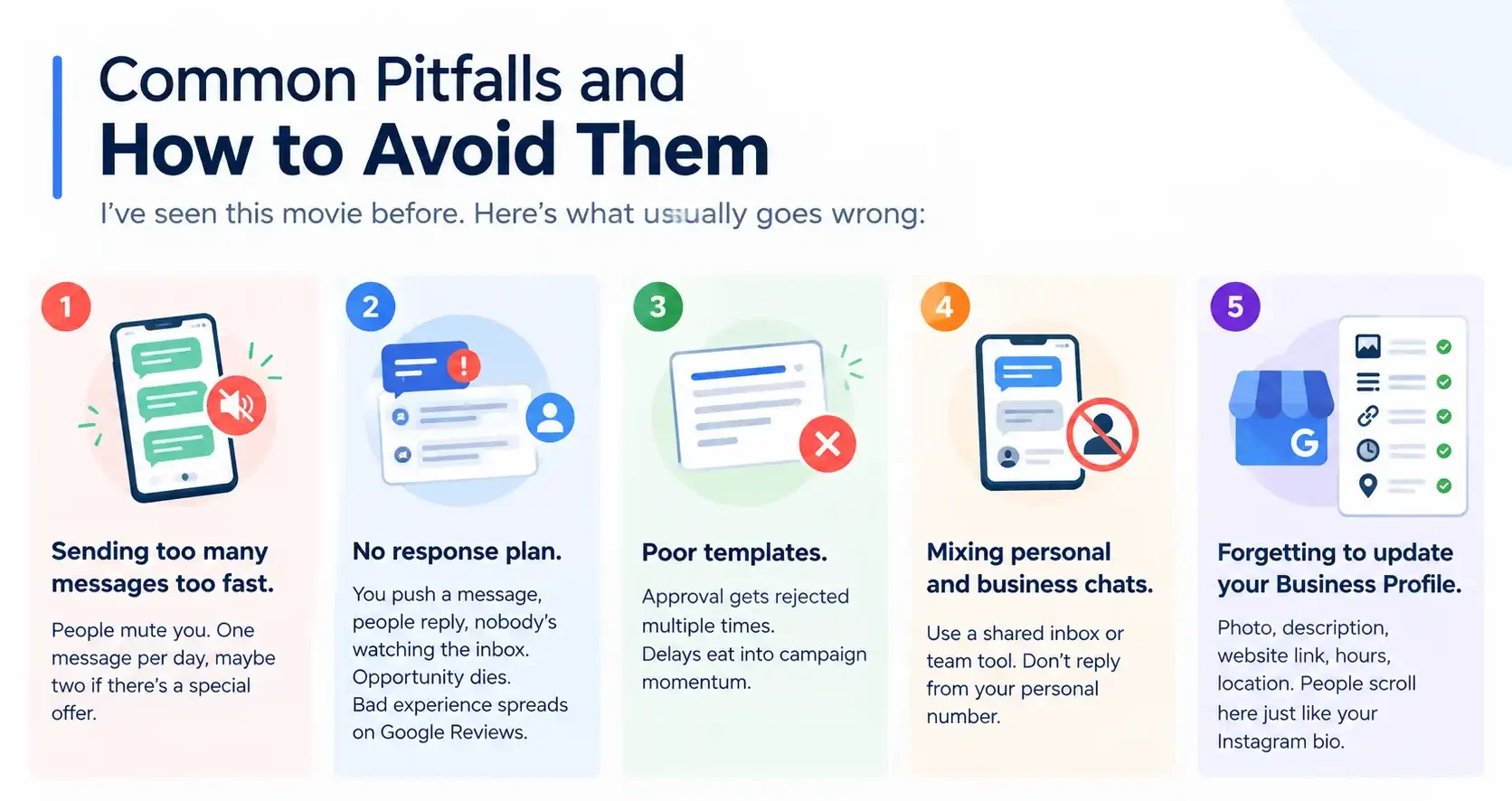
I’ve seen this movie before. Here’s what usually goes wrong:
- Sending too many messages too fast. People mute you. One message per day, maybe two if there’s a special offer
- No response plan. You push a message, people reply, nobody’s watching the inbox. Opportunity dies. Bad experience spreads on Google Reviews
- Poor templates. Approval gets rejected multiple times. Delays eat into campaign momentum
- Mixing personal and business chats. Use a shared inbox or team tool. Don’t reply from your personal number
- Forgetting to update your Business Profile. Photo, description, website link, hours, location. People scroll here just like your Instagram bio
Next Steps: Getting Started the Right Way
Start small. If you’re an SMB with 500-5,000 customers, begin with the Business App. Learn how people respond. Build a small list of opted-in contacts. Send one campaign a week. Track replies and sales.
Once you’re comfortable, move to the Business API if your volume justifies it. Most SMBs get solid ROI on WhatsApp at API level once they hit 5,000+ active contacts and are sending 3-4 campaigns per month.
Get your legal clarity first. Check with your compliance team (or hire a freelancer on Upwork for a quick review). Make sure your opt-in process is ironclad. Make sure your templates are safe. The Meta Business help centre has guides, but they’re dry and dense — sometimes it helps to have a second pair of eyes.
Quick checklist before you start:
- Define the one thing you want: leads, sales, awareness — pick one.
- Baseline your numbers: write down where you are today.
- Pick a 90-day window: nothing moves in 2 weeks.
- Agree on success metrics: with whoever is paying the bill.
- Set up proper tracking: GA4, UTMs, call tracking.
- Review monthly: kill what doesn’t work, double down on what does.
The Bottom Line
If you take one thing from this: whatsapp marketing india rewards patience and specificity, not volume or clever tricks. Start small, measure honestly, fix what breaks, and compound what works. The brands doing this well in India aren’t smarter — they’re just consistent. Need a hand with this for your business? Talk to us.
Need help with whatsapp marketing for small business?
Need help with WhatsApp marketing for your small business? Let our experts help you build effective WhatsApp campaigns, engage customers, and turn conversations into business opportunities.
FAQs
-
What's the difference between WhatsApp Business App and API in terms of cost?
Ans.The Business App is completely free. The Business API charges per message sent, but the per-message cost is very low (fractions of a rupee typically). For most SMBs, sending 500 messages a month through the API costs less than 500 rupees. The free app only works if your volume is small (under 100 messages a day) and you don't need automation. -
Can I legally send promotional messages without explicit consent?
Ans.No. Every promotional message requires explicit opt-in. Service messages (like order confirmations, shipping updates) are an exception and can be sent to anyone who's transacted with you. But offers, new product announcements, and sales pitches? They need opt-in. Violate this and your account gets suspended. No exceptions. -
How fast should I expect replies to WhatsApp messages?
Ans.This varies wildly. Service and support queries get replies within minutes. Marketing messages get replies within 1-24 hours if they're good. Average response rate to marketing messages for SMBs is around 20-35% of delivered messages, but top performers hit 50%+ with really targeted, relevant content. Response times are much faster than email. -
What happens if I send unsolicited messages or violate WhatsApp's policies?
Ans.Meta tracks your compliance. First violation, you get a warning. Second violation, your account gets temporarily restricted. Third violation, you get suspended entirely. Suspended means you can't send messages for weeks or months. In bad cases, permanent ban. It's not worth the risk. -
Should I use broadcast lists or WhatsApp groups for my customers?
Ans.Broadcast lists are for one-way messaging (you send, they receive). Use these for promotions, updates, and announcements. Groups are for two-way conversation (members can chat with each other and with you). Use groups for community, loyalty programmes, beta testing, and VIP support. Most SMBs need both. -
How do I get people to opt-in to my WhatsApp messages?
Ans.Add a "Join our WhatsApp" button on your website. Include the link in your Instagram bio, email signature, and checkout page. QR codes work well too — print them on packaging or point-of-sale materials. Make it easy and frictionless. Incentives help: "Get exclusive discounts on WhatsApp" usually drives 10-20% signup rates if you're already known. -
Can I use the same WhatsApp number for personal and business?
Ans.Technically yes with the Business App, but it's messy. Your personal chats mix with customer conversations. Use a dedicated business number if you can, or switch to the API where you use a shared inbox with your team. Separation keeps things organised and professional. -
What's the actual ROI on WhatsApp marketing for an SMB?
Ans.If your list is clean and opted-in, expect 2-5x ROI on simple product announcements or time-sensitive offers. More sophisticated campaigns with segmentation and personalization hit 5-10x. The exact number depends on your product margins, list quality, and how relevant your messages are. Start tracking conversions from WhatsApp immediately so you have real data. -
Do I need a developer to set up WhatsApp Business API?
Ans.Not necessarily. There are no-code platforms like Twilio, MessageBird, and local Indian services that handle API integration without coding. They charge a setup fee (usually one-time, 5,000-15,000 rupees) plus per-message fees. If your team is technical, direct API integration is cheaper. If not, no-code saves time and headaches.
Author Details

Latest Posts
-
 22 / Sep
Conversion Rate Optimization Conversion Rate Optimization: A Practical Guide
22 / Sep
Conversion Rate Optimization Conversion Rate Optimization: A Practical Guide -
21 / Sep
Whatsapp Marketing WhatsApp Marketing for Indian SMBs
-
 19 / Sep
-
 18 / Sep
Google Ads Google Ads Quality Score: Full Breakdown
18 / Sep
Google Ads Google Ads Quality Score: Full Breakdown -
 17 / Sep