-
Author: Anindita Barik
-
Updated Date: Jun-16-2026
-
Views: 2 Min Read
Digital Marketing Trends 2026 are reshaping how brands attract and retain customers. Key trends include AI-powered marketing automation, short-form video dominance, voice search optimization, first-party data strategies, vernacular content growth, and community-led marketing. Success in 2026 will depend on understanding customer behavior, leveraging AI strategically, building owned audiences, and focusing on platforms that deliver measurable results rather than chasing every new trend. Brands that test, adapt, and prioritize customer needs will gain a competitive edge.
In 2026, digital marketing is being reshaped by AI-powered personalization at scale — from hyper-targeted ad creatives generated in real time to AI chatbots handling full customer journeys. Short-form video continues to dominate across platforms, while social commerce has made the path from discovery to purchase nearly instant. Marketers are also leaning heavily into zero-party data strategies as third-party cookies are fully phased out, making trust-based data collection through quizzes, polls, and loyalty programs essential. Voice and visual search optimization are no longer optional, and brands ignoring AI-driven SEO (Answer Engine Optimization for tools like ChatGPT and Perplexity) are losing visibility fast.
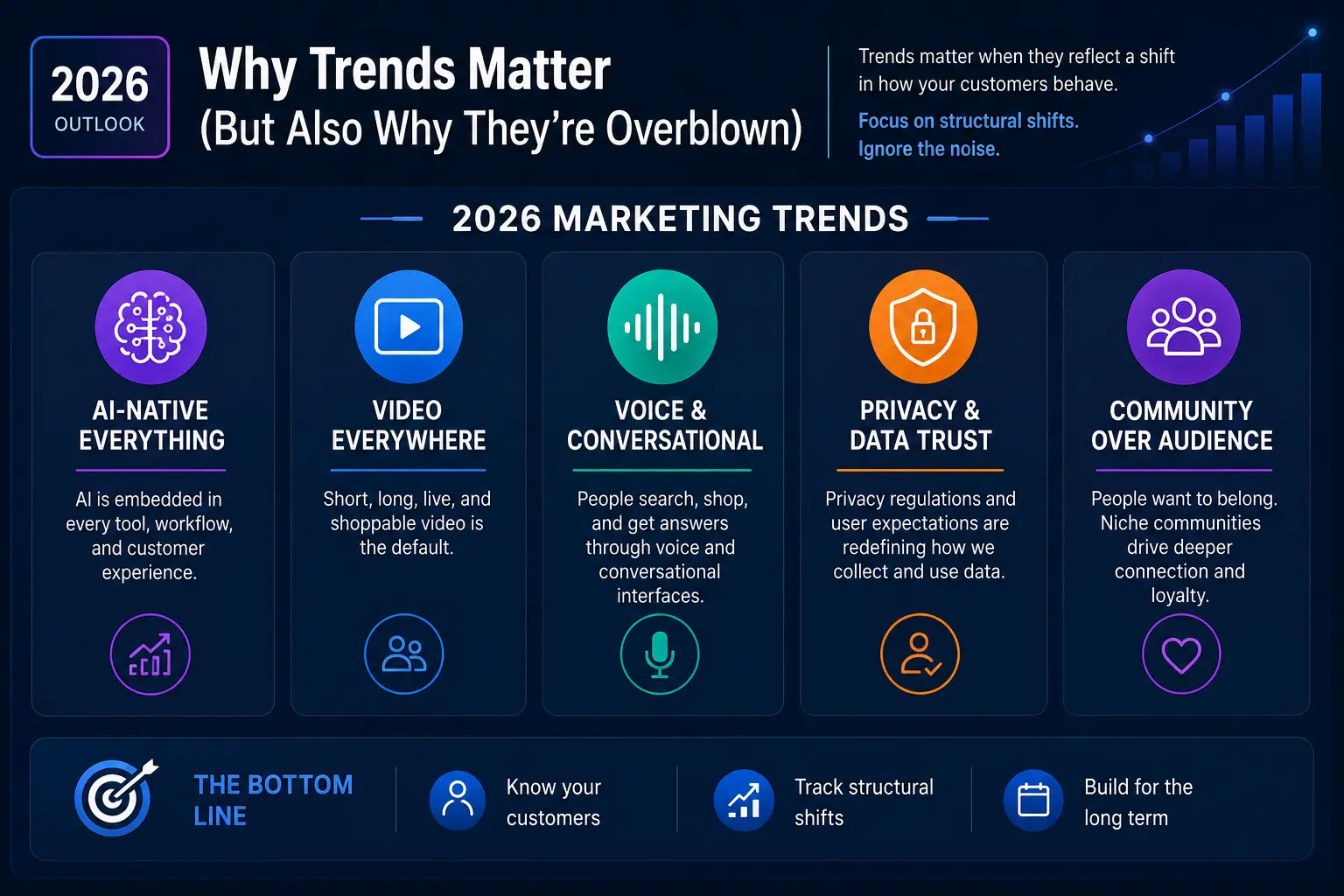
Why Trends Matter (But Also Why They’re Overblown)
Every January, marketers panic about trends. “What if we miss this?” “Should we pivot to TikTok?” “Is podcasting dead?” The answer is: trends matter, but not the way most people think.
A trend isn’t something you jump on because it’s shiny. A trend is a shift in how your actual customers behave. And if your customers aren’t on that platform, aren’t using that tool, aren’t interested in that format — then the trend doesn’t matter for your business.
But some trends are structural changes. They affect the entire game. Those are the ones worth paying attention to. And 2026 has a few of those.
AI and Marketing — It’s Not Just ChatGPT Anymore
Everyone’s talking about AI. But most people mean “ChatGPT for writing” or “Midjourney for images.” That’s table stakes now. Not special. Not a trend. Just expected.
The real shift? AI is embedded in every tool. Your email platform predicts send times. Your ads platform auto-optimizes bidding. Your analytics tool surfaces insights instead of requiring you to dig. Your social media tool recommends content ideas. And yes, generative AI is in there too — but it’s one piece, not the whole picture.
What this means: AI is increasing the baseline of what “good marketing” looks like. If you’re running campaigns manually, you’re already behind. If you’re writing all your ad copy from scratch instead of having AI draft variations and you pick the best ones — you’re leaving performance on the table.
We tested this heavily last year. One of our FMCG clients — a brand from Vadodara — was spending three weeks writing copy for seasonal campaigns. We implemented AI drafting (using tools they already subscribed to but weren’t using properly). Copy got done in three days. Then we had the human team review, edit, and pick winners. The AI drafts? About 40% made it to final without significant changes. Some campaigns actually performed better using the AI draft versions.
That’s not because AI is “better at marketing.” It’s because AI could explore more variations faster. The human team could then be strategic instead of just productive.
But here’s what scared the team: “Will AI replace copywriters?” No. Will it make mediocre copywriters obsolete? Yes. Already happening. The copywriters who survived? They’re the ones using AI as a starting point and adding strategy on top.
Short-Form Video Actually Won
This isn’t a trend anymore. It’s the baseline. YouTube Shorts gets 70+ billion views per day. Instagram Reels are still driving engagement above static posts. Kuaishou and Moj in India are where a massive chunk of Gen-Z hangs out. Even LinkedIn is pushing short-form now (awkwardly).
The mistake most brands make: they treat Shorts and Reels as “TikTok Jr.” Different audience dynamics, different algorithms, different content that works. A 30-second Reel that works on Instagram will probably flop on YouTube Shorts.
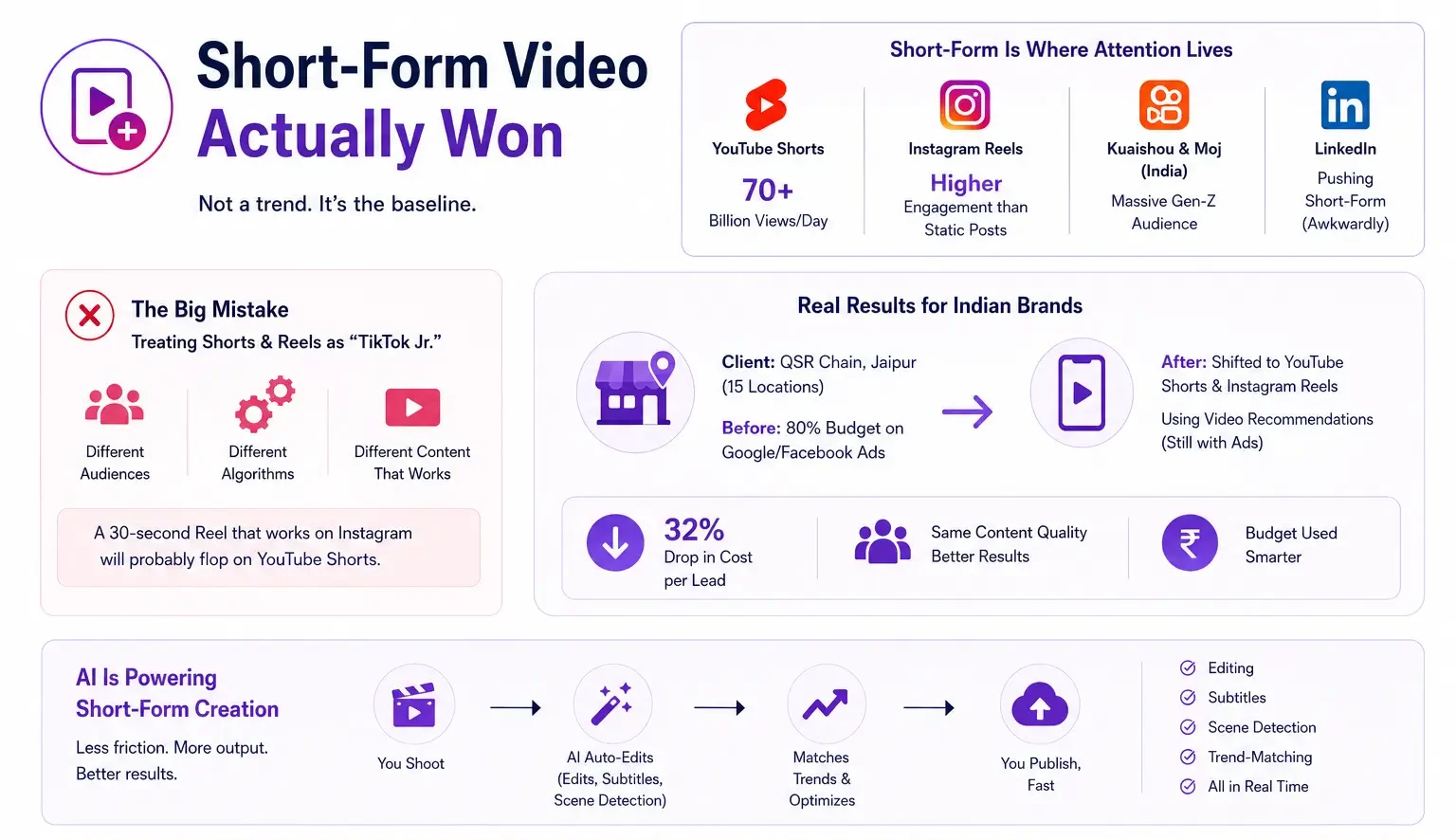
For Indian brands? Short-form video is where budget is moving. Aggressively. A client in Jaipur (quick-service restaurant chain, 15 locations) was spending 80% of their digital budget on Google/Facebook ads. We shifted them to YouTube Shorts and Instagram Reels — still using ads, but buying video recommendations instead of click-through ads. Cost per lead dropped 32%. And that was without changing their actual content quality.
Short-form video is also where AI is actually adding value. Editing, subtitles, scene detection, trend-matching — all happening in real time now. You shoot, it auto-edits, you publish. The friction that kept brands away from short-form is gone. Our audio-visual production and corporate video services can help brands build short-form assets that actually perform.
Voice Search Is Finally Useful (Kind Of)
For years, everyone said “voice search is coming!” Three years later, it’s still niche. Alexa usage in India hasn’t exploded. Google Assistant is popular but mostly for navigation and timer-setting, not for actual queries that drive business.
But Madhya Pradesh is shifting. Voice commerce — asking Alexa “order me groceries” — is growing. In-car voice search is real. And for B2B? More complex queries are happening via voice. A manufacturing manager asking Alexa “who supplies industrial valves near Pune?” is plausible now. Two years ago it wasn’t.
What this means: optimise for long-tail, conversational keywords. Stop obsessing over exact-match keywords. And if you’re in certain verticals — food delivery, local services, B2B manufacturing — voice search matters. For others, it’s still 2-3% of your traffic.
Privacy-First Marketing (Third-Party Cookies Actually Dying)
Google has delayed the phase-out of third-party cookies multiple times. But 2026 is looking different. Chrome’s Privacy Sandbox — their replacement for cookies — is actually being used. Not perfectly. Not completely. But actually.
What this means for you: you can’t rely on tracking every user across every site anymore. First-party data — the stuff you own, your email list, your customer database, your website analytics — is becoming more important. Pixel-based retargeting is getting weaker. Contextual targeting (showing ads based on content, not user history) is getting stronger.
Last year, we had to rebuild an e-commerce client’s entire tracking and attribution approach because third-party cookies couldn’t be trusted. They’d been using them as a crutch. It was painful for two months. But on the other side? They have a first-party data strategy that’s way more resilient. And they’re not sweating about Google’s next privacy update because they don’t depend on it.
Brands using Safari and Firefox properly were already ahead of this. Brands using Chrome? They have until late 2026 to get serious about first-party data collection. Email marketing and marketing automation are your best tools for building that owned data layer — these are channels you control completely, regardless of what Google does next.
Vernacular Content in Regional Languages
Hindi marketing isn’t new. But vernacular content — actual high-quality content in regional languages, not just badly translated English — is becoming mainstream. And it works. Demand is there. Competition is way lower than in English.
A real estate company in Hyderabad started posting content in Telugu. Not every post — but sales queries, property highlights, client testimonials. In the first month, their Telugu content got 2x the engagement of their English content. The audience was the same people. Just better language fit.
For brands in tier-2 and tier-3 cities, vernacular content is an unfair advantage. Try it. Seriously. Use AI for initial translation, have native speakers clean it up, watch what happens.
Community-Led Growth (Actually Real Now)
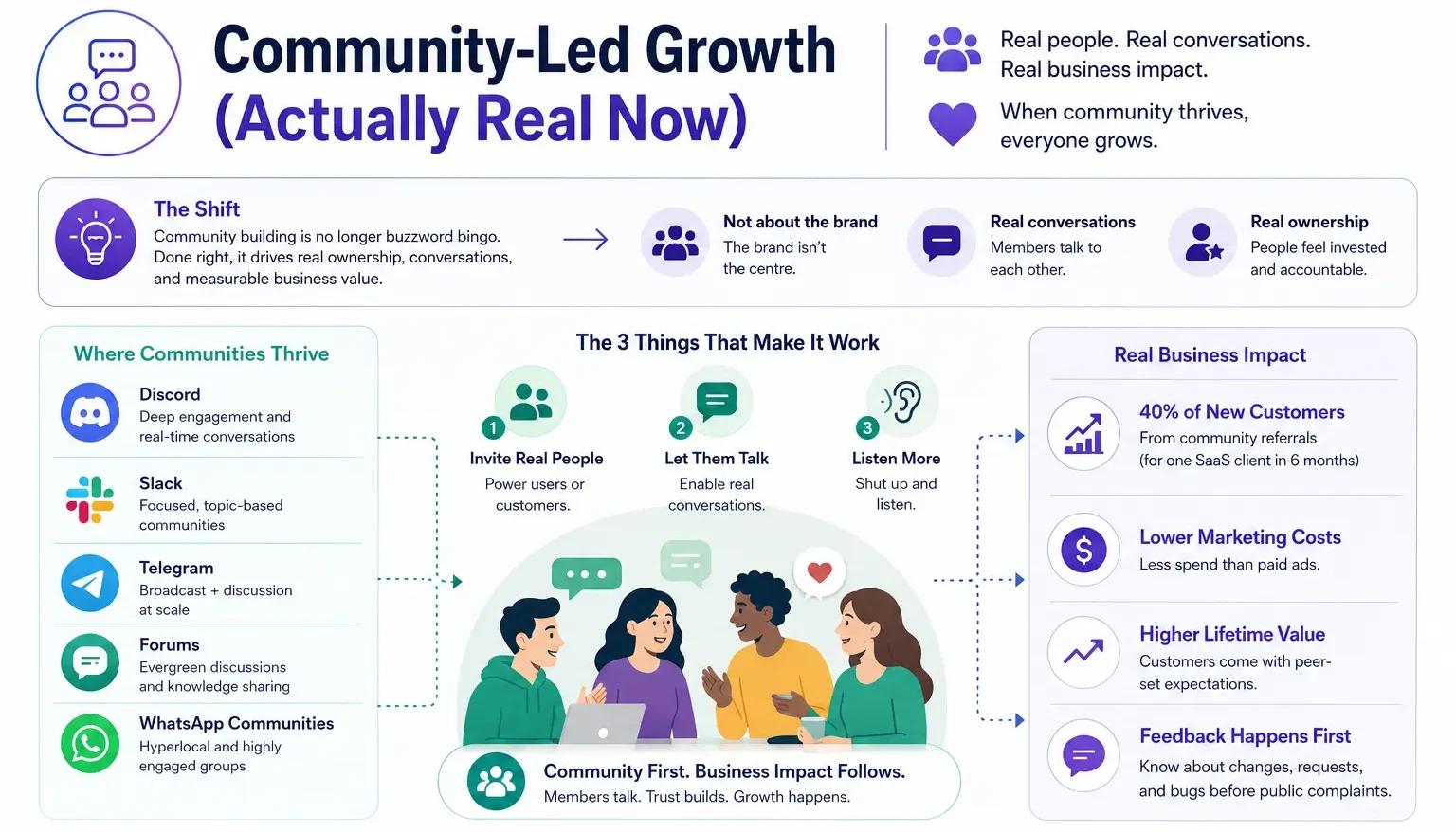
For years, “community building” was buzzword bingo. Every brand claimed to be building community. Most were just running Discord servers with no members or private Facebook groups with engagement rates at 0.02%.
But actual community — where real people feel ownership, where the brand isn’t the centre, where conversation happens — is finally delivering business value. Slack communities, Discord servers, Telegram groups, even WhatsApp communities for hyperlocal businesses.
The brands winning with community are the ones who do three things: 1) They invite real people (usually power users or customers), 2) They let that community have actual conversations, 3) They shut up and listen instead of constantly selling.
We helped a SaaS client launch a community on Slack. Six months in, 40% of their new customers were referrals from community members. Not because they asked. Because community members were bragging about the product to their networks. The marketing cost? Way lower than paid ads. The lifetime value? Higher because these customers came with expectations set by peers, not by sales.
Community is also where feedback happens first. Product changes, feature requests, bugs — you know them before customers complain on Twitter (X).
The Trends That Sound Big But Aren’t (For Most Brands)
Metaverse. Still waiting. Web3 marketing. Dead. Crypto ads. Actually dead, legally. NFTs. Nobody cares anymore. Augmented reality in ads. Possible but not many brands are making it work. These get hype. But they’re not trends. They’re experiments that mostly failed.
The marketing trends that actually matter are: where attention is flowing (short-form video, niche communities), how you reach that attention (AI tools, first-party data), and whether you’re actually listening to your customers (community, feedback loops).
What You Should Do Right Now
Don’t panic about “should I be on TikTok?” Instead, answer this: Where are my actual customers spending time? Not where marketers say they should be. Where they actually are.
Then: Invest in first-party data. Start collecting emails, zero-party data (surveys, preference centres), and building your own audience list. If Google kills something, you’re not scrambling.
Third: Test AI in your workflow. Not as a replacement for humans. As a tool to move faster on tactical stuff so humans can focus on strategy. Start with copywriting or image generation. See what sticks.
Fourth: Stop chasing every platform. Pick three. Own them. Then experiment with one new platform every quarter. Kill it if it doesn’t work. Keep it if it does. A social media optimisation strategy built around owned platforms compounds much faster than spreading thin across everything.
The biggest trend? Brands that test and adapt beat brands that follow trends. Simple as that. Most of our growth this year came from helping clients stop doing what they thought they should do and start doing what actually works. Sounds obvious. It’s not. Most brands skip the “test” part and go straight to “bet the budget.”
If you want to dive deeper into specific channels — social media strategy, performance marketing, integrated digital marketing — or if you’re wondering which trends matter for your specific business, let’s talk. We’ll audit your current approach, identify what’s working, and build a 2026 strategy that’s based on your actual customers, not on hype.
| Approach | Best for | Watch out for |
|---|---|---|
| DIY | Small teams, tight budgets | Slow ramp-up, trial-and-error |
| Freelancer | Specific project bursts | Inconsistency, limited ownership |
| Agency | Ongoing work, senior input | Higher retainer, less control |
Quick checklist before you start:
- Define the one thing you want: leads, sales, awareness — pick one.
- Baseline your numbers: write down where you are today.
- Pick a 90-day window: nothing moves in 2 weeks.
- Agree on success metrics: with whoever is paying the bill.
- Set up proper tracking: GA4, UTMs, call tracking.
- Review monthly: kill what doesn’t work, double down on what does.
The Bottom Line
If you take one thing from this: digital marketing trends 2026 what every marketer must know rewards patience and specificity, not volume or clever tricks. Start small, measure honestly, fix what breaks, and compound what works. The brands doing this well in India aren’t smarter — they’re just consistent. Need a hand with this for your business? Talk to us.
Ready to Build a Trend-Proof Strategy?
Trends change. But the principles of knowing your audience, testing, and iterating don’t. Let’s build something that works regardless of what’s trending next month.
FAQs
-
What are the top digital marketing trends for 2026?
Ans.AI integration into every tool (not just ChatGPT), short-form video dominating, voice search working for specific use cases, privacy-first marketing killing third-party cookies, vernacular content in regional languages, and community-led growth replacing pure paid acquisition. The biggest trend though? Brands accepting that algorithms care about whether humans find your content useful. Not about your campaign strategy. -
Is AI replacing digital marketers?
Ans.No. But AI is raising the bar on what a digital marketer should know. If you're just writing copy or managing campaigns manually, you're behind. Marketers winning are the ones treating AI as a tool for tactical stuff (bulk copy, data analysis, initial optimization) while they handle strategy and insight. We've been using this approach since 2023. AI isn't replacing us. It's accelerating everyone who uses it properly. -
Which social media platform will dominate in 2026?
Ans.None. Or all of them. Fragmentation is the meta-trend. Short-form video is everywhere — Shorts, Reels, Josh, Moj. But platform matters less than algorithm and audience fit. For most Indian brands, YouTube, Instagram, Facebook, LinkedIn matter in that order. But for Gen-Z? Discord, Telegram, Reddit matter more than brands realise. Stop caring about "which platform" and start caring about "where does my audience actually hang out."
Author Details

Latest Posts
-
 24 / Sep
GMB Optimisation Google Business Profile Optimization Guide 2026
24 / Sep
GMB Optimisation Google Business Profile Optimization Guide 2026 -
 23 / Sep
Search Engine Optimization Programmatic SEO: Template + Data Model Explained
23 / Sep
Search Engine Optimization Programmatic SEO: Template + Data Model Explained -
 22 / Sep
Conversion Rate Optimization Conversion Rate Optimization: A Practical Guide
22 / Sep
Conversion Rate Optimization Conversion Rate Optimization: A Practical Guide -
 21 / Sep
Whatsapp Marketing WhatsApp Marketing for Indian SMBs
21 / Sep
Whatsapp Marketing WhatsApp Marketing for Indian SMBs -
 19 / Sep
Related Knowledge