
























To succeed, FMCG brands should combine localized content, short-form videos, creator partnerships, performance marketing and strong e-commerce visibility. A data-driven approach helps brands build trust, improve retention and turn online attention into long-term sales growth. It tracks engagement, conversions, repeat purchases and customer feedback.
The FMCG brand that went viral and still lost money
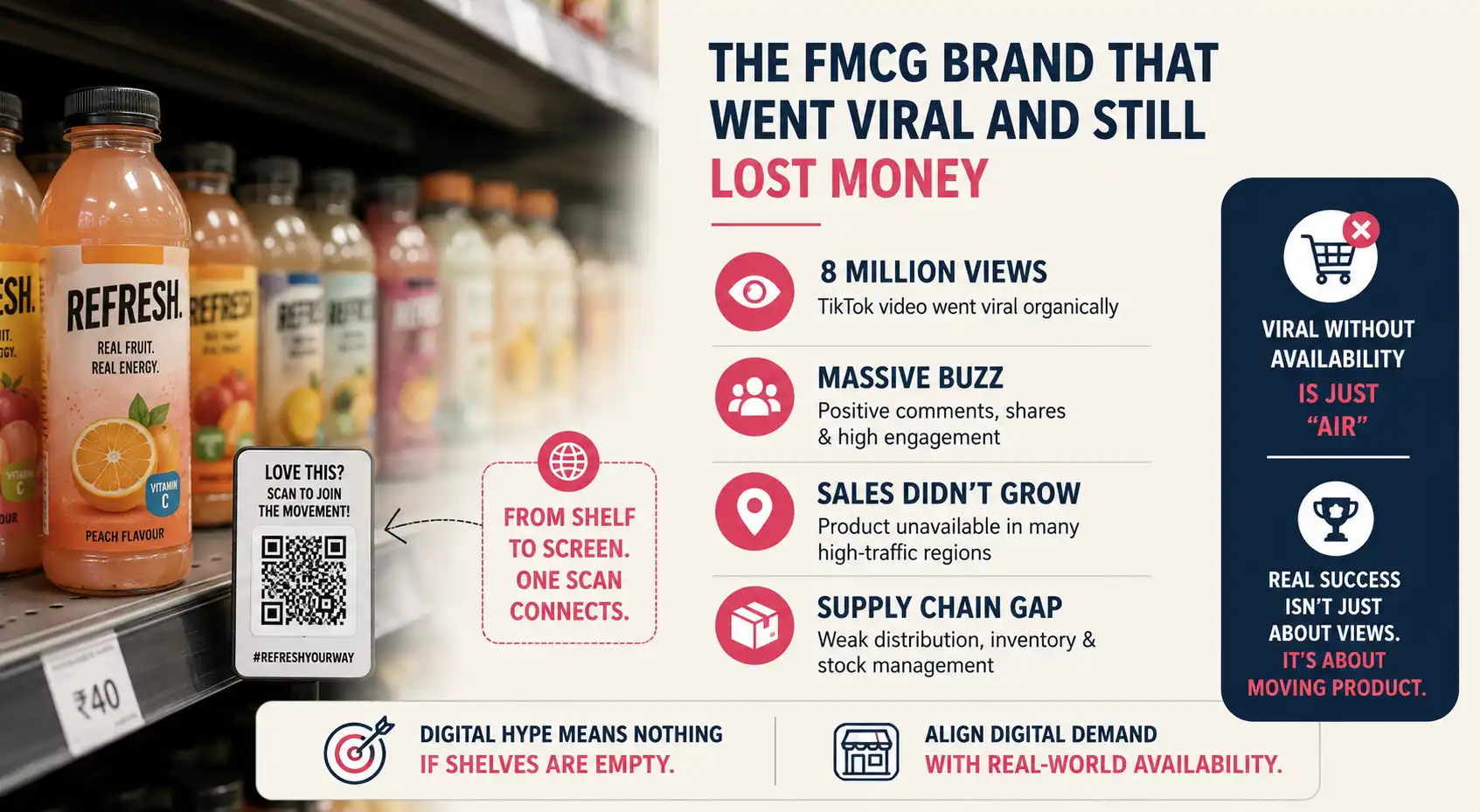
Imagine a ready-to-drink beverage brand out of Delhi (a made-up example). One of its TikTok videos hits 8 million views, all organic. The comments are chaos. All positive. People are tagging friends. It is everything you would pray for in marketing.
By the next month, the team expects sales to explode. Instead they stay flat, or even dip slightly.
Why? The product is not available in most of the cities sending TikTok traffic. Western India has sparse distribution. Northern tier-2 cities have no presence at all.
The brand has created demand in places where it cannot fulfil it.
That’s the broken part of FMCG digital marketing most people skip over. You can go viral. You can hit 10 million impressions. You can get Bollywood celebrities to post about you. But say your supply chain is weak. Maybe you are not in the right stores. Maybe your distributor cannot handle a sudden demand spike. Maybe your inventory management is poor. Then all that digital attention is just air.
This is what separates working FMCG digital from the kind that wins awards at agency shows but doesn’t move product.
The real FMCG digital equation
FMCG is messier than DTC or B2B SaaS. Here’s why.
A SaaS company sells direct. Customer clicks ad → lands on website → subscribes. Attribution is clean. Causation is clear.
Real estate uses long consideration cycles. You can nurture for 90 days and still win.
FMCG? Your customer sees an ad, gets interested, drives to the nearest Reliance, searches for the product, can’t find it, buys a competitor. All in 48 hours. Digital awareness window is maybe 3-7 days before your prospect forgets and defaults to their last brand.
That’s the pressure FMCG operates under. Which means your digital strategy can’t be separate from your distribution strategy. They have to breathe the same air.
When we work with FMCG brands, we actually talk to their distributors first. Where can we drive volume? Which regions have good stock depth? Where are we trying to expand? That feeds the digital roadmap, not the other way around.
The three types of FMCG buying decisions and how digital fits each
Impulse buy: someone grabs your product because they saw an Instagram post yesterday and it stuck in their head. It’s available in the store. Transaction happens in 10 seconds. Digital wins this through frequency and creative recall.
Considered buy: food products, premium beverages, beauty items. Someone researches. Checks reviews. Compares ingredients or price. This takes days to weeks. Digital builds trust through education content, UGC (user-generated content), and influencer testimonials.
Repeat purchase: your customer bought once and now they’re habit-formed. Digital keeps top-of-mind and can drive loyalty through apps, email, or retargeting.
Most FMCG brands spend the bulk of their budget on impulse buys and very little on the other two. We think that is the wrong way round. Repeat customers are worth far more over time, so build those first. Knowing where each type of buyer sits on the path to purchase is the idea behind building a marketing funnel that converts. Different stages need different content, different channels and different success metrics.
Performance marketing for FMCG
Google Ads and Facebook/Instagram Ads are how most FMCG brands think about “digital.” It’s the obvious play.
But the setup matters a lot.
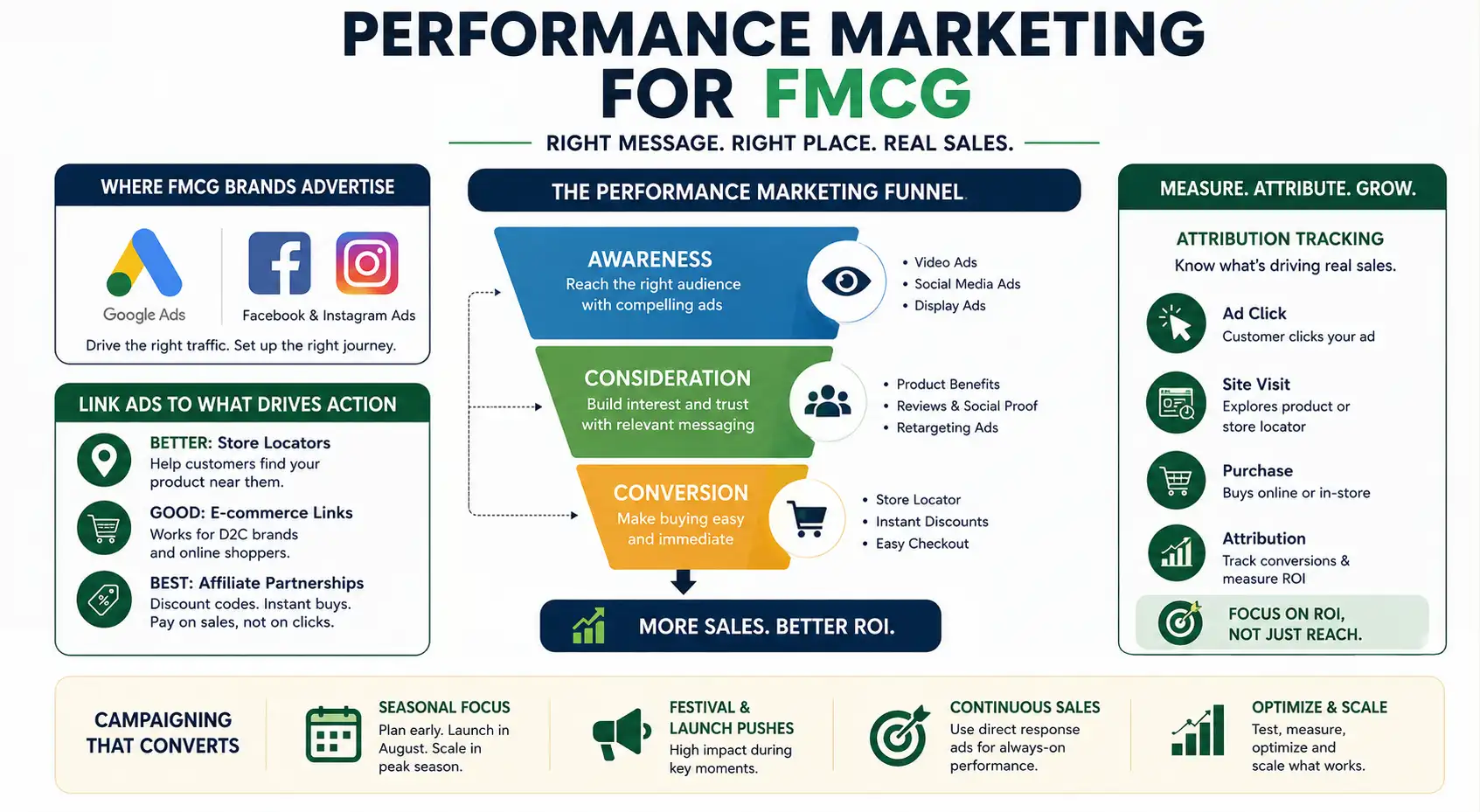
Most FMCG brands link their ads to a generic landing page or product catalogue. “Shop Now” takes you to Amazon or a website. That’s fine if you’re D2C. But if you’re selling through retail distribution, you’ve just sent someone who wanted it now down a 2-3 day ordering rabbit hole.
Better play: link ads to store locators. “Find near you” buttons. “Buy at Dmart, Big Basket, and local stores.” There is still friction, but at least you are facing reality.
The best play, which almost no FMCG brand does: affiliate partnerships with e-commerce platforms. Someone clicks your Instagram ad. Gets a 5-10% discount code. Buys on Amazon same hour. You pay commission on sales, not on clicks. That is ROI-first thinking.
Google and Facebook ads work best for seasonal pushes. Festival season, summer launches, monsoon-focused products. Diwali? Every FMCG brand fights for CPM (cost per thousand impressions) real estate in September-October and the cost explodes. We typically advise: launch your campaigns in August, build audience lists, then amplify hard during peak season.
For continuous sales, think direct response instead of awareness.
Influencer strategy for FMCG
Saurav (our Founder) has strong opinions about influencer marketing. He thinks most of it is theatre. I think he is right more often than not.
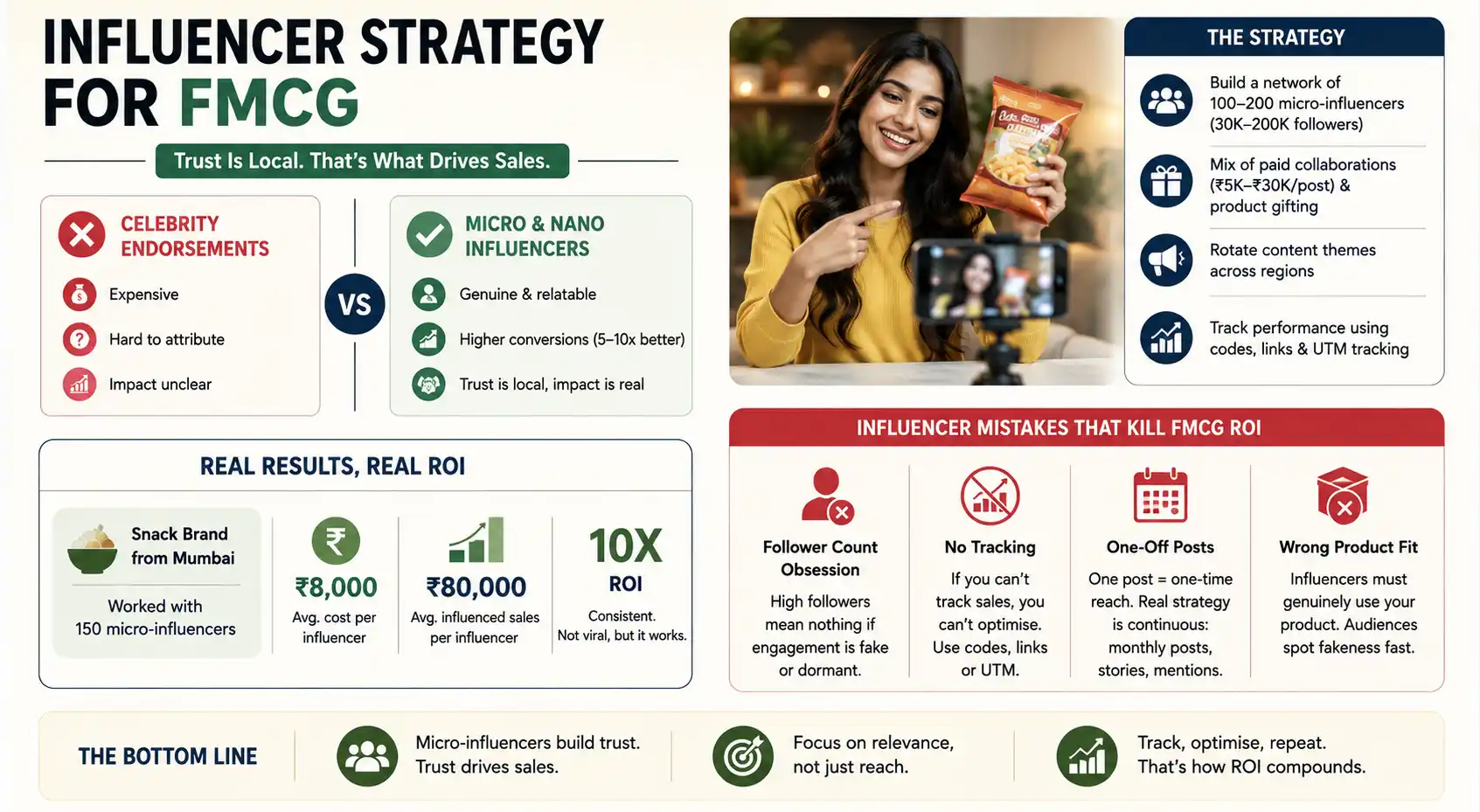
Celebrity endorsements are expensive and hard to attribute. A Bollywood actor posts about a beverage. Sales might go up. Or the product was just getting distribution at that moment. Was the celebrity the cause or coincidence? You’ll never know for sure.
But nano-influencers and micro-influencers? That’s where FMCG digital actually works.
Take a person with 10k followers in Pune. They are genuine. They actually use your product. They post authentically. They often drive far more conversions than a celebrity with 2 million followers who has never opened the product.
Why? Because trust is local. I’m more likely to buy something recommended by someone I vaguely recognise than someone I’ll never meet.
The strategy: build a network of 100-200 micro-influencers (30k-200k followers) across tier-1 and tier-2 cities. Give them product. Some are paid (Rs 5,000-30,000 per post depending on follower count). Some are gifting only. Rotate content themes. Track code or affiliate link performance per influencer.
Here is an example with made-up numbers. A snack food brand works with 150 micro-influencers. The average cost per influencer is Rs 8,000, and the average sales per influencer, tracked through promo codes, is Rs 80,000. That is 10 times the money back. Not glamorous. Not viral. But it works, and it keeps working.
Influencer mistakes that kill FMCG ROI
- Picking influencers based on follower count alone. 500k followers means nothing if many are fake or dormant.
- No tracking. If you can’t track sales attributed to an influencer, you can’t optimise. Use discount codes, affiliate links, or UTM tracking on landing pages.
- One-off posts. A single influencer post reaches their active followers once. That’s maybe 5-10% of total. Real influencer strategy is continuous. Monthly posts. Story mentions. Authentic integration, not forced.
- Working with people who don’t actually use your product. That shows. Audiences catch it immediately.
Social commerce: a channel most FMCG brands have not used yet
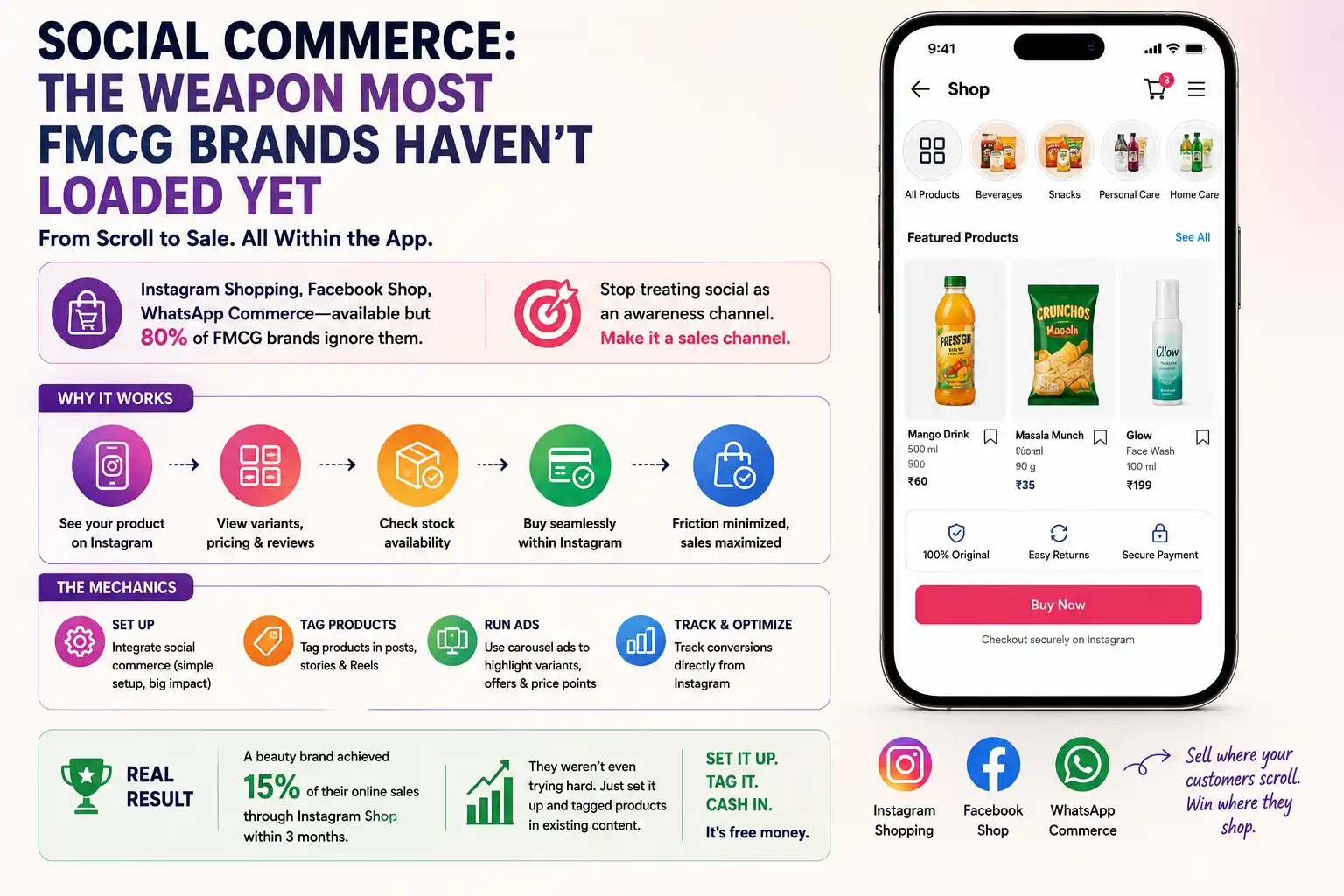
Instagram Shopping, Facebook Shop and WhatsApp Commerce are all available, yet most FMCG brands ignore them.
Why? Because they’re thinking of Instagram as “awareness channel” rather than “sales channel.” That’s outdated thinking.
Someone sees your product on Instagram. Clicks. Sees available variants. Pricing. Reviews. Checks it’s in stock. Buys. All within the Instagram app. There is very little friction.
The mechanics: set up social commerce integrations (it requires some technical setup but it’s not hard). Tag products in posts and stories. Run carousel ads that show different variants or price points. Track conversion directly from Instagram.
For an FMCG brand doing D2C or partnering with e-commerce platforms, this is close to free money. It is just a setup task.
Often all it takes is to set it up and tag products in content you already post.
Content that converts for FMCG
Brand values content is good for PR. “Our story,” “Our mission,” “We care about the environment.” Nice. Necessary in 2026. Doesn’t move product.
This moves product:
- Use-case content. Quick recipes. DIY solutions. “5 ways to use this product.” Reels and TikToks showing actual usage. Someone sees this and thinks “oh, I can use this for that too?” Purchase intent shifts.
- Proof content. User testimonials. Before-afters (if applicable). Unboxing videos. Real people, real reactions. This is what converts. Not a 30-second branded spot.
- Deal and discount content. “Available for 20% off till Sunday on Big Basket.” People respond to scarcity and deadlines. Yes, it’s manipulative. It also works. Use it strategically, not constantly.
- Seasonal content. “Summer drinks for 40 degrees,” “Monsoon snacks,” “Festival gift packs.” Timing matters. Content that’s relevant to the moment drives clicks.
A good habit is to test many content angles in a quarter, find the top performers, and then scale those.
Most FMCG brands put most of their effort into brand story content. It should be the other way round.
A distribution reality check: why your digital may be failing
I’ll say this bluntly because I’ve seen it too many times.
Your digital campaign is working. Awareness is up. Ads are converting well. Influencers are performing. But sales are flat. And you’re confused.
The issue is almost never digital. It’s distribution. Either you’re not in stores where your audience is searching. Or you don’t have enough stock depth. Or your retailers aren’t trained to sell it. Or your price point is misaligned with the market you’re targeting.
Take a premium health drink brand (a made-up example). It has beautiful digital, solid creative and good targeting. But it is in only a small number of stores across a metro of millions of people. Penetration is too low, so digital creates demand the brand cannot fulfil.
The fix is to pause aggressive digital while distribution is rebuilt in the target areas, then restart the campaigns. The same ads work far better once the product is available where it matters.
Before launching any FMCG digital campaign, map your distribution. Be honest. Then target media to areas where you have at least moderate stock depth. It seems obvious. It’s not. Most brands don’t do this.
Email and loyalty programmes
Nobody gets excited about email marketing. But for FMCG repeat purchases, it’s the best channel.
Build a loyalty programme. Phone number capture at purchase. Monthly email with 3 things: product recommendations based on past purchase, exclusive discount for that cohort, new product launches they might like.
Cost to send 1 million emails? Roughly Rs 15,000-30,000 with decent automation. Cost of running ads to 1 million people? Lakhs.
Loyalty emails are cheap to send and usually have a low CAC (customer acquisition cost). So repeat purchase becomes your most profitable channel.
Sending the right message to repeat customers at the right time can turn email into a big share of revenue.
Budget allocation for a typical FMCG launch (2026)
Here is an example split, assuming 10 lakh rupees a month for a new product launch:
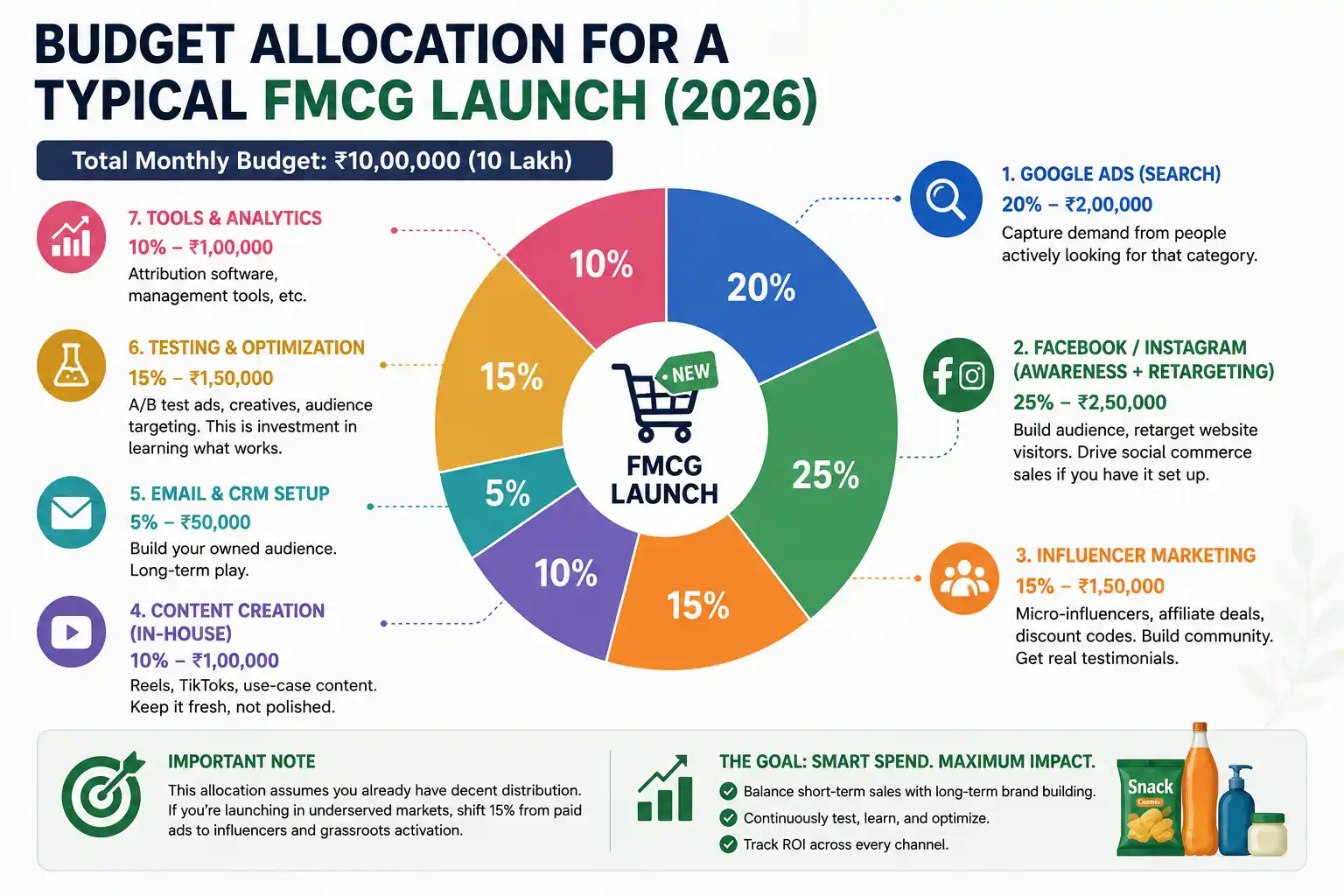
Google Ads (search): 20% (Rs 2L). Capture demand from people actively looking for that category.
Facebook/Instagram (awareness + retargeting): 25% (Rs 2.5L). Build audience, retarget website visitors. Drive social commerce sales if you have it set up.
Influencer marketing: 15% (Rs 1.5L). Micro-influencers, affiliate deals, discount codes. Build community. Get real testimonials.
Content creation (in-house): 10% (Rs 1L). Reels, TikToks, use-case content. Keep it fresh, not polished.
Email and CRM setup: 5% (Rs 0.5L). Build your owned audience. Long-term play.
Testing and optimisation: 15% (Rs 1.5L). A/B test ads, creatives, audience targeting. This is investment in learning what works.
Tools and analytics: 10% (Rs 1L). Attribution software, management tools, etc.
This assumes you already have decent distribution. If you’re launching in underserved markets, shift 15% from paid ads to influencers and grassroots activation. ROI maturity is different when you’re building ground-up.
Three campaigns that failed and why they matter
Some of the biggest marketing mistakes come from campaigns that looked successful on the surface but failed where it mattered most: business outcomes. The three cases below are made-up examples that show common patterns.
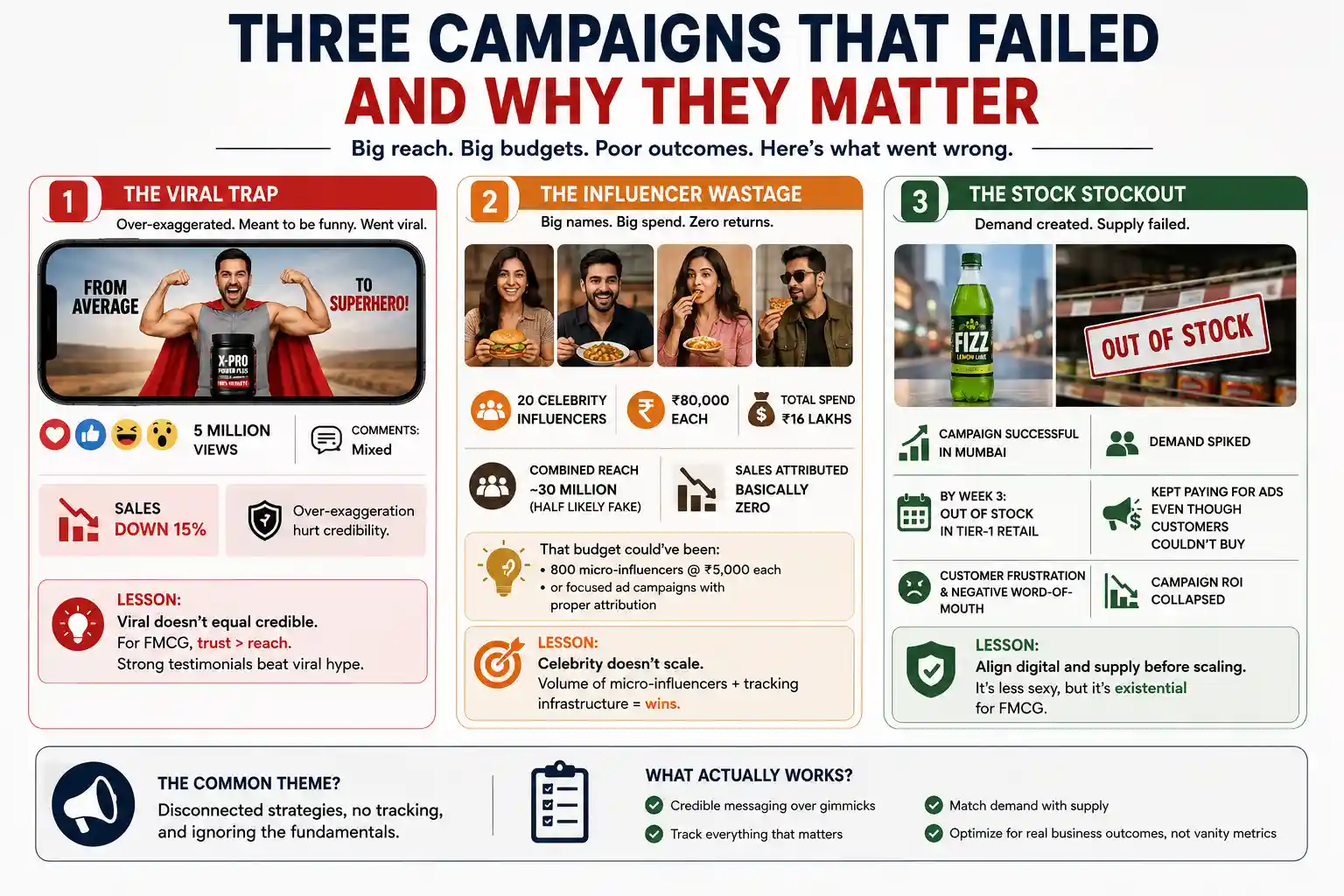
Campaign 1: the viral trap
A supplement brand created a 15-second video showing an over-the-top transformation. Super exaggerated. Meant to be funny and shareable.
It hit 5 million views. Shared everywhere. Comments were mixed. People loved the humour but were sceptical of the claims.
Sales? Down 15%. The association with over-exaggeration hurt credibility. People didn’t trust the product after seeing such an unrealistic claim.
Lesson: viral doesn’t equal credible. For FMCG, trust > reach. A modest campaign with strong testimonials outperforms a viral campaign with weak messaging.
Campaign 2: the influencer wastage
A food brand paid Rs 80,000 each to 20 celebrity influencers for single posts. Total spend: Rs 16 lakhs.
Combined reach: maybe 30 million (though half were probably fake followers).
Sales attributed: basically zero. No tracking. No discount codes. No affiliate links. Just posts that disappeared into the feed.
That budget could’ve been 800 micro-influencers at Rs 5,000 each (way better ROI), or focused ad campaigns with proper attribution. The same lesson applies across all paid channels. As our guide on how to measure digital marketing ROI explains, spend without attribution is just hope dressed up as strategy.
Lesson: celebrity doesn’t scale. A large group of micro-influencers plus proper tracking wins.
Campaign 3: the stockout
A beverage brand ran a successful campaign in Mumbai. Demand spiked. By week three of the campaign, they were out of stock in Tier-1 retail.
Had to keep paying for ads even though customers couldn’t buy. Wasted budget. People also got frustrated trying to find the product. Negative word-of-mouth kicked in.
Campaign ROI collapsed because supply chain failed.
Lesson: match digital to supply before scaling. It is less exciting than creative or strategy, but it makes or breaks FMCG.
Where most FMCG brands get stuck
They think digital is separate from sales. Like it’s a PR exercise or a brand-building play.
In reality, FMCG digital is a direct sales channel. Every rupee should map to product moving off shelves.
Second, they optimise for vanity metrics. Impressions, reach, engagement, follower growth. None of that matters if it doesn’t move product.
Third, they abandon channels too quickly. “We tried Instagram Ads for two weeks, no sales.” FMCG digital needs 4-6 weeks to show real traction because purchase cycles are still longer than instant.
Fourth, they don’t measure properly. No tracking. No attribution. “We spent 10 lakhs, got some sales, no idea if it was digital or distribution push or what.”
Fifth, they duplicate the offline playbook. If you’re doing TV ads about “family joy,” don’t replicate that in social. Digital audiences expect different, rawer, more authentic content. We break down this gap in our guide on difference between traditional and digital marketing. The creative, the targeting, the measurement and the feedback loops are all different. Brands that treat the two as the same medium tend to underperform.
What works right now for FMCG
Short-form video on Instagram Reels and TikTok still works best. 15-60 seconds. Use-case focused. Algorithm favours it heavily.
Affiliate partnerships with D2C brands (BigBasket, Amazon Fresh, local grocery delivery apps) instead of building your own e-commerce. Less inventory risk. Better attribution.
WhatsApp Business API for direct customer communication. Not ads. Actual messaging. Updates about new products, exclusive offers to your community. Open rates are usually high.
Localised influencer networks beat centralised campaigns. A brand performing well in Delhi doesn’t mean it performs the same way in Bangalore. Hyper-local micro-influencers understand local preferences.
User-generated content. Ask customers to film themselves using your product. Repost their videos (with permission). It’s cheaper than production and more credible.
Subscription models and loyalty. One-time purchase is painful FMCG math. Repeat purchase is where margins live. Build loyalty first.
How to know if your digital isn’t working
Cost per acquisition is higher than retail margin. If you spend Rs 50 to acquire a customer but your gross margin is only Rs 40, you’re losing money per sale. Digital might be working for brand, but it’s broken for business.
Influencer reach isn’t converting. If an influencer has 200k followers but your product link only gets 100 clicks, something’s wrong. Either the influencer isn’t authentic to their audience, or the product doesn’t fit their demographic.
Website traffic is high but store visits/sales are low. This means digital is building awareness but not converting to actual behaviour. Either messaging is misaligned or it takes a few more touchpoints to convert.
You can’t explain sales attribution. If you can’t trace a sale back to a specific campaign or channel, your tracking setup is broken. Fix it.
Where to start
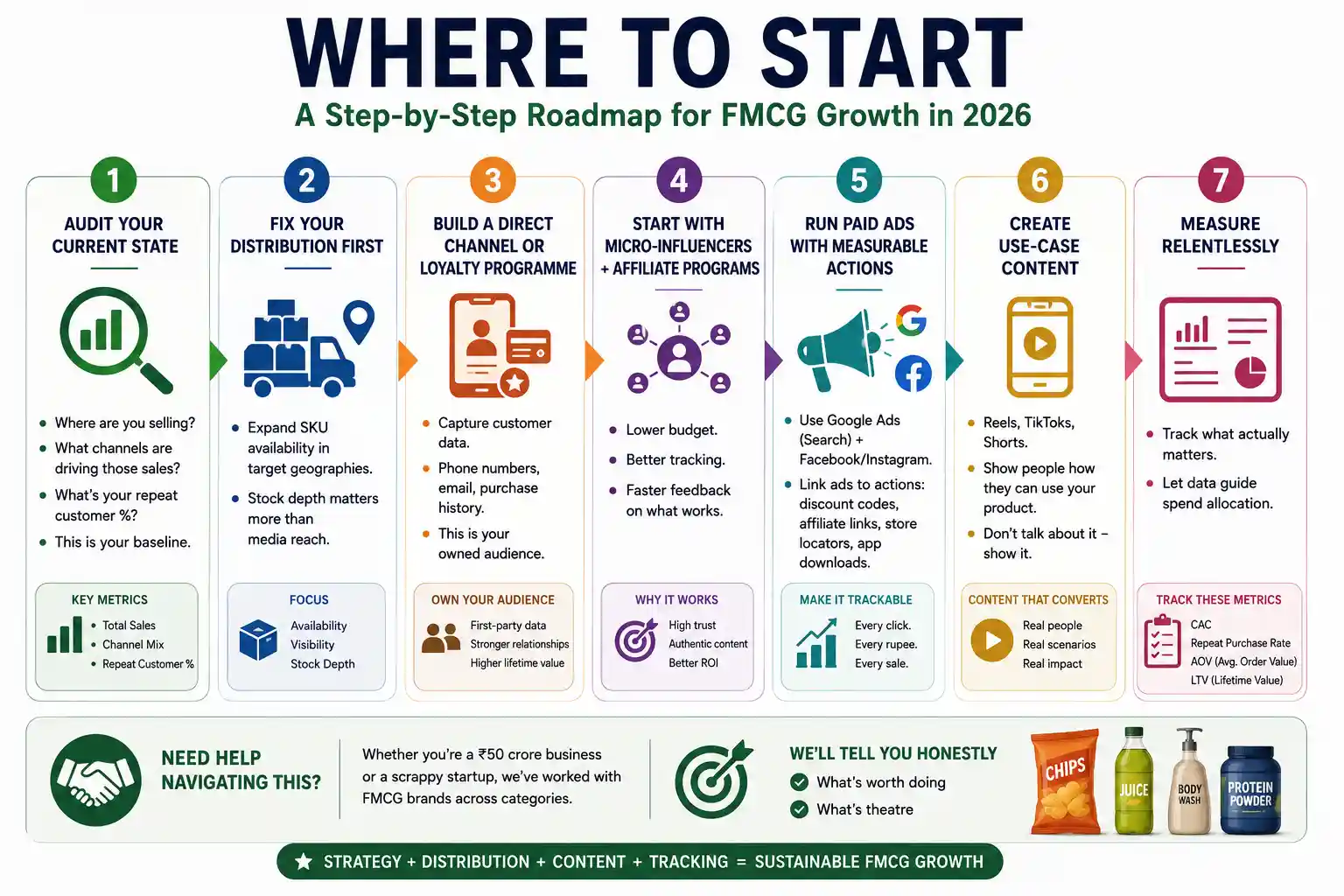
One: audit your current state. Where are you selling? What channels are driving those sales? What’s your repeat customer percentage? This is your baseline.
Two: fix your distribution first. Expand SKU availability in target geographies. Stock depth matters more than media reach.
Three: build a direct channel or loyalty programme. Capture customer data. Phone numbers, email, purchase history. This is your owned audience.
Four: start with micro-influencers + affiliate programmes. Lower budget, better tracking, faster feedback on what works.
Five: run paid ads (Google + Facebook) but link them to measurable actions: discount codes, affiliate links, store locators, app downloads.
Six: create use-case content. Reels, TikToks, shorts. Show people how they can use your product. Don’t talk about it, show it.
Seven: measure relentlessly. Track CAC, repeat purchase rate, average order value, LTV (lifetime value). Let data guide spend allocation.
You may be a ₹50 crore business or a scrappy startup. Either way, if you need help with any of this for your brand, we can tell you honestly what’s worth doing and what’s theatre.
The bottom line
If you take one thing from this, take this: digital marketing for FMCG works through patience and specific details, not volume or clever tricks.