-
Author: Anindita Barik
-
Updated Date: Jun-15-2026
-
Views: 2 Min Read
Google Ads and Facebook Ads serve different stages of the buyer journey. Google Ads targets high-intent users actively searching for a product or service — ideal for e-commerce, local services, and B2B research. Facebook Ads reaches users before they recognize a need, making it powerful for brand awareness, visual products, and D2C brands. For best results, use both: Facebook builds demand, Google captures it. The right platform depends on where your customer is in their buying journey.
Neither platform is universally better — it depends on where your customer is in their buying journey.
Choose Google Ads if your customers are actively searching for what you sell. It captures high-intent buyers already looking for a solution, making it ideal for e-commerce, local services, and B2B research-driven purchases. Choose Facebook Ads if you need to build awareness, create desire, or retarget visitors — it reaches people before they know they need you, making it powerful for visual products, D2C brands, and lifestyle categories. If budget allows, use both together: Facebook to create demand, Google to capture it.
When Your Competitor Crushes You On Google But You Crush Them On Facebook
Real story. Two e-commerce businesses selling very similar products — shoes, apparel, that kind of thing. Same market. Same margins. Same budget.
One brand went all-in on Google Ads. Beautiful campaigns, clean structure, keyword strategy locked down. ROAS was… 1.8. Brutal.
The other brand went with Facebook. Same ad spend. ROAS: 4.2.
Sounds like an easy choice? Here’s where it gets complicated. The first brand switched to Facebook, scaled the budget, and then their ROAS tanked to 2.1 because they saturated the audience too fast. The second brand tried Google and couldn’t make it work even after three months and multiple optimizations.
Two identical businesses. Same product. Wildly different results on each platform.
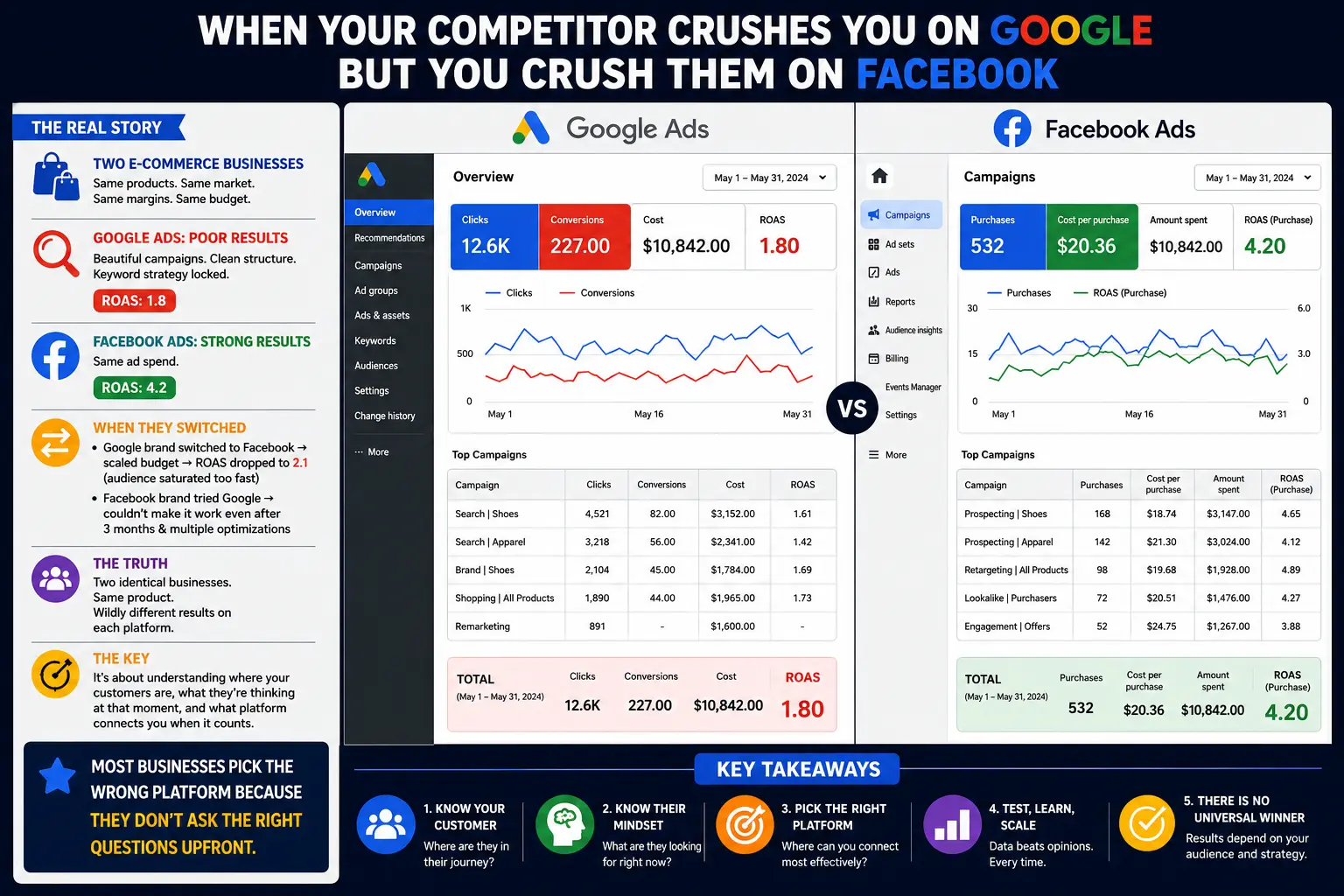
This is the reality of the Google vs Facebook debate. There’s no universal winner. It’s about understanding where your customers are, what they’re thinking at that moment, and what platform actually connects you to them when it counts.
Most businesses pick the wrong platform because they don’t ask the right questions upfront.
Google Ads vs Facebook Ads: The Fundamental Difference
Google Ads shows your message to people actively searching for what you sell.
Someone types “best running shoes under Rs 5,000” into Google. Your ad appears. They’re already interested. They’re already looking. Your job is just to convince them you’re the best option.
Facebook Ads shows your message to people who aren’t necessarily looking for anything yet.
Someone is scrolling their feed. They see your shoe ad. Maybe they didn’t know they wanted new shoes, but your ad reminded them. Your job is to create desire, not just satisfy existing desire.
This difference changes everything. Google is solving an active problem. Facebook is creating awareness of a solution someone didn’t know they needed.
Google = high intent, lower volume.
Facebook = low intent, massive volume.
Pick the wrong one and you’ll be profitable on one platform and bleeding money on the other.
If you’re still figuring out the basics of paid advertising, our guide on PPC advertising strategy, setup & ROI maximisation is a good place to start.
How Google Ads Actually Works
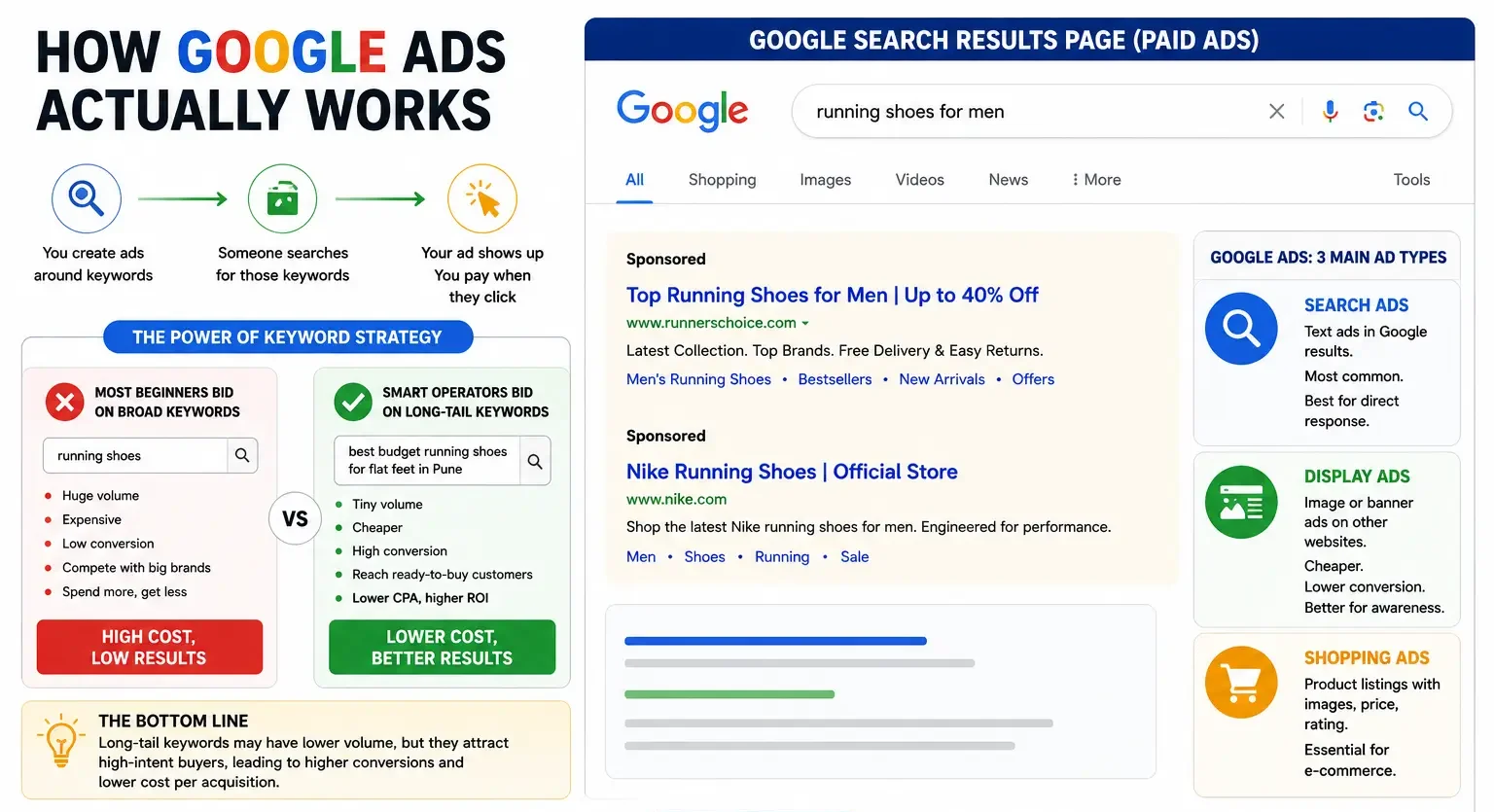
You create ads around keywords. Someone searches for those keywords. Your ad shows up. You pay when they click.
Simple, right?
The complexity comes from keyword strategy. Are you bidding on “running shoes” (huge volume, expensive, low conversion) or “best budget running shoes for flat feet in Pune” (tiny volume, cheaper, high conversion)?
Most beginners bid on the first one. Spend a ton of money. Get crushed by established brands with bigger budgets.
Smart operators bid on the second one. Lower volume, yes. But the people who search that are genuinely ready to buy. Conversion rates are way higher. Cost per acquisition is way lower even if cost per click is higher.
Google also shows three ad types:
- Search Ads: Text ads in Google results. Most common. Best for direct response.
- Display Ads: Image or banner ads on other websites. Cheaper. Lower conversion. Better for awareness.
- Shopping Ads: Product listings with images, price, rating. Essential for e-commerce.
Google Ads setup is a good starting point if you’re new to this.
How Facebook Ads Actually Works
You pick an audience. Facebook shows your ad to people matching that audience. You pay per click, per 1,000 impressions, or per result.
The targeting is insanely granular. Age, location, interests, behaviours, income level, relationship status, device type…
On one hand, this is powerful. You can get extremely specific about who sees your ad.
On the other hand, most people get this wrong. They pick too many targeting criteria and their audience becomes so small the algorithm can’t optimise. Or they pick too broad and waste money on irrelevant clicks.
Facebook also includes Instagram, Messenger, and Audience Network (a bunch of other apps). So one campaign can reach people across multiple Meta properties.
Video ads perform better on Facebook than static images, which is why so many Facebook campaigns now focus on video-first. But they’re also more expensive to produce.
The learning phase is brutal. First few days of a Facebook campaign, results look terrible. Cost per result is 5x higher. Spend a few hundred rupees on terrible metrics. Then suddenly — usually after 500+ conversions, though that varies — the algorithm learns who actually converts and performance improves 300-400%.
Most beginners kill campaigns during the learning phase thinking they’re broken.
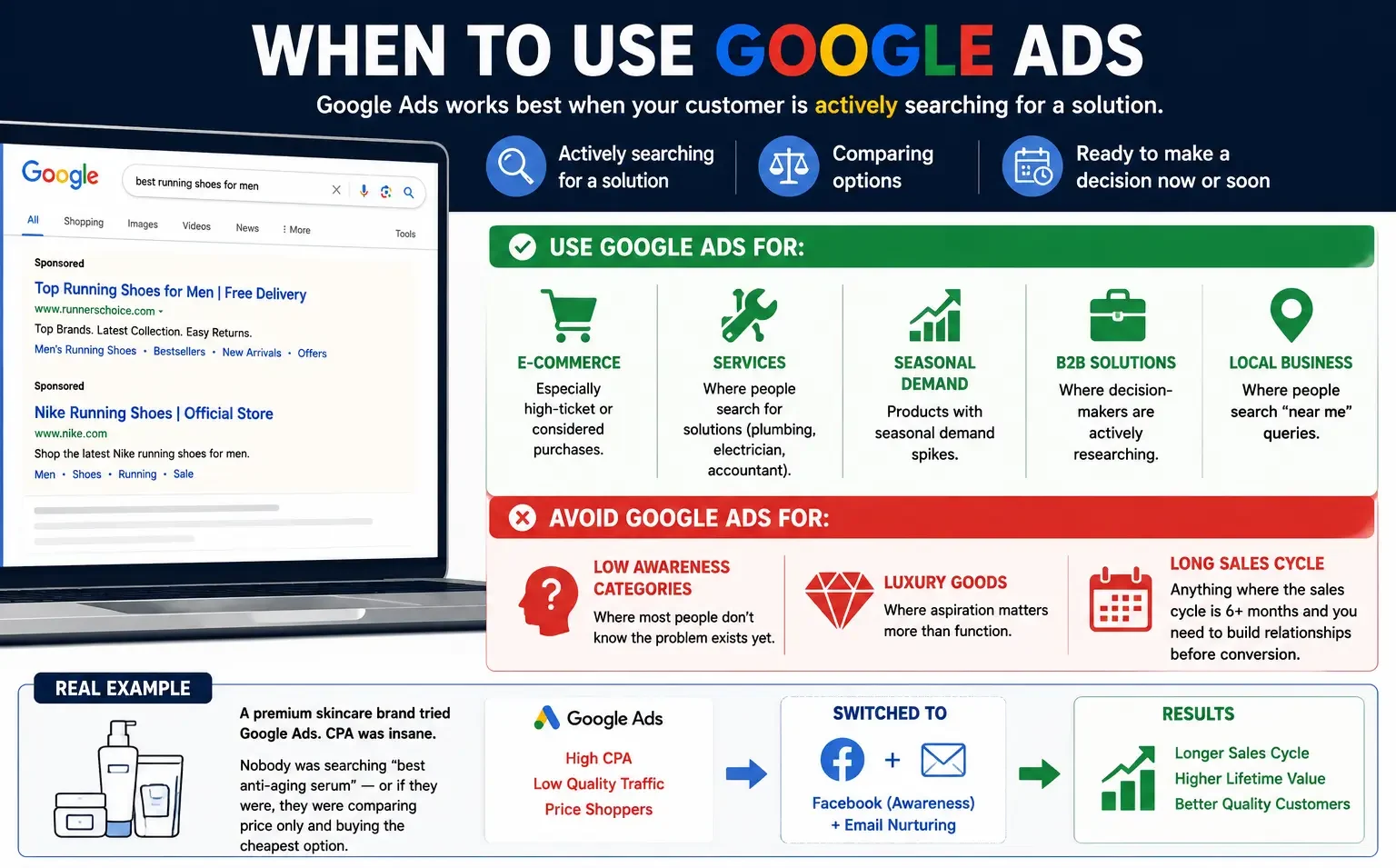
When To Use Google Ads
Your customer is actively searching for a solution. They’re comparing options. They’re ready to make a decision now or very soon.
Use Google Ads for:
- E-commerce (especially high-ticket or considered purchases)
- Services where people search for solutions (plumbing, electrician, accountant)
- Products with seasonal demand spikes
- B2B solutions where decision-makers are actively researching
- Local businesses where people search “near me” queries
Avoid Google Ads for:
Low awareness categories where most people don’t know the problem exists yet. Luxury goods where aspiration matters more than function. Anything where the sales cycle is 6+ months and you need to build relationships before conversion.
We had a premium skincare brand try Google Ads. CPA was insane. Nobody was searching “best anti-aging serum” or whatever they were bidding on — or if they were, they were comparing price only and buying the cheapest option.
We switched them to Facebook (visual platform, awareness focus) + email nurturing. Completely different results. Longer sales cycle, but way higher lifetime value.
When To Use Facebook Ads
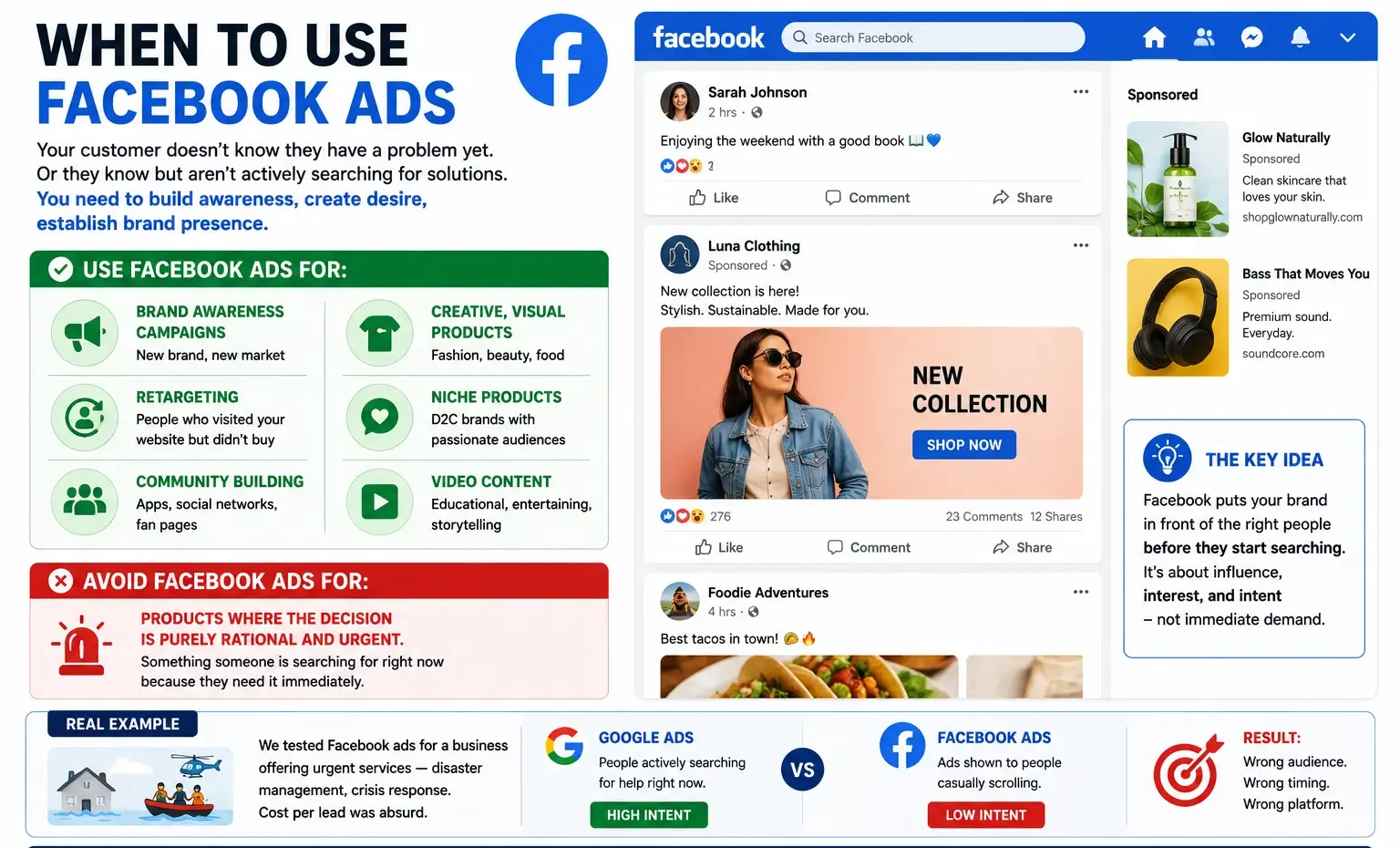
Your customer doesn’t know they have a problem yet. Or they know but aren’t actively searching for solutions. You need to build awareness, create desire, establish brand presence.
Use Facebook Ads for:
- Brand awareness campaigns (new brand, new market)
- Retargeting (people who visited your website but didn’t buy)
- Community building (apps, social networks, fan pages)
- Creative, visual products (fashion, beauty, food)
- Niche products (D2C brands with passionate audiences)
- Video content (educational, entertaining, storytelling)
Avoid Facebook Ads for:
Products where the decision is purely rational and urgent. Something someone is searching for right now because they need it immediately.
We tested Facebook ads for a business offering urgent services — disaster management, crisis response, that kind of thing. Cost per lead was absurd. Google had people actively searching for this help right now. Facebook was showing ads to people casually scrolling.
Wrong audience. Wrong timing. Wrong platform. Knowing how to map platforms to audience intent is part of any solid social media marketing strategy — and Facebook sits squarely in the awareness-to-consideration zone.
Cost Comparison: Which Is Cheaper?
Trick question. Both are cheap and expensive depending on what you’re optimising for.
Facebook usually has a lower cost-per-click. Maybe Rs 5-15 depending on targeting. Google might be Rs 20-100 depending on competition in your keyword.
But cost per click doesn’t matter. Cost per conversion matters.
We’ve run campaigns where Facebook clicks cost 3x less but conversions were 10x lower. So cost per acquisition ended up being higher on Facebook.
We’ve also run campaigns where Google clicks cost more but the person clicking was so close to buying that 50% converted. Facebook clicks were cheap but only 2% converted.
The real cost comparison comes down to ROAS (Return on Ad Spend). What revenue do you generate per rupee spent?
For most e-commerce, we see:
- Google Ads: 2.5-4.5 ROAS (depends on product, margins, competition)
- Facebook Ads: 2-3.5 ROAS (depends on audience saturation, retargeting depth)
But these ranges are useless for your business specifically. You need to test both and measure your own ROAS.
Using Both Platforms Together (The Right Way)
Short answer: yes. Most successful campaigns use multiple channels.
Long answer: you need a strategy for allocating budget across both.
Simple rule of thumb: Allocate budget based on ROAS. If Google is getting 4:1 ROAS and Facebook is 2.5:1, give 70% of budget to Google and 30% to Facebook.
But also consider the sales cycle and customer lifetime value. Maybe Facebook gets lower immediate ROAS but those customers come back more often. In that case, increase Facebook budget because the LTV is higher.
Also — and this is crucial — use Google for immediate sales intent and Facebook for retargeting. Someone doesn’t convert on Google, you retarget them on Facebook. Someone doesn’t convert on Facebook, you retarget on Google.
The customer journey often looks like: Facebook awareness → Google search → purchase.
They see your ad on Facebook, get interested, then search for you or your product type on Google.
If you’re only running Google ads, you’re missing the people who need awareness-building first.
If you’re only on Facebook, you’re missing the high-intent searchers on Google.
The Common Mistakes
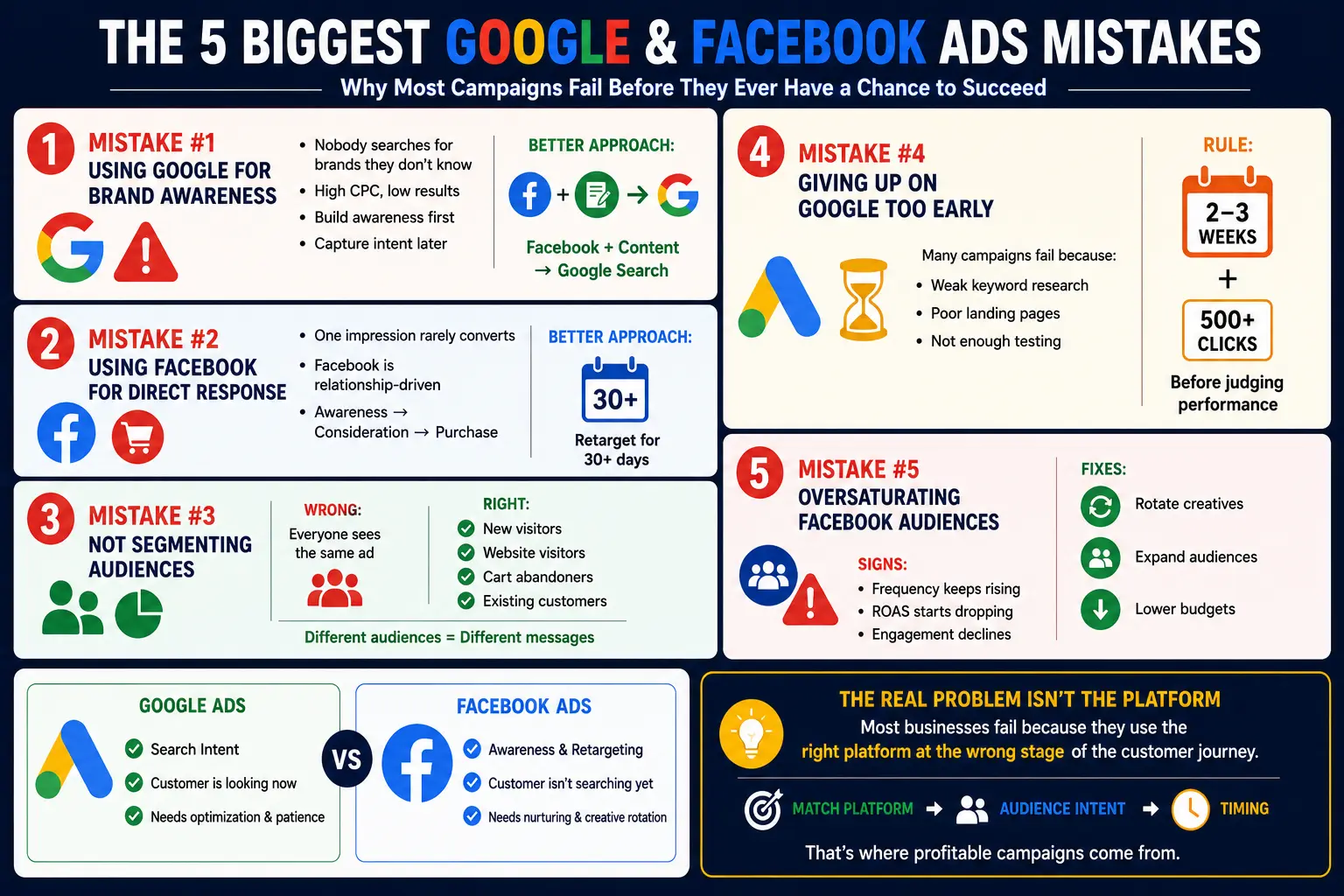
Mistake 1: Using Google for brand awareness. Google is for high-intent searching. If nobody is searching for you, Google will be expensive and ineffective. Start with brand awareness somewhere else (Facebook, content marketing) then use Google to capture intent once people know about you.
Mistake 2: Using Facebook for direct response. Facebook works best with a 30-day retargeting cycle. If you’re trying to sell something immediately with one ad impression, you’re fighting the platform. Facebook wants you to build relationships and nurture over time.
Mistake 3: Not segmenting audiences. A customer who visited your website but didn’t buy is different from someone who’s never heard of you. Yet most people run the same ad to both. Segment. Use different messages for different audience states.
Mistake 4: Giving up too early on Google. Google campaigns need keyword research, landing page optimization, and testing to work. They don’t just print money immediately. Give it at least 2-3 weeks and 500+ clicks before deciding it’s not working.
Mistake 5: Oversaturating Facebook audiences. Facebook audiences are finite. Keep scaling and you’ll show the same ad to the same person until they’re sick of it. Rotate creatives, expand audiences, or lower budget before ROAS collapses.
What About Other Platforms? LinkedIn? TikTok?
Short answer: yes, they exist.
LinkedIn is essential for B2B because that’s where decision-makers hang out. But it’s also expensive — cost per click can be Rs 50-200+. Only worth it if your sales are high-ticket. Only worth it if your sales are high-ticket. We’ve broken down exactly how to make it work in our LinkedIn marketing strategy for B2B guide.
TikTok is growing but audiences are young (under 25 mostly in India) and the platform is more entertainment-focused. Good if you’re selling to Gen Z, weird if you’re selling to corporate buyers.
YouTube is good for video and long-form content. Instagram is now basically Facebook (same owner, same algorithm). Twitter is hit-or-miss depending on your audience.
But for most businesses starting out — B2C or B2B — Google and Facebook are the two that matter most.
The Real Question You Should Be Asking
Not “which platform is better?”
But “where is my customer in their buying journey and which platform reaches them at that moment?”
Google reaches the person actively searching for a solution. Facebook reaches them before they know they need it. LinkedIn reaches them in a professional context. YouTube reaches them watching content.
Perfect strategy? Use all of them, but allocate budget based on where your customer actually is.
We had a B2B client spending 90% of budget on Facebook trying to sell enterprise software. Terrible ROI. We shifted budget to LinkedIn, added Google PPC, and suddenly their ROAS tripled. Same product. Different platforms matched to where the buyer actually was.
That’s the real advantage: knowing your customer’s decision-making process and using each platform for the stage of that journey where it actually works.
How To Decide For Your Business (Practical Steps)
Step 1: Ask yourself — do people actively search for what I sell? If yes, Google matters. If no, Google is probably a waste.
Step 2: Ask — are there visual/lifestyle elements to my product? If yes, Facebook/Instagram matters. If no (like industrial equipment), maybe not.
Step 3: Test both with a small budget. Rs 1,000 on Google, Rs 1,000 on Facebook. Run for 1 week. Measure ROAS.
Step 4: Allocate remaining budget based on which platform delivered better results.
Step 5: Set up retargeting on both platforms so you’re not losing money on people who showed interest but didn’t convert.
That’s it. Don’t overthink it.
| Approach | Best for | Watch out for |
|---|---|---|
| DIY | Small teams, tight budgets | Slow ramp-up, trial-and-error |
| Freelancer | Specific project bursts | Inconsistency, limited ownership |
| Agency | Ongoing work, senior input | Higher retainer, less control |
Quick checklist before you start:
- Define the one thing you want: leads, sales, awareness — pick one.
- Baseline your numbers: write down where you are today.
- Pick a 90-day window: nothing moves in 2 weeks.
- Agree on success metrics: with whoever is paying the bill.
- Set up proper tracking: GA4, UTMs, call tracking.
- Review monthly: kill what doesn’t work, double down on what does.
The Bottom Line
If you take one thing from this: google ads vs facebook ads which platform is better for you rewards patience and specificity, not volume or clever tricks. Start small, measure honestly, fix what breaks, and compound what works. The brands doing this well in India aren’t smarter — they’re just consistent. Need a hand with this for your business? Talk to us.
Not Sure Which Platform Is Right for Your Business?
We’ve managed both Google Ads and Facebook Ads for 250+ brands. We’ll audit your specific situation and tell you exactly where your marketing dollars should go.
FAQs
-
Is Google Ads better than Facebook Ads?
Ans.Neither. Google Ads is better if your customers are actively searching for solutions (high intent). Facebook is better if you are building awareness or retargeting. Different jobs, different tools. We have seen e-commerce brands get 8x better ROI on Google because they were selling high-intent products. And we have seen B2B SaaS get crushed on Google but thrive on LinkedIn. So the real answer is: it depends entirely on how and when your customers are ready to buy. -
Which is cheaper?
Ans.Facebook tends to have lower cost-per-click but lower conversion rates. Google has higher cost-per-click but people are actively looking for what you sell. We have run campaigns where Facebook was 3x cheaper per click but Google was 2x cheaper per conversion. Cost per click is meaningless — cost per conversion matters. -
Can I run both simultaneously?
Ans.Yes, absolutely. In fact, we recommend it if you have the budget. Google for immediate sales intent, Facebook for retargeting and awareness. The challenge is managing budgets smartly — do not just split 50-50. Test each platform separately, see which gives better ROAS, then allocate accordingly. Usually something like 60% to the stronger performer and 40% to the other.
Author Details

Latest Posts
-
 07 / Aug
Digital Marketing Digital Marketing for Education: Recruit Students & Fill Programs
07 / Aug
Digital Marketing Digital Marketing for Education: Recruit Students & Fill Programs -
 06 / Aug
Digital Marketing Digital Marketing for E-commerce: Drive Sales & Scale Fast
06 / Aug
Digital Marketing Digital Marketing for E-commerce: Drive Sales & Scale Fast -
 05 / Aug
-
 04 / Aug
-
 03 / Aug
Affiliate Marketing Affiliate Marketing in India: Building a Real Business
03 / Aug
Affiliate Marketing Affiliate Marketing in India: Building a Real Business
Related Knowledge