-
Author: Anindita Barik
-
Updated Date: Sep-28-2026
-
Views: 2 Min Read
Influencer marketing in India is no longer just about choosing creators with large follower counts. Brands need to look at audience quality, engagement, content fit, campaign goals, and measurable results. This guide covers nano, micro, and macro influencers, ASCI disclosure rules, barter and paid collaborations, fake follower checks, campaign briefs, content formats, tracking, and ROI. It also explains how regional creators and smaller communities can help brands reach relevant audiences and turn influencer campaigns into measurable business results.
You’ve probably sent out fifty DMs to influencers this month. No responses. Or worse — the “influencer” has 500k followers but zero engagement. Sound familiar?
Influencer marketing in India is broken. Not the concept. The execution. Everyone’s chasing vanity metrics, no one’s checking if the followers are real, and half the deals never ship working content. I’ve seen brands spend 80 lakhs on a campaign that moved zero product.
So what actually works? The answer isn’t glamorous. It’s boring stuff: knowing the difference between a nano influencer and a macro one, understanding ASCI rules before you post, spotting fake accounts in 30 seconds, and measuring with data that actually matters.
Why Most Brands Get Influencer Marketing Wrong
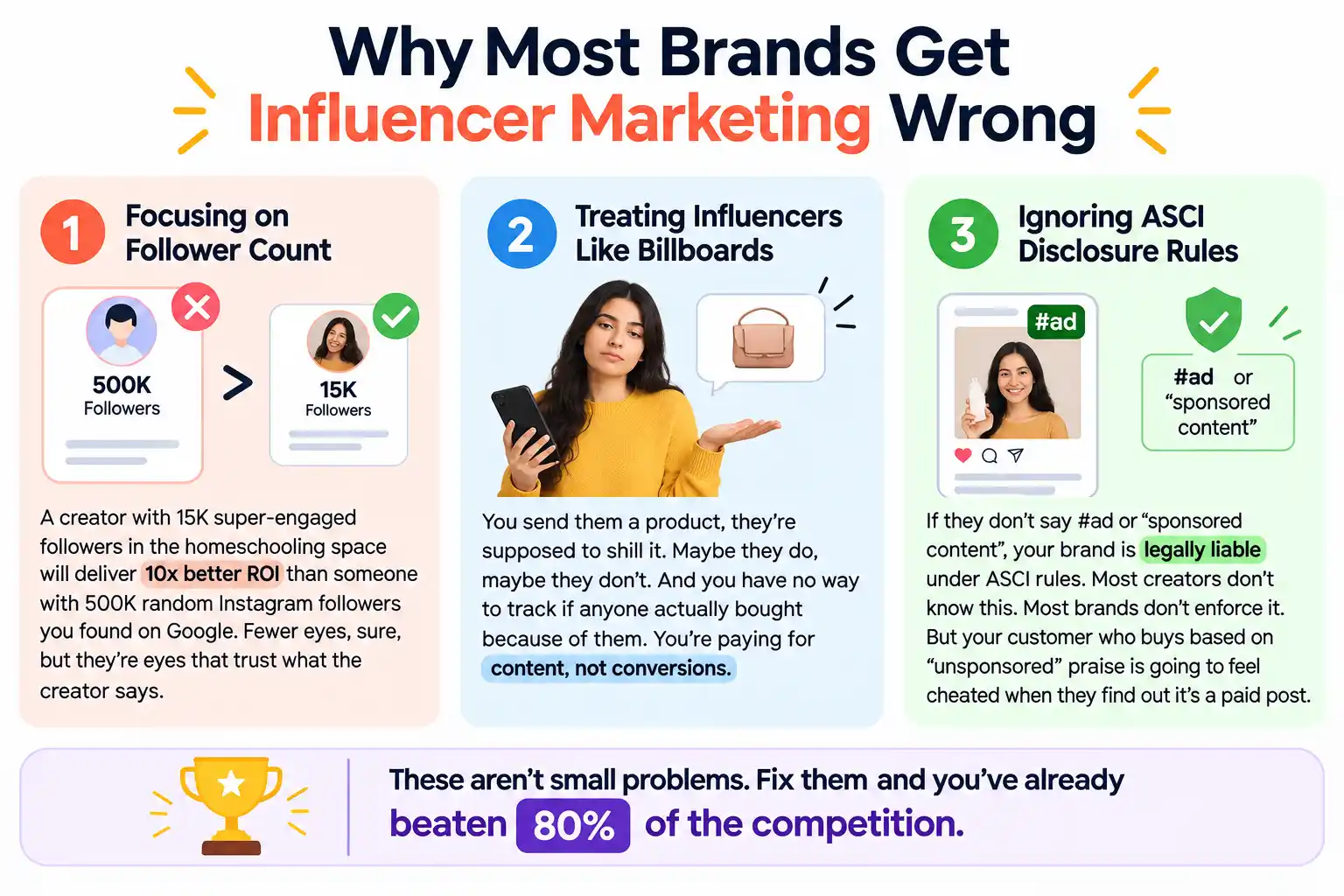
The biggest mistake? You think bigger follower count = bigger reach. Actually, that’s backwards. A creator with 15k super-engaged followers in the homeschooling space will deliver 10x better ROI than someone with 500k random Instagram followers you found on Google. Fewer eyes, sure. But they’re eyes that trust what the creator says.
Second mistake: treating influencers like billboards. You send them a product, they’re supposed to shill it. Maybe they do, maybe they don’t. And you have no way to track if anyone actually bought because of them. You’re paying for content, not conversions.
Third? You’re not following ASCI rules. If they don’t say #ad or “sponsored content”, your brand is legally liable. Most creators don’t know this. Most brands don’t enforce it. But your customer who buys based on “unsponsored” praise is going to feel cheated when they find out it’s a paid post.
These aren’t small problems. Fix them and you’ve already beaten 80% of the competition. For a broader view of how influencer marketing fits into a complete channel strategy, our influencer marketing service page covers how we structure campaigns from brief to measurement.
These aren’t small problems. Fix them and you’ve already beaten 80% of the competition.
Nano vs. Micro vs. Macro: Which One Actually Works for You
Let me break this down because there’s real money riding on this choice.
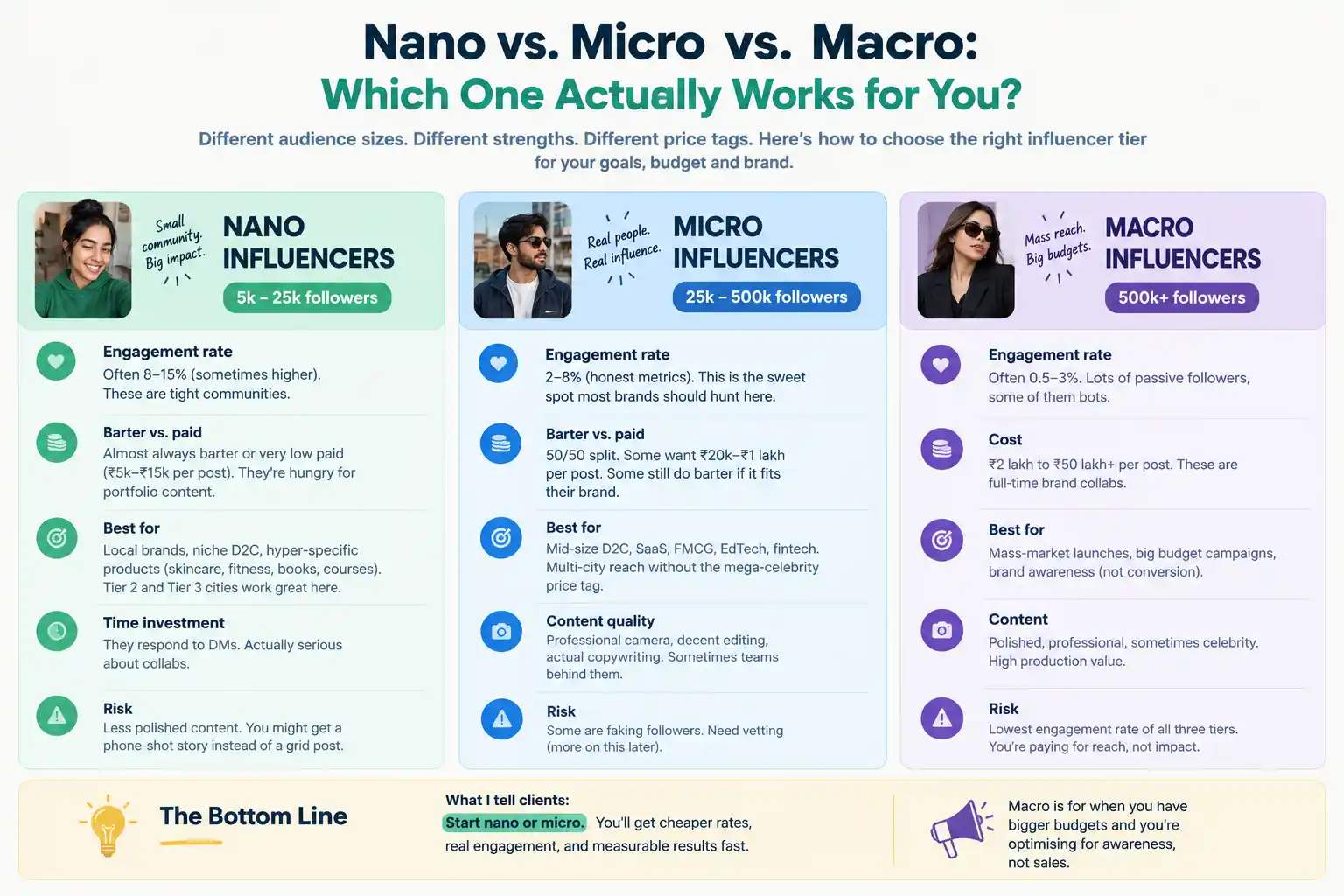
Nano influencers (5k–25k followers)
- Engagement rate: Often 8–15% (sometimes higher). These are tight communities.
- Barter vs. paid: Almost always barter or very low paid (~₹5k–₹15k per post). They’re hungry for portfolio content.
- Best for: Local brands, niche D2C, hyper-specific products (skincare, fitness, books, courses). Tier 2 and Tier 3 cities work great here.
- Time investment: They respond to DMs. Actually serious about collabs.
- Risk: Less polished content. You might get a phone-shot story instead of a grid post.
Micro influencers (25k–500k followers)
- Engagement rate: 2–8% (honest metrics). This is the sweet spot most brands should hunt here.
- Barter vs. paid: 50/50 split. Some want ₹20k–₹1 lakh per post. Some still do barter if it fits their brand.
- Best for: Mid-size D2C, SaaS, FMCG, EdTech, fintech. Multi-city reach without the mega-celebrity price tag.
- Content quality: Professional camera, decent editing, actual copywriting. Sometimes teams behind them.
- Risk: Some are faking followers. Need vetting (more on this later).
Macro influencers (500k+ followers)
- Engagement rate: Often 0.5–3%. Lots of passive followers, some of them bots.
- Cost: ₹2 lakh to ₹50 lakh+ per post. These are full-time brand collabs.
- Best for: Mass-market launches, big budget campaigns, brand awareness (not conversion).
- Content: Polished, professional, sometimes celebrity. High production value.
- Risk: Lowest engagement rate of all three tiers. You’re paying for reach, not impact.
What I tell clients: Start nano or micro. You’ll get cheaper rates, real engagement, and measurable results fast. Macro is for when you have bigger budgets and you’re optimising for awareness, not sales.
The ASCI Rule: Don’t Get Your Brand Sued
The Advertising Standards Council of India (ASCI) has one rule that most creators and brands ignore: disclose when content is sponsored.
No #ad? No “In association with”? That’s a violation. Your brand can get fined. More importantly, customers feel deceived. Brands that don’t enforce ASCI disclosures lose trust fast.
Also, check which platform the creator uses. Instagram Stories, Reels, and feed posts all have slightly different ASCI language. TikTok and YouTube have their own rules. If you’re working with regional language creators (Hindi, Tamil, Telugu, Kannada), they often don’t know ASCI exists. Train them. Seriously.
One retainer client we worked with saved ₹5 lakhs in legal trouble by just asking their creators upfront, “Who’s handling ASCI compliance?” The ones who answered confidently were safe. The ones who looked confused got swapped out. This is the same brand protection principle behind strong brand identity design — every external touchpoint, including sponsored content, reflects on your brand’s credibility.
Barter vs. Paid: What Gets You Real Content
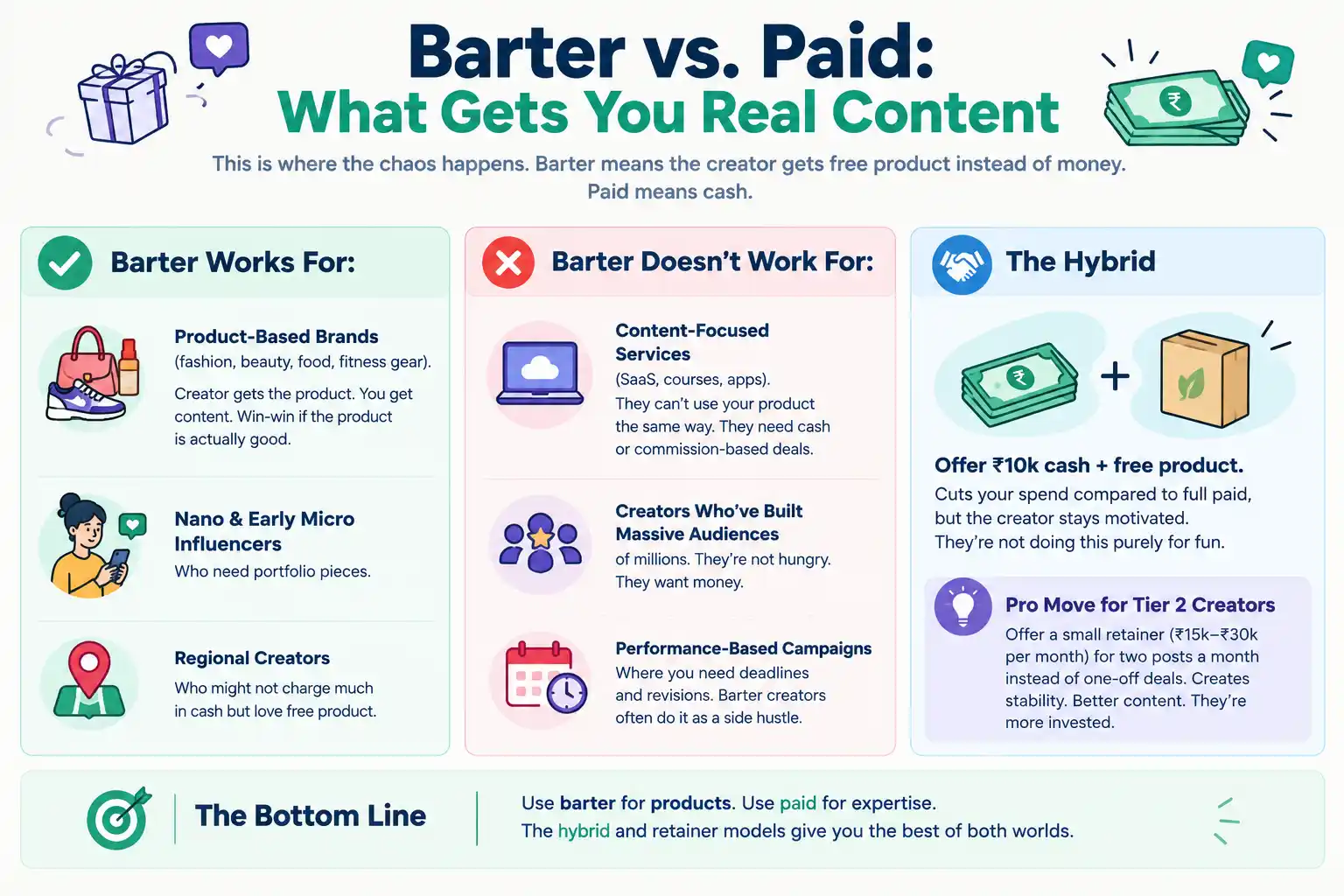
This is where the chaos happens. Barter means the creator gets free product instead of money. Paid means cash.
Barter works for:
- Product-based brands (fashion, beauty, food, fitness gear). Creator gets the product. You get content. Win-win if the product is actually good.
- Nano and early micro influencers who need portfolio pieces.
- Regional creators who might not charge much in cash but love free product.
Barter doesn’t work for:
- Content-focused services (SaaS, courses, apps). They can’t use your product the same way. They need cash or commission-based deals.
- Creators who’ve already built an audience of millions. They’re not hungry. They want money.
- Performance-based campaigns where you need deadlines and revisions. Barter creators often do it as a side hustle.
The hybrid: Offer ₹10k cash + free product. Cuts your spend compared to full paid, but the creator stays motivated. They’re not doing this purely for fun.
Pro move for Tier 2 creators: offer a small retainer (₹15k–₹30k per month) for two posts a month instead of one-off deals. Creates stability. Better content. They’re more invested.
How to Spot Fake Followers in 60 Seconds
Real talk: 40% of accounts you’ll pitch to have fake followers. Maybe bots, maybe from sketchy growth services. You won’t catch all of them. But here’s a quick filter.
Look for these red flags:
- 500k followers but 200 likes per post. The math doesn’t work. (Real engagement rate: divide likes by follower count. Should be at least 1%.)
- Comments that are generic: “Great photo! 😍😍😍” from accounts with no profile picture. Bots.
- Sudden spikes in follower count. Check their Instagram every month for three months. If they gained 100k followers in a month, someone bought them.
- All followers from one country or region that doesn’t match their content.
- Audience demographics in their Insights (if they share) look weird. 50k followers but 90% from Bangladesh? Check the content. If it’s Hindi content, that’s sus.
Use HypeAuditor or Social Blade (free version) to spot this stuff. Takes 30 seconds.
But here’s the uncomfortable truth: sometimes the brand themselves is choosing aesthetically pleasing fakes over boring real audiences. Fake followers look clean. Real followers are messier, sometimes mean, post random stuff in comments. If your metric is “looks good in a deck”, fakes win. If your metric is “actually converts”, real wins. This is exactly what what agencies hide about performance marketing covers — vanity metrics that look good in reports but don’t connect to actual business outcomes.
The Brief That Actually Gets You Good Content
Bad brief: “Post about our product. Use fun captions. Make it viral.”
Good brief: Here’s what matters.
- What message do we want? (Be specific: “We help startups hire faster” not “We’re awesome”)
- What format? (Reel, static post, carousel, story — creators will miss this otherwise)
- Where should they link? (Product page, landing page, discount code?)
- Any visuals we’re providing? (Give them assets. Don’t make them guess.)
- What’s the timeline? (Shoot date, post date. Three weeks minimum.)
- How many revisions? (Usually 2, max 3.)
- ASCI disclosure requirement — mandatory.
- Budget and payment terms.
This is boring stuff. Spreadsheet-level boring. But it’s the difference between getting a half-assed post and something that actually converts.
One more thing — and this sounds weird, but it works: Tell them why. “We’re launching this because it solves X problem. Here’s who we’re trying to reach.” Creators do better work when they understand the ‘why’. It stops being transactional.
Reels vs. Static Posts: Which Actually Converts
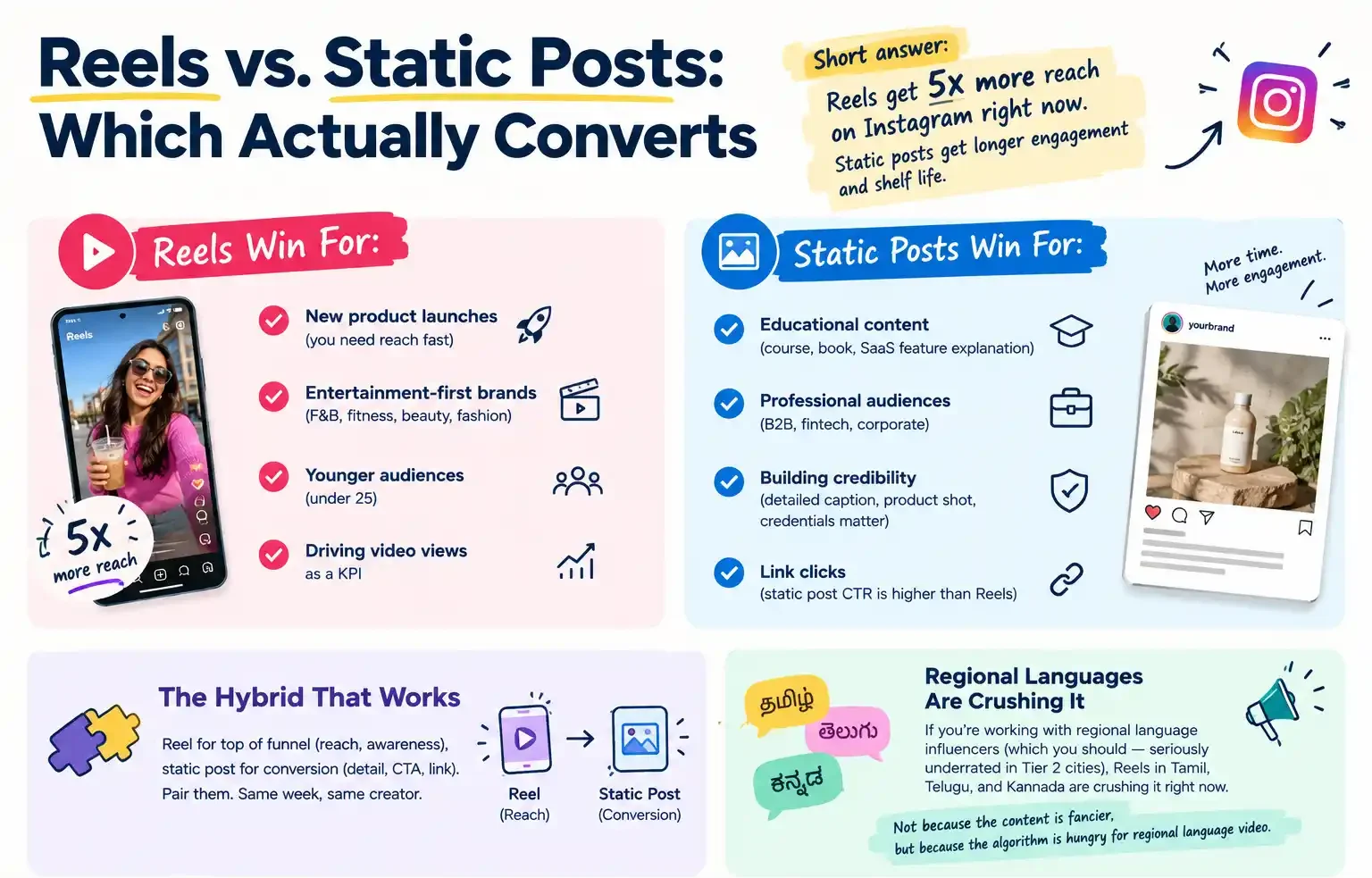
Short answer: Reels get 5x more reach on Instagram right now. Static posts get longer engagement and shelf life.
Reels win for:
- New product launches (you need reach fast)
- Entertainment-first brands (F&B, fitness, beauty, fashion)
- Younger audiences (under 25)
- Driving video views as a KPI
Static posts win for:
- Educational content (course, book, SaaS feature explanation)
- Professional audiences (B2B, fintech, corporate)
- Building credibility (detailed caption, product shot, credentials matter)
- Link clicks (static post CTR is higher than Reels)
Here’s the hybrid that works: Reel for top of funnel (reach, awareness), static post for conversion (detail, CTA, link). Pair them. Same week, same creator.
And if you’re working with regional language influencers (which you should be — seriously underrated in Tier 2 cities), Reels in Tamil, Telugu, and Kannada are crushing it right now. Not because the content is fancier, but because the algorithm is hungry for regional language video.
Measuring ROI: Stop Counting Vanity Metrics
This is the part where most brands lie to themselves.
“That Reel got 50k views! Massive win!” Except no one bought anything. Fifty thousand views means fifty thousand eyes for a second. Not fifty thousand potential customers.
What to measure instead:
- Click-through rate to your product or landing page. (Use UTM links. Every influencer gets a unique parameter so you know who sent the traffic.)
- Conversion rate from click to purchase. (Highest bar. This is what matters.)
- Cost per acquisition. (Campaign spend ÷ customers acquired. If you spent ₹2 lakh and got 10 customers, cost per acquisition is ₹20k. Is your lifetime customer value higher than that? If yes, win.)
- Repeat purchases from influencer traffic. (Check your CRM or backend. Did those customers buy again?)
- Discount code redemptions, if you gave them one. (Actually tangible ROI.)
The trick: You need proper UTM tracking and analytics setup before you run the campaign. Set it up first. Track it after. Compare to your baseline (what’s your normal conversion rate without influencer traffic?). That’s your ROI.
One client jumped to a 3x ROAS (return on ad spend) when they switched from counting “likes” to counting “sales from UTM links.” Suddenly the campaigns looked different. They cut micro influencers with high vanity metrics but low conversions. They doubled down on nano influencers with lower reach but higher conversion.
Common Influencer Marketing Scams (And How to Avoid Them)
Know what you’re risking. These happen all the time.
- The no-delivery: You pay upfront for a Reel, they disappear. Contract with specific dates and a refund clause. Milestone-based payments (50% upfront, 50% on delivery).
- The ghost post: They post it, then delete it after three hours because they’re worried it’ll hurt their “aesthetic”. You get zero reach. Ask for 72-hour minimum post time in writing.
- The fake engagement: They boost their numbers right before pitching you. Their engagement drops after you sign. Use Social Blade to check their follower and engagement history for the past 6 months.
- The over-delivered comment section: They post, then their friends (or fake accounts) spam it with likes and comments to inflate the metrics you see. Real accounts have natural comment velocity. If a post gets 1k likes in 10 minutes, something’s off.
- The resell: They promise exclusive content. You pay. They repurpose the exact same post for five other brands. Hard to prove, but if you see them using almost identical captions or shots for competitors, walk away.
Okay, that last one’s actually not a scam — it’s just lazy. But it means your content isn’t special. Insist on custom creative or walk.
| Approach | Best for | Watch out for |
|---|---|---|
| DIY | Small teams, tight budgets | Slow ramp-up, trial-and-error |
| Freelancer | Specific project bursts | Inconsistency, limited ownership |
| Agency | Ongoing work, senior input | Higher retainer, less control |
Quick checklist before you start:
- Define the one thing you want: leads, sales, awareness — pick one.
- Baseline your numbers: write down where you are today.
- Pick a 90-day window: nothing moves in 2 weeks.
- Agree on success metrics: with whoever is paying the bill.
- Set up proper tracking: GA4, UTMs, call tracking.
- Review monthly: kill what doesn’t work, double down on what does.
The Bottom Line
If you take one thing from this: influencer marketing india rewards patience and specificity, not volume or clever tricks. Start small, measure honestly, fix what breaks, and compound what works. The brands doing this well in India aren’t smarter — they’re just consistent. Need a hand with this for your business? Talk to us.
Need help with influencer marketing in india?
Connect with the right influencers to reach your target audience, build brand awareness, and drive meaningful engagement. Our influencer marketing experts help you plan and manage campaigns that deliver measurable results.
FAQs
-
What's the difference between ASCI compliance and FTC disclosure?
Ans.ASCI is India-specific. FTC is US law. If your audience is India-first, follow ASCI (#ad, "Sponsored by", "In association with"). If you're also selling to the US, add FTC language too (#ad is technically sufficient for both, but read ASCI guidelines directly). The ASCI website has detailed rules per platform. -
How much should I budget for influencer marketing in India?
Ans.Nano: ₹5k–₹20k per post (often barter). Micro: ₹20k–₹1 lakh per post. Macro: ₹2 lakh–₹50 lakh+ per post. Start with 3–5 micro influencers at ₹30k–₹50k each per month. That's ₹90k–₹2.5 lakh for a test. Measure ROI over 60–90 days before scaling. If cost per acquisition is lower than your lifetime value, expand. -
Should I work with celebrities or micro influencers?
Ans.Celebrities = brand awareness, low engagement, high cost. Micro influencers = conversions, real engagement, lower cost. If you're optimising for sales, micro wins. If you're optimising for brand recognition, celebrity wins. Most SMBs should start micro. Test, measure, then expand to macro if ROI supports it. -
How do I know if an influencer's audience is real?
Ans.Check: (1) Engagement rate (likes + comments ÷ followers). Should be 1–10% depending on niche. (2) Comment quality — real people leave real comments, not emoji spam. (3) Follower growth history on Social Blade — steady is good, spikes are bad. (4) Audience composition — if it matches their content topic and geographic location, good. (5) Follower-to-follow ratio — if they follow 2 lakh accounts but have 50k followers, they're bot-fishing. -
What's a good ROI for influencer marketing?
Ans.Minimum: 2x (spend ₹1 lakh, make ₹2 lakh). Good: 3–5x. Excellent: 5x+. But this depends on your product margin and repeat purchase rate. A D2C brand selling ₹5k products can afford higher CPA than a SaaS company with ₹500 plans. Calculate your LTV first. Then work backwards to your acceptable CPA. That's your target. -
Should I negotiate fees with influencers?
Ans.Yes, but tactfully. Nano and micro influencers almost always negotiate. Macro influencers rarely do. If they say ₹1 lakh, you can ask, "Can we do ₹75k plus product?" Most will say yes. If they're firm, respect it — pushing hard destroys the relationship. For long-term retainers (3+ months), you get 10–20% discount versus one-off posts. Always ask. -
What metrics should I track in my influencer campaign?
Ans.UTM-tracked clicks, conversion rate, cost per acquisition, customer lifetime value, repeat purchase rate, discount code redemptions. Ignore: likes, comments, reach, impressions (vanity metrics). These don't tell you if anyone bought. Focus on traffic and sales. Everything else is noise. -
How long should I wait before judging ROI?
Ans.60–90 days minimum. Some creators' audiences are slow to convert. Some take time to trust before buying. Don't kill a campaign after one week. Also, seasonal products (festival, summer, back-to-school) need seasonal timeframes. Give every creator fair runway before deciding. -
Can I do influencer marketing on a small budget?
Ans.Absolutely. Start with nano influencers in your niche. ₹2k–₹10k per post. Get 5–10 of them. Spend ₹50k–₹1 lakh total. Measure conversions. If it works, you've proved the model cheaply. Most of my best-performing campaigns started with 10 nano influencers, not one macro influencer. Yaar, scale is overrated. Precision is better.
Author Details

Latest Posts
-
 29 / Sep
Marketing Marketing Attribution Models Explained
29 / Sep
Marketing Marketing Attribution Models Explained -
28 / Sep
Influencer Marketing Influencer Marketing in India: What Really Works
-
 24 / Sep
GMB Optimisation Google Business Profile Optimization Guide 2026
24 / Sep
GMB Optimisation Google Business Profile Optimization Guide 2026 -
 23 / Sep
Search Engine Optimization Programmatic SEO: Template + Data Model Explained
23 / Sep
Search Engine Optimization Programmatic SEO: Template + Data Model Explained -
 22 / Sep
Conversion Rate Optimization Conversion Rate Optimization: A Practical Guide
22 / Sep
Conversion Rate Optimization Conversion Rate Optimization: A Practical Guide