-
Author: Anindita Barik
-
Updated Date: Sep-29-2026
-
Views: 2 Min Read
Marketing attribution models help businesses understand which marketing channels contribute to conversions across the customer journey. From last-click and first-click to linear, time-decay, position-based, and data-driven attribution, each model assigns conversion credit differently. Choosing the right marketing attribution model can reveal the real impact of Google Ads, social media, organic search, email, and other channels. This guide explains how attribution works, compares popular models, covers MTA and MMM, and shares practical steps for selecting an attribution approach for small business marketing.
You spent Rs 50,000 on Google Ads last month. Got 10 conversions. Paid Rs 5,000 per conversion. Sounds clean, right? Wrong. That math only works if every customer found you through one channel, one day, boom — conversion. Reality is messier. Someone sees your Instagram ad on Tuesday, clicks. Forgets about it. Comes back via Google Search on Friday, and completes the purchase. Which channel actually “owns” that sale?
That question is attribution — the core of all marketing attribution models, yaar. And your answer changes everything about where you spend money next. (Seriously. Your entire budget logic depends on getting this right.)
This is also why how to measure digital marketing ROI is so foundational — without solving attribution first, your ROI calculations will always be pointing you in the wrong direction.
Why Attribution Actually Matters
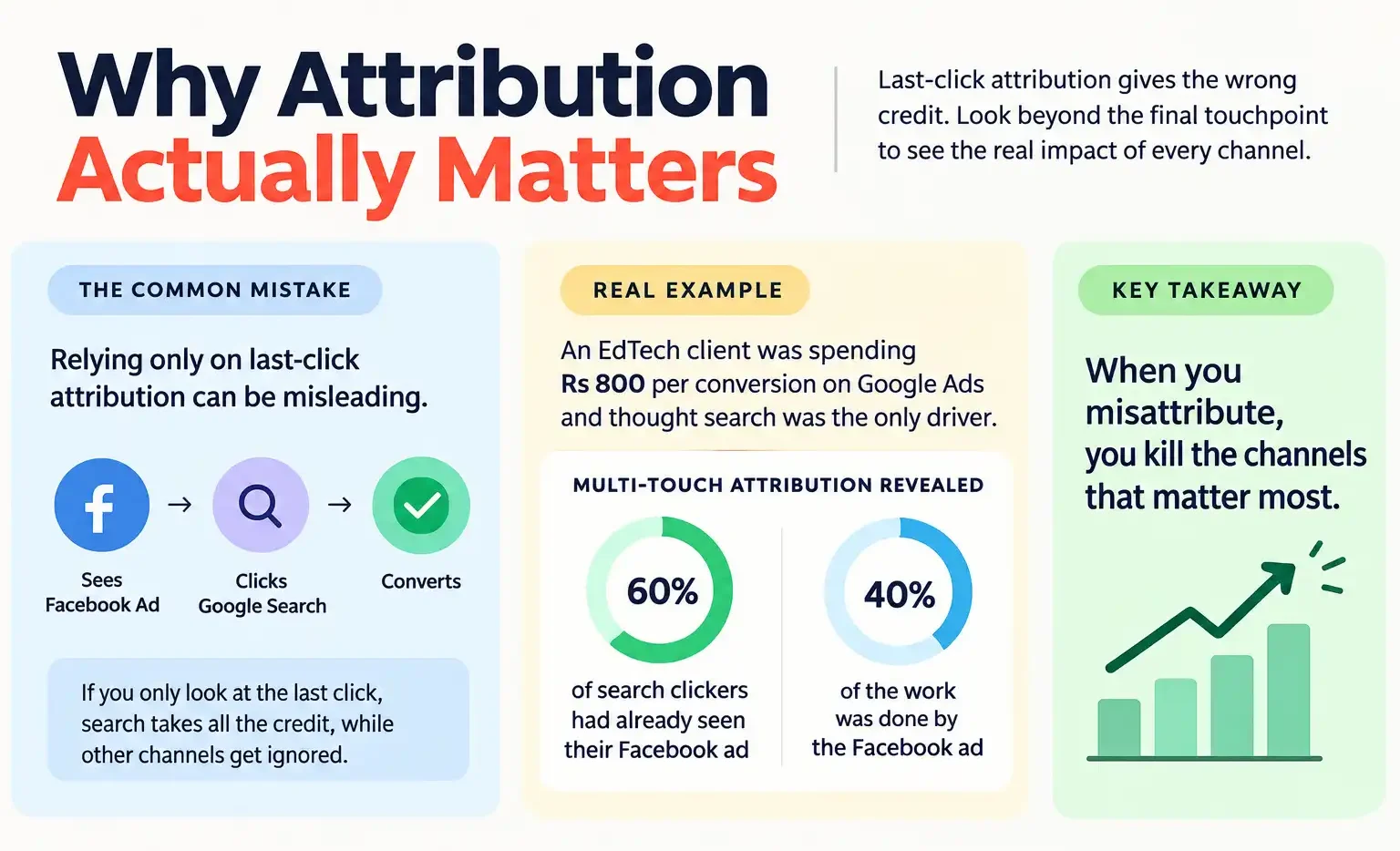
Most Indian SMBs think about this wrong. They look at Google Analytics, see last-click attribution, and assume the last touchpoint deserves all the credit. Makes sense on the surface. But it destroys strategy. You end up over-paying for clicks that close, while ignoring channels that warm people up.
An EdTech client we worked with was bleeding money on search. They saw conversion cost at Rs 800 in Google Ads. Seemed expensive. Pulled up Google Analytics. Every conversion last-clicked through search. Made sense to shift budget from social to search, right? We didn’t. Instead, we looked at multi-touch attribution. Turned out 60% of search clickers had already seen their Facebook ad first. The Facebook ad did 40% of the work. But last-click gave it zero credit.
When you misattribute, you kill the channels that matter most. This is exactly the failure mode we describe in fixing a backwards digital marketing strategy — brands that optimise based on broken attribution end up starving the channels doing the real work while over-investing in the ones just taking the last bow.
The Last-Click Trap (And Why It’s Still Everywhere)
Last-click attribution is default in Google Analytics. It’s simple: whichever channel the customer used last before converting gets 100% credit. Everything else? Ignored. It’s like giving all the medals to the strikers in a soccer game and none to the midfielders.
Why do people use it? Bas, it’s easy. You can set it up in five minutes. The data is instant. No messy calculations. But here’s the problem — last-click wildly overvalues bottom-of-funnel channels (mostly paid search) and destroys the story for top-of-funnel (social, display, organic content).
On a small budget, this is catastrophic. You cut social. Social stops. Awareness drops. Search clickers disappear. Everyone thinks search stopped working. Actually, you starved the funnel. This is the same funnel collapse we cover in how to build a marketing funnel that converts — when you remove top-of-funnel channels because attribution isn’t crediting them, the entire funnel quietly breaks downstream.
Use it as a starting point only. Don’t make budget decisions on it alone.
First-Click: The Opposite Problem
Some teams overcorrect. They flip to first-click attribution — the first touchpoint before any journey gets 100% credit. This time, social looks amazing. Display looks amazing. Organic looks amazing. And search looks dead.
It’s just as wrong. First-click ignores the entire consideration phase. A customer might see a brand awareness ad (first click), think about you for two weeks, then search for you by name (last click). The search was a decision channel, not an intro channel. Both matter. But first-click hides that.
First-click works best for full-funnel campaigns (like app installs) where that initial tap is genuinely the entire journey. For anything with multiple touchpoints, skip it.
Linear Attribution: The Middle Ground That Fails Quietly
Linear attribution splits credit evenly. Five touchpoints? Each gets 20% credit. Sounds fair. Actually, it’s lazy. Not all touchpoints are equal. The first brand awareness ad shouldn’t get the same credit as the final reminder email.
Use linear only if you have multiple channels, no real data science chops, and need something better than last-click fast. Otherwise, it’s just guessing with more steps.
Time-Decay Models: Getting Closer
This one makes intuitive sense. Recent touchpoints matter more than old ones. Most common is a 40-20-40 split (first click 40%, middle touchpoints 20%, last click 40%). Or 50-25-25. Variations exist.
Why? Because recency usually signals relevance. That search click five minutes before purchase probably matters more than the display ad three weeks back. But here’s the catch: you’re still guessing at the weights. Different businesses, different products, different customer psychology — thoda tweaking required. What works for a SaaS free trial won’t work for a jewelry brand with a 6-month consideration cycle.
Time-decay is better than linear. But you need testing and iteration. Most small teams just apply a template.
Position-Based (U-Shaped) Attribution
Here’s the practical one: give 40% credit to first touch, 40% to last touch, and split the middle 20% among everything in between. The logic — awareness and conversion matter. Middle-funnel is nice, but those two are what count.
For SMBs? This usually works well. A D2C brand we worked with in Sector V, Kolkata shifted from last-click to U-shaped. Suddenly they saw social’s contribution surge (because it was picking up first-click credit). They rebalanced budget. Turns out social had been doing way more work. Revenue didn’t change. But cost per acquisition dropped 12%.
Why? Because they stopped cutting social to feed search. The funnel stayed full.
MTA vs MMM and the Cookieless Future
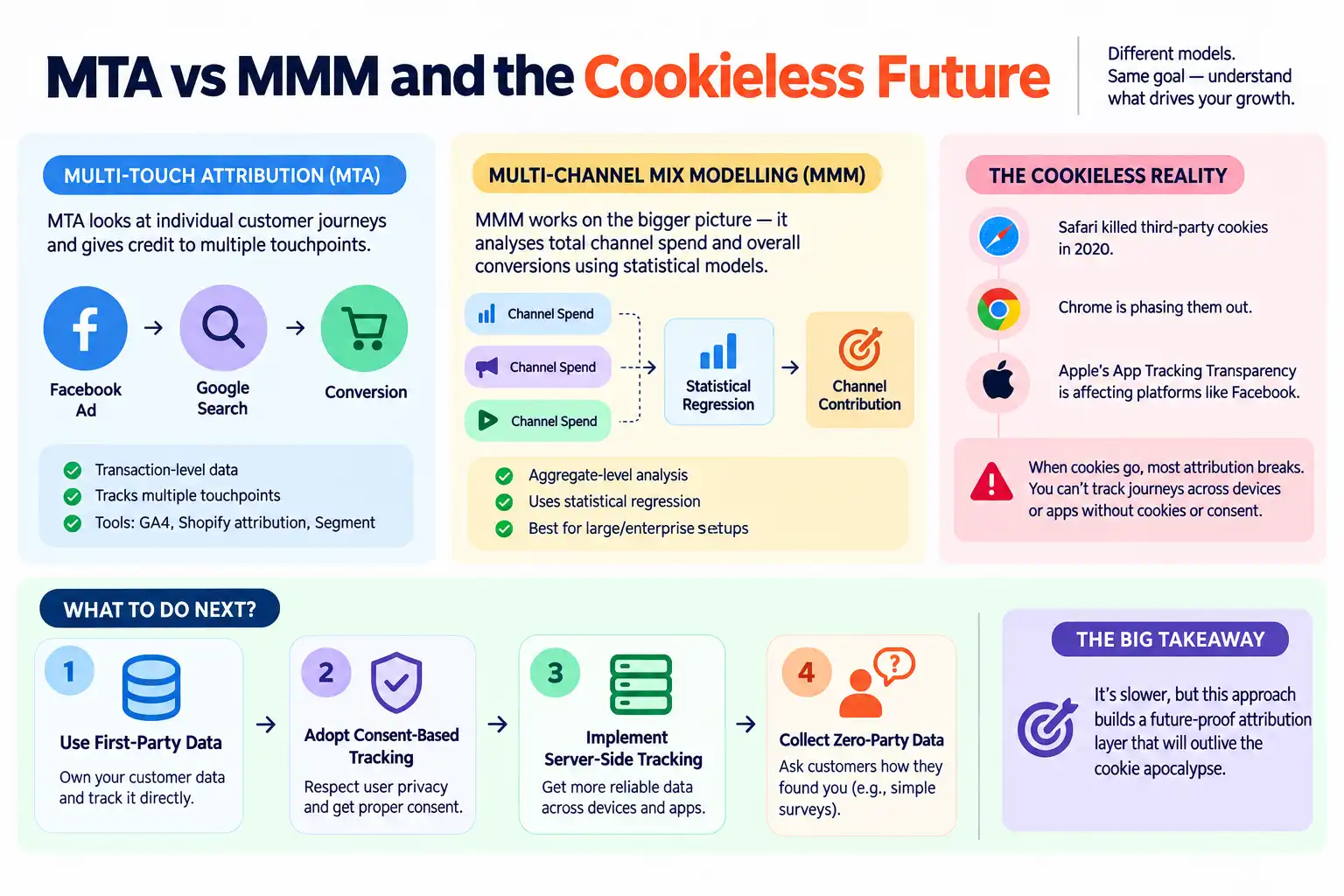
Quick terminology: Multi-Touch Attribution (MTA) is what we’ve been discussing. It’s transaction-level. One customer, one journey, multiple touches. GA4, Shopify attribution, Segment all do MTA. Multi-Channel Mix Modelling (MMM) is different — it’s aggregate. You feed in overall channel spend and overall conversions, then use statistical regression to estimate each channel’s contribution.
For an Indian SMB? Start with MTA (GA4 or your platform’s native tool). MMM is enterprise stuff.
Here’s the uncomfortable truth — third-party cookies are dying. Safari killed them in 2020. Chrome’s following suit. Apple’s App Tracking Transparency broke Facebook attribution. When cookies go, most attribution breaks. You can’t track journeys across devices or apps without cookies or consent.
So what? Brands are moving toward first-party data, consent-based tracking, and server-side implementation. GA4 introduced some built-in modelling for missing data. But honestly, small teams need to start collecting zero-party data now — ask customers how they found you. Simple surveys. That becomes your new attribution layer. It’s slower. But it’ll outlive the cookie apocalypse.
Here’s the uncomfortable truth — third-party cookies are dying. Safari killed them in 2020. Chrome’s following suit. Apple’s App Tracking Transparency broke Facebook attribution. When cookies go, most attribution breaks. You can’t track journeys across devices or apps without cookies or consent.
So what? Brands are moving toward first-party data, consent-based tracking, and server-side implementation. GA4 introduced some built-in modelling for missing data. But honestly, small teams need to start collecting zero-party data now — ask customers how they found you. Simple surveys. That becomes your new attribution layer. It’s slower. But it’ll outlive the cookie apocalypse.
How to Actually Pick One (When Your Budget Is Small)
You have Rs 2 lakhs a month to spend across Google Ads, Facebook, and content. Here’s what to do. First month? Use last-click. Set a baseline. It’s wrong, but you need a number.
Second month? Jump to U-shaped (position-based). Compare the two. Do socials look suddenly more valuable? Yes? That’s because they actually are. You were just hiding their impact.
Third month? If you’re consistently above 500 conversions monthly, enable GA4’s data-driven attribution model. Google’s DDA uses machine learning to calculate weights based on your actual conversion data. It learns which touchpoint sequences actually convert, and weights them accordingly. Give it a month to learn. Compare it to U-shaped. If the weights feel sane (social isn’t suddenly 70% of everything, search isn’t suddenly 5%), start adjusting budget based on it. If weights look crazy, your volume’s too low or your funnel is broken. You can read more about how GA4 approaches this in Google’s official attribution documentation.
This isn’t overthinking. This is the only way to stop leaving money on the table. Most teams pick one model and pray. You’re better than that.
| Approach | Best for | Watch out for |
|---|---|---|
| DIY | Small teams, tight budgets | Slow ramp-up, trial-and-error |
| Freelancer | Specific project bursts | Inconsistency, limited ownership |
| Agency | Ongoing work, senior input | Higher retainer, less control |
Quick checklist before you start:
- Define the one thing you want: leads, sales, awareness — pick one.
- Baseline your numbers: write down where you are today.
- Pick a 90-day window: nothing moves in 2 weeks.
- Agree on success metrics: with whoever is paying the bill.
- Set up proper tracking: GA4, UTMs, call tracking.
- Review monthly: kill what doesn’t work, double down on what does.
The Bottom Line
If you take one thing from this: marketing attribution models rewards patience and specificity, not volume or clever tricks. Start small, measure honestly, fix what breaks, and compound what works. The brands doing this well in India aren’t smarter — they’re just consistent. Need a hand with this for your business? Talk to us.
FAQs
-
What's the best attribution model for e-commerce?
Ans.U-shaped (position-based). E-commerce funnels usually need awareness + conversion. Linear or time-decay works second. Last-click should stay in GA4 as a comparison baseline only — never your primary decision metric. Data-driven comes third if you have 500+ monthly conversions. -
Does attribution matter if I'm only using one channel?
Ans.No. If you're spending only on Google Ads or only on Facebook, attribution is noise. You're measuring pure channel ROI, not attribution. Once you layer in two or more channels, attribution matters. Multi-channel is where the magic (and the confusion) happens. -
Can I use GA4's native attribution tools or do I need a third-party platform?
Ans.GA4's free tools are good enough for SMBs. You get multiple models, data-driven attribution once volume hits, and conversion paths. Third-party tools (like Triple Whale, Littledata, or advanced MMM) add sophistication but cost money. Only move if you're splitting budget across 5+ channels or want predictive modelling. -
Why do all my attribution numbers look different in different tools?
Ans.Different tools use different tracking methods, assumptions, and data sources. GA4 won't match Shopify, which won't match Segment. That's normal. Pick one as your source of truth and stick with it for quarter-over-quarter comparisons. Consistency matters more than perfection. -
If cookies are dying, how do I do attribution in 2026?
Ans.Start collecting first-party data. Implement GA4 with server-side tracking. Use consent-based tracking properly. Feed customer feedback into your models (email them post-purchase asking "how did you find us?"). It's slower, but it survives the cookie apocalypse. Avinash Kaushik's written about this thoroughly — his blog covers the transition. -
Should I use different models for different campaigns?
Ans.Yes. A brand awareness campaign should lean toward first-click or linear. A remarketing campaign should lean toward last-click. A nurture sequence? Time-decay. But at the account level, stick to one primary model to avoid flip-flopping budget week to week. Use secondary models for insight only. -
What's a "good" cost per acquisition after accounting for attribution?
Ans.Depends on your margin. If you make 50% gross margin per sale, your CPA needs to be below that 50%. But once you fix attribution, you usually find your real CPA is lower than you thought (because you were overvaluing last-click channels). Suddenly, campaigns that looked unprofitable become viable. That's the real win. -
Can I test attribution models on a small sample of traffic?
Ans.Not usefully. Attribution models need weeks of data to stabilize. Test them on a full quarter minimum. Run two models in parallel (last-click vs U-shaped, for example), track which one makes better predictions, then shift. Don't A/B test models — run them alongside each other and compare outcomes over time. -
Why does my boss trust last-click even though I've explained it's wrong?
Ans.Because it's simple. And it makes one channel look like a hero. That feels good in a board meeting. But you're leaving money on the table. Do this: run U-shaped for one month, show the impact on social spend, then model what would happen if you'd cut social before. Show the counterfactual. The business logic usually wins after that.
Author Details

Latest Posts
-
29 / Sep
Marketing Marketing Attribution Models Explained
-
 28 / Sep
Influencer Marketing Influencer Marketing in India: What Really Works
28 / Sep
Influencer Marketing Influencer Marketing in India: What Really Works -
 24 / Sep
GMB Optimisation Google Business Profile Optimization Guide 2026
24 / Sep
GMB Optimisation Google Business Profile Optimization Guide 2026 -
 23 / Sep
Search Engine Optimization Programmatic SEO: Template + Data Model Explained
23 / Sep
Search Engine Optimization Programmatic SEO: Template + Data Model Explained -
 22 / Sep
Conversion Rate Optimization Conversion Rate Optimization: A Practical Guide
22 / Sep
Conversion Rate Optimization Conversion Rate Optimization: A Practical Guide
Related Knowledge