-
Author: Anindita Barik
-
Updated Date: Sep-22-2026
-
Views: 2 Min Read
Conversion Rate Optimization (CRO) is the process of improving a website or landing page so more visitors complete desired actions such as purchases, form submissions, bookings, or signups. This practical guide explains how CRO works, from identifying friction points and creating hypotheses to running A/B tests and analysing user behaviour. Learn how heatmaps, session recordings, page speed, copy, mobile UX, CTAs, and trust signals can improve conversions while helping businesses make better use of existing traffic.
Conversion Rate Optimization (CRO) is the process of improving a website or landing page so more visitors complete a desired action, such as making a purchase, submitting a form, booking a call, or signing up. It uses data, user behavior, UX improvements, and testing to identify and remove barriers that prevent conversions.
What is Conversion Rate Optimization?
Conversion rate optimization is the systematic improvement of the percentage of visitors who complete a desired action on your site. That action could be a purchase, a signup, a demo request, or even a newsletter subscription. You measure it as a percentage: (conversions / total visitors) × 100.
If 1,000 people land on your checkout page and 50 buy, your conversion rate is 5%. If you improve that to 75 sales, you’ve jumped to 7.5%. Same traffic. Better returns.
The math is brutal here. A 2% improvement on medium traffic can mean thousands of extra rupees in revenue every month (or millions if you’re e-commerce at scale). That’s why CRO matters more than most founders realise. For a deeper look at CRO in practice with real Indian brand examples, our guide on conversion rate optimisation for Indian businesses covers the full framework from audit to iteration.
Common CRO Myths That Waste Your Time
Before we get into the how, let me kill some bad ideas floating around.
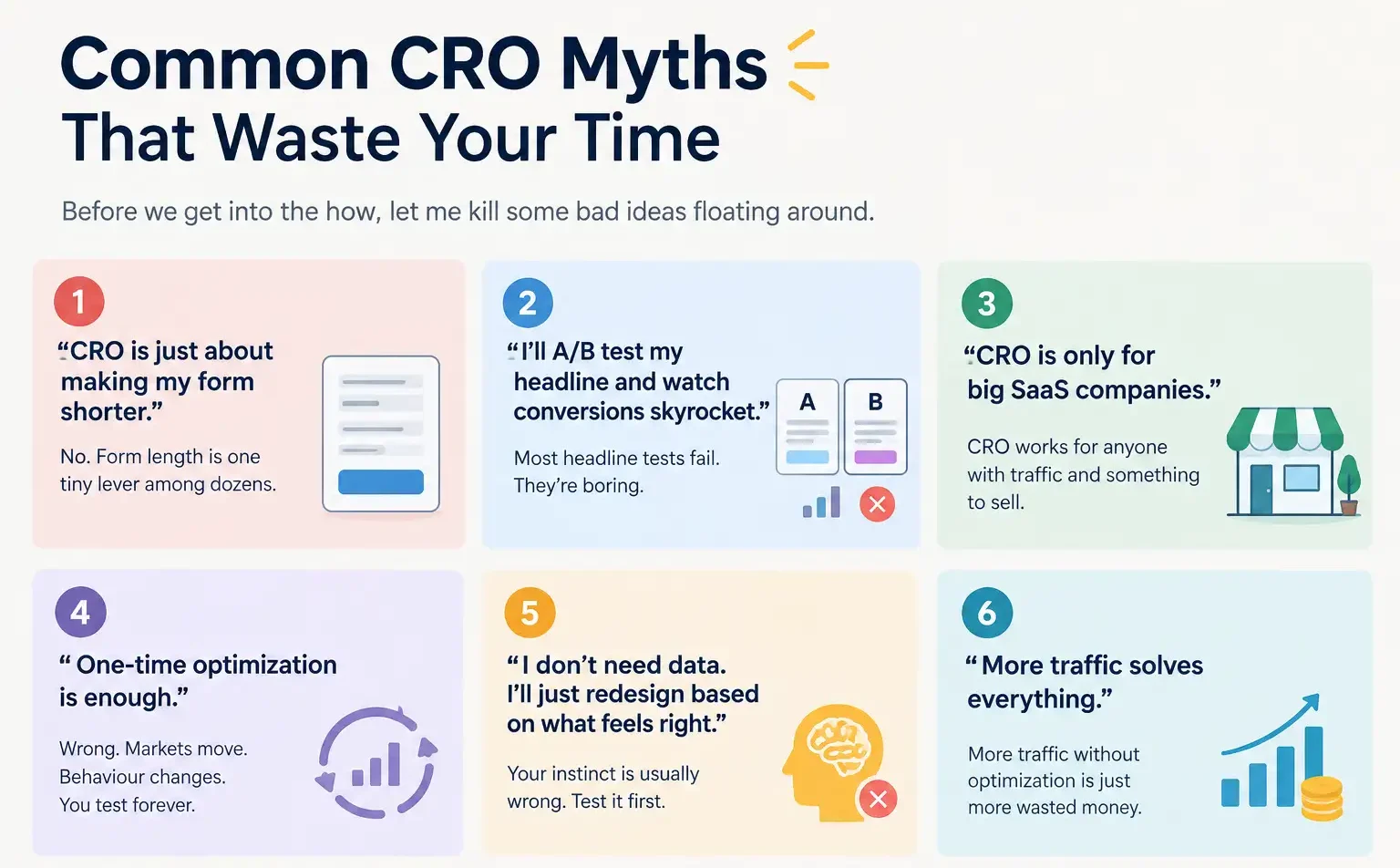
- “CRO is just about making my form shorter.” No. Form length is one tiny lever among dozens.
- “I’ll A/B test my headline and watch conversions skyrocket.” Most headline tests fail. They’re boring.
- “CRO is only for big SaaS companies.” CRO works for anyone with traffic and something to sell.
- “One-time optimization is enough.” Wrong. Markets move. Behaviour changes. You test forever.
- “I don’t need data. I’ll just redesign based on what feels right.” Your instinct is usually wrong. Test it first.
- “More traffic solves everything.” More traffic without optimization is just more wasted money. This is the same misdiagnosis we see constantly — as we cover in fixing a backwards digital marketing strategy, brands that invest in acquisition before fixing conversion are filling a leaking bucket, and the leak always costs more than the fill.
The CRO Formula That Actually Works
Here’s the thing: all CRO starts with a basic formula. Actually, scratch that—it’s not really a formula, more like a mindset you need to adopt before you optimise anything.
Conversion Rate = (Visitors – Friction Points) / Expected Behaviour
Okay, that’s cheesy marketing speak. Real formula is simpler: you need to know your baseline, find the friction, and remove it. That’s it (though there’s a lot of detail in the “remove it” part).
The flow looks like this. You gather data first. Then you form a hypothesis. You test it. You learn. Rinse and repeat until the money stops flowing upward.
The Testing Cycle: Hypothesis → Test → Learn
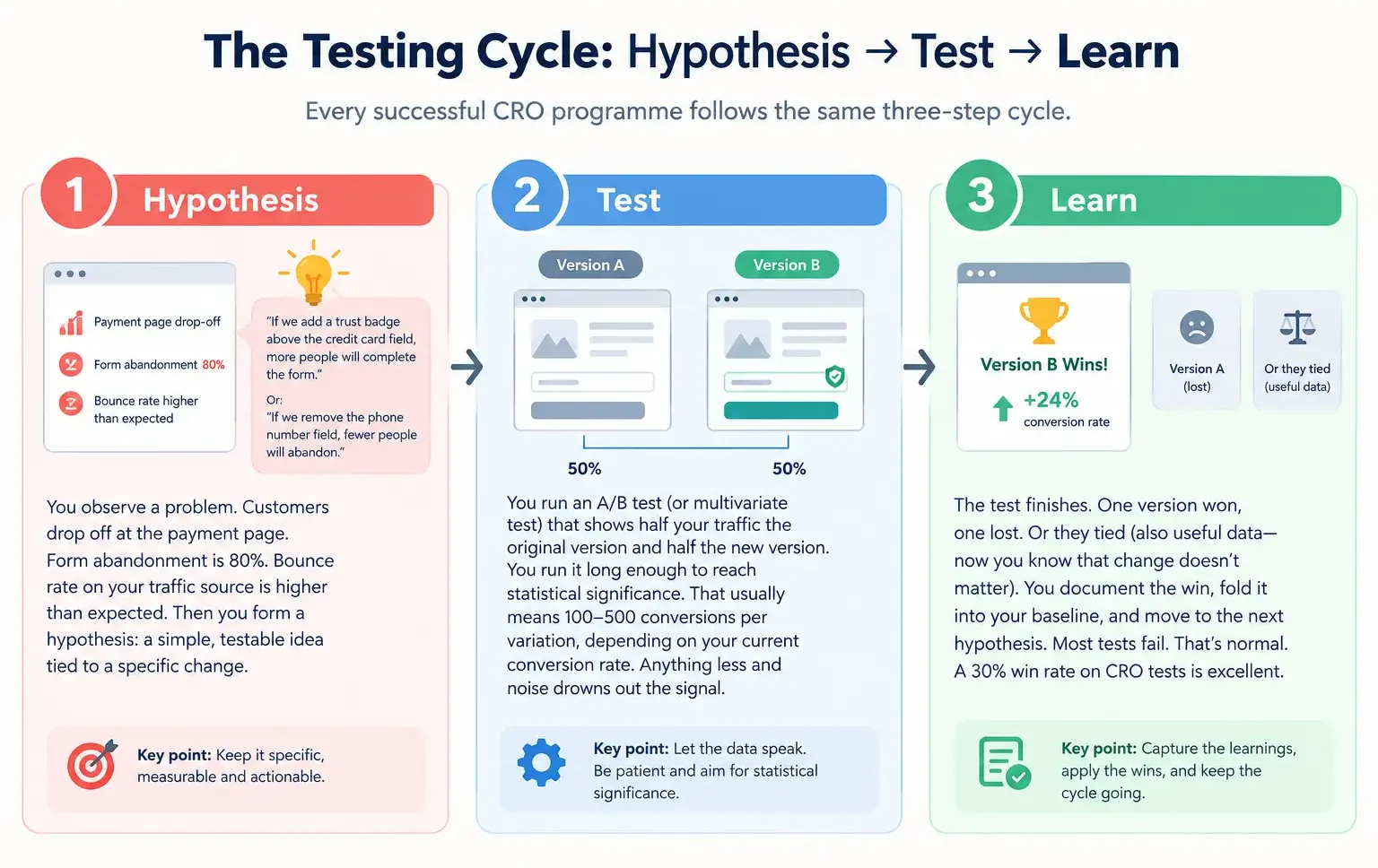
Every successful CRO programme follows the same three-step cycle.
Step 1: Hypothesis
You observe a problem. Customers drop off at the payment page. Form abandonment is 80%. Bounce rate on your traffic source is higher than expected. Then you form a hypothesis: “If we add a trust badge above the credit card field, more people will complete the form.” Or: “If we remove the phone number field, fewer people will abandon.” Simple, testable, tied to a specific change.
Step 2: Test
You run an A/B test (or multivariate test) that shows half your traffic the original version and half the new version. You run it long enough to reach statistical significance. That usually means 100–500 conversions per variation, depending on your current conversion rate. Anything less and noise drowns out the signal.
Step 3: Learn
The test finishes. One version won, one lost. Or they tied (also useful data—now you know that change doesn’t matter). You document the win, fold it into your baseline, and move to the next hypothesis. Most tests fail. That’s normal. A 30% win rate on CRO tests is excellent.
Heatmaps and Session Recordings: Seeing Where People Actually Get Stuck
Data tells you what happened. Heatmaps and session recordings show you why.
A heatmap shows you where people click, hover, and scroll on your page. Red zones = lots of activity. White zones = ghosts. If your best CTA button is white, you know you have a visibility problem. Session recordings let you watch actual users (anonymized) moving through your funnel. You’ll spot things that numbers alone won’t tell you—they’re clicking the wrong thing, they’re confused by your copy, they’re waiting too long for a page to load.
Tools like VWO bundle heatmaps with A/B testing so you can combine behavioral data with test data in one place. Spend an hour watching 10 real sessions. It’s yaar-level insights you won’t get any other way.
A/B Test Gotchas That Trap Most People
Running a test sounds easy. Running a good one is harder than it looks.
- Peeking at results early. You get excited. Conversions are up 15% on day three. So you stop the test. But that could be noise. Run the test to your planned duration even if an early winner looks obvious.
- Testing too many things at once. You change the headline, colour, button text, and copy. Something wins. But which change caused it? You’ll never know. One variable per test.
- Not accounting for seasonal variation. If you test Black Friday promotions in January, your results won’t hold in November. Context matters.
- Sample size too small. You get 23 conversions in the winner and declare victory. Flip a coin 23 times and you’ll see variance. Real significance requires volume.
- Cannibalization across channels. You improve checkout. But now email subscribers convert at a lower rate. Did you actually win overall? You need holistic tracking.
When CRO is Actually a Waste of Your Money
Not every situation calls for CRO work. Here’s when you should skip it.
If you’re running fewer than 1,000 visitors per month through a funnel, testing is noise. You don’t have the volume to reach statistical significance. Instead, go fix the obvious stuff: add trust signals, make your value prop clear, test one big change at a time manually. CRO is a volume game.
If you’re in active product development and the product itself is broken, optimise the product first. Don’t waste engineering cycles on CRO when you’re missing core functionality. If your app crashes on mobile, no CTA button tweak will save you.
If you’re a new brand with zero social proof and high customer acquisition cost, CRO can help but won’t solve your deeper problem. You might need to fix your positioning, your pricing, or your product-market fit first. CRO works best when the fundamentals are sound and you’re squeezing incremental gains from existing traffic.
Real-World CRO Priorities for SMBs
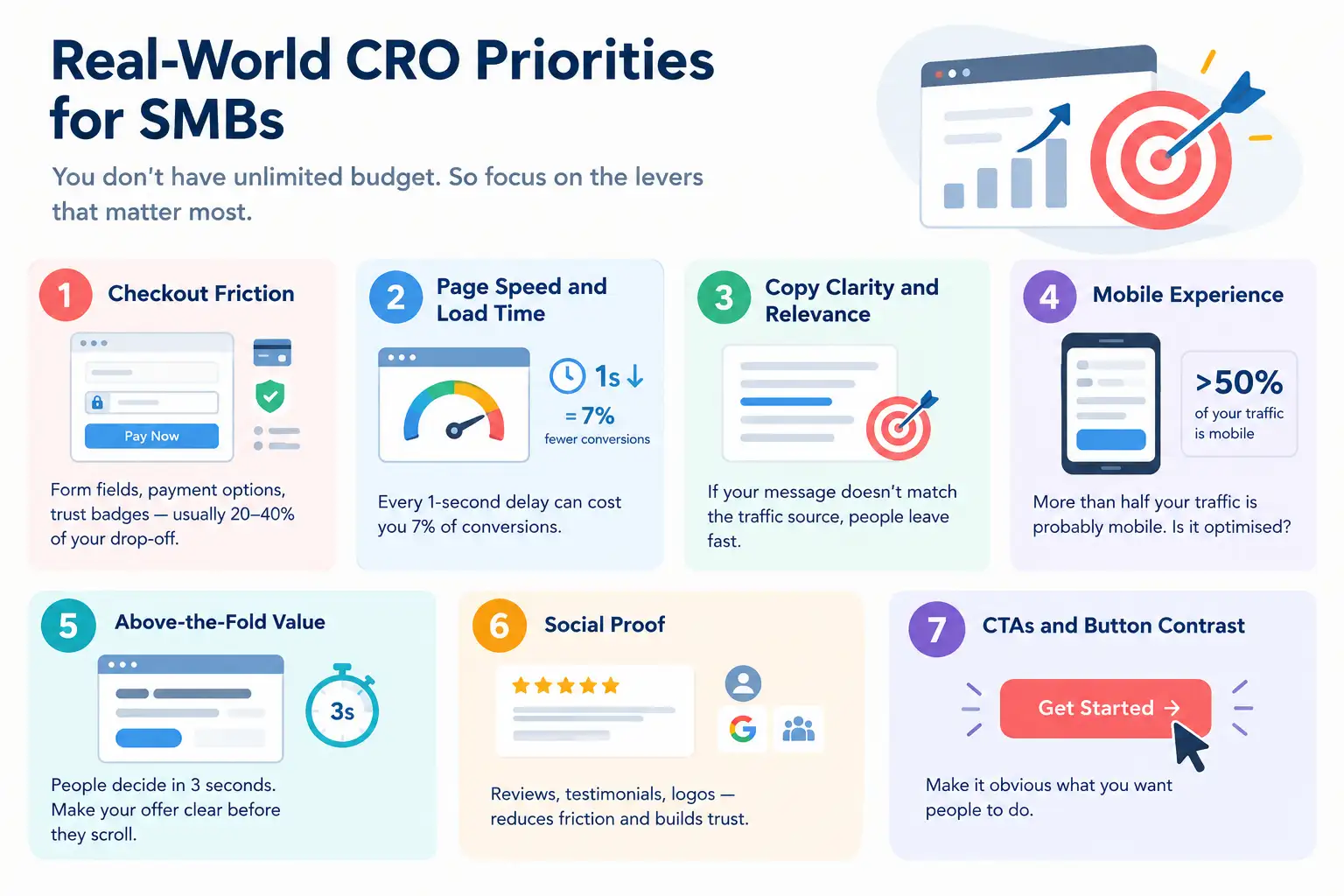
You don’t have unlimited budget. So focus on the levers that matter most.
- Checkout friction (form fields, payment options, trust badges) — usually 20–40% of your drop-off.
- Page speed and load time — every 1-second delay can cost you 7% of conversions. This is covered in detail in our website speed optimisation guide — slow pages hurt conversions directly and also suppress your ad Quality Scores, compounding the damage.
- Copy clarity and relevance — if your message doesn’t match the traffic source, people leave fast.
- Mobile experience — more than half your traffic is probably mobile. Is it optimised?
- Above-the-fold value — people decide in 3 seconds. Make your offer clear before they scroll.
- Social proof (reviews, testimonials, logos) — reduces friction and builds trust.
- CTAs and button contrast — make it obvious what you want people to do.
| Approach | Best for | Watch out for |
|---|---|---|
| DIY | Small teams, tight budgets | Slow ramp-up, trial-and-error |
| Freelancer | Specific project bursts | Inconsistency, limited ownership |
| Agency | Ongoing work, senior input | Higher retainer, less control |
Quick checklist before you start:
- Define the one thing you want: leads, sales, awareness — pick one.
- Baseline your numbers: write down where you are today.
- Pick a 90-day window: nothing moves in 2 weeks.
- Agree on success metrics: with whoever is paying the bill.
- Set up proper tracking: GA4, UTMs, call tracking.
- Review monthly: kill what doesn’t work, double down on what does.
The Bottom Line
If you take one thing from this: conversion rate optimization rewards patience and specificity, not volume or clever tricks. Start small, measure honestly, fix what breaks, and compound what works. The brands doing this well in India aren’t smarter — they’re just consistent. Need a hand with this for your business? Talk to us.
Need help with conversion rate optimization?
Get more value from your existing website traffic. Our CRO experts help identify what’s stopping visitors from converting and make practical improvements that encourage more action.
FAQs
-
What's a "good" conversion rate for my industry?
Ans.It depends. E-commerce typically sees 2–5% conversion rates. SaaS free trials run 10–20%. Lead generation can be 5–15%. Don't chase competitor benchmarks. Track your own baseline and improve it by 10–20% quarter over quarter. That's success. -
How long should an A/B test run?
Ans.At least 2 weeks if you have traffic daily. The first week often has noise from testing artifacts, browser cache, and natural variation. Two weeks gives you weekday and weekend data. If you're testing seasonal or weekly patterns, run longer. Math matters more than calendar—reach your target conversions per variation first. -
Should I test design or copy first?
Ans.Copy. If people don't understand your offer, design won't save you. Test your headline, value prop, and objection-handling copy first. Once that's locked, test design elements like button colour and image placement. Copy is usually 60–70% of the impact anyway. -
Can I use heat maps without running A/B tests?
Ans.Yes, but you'll miss half the insights. Heatmaps show you where the friction is. A/B tests prove which fix works. Use both together. Watch sessions to spot patterns, form a hypothesis, then test it. Data + behaviour = conviction. -
What if my test shows no winner?
Ans.That's data too. It means the change doesn't move the needle. Document it, move on to the next hypothesis. A no-result isn't a failure—it's information. Over time, no-results on low-impact tests help you focus on the levers that actually matter. -
How do I know if I'm ready to hire a CRO agency?
Ans.When you have consistent monthly traffic (5,000+), a clear funnel, and you've already squeezed the obvious optimization wins yourself. If you're doing 500 visitors a month, an agency will cost more than you'll gain. Do CRO internally first, then outsource when you hit scale and need velocity.
Author Details

Latest Posts
-
22 / Sep
Conversion Rate Optimization Conversion Rate Optimization: A Practical Guide
-
 21 / Sep
Whatsapp Marketing WhatsApp Marketing for Indian SMBs
21 / Sep
Whatsapp Marketing WhatsApp Marketing for Indian SMBs -
 19 / Sep
-
 18 / Sep
Google Ads Google Ads Quality Score: Full Breakdown
18 / Sep
Google Ads Google Ads Quality Score: Full Breakdown -
 17 / Sep