-
Author: Anindita Barik
-
Updated Date: Aug-07-2026
-
Views: 2 Min Read
Digital marketing for education is most effective when campaigns align with how parents and students actually make decisions. This article explores admission timelines, Google Search, YouTube, social media, WhatsApp, Local SEO, email nurturing, and performance tracking to help educational institutions generate quality enquiries and increase enrolments. It also explains why outcomes, trust, and consistency matter more than short-term advertising campaigns.
Digital Marketing for Education: Recruit Students & Fill Programs helps schools, colleges, universities, coaching institutes, and edtech brands attract qualified student inquiries through SEO, paid advertising, social media, content marketing, email campaigns, and local search optimization. A data-driven strategy increases visibility where students and parents actively research educational options.
An effective education marketing strategy focuses on the entire enrollment journey—from building awareness and generating leads to nurturing prospects and improving admissions. By targeting the right audience with relevant content and optimized campaigns, institutions can fill programs, reduce student acquisition costs, and achieve sustainable enrollment growth.
The College That Marketed For 18 Months Before Anything Moved
2021. A mid-tier engineering college from Indore. New principal. New vision. They wanted to increase admissions from 120 to 200 students per year. Called us in November saying “We need 80 more students by July.”
That’s… not how education works.
Here’s the actual timeline: a parent’s kid is in Class 11 in November. They’re exploring colleges. Not right now. In March or April when the board exam stress peaks and choices get real. So you’re marketing 5-6 months ahead of the actual decision. Then the college visit happens. Then the application. Then the acceptance. By the time everyone’s enrolled, it’s July-August. So the college needed to have started marketing in the previous August for July admissions. They called in November. They were already three months behind.
We explained this. They didn’t believe us. Wanted quick results anyway.
So we ran an aggressive campaign. YouTube, Google Ads, campus tours, alumni testimonials. Spent Rs 3.5 lakhs December to June. Got 45 enquiries. Maybe 12-15 eventual admissions. They weren’t thrilled. “Digital marketing doesn’t work for education,” they said.
Then something happened. The following year. We ran the same campaign from August onward. Zero changes. Same budget. Same creative. Same channels. That year? 68 enquiries. 52 enrolments. Suddenly it “worked.” It was the timing. This is the same lesson we cover in fixing a backwards digital marketing strategy — investing before you’ve validated timing and audience readiness produces expensive results regardless of how good the creative is.
The difference wasn’t the marketing. It was the timing.
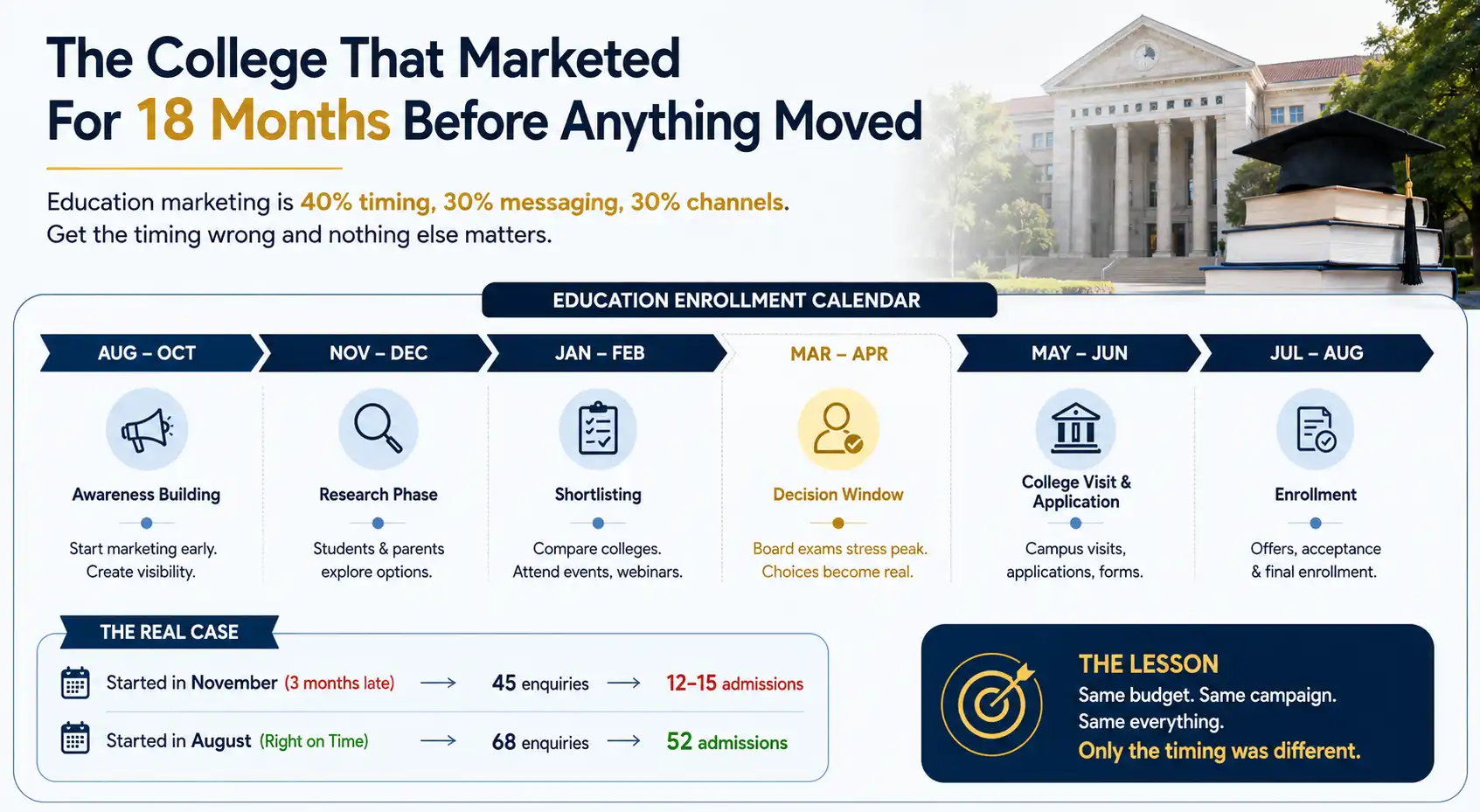
This is the bit nobody talks about. Education marketing success is 40% timing and 30% messaging and maybe 30% channels. Get the timing wrong and nothing else matters.
The Actual Decision Timeline
Here’s what happens with education decisions. Roughly.
- School admissions: Parent starts researching in May-June for September admission. Campus visits in June-July. Applications submitted July-August. Admissions declared August-September. So marketing needs to happen March-May to be effective.
- Board exam coaching: Parent gets worried in September-October of Class 11. Starts coaching search then. Most active research November-December. Admission happens December-January for exams in March-April. Marketing window: August-December.
- JEE/NEET coaching: Parent thinks about this early. Class 11 parents are already researching in July-August. Some even in June. Coaching starts in June-July. Marketing window: April-June, sometimes earlier.
- College admissions: Class 12 parents stress in December-February. Board exams March-April. Result out May-June. But actual college search happens in October-December of Class 11. So you need visibility 12-18 months before enrolment.
- Skill/short courses: Different animal. Someone needs a skill (coding, digital marketing, whatever). They research and decide within 30-90 days. Much faster.
The mistake most institutions make: they think about admissions in April and run campaigns in May-June. But actual decisions were made months earlier. You’re showing up after the decision’s already made.
Parent Psychology vs Student Psychology
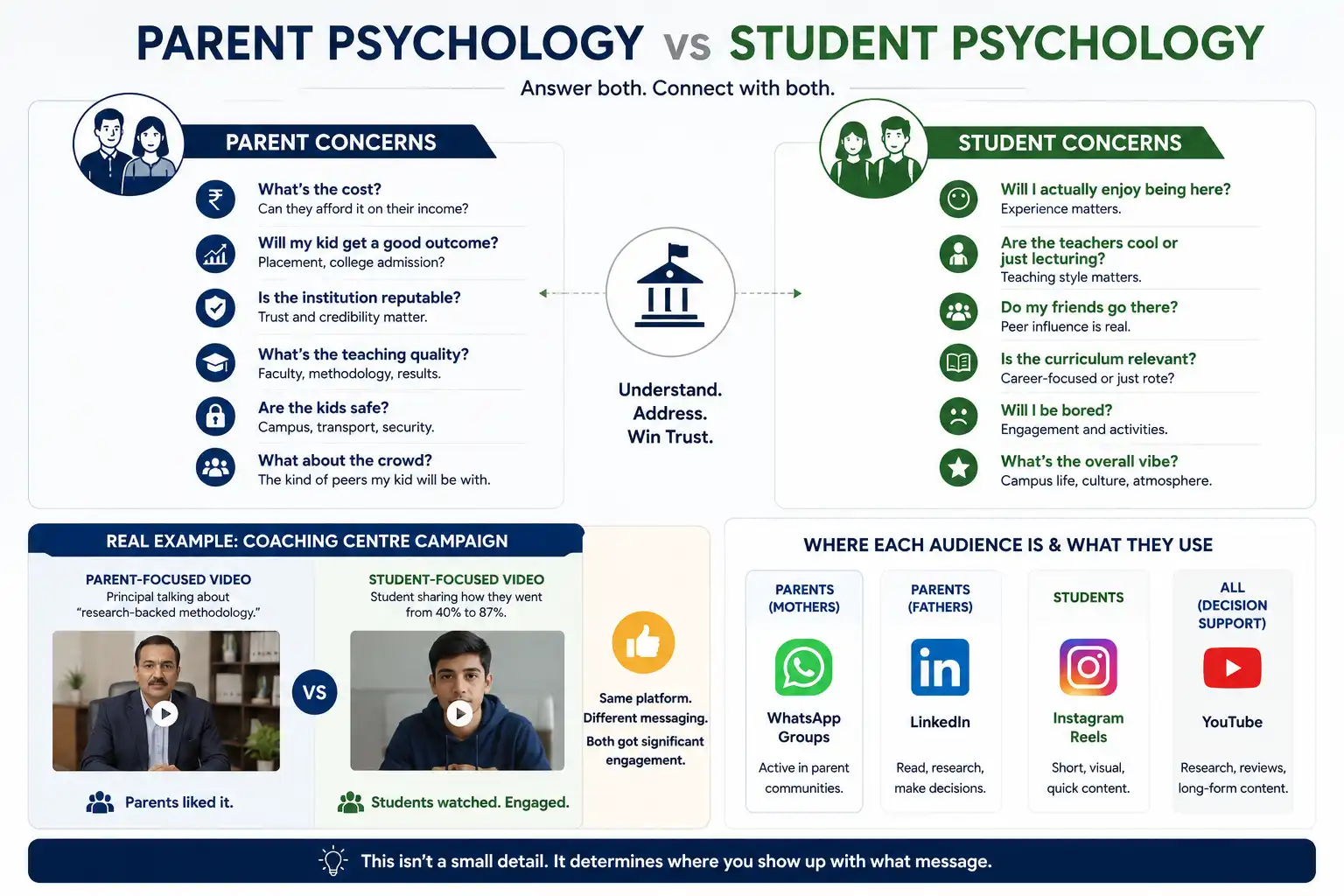
Parents ask different questions than students. And you have to answer both.
Parent concerns: What’s the cost? Will my kid get a good outcome (placement, college admission)? Is the institution reputable? What’s the teaching quality? Are the kids safe? What about the crowd my kid will be with? Can they afford it on their income?
Student concerns: Will I actually enjoy being here? Are the teachers cool or just lecturing? Do my friends go there? Is the curriculum relevant to actual career or just rote? Will I be bored? What’s the overall vibe?
A coaching centre we worked with had this problem. Their testimonial video featured the principal talking about “research-backed methodology.” Parents liked it. Students scrolled past. So we made another video. Student talking about how they went from 40% to 87%. Short, genuine, no jargon. Same platform. Both videos got significant engagement. Different audiences, different messaging needed.
Also — parents are on Google and YouTube. Students are on Instagram and YouTube. Mothers specifically are in WhatsApp groups. Fathers are reading LinkedIn. Younistudents are on Instagram Reels. This isn’t a small detail. This determines where you show up with what message. It’s the same audience-first thinking behind effective social media optimisation — the platform choice should follow the audience, not the other way around.
The Channels That Actually Matter
- Google Search. Someone’s ready to decide. They search “best engineering colleges in Maharashtra” or “JEE coaching centres Pune.” High intent. Cost is higher because everyone bids. But quality is excellent. Use this for decision stage — when someone’s already motivated.
- YouTube. Parents watch campus tours. Students watch alumni success stories. Someone uploads “a day in my life at [college]” and it resonates. YouTube is where education marketing compounds — a good video works for years. Get this right and it drives traffic for 24 months. This is long-term play.
- Facebook / Instagram. Mostly awareness for parents. They’re not actively searching but you can target them based on behaviour. Parents of teens, high income, certain interests. Ads show up, build familiarity. Then when they search Google, they remember you. This is top-of-funnel work.
- Google My Business. Nobody talks about it but — local search matters. “Best schools Bangalore” or “UPSC coaching near me” shows Google My Business results. Reviews matter. Operating hours matter. Photos matter. Most institutions ignore this and wonder why they don’t show up locally. It’s free and works. The same local SEO principles that make Google My Business optimisation powerful for restaurants and clinics apply directly to educational institutions — a parent searching locally is already motivated and close to deciding.
- WhatsApp. This is where actual conversations happen. Parent has a question. They WhatsApp. They don’t call. They don’t email. WhatsApp. Have proper WhatsApp Business setup. Respond quickly. Most institutions miss this channel entirely because they think “that’s not digital marketing.”
- Email. Someone enquires in March. Admission cycle isn’t until July. What do you do for 4 months? Email nurture. Monthly updates, success stories, webinars for parents, FAQ videos. The leads that stay in your funnel longest convert highest. Email keeps you top-of-mind during the waiting period.
The Channels That Work
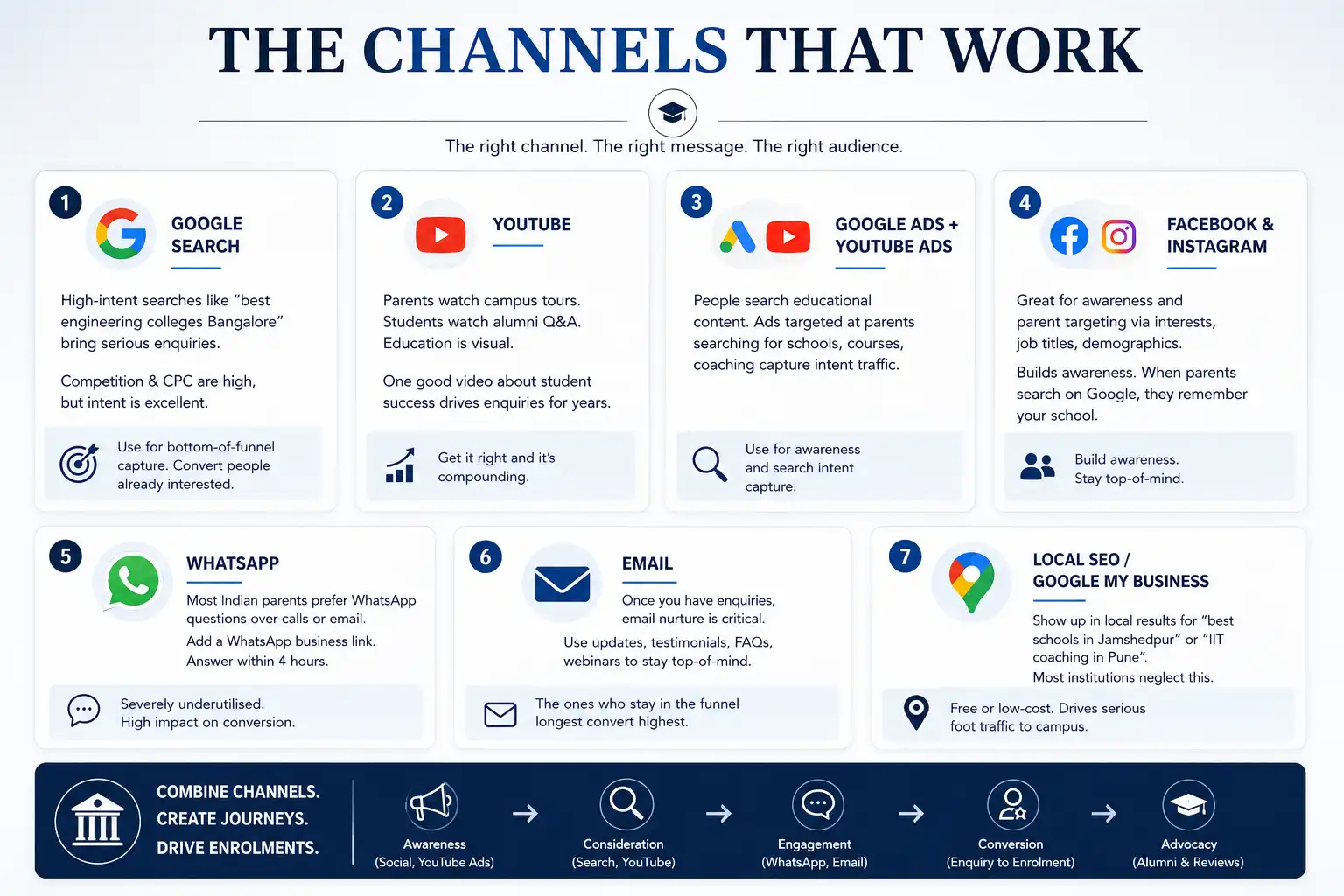
1. Google Search : Someone types “best engineering colleges Bangalore” or “UPSC coaching near me” — they’re in research mode. Show up there and you get serious enquiries. Problem: competition for these keywords is high and cost per click is expensive. But intent is excellent. Use this for bottom-of-funnel capture. You’re converting people already interested.
2. YouTube : Parents watch campus tours. Students watch alumni Q&A sessions. Someone uploads “life at [college name]” and gets thousands of views. YouTube works because education is visual. People want to see the campus, the classrooms, the people. Word of mouth happens on YouTube now. Get this right and it’s compounding — one good video about student success drives enquiries for years.
3. Google Ads + YouTube ads for awareness and search : People search educational content. Run ads targeted at parents searching for “best boards schools” and you catch the intent traffic.
4. Facebook and Instagram : Mostly for awareness and parent targeting. Not many parents are “hanging out” on social media actively seeking education options. But you can target them via interest — parents of teens, job titles, interests. The ads don’t convert directly usually. They build awareness. Then when the parent searches on Google, they remember your school.
5. WhatsApp : Severely underutilised. Most Indian parents prefer WhatsApp questions to phone calls or email. Add a WhatsApp business link on your website. Answer questions within 4 hours. You’d be shocked at the conversion. This isn’t a paid channel, but it’s where decisions happen now.
6. Email : Once you have enquiries, email nurture is critical. You get a lead in March. Admission cycle doesn’t start until May. What do you do for two months? Email. Monthly updates, student testimonials, FAQs, parent webinars. The ones who stay in the funnel longest convert highest. Email keeps you top-of-mind.
7. Local SEO / Google My Business : If you have a physical campus, local SEO matters. “Best schools in Jamshedpur” or “IIT coaching in Pune” — you want to show in local results with good reviews, address, operating hours. Most educational institutions neglect this. It’s free or cheap and drives serious foot traffic to campus.
The Lead Magnet Game
A lead magnet for education needs to demonstrate value, not just collect emails.
What works: Free mock test (student takes it, sees their score, wants improvement). Webinar on “how to crack boards in 90 days” (actually useful content). Sample lesson video (shows teaching quality). Curriculum PDF (parents want to see what’s taught). College admission success stories (video of an alumni talking about their journey). Parent webinar on “what colleges actually look for”.
What doesn’t work: “Download our brochure” (PDFs nobody reads). “Subscribe to newsletter” (too vague). “Call for free consultation” (high friction). Generic “free study material” (not specific).
One coaching centre digitised their offline test. Free mock test online, students take it on mobile, get instant feedback, see detailed analysis. Within 24 hours they email solution tricks and invite to a sample class. 40% who took the test enrolled within 2 months. Compare that to “download brochure” which converted 5%. The first one demonstrates value. The second one just asks for commitment.
Also — personalisation matters. Generic “free material for all subjects” gets lower conversion than “free NEET biology practice questions for Class 12.” Specific works better.
Outcomes & Social Proof
In education, everything sounds the same. “Expert faculty.” “Proven methodology.” “Best results.” Every institution says this. Parents know this too. So they don’t believe any of it.
What works? Proof. Actual outcomes.
For coaching: “85% of our students score 90+ on boards compared to 28% state average.” Specific. Verifiable. Shows real value.
For colleges: “90% placement in tier-1 companies within 6 months.” Not “great placements.” Actual numbers.
For skill courses: “Students land jobs with average salary Rs 6.5 LPA within 3 months.” Concrete outcome.
Student testimonials are gold. Not a principal saying “our students are very happy.” An actual student on video: “I joined thinking I’d score 60%. Scored 87%. Didn’t expect this.” Way more powerful. Because it’s real.
Alumni interviews work. Someone successful talking about their journey — how they prepared, what helped, where they are now. This is social proof that costs very little to produce.
A coaching centre from Delhi started collecting student score improvements. Before and after. They made a simple video. “Student came with 40% average. Left with 89%. Here’s their story in 60 seconds.” Posted on YouTube. It’s still getting views and enquiries 18 months later. Because it’s real.
Also — and this is important — don’t hide your average. Some institutions only show top performers. “Here are our 5 toppers!” Okay. But what about the rest? Parents know their kid isn’t a topper. Show what happens to average students. Improvement from 55% to 78%. That’s what resonates with most parents.
The Funnel Stages
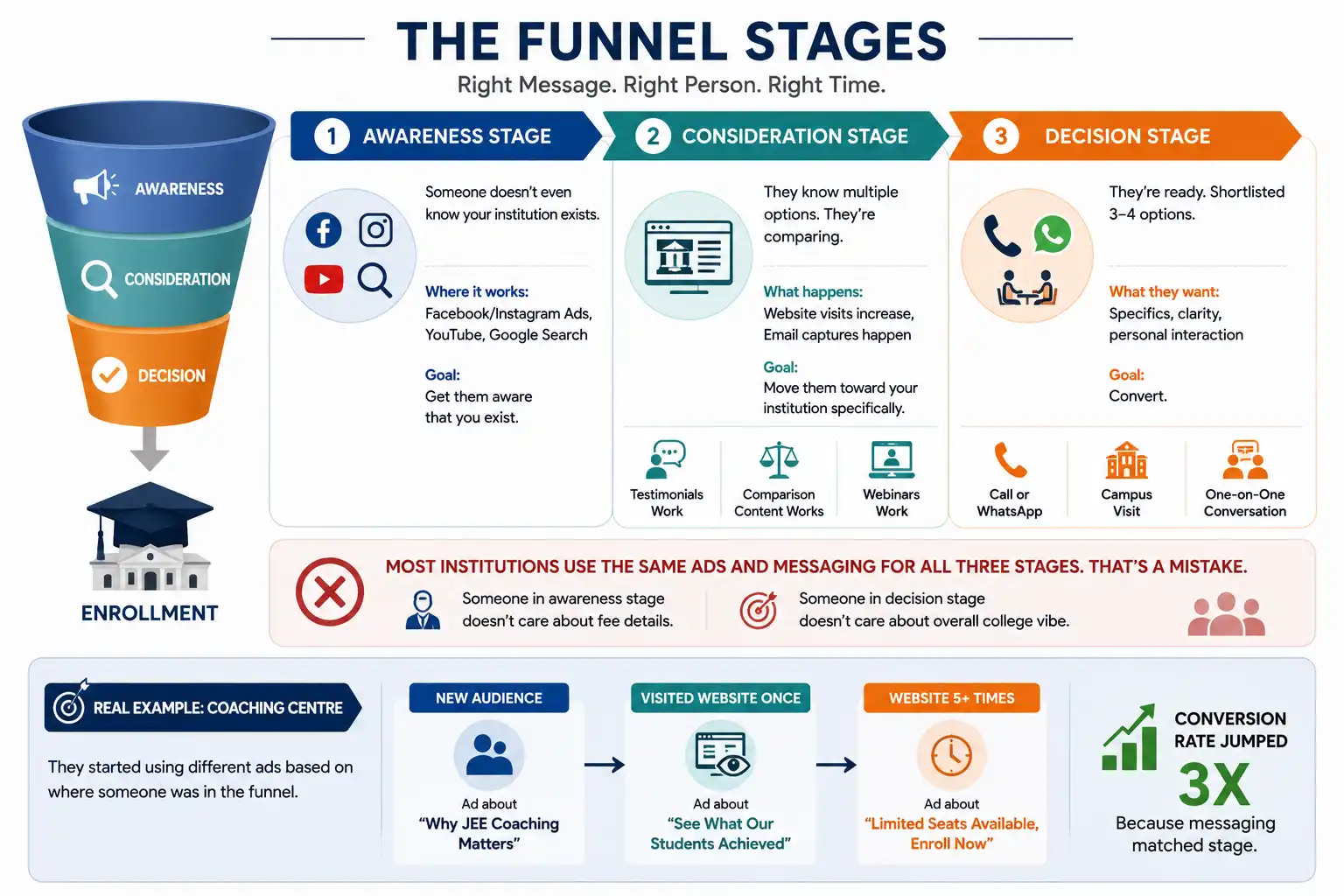
Awareness stage: Someone doesn’t even know your institution exists. Facebook/Instagram ads work here. YouTube content works. Google search works if they’re searching broadly (“best colleges in Bangalore”). Goal: get them aware that you exist.
Consideration stage: They know multiple options. They’re comparing. Website visits increase. Email captures happen. Goal: move them toward your institution specifically. Testimonials work. Comparison content works. Webinars work.
Decision stage: They’re ready. They’ve shortlisted maybe 3-4 options. Now they want specifics. Call or WhatsApp. Campus visit. One-on-one conversation. Goal: convert.
Most institutions use the same ads and messaging for all three stages. That’s a mistake. Someone in awareness stage doesn’t care about fee details. Someone in decision stage doesn’t care about overall college vibe. Different stage, different message.
A coaching centre started using different ads based on where someone was in the funnel. New audience? Ad about “why JEE coaching matters.” People who visited website once? “See what our students achieved.” People on the website 5+ times? “Limited seats available, enrol now.” Conversion rate jumped 3x because messaging matched stage.
The Measurement Problem
Most education institutions measure clicks, views, website traffic. Vanity metrics.
What matters: Enquiries. Qualified enquiries (actual interest, right fit). Campus visits. Enrolments. Cost per enrolment. Enrolment to completion rate. Post-completion outcomes (where did students go, what did they achieve).
We had a school tracking “website visitors: 2,000 per month.” Feeling good. Then we asked: how many enquired? 30. How many visited campus? 8. How many enrolled? 3. So they spent Rs 2 lakhs a month to enrol 3 students. Cost per enrolment: Rs 67,000. That same month, their alumni referral programme brought 2 enrolments at zero cost. Which channel is actually working?
Build a proper attribution model. Track each enquiry to source. Know which channel (Google, YouTube, Facebook, WhatsApp, alumni referral) is bringing students at what cost. Then double down on the cheapest, highest-quality channels.
Also — track longitudinal value. A student enrolls and completes. They become alumni. They refer a friend. They post testimonials. Their salary after graduation. That matters for future marketing. A student is worth way more than the enrolment fee if managed well.
The Metrics That Actually Matter
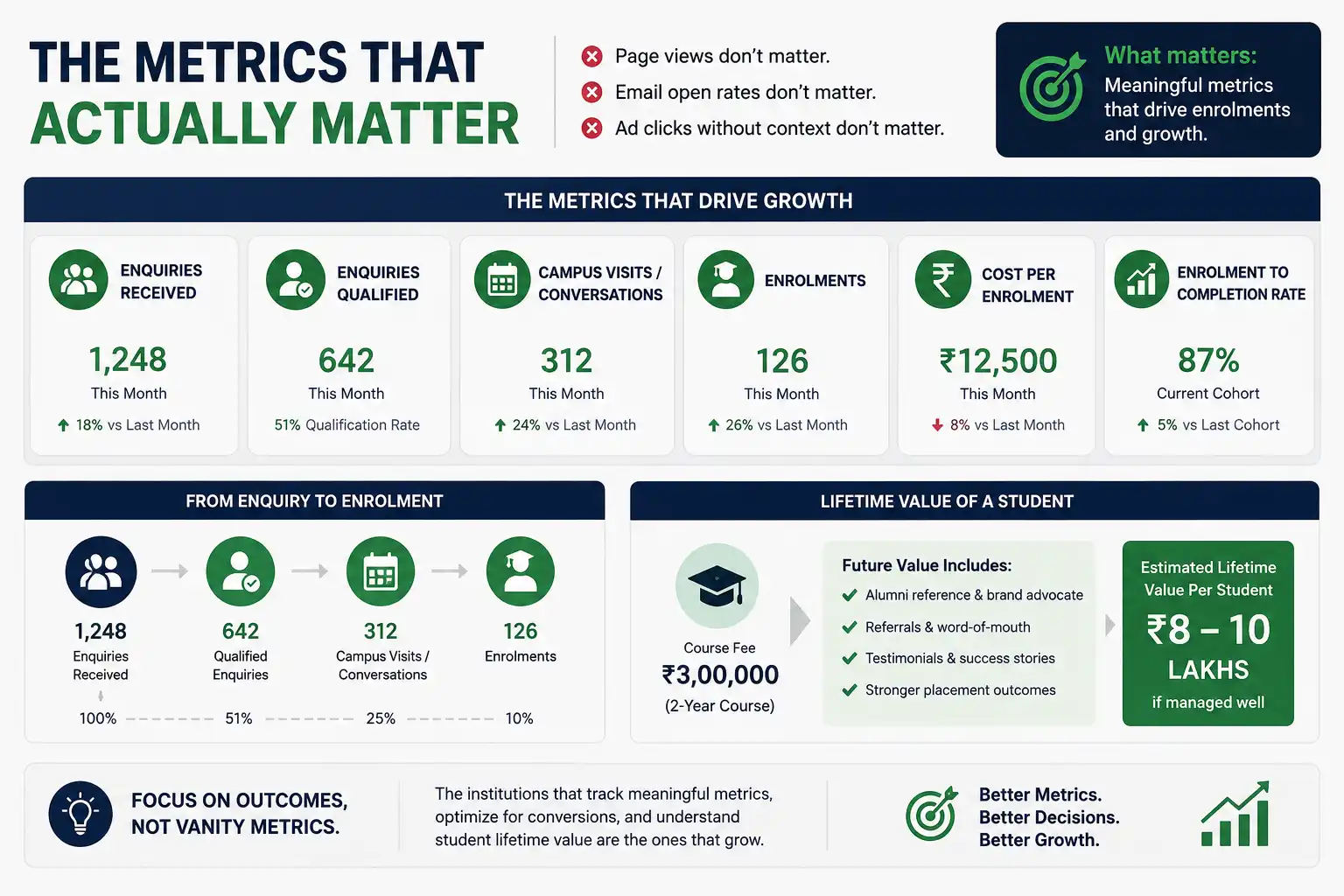
Page views don’t matter. Neither does email open rates. Neither do ad clicks without context.
What matters: Enquiries received. Enquiries qualified (actual interest, right demographics). Campus visits or conversations. Enrolments. Cost per enrolment. Enrolment to completion rate. Alumni outcomes.
Most education marketers report vanity metrics. “We got 5,000 website visitors this month!” Okay. How many enquired? How many enrolled? The ones reporting meaningful numbers are the ones that actually grow.
Also — consider the lifetime value of a student. If you enrol someone in a 2-year course at Rs 3 lakhs, their value isn’t just Rs 3 lakhs. They become an alumni reference for you. They might refer friends. If you place them well, they’re your testimonial for next year. That student is probably worth Rs 8-10 lakhs in future value if managed well. Marketing budgets should reflect that.
What Actually Kills Education Marketing Campaigns
Impatience is the biggest killer : “We need 50 more students by July.” Marketing for education takes 12-18 months minimum to show real results. If you’re running 3-month campaigns and killing them because you didn’t hit targets, you’re wasting money every time.
Second: treating education like e-commerce. In e-commerce, someone clicks, buys same day. Education is 6-18 month consideration. You need different funnels, different nurturing, different messaging.
Third: wrong audience targeting. A school we worked with was targeting 14-year-olds for Class 12 admissions. But Class 12 decisions are made by parents. Wasting Rs 1 lakh per month on the wrong audience. One simple change — target parents of 16-year-olds instead — cut CAC in half.
Fourth: no post-enrolment marketing. Student enrolls in July. You forget about them. But a current student is your best marketer. Keep them happy. Get their testimonials. Get their outcomes. That feeds next year’s marketing.
Fifth: trying everything at once. “Let’s do YouTube, Facebook, Instagram, LinkedIn, Google, TikTok.” No. Pick one or two. Master it. Then expand. Scattered budgets = scattered results.
The Starting Point
Fix your Google My Business. Claim it. Verify. Photos of campus (recent ones). Operating hours. Contact info. Ask 5-10 happy parents and students to leave reviews. This is free and it works. When someone searches “best schools Bangalore,” you show up with ratings and reviews.
Create one outcome video. Interview a student or alumni. “I went from 60% average to 85%. Here’s what helped.” No fluff. Genuine. Post on YouTube. Share on WhatsApp, email, Instagram. One good video compounds for years.
Map your timeline. When do parents actually research? November? July? December? Write it down. When do they visit? When do they decide? Calendar this for the next 24 months. Then plan your marketing around actual decision points, not when you want enquiries.
Set up email capture. Every enquiry gets added to a list. Send monthly updates — student achievements, campus highlights, upcoming events. Not promotional. Just staying top-of-mind. Track open rates and click rates. See which emails resonate.
Pick one paid channel. Google search if high intent (lots of people searching for colleges in your area). Facebook/Instagram if you’re trying to build awareness among parents. Not both. Not five. One. Run for 90 days minimum. Measure cost per enquiry. Then decide to scale or pivot.
This all costs less than Rs 2-3 lakhs for 3-4 months and should give you solid data on what works. Then expand from there.
The Real Challenge
Here’s the honest part.
Education marketing works brilliantly when your institution actually delivers results. Good teaching, good outcomes, happy students — that’s the foundation. Marketing just amplifies it.
But if your institution is mediocre? If outcomes are average? Marketing won’t save you. You can run perfect ads and get people in. But they’ll enrol, realise it’s not worth it, and leave. Word-of-mouth turns negative. Parents talk. You’re done.
So before you spend Rs 5 lakhs on a marketing agency, fix the product. Are your outcomes genuinely good? Can you prove it with data? Do students and parents actually recommend you? If the answer is “mostly” or “maybe,” marketing will waste money.
If the answer is yes — if you’re legitimately good — then digital marketing becomes almost easy. Because you’re just telling the truth. And the truth spreads fast.
The best education institutions we work with aren’t the ones spending the most on ads. They’re the ones with the best outcomes who’ve figured out how to tell that story digitally. Think about that.
| Approach | Best for | Watch out for |
|---|---|---|
| DIY | Small teams, tight budgets | Slow ramp-up, trial-and-error |
| Freelancer | Specific project bursts | Inconsistency, limited ownership |
| Agency | Ongoing work, senior input | Higher retainer, less control |
Quick checklist before you start:
- Define the one thing you want: leads, sales, awareness — pick one.
- Baseline your numbers: write down where you are today.
- Pick a 90-day window: nothing moves in 2 weeks.
- Agree on success metrics: with whoever is paying the bill.
- Set up proper tracking: GA4, UTMs, call tracking.
- Review monthly: kill what doesn’t work, double down on what does.
The Bottom Line
If you take one thing from this: digital marketing for education recruit students fill progra rewards patience and specificity, not volume or clever tricks. Start small, measure honestly, fix what breaks, and compound what works. The brands doing this well in India aren’t smarter — they’re just consistent. Need a hand with this for your business? Talk to us.
Ready to Build Real Marketing For Your Institution?
250+ brands across sectors trust PromotEdge. Schools, colleges, coaching centres, EdTech platforms. We’ve worked with education through the long timelines and patient capital it requires. Let’s talk about your specific challenges.
FAQs
-
What's the right budget for education marketing in India?
Ans.Depends on your institution, city, and competition. A coaching centre in Tier 2 might need Rs 50,000-1 lakh per month during peak season. A top college could spend 3-5 lakhs depending on seat inventory. We work with schools spending Rs 20,000 monthly and getting great ROI, and colleges spending 8 lakhs with poor returns. The difference? Good targeting and clear messaging. Also — budget seasonally. June-July is peak season for admissions. September-October for coaching. Spread your budget accordingly. -
Are we marketing to students or parents?
Ans.Both. But differently. For coaching and test prep, you're mostly targeting parents — they control money and make the final call. For colleges and skill courses, you're targeting students but parents still influence the decision heavily. Parents care about outcomes: placement rates, fees, track record, safety. Students care about experience: campus, friends, job opportunities. Same institution, different messaging for each audience. Most schools use the same ad for both and wonder why neither converts. -
How long does it take to see admission results?
Ans.Patient money wins here. For board exams and coaching, you're marketing 18-24 months before the result matters. For colleges, 12-18 months minimum. For skill courses, faster — 60-90 days. But... most education organisations cut campaigns after 3-4 months seeing no admissions and switch to something else. Then the student from your June campaign admits in January and they've already moved budget. Think in academic years, not quarters. Calendar matters more than sales funnels in education.
Author Details

Latest Posts
-
 24 / Sep
GMB Optimisation Google Business Profile Optimization Guide 2026
24 / Sep
GMB Optimisation Google Business Profile Optimization Guide 2026 -
 23 / Sep
Search Engine Optimization Programmatic SEO: Template + Data Model Explained
23 / Sep
Search Engine Optimization Programmatic SEO: Template + Data Model Explained -
 22 / Sep
Conversion Rate Optimization Conversion Rate Optimization: A Practical Guide
22 / Sep
Conversion Rate Optimization Conversion Rate Optimization: A Practical Guide -
 21 / Sep
Whatsapp Marketing WhatsApp Marketing for Indian SMBs
21 / Sep
Whatsapp Marketing WhatsApp Marketing for Indian SMBs -
 19 / Sep
Related Knowledge