-
Author: Anindita Barik
-
Updated Date: Aug-05-2026
-
Views: 2 Min Read
Digital marketing for real estate helps developers and agencies generate qualified leads through SEO, Google Ads, YouTube, retargeting, and email—without relying on price discounts. This guide breaks down the four channels that actually drive property sales, real client case studies (including a Rs 8,200 to Rs 2,400 cost-per-lead turnaround), a seasonal marketing calendar for Indian buyers, and a step-by-step framework to build sustainable lead generation that converts.
Digital marketing for real estate helps developers, builders, and real estate agencies generate qualified leads through SEO, PPC, social media, content marketing, email campaigns, and local search optimization. Instead of relying only on property portals or price discounts, businesses can attract buyers by reaching the right audience at every stage of the buying journey.
A well-planned real estate digital marketing strategy focuses on building trust, showcasing projects, nurturing prospects, and improving lead quality. By combining targeted advertising, optimized websites, virtual tours, and valuable content, real estate brands can increase inquiries, improve conversions, and achieve sustainable sales growth without reducing property prices. This is exactly what a properly structured digital marketing for real estate programme delivers — not just lead volume, but lead quality that actually converts to sales.
That Phone Call at 11 PM That Changed How I See Real Estate Marketing
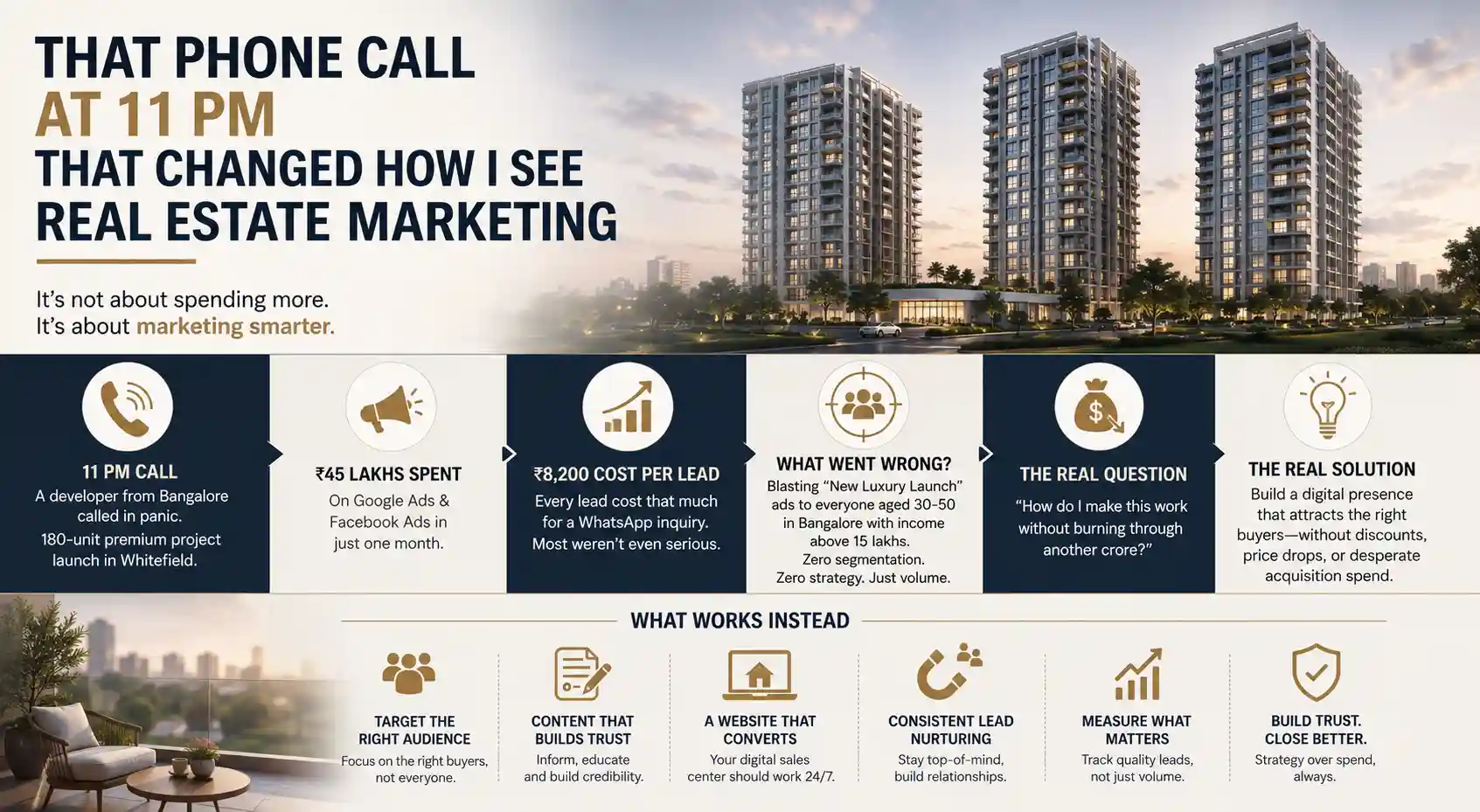
January 2023. I was leaving the office when a developer from Bangalore — let’s call them Phoenix Realty (and yes, they’re an approved client of ours) — called in absolute panic mode.
They had a 180-unit residential project launching in Whitefield. Three towers. Premium segment. They’d already spent Rs 45 lakhs on Google Ads and Facebook ads in the first month, and the cost per lead had climbed to Rs 8,200. Every lead cost that much just to get a WhatsApp inquiry. Most weren’t even serious.
Know what their agency was doing? Blasting “New Luxury Launch” ads to everyone aged 30-50 in Bangalore with income above 15 lakhs. Zero segmentation. Zero strategy. Just… volume.
He asked: “How do I make this work without burning through another crore?”
That’s what we’re talking about today. Not just “how to sell properties online” — that’s easy, throw money at ads. But how to actually build a digital presence that doesn’t rely on discounts, price drops, or desperate acquisition spend.
The Brutal Truth About Real Estate and Digital
Real estate is weird in digital marketing. It sits in this strange middle ground.
On one end, you’ve got e-commerce (sell 100 laptops by Friday, optimise conversion, move on). On the other, B2B SaaS (long sales cycle, relationship-based, decision committee). Real estate is somehow both and neither.
Your buyer journey is 60-90 days minimum. Sometimes six months. But they’re also extremely motivated — they’re actively searching for where to live or invest. Google and YouTube are showing them content constantly. And your competitor’s billboard or WhatsApp forward can sway the decision in 24 hours.
The agencies that win at real estate digital get this duality. They’re not trying to close someone on day three. They’re building the presence so that when someone lands on Google and searches “3BHK apartment Powai Mumbai” — your project shows up, your website tells the story better than anyone else’s, and your credibility is already established.
Cost per lead drops 60-70% when you stop chasing random people and start being found by people actively hunting.
Why Discount-Driven Marketing Collapses Faster Than You Think
I’ll be direct — if your initial go-to-market is “book 20% discount this month only,” you’ve already set the tone for your entire sale cycle.
Buyers remember discounts. They’ll hold out for the next one. Or they’ll negotiate harder. Or they’ll buy from someone who offered more. You’ve commoditised your product in their mind. A property that could’ve been a lifestyle investment becomes a spreadsheet comparison.
We had another real estate client — actually, a mid-size developer from Jamshedpur — they tried the discount route. After three months and Rs 60 lakhs spent, they’d sold 45 units. Average discount: 7%. Customer lifetime value was negative because everyone expected better pricing. It was a disaster.
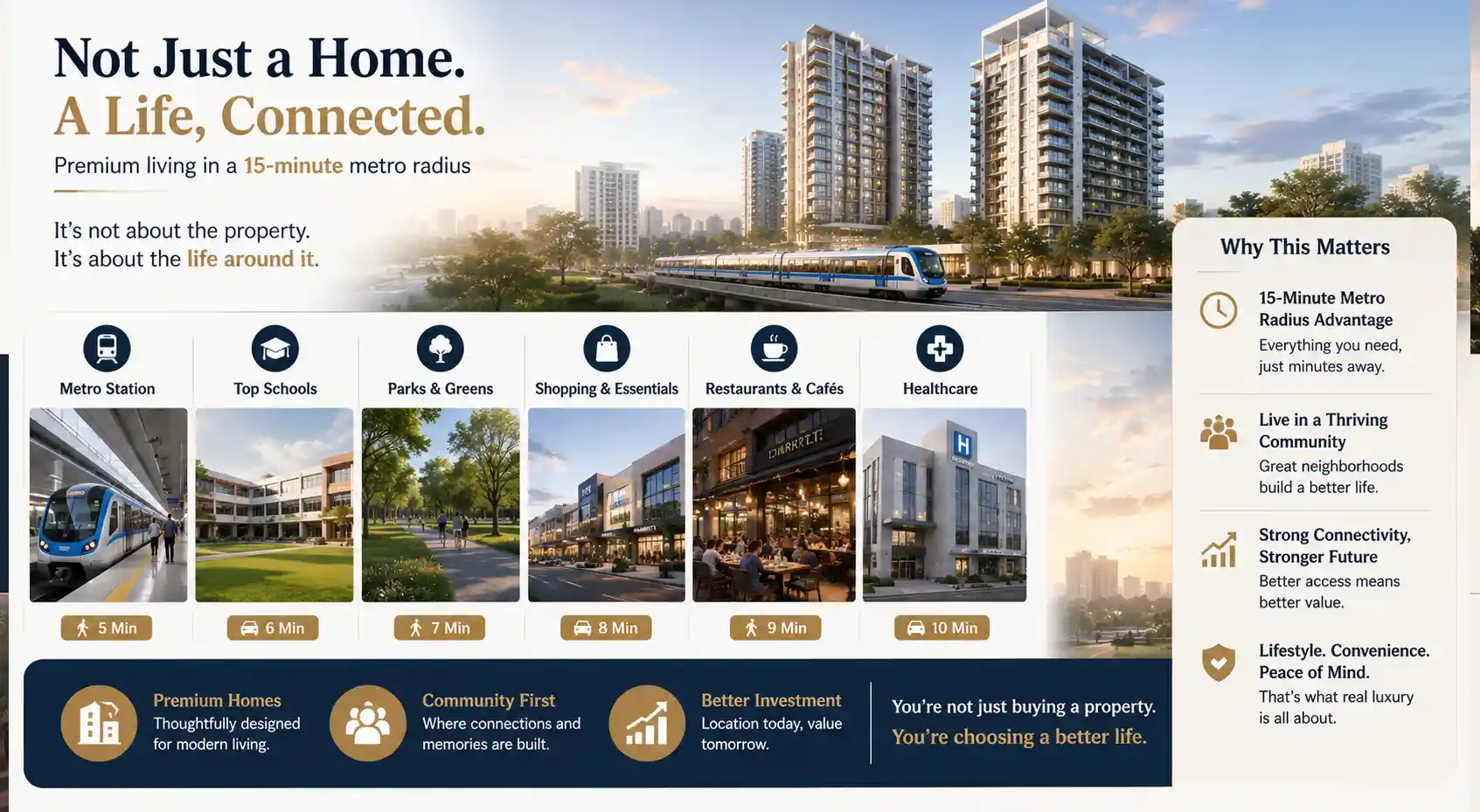
Compare that to what we built with Phoenix Realty. Position it differently. “Premium homes in a 15-minute metro radius” vs “luxury flats.” Tell the neighborhood story. Show the design philosophy. Bring in testimonials from people who’ve already bought. Suddenly, you’re not selling property — you’re selling belonging to a community. This is what brand strategy and positioning does at the property level — a project with a clear identity and story commands premium pricing, while a project that competes only on price ends up in a race to the bottom.
And yes, cost per lead went down to Rs 2,400 by month four. While their actual deal size went up.
The Four Digital Channels That Actually Move Property Sales
And I mean actually. Not “nice to have.” Not “let’s try this.” These are the channels where real estate buyers spend time.
1. Google Search
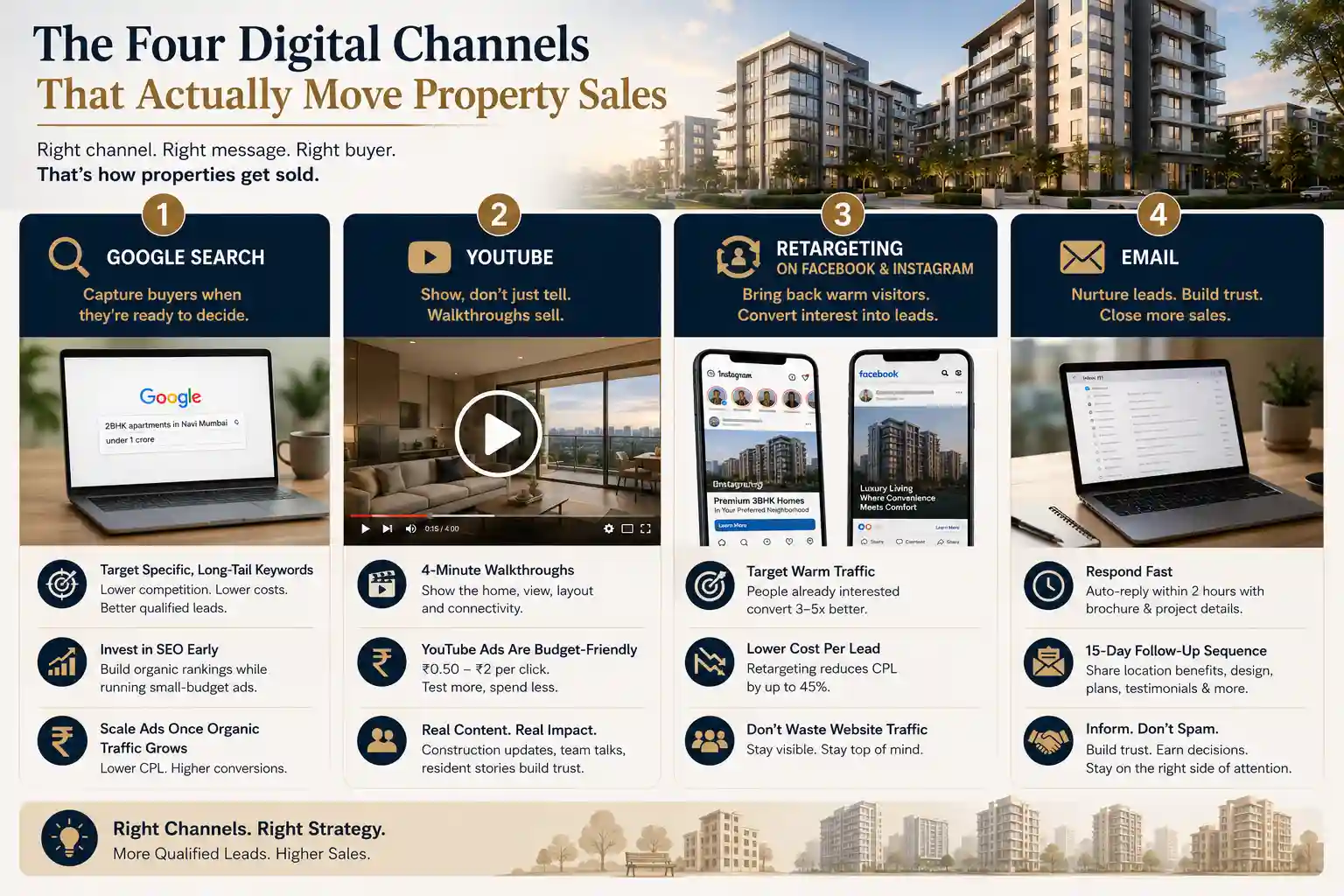
When someone types “2BHK apartments in Navi Mumbai under 1 crore,” they’re ready. They’re not dreaming — they’re decision-making. Google Ads for those searches cost less than Facebook and convert way higher.
But here’s where most developers mess up: they bid on generic terms like “Mumbai flats” or “Navi Mumbai housing.” Costs soar. Junk leads everywhere.
The move is specific long-tail keywords: “3BHK luxury apartments Thane near railway station,” “affordable housing Pune 8-10 lakhs,” “commercial office space Bangalore tech park.” Lower competition. Lower costs. Better qualified people clicking.
Plus — and this is critical — your SEO should own these searches organically. Google Ads are expensive short-term. Organic rankings are the play. We typically advise developers to spend the first 3-4 months on SEO strategy while running small-budget Google Ads, then scale ads once organic starts flowing.
2. YouTube
Seriously. In 2026, how many property videos have you seen that don’t feel like they were filmed on a phone in 2008?
YouTube property walkthroughs are content gold. A 4-minute professional walkthrough of your 3BHK, showing the balcony view, the kitchen layout, the location connectivity — someone watching that is 80% closer to deciding than someone who just saw your website.
Bonus: YouTube Ads (video pre-rolls) are dirt cheap for real estate. Rs 0.50-2 per click. Compare that to Google Search at Rs 15-40. You can test neighborhoods, buyer segments, and messaging for minimal cost.
The content doesn’t have to be glossy corporate production. It can be raw. Actually, buyers respond better to that. Show the construction progress. Interview your team. Get a resident from your previous project talking about why they love living there.
3. Retargeting on Facebook & Instagram
Someone visits your website. Scrolls through three projects. Leaves without filling a form. Now what?
Retargeting. Show them an Instagram story ad with a specific project detail, or a Facebook ad highlighting the exact neighborhood they were looking at. Costs are low because you’re targeting warm traffic. Conversion rates are 3-5x higher than cold outreach.
Most developers don’t do this. They waste site traffic. We built this for a Pune-based developer and saw cost per lead drop 45% within month one, just by capturing the people already interested.
4. Email
A buyer enquires. Fills a form. Never hears from you for a week. By then, they’ve visited five other projects.
Instead: Auto-response within 2 hours (even if it’s just a welcome + project brochure). Follow-up sequence over 15 days with different angles: location benefits, design philosophy, payment plans, customer testimonials, neighborhood insights. Not salesy. Informative.
People don’t buy on day one. They buy when they feel informed and trusted. Email does that. Spam email does the opposite. There’s a line — don’t cross it.
How to Build a Real Estate Website That Doesn’t Suck
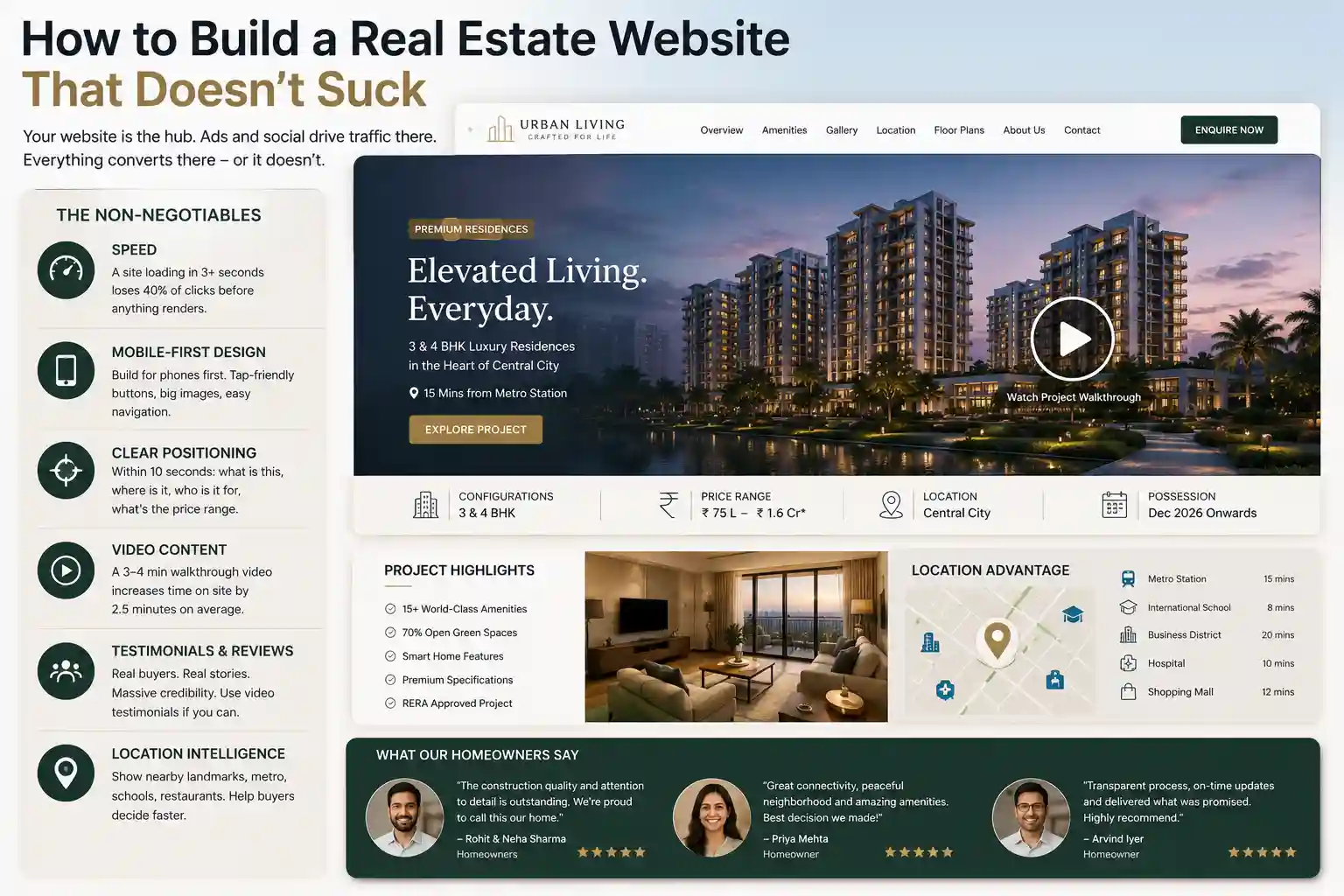
Your website is the hub. Ads and social drive traffic there. Everything converts there or it doesn’t.
Most real estate websites are… okay, I’ll be honest — most are trash. Slow. Mobile-unfriendly. Buried contact forms. Stock images. No clear value prop.
Here’s the non-negotiable stuff:
Speed. A property website loading in 3+ seconds loses 40% of clicks before anything renders. Use a fast host, compress images, and test on 4G (because buyers research on their commute).
Mobile-first design. You’re not selling to desktop users. You’re selling to someone sitting in Uber checking properties on their phone. Make sure your site is built for that. Tap-friendly buttons. Big images. Easy navigation.
Clear project positioning. Within 10 seconds of landing, someone should know: what is this, where is it, who is it for, what’s the price range. No mystery. No design flourishes over clarity.
Video content. One good 3-4 minute walkthrough video on your homepage increases time on site by 2.5 minutes on average. More time = more trust.
Testimonials and reviews. I used to think these were “nice to have.” They’re not. Seeing a name, a photo, and a genuine comment from someone who bought there transfers massive credibility. Use video testimonials if you can (they’re worth 10x text).
Location intelligence. Map your property to nearby landmarks, metro stations, schools, restaurants. Make it interactive if budget allows. Someone deciding between two projects is checking “is it near my office” — answer that question immediately.
Work with a team that understands real estate specifically. We’ve done this for brands across the real estate sector — they know not to overthink the design and to focus on conversion mechanics.
The Calendar That Moves Real Estate Sales
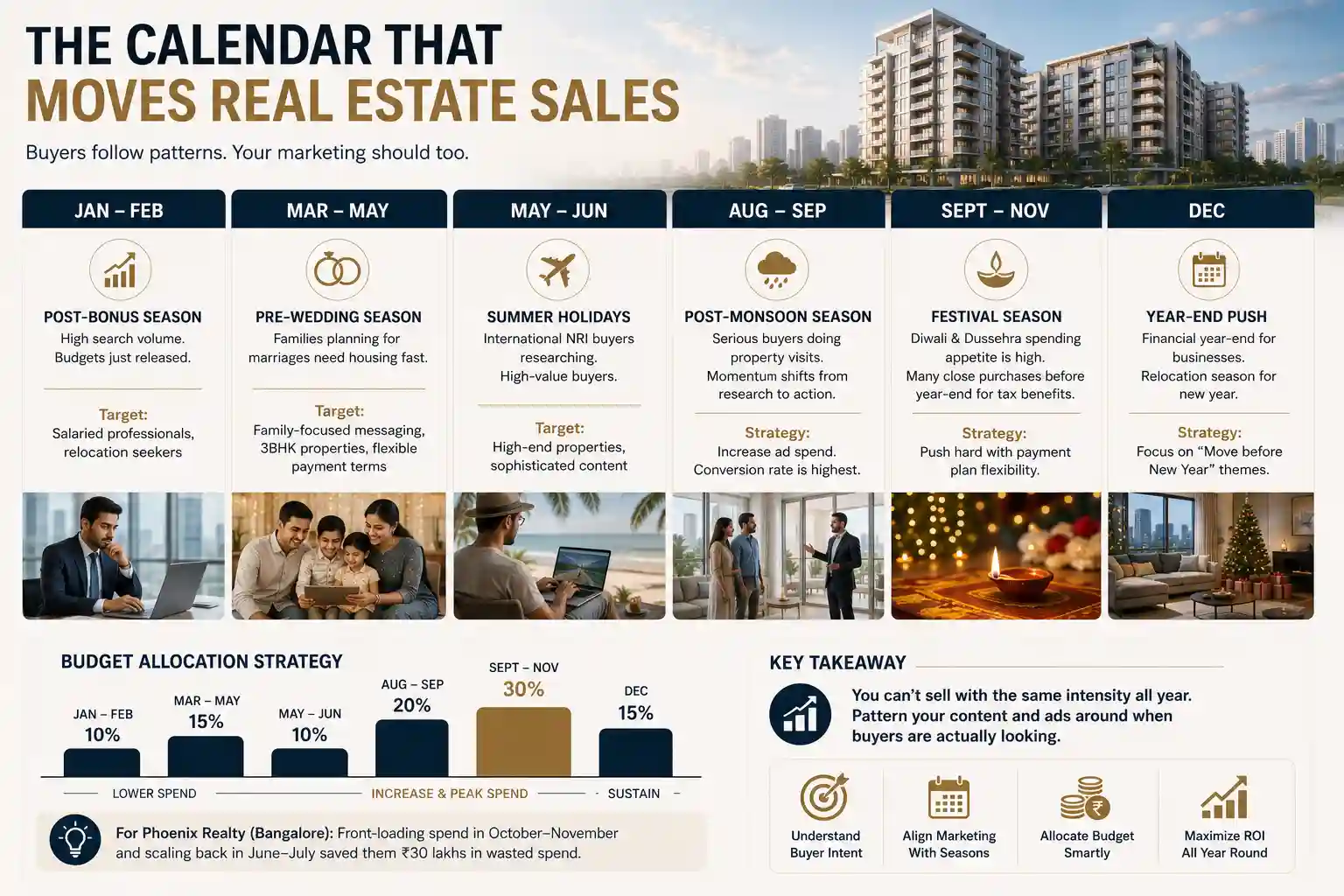
Real estate isn’t random. Buyers cluster.
Post-bonus season (January-February): high search volume. Budgets just released. Targets: salaried professionals, relocation seekers.
Pre-wedding season (March-May): families planning for marriages need housing fast. Target: family-focused messaging, 3BHK properties, flexible payment terms.
Summer holidays (May-June): international NRI buyers researching. High-value buyers. Sophisticated content needed.
Post-monsoon (August-September): serious buyers doing property visits. Momentum shifts from research to action. Increase ad spend here. The conversion rate is highest.
Festival season (Sept-Nov): Diwali and Dussehra spending appetite is high. Many close purchases before year-end for tax benefits. Push hard here with payment plan flexibility.
Year-end (December): financial year-end for businesses. Tax planning drives some purchases. Also, relocation season (people transferring jobs in new year). Content should focus on “move before New Year” themes.
For Phoenix Realty in Bangalore, we front-loaded spend in October-November (right before their Q4 push) and scaled back in June-July. Single move saved them Rs 30 lakhs in wasted spend.
You can’t sell with the same intensity all year. Pattern your content and ads around when buyers are actually looking.
Three Stories That Went Sideways
Failure makes better teachers. So…
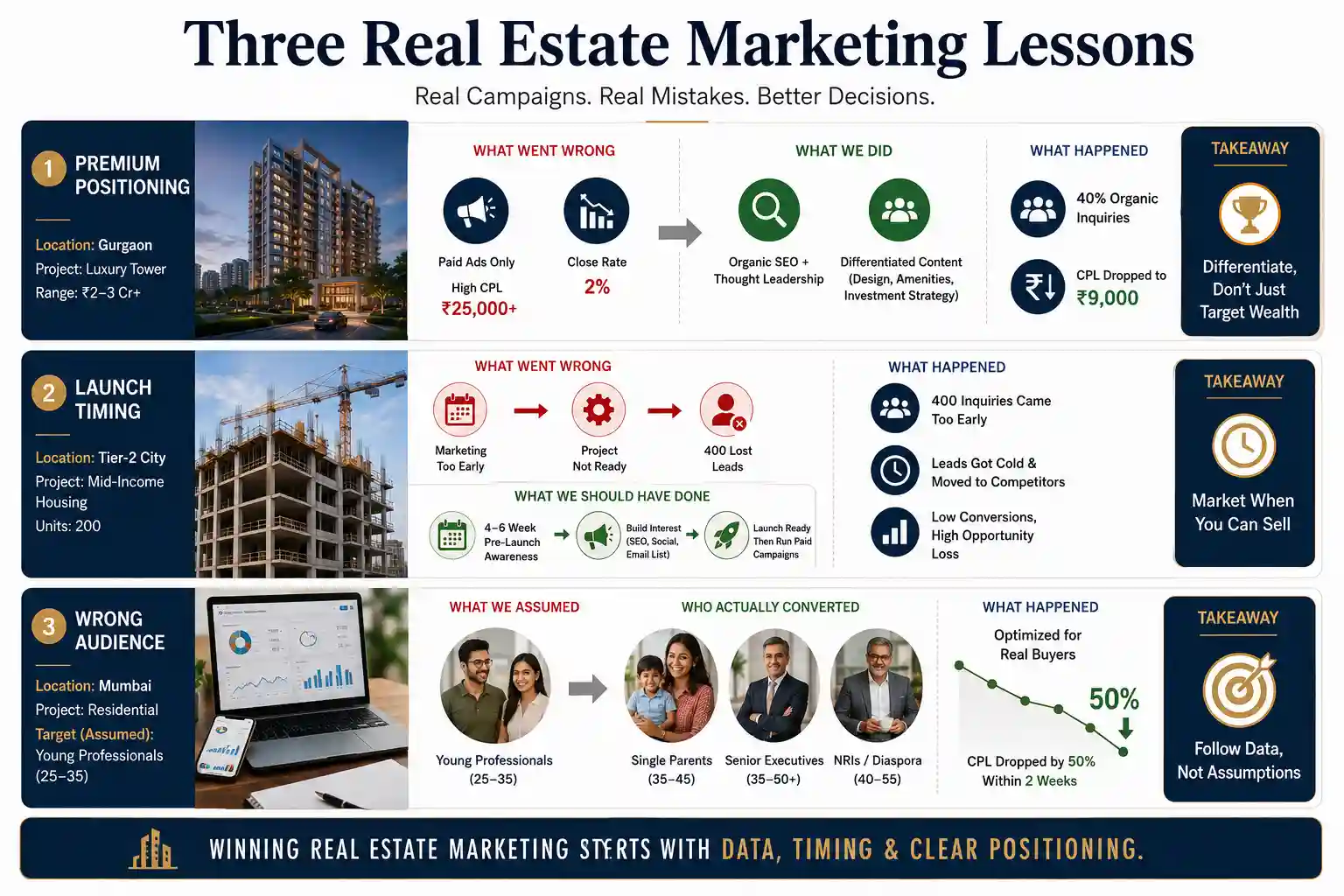
Story 1: The Premium Disaster
Gurgaon. Luxury residential tower. 300+ units. Rs 2-3 crore+ range.
Initial strategy: target high-net-worth individuals. Premium publications. Exclusive WhatsApp groups. Sponsored content on Business Today.
What actually happened: zero traction. No organic discovery. Depended entirely on paid channels. Cost per lead was Rs 25,000+. Close rate was 2%.
The problem: we were chasing high-income demographics. But we weren’t answering the actual buyer’s question: “Why should I pick this over someone else’s luxury tower?”
We pivoted. Built SEO around “luxury apartments Gurgaon golf course,” “high-end properties with private amenities,” “3-year possession property Gurgaon” — specific differentiators. Created thought leadership content about luxury real estate investment strategy (not sales collateral). Got architects and interior designers talking about the design.
By month 5, organic was responsible for 40% of inquiries. Cost per lead dropped to Rs 9,000. Still high-end buyers, still premium, but now they were finding them organically and coming to the table informed rather than cold.
Story 2: The Timing Miss
Tier-2 city. Mid-income housing. 200-unit project.
They launched digital marketing on day one of their soft launch. Made sense, right?
Wrong. The project wasn’t actually launch-ready for another 45 days. Nothing was finalized. Payment plans weren’t decided. Registration was still pending. So inquiries flooded in and they couldn’t convert anyone because they literally couldn’t sell yet.
Now they have 400 inquiries from people who got excited, couldn’t buy, forgot about the project, and moved on to competitors.
Lesson: don’t start aggressive digital before you’re ready. It sounds obvious. It’s not. We now tell clients: 4-6 weeks of pre-launch awareness (gentle SEO, soft social content, email list building) then ramp aggressive paid when you can actually close.
Story 3: The Demographic Assumption
Mumbai project. Positioned for young professionals, 25-35 age bracket.
Their ad spend was entirely Facebook and Instagram to that demographic.
Actual buyers? Single parents (both male and female) aged 35-45 looking for family housing. Senior executives planning retirement homes. And diaspora NRIs 40-55 looking for investment properties.
The website traffic showed this. The analytics were screaming it. But the agency kept pushing the same young professional angle.
By month three, we looked at who was actually converting and rebuilt the messaging for the real buyers. Immediately — and I mean immediately, within two weeks — cost per qualified lead dropped 50%.
Don’t assume your buyer. Watch your analytics. Serve the people actually showing up.
The Content That Actually Converts
Sales brochures don’t convert. Spec sheets don’t convert. “View our luxury amenities” doesn’t convert.
This converts:
Buyer story content. Interview someone who bought your previous project. What was their decision process? What mattered to them? What surprised them about living there? Video or written, doesn’t matter. Authenticity matters.
Neighborhood guides. “Living in Whitefield, Bangalore: A Guide for First-Time Home Buyers” — local insights, schools, commute times, best restaurants, weekend hangout spots. Make your project location feel like home, not just a property code.
Investment angle content (if applicable). For commercial or rental properties: ROI calculations, cap rate expectations, rental yield data for your area. Give people a reason to think in numbers instead of emotions.
Process transparency. How are you building this? Quarterly progress updates. Show the construction, the quality checks, the timeline honesty. People trust process more than promises.
Comparison content (careful here). “How to Choose Between 2BHK and 3BHK” or “Apartment vs. Villa: Financial Comparison” — educational, not salesy. Helps buyers clarify their own needs.
Why Your Agency Isn’t Delivering
Most real estate agencies fail because they treat every project the same. Same ad templates. Same targeting. Same messaging. If you’re evaluating what a proper real estate digital marketing engagement should actually include, our breakdown of best real estate digital marketing services gives you a clear checklist to benchmark any agency against.
A luxury tower in Bangalore needs different messaging than a mid-income housing in a tier-2 city. An NRI investment property needs different content than a first-time homebuyer purchase.
Second reason: they optimise for wrong metrics. “We got you 500 leads” — great, if 450 are unqualified. “Your website got 10,000 visitors” — cool, if 9,900 bounce in 5 seconds.
Third: they don’t understand real estate timelines. Expecting ROI in 30 days from a property that takes 90 days to close is insane. But agencies push it because it looks good in monthly reports.
Fourth: brand-new launches get massive attention (everyone’s excited). Existing inventory gets ignored. But most conversions happen from inventory that’s been sitting there three months because the initial buzz faded.
Fifth — and this kills most campaigns — they don’t integrate channels. Facebook is one person’s job. Google Ads is another. Email is nobody’s job. Instead of a cohesive strategy, you get fragmented noise.
What Actually Happens When This Works
You start getting calls from warm leads. People have already researched. They know your project, your location, your price range, your delivery timeline. They’re calling to schedule a site visit, not to be convinced.
Your cost per lead stabilizes at a sustainable number (somewhere between Rs 1,500-4,000 depending on your segment — not Rs 10,000+).
Discounting becomes unnecessary. People buy because they want your property, not because you’re desperate. Your margins improve. A lot.
Your team doesn’t live in panic mode. Launches aren’t “blast ads and pray.” They’re planned sequences that unfold over months.
Your reputation compounds. Buyers talk. They leave reviews. They recommend. By year two, word-of-mouth becomes a meaningful channel alongside paid efforts.
You actually know what’s working. Attribution is messy (it always is in real estate), but you have data. You test. You refine. You get better each cycle.
This is the outcome of digital marketing done properly for real estate. Not flashy. Not packed with AI tricks. Just… working.
How to Actually Start
Assuming you’re serious about this and not just shopping agencies:
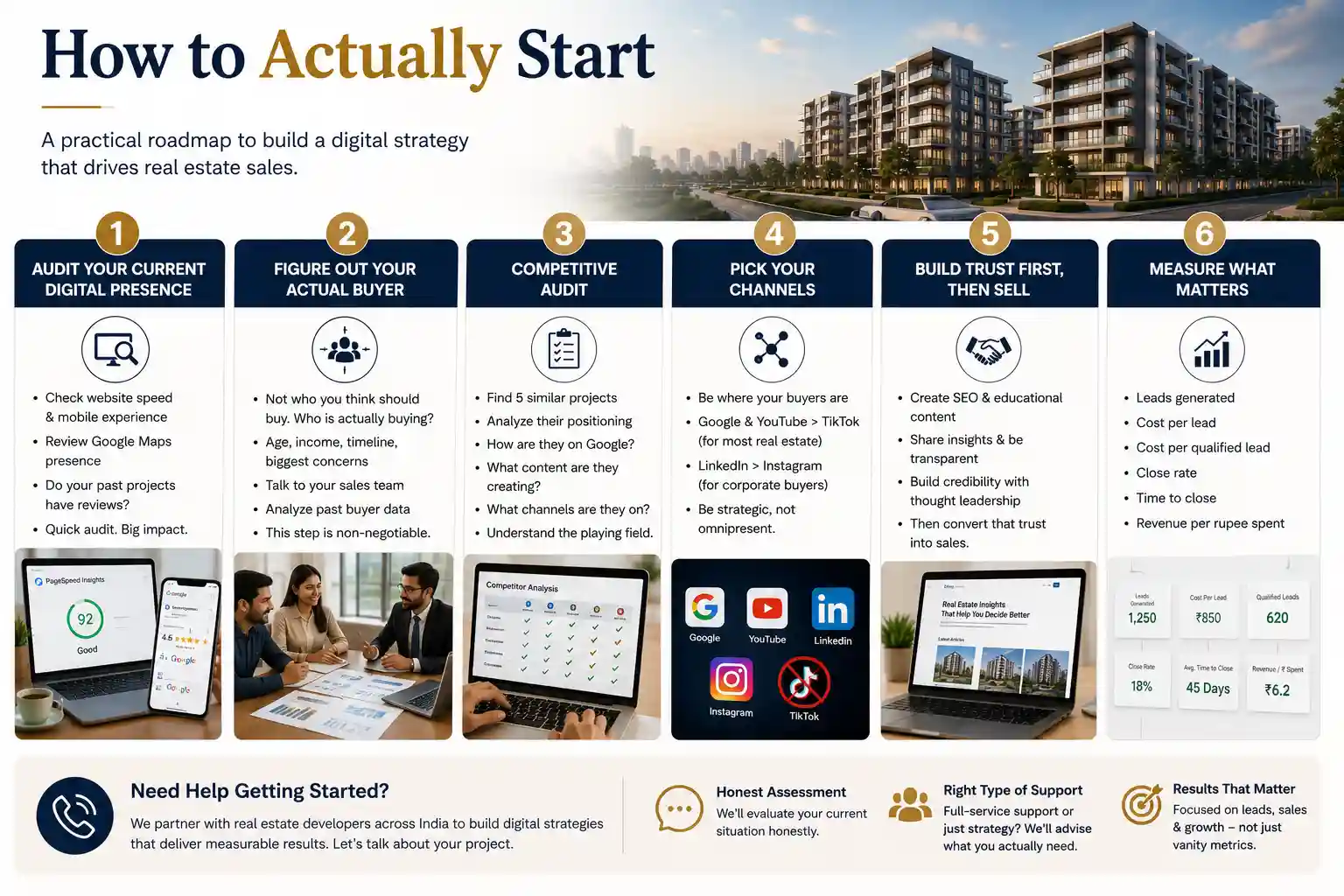
One: Audit your current digital presence. Website speed, mobile experience, how you’re showing up on Google Maps, whether your previous projects have reviews (they should). This takes a weekend and a cup of chai.
Two: Figure out your actual buyer. Not who you think should buy. Who is actually buying your properties? Age, income, decision timeline, biggest concerns? Talk to your sales team. Look at past buyer data. This is non-negotiable.
Three: Competitive audit. Find five similar projects in your area. What’s their positioning? How are they showing up on Google? What content are they creating? What channels are they on? Don’t copy them. Just… understand the playing field.
Four: Pick your channels. Don’t try to be on TikTok if your buyers are on Google and YouTube. Don’t pour into Instagram if your segment is corporate professionals looking on LinkedIn. Be strategic, not omnipresent.
Five: Start with brand-building content before aggressive selling. SEO, thought leadership, educational content, transparency. Build trust. Then monetise the trust with ads and direct sales efforts.
Six: Measure what matters. Not impressions or clicks. Leads generated. Cost per lead. Cost per qualified lead. Close rate. Time to close. Revenue per rupee spent.
If you want help with any of this, we work with developers across India doing exactly this kind of work. Let’s talk about your specific situation. We’ll give you straight assessment — do you need full-service support or just strategy direction? Different answers for different projects.
| Approach | Best for | Watch out for |
|---|---|---|
| DIY | Small teams, tight budgets | Slow ramp-up, trial-and-error |
| Freelancer | Specific project bursts | Inconsistency, limited ownership |
| Agency | Ongoing work, senior input | Higher retainer, less control |
Quick checklist before you start:
- Define the one thing you want: leads, sales, awareness — pick one.
- Baseline your numbers: write down where you are today.
- Pick a 90-day window: nothing moves in 2 weeks.
- Agree on success metrics: with whoever is paying the bill.
- Set up proper tracking: GA4, UTMs, call tracking.
- Review monthly: kill what doesn’t work, double down on what does.
The Bottom Line
If you take one thing from this: digital marketing for real estate building leads without dis rewards patience and specificity, not volume or clever tricks. Start small, measure honestly, fix what breaks, and compound what works. The brands doing this well in India aren’t smarter — they’re just consistent. Need a hand with this for your business? Talk to us.
Ready to Fix Your Real Estate Digital Game?
We’ve worked with 250+ brands across India, including property developers from tier-1 metros to tier-2 growth cities. Let’s audit your current situation and build a strategy that actually moves units.
FAQs
-
How do real estate developers generate leads online without discounting properties?
Ans.Position yourself as someone who solves real problems for specific buyer segments. A mid-income family looking at affordable housing in Kolkata's eastern suburbs needs different information than a corporate relocation specialist looking at premium properties. SEO, content, and targeted ads speaking directly to those pain points generate better-quality leads than discount offers ever will. You own the property. They need it. That asymmetry matters. -
Which digital channels matter most for property sales in 2026?
Ans.Google Search (for people actively looking), YouTube (property walkthroughs), Google Ads and Facebook Ads (retargeting), Instagram (lifestyle content), and email (nurturing). Pick 2-3, master them, expand later. -
Why invest in brand building instead of just running aggressive sales ads?
Ans.A 200-unit project takes 3-4 years to sell out. If you're running ads for 36 months straight, costs kill margins. But if you build trust and authority upfront, you shift from "please buy" to "people want to invest with us." That difference is substantial.
Author Details

Latest Posts
-
 07 / Aug
Digital Marketing Digital Marketing for Education: Recruit Students & Fill Programs
07 / Aug
Digital Marketing Digital Marketing for Education: Recruit Students & Fill Programs -
 06 / Aug
Digital Marketing Digital Marketing for E-commerce: Drive Sales & Scale Fast
06 / Aug
Digital Marketing Digital Marketing for E-commerce: Drive Sales & Scale Fast -
 05 / Aug
-
04 / Aug
-
 03 / Aug
Affiliate Marketing Affiliate Marketing in India: Building a Real Business
03 / Aug
Affiliate Marketing Affiliate Marketing in India: Building a Real Business



Related Knowledge