-
Author: Anindita Barik
-
Updated Date: Jun-25-2026
-
Views: 2 Min Read
YouTube SEO helps your videos rank higher in search results by optimizing titles, descriptions, thumbnails, and tags — without paid ads. Focus on keyword research using YouTube’s autocomplete, craft titles that balance search intent with click appeal, and prioritize watch time and click-through rate above all other signals. Consistent uploads, interlinked playlists, and strong descriptions compound over time. Brands that apply these strategies systematically build sustainable video traffic that generates leads and revenue month after month.
A well-optimized YouTube description should be at least 200–300 words, naturally include your primary keyword in the first 1–2 sentences, and use related keyword variations throughout the rest of the text. Structure it with the most important information at the top (since only the first 2–3 lines show before “Show More”), followed by timestamps, relevant links, social media handles, and a call-to-action. YouTube’s algorithm reads your description to understand your video’s context, so writing for both the viewer and the crawler is essential for ranking.
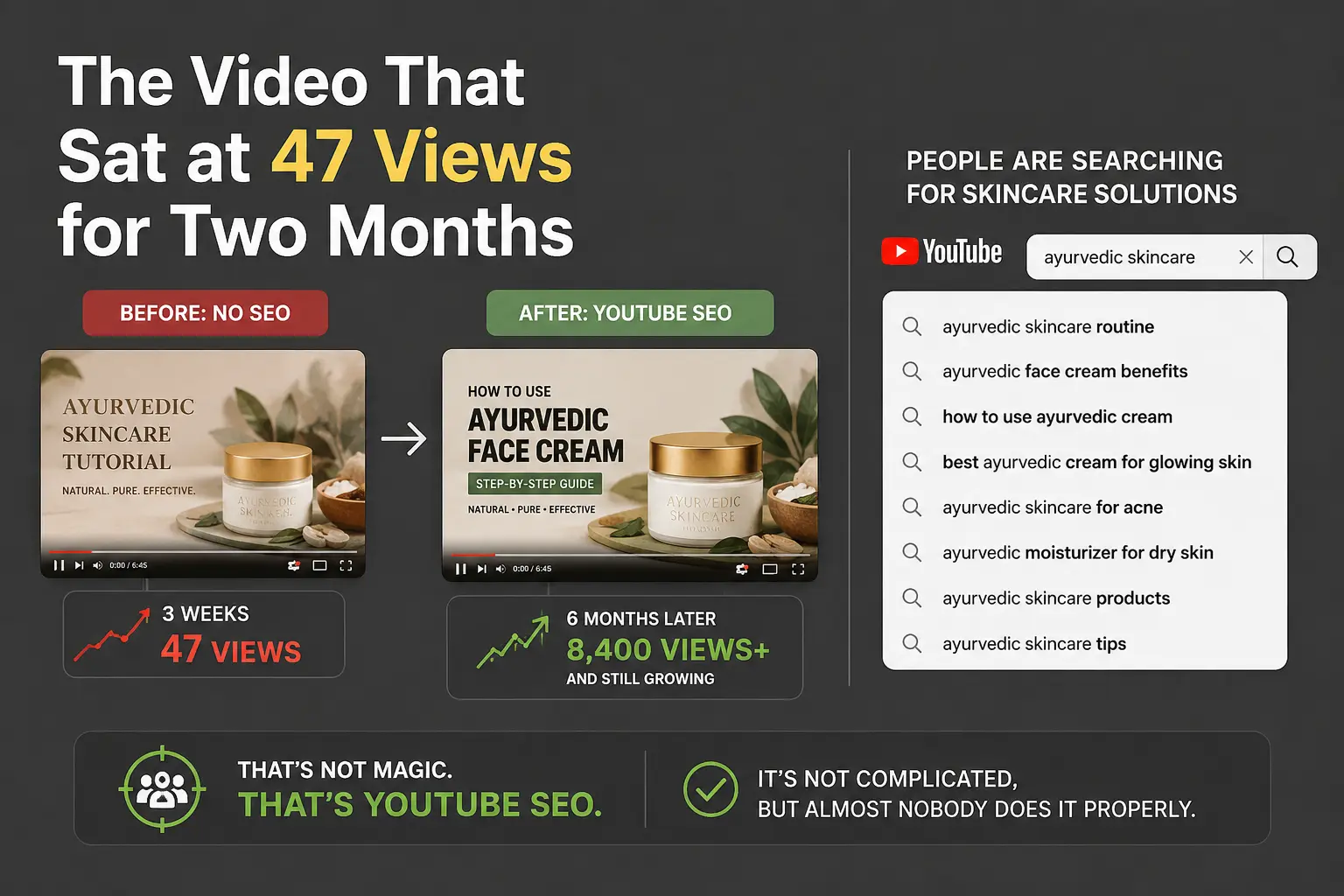
The Video That Sat at 47 Views for Two Months
Last year, a skincare brand we work with — they make ayurvedic creams, based in Nashik — uploaded their first product tutorial video.
Professional shoot. Lights, camera, the works. Beautiful intro. Sayantan’s team spent a week editing it. The founder was excited. We uploaded it to YouTube.
By week three, it had 47 views. Most of them were probably from the team checking it.
Then we sat down and did proper YouTube SEO. New title. Description rewritten. Tags added. Better thumbnail — still kept the professional look but changed the text overlay to something more direct. Playlists, cards, everything in place.
Six months later, that same video is at 8,400 views. And it’s still getting traction every week.
That’s not magic. That’s YouTube SEO. It’s not complicated, but almost nobody does it properly.
What Is YouTube SEO, Actually?
YouTube has over 2 billion logged-in users every month. It’s the second-largest search engine after Google. People search for tutorials, answers, entertainment — everything.
YouTube SEO means getting your video to show up higher when someone searches for something you’ve made a video about. Not through ads. Through the organic search results.
And the algorithm? It’s not one thing. It’s a combination of signals: what people search, whether they click your result, how long they watch, whether they engage with it, does the thumbnail stop them, does the title make sense…
Most creators ignore 80% of this stuff and wonder why their videos don’t get views.
The First Thing: Keyword Research for YouTube
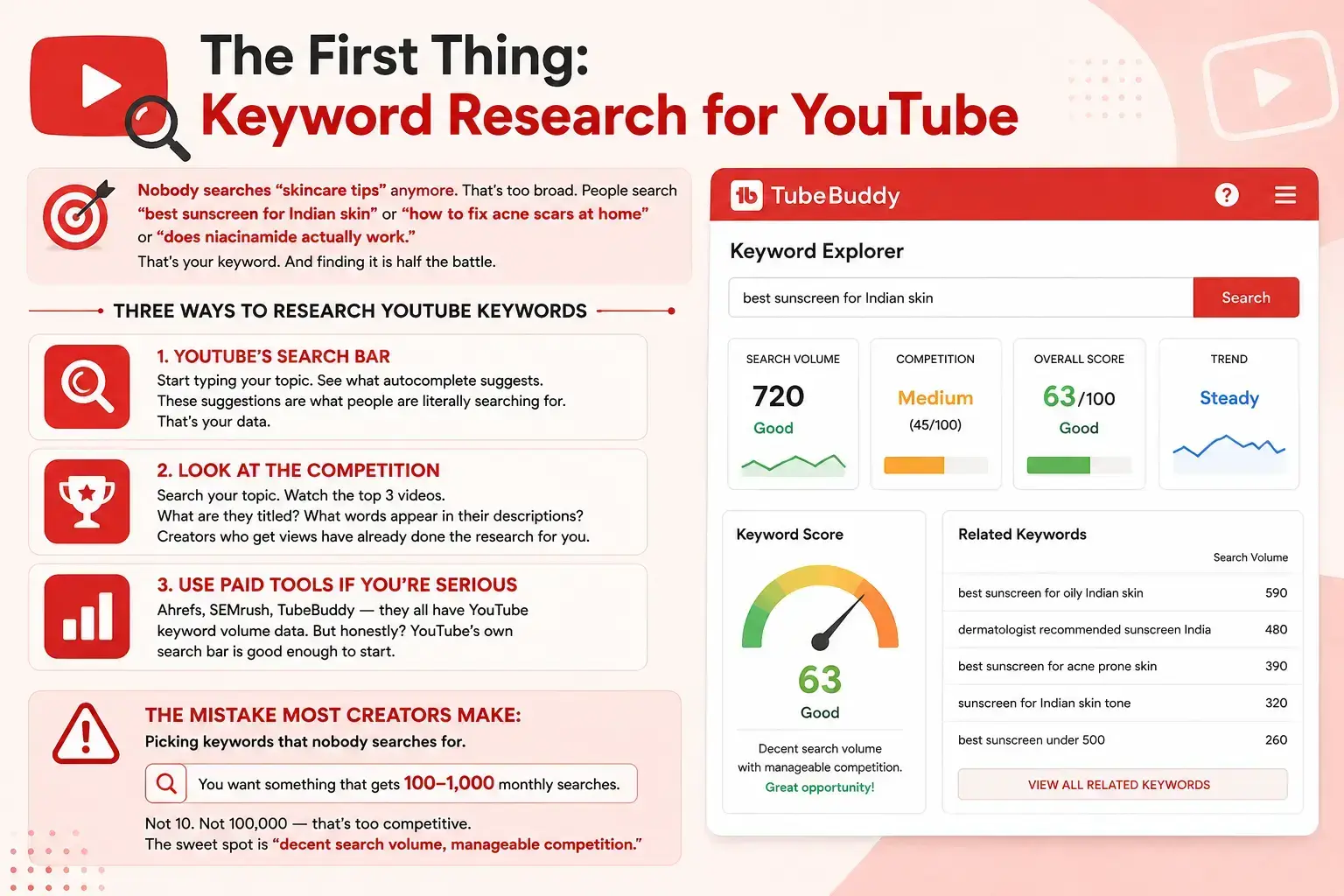
Nobody searches “skincare tips” anymore. That’s too broad. People search “best sunscreen for Indian skin” or “how to fix acne scars at home” or “does niacinamide actually work.”
That’s your keyword. And finding it is half the battle.
Keyword research is foundational — and the same principles that apply to Google SEO apply here. Three ways to research YouTube keywords:
Three ways to research YouTube keywords:
- YouTube’s search bar : Start typing your topic. See what autocomplete suggests. “How to apply…” and there are 20 variations. “Best…” and another 20. The autocomplete suggestions are what people are literally searching for. That’s your data.
- Look at the competition : Search your topic. Watch the top 3 videos. What are they titled? What words appear in their descriptions? The creators who are getting views have already done the research for you — just read their meta information.
- Use paid tools if you’re serious : Ahrefs, SEMrush, Tubebuddy — they all have YouTube keyword volume data. But honestly? YouTube’s own search bar is good enough to start. We’ve built entire video strategies on it.
The mistake most creators make: picking keywords that nobody searches for. You want something that gets 100-1,000 monthly searches. Not 10. Not 100,000 — that’s too competitive. The sweet spot is “decent search volume, manageable competition.”
Your Video Title — It Needs to Work Twice
Once for the algorithm. Once for the human clicking.
The algorithm cares that your keyword is in the title. Ideally in the first 40 characters because that’s what shows on mobile. The human cares that the title makes them curious enough to click instead of the three other videos on the results page.
This is where most titles fail. They’re either optimised for the algorithm (clunky, keyword-stuffed, boring) or optimised for clicks (clickbait, misleading, you click and regret it).
Here’s what works: keyword first, then hook. “Best Sunscreen for Oily Skin in India | Dermatologist Tested” — the keyword is there, but the human is clicking because they want to know if it’s dermatologist tested.
Or flip it: “This Sunscreen Changed My Skin | Best SPF for Indian Weather” — the hook comes first, the keyword is strong in the second part. Both work. Both are honest. Neither is clickbait.
Bad title? “Sunscreen.” “Skincare routine.” “Product review.” These could be about anything. YouTube’s algorithm has no idea what you’re actually reviewing.
Long titles (50-60 characters) usually outperform short ones. But don’t stuff keywords. That’s 2019 thinking.
The Description — Where Most People Give Up
We see descriptions like: “Check out our skincare routine! Like and subscribe for more content.” That’s it. Five sentences.
YouTube actually reads the first 3-4 lines of your description before people have to click “show more.” That space is valuable real estate.
Put your keyword in the first two lines. Naturally. Not forced. Then a quick summary of what the video’s about. Then links — to your website, related videos, playlist. Then hashtags at the bottom (they mostly don’t matter, but people will still find them useful).
A good description reads like you’re explaining to a friend what the video is about. Not like a marketing copy.
“In this video, we test three sunscreens that actually work for oily, acne-prone skin in India’s heat. We test on real skin (not just lab conditions), show application, talk about the ingredients, and compare prices. If you’ve struggled with sunscreen feeling greasy, this one’s for you.”
That’s 3 sentences. Clear. Has your keyword. Sets expectations. The algorithm understands it. A human reading it thinks, okay, this video is actually relevant.
Tags — Honestly, Overrated But You Should Still Do Them
Tags tell YouTube “this video is about X topic.” But YouTube understands that from your title and description already. So tags are secondary.
Still, add them. Your primary keyword as one tag. A few variations. Maybe a broader related tag. Don’t tag everything under the sun — the algorithm notices if you’re tagging irrelevantly and it actually hurts.
Pro tip: look at the top videos in your space. Click “more” on the video details. You can see their tags (there are extensions that show this). Steal from the winners.
The Thumbnail — This Determines Everything
Click-through rate (CTR) is huge for YouTube rankings. If 5,000 people see your video thumbnail and 50 click, that’s a 1% CTR. If another video has 5,000 impressions and 250 clicks, that’s 5% CTR.
That creator’s video will rank higher. Because YouTube assumes “more people wanted to watch this one.”
Thumbnail rules that actually work: high contrast colours (not dark blues against dark backgrounds), a clear face or emotion if relevant, text overlay that’s readable even when shrunk to thumbnail size, curiosity without being outright misleading.
We spent weeks arguing about thumbnails. Some of our team swore by bright yellows and reds. Others preferred softer palettes. Truth? Both work — if they’re different from everything else in the search results.
Do a competitive thumbnail audit. Look at the top 10 results for your keyword. What do their thumbnails have in common? Now do something different but professional. This is where strong creative designing instincts really pay off.

Engagement Signals — The Stuff That Actually Keeps You Ranking
YouTube cares about watch time above almost everything else. If people click but leave after 5 seconds, it’s a weak video signal.
But they also care about likes, comments, shares. And most importantly, whether people watch multiple videos from your channel in one session (because that’s more ad revenue for YouTube).
The catch? You can’t force engagement. You can only make videos good enough that people want to engage.
But you can structure for it. End screens linking to your next video (people are more likely to click if you ask). Cards in the middle of videos pointing to relevant content. Playlists grouping related videos. All of this increases the likelihood someone watches more from your channel.
Comments matter. More comments = more signal that your video is interesting. We’ve seen creators respond to every comment in the first 24 hours and their videos consistently outrank. Is it a coincidence? Probably not.
The tough part: if your video is boring, none of this matters. No amount of clever playlisting saves a bad video.
The Campaign That Actually Worked (And The Numbers)
That skincare brand we mentioned. Let me walk through what we did, month by month.
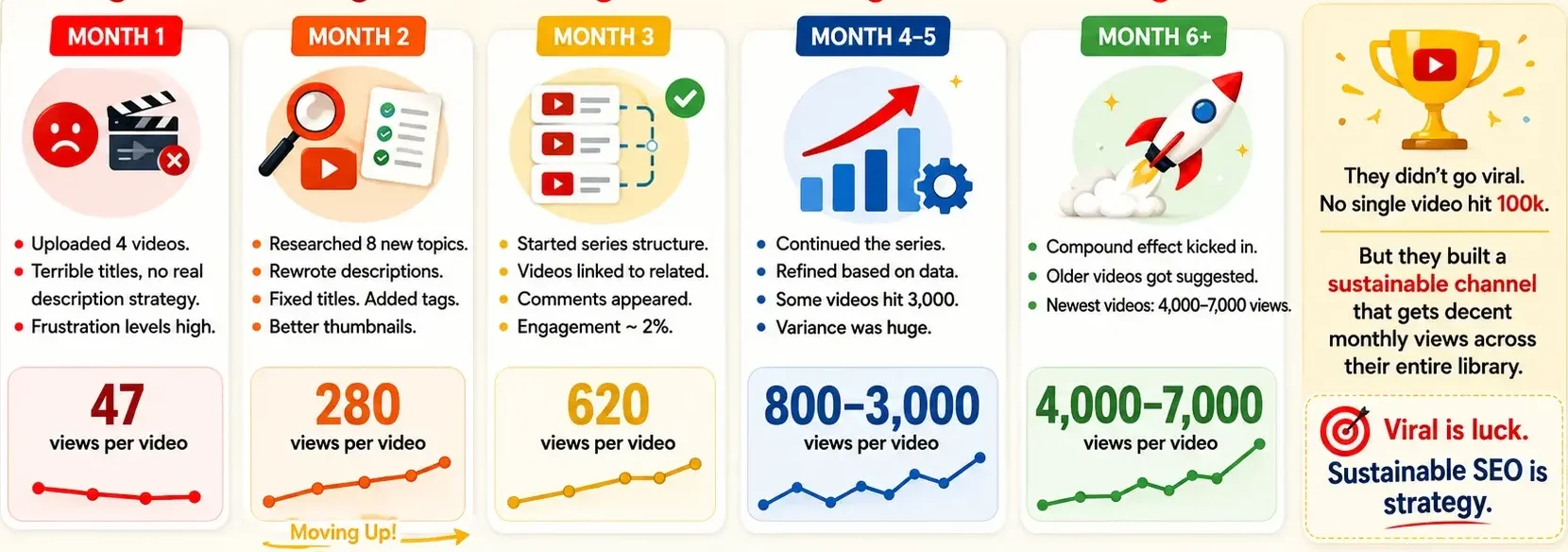
Month 1: Uploaded 4 videos. Terrible titles, no real description strategy. 47 views per video average. Frustration levels high.
Month 2: Researched 8 new video topics using YouTube search bar + competitor videos. Rewrote descriptions for all old videos. Fixed titles. Added proper tags. New uploads had better thumbnails. Average per video went to 280 views. Still not great. But moving.
Month 3: Started a series structure — “Sunscreen Showdown,” “Skincare Myths Busted,” etc. Each video linked to related ones. Average climbed to 620 views per video. Comments started appearing. Engagement rate went from basically zero to maybe 2%.
Month 4-5: Continued the series, refined based on what was working. Some videos hit 3,000 views. Others still around 800. The variance was huge. But the average kept climbing.
Month 6 onwards: The compound effect kicked in. Older videos started getting views from suggested video sections. A six-month-old video about “best sunscreen for monsoon season” got 400 views in a single month because YouTube started recommending it. Newest videos getting between 4,000-7,000 views.
They didn’t go viral. No single video hit 100k. But they built a sustainable channel that now gets decent monthly views across their entire library. That’s the real win. Viral is luck. Sustainable SEO is strategy.
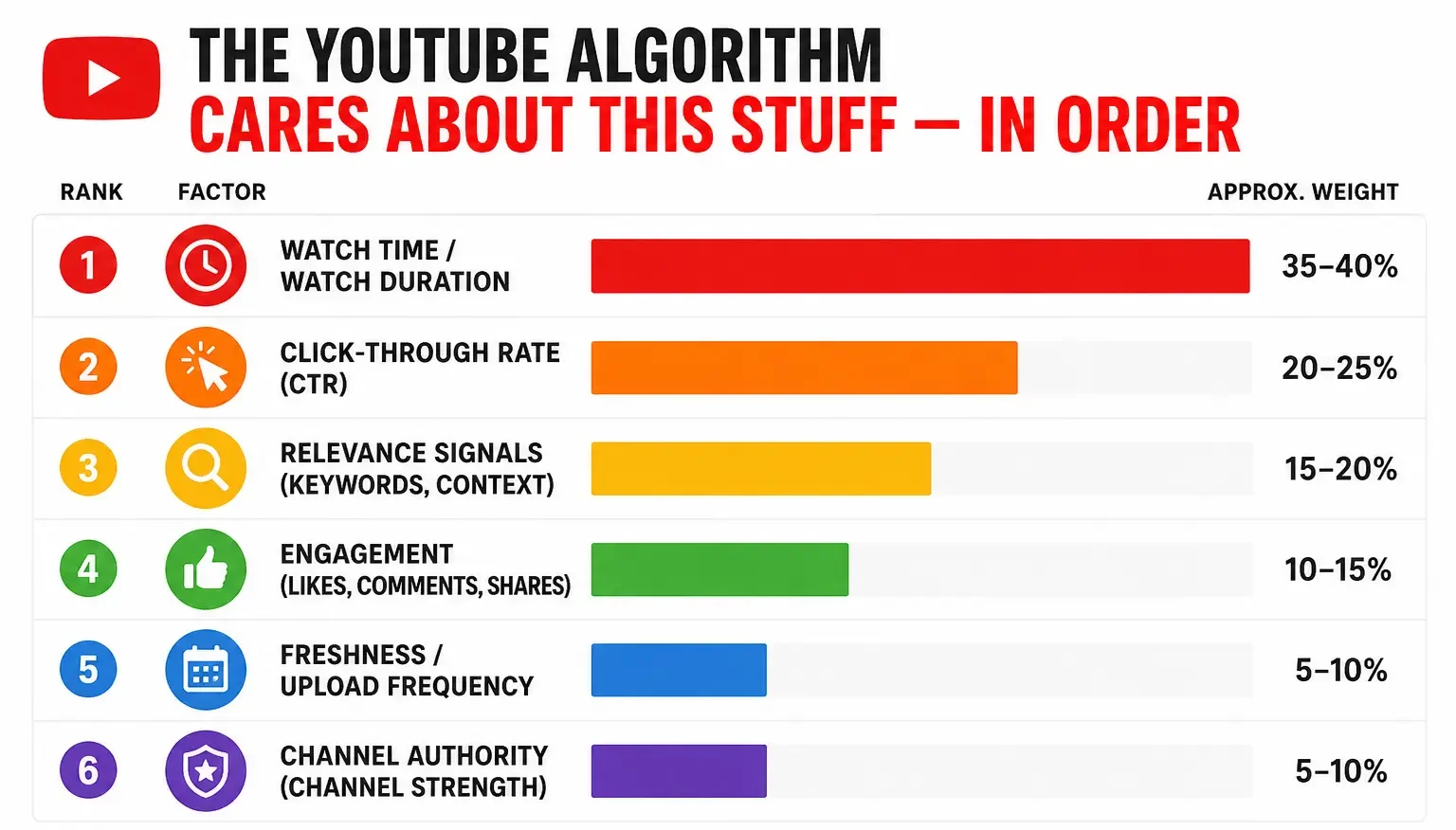
The YouTube Algorithm Cares About This Stuff — In Order
Not all ranking factors are equal. We’ve tested enough to know roughly how much weight each one gets (rough estimate):
- Watch time / Watch duration — How long people actually watch your video. If 10% quit after 30 seconds, that’s a weak signal. If 40% stay for the full 10 minutes, that’s strong. This is maybe 35-40% of the algorithm.
- Click-through rate — Did the thumbnail and title make people click when they saw it in search results? 20-25% of the ranking weight.
- Relevance signals — Keywords in title, description, tags. But YouTube understands context now, so cramming keywords doesn’t help. 15-20% weight.
- Engagement — Likes, comments, shares. But watch time is more important. 10-15%.
- Freshness / Upload frequency — Channels uploading consistently rank better. But it’s not the biggest factor. 5-10%.
- Channel authority — Bigger channels rank easier. But a smaller channel with better watch time metrics beats a big channel with weak metrics. 5-10%.
Most creators focus on #3 and #4 (keywords and engagement) and ignore #1 and #2 (watch time and CTR). That’s backward.
What About YouTube Shorts?
Shorts get treated differently. They have their own recommendation engine, separate from long-form videos. You can’t really “SEO” a Short the way you do a 10-minute video.
But there’s a crossover: create Shorts from your long-form content, add a link in the description to the full video. Some people will click through. That helps both videos.
Shorts are more about consistency and entertainment value. Long-form YouTube videos are where SEO actually works. This is also why video marketing remains one of the highest-ROI channels when done with proper strategy behind it.
The Mistakes We See Constantly
- Uploading and abandoning : Video goes live, no description refinement, no follow-up video linking to it, no consistency. And then they wonder why nobody watched it. YouTube rewards channels that upload regularly. Not sporadically.
- Chasing trends instead of building strategy : Last month we had a client who wanted to jump on the latest beauty trend. We said no — stick to your core topics. They pushed back. They made the trend video. Got 340 views. Then went back to their core topic videos, which consistently get 2,000+. Lesson learned, slowly.
- Keyword research based on gut feel : “I think people search for this.” No. Data. Use YouTube’s search bar. Look at competitor videos. Use free tools at minimum. Your gut is wrong.
- Bad audio quality : Visual quality gets maybe 60% credit. Audio gets 40%. A video with great visuals but harsh audio, bad mic, wind noise — people leave. We’ve seen it tank CTR by half.
- Too many calls-to-action : “Like and subscribe and comment and ring the bell and check out the link in the description…” People are annoyed by 30 seconds in. One CTA, at the end, delivered naturally. That’s it.
Getting Started: What You Actually Need to Do
Okay, you’re convinced. What’s the action plan?
Pick a topic. Search it on YouTube. Spend 10 minutes looking at the top 5 results. Write down: their titles, keywords used, description structure, thumbnail style, video length, engagement metrics (visible in comments and likes). This is your competitive baseline.
Brainstorm 10 video ideas based on this. Not just copy competitors — but in the same space, different angles. Use YouTube’s autocomplete. See what variations exist.
Pick the one with moderate search volume (100-500 monthly searches) and lower competition. Shoot it. Edit it. Write a proper title, description, tags. Upload.
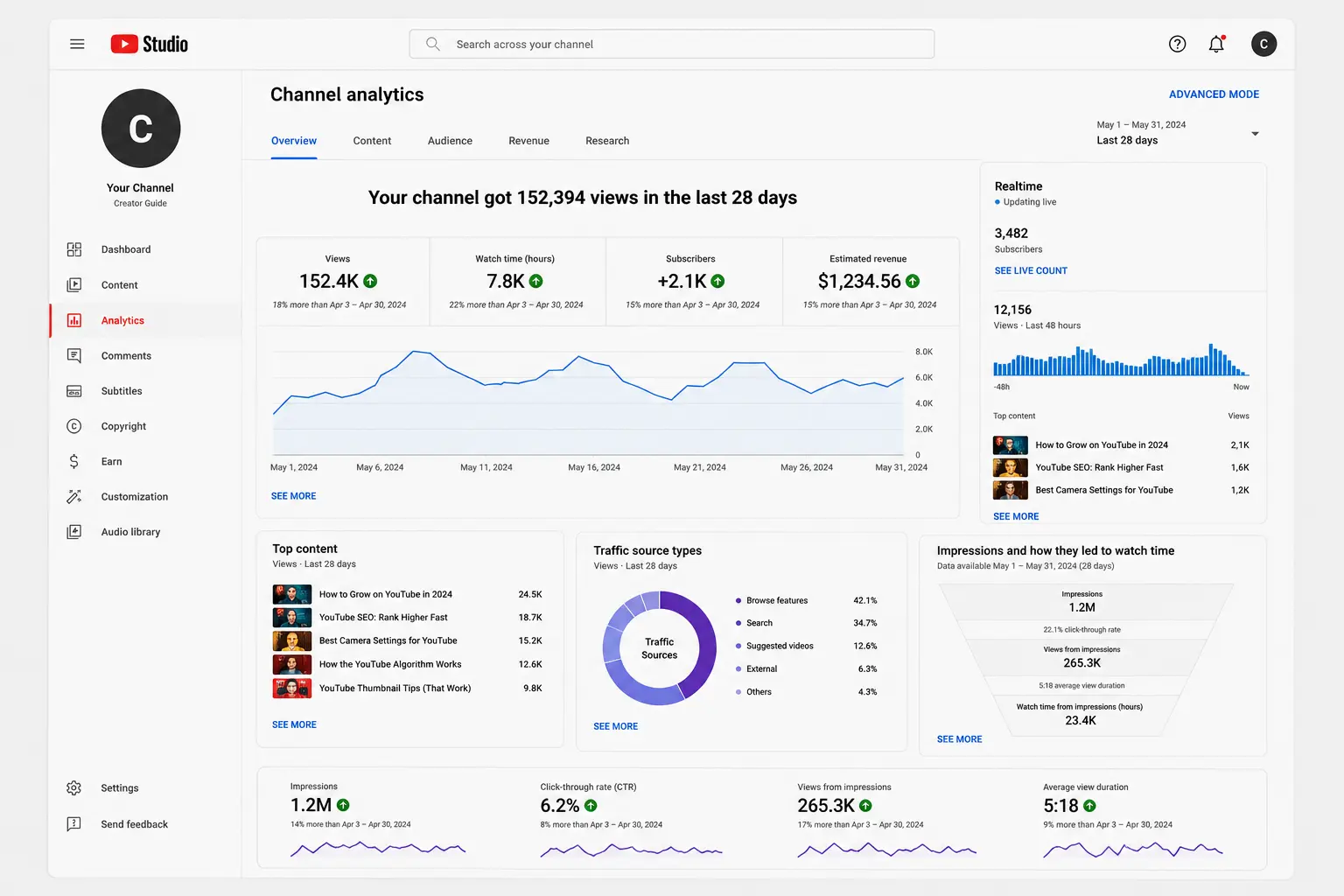
Wait two weeks. Check analytics. Did people click the thumbnail? Did they watch the full video? Did they like it? Adjust your next video based on these insights.
Build a schedule. Commit to one video per week (or whatever cadence you can sustain) for at least 6 months. Consistency matters more than perfection.
Interlink. Create a series or playlist. Point each new video to related older content. Make it easy for someone to watch three of your videos in one session.
Check analytics monthly. See which videos are working. Understand why. Double down on those formats.
Why We Keep Coming Back to This
YouTube traffic is free traffic. Once you’ve built a library of ranked videos, they keep generating views. Month after month. Years, in some cases.
Google Ads? You stop paying, views stop immediately. YouTube SEO? Stop uploading and maybe there’s a dip, but your old videos keep working.
And there’s a compounding effect. More views lead to more recommendations, which lead to more views, which lead to more channel authority, which makes your new videos rank faster.
The creator we worked with is now — eight months later — getting roughly 3,000 views a day across their entire channel. They don’t have a massive audience. But the engagement is consistent. The leads for their skincare brand are consistent. The revenue, therefore, is consistent.
That’s not exciting like going viral. But it’s reliable. And reliability beats viral every time in business.
If you’re thinking about video content for your brand — whether you’re a coach, a product company, an educational brand — YouTube SEO deserves your attention. It’s not complicated. Most creators just don’t do it properly.
Want to build a video strategy that actually ranks? Or audit why your current videos aren’t getting traction? Talk to our creative and content teams. We’ve built strategies for food brands, beauty companies, coaches, SaaS platforms, and everything in between. Let’s figure out what makes sense for your specific situation.
| Approach | Best for | Watch out for |
|---|---|---|
| DIY | Small teams, tight budgets | Slow ramp-up, trial-and-error |
| Freelancer | Specific project bursts | Inconsistency, limited ownership |
| Agency | Ongoing work, senior input | Higher retainer, less control |
Quick checklist before you start:
- Define the one thing you want: leads, sales, awareness — pick one.
- Baseline your numbers: write down where you are today.
- Pick a 90-day window: nothing moves in 2 weeks.
- Agree on success metrics: with whoever is paying the bill.
- Set up proper tracking: GA4, UTMs, call tracking.
- Review monthly: kill what doesn’t work, double down on what does.
The Bottom Line
If you take one thing from this: youtube seo rank your videos higher in search results rewards patience and specificity, not volume or clever tricks. Start small, measure honestly, fix what breaks, and compound what works. The brands doing this well in India aren’t smarter — they’re just consistent. Need a hand with this for your business? Talk to us.
Ready to Build a Video Strategy That Ranks?
PromotEdge has been producing and optimising video content for 250+ brands for over a decade. From YouTube SEO to full content production, we know what works. Let’s talk about your video goals.
FAQs
-
How do I rank my YouTube video higher?
Ans.Find a keyword people are searching for. Put it naturally in your title — first 40 characters ideally. Write a description that explains what the video is about in the first 2-3 lines. Make a thumbnail that stops people from scrolling. But honestly? None of that matters if people click and then leave. Watch time is king. Make videos people actually want to finish watching. That sounds obvious, but most videos fail here. -
Does YouTube SEO actually work, or is it just luck?
Ans.It works. Not as fast as you want, and not like going viral (which is luck). But if you do the keyword research, build a content strategy around 6-8 related topics, upload consistently for 6+ months, and actually care about making good videos — the views compound. We have seen it happen repeatedly with creators who had zero traction initially. -
How long before I see results from YouTube SEO?
Ans.Three to four months minimum to see meaningful movement. In month one and two, you are likely building the foundation — uploading videos, refining your approach, figuring out what resonates. Month three is where rankings start shifting. By month six, if you have been consistent, the compounding effect becomes visible.
Author Details

Latest Posts
-
 24 / Sep
GMB Optimisation Google Business Profile Optimization Guide 2026
24 / Sep
GMB Optimisation Google Business Profile Optimization Guide 2026 -
 23 / Sep
Search Engine Optimization Programmatic SEO: Template + Data Model Explained
23 / Sep
Search Engine Optimization Programmatic SEO: Template + Data Model Explained -
 22 / Sep
Conversion Rate Optimization Conversion Rate Optimization: A Practical Guide
22 / Sep
Conversion Rate Optimization Conversion Rate Optimization: A Practical Guide -
 21 / Sep
Whatsapp Marketing WhatsApp Marketing for Indian SMBs
21 / Sep
Whatsapp Marketing WhatsApp Marketing for Indian SMBs -
 19 / Sep


Related Knowledge