
-
Author: Anindita Barik
-
Updated Date: Jul-14-2026
-
Views: 2 Min Read
User-generated content is the marketing strategy where customers create photos, reviews, and videos that promote your brand — often outperforming polished branded content. This blog explains what counts as user-generated content, why it drives 4.5x higher click-through rates and 30% better conversions, and how brands can ethically collect it through hashtag campaigns, packaging prompts, and contests. It also covers legal permissions, common mistakes, and real Indian brand case studies showing measurable results.
Why Your Customers Are Better Marketers Than You
This might sound brutal. But it’s true.
Your marketing team can spend months polishing an Instagram post. The lighting is perfect. The caption is witty. The call-to-action is optimised. It gets 200 likes and 3 conversions.
Meanwhile, a customer posts a blurry phone photo of your product. Bad lighting. Caption is just a heart emoji and a tag. It gets 2,000 views and 15 conversions.
The difference? The customer’s photo is real. People believe other people more than they believe brands. It’s not new psychology — humans have known this forever. But in 2026, with ad fatigue at an all-time high, real customer content is basically a cheat code.
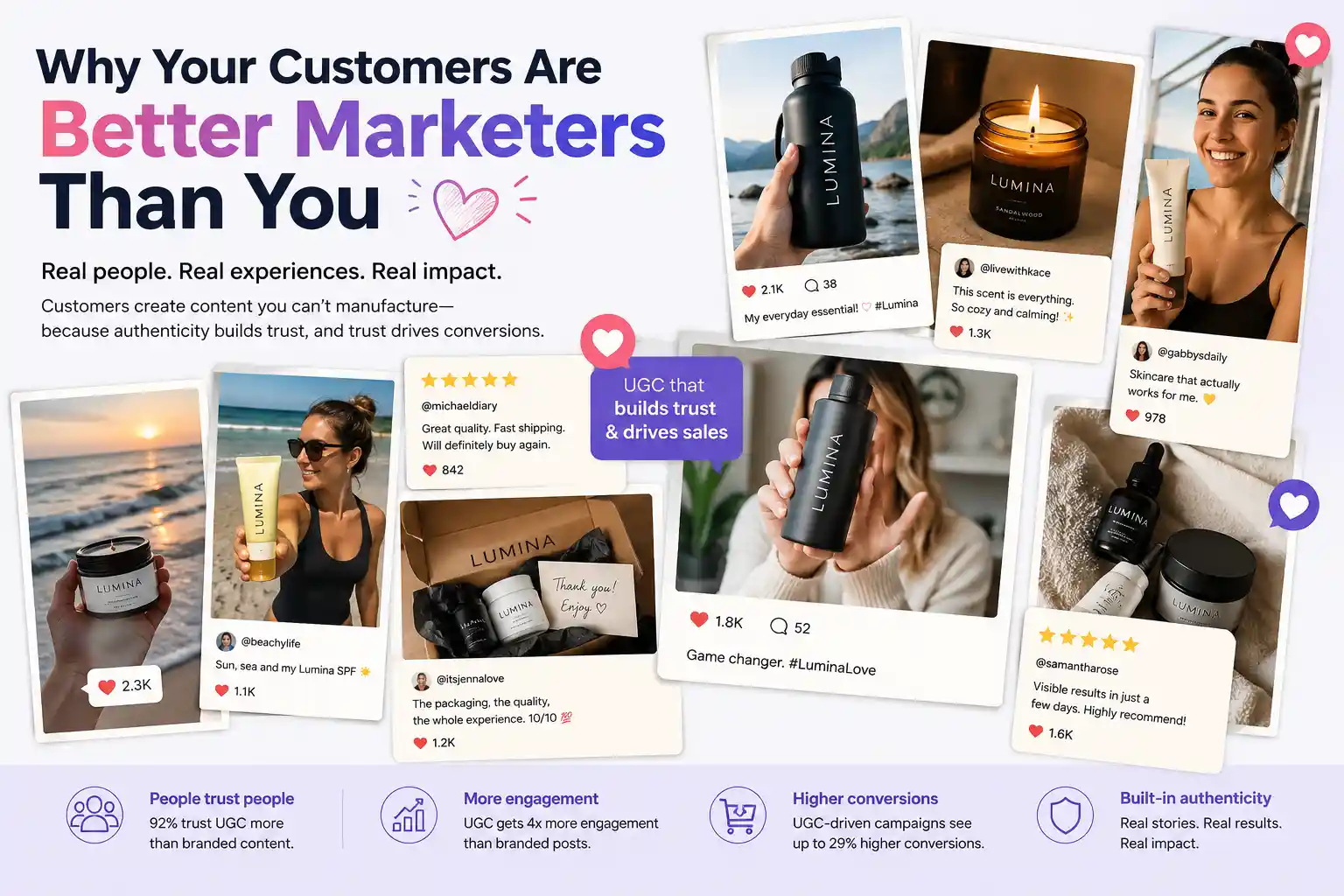
User-generated content — or UGC — is one of the few marketing channels that actually gets better the more authentic you let it be. It’s backwards from everything else. And that’s exactly why it works. It’s also one of the most cost-efficient tools in any digital marketing strategy — the content is created by your customers, the trust is built by your customers, and the conversions follow naturally.
What Actually Counts as UGC?
Any content your customers create that mentions or features your brand. That’s it. The list is long:
- Product photos (someone holding your product, wearing it, using it)
- Customer reviews or testimonials
- Social media posts (Instagram, Facebook, Twitter, YouTube shorts)
- Videos of your product in action
- Blog posts or articles people write about your brand
- Comments and feedback on your posts
- Before-and-after photos (beauty, fitness, home improvement)
- Unboxing videos
- Testimonial quotes
- Customer stories or case studies
The key detail: the customer created it. You didn’t stage it, photograph it, or script it. It’s theirs. Yes, you can repost with permission, but the creation was their idea.
Why UGC Works
Trust is the issue. People don’t trust ads anymore. Ads feel like ads. UGC feels like a friend’s recommendation. Your brain knows the difference and reacts accordingly.
The data backs it up: UGC gets 4.5x higher click-through rates than branded content. Conversion rates are 30% higher. Cost per acquisition is often 50% lower. And — this is the wild part — customer content gets more engagement than brand content even on the brand’s own account.
We worked with an apparel brand about 18 months ago. Their Instagram posts of styled outfits got maybe 300-400 likes. Then they ran a campaign asking customers to post their own fits. Same products, customer photos. Those posts got 1,200+ likes, 40+ new followers, and better sales numbers. The product was identical. The only difference was who took the photo.
Why don’t all brands do this? Because it requires letting go of control. Brands are obsessed with perfection. Perfect lighting, perfect angles, perfect messaging. UGC is messy and imperfect and real. Some CFOs hate it. Fortunately for us, that means less competition for brands willing to try it.
Types of UGC
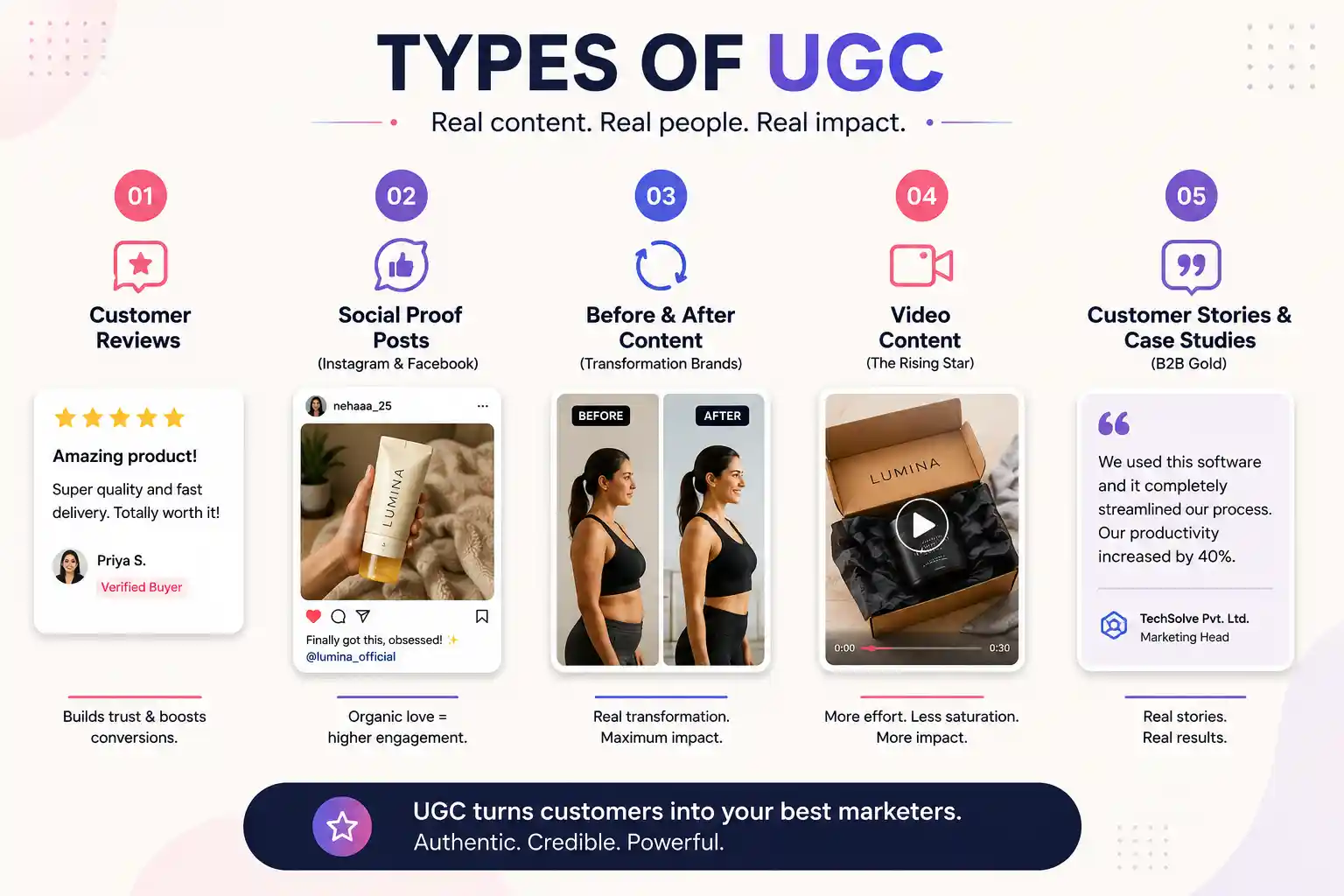
1. Customer Reviews (Most Underrated)
A product page with 47 five-star reviews outsells the same product with perfect photography. People read reviews before they buy. Full stop. We’ve seen conversion rate jumps of 20-30% just from adding more customer reviews to product pages.
Reviews need to be visible, searchable, and easy to leave. Amazon figured this out. Most Indian brands are still fighting it.
2. Social Proof Posts (Instagram & Facebook)
A customer posts a photo of your product with a caption like “Finally got this, obsessed” — that’s gold. It feels organic because it is. These posts cost you nothing. The engagement is usually higher than paid ads. You repost with credit and permission, and suddenly your follower base sees real proof of happiness.
3. Before-and-After Content (For Service/Transformation Brands)
Beauty, fitness, education, real estate — anything with transformation. A customer posts their before-and-after. That’s the most powerful UGC you can get. It’s proof. It’s vulnerable. It’s real. We worked with a fitness brand and before-and-after posts from customers got literally 10x the engagement of their trainer-posted fitness tips.
4. Video Content (The Rising Star)
Unboxing videos, product reviews on YouTube, TikTok videos, Instagram Reels of someone using your product — video UGC is exploding. It’s more effort than a photo, so fewer people do it, which means less saturation. If you can encourage video UGC, you win. As we break down in why video marketing is the ultimate tool for promoting businesses, authenticity in video converts far better than production value — and UGC video is the most authentic format that exists.
5. Customer Stories & Case Studies (B2B Gold)
A customer writing about how your product solved their problem — this is basically marketing itself. For B2B, this is huge. A real company saying “we used this software and here’s how it impacted our business” is more credible than your sales page saying the same thing.
How to Actually Get Customers to Share (Not Force It)
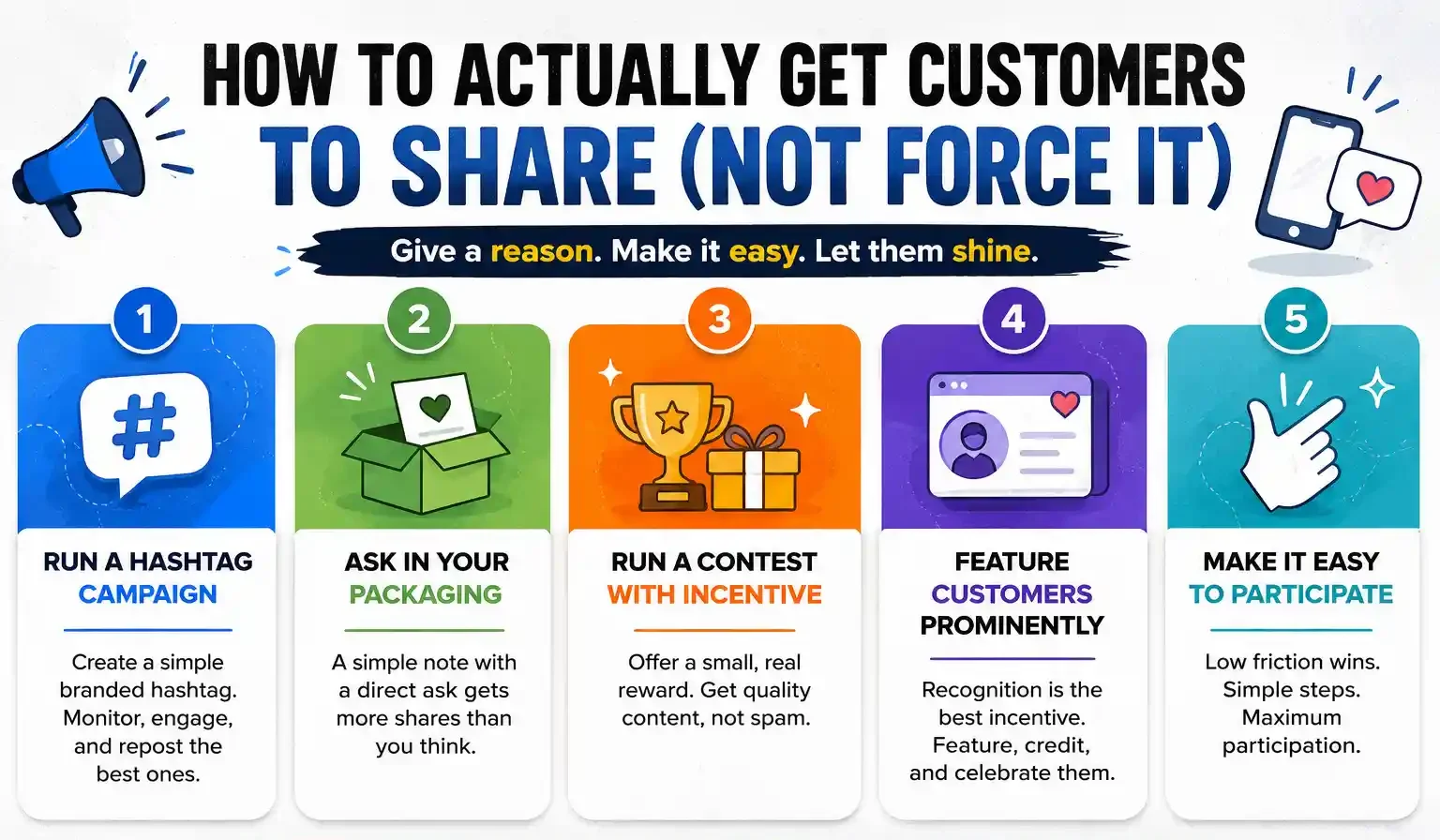
Most brands try to beg. “Please tag us!” Begging doesn’t work. You need a real incentive or a really easy way to participate. Or both.
-
Run a hashtag campaign
Create a branded hashtag. Ask customers to post using it. Make it simple — #MyBrandStory or #WearOurBrand. Don’t make it complicated. Then monitor the hashtag and repost the best ones. We had a clothing brand run #StyleWithUs and got 300+ customer posts in two months without paying a single rupee.
-
Ask directly in your product packaging
Include a note: “Love our product? Share your photo and tag us @yourbrand for a chance to be featured.” Physical packaging + direct ask = surprisingly high response rate. You’d think people would ignore it, but they don’t.
-
Run a contest with a small incentive
Not a massive prize — that attracts spam. But something real. “Post your unboxing, tag us, and the best 10 win a discount code.” You get content, winners feel special, others see winners getting prizes and want to participate next time.
-
Feature customers prominently
The best incentive is recognition. Create a “Customer Stories” section on your website. Feature people by name and photo. Post their content on your accounts with credit. Once people see they’ll be featured, they start sharing more. It costs nothing and people often find it more valuable than a discount.
-
Make it easy to participate
Low friction. A single hashtag. A simple tag. A URL to a form. Don’t ask for 47 pieces of information. You want volume? Make participation effortless.
The Legal Minefield
This is where most brands mess up.
Just because someone posted about your brand doesn’t mean you can use that content. They own the copyright. You don’t. Reposting someone’s photo without permission is technically copyright infringement — even if they tagged you.
So what do you do?
Always ask. Send a DM: “We love your post! Can we share it on our account with credit?” Most people say yes. Takes 30 seconds. Always credit the original creator — in the caption, tag them, mention their handle.
Make it easy upfront. In your hashtag campaign, include terms. “By using this hashtag, you grant [Brand] permission to repost and use your content.” Legal language, but clear. Most platforms have standard UGC terms — use them.
If someone says no, respect it. Some people don’t want their photo reposted. That’s their right. Move on. There are plenty of other posts.
For commercial use (like ads), negotiate. If you want to use someone’s photo in a paid ad campaign, you’re getting the value beyond exposure. Offer payment or a significant incentive. It’s the right thing and it avoids legal headaches.
We had a brand repost customer photos for a year without asking. Turned out one customer actually had a lawyer — threatened copyright suit, demanded payment. Situation got messy. Now we always ask. It’s not just legal; it builds goodwill.
Real Campaign Examples
Here are a few recent campaigns from Indian brands that successfully encouraged customers to create authentic content and significantly boosted engagement.
Fashion Brand — The Styling Challenge
A mid-size apparel brand running out of Bangalore asked customers to style their pieces and post on Instagram with #StyleOurCollection. They featured the best outfits on their main feed and Stories, gave those people a Rs 5,000 gift voucher. Got 600+ submissions in month one. Engagement rates were 4-5x their normal posts. More importantly, website traffic from Instagram doubled — people saw real people wearing real outfits and clicked to shop.
Food Brand — The Taste Test
A snack brand sent product samples to 100 micro-influencers and home cooks. Didn’t ask them to post anything specific — just asked them to share if they wanted. People loved it and posted naturally. The brand reposted with permission and credit. No paid partnership, no scripted content. Just real tasting, real reactions. The organic reach on those posts was insane because they didn’t look like ads.
Real Estate — The Move-In Stories
A construction company asked residents to share photos and stories of their new homes. Ran a hashtag campaign. Got hundreds of real family photos, celebrations, move-in day moments. Repurposed all of it into a video montage for their YouTube channel and website. Emotional, authentic, way more credible than their sales videos. New project launches got 30% more inquiries — people saw real families actually enjoying the properties.
SaaS Company — The Case Study Approach
A B2B software company reached out to their happiest customers and asked them to share their stories. Offered a featured case study on their website. No payment, just visibility. Got 8 detailed customer stories. Each story was 800+ words and became a blog post, a case study page, and marketing collateral. Conversion rates from organic search jumped 45% in four months. This is content marketing strategy and UGC working as the same system — customer stories become search-ranked content that keeps generating leads long after the initial effort.
Where to Collect and Display UGC
You need places to collect it and places to showcase it.
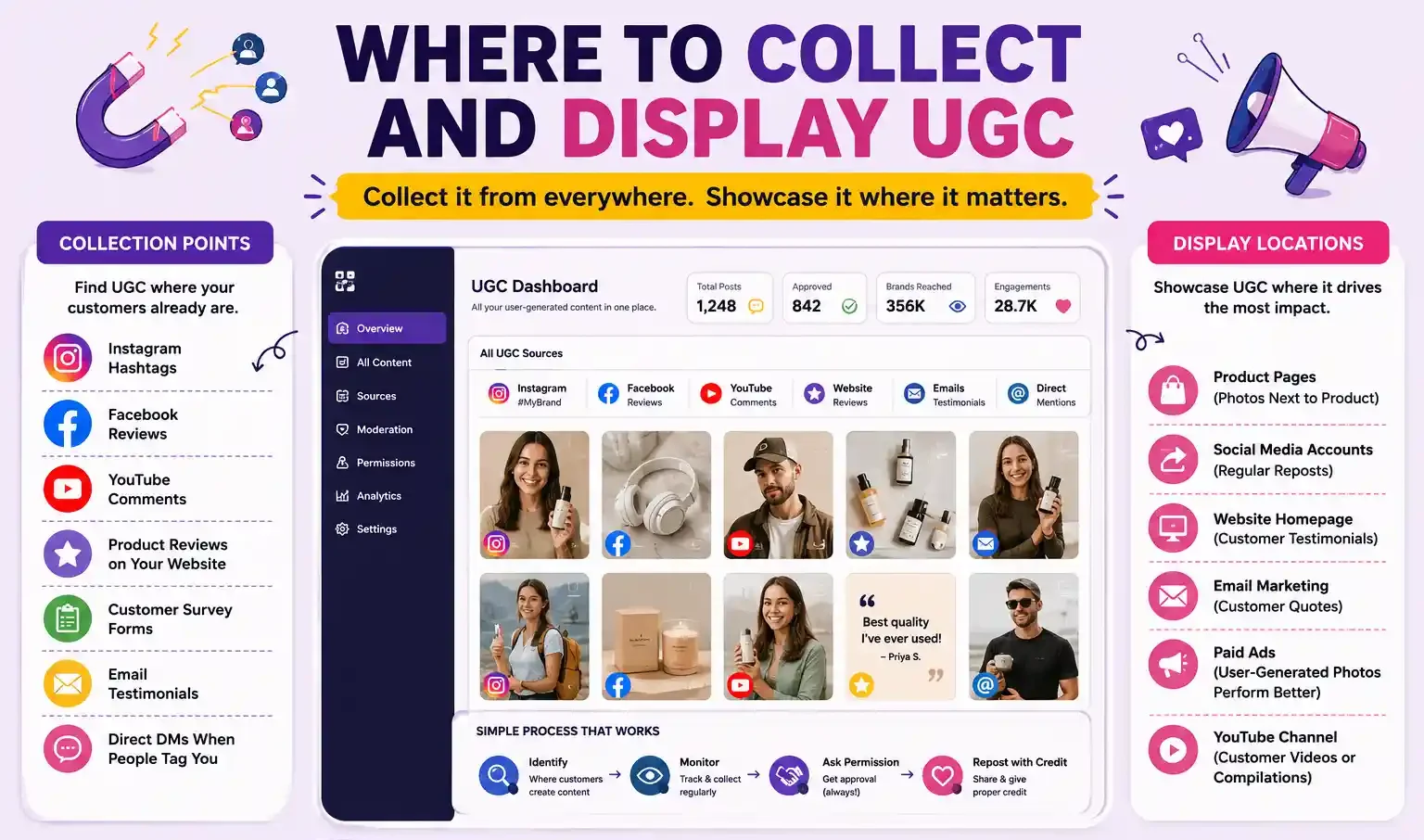
Collection points: Instagram hashtags, Facebook reviews, YouTube comments, product reviews on your website, customer survey forms, email testimonials, direct DMs when people tag you.
Display locations: Product pages (photos next to product), social media accounts (regular reposts), website homepage (customer testimonials), email marketing (customer quotes), paid ads (user-generated photos perform better than branded ones), YouTube channel (customer videos or compilations).
We usually recommend a simple process: identify where customers are creating content naturally, set up monitoring, ask permission, repost with credit. Sounds simple because it is. Most brands just fail at the “ask permission” step.
The Mistakes Brands Make With UGC
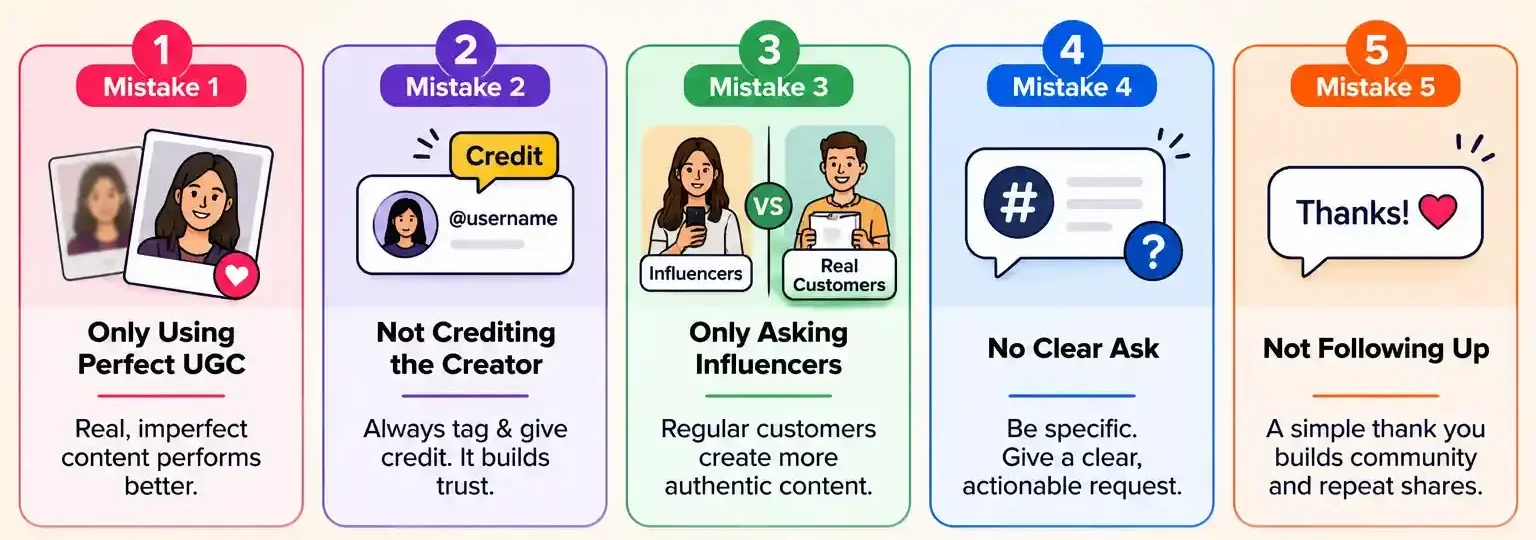
Many brands embrace user-generated content but unknowingly make mistakes that reduce its impact. Avoiding these common pitfalls can help you build trust, encourage participation, and get better results from every campaign.
Mistake 1:
Only using pretty, perfect UGC. The slightly blurry photos, imperfect lighting, real reactions — those perform better. Brands see an imperfect photo and don’t repost because it’s not “professional enough.” That’s backwards. The imperfection is the asset.
Mistake 2:
Not crediting the creator. Repost without tagging, without mentioning their name, without asking. It feels sketchy to the creator and to your audience. Always credit. It builds relationships and encourages more people to share knowing they’ll get visibility.
Mistake 3:
Only asking influencers for UGC. Regular customers often create better, more authentic content. Influencers are incentivized. Customers create because they genuinely like the product. The difference shows.
Mistake 4:
Running UGC campaigns without a clear ask. “Post about us for a chance to win!” is vague. Better: “Post a photo of how you use our product using #[hashtag] for a chance to be featured on our Instagram.” Clear, specific, actionable.
Mistake 5:
Not following up with participants. Someone shares your product, you like it and repost. Then radio silence. A follow-up (even a message saying “thanks for sharing!”) encourages repeat sharing and builds community. Small effort, big impact.
Mixing UGC With Other Marketing Channels
UGC doesn’t replace everything else. It works best as part of a bigger strategy. Combine it with social media strategy, paid ads (use UGC photos in ads — they convert better), content marketing (use customer stories as blog posts), and email.
A good integrated approach: organic UGC builds trust and engagement, paid ads amplify the best UGC, email nurtures people who engaged, influencer marketing adds reach. Each channel supports the others.
We’ve seen brands that only do UGC plateau. Brands that mix UGC with paid amplification, email follow-up, and content strategy see compounding growth. Same content, different distribution, way better results.
Measuring UGC Success
Track three things: volume (how much UGC you’re getting), engagement (likes, shares, comments on UGC vs. branded content), and conversions (do people who see UGC actually buy).
We recommend tracking:
- Number of customer posts per month using your hashtag
- Average engagement rate on customer posts vs. branded posts
- Traffic to your website from customer-generated content
- Conversion rate from pages featuring UGC vs. pages without it
- Cost per acquisition if you’re using UGC in paid ads
The beauty of UGC: it’s cheap to produce (you didn’t make it), but it converts well. Most brands find their cost per acquisition actually drops when they start using UGC heavily. That’s why CFOs eventually love it — the ROI is stupid good.
| Approach | Best for | Watch out for |
|---|---|---|
| DIY | Small teams, tight budgets | Slow ramp-up, trial-and-error |
| Freelancer | Specific project bursts | Inconsistency, limited ownership |
| Agency | Ongoing work, senior input | Higher retainer, less control |
Quick checklist before you start:
- Define the one thing you want: leads, sales, awareness — pick one.
- Baseline your numbers: write down where you are today.
- Pick a 90-day window: nothing moves in 2 weeks.
- Agree on success metrics: with whoever is paying the bill.
- Set up proper tracking: GA4, UTMs, call tracking.
- Review monthly: kill what doesn’t work, double down on what does.
The Bottom Line
If you take one thing from this: user generated content leverage your customers for marketing rewards patience and specificity, not volume or clever tricks. Start small, measure honestly, fix what breaks, and compound what works. The brands doing this well in India aren’t smarter — they’re just consistent. Need a hand with this for your business? Talk to us.
Want to Build a UGC Strategy That Actually Works?
We’ve helped 40+ brands collect, curate, and amplify customer content. Some saw 3x engagement improvements. Some discovered entirely new customer segments. Let’s figure out what works for your brand.
FAQs
-
What is user-generated content?
Ans.Any content your customers create mentioning your brand. Photos of your product in use. Reviews. Videos. Testimonials. Social media posts. Blog comments. Even an Instagram story tagging your handle counts as UGC. The key: a customer made it, not your team. -
Do I need permission to use UGC?
Ans.Legally, yes. Just because someone posted about your brand does not mean you own that content. Repost it only if you have permission or a license. Most brands ask in DMs or through a hashtag campaign. Always credit the original creator — it is right and it encourages more sharing. -
How do I encourage customers to create content?
Ans.Run a hashtag campaign, ask directly, make it easy to participate, offer a small incentive (recognition often works better than money). A clothing brand running #WearOurBrand asking people to post fits gets organic UGC. A beauty brand running a contest for best product photos gets volume. Same concept, different execution.
Author Details

Latest Posts
-
 26 / Aug
Search Engine Optimization Video SEO: How to Rank Your Videos in Google & YouTube
26 / Aug
Search Engine Optimization Video SEO: How to Rank Your Videos in Google & YouTube -
 25 / Aug
Video Production Corporate Video Production: A Practical Guide for Indian Brands
25 / Aug
Video Production Corporate Video Production: A Practical Guide for Indian Brands -
 24 / Aug
-
21 / Aug
Catalogue Design Catalogue Design: How to Create Catalogues That Actually Sell
-
 20 / Aug



Related Knowledge