
























Once you know that, everything gets simpler. You write things that actually help people, you show up regularly in the places they already spend time, and you make it easy for them to take a next step when they are ready. The businesses that win at content marketing have built enough trust over time that when someone is ready to buy, they already know exactly who to call.
The blog your competitor is not writing (but should be)
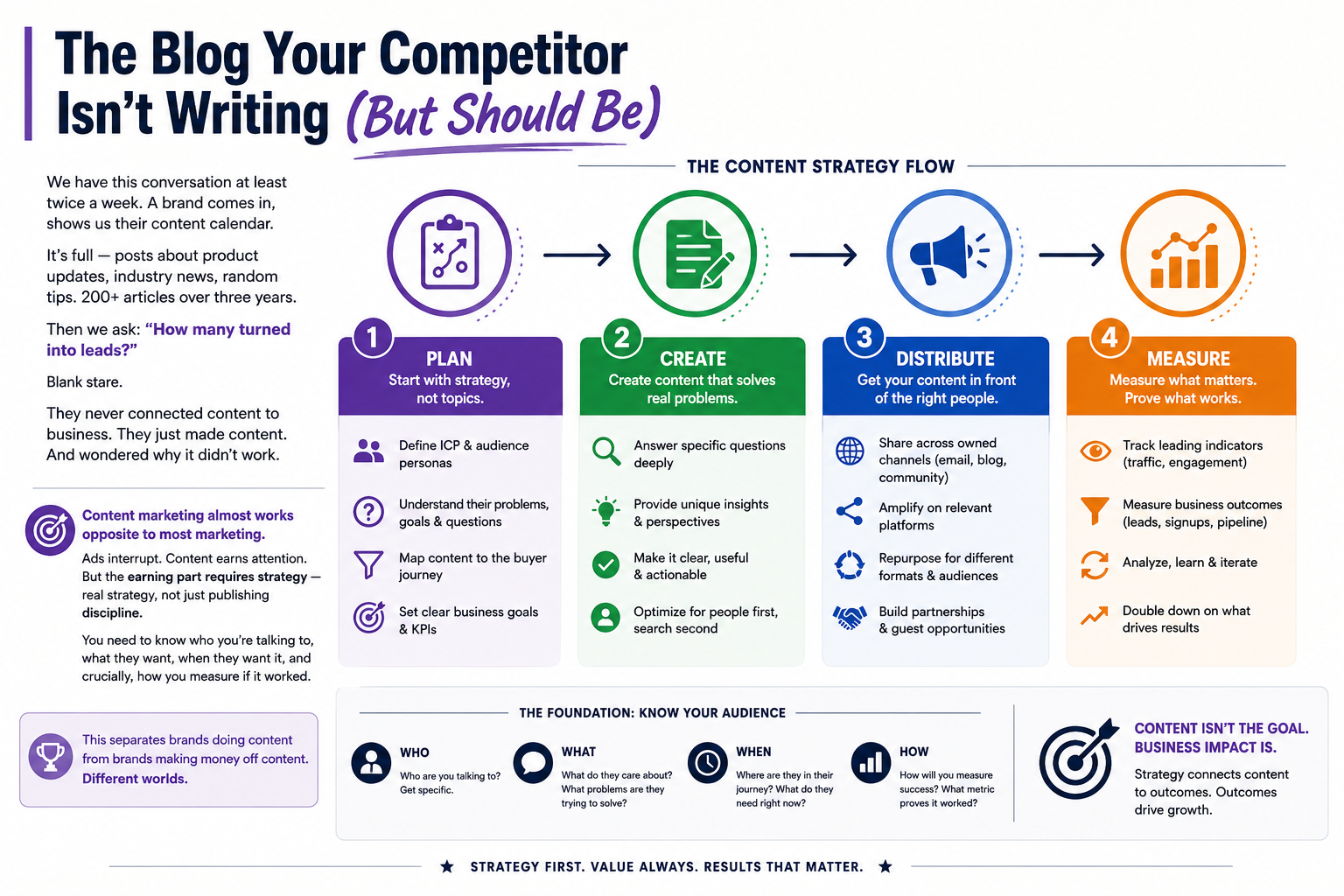
We have this conversation at least twice a week. A brand comes in and shows us its content calendar. It is full of posts about product updates, industry news and random tips, more than 200 articles over three years.
Then we ask: “How many turned into leads?”
Blank stare.
They never connected content to business. They just made content, and wondered why it did not work.
Content marketing works almost opposite to most marketing. Ads interrupt, while content earns attention. Earning it takes real strategy, not just the discipline to publish. You need to know who you are talking to, what they want, when they want it and, most important, how you will measure whether it worked.
This is what separates brands doing content from brands making money from content.
An example: a frozen pizza brand
Here is an illustration, not a real client result. Take a frozen pizza brand: a family business, 15 years old, selling mostly through retail. It wants to sell direct to consumers at higher margins, but nobody knows it exists, and competitors have big ad budgets.
So start with audience research: real conversations with home cooks. What do they care about? Probably not frozen pizza facts. They want quick weeknight dinner solutions, ways to host people without stress, and restaurant-quality food at home without special skill.
Build content around that: recipe videos showing how the pizzas work with three-ingredient sides, blog posts about hosting, and reels about weeknight stress (relatable, not salesy). Nothing sells directly. It is just useful.
Over the months, calls start coming in. The blog articles begin to rank for searches such as “easy weeknight dinner ideas” and “quick entertaining at home”, the exact terms the audience uses. Over a year, direct sales can become a real part of revenue.
The messy part is that the first two months are slow. Traffic is near zero, and the founder may want to pull the plug because it is expensive and nobody is seeing it. You have to keep pushing. Things usually begin to move around month four, momentum shows by month five, and by month twelve everything makes sense.
By then the content brings steady visitors every week. The numbers are not enormous, but they are qualified. They are people who actually want frozen pizza.
What most content plans get wrong
They start with the content: “What should we write about?” That is the wrong question.
Ask these first. Who are we reaching? What are they searching for? What problems keep them up? What does buying look like for them? Are they researching or ready to buy?
Only after answering these should you create content. Content without audience clarity is just noise, and expensive noise.
Research your audience first
Use Google Search Console and Analytics to see which queries already bring people. Use SEMrush or Ahrefs to check competitor keywords. Send real surveys: email 100 customers asking “what problem were you solving when you found us?” You may be surprised how often your content does not match what people want.
Then segment them into first-time researchers, comparison shoppers and ready buyers. Each needs different content. A researcher wants guides, a shopper wants case studies and a ready buyer wants your sales page.
The content funnel
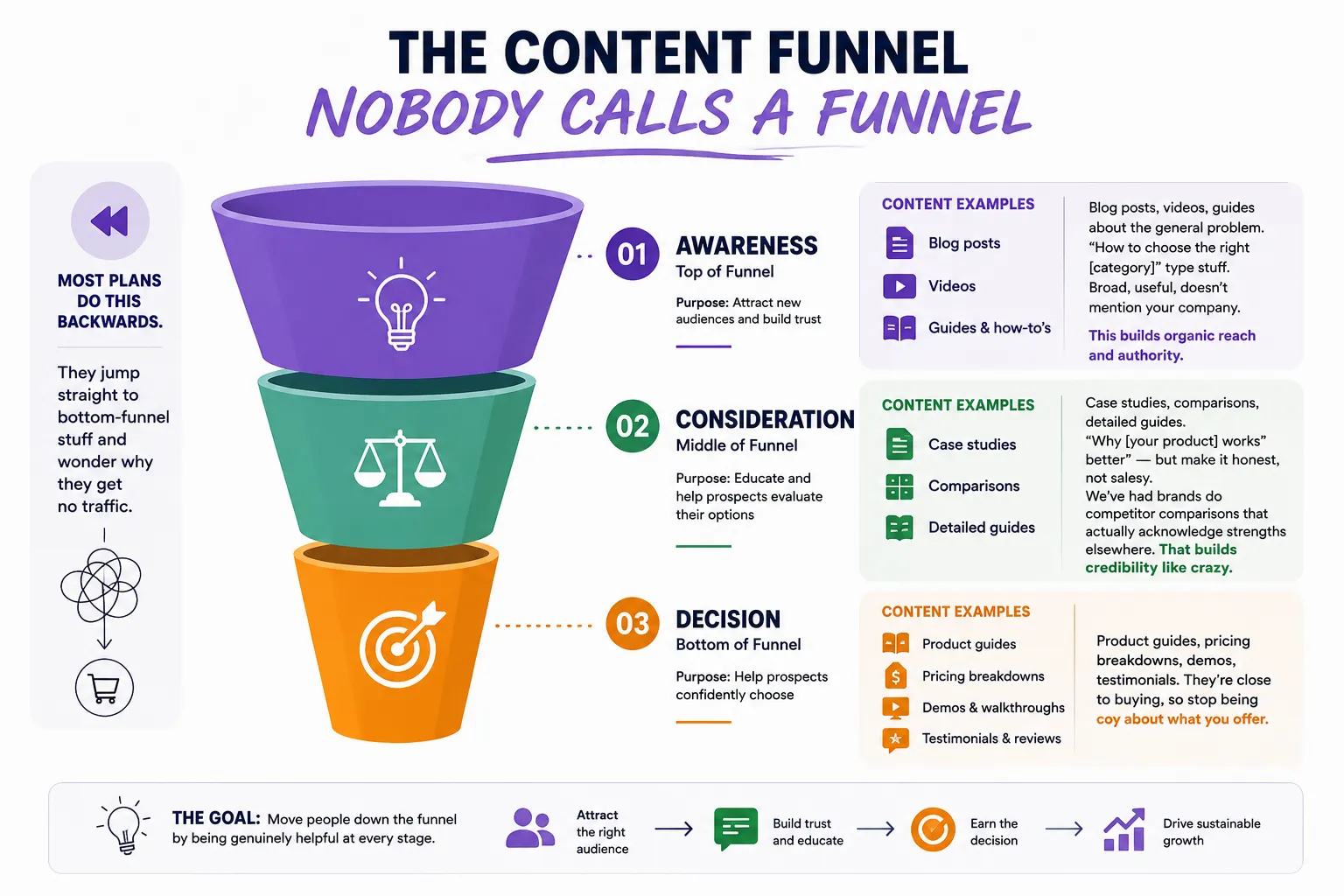
Top of the funnel is awareness content: blog posts, videos and guides about the general problem, such as “how to choose the right [category]”. Keep it broad and useful, and do not mention your company. This builds organic reach and authority.
The middle is consideration content: case studies, comparisons and detailed guides, such as “why [your product] works better”. Keep it honest and not salesy. Some brands have done competitor comparisons that admit strengths elsewhere, and that builds credibility.
The bottom is decision content: product guides, pricing breakdowns, demos and testimonials. These readers are close to buying, so be clear about what you offer.
Most plans do this backwards. They jump straight to bottom-funnel content and wonder why they get no traffic.
Making content that ranks
Organic search is one of the most effective channels for content marketing, and it starts with proper keyword research. Understanding why keyword research is important helps you find search opportunities, target the right audience and create content that brings relevant traffic.
Pick keywords with decent search volume but not heavy competition. A new brand going after “digital marketing strategy” will lose. Going after “digital marketing strategy for manufacturing Pune” is far more winnable.
Write content that answers the search query better than what is ranking now. Skip the 1,000 words of filler and be specific and useful. If someone searches “how to structure a product video for e-commerce”, your article should show structure examples, not just say “structure matters”.
Get other websites to link to yours. This is the hardest part. Digital PR, guest articles, partnerships and content so useful that people link to it naturally all help. One link from a high-authority site matters more than many from random directories.
Republish smartly. Once content ranks, update it: add new case studies, refresh stats and improve the formatting. Updated content shows that you maintain what you publish.
Content types that give a return on investment (ROI)
Video is a strong way to engage audiences in India, particularly through Reels and YouTube Shorts. Staying updated with the latest video marketing trends can help businesses create audience-focused content that increases visibility, engagement and brand recall.
Case studies work very well. Use real before-and-after results, real numbers and real challenges. A potential customer reading about someone similar who had the same problem is far more likely to convert.
Blog guides for top-of-funnel keywords do not convert directly, but they bring traffic, build authority and feed your email list. That is the real ROI: long-term relationships more than immediate sales.
Email nurturing comes next. Once someone downloads a guide or joins your list, email them. Send educational emails, not sales emails: share an insight, recommend a tool, acknowledge a problem. Then maybe sell something.
Webinars and workshops can help too. Host one with real value, not sales disguised as education, and announce it through your content. Get a group of interested people on a call. Some will buy, and you will understand your audience far better afterwards.
Your content calendar and why it matters
A calendar forces consistency, and consistency beats perfection. The friend who posts three times a week forever wins over the one who posts 50 times and disappears.
Your calendar should include the topic, keyword target, content type, owner, deadline and promotion plan. You will break it many times, and that is fine. At least you have a plan to break.
In months one and two you are putting out content and seeing almost nothing. This is ROI-first thinking: you invest now for later. By month three you should see traffic trickle in, and from month six onwards momentum builds. One early article that ranks can keep bringing visitors for years.
Make calendars based on what your audience searches, not what you want to talk about. That decides whether content lands or gets ignored.
Measure what matters, not vanity metrics
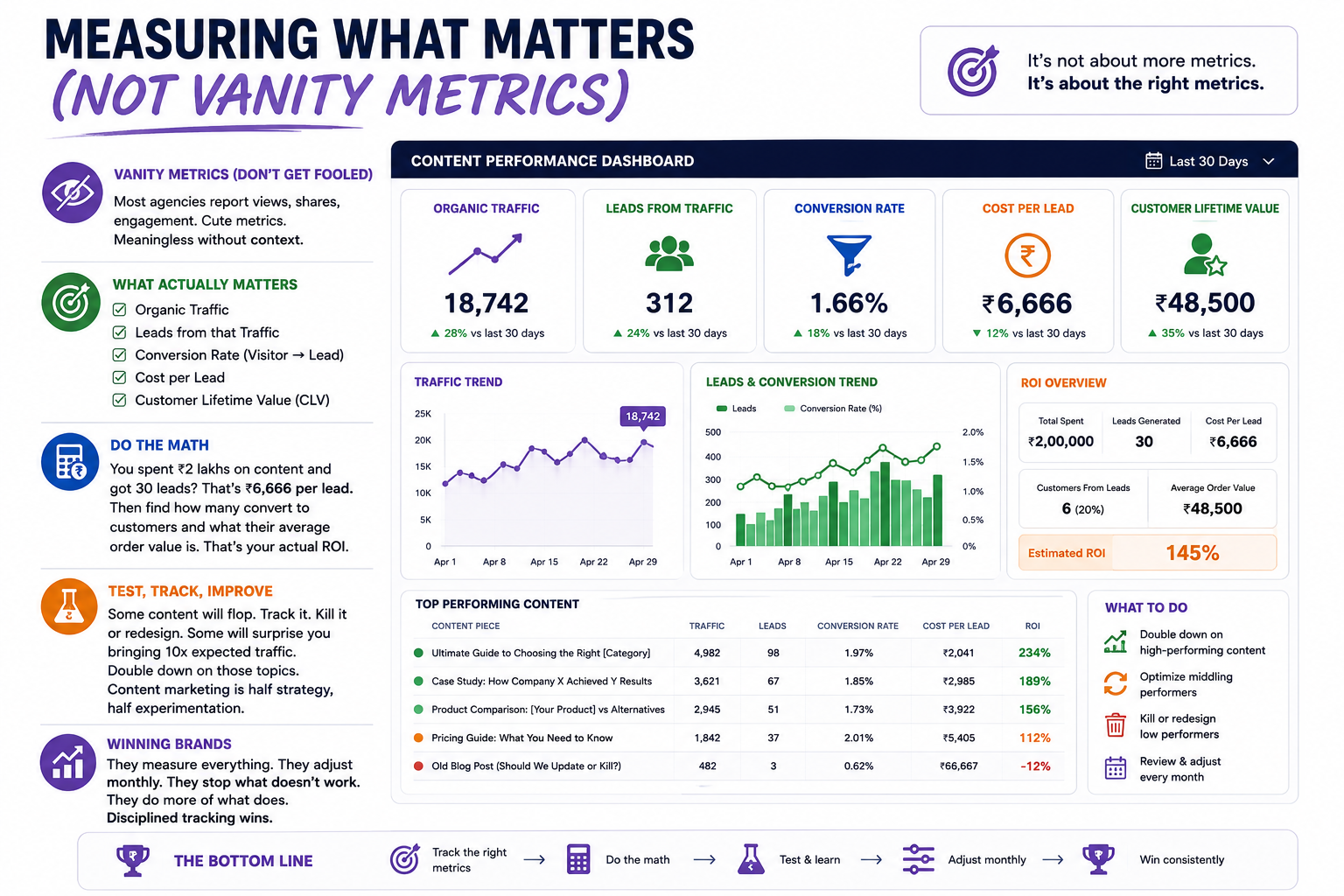
Most agencies report views, shares and engagement. These are vanity metrics, numbers that look good but mean little without context.
What matters is organic traffic, leads from that traffic, conversion rate from visitor to lead, cost per lead and customer lifetime value. Learn more about digital marketing KPI metrics that help you judge real progress.
Say you spent Rs 2 lakhs on content and got 30 leads. That is 6,666 rupees per lead. Then find out how many of those leads become customers and what their average order value is. That is your actual ROI.
Some content will flop. Track it, then remove or redesign it. Some will surprise you with far more traffic than expected, so double down on those topics. Content marketing is half strategy and half experimentation.
Winning brands measure everything and adjust monthly. They stop what does not work and do more of what does. It is not complicated maths, just disciplined tracking.
Common content strategy mistakes
- Publishing without a goal. “We need a blog because everyone has one” is a poor reason. Do you need a blog to reach your audience? If yes, do it. If not, do not. The medium should serve the strategy, not the other way round.
- Forgetting to promote. You publish, then go silent: no email, no social shares, no retargeting ads. Promotion is a big part of the work. Mediocre content that is heavily promoted can outperform excellent content that nobody knew about.
- Copying competitors. They publish articles, so you publish similar ones. But they already own that space, and doing the same thing will not rank you better. Go after different keywords, angles and formats.
- Not measuring. You publish for a year and never ask whether it worked. How do you know what to keep doing? Measure from day one: clicks, leads, conversions and revenue attribution.
- Changing direction constantly. Content marketing rewards patience. If you jump from blogs to videos to podcasts every month, nothing takes off. Pick a format, stay with it for six months or more, then evaluate.
Getting started
First, list 20 questions your audience asks. Do not guess. Use surveys, sales calls, comments and forums to find out what they are actually confused about.
Second, research search volume. Which questions have traffic worth pursuing? Which are too competitive? Rank them by opportunity.
Third, create content that answers those questions. Start with the easiest wins: low competition and real volume, but not massive. You want early wins.
Fourth, promote it through email, social media, online communities and, if the budget allows, paid promotion.
Fifth, measure. After 30 days, did traffic come? Did anyone fill a form? Track this closely.
Sixth, adjust. Do more of what worked. Find out why the rest flopped: maybe the content was bad, maybe the keyword was wrong, maybe nobody is looking. If so, drop it and move on.
Repeat this cycle monthly in year one. In year two you shift towards optimisation and expansion. By then your best content is a lead-generation machine, the recurring investment gets smaller and new content does not start from zero.
What to expect
It is not fast and not easy, and it does not work if you will not measure and adjust constantly.
But it compounds. With ads, traffic stops the day you stop paying. Good content keeps working for years. An article that ranks for a commercial keyword by month twelve can keep bringing qualified leads for a long time.
Brands that invest seriously in content over a long period can get a good share of their leads from organic search, which is cheaper than ads and more predictable than social media. When content works, it can become your strongest marketing channel. Build the brand first, and the leads follow.
If you want to explore this for your business, whether you are starting from zero or your content is not converting, let us have a real conversation about what could work. No promises and no pitch deck, just an honest assessment.
Want to build a content strategy that works?
Content can change a business when it is strategic, measured and relentless. Let us talk about what could work for yours.