-
Author: Anindita Barik
-
Updated Date: May-20-2026
-
Views: 2 Min Read
Use SEO (organic search) when you want long-term, compounding traffic at low ongoing cost. Use SEM (paid ads) when you need immediate visibility, are launching something new, or targeting high-intent buyers with a clear budget. Most businesses need both — layered strategically based on their timeline, industry, and monthly spend.
Use SEO when you want long-term, compounding traffic at low ongoing cost. Use SEM when you need immediate visibility, are launching something new, or targeting high-intent buyers with a clear budget. Most businesses need both.
The Question That Comes Up Every Single Client Call
“Should we do SEO or Google Ads?”
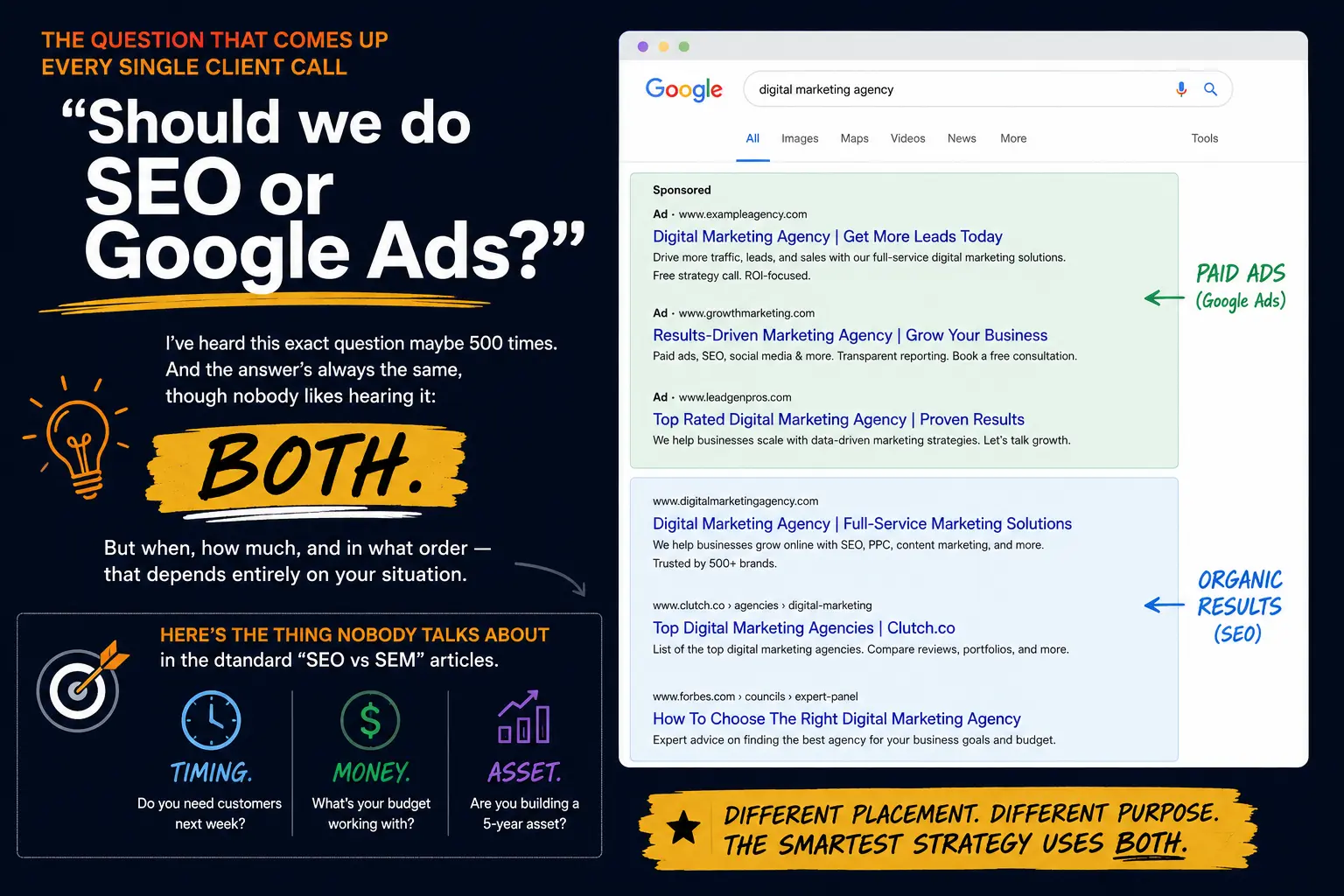
I’ve heard this exact question maybe 500 times. And the answer’s always the same, though nobody likes hearing it: Both. But when, how much, and in what order — that depends entirely on your situation.
Here’s the thing nobody talks about in the standard “SEO vs SEM” articles. The difference isn’t really about which one’s better. It’s about timing. It’s about money. It’s about whether you need customers next week or you’re building a five-year asset.
First: What Even Are These Things?
SEO (Search Engine Optimization)
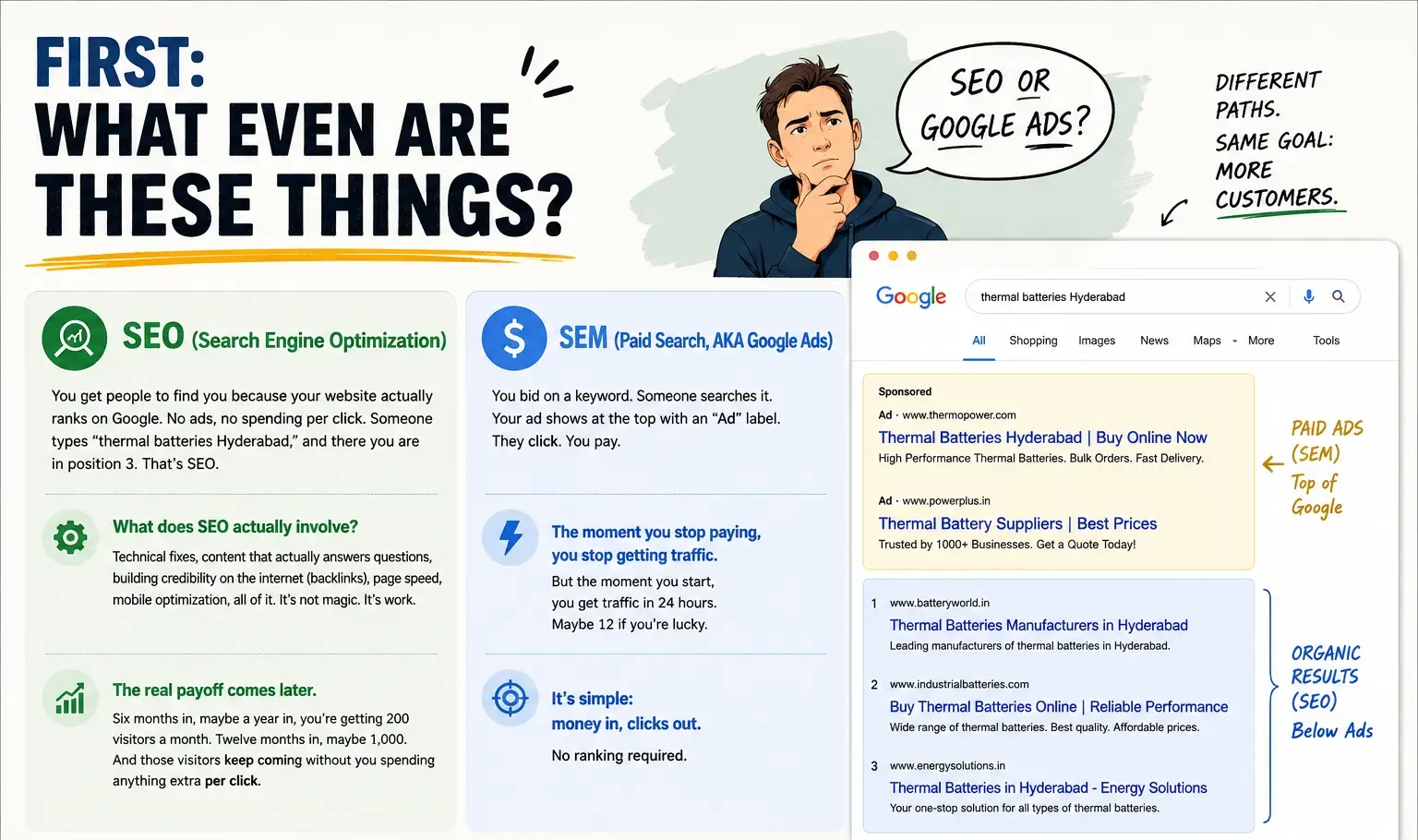
You get people to find you because your website actually ranks on Google. No ads, no spending per click. Someone types “thermal batteries Hyderabad,” and there you are in position 3. That’s SEO.
What does SEO actually involve? Technical fixes, content that actually answers questions, building credibility on the internet (backlinks), page speed, mobile optimization, all of it. It’s not magic. It’s work.
The real payoff comes later. Six months in, maybe a year in, you’re getting 200 visitors a month. Twelve months in, maybe 1,000. And those visitors keep coming without you spending anything extra per click.
SEM (Paid Search, AKA Google Ads)
You bid on a keyword. Someone searches it. Your ad shows at the top with an “Ad” label. They click. You pay.
The moment you stop paying, you stop getting traffic. But the moment you start, you get traffic in 24 hours. Maybe 12 if you’re lucky.
It’s simple: money in, clicks out. No ranking required.
The Numbers Nobody Believes Until They See Them
I had a B2B manufacturing client — actually, they were more of an industrial equipment supplier from Gujarat — who was stuck between these two.
They came to us spending ₹1,50,000 per month on Google Ads. Getting about 40-50 clicks. 2-3 turned into real leads each month.
We built an SEO strategy alongside it. Not instead of, alongside.
Six months later — and this is the messy part that rarely makes it into case studies — they were getting the same 40-50 clicks from Google Ads still (same budget, same keywords). But now they were also getting 35-40 organic clicks. Different keywords mostly. Lower-intent stuff, more exploratory. But the volume added up.
The real kicker? Month 18, they cut the Google Ads budget to ₹50,000. Organic had grown to 150+ clicks, most of them more qualified than the paid ones. One less budget, way more traffic. That’s the SEO advantage nobody talks about when they’re trying to sell you on quick wins.
But — and this is crucial — if they’d only done SEO, the first four months would’ve been death. No leads, no traffic, nothing. The ads kept them alive while SEO was building.
What It Actually Costs
SEO Money
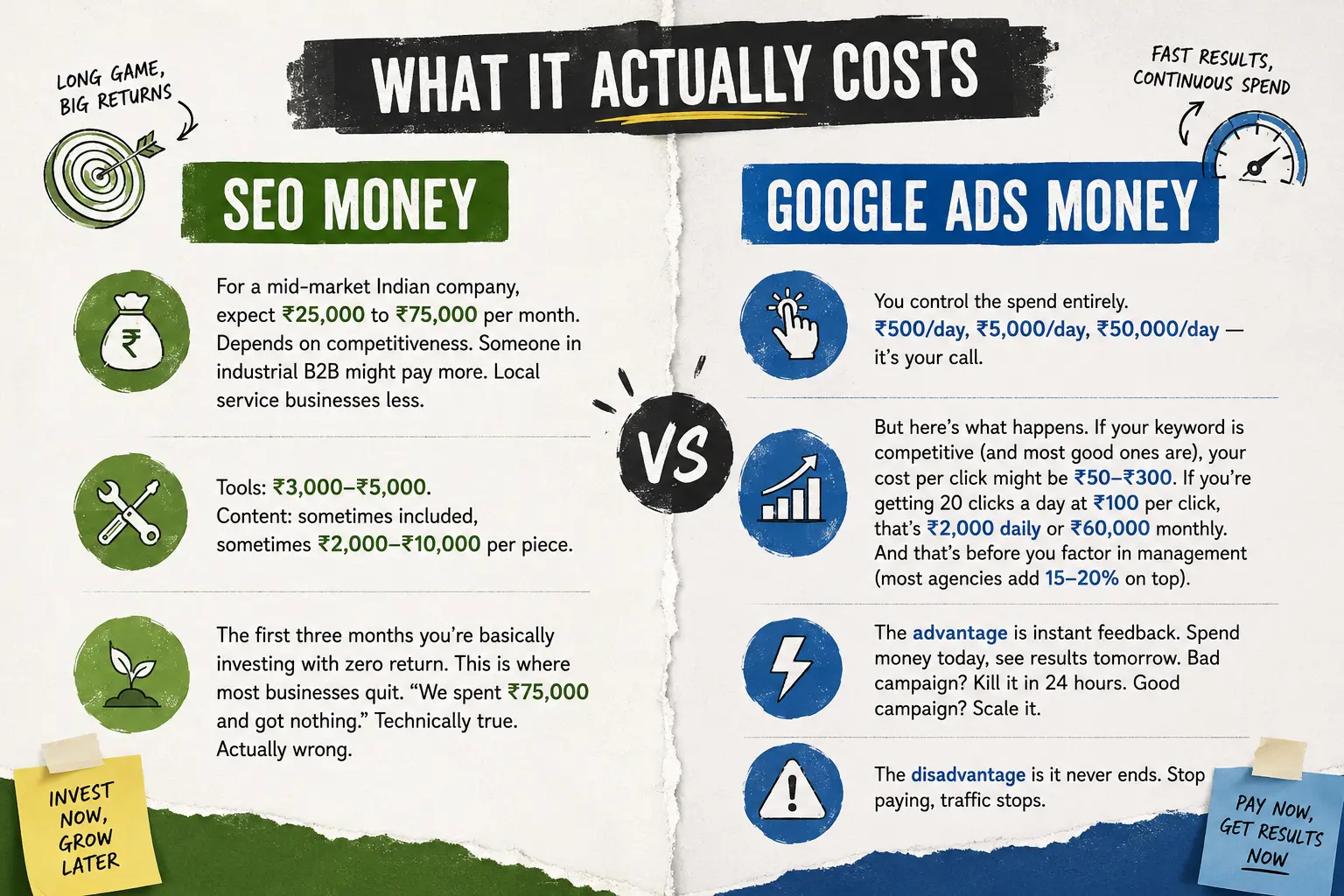
For a mid-market Indian company, expect ₹25,000 to ₹75,000 per month. Depends on competitiveness. Someone in industrial B2B might pay more. Local service businesses less.
Tools: ₹3,000-₹5,000. Content: sometimes included, sometimes ₹2,000-₹10,000 per piece.
The first three months you’re basically investing with zero return. This is where most businesses quit. “We spent ₹75,000 and got nothing.” Technically true. Actually wrong.
Google Ads Money
You control the spend entirely. ₹500/day, ₹5,000/day, ₹50,000/day — it’s your call.
But here’s what happens. If your keyword is competitive (and most good ones are), your cost per click might be ₹50-₹300. If you’re getting 20 clicks a day at ₹100 per click, that’s ₹2,000 daily or ₹60,000 monthly. And that’s before you factor in management (most agencies add 15-20% on top).
The advantage is instant feedback. Spend money today, see results tomorrow. Bad campaign? Kill it in 24 hours. Good campaign? Scale it.
The disadvantage is it never ends. Stop paying, traffic stops.
When You’re Actually Supposed to Pick SEO
Pick SEO Service when:
- You’re thinking in years, not months. If you’re still going to need customers in year three of your business, SEO compounds.
- Your industry is full of researchers. B2B, education, healthcare — people search extensively. Your long blog post ranks for years.
- You don’t have emergency capital. You’ve got ₹30,000/month to spend, not ₹3 lakhs. SEO’s patient. Google Ads needs more fuel.
- Your competition isn’t laser-focused on paid ads. If everyone’s throwing money at Google Ads, organic ranking gaps emerge.
- Your margins can handle a six-month wait. If you need revenue in 60 days, you can’t do SEO alone.
When Google Ads Actually Makes Sense
Pick Google Ads Service when:
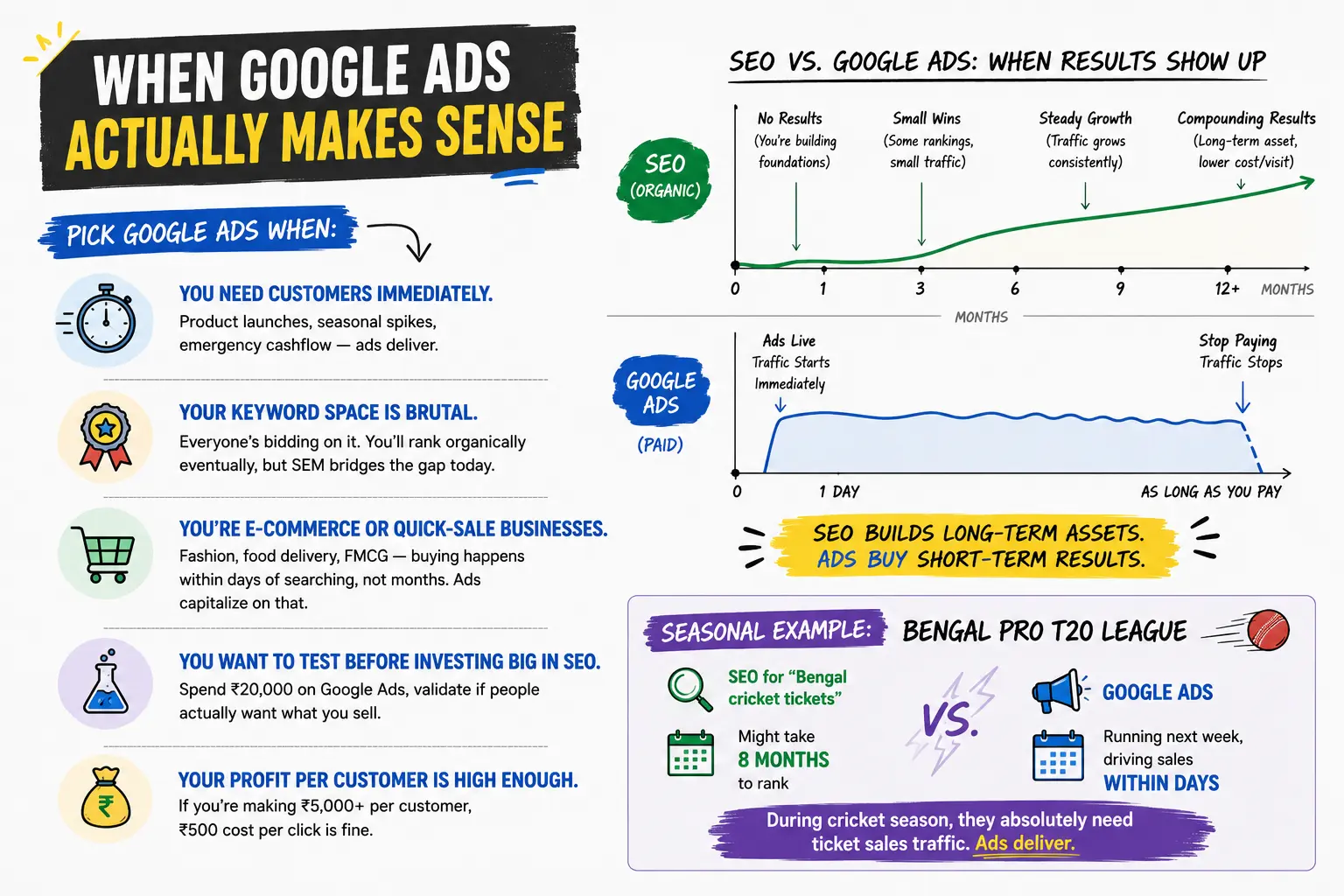
- You need customers immediately. Product launches, seasonal spikes, emergency cashflow — ads deliver.
- Your keyword space is brutal. Everyone’s bidding on it. You’ll rank organically eventually, but SEM bridges the gap today.
- You’re e-commerce or quick-sale businesses. Fashion, food delivery, FMCG — buying happens within days of searching, not months. Ads capitalize on that.
- You want to test before investing big in SEO. Spend ₹20,000 on Google Ads, validate if people actually want what you sell.
- Your profit per customer is high enough. If you’re making ₹5,000+ per customer, ₹500 cost per click is fine.
Seasonal example: Bengal Pro T20 League. During cricket season, they absolutely need ticket sales traffic. SEO for “Bengal cricket tickets” might take eight months to rank. Ads? Running next week, driving sales within days.
The Real Strategy: Playing Both
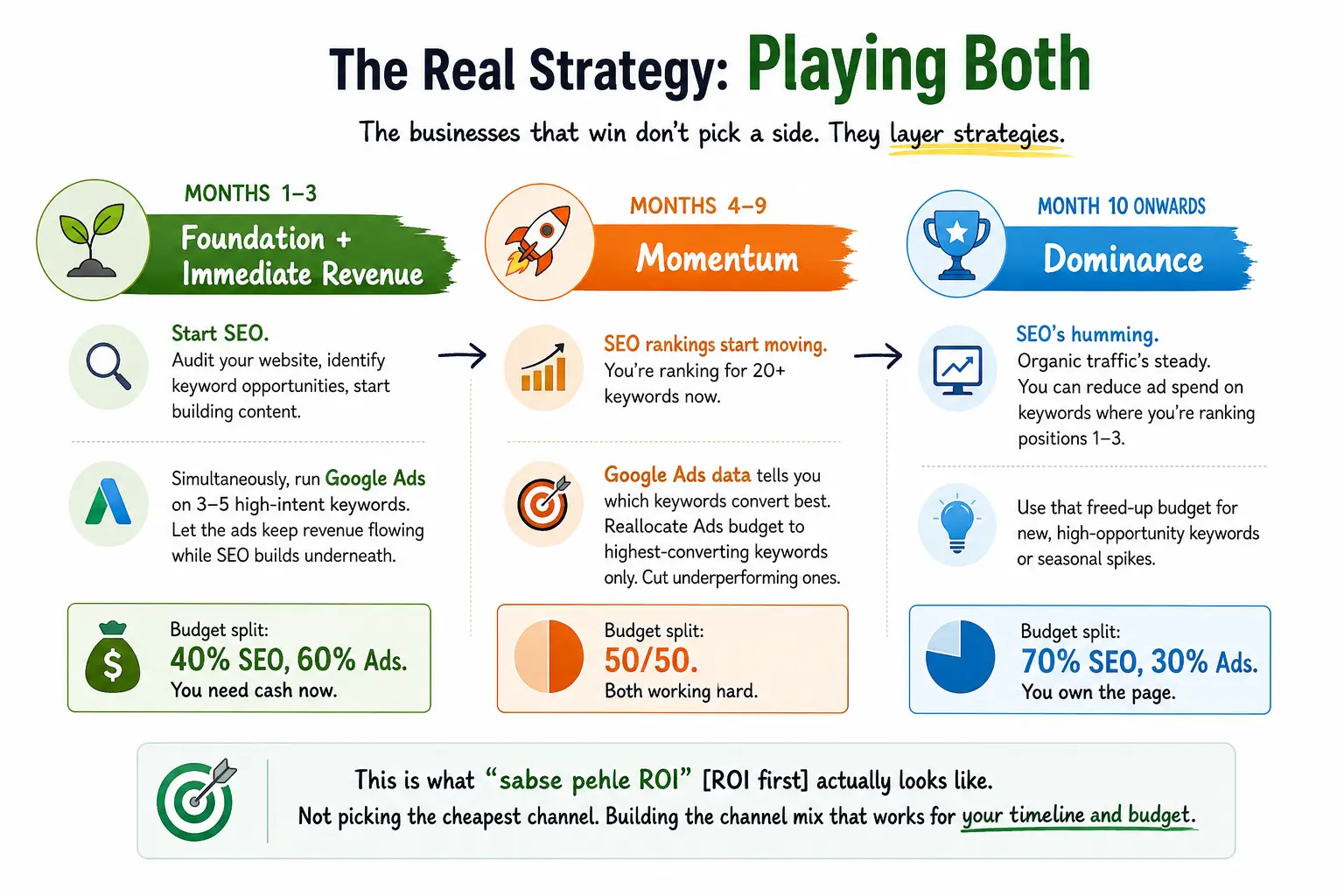
The businesses that win don’t pick a side. They layer strategies.
Months 1-3: Foundation + Immediate Revenue
Start SEO. Audit your website, identify keyword opportunities, start building content. Simultaneously, run Google Ads on 3-5 high-intent keywords. Let the ads keep revenue flowing while SEO builds underneath.
Budget split: 40% SEO, 60% Ads. You need cash now.
Months 4-9: Momentum
SEO rankings start moving. You’re ranking for 20+ keywords now. Google Ads data tells you which keywords convert best. Reallocate Ads budget to highest-converting keywords only. Cut underperforming ones.
Budget split: 50/50. Both working hard.
Month 10 Onwards: Dominance
SEO’s humming. Organic traffic’s steady. You can reduce ad spend on keywords where you’re ranking positions 1-3. Use that freed-up budget for new, high-opportunity keywords or seasonal spikes.
Budget split: 70% SEO, 30% Ads. You own the page.
This is what “sabse pehle ROI” [ROI first] actually looks like. Not picking the cheapest channel. Building the channel mix that works for your timeline and budget.
The Messy Story Nobody Talks About
We had an e-commerce client. Fashion. They did SEO-only for 14 months.
Months 1-8? Barely moved the needle. ₹4 lakhs spent, maybe ₹10 lakhs in attributed revenue. Math was brutal. They almost quit.
Month 9-12? Suddenly organic traffic doubled. Then tripled. By month 14, they were getting 2,000+ monthly organic visitors. The math flipped. ₹10 lakhs investment, ₹1.5 crores revenue over two years. But those first eight months almost killed the project.
If they’d run Google Ads in parallel, they would’ve hit their cashflow targets in month three. No drama. Just smooth revenue. The SEO would’ve still paid off later. But they’d have arrived there less panicked.
This is what I mean by “messy outcomes.” Not everything’s linear.
Different Industries, Different Strategies
B2B (Manufacturing, SaaS, Professional Services)
Go 70% SEO, 30% Ads. Long sales cycles mean ranking authority matters. Ads handle urgent requests.
E-Commerce
Go 40% SEO, 60% Ads. Speed of purchase matters. Ads deliver immediate revenue while SEO compounds over time.
Local Services (Plumbers, Accountants, Clinics)
Go 80% SEO, 20% Ads. Local SEO service is cheap and effective. Google My Business ranking is killer. Ads supplement peak demand.
Real Talk: What About Budget Constraints?
Most of our clients work with constraints.
If you have ₹1 lakh/month: Split it 60/40 (SEO/Ads). Build SEO foundation, run Ads for immediate cash. Not ideal mix, but workable.
If you have ₹5 lakhs/month: Split it 50/50. Proper balance. You can afford to wait and also afford to bid aggressively.
If you have ₹20 lakhs/month: You can afford 70/30 or 80/20 toward SEO because you have enough buffer for ads to stay profitable.
Budget doesn’t determine which to choose. It determines how much of each.
The Metrics That Actually Matter
For SEO, Track:
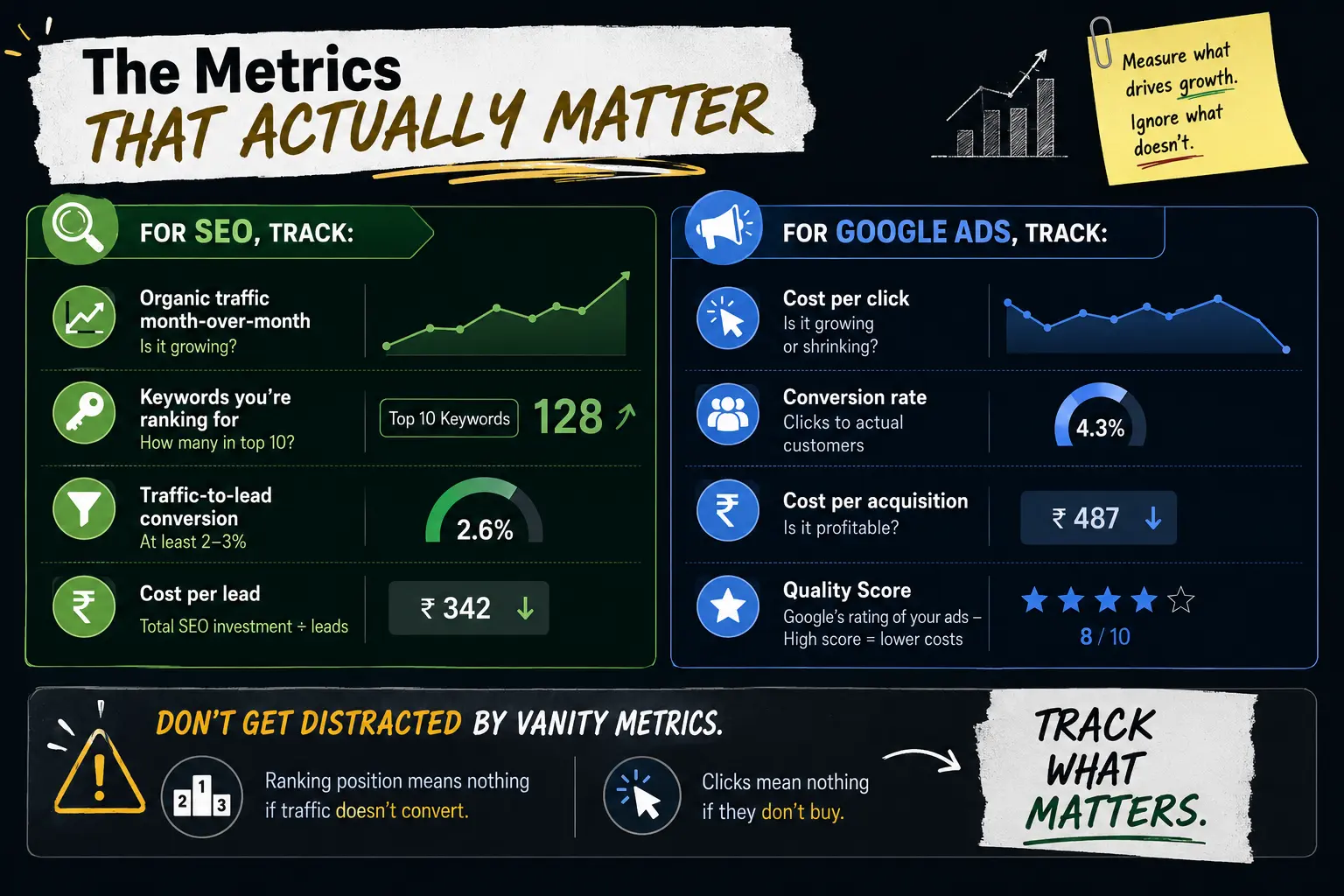
- Organic traffic month-over-month (is it growing?)
- Keywords you’re ranking for (how many in top 10?)
- Traffic-to-lead conversion (at least 2-3%)
- Cost per lead (total SEO investment ÷ leads)
For Google Ads, Track:
- Cost per click (is it growing or shrinking?)
- Conversion rate (clicks to actual customers)
- Cost per acquisition (is it profitable?)
- Quality Score (Google’s rating of your ads — high score = lower costs)
Don’t get distracted by vanity metrics. Ranking position means nothing if traffic doesn’t convert. Clicks mean nothing if they don’t buy. Track what matters.
One More Story: The Numbers-Obsessed Startup
A Bangalore fintech startup came to us. They were trying SEM only. Burning ₹1.5 lakhs daily on Google Ads. But after 8 months, cost per acquisition had gotten out of hand — ₹8,000+ per customer.
They’d never done SEO. We started immediately. “But we need revenue now,” they said. Sure. Keep the ads. But parallel-track SEO.
Month 4 of SEO: started ranking for secondary keywords. Lower volume, but dramatically cheaper to acquire. Month 9: 30% of their traffic was now organic at 5x lower acquisition cost than ads.
They scaled down ads, reinvested savings in SEO. Two years later, 70% organic, 30% ads. Fundamentally different business economics. But it only worked because they didn’t wait for perfect SEO timing — they built while ads kept them afloat.
Here’s What You Actually Do Monday Morning
- Ask yourself: “Do I need customers in the next 60 days?” If yes, do Google Ads now. Then add SEO.
- Ask: “What’s my profit per customer?” If ₹5,000+, ads are viable. If ₹2,000-, you need SEO.
- Ask: “How competitive is my space?” Look up your main keywords on Google. If first page is all huge brands paying for ads, you need both.
- Run Google Ads for 60 days even if SEO-heavy. Track metrics. See if it’s profitable. If yes, keep it. If no, kill it and go SEO-only.
- Start SEO immediately. Doesn’t matter if ads are running. SEO needs to compound.
- After 6 months, review. Is SEO growing? Cut underperforming ad keywords, fund new ones. Reinvest.”
That’s not a framework. That’s how real businesses actually do this.
| Approach | Best for | Watch out for |
|---|---|---|
| DIY | Small teams, tight budgets | Slow ramp-up, trial-and-error |
| Freelancer | Specific project bursts | Inconsistency, limited ownership |
| Agency | Ongoing work, senior input | Higher retainer, less control |
Quick checklist before you start:
- Define the one thing you want: leads, sales, awareness — pick one.
- Baseline your numbers: write down where you are today.
- Pick a 90-day window: nothing moves in 2 weeks.
- Agree on success metrics: with whoever is paying the bill.
- Set up proper tracking: GA4, UTMs, call tracking.
- Review monthly: kill what doesn’t work, double down on what does.
The Bottom Line
If you take one thing from this: seo vs sem when to use organic search vs paid ads rewards patience and specificity, not volume or clever tricks. Start small, measure honestly, fix what breaks, and compound what works. The brands doing this well in India aren’t smarter — they’re just consistent. Need a hand with this for your business? Talk to us.
Want a Real Strategy, Not a Sales Pitch?
We’ve built search strategies for 250+ brands across India. We don’t do one-size-fits-all. We look at your cash flow, timeline, margins, and competition — then tell you exactly where to invest.
FAQs
-
What's the real difference between SEO and SEM?
Ans.SEO is organic. You rank, traffic comes free. SEM is paid ads. You pay per click. One takes time and compounds. One is immediate and stops when you stop paying. They're not really competitors — they're tools for different timelines. -
Should I use both together or pick one?
Ans.Both. Not debate. The best strategy is SEO as your foundation (builds over time) and ads for immediate revenue (covers your cash flow while SEO grows). Trying to do only one is leaving money on the table. -
How much does each cost really?
Ans.SEO: ₹25,000-₹75,000/month depending on competitiveness, but it compounds. Ads: as low as ₹500/day but scales based on keyword competition. Over three years, SEO's usually cheaper. Over three months, ads are. Your timeline determines the answer.
Author Details

Latest Posts
-
 26 / Aug
Search Engine Optimization Video SEO: How to Rank Your Videos in Google & YouTube
26 / Aug
Search Engine Optimization Video SEO: How to Rank Your Videos in Google & YouTube -
 25 / Aug
Video Production Corporate Video Production: A Practical Guide for Indian Brands
25 / Aug
Video Production Corporate Video Production: A Practical Guide for Indian Brands -
 24 / Aug
-
21 / Aug
Catalogue Design Catalogue Design: How to Create Catalogues That Actually Sell
-
 20 / Aug

Related Knowledge