
-
Author: Anindita Barik
-
Updated Date: Jun-19-2026
-
Views: 2 Min Read
Online reputation can make or break a brand in hours. ORM — Online Reputation Management — is the strategic practice of monitoring reviews, responding to criticism, and amplifying positive content across Google, Quora, social media, and industry platforms. Indian brands especially are catching up fast. This guide covers the biggest ORM mistakes, strategies that actually work, which platforms to prioritise, and when to handle it in-house versus hiring an agency.
Your brand’s reputation is shaped 24/7 by reviews, social media, and search results — most of it beyond your control. Online Reputation Management (ORM) gives you the tools and strategies to monitor what’s being said, respond to negative content, and amplify the positive — so the first impression customers get is the one you want them to have.
Your Brand’s Reputation Moment
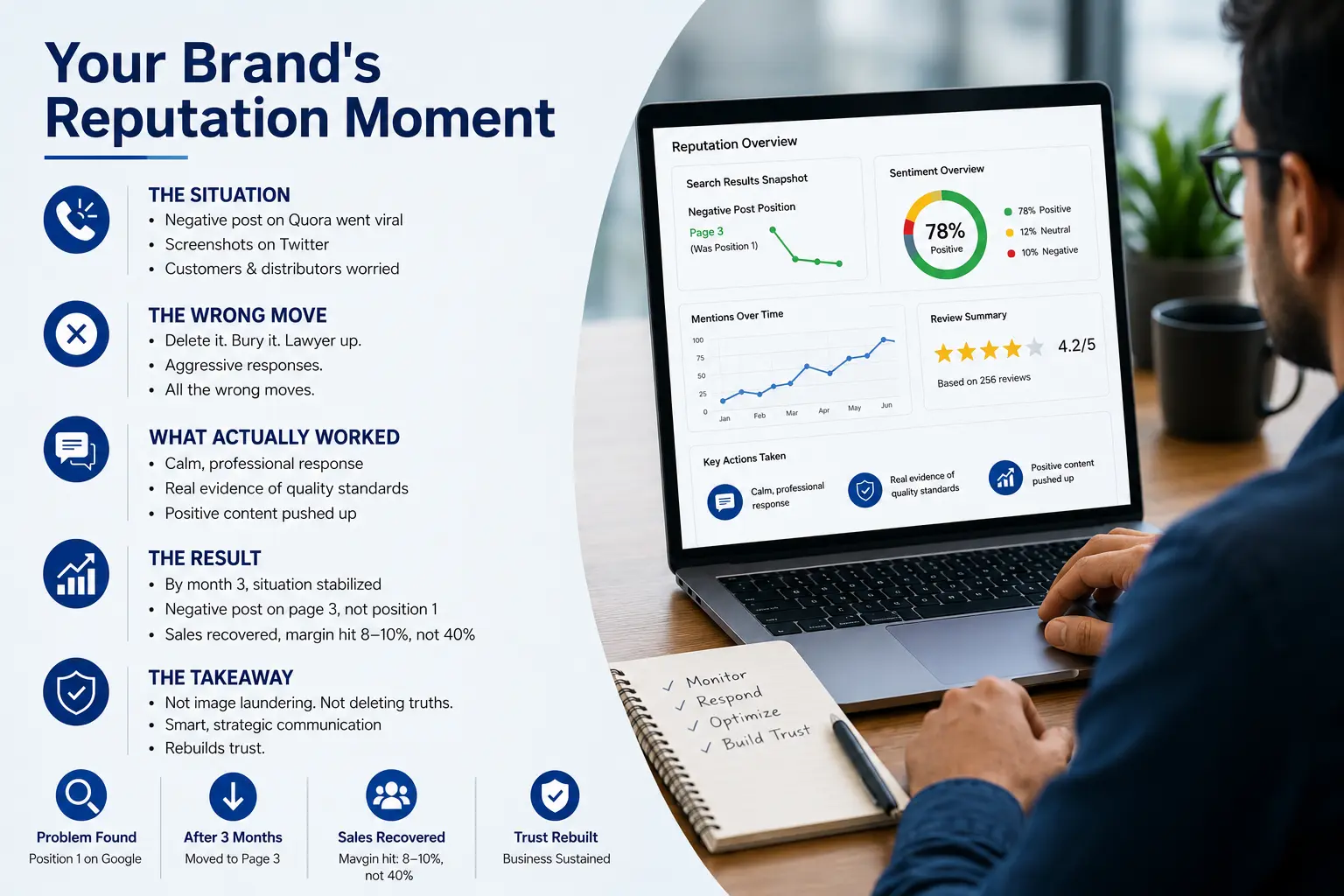
Three years ago, we got a panicked call from a pharma company in Surat. A disgruntled former employee posted a long, detailed negative review on Quora claiming the company was cutting corners on quality. Whether the claims were true or exaggerated, they couldn’t say. But the post was getting shared. Screenshots were on Twitter. The company’s sales team was getting calls from worried customers and distributors.
The first instinct? Delete it. Bury it. Get a lawyer involved. Aggressive responses. All the wrong moves.
What actually needed to happen: A calm, professional response acknowledging the concerns without admitting fault. Real evidence of quality standards. Other positive content pushed up so that post wasn’t the first thing people found when they Googled the company name.
By month 3, the situation stabilized. The negative post was still there. But it was now on page 3 of Google instead of position 1. And when customers called, the company had responses ready. Sales recovered. Margin hit was maybe 8-10%, not 40%.
That’s online reputation management. Not image laundering. Not deleting inconvenient truths. Just smart, strategic communication that rebuilds trust.
What Is ORM (Actually)
Online reputation management is the practice of monitoring, managing, and improving what the internet says about you.
That sounds simple. Implementation is… messier.
It includes: reviewing platforms like Google, Trustpilot, Quora, industry-specific sites. Social media mentions. Forum discussions. Press coverage. Search results. Everything.
Then it’s responding to negative feedback, amplifying positive reviews, generating new content that ranks and changes the narrative, handling genuine complaints, working with platforms to remove policy-violating content, and preparing for crisis situations.
What it is NOT: deleting honest negative reviews (usually illegal), creating fake positive reviews (definitely illegal), threatening people who criticize you (illegal AND destructive), or pretending problems don’t exist.
The companies that do ORM well don’t hide their problems. They address them, talk about how they’re fixing them, and let their results do the talking.
Why This Matters More for Indian Brands
For decades, brand reputation was regional. You had a bad experience with a Delhi shopkeeper? You told your friends. 50 people knew.
Now? You post on Google. Screenshot goes to Quora. Someone shares it on Reddit. That 50-person story becomes 50,000 people. And unlike traditional media, you can’t control the narrative.
Indian brands are also playing catch-up. Western brands learned this lesson in 2009. We learned it around 2019. Which means a lot of Indian companies still treat online reputation as something that “happens” rather than something they actively manage.
Result? They’re vulnerable. A single negative review from an influencer can trigger a cascade of copycats. One viral complaint can become a PR crisis.
Smart brands — especially D2C, e-commerce, and service-based ones — are realising that ORM is as important as having a website. Maybe more.
The Biggest ORM Mistakes We See
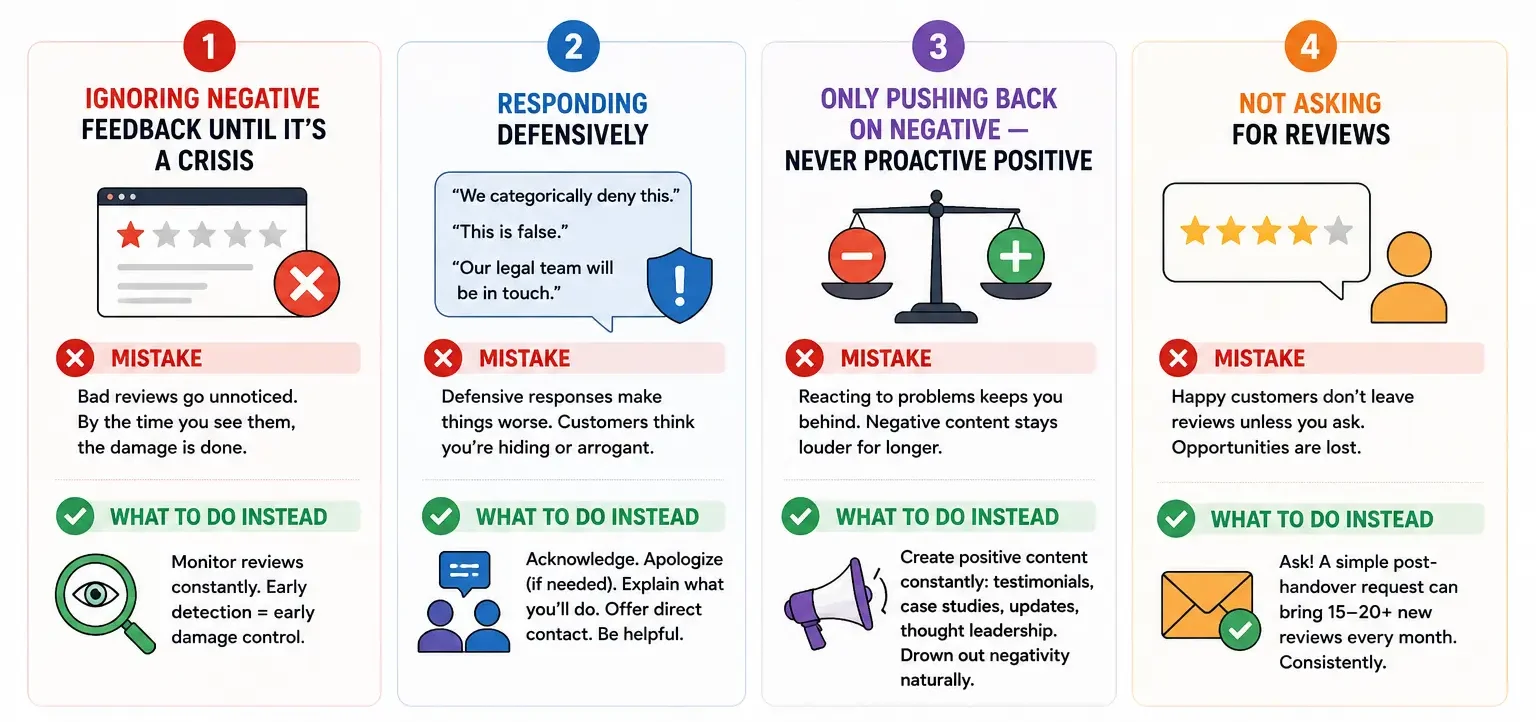
Most brands don’t fail at ORM because they don’t care — they fail because they make the same avoidable mistakes, repeatedly. Here’s what we see going wrong, and what to do instead.
Mistake 1: Ignoring Negative Feedback Until It’s A Crisis
The company that doesn’t notice bad reviews until the CEO finds them on Google search. By then, the damage is weeks old, other customers have chimed in, and it’s much harder to control. Early detection matters enormously.
Mistake 2: Responding Defensively
“We categorically deny this” or “This is false” or “Our legal team will be in touch” — these responses make things WORSE. The reasonable customers read it and think you’re hiding something. The angry ones think you’re being arrogant.
Better response: acknowledge, apologize if appropriate, provide specific steps you’re taking to fix it, offer a direct contact for follow-up. Takes more effort. Works a thousand times better.
Mistake 3: Only Pushing Back on Negative — Never Proactive Positive
Companies that wait for problems and react are always behind. Brands that constantly generate positive content — customer testimonials, case studies, behind-the-scenes, thought leadership — naturally drown out negative stuff. Algo-mically and psychologically.
Mistake 4: Not Asking for Reviews
I had a real estate client based in Jamshedpur. Finished 50 projects. Barely 40 Google reviews. Why? Because nobody asked. Post-handover, they thanked customers, gave them a certificate, and moved on. Never asked them to leave a review.
We started a simple post-handover sequence: “Hey, thanks for trusting us. If you had a good experience, a Google review would mean a lot.” Result? 15-20 new reviews a month. Naturally overwhelmed the old negative reviews. Sales improved.
ORM Strategies That Actually Work
Forget the gimmicks — hiding bad reviews, flooding platforms with fake ratings, or sending legal notices to unhappy customers. What actually works is simpler, more sustainable, and something any serious brand can execute.
Strategy 1: Monitor Everything, Respond Strategically
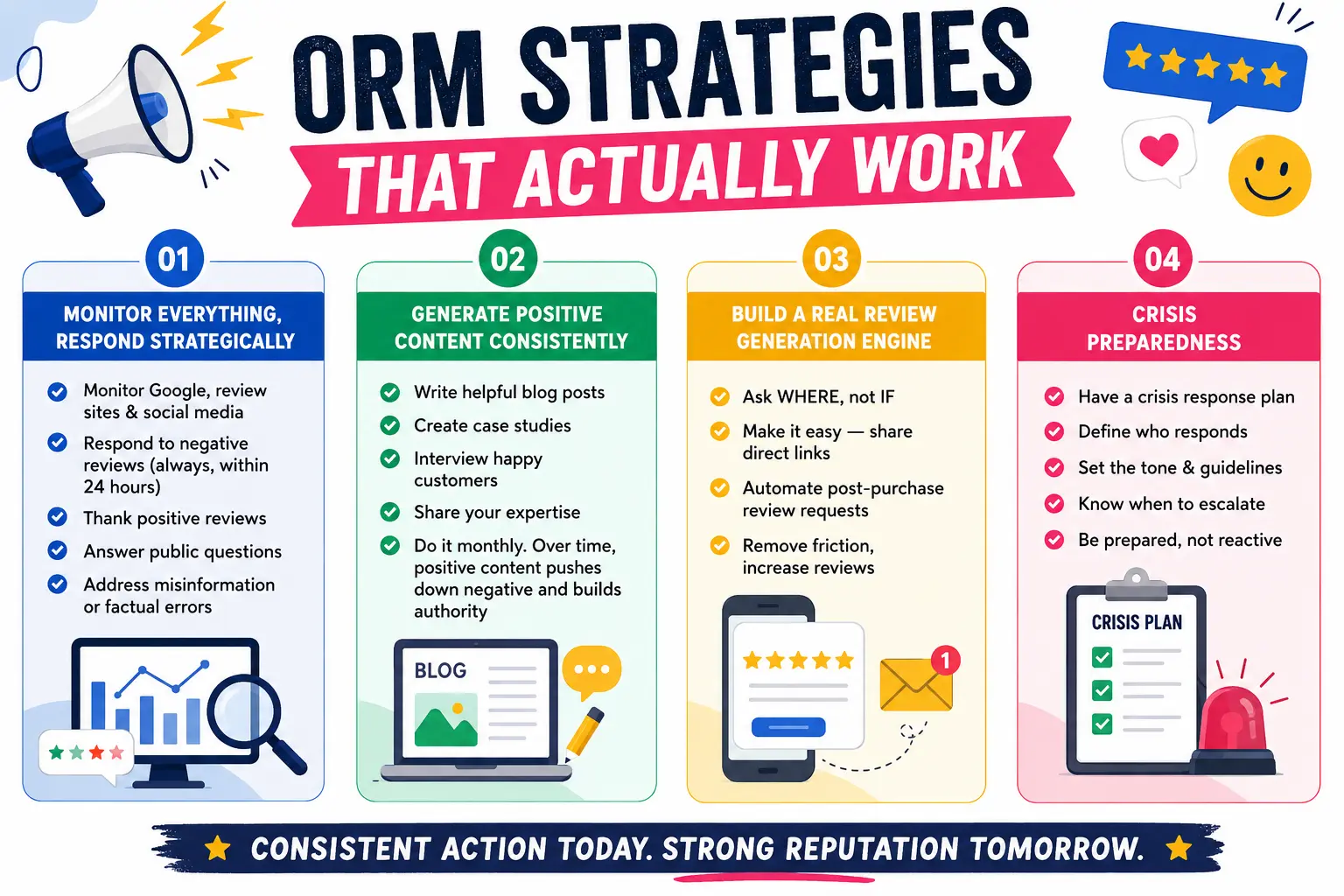
Set up monitoring on Google My Business, your industry review sites (Trustpilot, JustDial, Quora, etc.), and social media. Don’t respond to every mention — that’s exhausting and looks defensive. Respond to:
- Negative reviews (ALWAYS, usually within 24 hours)
- Positive reviews that deserve a thank-you
- Public questions that other potential customers might read
- Misinformation or factual errors
Strategy 2: Generate Positive Content Consistently
This is where a lot of ORM becomes a content marketing game. Write blog posts that answer questions people have about your industry. Create case studies. Interview happy customers. Share your expertise. Do this monthly. Year-over-year, this pushes down negative results and positions you as a thought leader. That’s worth more than any reputation specialist’s damage control.
Strategy 3: Build a Real Review Generation Engine
Don’t ask customers IF they’ll leave a review. Ask WHERE they’ll leave it. “Could you review us on Google?” is different from “Please share your experience on Google — link in the email below.” Conversion is dramatically better when you remove friction.
For some businesses, it’s as simple as post-purchase automation: “Hey! Thank you for your order. We’d love to hear your feedback — leave a review here [link].” This is where marketing automation for Indian brands can do a lot of the heavy lifting consistently.
Strategy 4: Crisis Preparedness
If you’re medium-sized or above, prepare for what happens when someone goes viral with a complaint. Do you have a crisis response plan? Who responds? What’s the tone? When do you escalate? We’ve seen companies handle genuine crises beautifully because they had a plan, and others implode because they were reactive and confused.
The Common ORM Channels (And How to Prioritise)
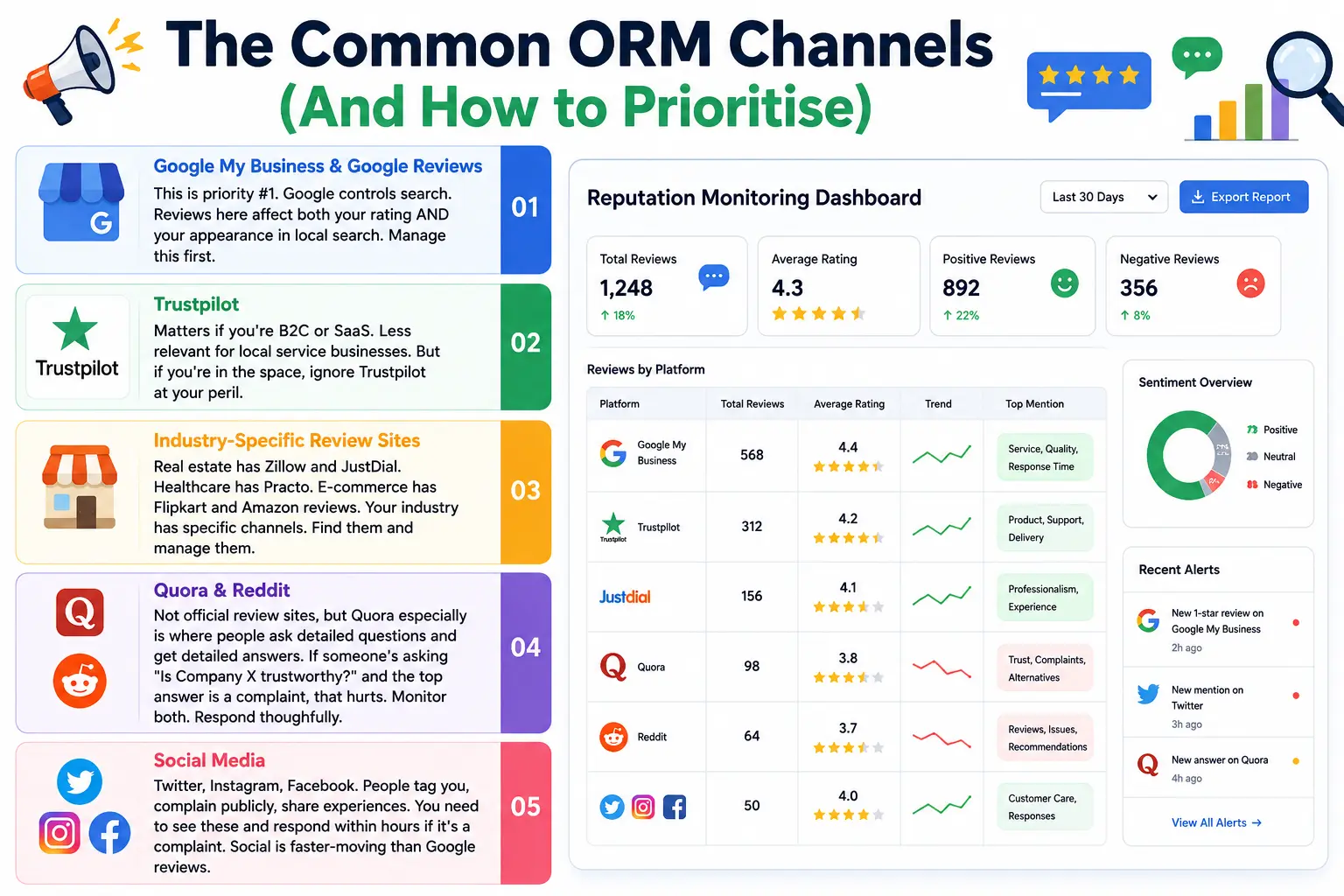
Not all review platforms matter equally. Depends on your industry.
-
Google My Business & Google Reviews
This is priority #1. Google controls search. Reviews here affect both your rating AND your appearance in local search. Manage this first.
-
Trustpilot
Matters if you’re B2C or SaaS. Less relevant for local service businesses. But if you’re in the space, ignore Trustpilot at your peril.
-
Industry-Specific Review Sites
Real estate has Zillow and JustDial. Healthcare has Practo. E-commerce has Flipkart and Amazon reviews. Your industry has specific channels. Find them and manage them.
-
Quora & Reddit
Not official review sites, but Quora especially is where people ask detailed questions and get detailed answers. If someone’s asking “Is Company X trustworthy?” and the top answer is a complaint, that hurts. Monitor both. Respond thoughtfully.
-
Social Media
Twitter, Instagram, Facebook. People tag you, complain publicly, share experiences. You need to see these and respond within hours if it’s a complaint. Social is faster-moving than Google reviews.
When to Hire an ORM Agency (And When NOT To)
Hire if:
- You’ve had a reputation crisis (or you’re worried you might)
- You’re mid-market and can’t spare internal resources
- You’re in a high-scrutiny industry (healthcare, finance, education)
- You’re an e-commerce brand and reviews are a major conversion factor
- You don’t have time to monitor and respond systematically
DIY if:
You’re a local business, your volume of reviews is manageable (less than 20 a month), and you can commit to responding within 24 hours. Some businesses do this well. Not most. But some.
One More Real Thing: Long-Term Reputation vs. Short-Term Fixes
The best ORM isn’t about managing perception. It’s about being genuinely good enough that perception takes care of itself, ja?
A Hinglish phrase we use internally: “Pehle apna khud banao acha, phir duniya bolegi (Make yourself good first, then the world will talk about it).”
If your product sucks, your service sucks, or your experience sucks, ORM is temporary band-aid. The negative reviews will keep coming, faster than you can push them down. Eventually, you lose.
But if you actually run a solid business — good products, good service, genuine commitment to customers — then ORM is leverage. You’re amplifying the truth. You’re making sure people find out how good you are.
Companies that understand this difference last. The ones that treat ORM as a substitute for actually being good? They’re just delaying the inevitable.
| Approach | Best for | Watch out for |
|---|---|---|
| DIY | Small teams, tight budgets | Slow ramp-up, trial-and-error |
| Freelancer | Specific project bursts | Inconsistency, limited ownership |
| Agency | Ongoing work, senior input | Higher retainer, less control |
Quick checklist before you start:
- Define the one thing you want: leads, sales, awareness — pick one.
- Baseline your numbers: write down where you are today.
- Pick a 90-day window: nothing moves in 2 weeks.
- Agree on success metrics: with whoever is paying the bill.
- Set up proper tracking: GA4, UTMs, call tracking.
- Review monthly: kill what doesn’t work, double down on what does.
The Bottom Line
If you take one thing from this: online reputation management protect your brand on the inter rewards patience and specificity, not volume or clever tricks. Start small, measure honestly, fix what breaks, and compound what works. The brands doing this well in India aren’t smarter — they’re just consistent. Need a hand with this for your business? Talk to us.
Concerned About Your Brand’s Online Reputation?
PromotEdge has helped brands across India recover from reputation crises and build trust. From monitoring to crisis response to positive content, we handle the full spectrum. Let’s talk about where you stand.
FAQs
-
What is online reputation management?
Ans.It is basically damage control meets brand building. You monitor what people are saying about you online — Google, Trustpilot, Quora, Reddit, everywhere. Then you respond to negative reviews, amplify the positive ones, and work to push down search results that hurt you. The goal: when someone Googles your brand, the first 5-10 results tell a story you would actually want them to read. -
How much does ORM cost?
Ans.Depends. For small business doing basic monitoring and responding to reviews? Maybe Rs 10,000-25,000 a month. For mid-size brand needing active review generation and content pushing? 50,000-2 lakhs per month. The REAL cost is not the agency fee — it is the opportunity cost of lost customers if you ignore it. -
Can negative reviews be removed?
Ans.Not really. If someone genuinely had a bad experience and left an honest review, Google would not remove it. What you DO is respond professionally, offer to make it right, and generate so many positive reviews that the negative one gets buried. More honest, more effective, less legally risky than trying to delete things.
Author Details

Latest Posts
-
 24 / Sep
GMB Optimisation Google Business Profile Optimization Guide 2026
24 / Sep
GMB Optimisation Google Business Profile Optimization Guide 2026 -
 23 / Sep
Search Engine Optimization Programmatic SEO: Template + Data Model Explained
23 / Sep
Search Engine Optimization Programmatic SEO: Template + Data Model Explained -
 22 / Sep
Conversion Rate Optimization Conversion Rate Optimization: A Practical Guide
22 / Sep
Conversion Rate Optimization Conversion Rate Optimization: A Practical Guide -
 21 / Sep
Whatsapp Marketing WhatsApp Marketing for Indian SMBs
21 / Sep
Whatsapp Marketing WhatsApp Marketing for Indian SMBs -
 19 / Sep



Related Knowledge