-
Author: Anindita Barik
-
Updated Date: Aug-01-2026
-
Views: 2 Min Read
LinkedIn Ads for B2B help companies reach decision-makers, generate qualified leads, and improve ROI through precise audience targeting. This guide explains proven campaign structures, targeting strategies, budget planning, creative best practices, and common mistakes that reduce performance. Whether you’re launching your first campaign or optimizing existing ads, you’ll learn practical tactics that help B2B businesses generate higher-quality leads and scale LinkedIn advertising more effectively.
LinkedIn Ads are one of the most effective B2B advertising channels because they allow businesses to target decision-makers, industry professionals, and specific job roles with precision. Unlike other social platforms, LinkedIn focuses on professional networking, helping companies generate qualified leads, build brand authority, and shorten the B2B sales cycle through highly targeted campaigns.
The key to success with LinkedIn Ads goes beyond choosing the right campaign objective. High-performing B2B campaigns rely on accurate audience targeting, compelling ad creatives, value-driven offers, continuous A/B testing, and regular campaign optimisation. This guide explains the strategies, mistakes to avoid, and practical tactics that experienced marketers use to improve ROI and generate high-quality business leads from LinkedIn Ads. LinkedIn sits alongside Google Search as one of the few channels where performance marketing can reach people based on professional intent rather than just behavioural signals — which is why the premium cost is often justified for B2B companies with high deal values.
The CFO Who Spent 5 Lakhs and Got Nothing
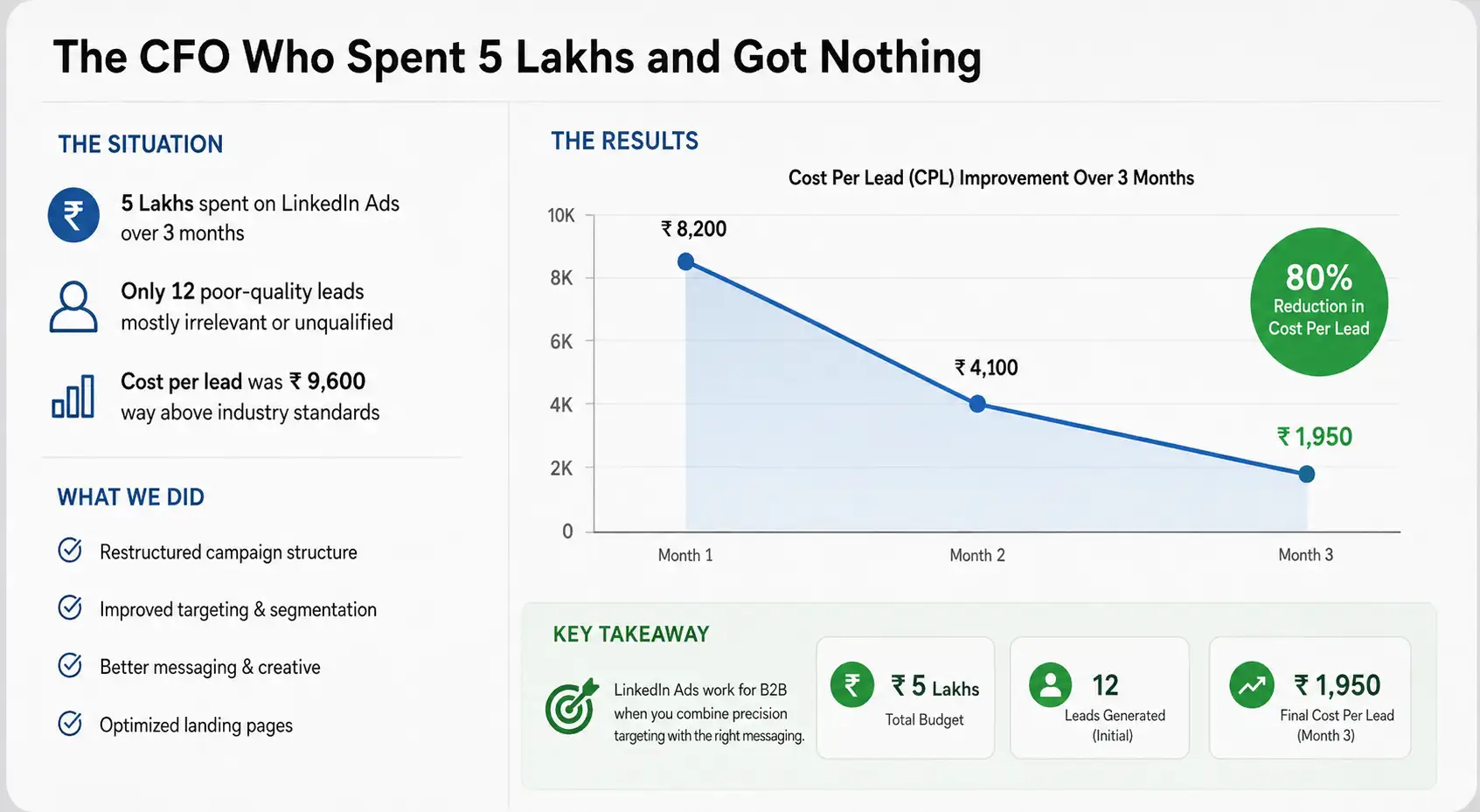
Last October, I got a call from a software company in Bangalore. Founders were frustrated. They’d allocated 5 lakhs for LinkedIn ads over three months. Expected like 40-50 decent leads. Got 12. Twelve. And most of them were random — a student in their early twenties, a business development executive who wasn’t actually empowered to buy anything, one person who replied asking if the founder wanted to “explore partnership opportunities” (which is code for “I want to sell you something”).
First thing I did? Pulled their ad account. Campaign structure was… I’ll be polite and say “chaotic.” Targeting software architects across India, across all industries, mixing product campaigns with thought leadership content, landing pages that looked like they were designed in 2012.
Cost per lead was Rs 9,600. That’s not a typo.
For context, our other B2B clients average about Rs 2,000-3,500 per lead on LinkedIn depending on the industry. Some manage below Rs 1,500. This company was basically flushing money down the internet and wondering why the KPI wasn’t happening.
We restructured everything. New targeting. Segmented campaigns by job level. Better creative (not better design, but better messaging — which is a totally different thing). And you know what happened?
Month one: Rs 8,200 per lead. Still bad.
Month two: Rs 4,100. Getting there.
Month three: Rs 1,950. Now we’re talking.
So the short answer is: yes, LinkedIn works for B2B. But like every marketing channel, it rewards precision. And most companies are shooting buckshot instead of bullets. his is the same pattern we see across every paid channel — as we cover in what agencies hide about performance marketing, the problem is almost never the platform. It’s targeting, structure, and messaging.
Why LinkedIn Is Stupidly Expensive
Let me be honest. LinkedIn’s CPM (cost per thousand impressions) is roughly 3-4x higher than Facebook ads. CPC (cost per click) is 2-3x higher than Google Search. If you’re running campaigns on LinkedIn, you’re going to spend more money for fewer clicks and impressions.
This makes a lot of people decide it’s “not worth it” based on that number alone.
Those people are wrong. Or more specifically, they’re comparing the wrong metrics.
LinkedIn isn’t expensive because it’s bad. It’s expensive because the people on it have decision-making power. A CFO earning Rs 2 crore a year — their attention is valuable. An engineering director at a 500-person tech company — that’s a valuable impression. When you’re trying to reach people like that, LinkedIn is actually cheaper than most alternatives. The sales director at a mid-market manufacturing firm doesn’t respond to Facebook ads. They might respond to a LinkedIn message. That’s the premium you’re paying.
Here’s what I tell clients. LinkedIn is expensive if you’re targeting everyone. It’s valuable if you’re targeting *exactly the right person.*
An industrial equipment manufacturer in Jamshedpur wanted to reach procurement heads at steel plants. Specific title, specific industry, specific region. We ran a campaign targeting maybe 5,000 people across India. Cost per lead came to Rs 1,600. Their average deal size? 25 lakhs. Suddenly that Rs 1,600 looks like a bargain.
But if the same company decided “let’s target anyone in manufacturing” suddenly you’re reaching plant workers, HR assistants, people with zero purchasing power. Cost per lead jumps to Rs 7,000-8,000. Same channel. Totally different results. The difference wasn’t LinkedIn. The difference was targeting.
Campaign Structure That Actually Works
This is where most people mess up.
They create a LinkedIn campaign. One campaign. With one ad. Targeting everyone remotely connected to their industry. Budget Rs 50,000 a month. Then they wonder why results suck.
You can’t run B2B LinkedIn like you run Facebook ads for FMCG. Facebook is volume game — get enough impressions in front of enough eyeballs, some convert. LinkedIn is precision game. You need fewer, tighter audiences. More specific messaging for each audience segment.
What we do for clients: create separate campaigns for different audience segments. Not just “decision makers” — that’s too broad. Separate campaigns for:
- IT Directors at companies 500+ employees in the financial services space
- Plant Managers at manufacturing facilities in tier-2 cities with 200-1000 employees
- CFOs at listed companies looking for cost management solutions
Each segment gets its own ad copy tailored to their specific pain point. CFOs respond to ROI language. Plant managers respond to operational efficiency. IT Directors worry about security and scalability. Same product, different messaging. This audience-first segmentation is the same discipline behind how to build a marketing funnel that converts — different people at different stages need different messages, and one-size-fits-all messaging leaks leads at every stage.
Also — and this matters — don’t dump everyone into your ads. Run separate campaigns by seniority level. C-suite gets different creative than VPs get different creative than managers. The way you speak to a CEO (“Reduce operational costs by 18% in Q3”) is completely different from how you speak to a manager (“Streamline your team’s reporting process”).
What the Campaign Structure Looks Like
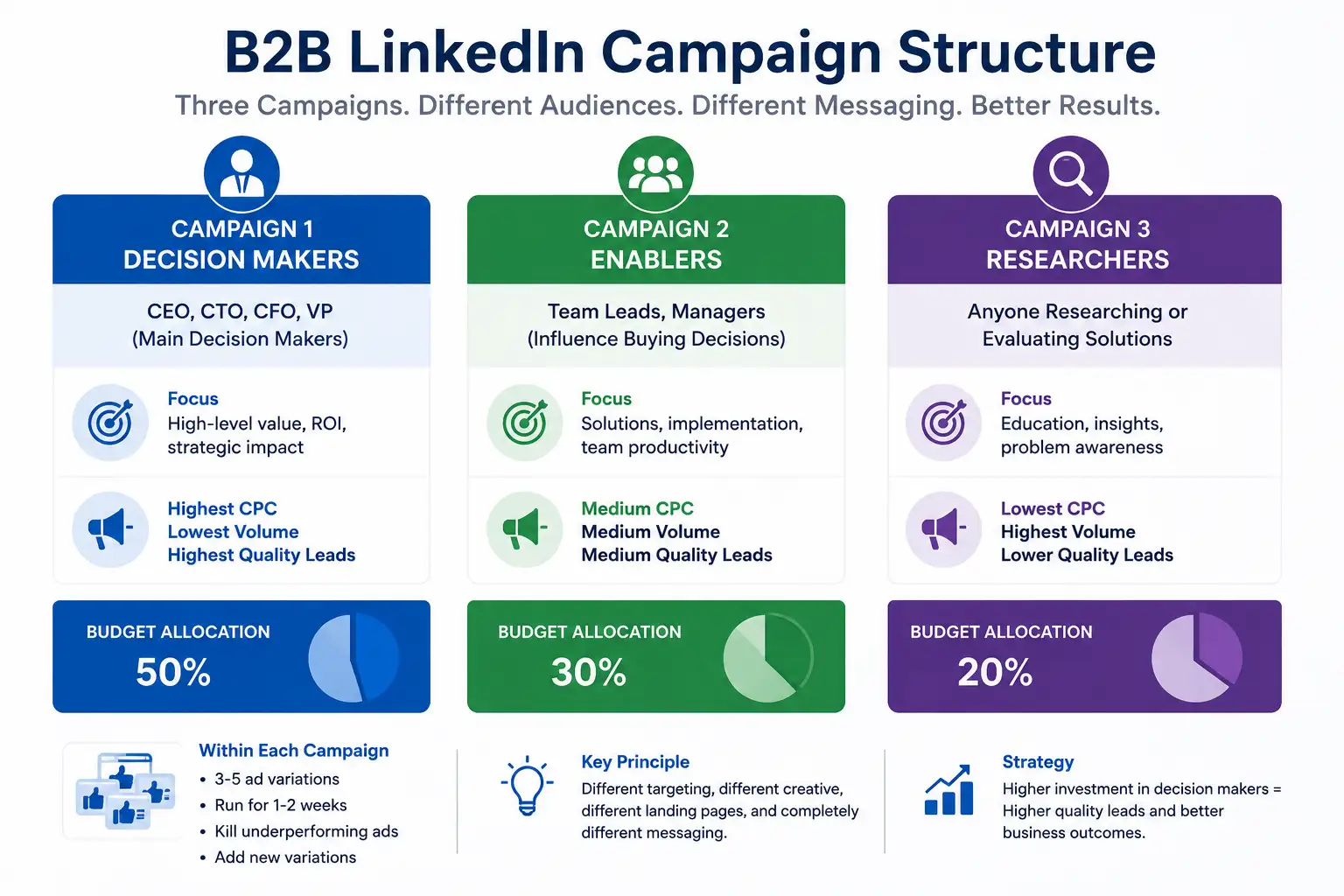
Campaign 1: Decision Makers (CEO, CTO, CFO, VP — main decision makers)
Campaign 2: Enablers (Team leads, managers who influence buying decisions but don’t have final sign-off)
Campaign 3: Researchers (Anyone in the account who might be researching or evaluating solutions)
That’s it. Three campaigns. Different targeting, different creative, different landing pages. Not “different” like a different logo or colour scheme. Different messaging completely.
Within each campaign: 3-5 ad variations. LinkedIn is terrible at creative rotation compared to Facebook. So you need more variations for the algorithm to find what works. Run them for 1-2 weeks, kill what’s underperforming, add new variations.
Budget allocation? Give 50% to the decision maker campaign. 30% to enablers. 20% to researchers. The decision maker campaign will have the highest CPC and lowest volume but highest quality leads. That’s intentional.
The Targeting Trap That Everyone Falls Into
LinkedIn’s targeting options are… extensive. Maybe too extensive. It’s like walking into a store with a million products and no shopping list. You want to pick everything and end up picking nothing useful.
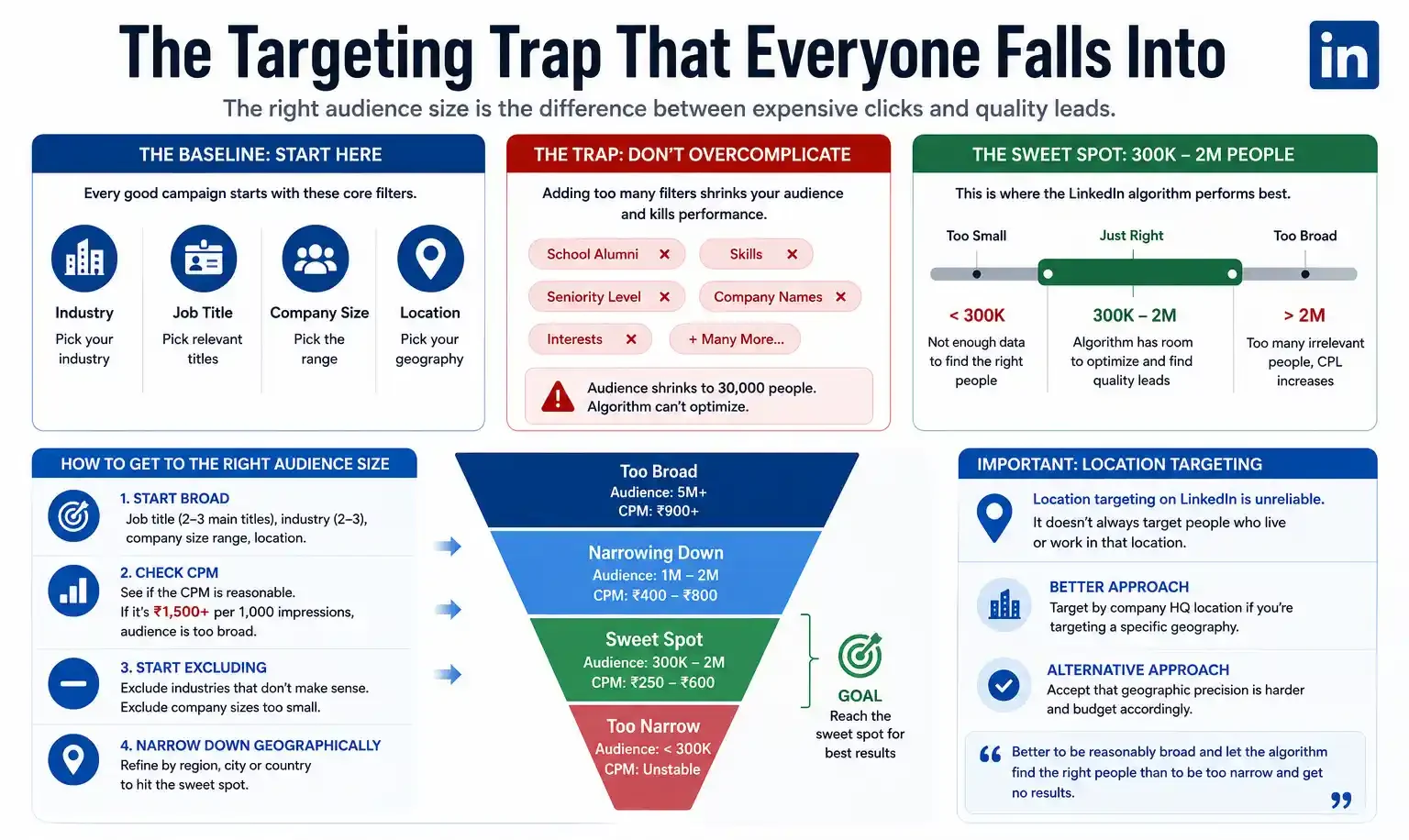
Most people start by choosing:
- Industry (pick your industry)
- Job Title (pick relevant titles)
- Company Size (pick the range)
- Location (pick geography)
And that’s fine. That’s the baseline. But then they get fancy. They start adding school alumni filters, skills, seniority level, company names, interests — and suddenly the audience shrinks to 30,000 people. LinkedIn’s algorithm now has so few people to show ads to that it can’t optimise effectively.
The sweet spot? Your audience size should be between 300,000 and 2 million people. Below 300,000 and the algorithm doesn’t have room to find the right people. Above 2 million and you’re too broad and cost per lead rockets because you’re reaching too many irrelevant people.
How do we get to the right audience size? Start broad. Job title (2-3 main titles), industry (maybe 2-3), company size range. See if the CPM is reasonable. If it’s Rs 1,500+ per thousand impressions, audience is too broad. Start excluding. Exclude industries that don’t make sense. Exclude company sizes too small. Narrow down geographically.
Also — and I’ve learned this through painful trial and error — location targeting on LinkedIn is unreliable. If you want people in “Bangalore, Hyderabad, Pune” you’d think it would target people who live there or work there. It doesn’t always. Better to target by company HQ location if you’re targeting a specific geography. Or just accept that geographic precision is harder and budget accordingly.
The Ad Creative Problem
People assume the issue with LinkedIn ads is creative. “Our ad isn’t catchy enough.” “We need better design.” “The copy isn’t compelling.”
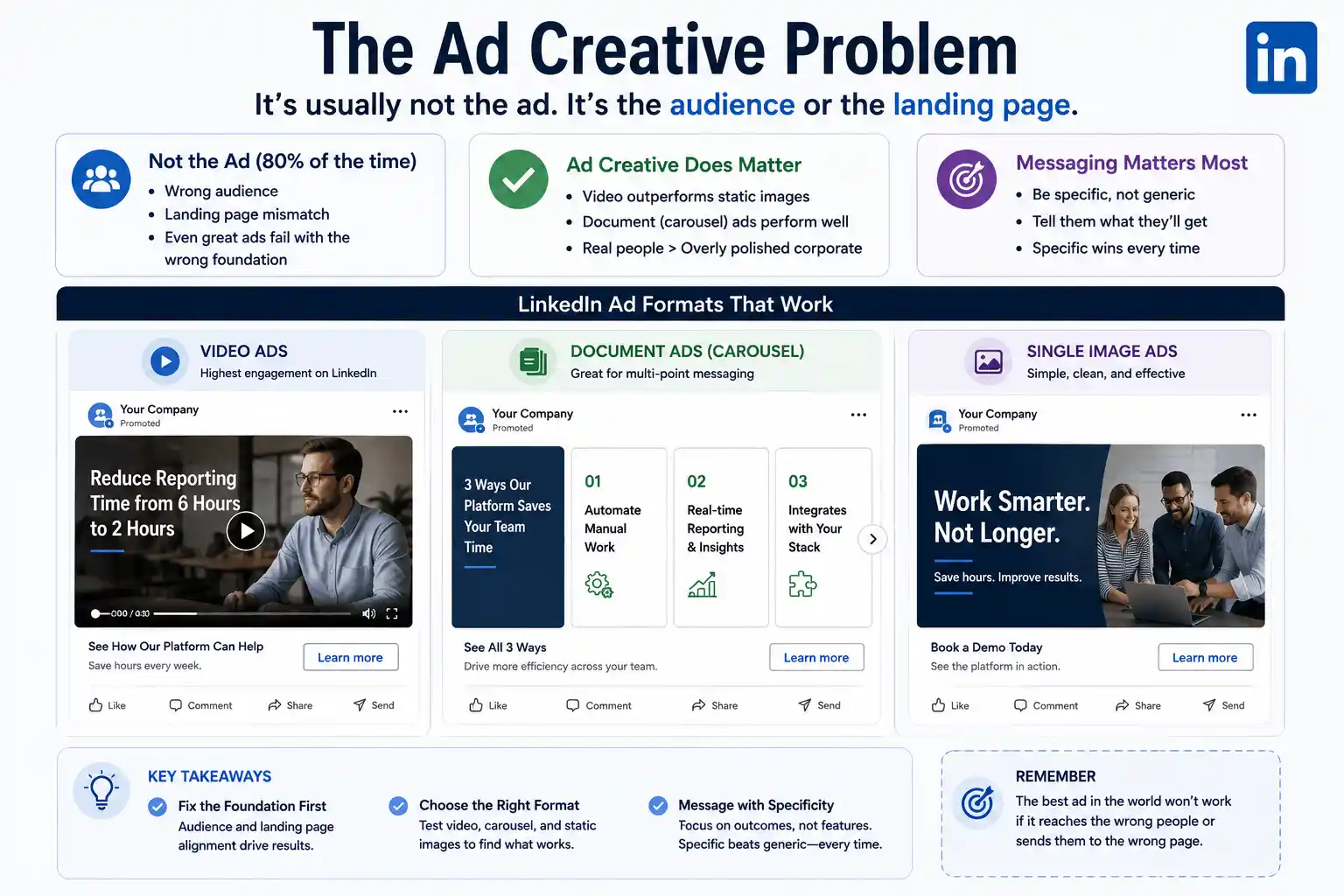
Sometimes that’s true. But 80% of the time, the problem is the audience or the landing page — not the ad itself. I’ve run absolute garbage-looking ads on LinkedIn that performed great because the audience was right. And I’ve run beautiful ads with terrible results because we were targeting the wrong people or sending them to a landing page with mismatch.
That said. Ad creative does matter. On LinkedIn specifically, video tends to outperform static images. Document ads (LinkedIn’s carousel-style ads) tend to perform well. And — this is specific to LinkedIn — professional-looking ads with people in them tend to beat overly polished corporate stuff. A real photo of your team. Authentic headline. Works better than a stock photo of a person in a suit shaking hands.
The messaging, though. That’s where it matters most. “Increase your team’s productivity” is generic. “Reduce reporting time from 6 hours to 2 hours using our platform” is specific. Specific wins every single time. Tell people what they’ll get, not what it is.
Budget — What Actually Works in India
Let’s talk numbers. Real numbers. Not ranges that mean nothing.
Minimum viable budget: Rs 40,000 a month. If you’re below that, don’t bother. LinkedIn can’t optimise with such small daily spend. Your cost per lead will be double what it should be because the algorithm is basically guessing.
Entry-level serious budget: Rs 80,000-1,20,000/month. This is enough for 2-3 campaigns with decent daily budget ($15-20/day per campaign). You’ll get meaningful data in 4 weeks.
Actual working budget for most B2B companies: Rs 1,50,000-3,00,000/month. This is for companies doing 5-15 lakhs of revenue per month who can afford to invest in lead generation. Run 3-4 campaigns, get 40-100 leads per month depending on industry, convert some percentage to deals.
Aggressive growth budget: Rs 4,00,000+/month. This is for companies that have product-market fit and want to scale. Or for enterprise deals where a single customer is worth crores.
Now — budget allocation. Your first month should be split: 60% new customer acquisition, 40% remarketing/engagement with existing audience.
Months 2-3: 50-50 if you’ve got email list and previous engagements. Otherwise stay at 60-40.
Months 4+: 40% new, 60% warm audiences. By now you’ve got people who’ve visited your site, downloaded your content, engaged with your ads. They’re much cheaper to convert.
A Campaign That Almost Worked (And Why It Didn’t)
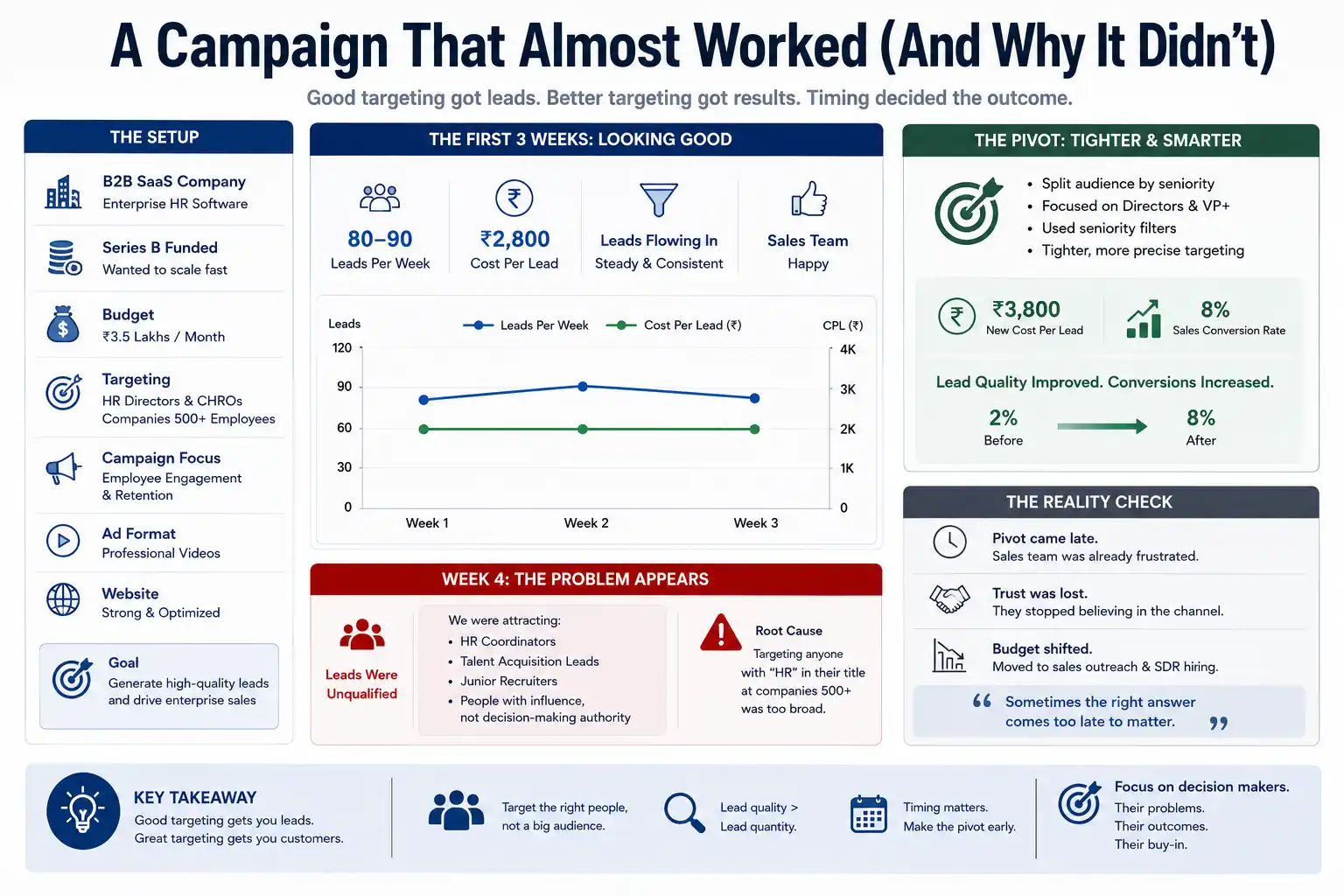
Early 2025. B2B SaaS company, enterprise HR software, series B funded. Had raised money, wanted to grow customer acquisition fast. Budget was Rs 3.5 lakhs a month. Aggressive but doable.
We built out campaigns targeting HR directors and CHROs at companies 500+ employees. Good targeting. Messaging around employee engagement and retention. Videos were professional. Website was solid.
First three weeks? Leads came in. About 80-90 per week. Cost per lead was Rs 2,800. Not bad for enterprise software. Sales team was happy. Everyone felt good.
Then week four. The sales team started reporting that leads were unqualified. People were “interested” but weren’t actual decision makers. They were HR coordinators, talent acquisition leads, people who could influence but had zero authority to buy.
We looked back at the targeting. Problem was clear — we were targeting anyone with “HR” in their title at companies 500+. That captures everyone from the CHRO down to junior recruiters.
So we split the audience. Different campaign for VP+ level and directors. Tighter targeting on seniority filters. CPL jumped to Rs 3,800. But lead quality improved massively. Sales conversion rate went from like 2% to 8%.
But here’s the part that doesn’t fit the neat story. By the time we made the pivot, the sales team was already frustrated. They didn’t trust the channel anymore. Even though the Q2 numbers showed real improvement, they’d mentally moved on. Company shifted budget to sales outreach and SDR hiring instead. Sometimes the right answer comes too late to matter.
Why We Keep Coming Back to This Channel
After all this — budget concerns, algorithm frustrations, targeting complexity — we still allocate significant budget to LinkedIn for B2B clients.
Because it works. Not for every company. Not for every industry. But for the right companies, at the right point in their growth curve, with the right audience and proper execution… no other channel gives you access to decision makers like LinkedIn does.
Facebook gets you quantity. Google gets you intent. LinkedIn gets you access to people with authority and budget. That’s valuable enough to justify the premium you pay. Sabse pehle ROI. That’s what this is about.
Want to explore this for your B2B business? Talk to our performance marketing team. We’ll look at your situation — industry, deal size, sales cycle, audience — and tell you straight whether LinkedIn makes sense or whether you’d be better served by Google Ads, email, or something else entirely.
| Approach | Best for | Watch out for |
|---|---|---|
| DIY | Small teams, tight budgets | Slow ramp-up, trial-and-error |
| Freelancer | Specific project bursts | Inconsistency, limited ownership |
| Agency | Ongoing work, senior input | Higher retainer, less control |
Quick checklist before you start:
- Define the one thing you want: leads, sales, awareness — pick one.
- Baseline your numbers: write down where you are today.
- Pick a 90-day window: nothing moves in 2 weeks.
- Agree on success metrics: with whoever is paying the bill.
- Set up proper tracking: GA4, UTMs, call tracking.
- Review monthly: kill what doesn’t work, double down on what does.
The Bottom Line
If you take one thing from this: linkedin ads for b2b the guide nobody tells you about rewards patience and specificity, not volume or clever tricks. Start small, measure honestly, fix what breaks, and compound what works. The brands doing this well in India aren’t smarter — they’re just consistent. Need a hand with this for your business? Talk to us.
Ready to Run LinkedIn Ads That Actually Convert?
PromotEdge has been running B2B campaigns across 250+ brands. We know what works and what wastes money. Let’s talk about your specific situation.
FAQs
-
Is LinkedIn worth the cost for B2B lead generation?
Ans.Depends entirely on what you're selling. If you're selling something the C-suite or senior managers actually search for — ERP software, industrial equipment, professional services — then yes, absolutely. We worked with a manufacturing firm in Pune doing custom die-cast components for automotive suppliers. LinkedIn generated leads at Rs 1,200 each. Their sales cycle was 3-4 months, but 40% of those leads converted to projects worth 8-12 lakhs each. The math works. But if you're selling something that junior employees research on their phones without telling their bosses? LinkedIn will bleed your budget while your competitors who are using Google Ads laugh. -
How much should we budget for LinkedIn ads monthly?
Ans.Start with Rs 40,000-50,000 minimum if you want any real data. Below that, the platform can't optimise properly. For B2B, most clients we work with run Rs 80,000-2,50,000/month depending on their industry, target audience size, and sales cycle. Tech/SaaS companies tend to be higher because the competition for engineers and CTOs is fierce. A manufacturing business in tier-2 cities usually does fine at the lower end. Give it 3 months before judging. First month is setup, second is learning, third is when you actually see the real performance. -
LinkedIn or Google Ads for B2B — which should we pick?
Ans.Not either-or. Google Ads catches people who are actively searching for what you do — high intent, usually lower cost per lead, but the person might be a junior researcher not a decision maker. LinkedIn reaches decision makers directly based on job title, company size, industry — but it's expensive and the intent is lower because people aren't on LinkedIn thinking about buying. Best approach: use Google Ads for actual searches and LinkedIn for relationship building and brand awareness. Use both if your budget allows. If you must choose one? Google Ads, unless you're specifically targeting executives at Fortune 500 companies in India, then LinkedIn makes more sense.
Author Details

Latest Posts
-
 24 / Sep
GMB Optimisation Google Business Profile Optimization Guide 2026
24 / Sep
GMB Optimisation Google Business Profile Optimization Guide 2026 -
 23 / Sep
Search Engine Optimization Programmatic SEO: Template + Data Model Explained
23 / Sep
Search Engine Optimization Programmatic SEO: Template + Data Model Explained -
 22 / Sep
Conversion Rate Optimization Conversion Rate Optimization: A Practical Guide
22 / Sep
Conversion Rate Optimization Conversion Rate Optimization: A Practical Guide -
 21 / Sep
Whatsapp Marketing WhatsApp Marketing for Indian SMBs
21 / Sep
Whatsapp Marketing WhatsApp Marketing for Indian SMBs -
 19 / Sep
Related Knowledge