-
Author: Anindita Barik
-
Updated Date: Jun-06-2026
-
Views: 2 Min Read
To choose a digital marketing agency in Bangalore for tech and startups, prioritize agencies that understand SaaS metrics like CAC, LTV, and churn — not vanity metrics. Verify their startup-stage experience, technical understanding, and B2B positioning skills. Ask for SaaS-specific case studies and test them with hard questions. Bangalore’s tech buyers are skeptical and data-driven — your agency must be too.
Choosing a digital marketing agency in Bangalore can feel overwhelming — especially when you’re a startup still figuring out your product-market fit, or a tech company that needs marketers who actually get the technical side. The right agency isn’t just about flashy decks; it’s about finding a partner who understands your growth stage, speaks your language, and delivers results that actually move the needle.
The SaaS Company That Needed a Completely Different Approach
Year 2019. A B2B SaaS company in Whitefield reached out. They were burning money on Google Ads but couldn’t figure out why CAC kept climbing while LTV stayed flat. Spent about 40 lakhs on ads over 8 months. Landed 32 customers. At Rs 1.25 lakhs per customer. Which… wasn’t working.
Their previous agency kept saying “increase ad spend, we’ll optimise” which is basically every agency’s answer when performance tanks. But the real problem wasn’t the ads. It was the product-market fit story wasn’t clear enough. When a CTO landed on their site, they couldn’t quickly understand why this tool was better than the three competitors.
We basically paused ads. Spent 3 months building out content, case studies, positioning. Then restarted ads with that new narrative. CAC dropped to Rs 45K. Same ad budget. Different story.
That’s the Bangalore difference. Standard marketing playbooks don’t work because Bangalore buyers are skeptical, technical, and data-driven.

Why Bangalore Agencies Can’t Think Like Delhi or Mumbai
Bangalore’s tech market moves faster. Decisions are made differently. A CTO cares about different things than an FMCG marketing manager.
And here’s what most generic agencies miss: your customer isn’t scrolling Instagram at lunch. They’re reading GitHub issues, following thought leaders on Twitter (X), and listening to engineering podcasts. They actively avoid traditional advertising.
So when an agency tries to “build brand awareness” with pretty Instagram stories, it’s… not landing. These buyers want substance. Data. Proof. They ask harder questions. They fact-check everything.
If your agency doesn’t understand that, you’re wasting budget.
Industries That Matter in Bangalore
SaaS & B2B Software. FinTech. EdTech. HealthTech. D2C & E-commerce. Startups across everything.
Each has different buyer psychology. Each needs different channels. An EdTech startup recruiting students needs YouTube and Instagram Reels. A B2B SaaS selling to enterprises needs LinkedIn and thought leadership. A fintech app needs careful compliance messaging and trust-building.
Good Bangalore agencies understand these distinctions. They don’t just optimise ads. They rethink positioning.
What “SaaS Marketing Expertise” Actually Means (And How to Test for It)
Any agency can claim SaaS expertise. But here’s how to know if they actually have it:
1. Ask About Their SaaS Case Studies
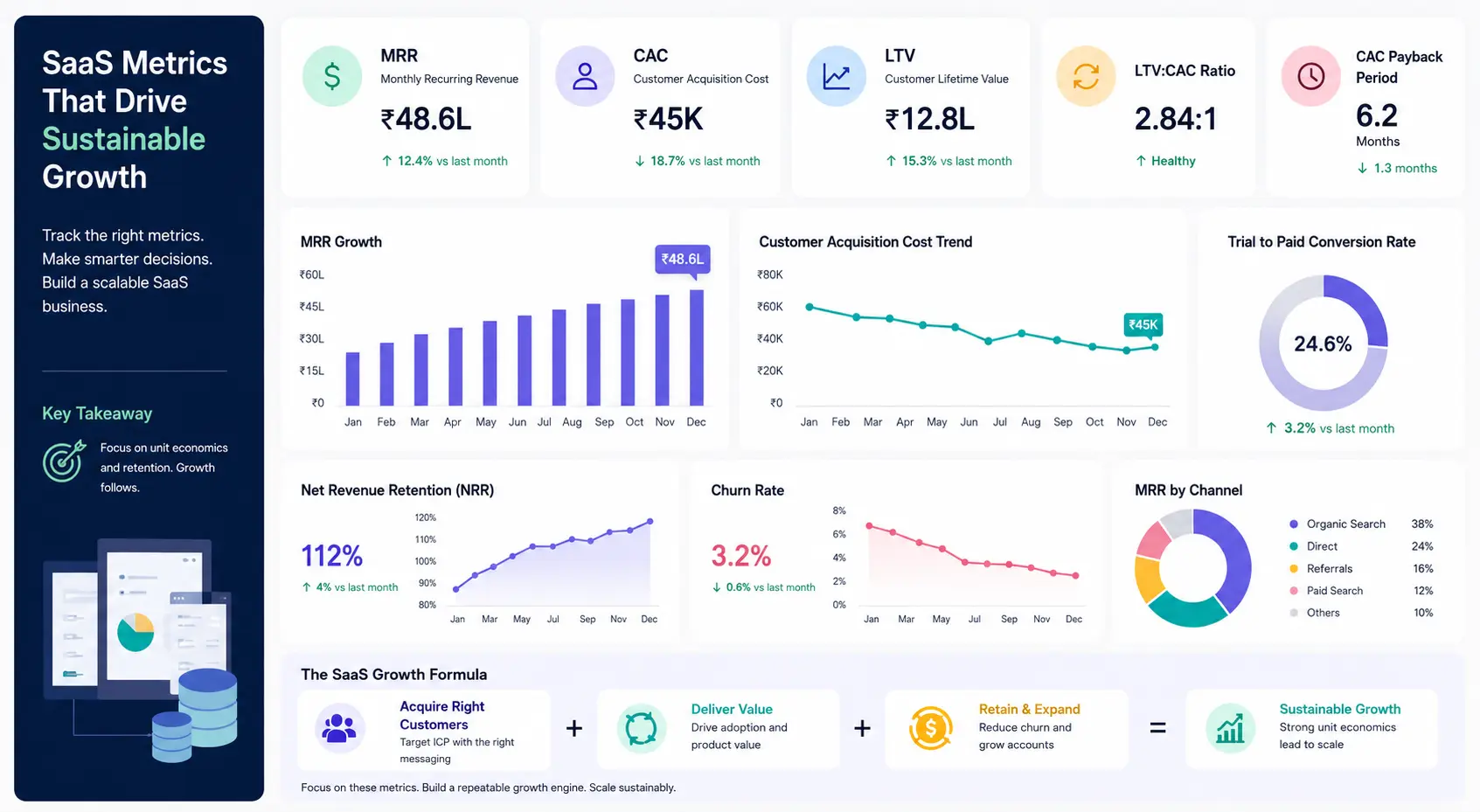
Get specifics. What was the company’s ARR (annual recurring revenue)? What was CAC before and after? LTV? Conversion rate from trial to paid? Churn rate?
If they can’t answer these without consulting notes… they don’t understand SaaS metrics. Move on.
2. Ask How They Position Complex Products
This is the killer question. How would you position a tool that does X for engineers but we want to sell to CTO-level decision makers? Their answer reveals if they understand buyer committees, technical personas, and the different languages each speaks.
Bad answer: “We’d build awareness and drive traffic.” Good answer involves positioning, narrative, competitive framing, proof points.
3. Ask About Developer Marketing
Have they built GitHub communities? Sponsored conferences? Worked with developer platforms? Run ambassador programmes?
Developer communities are where word-of-mouth happens in Bangalore’s tech world. Agencies that understand this know it’s not just marketing. It’s authentic community building.
4. What Metrics Do They Track?
They should care about: MRR (monthly recurring revenue), CAC, LTV, CAC payback period, net revenue retention, churn. Not vanity metrics like impressions or reach.
If they’re focused on “likes” and “engagement,” they’re not SaaS-ready.
What Startup Founders Should Actually Look For
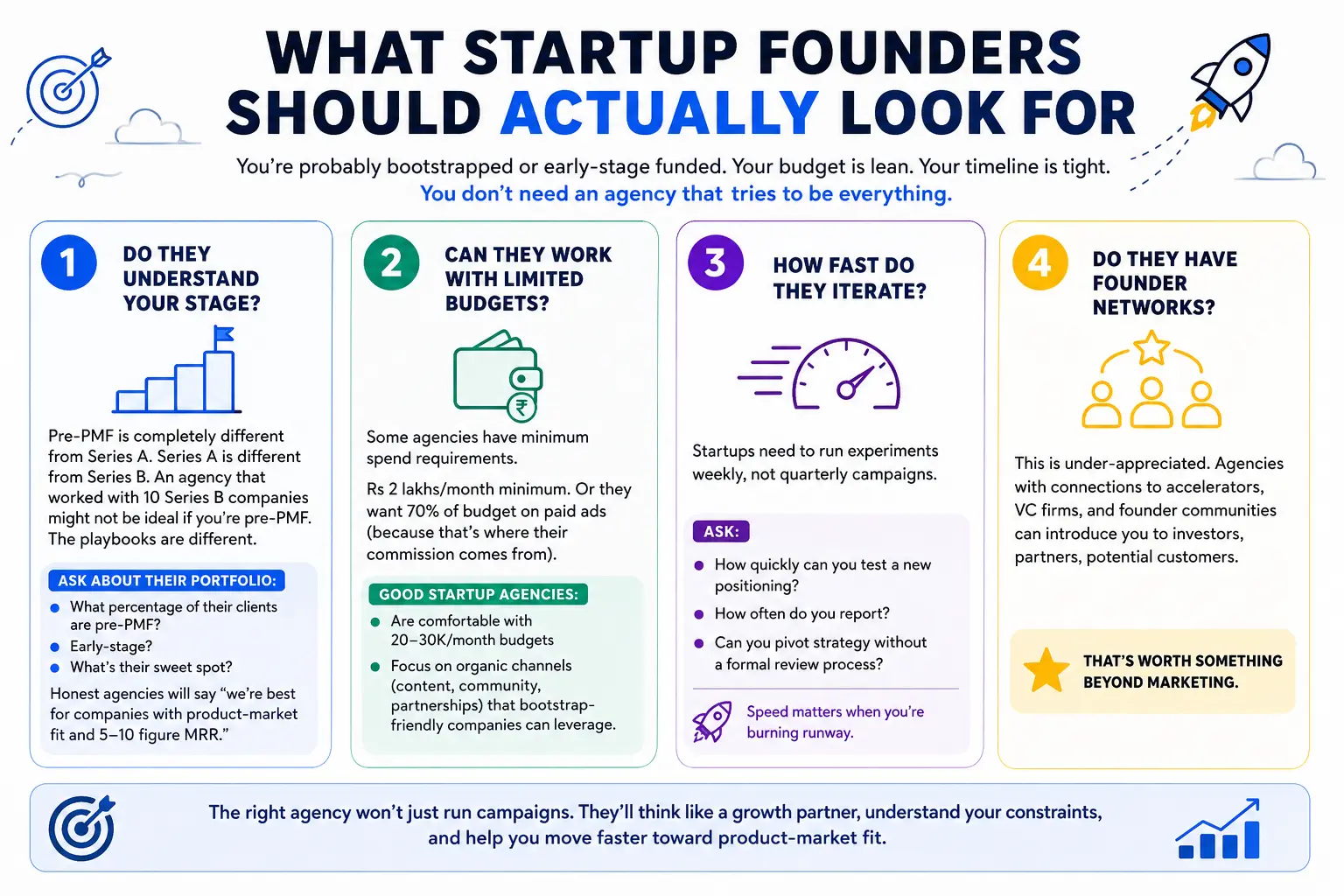
You’re probably bootstrapped or early-stage funded. Your budget is lean. Your timeline is tight. You don’t need an agency that tries to be everything.
1. Do They Understand Your Stage?
Pre-PMF is completely different from Series A. Series A is different from Series B. An agency that worked with 10 Series B companies might not be ideal if you’re pre-PMF. The playbooks are different.
Ask about their portfolio: What percentage of their clients are pre-PMF? Early-stage? What’s their sweet spot? Honest agencies will say “we’re best for companies with product-market fit and 5-10 figure MRR.”
2. Can They Work With Limited Budgets?
Some agencies have minimum spend requirements. Rs 2 lakhs/month minimum. Or they want 70% of budget on paid ads (because that’s where their commission comes from).
Good startup agencies are comfortable with 20-30K/month budgets and focus on organic channels (content, community, partnerships) that bootstrap-friendly companies can leverage.
3. How Fast Do They Iterate?
Startups need to run experiments weekly, not quarterly campaigns. Ask: How quickly can you test a new positioning? How often do you report? Can you pivot strategy without a formal review process?
Speed matters when you’re burning runway.
4. Do They Have Founder Networks?
This is under-appreciated. Agencies with connections to accelerators, VC firms, and founder communities can introduce you to investors, partners, potential customers. That’s worth something beyond marketing.
Bangalore-Specific Things That Matter (And Don’t)
-
Remote vs Local Teams
Bangalore has distributed everything. Founders are used to async communication and remote teams. A remote agency works fine. But local teams have direct access to the ecosystem—accelerators, VCs, other founders. That’s valuable if you’re fundraising.
-
Language Capabilities
Tech companies target English. Always. Even if your product eventually goes mainstream, your early users are English speakers. So Kannada content isn’t critical for B2B SaaS.
But if you’re selling to consumers (D2C, fintech apps for masses, edtech), bilingual content matters. Ask if they have native Kannada speakers on the team.
-
Global vs India-Only Mindset
Many Bangalore tech companies target US/Europe markets. Does your agency understand international SEO? Multi-market campaigns? Currency and compliance issues? Or are they India-only thinkers?
Matters hugely if you’re building globally.
-
Tech Stack Understanding
Can they work with your stack? If you’re a product company running tests constantly, you need an agency that can set up custom events in GA4, create UTM structures, integrate with your analytics. Some agencies are… not good at this.
Red Flags Specific to Bangalore
- “We don’t focus on metrics, just brand building.” In Bangalore’s VC ecosystem, metrics are everything. If an agency downplays them, walk away.
- “We’ve never worked with startups before.” Startup marketing is a different game. Ask for proof of experience.
- “SaaS is like any other B2B business.” No. It’s not. If they don’t see the difference, they’re not ready.
- “We guarantee X leads in X months.” Overconfidence signals inexperience. Real SaaS is too variable to guarantee.
- No Bangalore case studies. They claim SaaS expertise but their portfolio is full of e-commerce and FMCG work? Suspicious.
- “Team isn’t technical, but we have creative people.” In Bangalore tech, creative without substance fails. You need both.
- Slow communication. Bangalore moves fast. Agencies that move slow become bottlenecks.
I’ve seen startups hire agencies that checked every other box but failed on one of these. It gets messy.
The Founder’s Question to Ask: “Show Me Your Worst Campaign”
Here’s my favourite test question. Ask any agency: “Tell me about a campaign that didn’t work. What happened? What did you learn?”
Listen to how they answer. Do they blame the client? Do they blame market conditions? Or do they own it and explain specific learnings?
Honest agencies admit failures. They explain what went wrong. They show iteration. Defensive agencies either brag only or avoid the question.
The agencies that have learned the most are the ones that have failed the most.
Why PromotEdge Works for Bangalore Tech
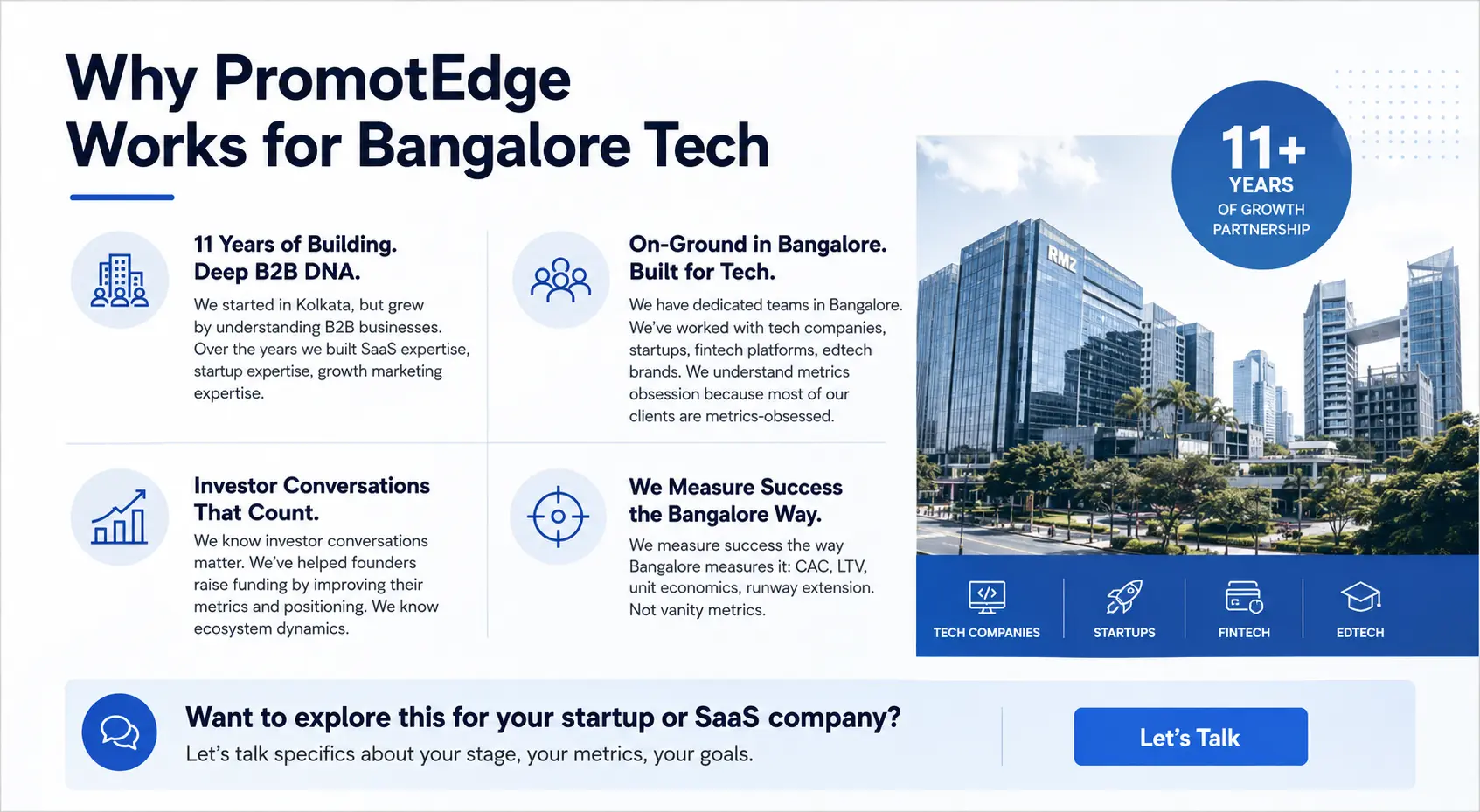
We’ve been building for 11 years. We started in Kolkata, yes, but grew specifically because we understood B2B businesses. Over the years we built SaaS expertise, startup expertise, growth marketing expertise.
We have dedicated teams in Bangalore. We’ve worked with tech companies, startups, fintech platforms, edtech brands. We understand metrics obsession because most of our clients are metrics-obsessed.
We know investor conversations matter. We’ve helped founders raise funding by improving their metrics and positioning. We know ecosystem dynamics.
We measure success the way Bangalore measures it: CAC, LTV, unit economics, runway extension. Not vanity metrics.
Want to explore this for your startup or SaaS company? Let’s talk specifics about your stage, your metrics, your goals.
Timeline Expectations for Bangalore Tech
Months 1-2: Discovery and positioning work. Audit of product, market, positioning. This looks boring but it’s where most agencies fail. Good positioning changes everything.
Months 3-4: Content and proof-points. Case studies, testimonials, thought leadership pieces. Community building starts.
Months 5-7: Early traction. Website improvements are showing. Content is driving inbound. Initial paid campaigns are optimised. You should see lead volume increases 30-50%.
Months 8-12: Real metrics movement. CAC improves. LTV clarity increases. Conversion rates go up. Growth compounds. If the positioning was right, this is where you see 2-3x improvements.
The key: positioning clarity in months 1-2 determines whether months 8-12 work or not.
| Approach | Best for | Watch out for |
|---|---|---|
| DIY | Small teams, tight budgets | Slow ramp-up, trial-and-error |
| Freelancer | Specific project bursts | Inconsistency, limited ownership |
| Agency | Ongoing work, senior input | Higher retainer, less control |
Quick checklist before you start:
- Define the one thing you want: leads, sales, awareness — pick one.
- Baseline your numbers: write down where you are today.
- Pick a 90-day window: nothing moves in 2 weeks.
- Agree on success metrics: with whoever is paying the bill.
- Set up proper tracking: GA4, UTMs, call tracking.
- Review monthly: kill what doesn’t work, double down on what does.
The Bottom Line
If you take one thing from this: digital marketing agencies how to choose for te rewards patience and specificity, not volume or clever tricks. Start small, measure honestly, fix what breaks, and compound what works. The brands doing this well in India aren’t smarter — they’re just consistent. Need a hand with this for your business? Talk to us.
Ready To Talk Tech Marketing Strategy?
Whether you’re a SaaS company optimising CAC or a startup raising your next round, the right strategy accelerates everything. Let’s discuss your specific situation.
FAQs
-
Why is SaaS marketing different?
Ans.Your buyers are technical and skeptical. They ignore ads. They research extensively before talking to sales. Sales cycles are long. They make decisions in committees. None of this is true for e-commerce or FMCG. Standard marketing playbooks don't work. You need positioning, content, and proof-points. Paid ads are support, not the main driver. -
Should my startup hire a full-service agency or specialist?
Ans.Depends on your stage. Pre-PMF? You might need a strategic advisor more than an agency. Early-stage funded? Full-service is good because you need integrated thinking. Growth-stage? Specialists might work if you're super focused on one channel. We usually recommend full-service for startups because the learning compounds. -
How do I know if an agency truly understands SaaS?
Ans.Ask for SaaS case studies with specific numbers. Ask how they'd position a technical product to non-technical buyers. Ask about developer marketing. Ask what metrics they care about. If they can't answer deeply, they don't understand SaaS.
Author Details

Latest Posts
-
 26 / Aug
Search Engine Optimization Video SEO: How to Rank Your Videos in Google & YouTube
26 / Aug
Search Engine Optimization Video SEO: How to Rank Your Videos in Google & YouTube -
 25 / Aug
Video Production Corporate Video Production: A Practical Guide for Indian Brands
25 / Aug
Video Production Corporate Video Production: A Practical Guide for Indian Brands -
 24 / Aug
-
21 / Aug
Catalogue Design Catalogue Design: How to Create Catalogues That Actually Sell
-
 20 / Aug



Related Knowledge