-
Author: Anindita Barik
-
Updated Date: May-14-2026
-
Views: 2 Min Read
Local SEO for Indian businesses works best when you target neighborhoods instead of competing nationally. Focus on location-specific keywords, optimize your Google Business Profile, maintain NAP consistency, and build regular customer reviews. Creating service + location pages improves visibility in Maps and search, helping you attract more relevant customers, rank faster, and achieve better ROI than broad national SEO efforts.
The Biggest Local SEO Mistake I See (Again and Again)
- Restaurant owner in Pune. Beautiful menu. Good food. They wanted to rank for “best restaurant in Pune.”
- Impossible. Not because they’re not good. But because 500+ restaurants are competing for that exact keyword. They’ll lose to better-known brands.
- Better strategy? Rank for “best North Indian restaurant in Koregaon Park.” Rank for “casual dining near Viman Nagar.” Rank for specific neighborhoods and sub-cuisines.
- Micro-competition. Easier to win. More qualified customers.
That’s the entire game of local SEO. Stop thinking nationally. Think in neighborhoods.
Local SEO Isn’t Optional (If Your Customers Are Nearby)
If you’re a doctor, plumber, dentist, cafe, gym, salon, repair shop, real estate agent — basically, if people search for you WITH a location — you need local SEO.
When someone searches “dentist near me” on their phone, they’re usually looking for a place just a couple of kilometres away. Google knows this. Your job is making sure Google knows YOU’RE IN THAT AREA.
This is different from national SEO. Different tactics. Different keywords. Different mindset.
The hierarchy of local search
Google typically shows three things: Google Maps results (the map with 3 businesses), then organic search results below. But the map gets the most clicks for local queries. So your Google Business Profile matters more than your website.
But your website matters too. Both need attention.
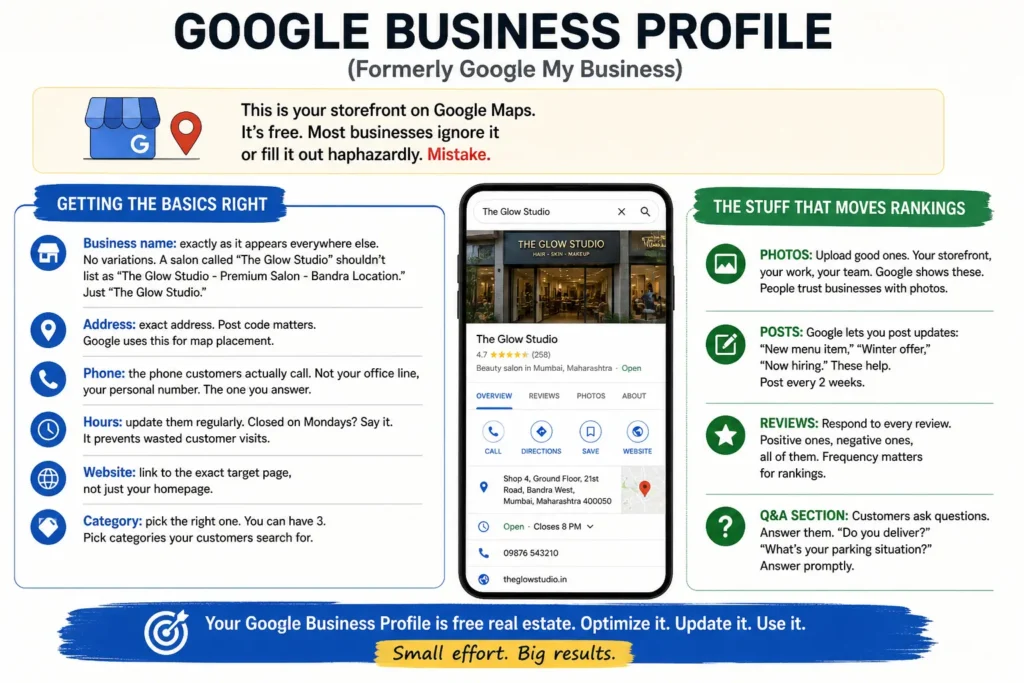
Google Business Profile (Formerly Google My Business)
This is your storefront on Google Maps. It’s free. Most businesses ignore it or fill it out haphazardly. Mistake.
Getting the basics right
- Business name: exactly as it appears everywhere else. No variations. A salon called “The Glow Studio” shouldn’t list as “The Glow Studio – Premium Salon – Bandra Location.” Just “The Glow Studio.”
- Address: exact address. Post code matters. Google uses this for map placement.
- Phone: the phone customers actually call. Not your office line, your personal number. The one you answer.
- Hours: update them regularly. Closed on Mondays? Say it. It prevents wasted customer visits.
- Website: link to the exact target page, not just your homepage.
- Category: pick the right one. You can have 3. Pick categories your customers search for.
The stuff that moves rankings
Photos : Upload good ones. Your storefront, your work, your team. Google shows these. People trust businesses with photos.Posts.
Google lets you post updates : “New menu item,” “Winter offer,” “Now hiring.” These help. Post every 2 weeks.
Reviews : Respond to every review. Positive ones, negative ones, all of them. Frequency matters for rankings.
Q&A section : Customers ask questions. Answer them. “Do you deliver?” “What’s your parking situation?” Answer promptly.
NAP Consistency: The Unsexy But Critical Part
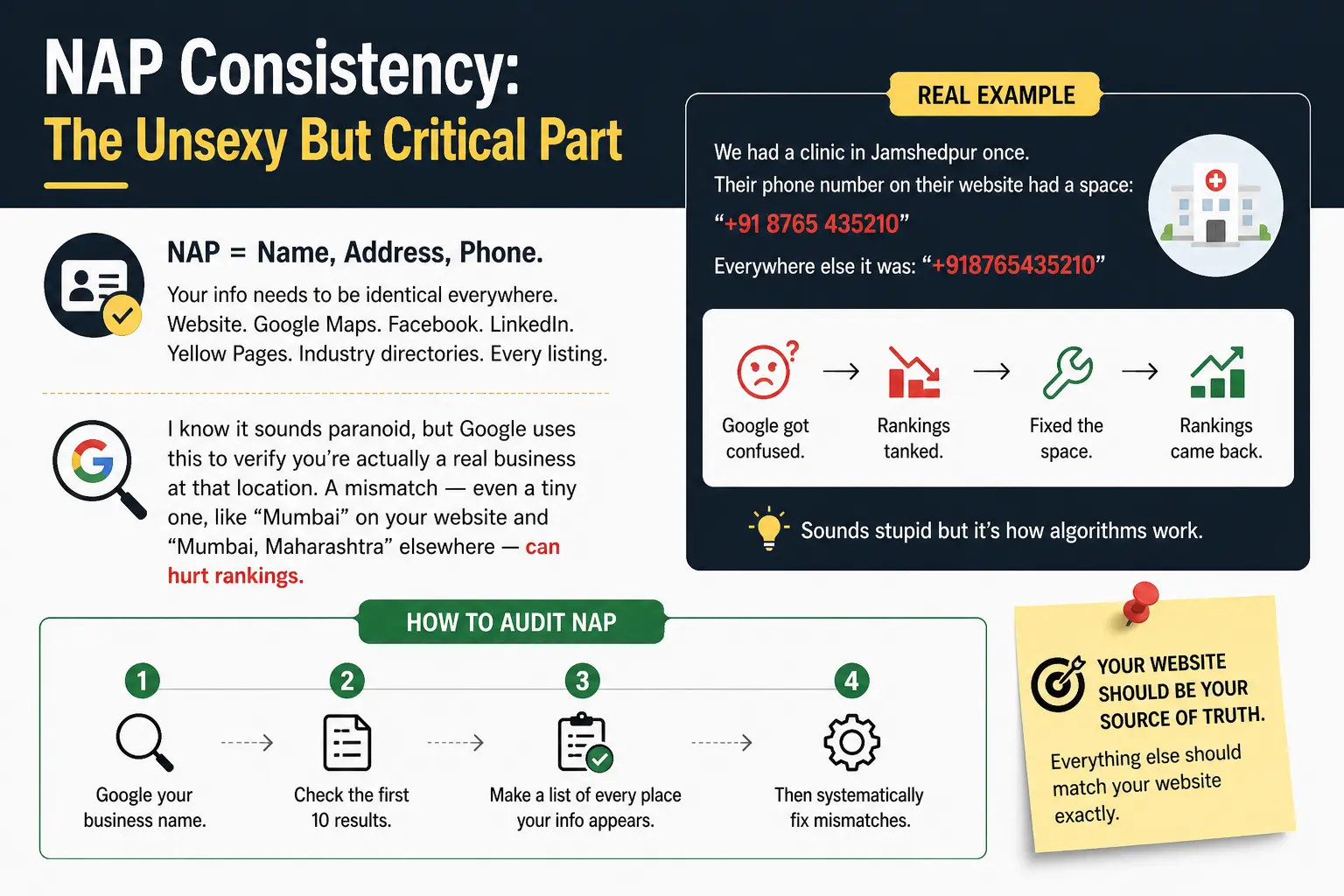
NAP = Name, Address, Phone.
Your info needs to be identical everywhere. Website. Google Maps. Facebook. LinkedIn. Yellow Pages. Industry directories. Every listing.
I know it sounds paranoid, but Google uses this to verify you’re actually a real business at that location. A mismatch — even a tiny one, like “Mumbai” on your website and “Mumbai, Maharashtra” elsewhere — can hurt rankings.
We had a clinic in Jamshedpur once. Their phone number on their website had a space: “+91 8765 435210”. Everywhere else it was “+918765435210”. Google got confused. Rankings tanked. Fixed the space. Rankings came back.
Sounds stupid but it’s how algorithms work.
How to audit NAP
Google your business name. Check the first 10 results. Make a list of every place your info appears. Then systematically fix mismatches.
Your website should be your source of truth. Everything else should match your website exactly.
Reviews: The Real Ranking Driver for Local
More important than we probably admit: Google Maps rankings are influenced heavily by review quantity and recency.
A business with 50 recent reviews ranks higher than one with 20 old reviews. Even if the old reviews have higher star ratings.
This matters because reviews are hard to fake at scale. A business with genuine customers leaving reviews is probably legitimate.
We worked with a physiotherapy clinic in Bangalore. Started with 5 reviews. Got a system going to ask patients: “Would you mind reviewing us on Google?” Simple request. Non-pushy.
6 months later, 90 reviews. Average 4.7 stars. They moved from position 4 to position 1 for their main keywords. Everything else stayed the same.
Reviews matter that much.
How to get more reviews (without bribing people)
Just ask. Most customers don’t leave reviews simply because it never crosses their mind. A simple, polite ask like, “If this helped, would you mind leaving us a Google review?” often works.
Follow up with a simple email after the purchase. Share the review link so it’s easy for them.
Even a small sign in your store helps. Something like “We’d love your Google review” is often enough to nudge people.
QR codes: a physical QR code to your review link in your shop is underrated.
Respond to reviews. Every single one. Thank positive reviewers. Address negative ones professionally. Google sees this engagement and ranks the business higher.
Your Website for Local (It Matters More Than You Think)
Your website still ranks in organic search. Not just Google Maps. So you need pages optimised for local.
Location pages
If you serve multiple neighborhoods or cities, create pages for each. Don’t just list them. Create actual content. “Dentist in Connaught Place” with info specific to that area. Services you offer there. Maybe a photo of that location.
Helps Google understand you operate there. Helps customers find you.
Service + location keywords
“Plumber in South Delhi,” “Wedding photographer in Mumbai suburbs,” “Car service centre in Pune.” Create content around combinations of your service and location.
Easier to rank than just the service name nationally. And more qualified — someone searching “plumber in South Delhi” is more likely to hire you than someone searching just “plumber.”
Internal linking
Link location pages to each other. Link them to your homepage. Link them from your service pages. Geographic clustering helps Google understand your presence.
The Campaign That Made A Difference
Clinic network in Delhi. 5 locations. Before local SEO work, they had one Google Maps listing (the main one). The other 4 locations? Not optimised at all.
We created separate profiles for all 5. Optimised each with correct address, hours, phone. Had them ask patients for reviews. Created location-specific pages on their website.
3 months in: each location ranking top 3 for their local keywords. Traffic to their website: 3x increase. Patient inquiries: doubled.
Most of the lift came from having profiles and website pages that Google could actually match to the queries.
Jugaad zyada nahi tha (no complex magic involved). Just basic work done properly.
Common Mistakes I See Weekly
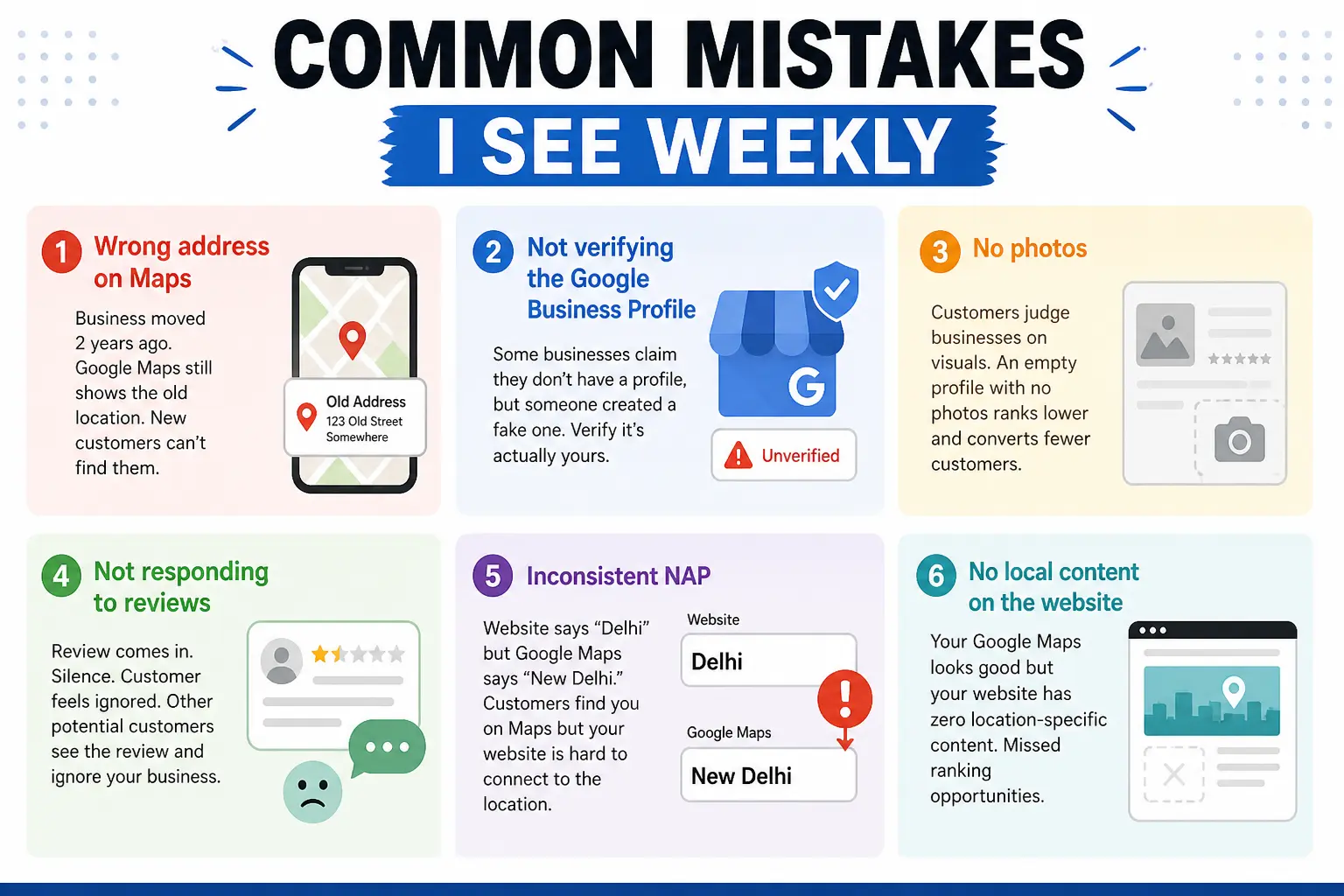
Wrong address on Maps : Business moved 2 years ago. Google Maps still shows the old location. New customers can’t find them.
Not verifying the Google Business Profile : Some businesses claim they don’t have a profile, but someone created a fake one. Verify it’s actually yours.
No photos : Customers judge businesses on visuals. An empty profile with no photos ranks lower and converts fewer customers.
Not responding to reviews : Review comes in. Silence. Customer feels ignored. Other potential customers see the review and ignore your business.
Inconsistent NAP : Website says “Delhi” but Google Maps says “New Delhi.” Customers find you on Maps but your website is hard to connect to the location.
No local content on the website : Your Google Maps looks good but your website has zero location-specific content. Missed ranking opportunities.
When Local SEO Beats National Every Time
You have limited budget. Limited time. Limited marketing expertise.
If you’re a local business, invest in local SEO first. It’s faster to show results. Lower competition. Better ROI than trying to rank nationally.
Most service businesses should almost never chase national rankings. Local dominance is the real win.
| Approach | Best for | Watch out for |
|---|---|---|
| DIY | Small teams, tight budgets | Slow ramp-up, trial-and-error |
| Freelancer | Specific project bursts | Inconsistency, limited ownership |
| Agency | Ongoing work, senior input | Higher retainer, less control |
Quick checklist before you start:
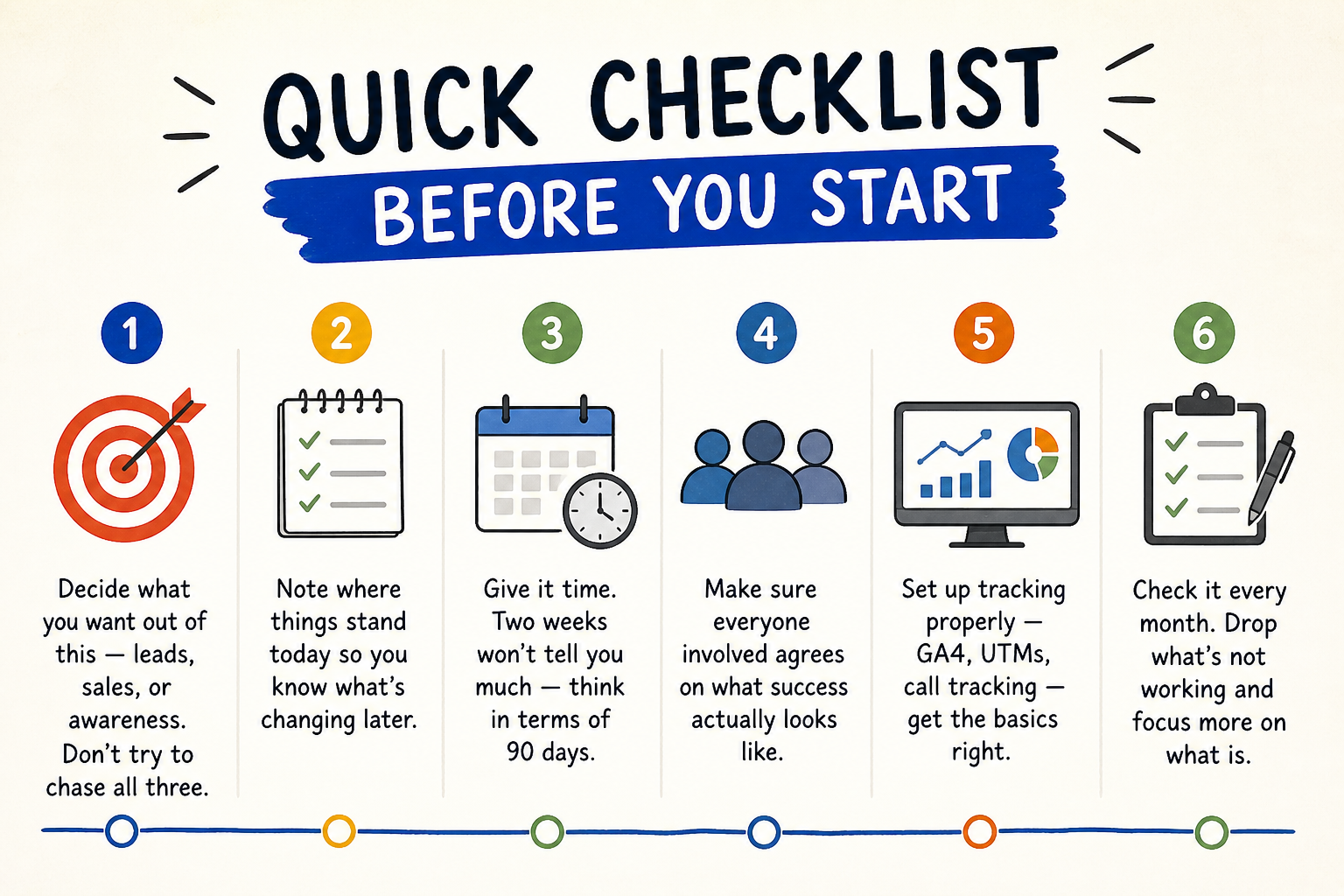
- Decide what you want out of this — leads, sales, or awareness. Don’t try to chase all three.
- Note where things stand today so you know what’s changing later.
- Give it time. Two weeks won’t tell you much — think in terms of 90 days.
- Make sure everyone involved agrees on what success actually looks like.
- Set up tracking properly — GA4, UTMs, call tracking — get the basics right.
- Check it every month. Drop what’s not working and focus more on what is.
The Bottom Line
If you take one thing from this: local seo for indian businesses stop competing nationally rewards patience and specificity, not volume or clever tricks. Start small, measure honestly, fix what breaks, and compound what works. The brands doing this well in India aren’t smarter — they’re just consistent. Need a hand with this for your business? Talk to us.
Need a Local SEO Audit for Your Business?
We’ve optimised local presence for service businesses, retail, restaurants across 12+ Indian cities. Let’s see where your local ranking opportunities are.
FAQs
-
Do I need local SEO if I serve multiple cities?
Ans.Yes. Create location-specific pages and Google Maps profiles for each city. A plumber serving Delhi and Gurgaon needs separate profiles and city-specific content. Otherwise Google doesn't know where you operate. -
How much do Google reviews matter for rankings?
Ans.Very much. We've seen businesses jump from position 5 to position 1 after getting consistent reviews over 3 months. It's not just star rating — it's frequency and recency of reviews that signal to Google you're actively used. -
What happens if my NAP is inconsistent?
Ans.Google gets confused. Rankings suffer. We've fixed rankings just by standardizing Name, Address, Phone across all platforms. Even small inconsistencies like pin code variations can impact visibility.
Author Details

Latest Posts
-
 26 / Aug
Search Engine Optimization Video SEO: How to Rank Your Videos in Google & YouTube
26 / Aug
Search Engine Optimization Video SEO: How to Rank Your Videos in Google & YouTube -
 25 / Aug
Video Production Corporate Video Production: A Practical Guide for Indian Brands
25 / Aug
Video Production Corporate Video Production: A Practical Guide for Indian Brands -
 24 / Aug
-
21 / Aug
Catalogue Design Catalogue Design: How to Create Catalogues That Actually Sell
-
 20 / Aug





Related Knowledge