-
Author: Anindita Barik
-
Updated Date: Oct-03-2026
-
Views: 2 Min Read
AI SEO is changing how businesses measure organic search success. Rankings can remain stable while AI Overviews and zero-click searches reduce website clicks, especially for long informational and question-based queries. This article explains how AI affects SEO click-through rates, which keywords are most exposed, how to diagnose traffic declines, and what content signals matter now. It also covers practical ways to measure organic performance through qualified traffic, conversions, branded demand, and revenue rather than rankings alone.
AI is changing SEO in a way that breaks the discipline’s oldest assumption: that a good ranking produces traffic. According to Similarweb clickstream data analysed by SparkToro., in the first four months of 2026, 68.01% of US Google searches ended without a click.
Two years earlier that figure was 60.45%. Your rankings did not move. The page underneath them did, and a zero-click search leaves your listing visible and unvisited.
Pew Research Center measured the effect on the real browsing data of 900 US adults. People who saw an AI summary clicked a search result on 8% of visits. People who did not see one clicked on 15%.
Clicks on links inside the AI summary itself happened on just 1% of visits. The traffic is not moving to the citation, it is going nowhere, which is why appearing inside AI Overviews solves a brand problem rather than a traffic problem.
How AI Is Changing Seo At The Click Layer, Not The Ranking Layer
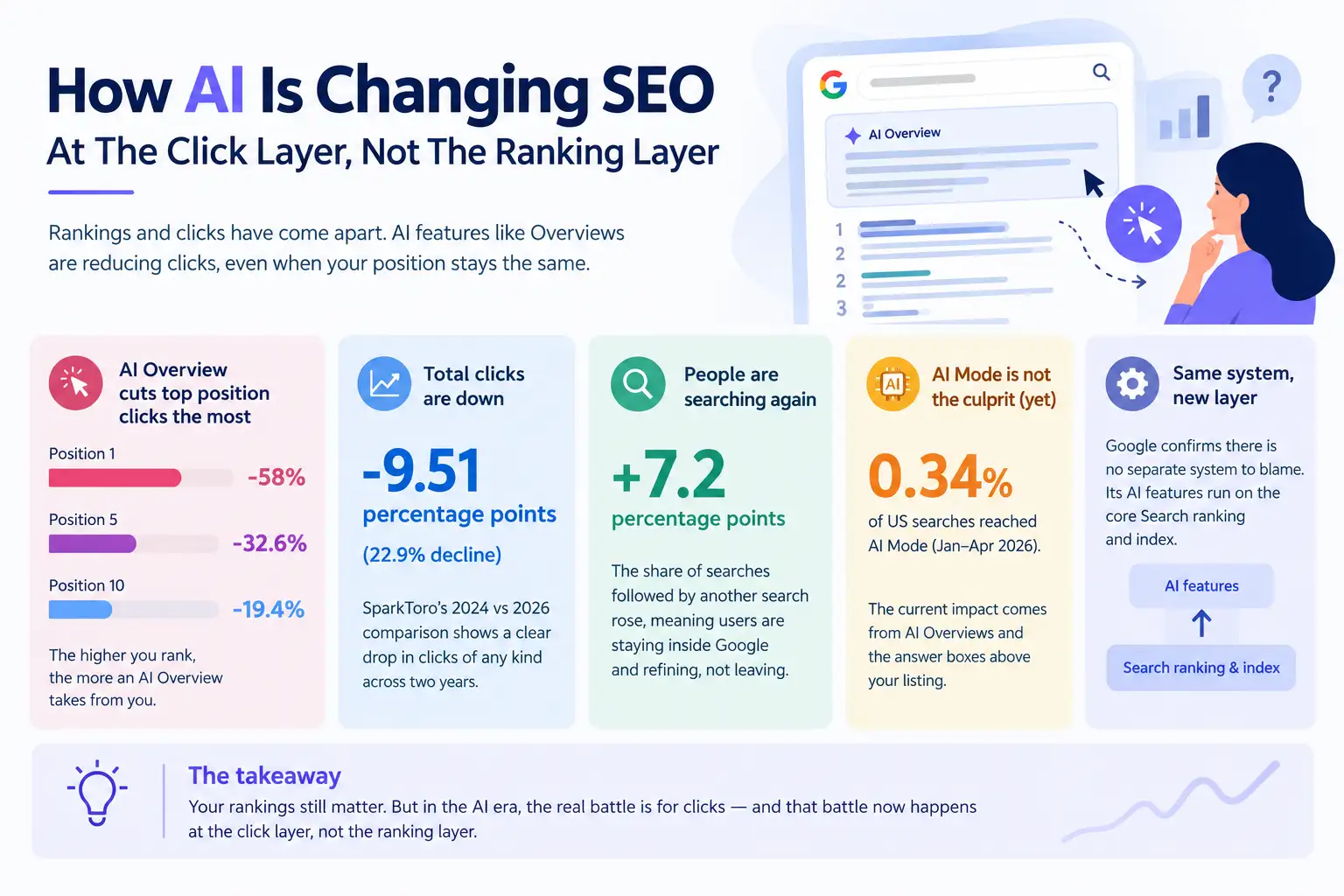
Rankings and clicks have come apart. Ahrefs re-ran its click-through study across 300,000 keywords using December 2025 Search Console data and found that an AI Overview cuts position-one click-through rate by 58%.
The loss is not uniform down the page, and the pattern is counter-intuitive. Position one loses 58%, position five loses 32.6%, position ten loses 19.4%. The better you rank, the more an AI Overview takes from you.
SparkToro’s comparison of its 2024 and 2026 panels puts a number on the aggregate loss. Clicks of any kind fell 9.51 percentage points across two years, a 22.9% decline.
Repeat searching absorbed most of that. The share of searches followed by another search rose 7.2 points over the same period. People are staying inside Google and refining, not leaving.
One correction is worth making early. AI Mode is not yet the cause: only 0.34% of US searches reached it between January and April 2026. The damage so far comes from AI Overviews and the answer boxes sitting above your listing.
Google’s documentation confirms there is no separate system to blame. Its AI features run on the core Search ranking and index, which is exactly why your position holds while the click disappears.
Work Out Which Of Your Keywords Are Actually Exposed
Not every keyword has the same chance of triggering an AI summary. The way people phrase a search plays a major role. Pew Research Center analyzed 68,879 Google searches and found that 18% showed an AI summary in March 2025.
Query length stood out as the strongest signal. AI summaries appeared for only 8% of one- and two-word searches, compared with 53% of searches that contained 10 words or more.
Question-based searches showed a similar pattern. Around 60% of queries starting with “who,” “what,” “when,” or “why” produced an AI summary. The figure was 36% for searches that included both a noun and a verb.
| Query shape | Produces an AI summary | What it means for your traffic |
|---|---|---|
| One or two words | 8% | Mostly navigational and branded. Clicks largely intact. |
| Ten words or more | 53% | Long informational queries. Steepest click loss. |
| Starts with who, what, when, why | 60% | Definitional and how-to content. Answered on the results page. |
| Contains a noun and a verb | 36% | Task and comparison queries. Partial loss, intent survives. |
| All searches (March 2025) | 18% | A site-wide average understates the damage to informational pages. |
Run this analysis on your own data. Export the last 16 months of Search Console queries, add a word-count column, and flag queries that start with question words.
Then sort the data by impressions. The real loss usually sits in the group with high impressions, longer or question-based queries, and a declining click-through rate. In many cases, you will find the drop concentrated in a small number of informational posts built around question keywords.
Short, branded and transactional queries usually remain more stable. If those queries are also losing clicks, AI may not be the main issue. In that case, the diagnosis covered in the two sections below is more relevant.
What Happens Between Your Page And The Answer
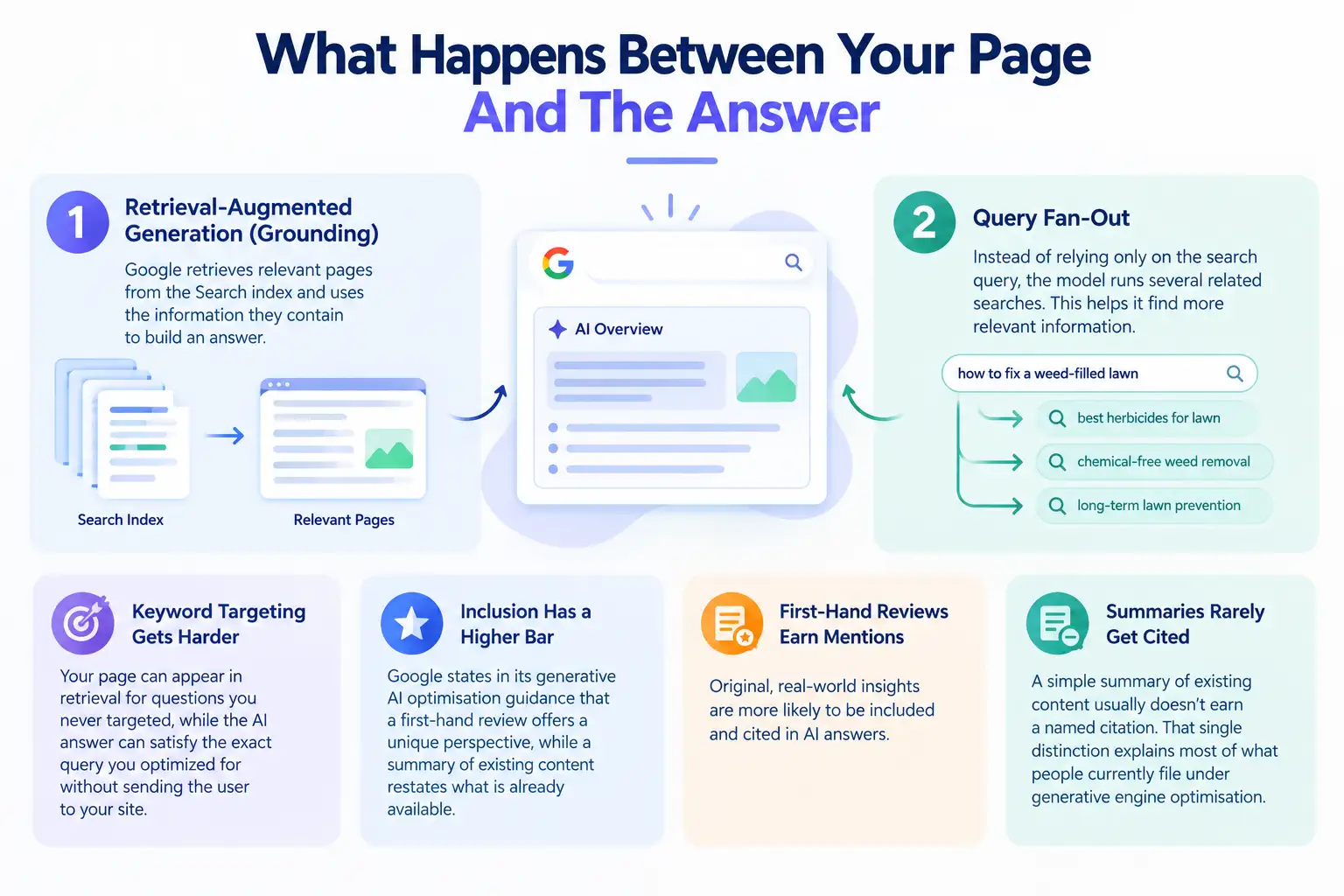
Google uses two techniques to power its AI features. The first is retrieval-augmented generation, or grounding. It retrieves relevant pages from the Search index and uses the information they contain to build an answer.
The second is query fan-out. Instead of relying only on the search query a user enters, the model runs several related searches. For example, someone searching how to fix a weed-filled lawn may also trigger searches about herbicides, chemical-free removal methods and long-term prevention.
This changes how keyword targeting works. Your page can appear in retrieval for questions you never targeted, while the AI answer can satisfy the exact query you optimized for without sending the user to your site.
It also raises the bar for inclusion. Google states the test plainly in its generative AI optimisation guidance: a first-hand review offers a unique perspective, while a summary of existing content restates what is already available.
The second category rarely earns a named citation. That single distinction explains most of what people currently file under generative engine optimisation.
Rule Out The Ordinary Explanations Before You Blame AI
Not every decline since 2024 is an AI story, and Google publishes a documented process for debugging search traffic drops. Work through it before rewriting anything.
Look at how impressions and clicks changed before assuming there is a ranking problem. If impressions stay flat or rise while clicks fall, the issue may sit on the search results page. If both impressions and clicks decline, check rankings, indexing and manual actions.
Compare the data with the same period last year, not just the previous month. Seasonal businesses can see normal fluctuations from one month to the next, and treating a routine July dip as an algorithmic penalty can lead to the wrong diagnosis.
Then look at when the decline began. A sharp drop on a specific date can point to a technical issue or a major algorithm update. A gradual decline across several months suggests a different problem, such as changing search behaviour, growing competition or gradual ranking loss.
Then split branded from non-branded queries. If people searching your company name stopped clicking, something broke on your listing or in how Googlebot reaches your pages, and no amount of content work will fix it.
What Google Says You Can Ignore
Google’s generative AI guidance, last updated in July 2026, challenges several tactics now being marketed as GEO best practices. Four common recommendations stand out as unnecessary.
- llms.txt and similar machine-readable files: Google Search does not use these files for ranking or AI visibility. Creating one does not improve or hurt your visibility.
- Breaking content into small blocks for AI: Google does not require content to follow a specific chunking format, and there is no ideal page length for AI visibility.
- Special schema markup for AI: Google has not introduced a separate schema type for AI inclusion. Structured data still has value for eligible search features, but it does not act as a special signal for appearing in AI results.
- Chasing inauthentic mentions across the web: Producing artificial mentions simply to influence AI visibility adds little value. Google’s quality and spam systems still apply, so genuine authority and useful content matter more than manufactured visibility.
Google’s stated position is that GEO and AEO are SEO, since its generative features sit on core Search ranking. It also warns that no third-party tool has access to its internal ranking or AI systems, which is worth remembering when comparing SEO, GEO and AEO claims.
All of that guidance covers Google Search and nothing else. ChatGPT, Perplexity and Copilot retrieve through different pipelines, and an llms.txt file costs about an hour to write.
The academic evidence favours those other engines. The GEO paper from Princeton and Georgia Tech, presented at KDD 2024, found that adding statistics, quotations and citations raised a source’s visibility in generative engine answers by up to 40%.
Both statements can hold at once. Those tactics do nothing for Google Search, and they plausibly help elsewhere. Decide by where your buyers actually search, which for many B2B firms now includes assistant platforms such as ChatGPT and Perplexity.
Google makes a clear distinction between commodity content and information that offers something genuinely useful or original. Its own examples show the difference. A generic list of first-time homebuyer tips is easy to find. A firsthand account of skipping an inspection and what the sewer line revealed is much harder to replicate.
The difference is not how much you write. It is whether your page contains information that other websites do not have. That is what gives content a better chance of being referenced instead of simply summarised.
Most businesses already have this kind of material. Five types are particularly valuable:
- Data from your own operations: quoted price ranges, turnaround times, failure rates, job volumes or seasonal patterns.
- Dated observations: what changed in your market this quarter, how customer demand shifted, or what those changes cost your business.
- Named experts: employees or specialists with verifiable credentials, along with their job title and relevant experience.
- Trade-offs and failures: what you tried, what did not work, what you changed and why.
- Original comparisons: tests or comparisons you conducted yourself, even if the sample includes only ten cases.
None of this requires a large research budget. A plumbing company that publishes data from its last 400 service calls already has information that competitors do not have and that generic AI-generated content cannot be recreated from public sources.
The reverse also holds. Pages that open with 200 words of restated background are the first to be replaced by a 67-word summary, which is the median AI Overview length Pew recorded. Cutting that padding is the cheapest fix available and one of the content mistakes that quietly costs rankings.
Rebuild What You Measure
Sessions stopped being a reliable scorecard once more searches ended without a click. As AI answers take a larger share of the search journey, four measures give you a clearer view of organic performance:
- Search Console’s generative AI performance report: Use it to compare how your site performs in AI features versus traditional search results.
- Clicks per 1,000 impressions: Track this separately for branded, informational and transactional queries to see where search visibility still leads to visits.
- Branded search volume and direct traffic: These provide a useful proxy for awareness when people discover your brand but do not visit through a search result.
- Organic conversion rate: Measure the quality of the organic traffic you still receive. As low-intent visits decline, conversion rates can give you a better picture of whether the remaining traffic has stronger commercial value.
Google reports that clicks from search results with an AI Overview can bring more engaged visitors who spend more time on the site. So, if sessions fall while revenue stays stable, that does not necessarily signal a problem. Your reporting framework should show whether those visitors are converting and creating more value.
A Sequence That Works Over The Next Quarter
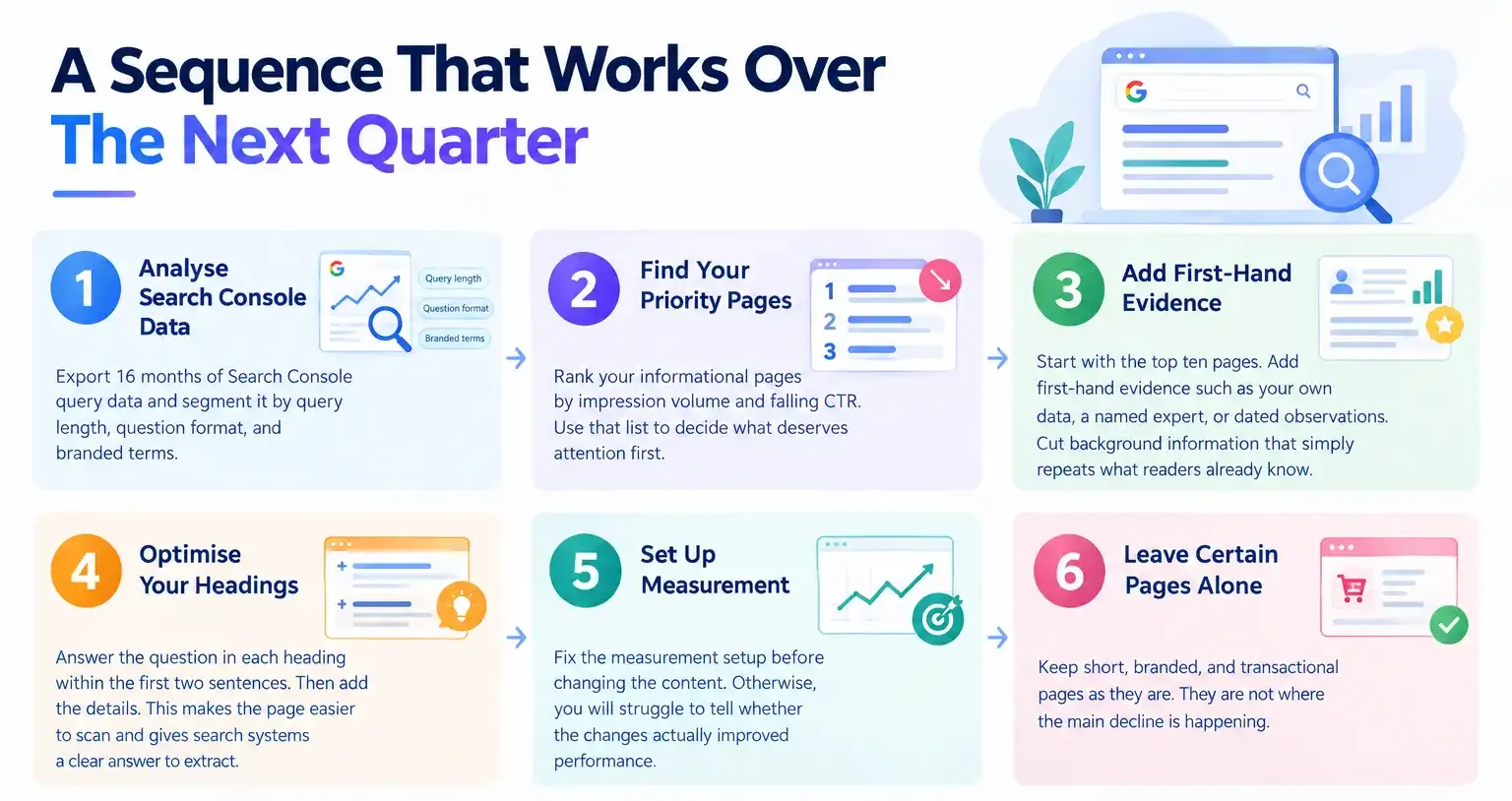
- Export 16 months of Search Console query data and segment it by query length, question format, and branded terms.
- Rank your informational pages by impression volume and falling CTR. Use that list to decide what deserves attention first.
- Start with the top ten pages. Add first-hand evidence such as your own data, a named expert, or dated observations. Cut background information that simply repeats what readers already know.
- Answer the question in each heading within the first two sentences. Then add the details. This makes the page easier to scan and gives search systems a clear answer to extract.
- Fix the measurement setup before changing the content. Otherwise, you will struggle to tell whether the changes actually improved performance.
- Leave short, branded, and transactional pages alone. They are not where the main decline is happening.
If Google remains your main discovery channel, this sequence makes sense. But if your buyers also turn to YouTube, Reddit, or AI assistants to find answers, the same audit should extend beyond Google as part of a broader search everywhere approach.
The Number Worth Checking First
One number can tell you how exposed your business is: the percentage of organic clicks that come from queries with four words or fewer.
If that figure is above 60%, you may feel less impact because short and branded searches are less likely to trigger an AI-generated summary. If it falls below 30%, your site may depend heavily on informational searches, which makes it more vulnerable to a decline in organic sessions.
Calculate this number before commissioning a single content rewrite. You can find it in Google Search Console in about ten minutes. More importantly, it helps you decide whether you need to invest in another content programme or rethink how your business attracts traffic.
Final Thoughts
AI is changing how businesses get value from SEO, but it does not make organic search irrelevant. The focus now needs to shift from rankings and traffic to qualified visits, conversions, brand demand, and revenue.
Audit where your organic visibility still creates business value, protect those areas, and invest your content resources where search can still influence buying decisions. Not every decline in clicks requires a complete SEO rethink; the priority is to understand which parts of organic search still support your business goals and act on that data.
Frequently Asked Questions
-
Will SEO be replaced by AI?
Ans.No. Google's generative features run on the same ranking systems and index that classic results use, so being crawlable, relevant and trustworthy still decides whether a page gets retrieved. What changed is the payoff, because visibility no longer converts into traffic at the old rate. -
How is SEO affected by AI?
Ans.AI affects the click rather than the ranking. Pages hold their positions while click-through rate falls, most sharply on long informational queries where an AI Overview answers above the results. Transactional and branded queries are far less affected. -
How is AI changing SEO in 2026?
Ans.In the first four months of 2026, 68.01% of US Google searches ended without a click, up from 60.45% in 2024. Ahrefs measured a 58% drop in position-one click-through rate on queries carrying an AI Overview. AI Mode reached only 0.34% of searches in that period, so it is not yet the main driver. -
What is AI SEO called now?
Ans.The common labels are generative engine optimisation (GEO) and answer engine optimisation (AEO). Google's own position is that optimising for its generative features is still SEO, because those features rely on core Search systems rather than a separate pipeline. -
Why are my impressions up but my clicks down?
Ans.Rising impressions with falling clicks means your ranking held while the page above you changed. An AI Overview, featured snippet or expanded answer box is satisfying the query in place. Check whether the affected queries are long or question-shaped before assuming a penalty. -
Do I need an llms.txt file?
Ans.Not for Google. Google Search ignores llms.txt and states that having one neither helps nor harms visibility. Other AI products may read such files, so the decision rests on whether your audience uses non-Google assistants. -
Is it still worth publishing blog content?
Ans.Yes, but the economics changed. Content that restates common knowledge now feeds summaries without earning citations, while content carrying original data and first-hand experience still gets named. The real question is what a post must contain to justify itself.
Author Details

Latest Posts
-
 18 / Sep
Search Engine Optimization AI Is Changing Seo: You Still Rank, But Clicks Are Falling
18 / Sep
Search Engine Optimization AI Is Changing Seo: You Still Rank, But Clicks Are Falling -
 11 / Sep
-
 18 / Aug
Google Search Console Google Search Console For Social Media: How To Track Instagram, Tiktok, X And Youtube
18 / Aug
Google Search Console Google Search Console For Social Media: How To Track Instagram, Tiktok, X And Youtube -
 05 / Aug
SEO vs GEO vs AEO SEO vs GEO vs AEO: A Simple 2026 Comparison for Businesses
05 / Aug
SEO vs GEO vs AEO SEO vs GEO vs AEO: A Simple 2026 Comparison for Businesses -
 31 / Jul
Uncategorized How to Build a 90-Day Digital Marketing Plan That Works
31 / Jul
Uncategorized How to Build a 90-Day Digital Marketing Plan That Works

Blogs
Journey into Ideas Unveiling Tomorrow's Insights Today.



-
Will SEO be replaced by AI?
Ans.No. Google's generative features run on the same ranking systems and index that classic results use, so being crawlable, relevant and trustworthy still decides whether a page gets retrieved. What changed is the payoff, because visibility no longer converts into traffic at the old rate. -
How is SEO affected by AI?
Ans.AI affects the click rather than the ranking. Pages hold their positions while click-through rate falls, most sharply on long informational queries where an AI Overview answers above the results. Transactional and branded queries are far less affected. -
How is AI changing SEO in 2026?
Ans.In the first four months of 2026, 68.01% of US Google searches ended without a click, up from 60.45% in 2024. Ahrefs measured a 58% drop in position-one click-through rate on queries carrying an AI Overview. AI Mode reached only 0.34% of searches in that period, so it is not yet the main driver. -
What is AI SEO called now?
Ans.The common labels are generative engine optimisation (GEO) and answer engine optimisation (AEO). Google's own position is that optimising for its generative features is still SEO, because those features rely on core Search systems rather than a separate pipeline. -
Why are my impressions up but my clicks down?
Ans.Rising impressions with falling clicks means your ranking held while the page above you changed. An AI Overview, featured snippet or expanded answer box is satisfying the query in place. Check whether the affected queries are long or question-shaped before assuming a penalty. -
Do I need an llms.txt file?
Ans.Not for Google. Google Search ignores llms.txt and states that having one neither helps nor harms visibility. Other AI products may read such files, so the decision rests on whether your audience uses non-Google assistants. -
Is it still worth publishing blog content?
Ans.Yes, but the economics changed. Content that restates common knowledge now feeds summaries without earning citations, while content carrying original data and first-hand experience still gets named. The real question is what a post must contain to justify itself.