-
Author: Anindita Barik
-
Updated Date: Aug-06-2026
-
Views: 2 Min Read
Digital marketing for e-commerce helps online stores increase sales by combining paid advertising, SEO, conversion optimization, email automation, and customer retention strategies. This guide explains how to improve customer acquisition cost (CAC), increase average order value (AOV), optimize landing pages, measure ROAS, and build sustainable growth. Learn which marketing channels work best, the metrics that matter, and the framework successful e-commerce brands use to scale profitably instead of relying on short-term marketing trends.
Digital marketing for e-commerce is the process of using SEO, paid advertising, social media, email marketing, content marketing, and conversion rate optimization (CRO) to attract qualified customers, increase online sales, and grow an e-commerce business. It focuses on improving customer acquisition while maximizing revenue and profitability.
To drive sales and scale fast, e-commerce businesses should optimize product pages, run targeted Google and social media ads, automate email campaigns, track key metrics like CAC, ROAS, AOV, and LTV, and improve customer retention. A data-driven strategy helps brands achieve sustainable growth instead of relying on short-term marketing trends.
The Clothing Brand That Lost 40% of Its Revenue in 90 Days
Happened about six months ago. A mid-sized apparel brand — D2C, decent Instagram presence, been doing okay for about three years. They were spending about Rs 3 lakhs a month on Facebook and Google Ads. Steady traffic, reasonable conversion rate, growing slowly. Then someone suggested: “Let’s try TikTok. All the young people are there.” So they split their budget. Diverted Rs 1 lakh to TikTok testing.
Within two months, revenue dropped 35%. Not because TikTok was bad. But because Google Ads stopped getting proper budget to work. And Facebook performance fell when you reduce volume.
Moral? E-commerce marketing is not about chasing trends. It’s about understanding unit economics and execution discipline. This is exactly what we cover in fixing a backwards digital marketing strategy — chasing new channels before validating existing ones is one of the most common and expensive mistakes in e-commerce.
This is the conversation that should happen before anything else. But it rarely does. Most brands come in with: “We want more sales.” That’s true but not actionable. The real question is: what can you afford to spend to acquire a customer, and how many customers actually stay loyal to you?
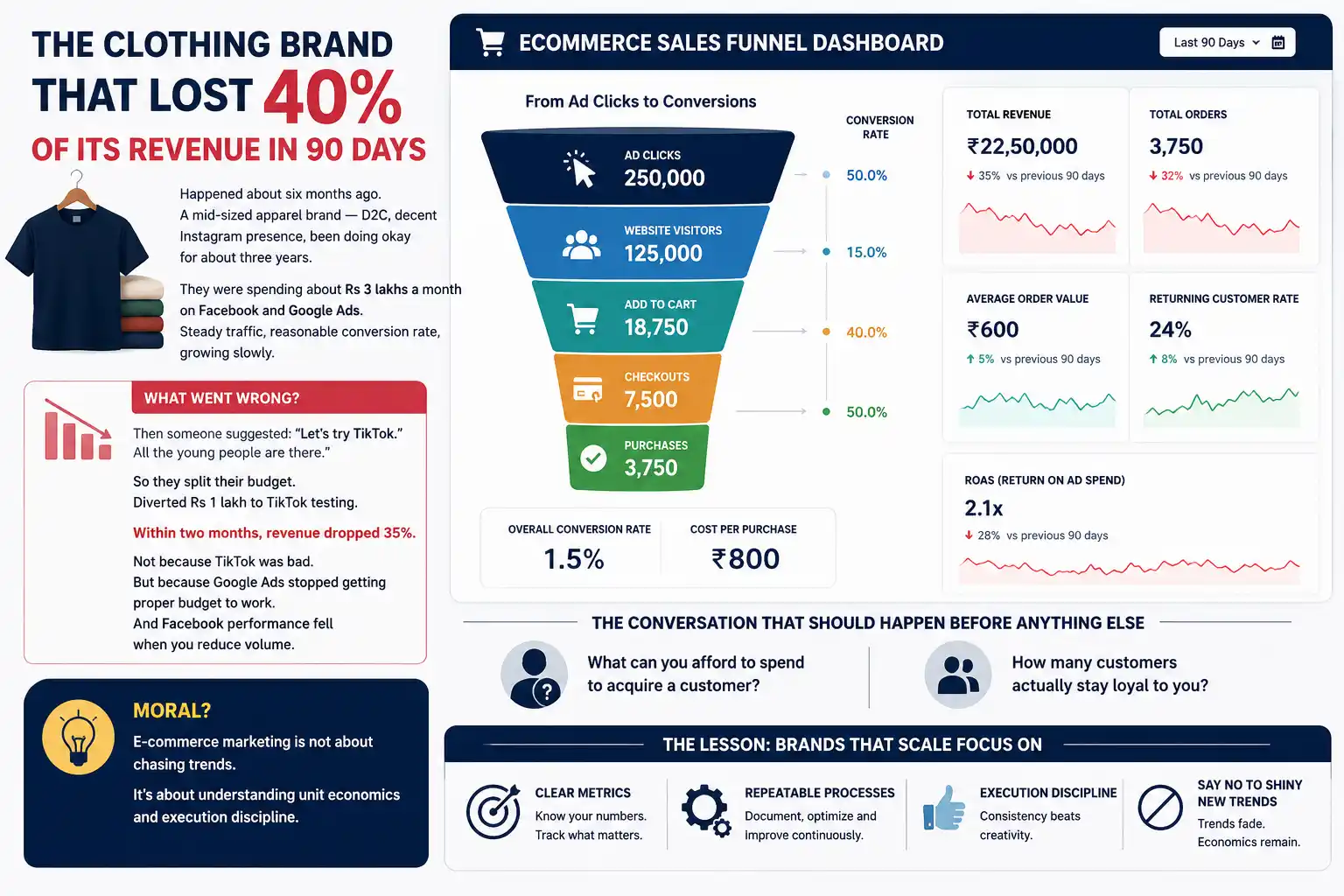
Because here’s what I’ve learned after handling campaigns for 50+ e-commerce brands in the last 18 months: the brands that scale aren’t the ones with viral posts or perfect landing pages. They’re the ones with clear metrics, repeatable processes, and the ability to say “no” to shiny new trends.
Start Here: Unit Economics
Before you spend a rupee on ads, understand three numbers.
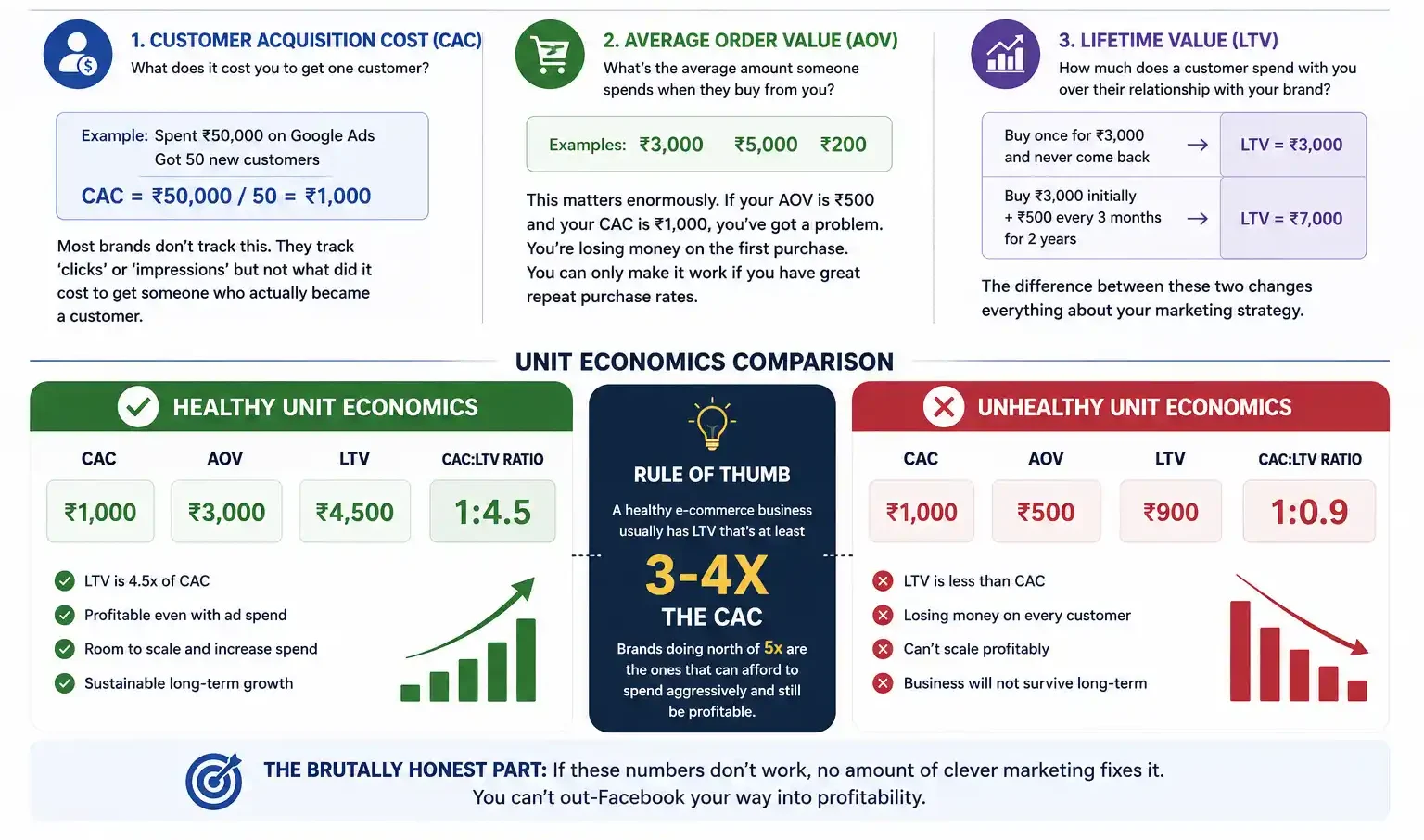
- Customer Acquisition Cost (CAC) : What does it cost you to get one customer? If you spend Rs 50,000 on Google Ads and get 50 new customers, your CAC is Rs 1,000. Seems basic but most brands don’t actually track this. They track ‘clicks’ or ‘impressions’ but not ‘what did it cost to get someone who actually became a customer.’
- Average Order Value (AOV) : What’s the average amount someone spends when they buy from you? Rs 3,000? Rs 5,000? Rs 200? This matters enormously because if your AOV is Rs 500 and your CAC is Rs 1,000, you’ve got a problem. You’re losing money on the first purchase. You can only make it work if you have great repeat purchase rates.
- Lifetime Value (LTV) : How much does a customer spend with you over their relationship with your brand? If they buy once for Rs 3,000 and never come back, LTV is Rs 3,000. If they buy Rs 3,000 initially and then Rs 500 every three months for two years, LTV is Rs 7,000. The difference between these two changes everything about your marketing strategy.
A healthy e-commerce business usually has LTV that’s at least 3-4x the CAC. So if your CAC is Rs 1,000, you want LTV of Rs 3,000-4,000 minimum. Brands doing north of 5x are the ones that can afford to spend aggressively and still be profitable.
Here’s the brutally honest part: if these numbers don’t work, no amount of clever marketing fixes it. You can’t out-Facebook your way into profitability.
The Channel Question (And Why Most Brands Get This Wrong)
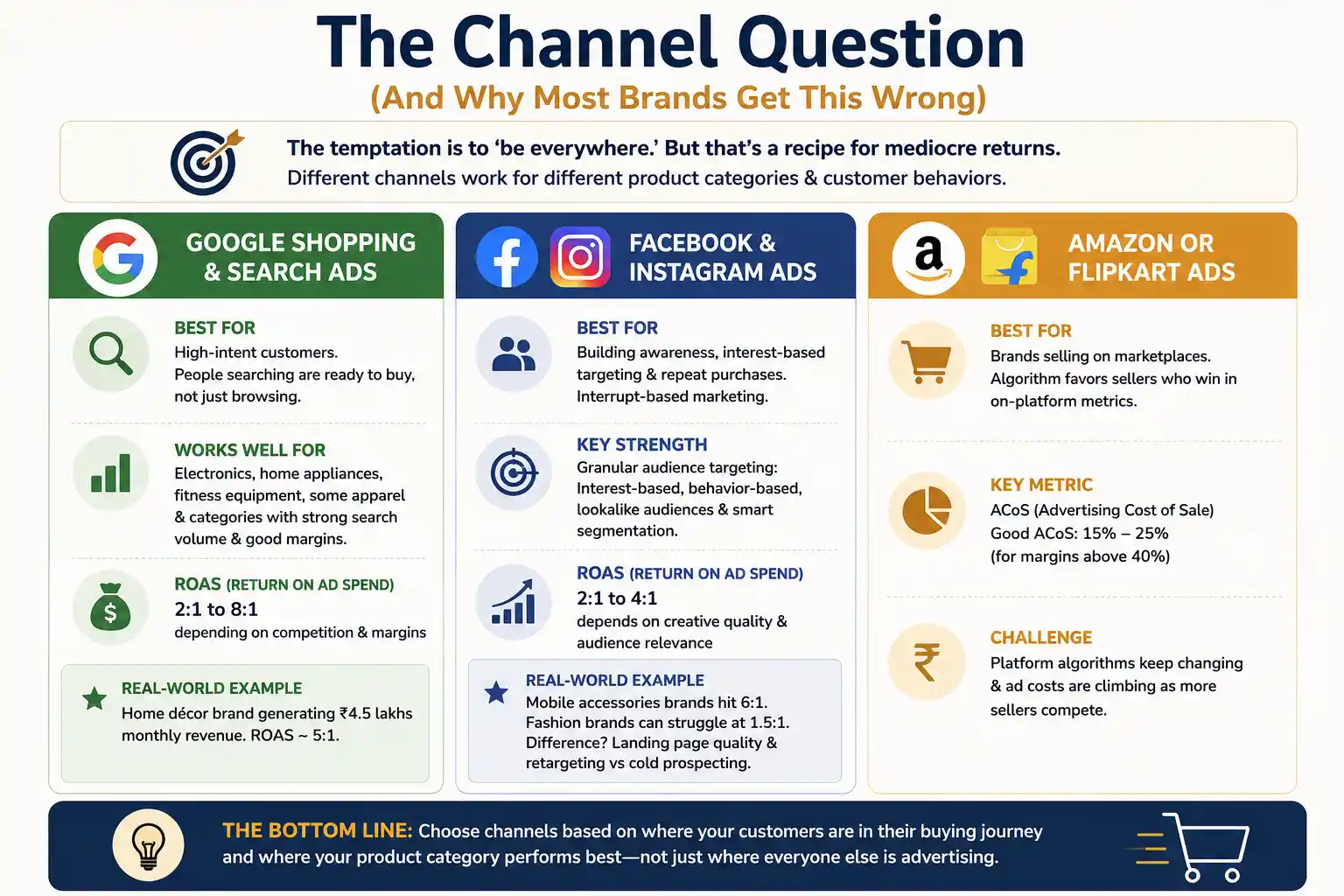
Google Ads, Facebook Ads, Instagram, Amazon, maybe Pinterest or TikTok. The temptation is to ‘be everywhere.’ I understand. But that’s a recipe for mediocre returns.
Different channels work for different product categories. And even within the same category, what works depends on your target customer’s behaviour.
Google Shopping & Search Ads
Best for: High-intent customers. Someone searching “wireless earbuds under Rs 5,000” or “stainless steel watch” is ready to buy. They’re not browsing. They’re shopping.
Brands we’ve managed that do well with Google Ads are usually selling categories that have strong monthly search volume and reasonable profit margins. Electronics, home appliances, fitness equipment, some apparel. If your product isn’t something people Google, Google Ads won’t help much.
ROAS (return on ad spend) on Google Shopping can be anywhere from 2:1 to 8:1 depending on competition and margins. We’re working with a home décor brand right now pushing Rs 4.5 lakhs monthly revenue through Google. ROAS is sitting at about 5:1, which is solid for that space.
Facebook & Instagram Ads
Best for: Building awareness, interest-based targeting, and repeat purchases. Someone isn’t searching for your brand — they’re scrolling Instagram and your ad shows up. It’s interrupt-based marketing. Requires better creative and stronger landing pages because you’re breaking into their feed.
Facebook also allows much more granular audience targeting. Interest-based, behaviour-based, lookalike audiences. This is where you can do smart segmentation — show different products to different audience groups.
ROAS here typically runs 2:1 to 4:1 depending on your creative quality and audience relevance. We’ve had mobile accessories brands hit 6:1, and some fashion brands struggle to maintain 1.5:1. The difference? Usually it’s landing page quality and whether you’re retargeting or cold prospecting.
Amazon or Flipkart Ads
Best for: Brands selling on these marketplaces. The algorithm favours sellers who are consistently winning in on-platform metrics. ACoS (advertising cost of sale) is the metric that matters here. If you’re spending Rs 20 on ads to get a Rs 100 sale, that’s a 20% ACoS. Good ACoS depends on your margin, but generally 15-25% is healthy for margins above 40%.
The challenge here is that platform algorithms keep changing. And ad costs are climbing as more sellers compete for placements.
The Landing Page Problem
You can run perfect ads and crash them into a terrible landing page. I see this constantly. High-traffic sites with conversion rates under 1%.
Not because the page looks bad. Often they look fine. But they’re not designed around conversion. They’re designed around being ‘professional’ or ‘modern.’
A good landing page for e-commerce does specific things. Product images that let people zoom in and actually see details. Fast loading (people abandon if it takes more than 3 seconds to load). Clear pricing with no surprises. Trust signals — reviews, ratings, maybe testimonials if it’s relevant. A checkout process that doesn’t require users to create accounts.
We did a redesign for a home appliance brand three months ago. Same ad spend, same traffic. Just fixed the landing page: cleaner product images, removed the ‘create an account to buy’ requirement, added customer reviews prominently. Conversion rate went from 1.8% to 4.2%. That’s more than 2x conversions from the same ad budget.
The bigger insight though? Most e-commerce sites are optimised for ‘traffic’ not ‘sales.’ They’re designed by people thinking about aesthetics and brand guidelines rather than “what makes someone actually complete a purchase.”
Email & Automation
Most e-commerce brands under-use email. They treat it like a channel for promoting sales. “Summer sale 40% off! Click here!” once a week.
That’s not email marketing. That’s spam you’re technically allowed to send because people opted in.
Real email strategy is about automations. Triggered emails based on customer behaviour. Cart abandonment emails (highest ROI in email marketing, typically 5-8% conversion on abandoned cart emails). Post-purchase follow-up to request reviews. Re-engagement campaigns for inactive customers. Product recommendation sequences.
We set up automation flows for a fashion D2C brand (Hinglish: basically a brand selling directly, no retail intermediaries). Cart abandonment alone is generating Rs 2+ lakhs monthly revenue. Post-purchase review requests are driving better social proof and customer generated content. Total email revenue is now 18% of total online sales. They weren’t tracking email ROI before, so technically this is ‘new’ revenue.
The platforms are simple — ActiveCampaign, Klaviyo, HubSpot, even Mailchimp works. The hard part is actually building good sequences. Writing emails that don’t feel salesy. Testing subject lines. Segmenting audiences properly.
The Retention Puzzle (Why Most Growth Is Expensive)
Here’s something I keep hammering our team on: acquisition is easy. Expensive, but straightforward. You spend money on ads, you get new customers.
Retention is hard.
And yet it’s the number that determines whether your business is actually profitable at scale. If you’re acquiring customers at Rs 1,500 but only 10% come back for a second purchase, your economics are broken. If 40% come back, suddenly your LTV is much healthier and your CAC payback period makes sense.
We had a cosmetics brand doing about 10 lakh rupees a month in sales. Traffic was fine. Conversion rate was fine. But repeat purchase rate was 8%. So they were on a treadmill — constantly acquiring new customers just to maintain sales. Profitability was thin.
We worked on their post-purchase experience. Email sequences got better. They added a loyalty programme (basic points system). Improved packaging. Added discount codes for repeat purchases. Within five months, repeat purchase rate moved to 24%.
Same acquisition spend. Same volume of new customers. But now those customers were buying again. Revenue grew 30% with zero additional ad spend.
That’s where the real money is in e-commerce — not in getting more people to click, but in getting the people who click to actually come back.
Inventory & Seasonality
Marketing teams and inventory teams usually don’t talk enough. We’ve had campaigns performing beautifully and then… stock runs out. Or certain variants are out while others have dead inventory.
This is where the romance of ‘scale fast’ runs into reality. You can’t scale faster than you can fulfil. And you shouldn’t run out of your best sellers mid-campaign.
We work with a home furnishing brand that’s learned this the hard way. Diwali season, they ran aggressive Google Ads. Traffic was there. Conversions were flowing. But their logistics couldn’t handle the volume. Delivery delays spiralled. Customer complaints went up. Refunds increased. By the time they’d caught up, customer satisfaction had taken a hit that took two months to recover.
The lesson: your marketing strategy has to align with your operational capacity. If you can fulfil 500 orders a day, don’t run campaigns designed to generate 1,000 orders a day. A well-built e-commerce portal with proper inventory management integration is what prevents this — when your store, your inventory system, and your logistics are connected, scale becomes manageable rather than chaotic.
The Numbers You Should Actually Track
Not ‘impressions’ or ‘reach.’ Not even ‘clicks.’ Those are diagnostic metrics. The metrics that matter are:
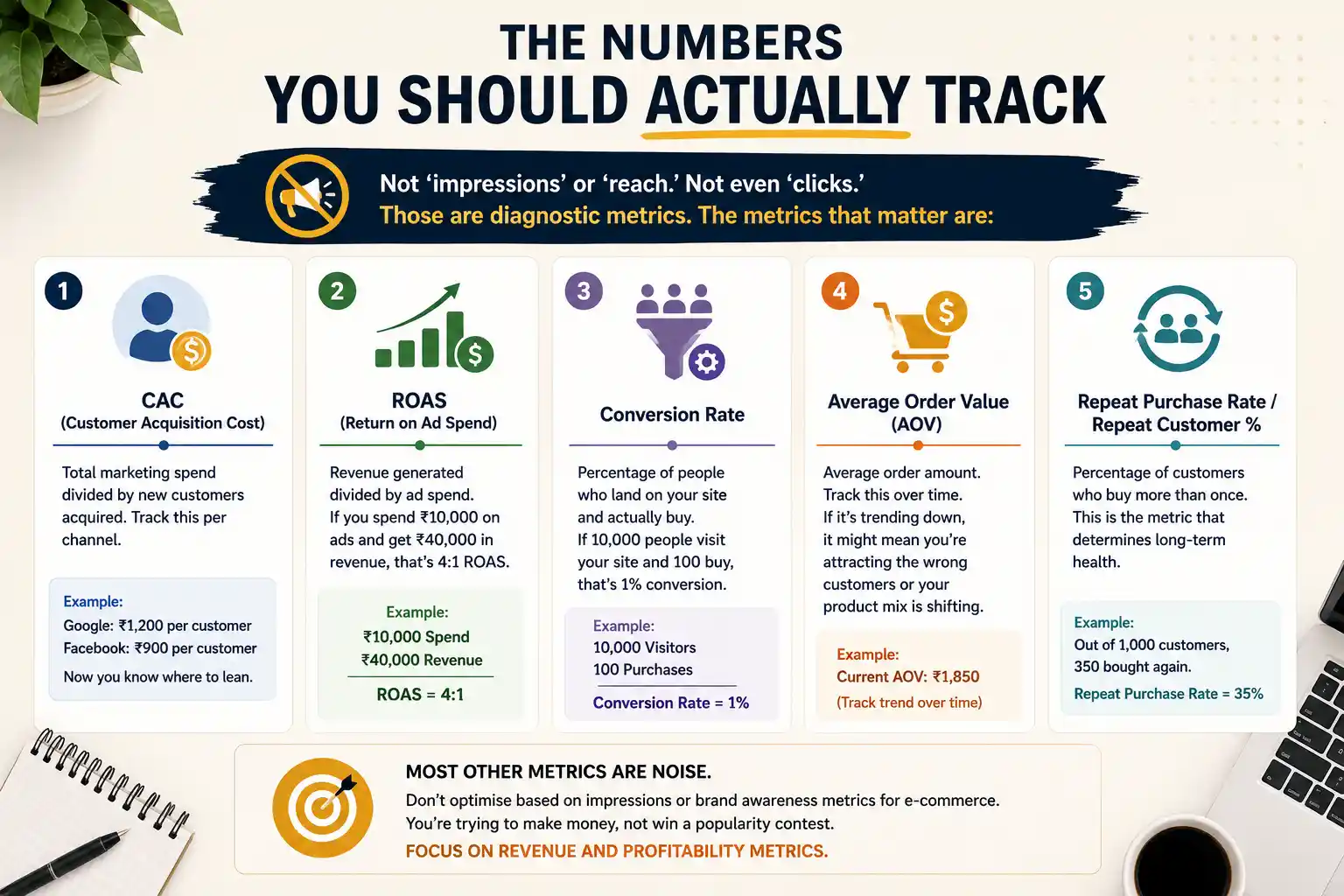
1. CAC (Customer Acquisition Cost) : Total marketing spend divided by new customers acquired. Track this per channel. Google might be Rs 1,200 per customer. Facebook might be Rs 900. Now you know where to lean.
2. ROAS (Return on Ad Spend) : Revenue generated divided by ad spend. If you spend Rs 10,000 on ads and get Rs 40,000 in revenue, that’s 4:1 ROAS.
3. Conversion Rate : Percentage of people who land on your site and actually buy. If 10,000 people visit your e-commerce site and 100 buy, that’s 1% conversion.
4. Average Order Value (AOV) : Average order amount. Track this over time. If it’s trending down, it might mean you’re attracting the wrong customers or your product mix is shifting.
5. Repeat Purchase Rate / Repeat Customer Percentage : Percentage of customers who buy more than once. This is the metric that determines long-term health.
Most other metrics are noise. Don’t optimise based on impressions or brand awareness metrics for e-commerce. You’re trying to make money, not win a popularity contest. Focus on revenue and profitability metrics.
Common Mistakes
- Running ads for products that don’t have margins. If your gross margin is 20% and your CAC is Rs 500, you’re starting in a hole.
- Ignoring product-market fit. I’ve seen brands that try to sell everything. “Maybe this segment will work. Let’s add a category and run ads.” No. Fix your core offering first. Nail that. Then expand.
- Over-personalisation that becomes creepy. Too much retargeting. Following someone across the internet after they visited once is… a lot. They’ll probably convert or they won’t. Maybe give it one follow-up email, not 47 retargeting ads.
- Not optimising for the actual customer journey. Ads that work great on desktop but terrible on mobile. Landing pages that load slowly. Checkout that has too many form fields. These friction points kill conversion.
- Changing things too often. Someone says “social media isn’t working, let’s stop and try TikTok.” Six weeks later they’re changing again. Give strategies at least 2-3 months to show results. E-commerce marketing compounds over time.
The Actual Framework We Use
Month 1: Audit and baseline. What’s working currently? What channels exist? What’s the conversion rate? What’s CAC? Build a measurement framework so you can actually track what happens next.
Month 2-3: Optimization. Improve landing pages. Fix product image issues. Tighten audience targeting. These usually don’t cost extra but improve returns significantly.
Month 4-6: Scale methodically. Increase budget on channels that are working. Test new segments within those channels. Set up automation flows (email, SMS, etc).
Month 6+: Iteration and retention focus. You’ve found what works. Now make sure customers stick around. That’s where real profitability comes from.
And honestly? This whole thing depends on having a product that people actually want and at a price they’re willing to pay. Marketing can’t fix a product problem. It can only amplify something good.
| Approach | Best for | Watch out for |
|---|---|---|
| DIY | Small teams, tight budgets | Slow ramp-up, trial-and-error |
| Freelancer | Specific project bursts | Inconsistency, limited ownership |
| Agency | Ongoing work, senior input | Higher retainer, less control |
Quick checklist before you start:
- Define the one thing you want: leads, sales, awareness — pick one.
- Baseline your numbers: write down where you are today.
- Pick a 90-day window: nothing moves in 2 weeks.
- Agree on success metrics: with whoever is paying the bill.
- Set up proper tracking: GA4, UTMs, call tracking.
- Review monthly: kill what doesn’t work, double down on what does.
The Bottom Line
If you take one thing from this: digital marketing for e commerce drive sales scale fast rewards patience and specificity, not volume or clever tricks. Start small, measure honestly, fix what breaks, and compound what works. The brands doing this well in India aren’t smarter — they’re just consistent. Need a hand with this for your business? Talk to us.
Ready to Build a Real E-commerce Strategy?
250+ brands across India have scaled their online sales with PromotEdge. Most of them started with messy data and unclear metrics. Let’s clean yours up and actually grow something sustainable.
FAQs
-
What's the biggest mistake e-commerce brands make with their marketing budget?
Ans.Spreading money everywhere. You run Google Ads, Facebook, Instagram, maybe email. But nothing gets enough budget to actually work. We had a home décor brand doing this — Rs 50,000 across five channels. Traffic was fine but conversions? Nothing. We consolidated to three channels, gave each proper budget, and COGS dropped 35% in two months. You'd be surprised how much of your budget is going straight into the algorithmic graveyard. -
How much should an e-commerce business spend on digital marketing?
Ans.Depends on what margin you're running and how you define 'spend.' A D2C fashion brand we worked with — relatively new to market — allocated 15-20% of revenue to marketing. Worked for them because they had strong unit economics. A fashion accessories store on Amazon though, they can't afford that. Their margins are tighter. General rule: if your gross margin is 50% or higher, you can usually spend 10-15% on marketing and still grow. But the best approach is reverse-engineering from your CAC and LTV. If you're acquiring a customer for Rs 200 and they're spending Rs 1,200 over a year? That's healthy. If you're spending Rs 500 to get Rs 800 in annual value? You've got a problem. -
Does email marketing actually work for e-commerce anymore?
Ans.Yes. When it's done right — segmented lists, personalised sends, automated flows for abandoned carts and post-purchase — email typically delivers 3-5x ROI. Better margins than paid ads. The problem is most brands mess it up. Bad copy, too many promotional emails, no segmentation. We set up an automation flow for a beauty brand last quarter (cart abandonment, post-purchase upsells, re-engagement series). First month, that flow alone contributed Rs 3.2 lakhs in revenue with basically zero ongoing effort.
Author Details

Latest Posts
-
 24 / Sep
GMB Optimisation Google Business Profile Optimization Guide 2026
24 / Sep
GMB Optimisation Google Business Profile Optimization Guide 2026 -
 23 / Sep
Search Engine Optimization Programmatic SEO: Template + Data Model Explained
23 / Sep
Search Engine Optimization Programmatic SEO: Template + Data Model Explained -
 22 / Sep
Conversion Rate Optimization Conversion Rate Optimization: A Practical Guide
22 / Sep
Conversion Rate Optimization Conversion Rate Optimization: A Practical Guide -
 21 / Sep
Whatsapp Marketing WhatsApp Marketing for Indian SMBs
21 / Sep
Whatsapp Marketing WhatsApp Marketing for Indian SMBs -
 19 / Sep
Related Knowledge