
-
Author: Anindita Barik
-
Updated Date: Aug-05-2026
-
Views: 2 Min Read
A 90-day digital marketing plan helps businesses set measurable goals, prioritize high-impact marketing channels, and make data-driven decisions within a single quarter. This guide explains how to build a 90-day digital marketing plan by establishing a baseline, allocating budgets, choosing the right channels, tracking weekly progress, and evaluating results at Day 90. It also covers AI search optimization, common planning mistakes, and practical strategies to improve marketing performance with realistic expectations.
A 90-day digital marketing plan works because a quarter gives you enough time to generate meaningful data without giving poor decisions time to hide. Google acknowledges that timeline. Some changes appear within a few days, but its systems can take several months to confirm that a website has genuinely improved.
So a plan that assumes everything pays back by Day 90 will disappoint. One based on what each channel can actually prove within a quarter will not. Budget pressure is real too. Gartner’s 2026 CMO Spend Survey put marketing budgets at 7.8% of company revenue, with 56% of CMOs saying they lack the money to deliver their strategy.
Smaller businesses feel that pressure all the more, which is why selecting the right marketing channel matters more than the budget size. Content Marketing Institute’s 2026 B2B research found the same pattern: among teams whose results improved, 74% credited refining the strategy and only 20% credited a budget change.
The plan below follows the quarter week by week, with realistic per-channel timelines, a budget split, and a decision gate at Day 90. It assumes you track KPIs you genuinely use.
What a 90 Day Digital Marketing Plan Actually Is
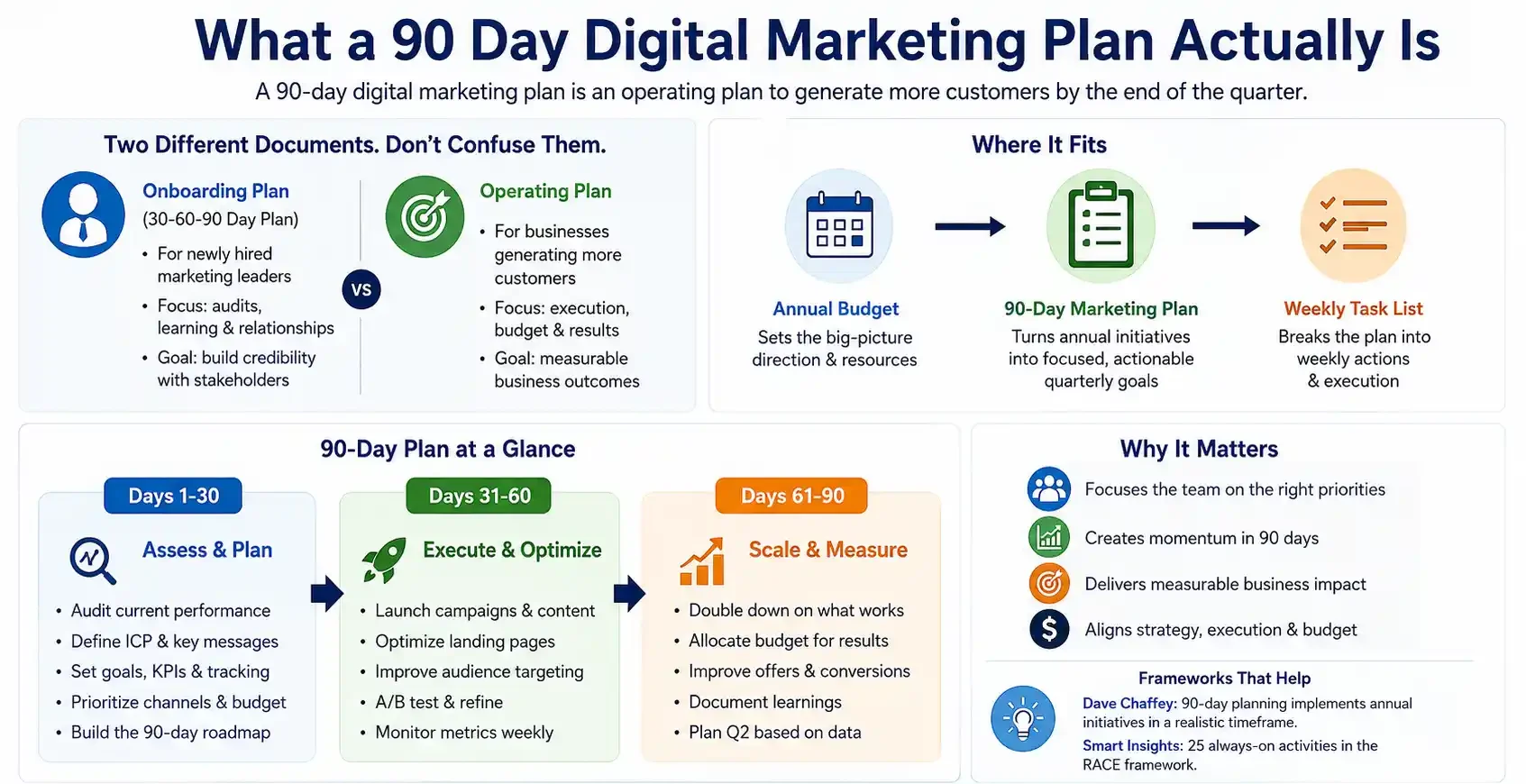
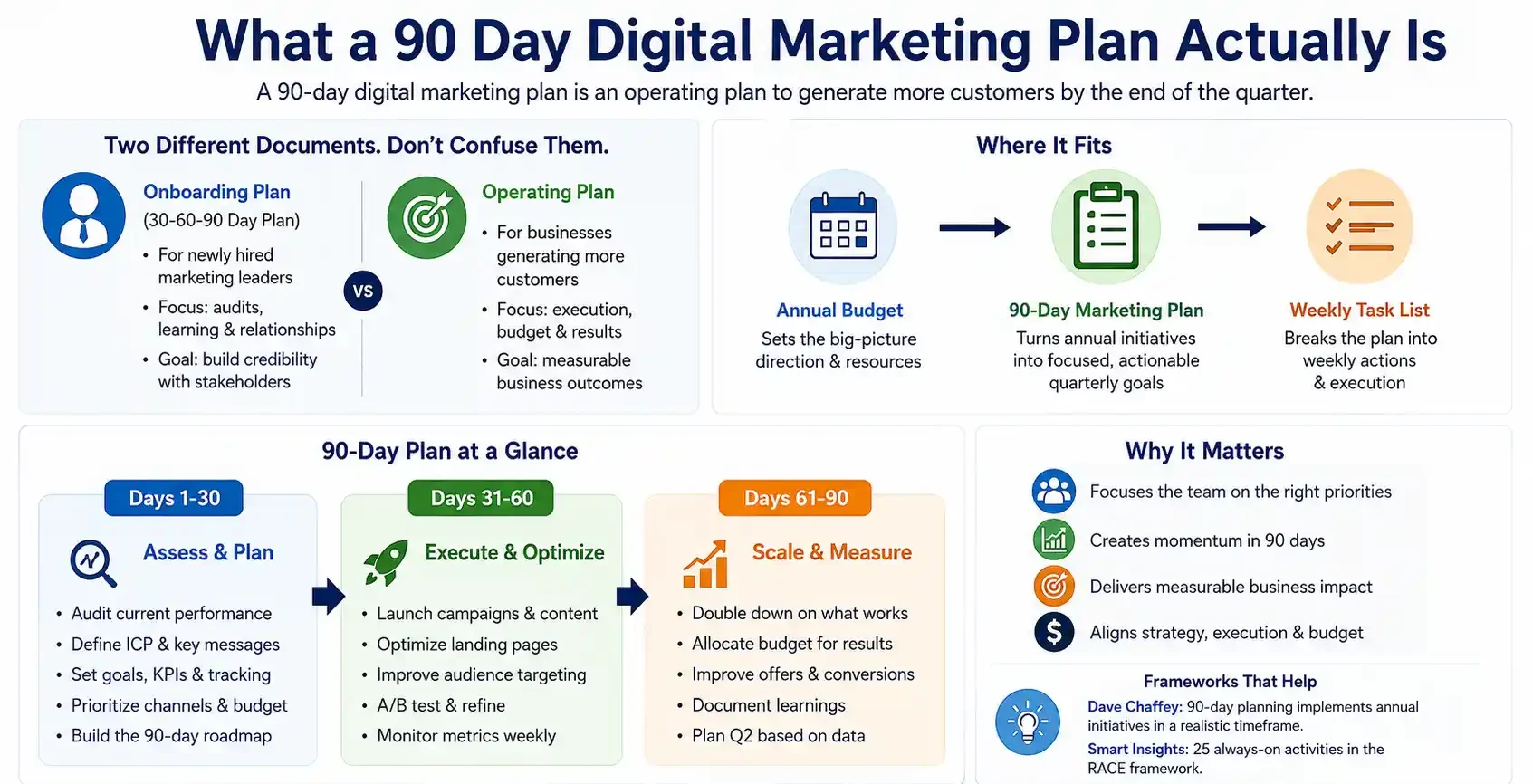
Two very different documents share this name, and confusing them can cost you an entire quarter. The first is an onboarding plan for a newly hired marketing lead, usually structured as a 30-60-90-day plan, where the real deliverable is credibility with stakeholders. The second is an operating plan for a business that wants to generate more customers by the end of the quarter.
This guide covers the second. If you have just started a marketing role, you need the onboarding version instead. It focuses more on audits and relationship-building, and far less on budget and execution. Most articles ranking for this topic quietly answer the wrong version.
For a business, a 90-day marketing plan sits between the annual budget and the weekly task list. Dave Chaffey describes 90-day planning as a way to implement annual initiatives within a timeframe that is more realistic than 30 days, while Smart Insights structures its template around 25 always-on activities in the RACE framework. Both approaches make sense. Neither tells you what to do in Week 3.
Set Your Baseline Before You Change Anything
The biggest reason 90-day digital marketing plans fail is that nobody records where things stand on Day 1. Ninety days later, the conversation shifts to whether anything improved, but no baseline exists to answer it. Spend the first week measuring, not launching.
1. The five numbers to record on Day 1
- Monthly qualified leads or orders, averaged across the last three months rather than your best month.
- Cost per lead or cost per acquisition by channel, including the channels you assume cost nothing.
- Conversion rates for your three highest-traffic pages.
- Organic impressions and clicks from Search Console, along with the page two queries you already rank for.
- Revenue per customer, because lowering the cost per lead means very little if the quality of those customers falls.
Screenshot every metric. Save them in a single document and add the date. The process takes about two hours, but it gives you a baseline you can measure against instead of relying on opinions at the end of the quarter.
2. Fix tracking before you fix campaigns
Broken measurement is more common than broken marketing. Check that form submissions and phone calls are tracked as conversions, that thank-you pages are not counted twice, and that your ad platforms and analytics report broadly consistent data. If browser restrictions reduce data accuracy, this is the right time to evaluate server-side and client-side tracking.
End the baseline week with a quick review of your competitors and where they outperform you. A focused competitor analysis shows which gaps you can close quickly and which will take a year. For this quarter, focus on the gaps you can realistically close.
3. Pick One Outcome and Three Initiatives, Not Nine
Write one sentence that defines the outcome, backed by a number and a deadline. “Go from 40 to 65 qualified leads a month by 30 September, at a cost per lead under Rs 900.” Vague goals lead to vague plans, and vague plans lead to a Day 90 review where everyone agrees things feel better without knowing what actually changed.
Then cap the plan to three initiatives. Growth Method recommends running no more than three to five projects at the same time before quality begins to drop. For a small team, three is usually the realistic limit. A fourth initiative rarely adds momentum. It usually takes attention away from the first three.
Use one final test. If an initiative cannot produce a measurable signal within 90 days, it does not belong in this plan as a headline initiative. It belongs in the annual roadmap instead, where you can start the work this quarter and measure the outcome next year. Rebuilding your entire website is the classic example.
Which Channels Can Realistically Pay Inside 90 Days
Most competing articles skip this section, even though it can stop you from abandoning a channel that was already working. Every marketing channel works differently. Paid media can generate measurable results within weeks, while organic search builds gradually and compounds over time. Understanding the difference between organic and paid search is what stops you from cancelling SEO in Week 8.
| Channel | Earliest Reliable Signal | What 90 Days Buys You | Verdict for This Quarter |
|---|---|---|---|
| Paid Search | 2 to 3 weeks | Validated keywords, a real CPL benchmark, and proven ad copy | Include. It gives you the fastest reliable read on demand. |
| Paid Social | 2 to 4 weeks | Winning creatives, audience signals, and a CPA range | Include if you can produce fresh creative every week. |
| Email to Your Existing List | 1 to 2 weeks | Revenue from people who already know your business | Always include. It is the lowest-cost win on the list. |
| Conversion Work on Current Pages | 4 to 8 weeks | Higher conversion from the traffic you already pay for | Include. It improves every other channel. |
| SEO on Pages Already Indexed | 4 to 10 weeks | Movement on page-two queries, stronger titles, and better internal links | Include, but focus on updates rather than new pages. |
| SEO on New Content or a New Domain | 4 to 12 months | Indexation and early impressions | Start it. Do not judge it by Day 90. |
| Organic Social | 8 to 12 weeks | Format learning and an audience baseline | Include as a learning channel, not a revenue channel. |
| Digital PR and Link Acquisition | 3 to 6 months | Placements and early authority gains | Start it. Measure placements, not revenue. |
Notice what this implies. A first quarter weighted toward paid search, email and conversion work will produce numbers you can defend. A first quarter weighted toward new blog content and link building will produce a defensive meeting. Both sets of activities are worth doing. Only one of them proves itself by Day 90.
The Week-by-Week Build
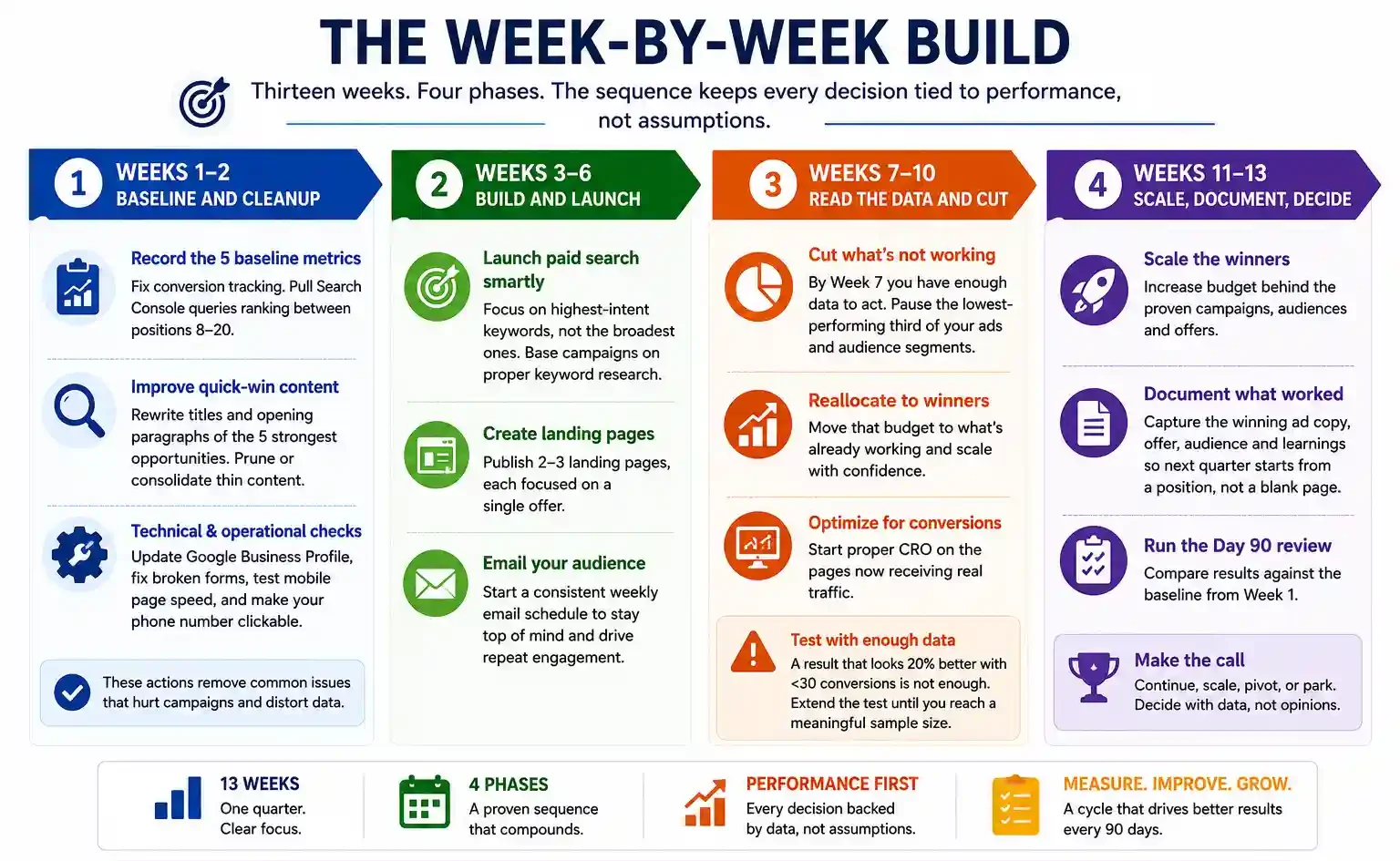
Thirteen weeks. Four phases. The dates matter less than the sequence because the sequence keeps every decision tied to performance instead of assumptions.
Weeks 1 to 2: baseline and cleanup
Record the five baseline metrics. Fix conversion tracking. Pull your Search Console queries ranking between positions 8 and 20, because those pages already have visibility and targeted improvements can move them further up the results. Rewrite the titles and opening paragraphs of the five strongest opportunities. Prune or consolidate thin content where necessary.
Complete the technical and operational checks at the same time. Update your Google Business Profile, fix broken forms, test page speed on mobile, and make sure your phone number is clickable. These are not growth strategies, but they remove common issues that reduce campaign performance and distort performance data later.
Weeks 3 to 6: build and launch
Launch paid search around your highest-intent keywords, not your broadest ones. Base those campaigns on proper keyword research to avoid paying for traffic that is unlikely to convert. Publish two or three landing pages, each focused on a single offer, and start emailing your existing audience on a consistent weekly schedule.
Weeks 7 to 10: read the data and cut
By Week 7 you have enough to act on. Pause the lowest-performing third of your ads and audience segments. Allocate that spend to whatever is already working, and start proper conversion rate optimization on the pages now receiving real traffic.
Be careful when interpreting test results. A variation that appears 20% better with fewer than 30 conversions rarely provides enough evidence to support a decision. If a test has not reached a meaningful sample size, extend it instead of declaring a winner. Acting on insufficient data usually leads to the wrong optimisation decisions and wastes the next testing cycle.
Weeks 11 to 13: scale, document, decide
Push the budget into the proven winners. Document exactly what worked, including the ad copy, the offer and the audience, so next quarter starts from a position rather than a blank page. Run the Day 90 review against the baseline you wrote in Week 1.
How to Split Budget Across the Quarter
Front-loading your budget is one of the most expensive mistakes in a 90-day plan because you spend the most when you know the least. A staged budget split usually performs better than an even one.
- Weeks 1 to 4: around 20%. Enough to generate a signal. Not enough to hurt if the targeting is wrong.
- Weeks 5 to 9: around 45%. This is your testing window, and testing needs enough volume to produce reliable results.
- Weeks 10 to 13: around 35%. Concentrate the spend behind what the data has already validated.
Keep 10% to 15% of the total budget unallocated as a test pool. Something unexpected almost always works, and you want enough flexibility to fund it without taking budget away from a campaign that is already performing. Gartner’s 2026 media research found that awareness and conversion together absorb 62.6% of total media spend, leaving the middle of the funnel underfunded in most companies. If your consideration-stage content is weak, that is often the cheapest gap to close within a quarter.
Tie the budget split to outcomes rather than activity. Set up your performance marketing framework early so you can move budget on the basis of data instead of debating it halfway through the quarter.
Build for AI Search in the Same 90 Days
Most pages ranking for this topic overlook this point, even though it may be the most consequential one. A meaningful share of searches now ends inside an AI-generated answer, so being discoverable no longer guarantees a click. Understanding how zero-click search changes user behaviour is essential if you want to set realistic traffic expectations.
Google has published its own guidance on optimising for generative AI features, and the advice is more practical than the acronyms make it sound. Clear structure, self-contained answers, and content that a machine can quote without distortion matter more than new terminology. Work on generative engine optimisation alongside conventional SEO instead of treating it as a separate project.
Within 90 days, aim to restructure a handful of pages so that each section answers one question in two or three quotable sentences, followed by a short FAQ block. Check each month whether those pages appear in Google AI Overviews. That gives you a leading indicator long before rankings begin to move.
Gartner also reports that CMOs now allocate 15.3% of their budgets to AI, while only 30% feel ready to scale it. So the gap here is execution rather than intent.
The Day 90 Decision Gate
A quarterly plan without a decision at the end is only a to-do list with a deadline. Every initiative should end with one of three verdicts, measured against the Week 1 baseline and nothing else.
- Scale. Cost per acquisition stays at or below target, and the campaign generates enough conversions to trust the data. Increase the budget next quarter.
- Fix. The direction is right, but the cost is too high or the volume is too low to reach a reliable conclusion. Keep the initiative, change one variable, and review it again at Day 45 next quarter.
- Kill. Nothing changes after a fair test with adequate spend. Stop the initiative and record the reason, so the same idea does not return six months later under a different name.
Assess organic search separately and against its own benchmarks. Google states clearly that no one can guarantee a number one ranking, and every SEO audit should provide realistic estimates rather than promises. At Day 90, judge SEO by impressions, indexation, and average position, not by revenue.
Mistakes That Quietly Kill 90-Day Plans
Most quarters fail for the same handful of reasons, and almost all of them are avoidable. Reviewing the most common digital marketing mistakes to avoid before you begin costs far less than learning them through trial and error.
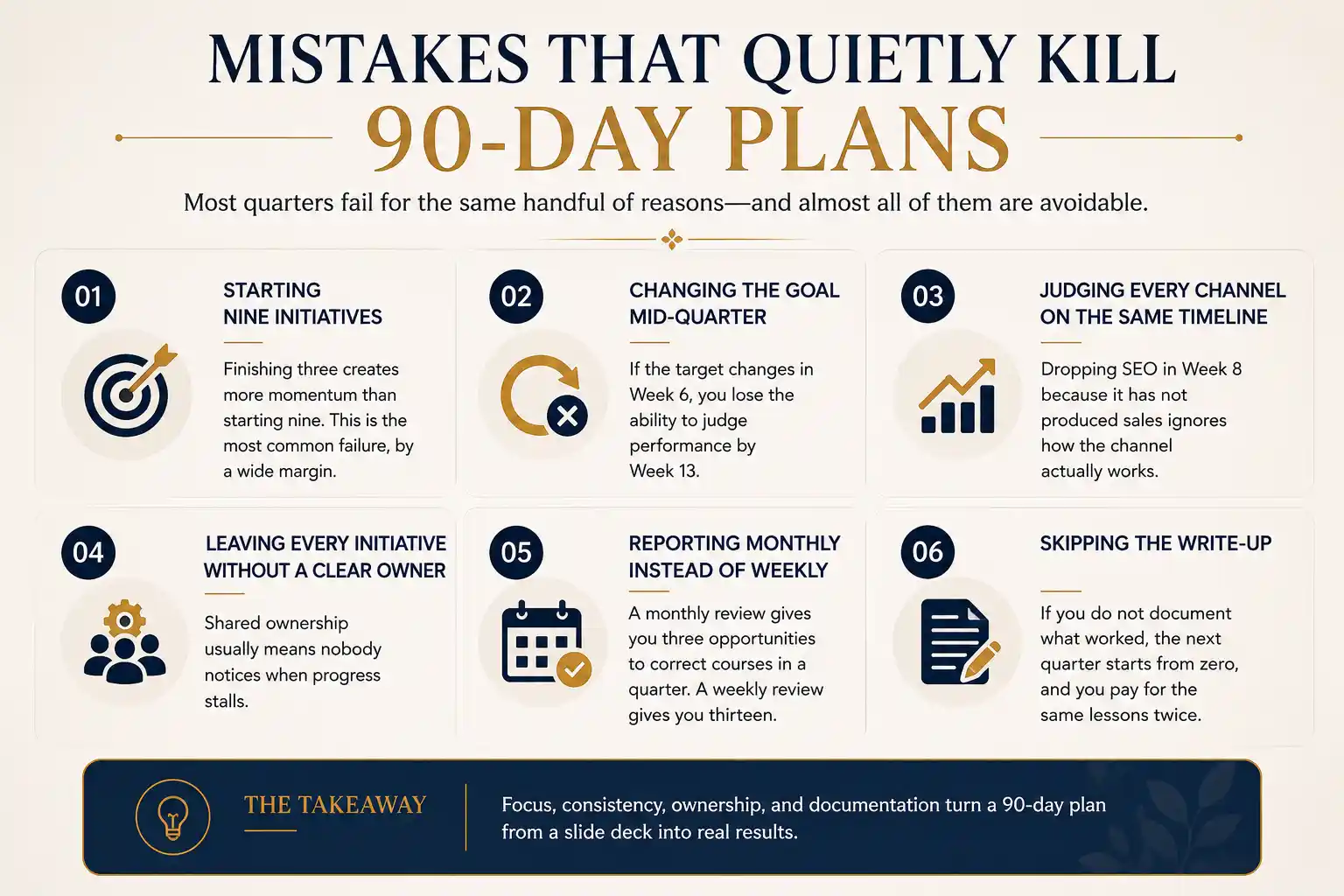
- Starting nine initiatives. Finishing three creates more momentum than starting nine. This is the most common failure, by a wide margin.
- Changing the goal mid-quarter. If the target changes in Week 6, you lose the ability to judge performance by Week 13.
- Judging every channel on the same timeline. Dropping SEO in Week 8 because it has not produced sales ignores how the channel actually works.
- Leaving every initiative without a clear owner. Shared ownership usually means nobody notices when progress stalls.
- Reporting monthly instead of weekly. A monthly review gives you three opportunities to correct courses in a quarter. A weekly review gives you thirteen.
- Skipping the write-up. If you do not document what worked, the next quarter starts from zero, and you pay for the same lessons twice.
What Should Carry Into the Next Quarter
The most valuable outcome of a 90-day plan is not the results alone. It is the documented understanding of which channels generate customers, at what cost, and with what level of return. That knowledge removes guesswork from every quarter that follows. Businesses that review four consecutive quarters build a clear understanding of what works, what does not, and where to invest next.
Start the next plan before this one ends, using the Day 90 findings as the starting point. Continue investing in the channels that performed, stop investing in the ones that did not, and test one genuinely new opportunity. Repeating that process every quarter creates a stronger marketing strategy based on evidence rather than assumptions.
Frequently Asked Questions
-
What is a 90 day marketing plan?
Ans.A 90-day marketing plan is a quarterly operating document that names one measurable outcome, a small number of initiatives to reach it, weekly actions, a budget split and a review date. It sits between the annual strategy and the weekly task list, translating long-term intent into work that can actually be scheduled. -
What should a 90 day plan include?
Ans.It should include a Day 1 baseline of your key metrics, one outcome stated with a number and a date, no more than three initiatives with named owners, a week-by-week schedule, a staged budget allocation, and explicit success criteria for the Day 90 review. Anything beyond that usually belongs in the annual roadmap. -
What is the 3-3-3 rule in marketing?
Ans.There is no single agreed definition, which is worth knowing before someone sells you one. It is used most often to describe attention spans: roughly three seconds to catch someone, thirty seconds to hold them, three minutes to convince them. Some marketers use it instead to mean three content pillars across three channels. Treat it as a rough heuristic, not a framework. -
How do you create a 3 month marketing plan?
Ans.Record your current numbers, pick one outcome with a date attached, choose up to three initiatives that can show a signal within the quarter, and map them across thirteen weeks. Allocate budget in stages rather than all at once, report weekly, and end with a scale, fix or kill decision for each initiative. -
Is 90 days enough time to judge SEO results?
Ans.Not for revenue, but yes for leading indicators. Google notes that changes can take several months for its systems to confirm, so at Day 90 you should be reading impressions, indexation and average position rather than sales. Pages that already rank between positions 8 and 20 are the exception and often move within four to ten weeks.
Author Details

Latest Posts
-
 18 / Aug
Google Search Console Google Search Console For Social Media: How To Track Instagram, Tiktok, X And Youtube
18 / Aug
Google Search Console Google Search Console For Social Media: How To Track Instagram, Tiktok, X And Youtube -
 05 / Aug
SEO vs GEO vs AEO SEO vs GEO vs AEO: A Simple 2026 Comparison for Businesses
05 / Aug
SEO vs GEO vs AEO SEO vs GEO vs AEO: A Simple 2026 Comparison for Businesses -
 31 / Jul
Uncategorized How to Build a 90-Day Digital Marketing Plan That Works
31 / Jul
Uncategorized How to Build a 90-Day Digital Marketing Plan That Works -
 17 / Jul
Website Redesign 7 Real Signs Your Business Website Needs a Redesign in 2026
17 / Jul
Website Redesign 7 Real Signs Your Business Website Needs a Redesign in 2026 -
 10 / Jul




Blogs
Journey into Ideas Unveiling Tomorrow's Insights Today.

-
What is a 90 day marketing plan?
Ans.A 90-day marketing plan is a quarterly operating document that names one measurable outcome, a small number of initiatives to reach it, weekly actions, a budget split and a review date. It sits between the annual strategy and the weekly task list, translating long-term intent into work that can actually be scheduled. -
What should a 90 day plan include?
Ans.It should include a Day 1 baseline of your key metrics, one outcome stated with a number and a date, no more than three initiatives with named owners, a week-by-week schedule, a staged budget allocation, and explicit success criteria for the Day 90 review. Anything beyond that usually belongs in the annual roadmap. -
What is the 3-3-3 rule in marketing?
Ans.There is no single agreed definition, which is worth knowing before someone sells you one. It is used most often to describe attention spans: roughly three seconds to catch someone, thirty seconds to hold them, three minutes to convince them. Some marketers use it instead to mean three content pillars across three channels. Treat it as a rough heuristic, not a framework. -
How do you create a 3 month marketing plan?
Ans.Record your current numbers, pick one outcome with a date attached, choose up to three initiatives that can show a signal within the quarter, and map them across thirteen weeks. Allocate budget in stages rather than all at once, report weekly, and end with a scale, fix or kill decision for each initiative. -
Is 90 days enough time to judge SEO results?
Ans.Not for revenue, but yes for leading indicators. Google notes that changes can take several months for its systems to confirm, so at Day 90 you should be reading impressions, indexation and average position rather than sales. Pages that already rank between positions 8 and 20 are the exception and often move within four to ten weeks.